
Which of the following cannot be the probability of an event?
25%
0.96
−0.5
Answer
Probability is a measure of the likelihood of an event occurring, and it must always fall within a specific range:
0 ≤ P(E) ≤ 1
Probability can't be negative.
Hence, option 4 is the correct option.
Which of the following cannot be the probability of any event ?
0.25
67%.
Answer
Probability of any event is always between 0 and 1.
= 1.25, which is greater than 1, which is not possible.
Hence, option 1 is the correct option.
Which of the following cannot be the probability of an event?
Answer
We know that,
0 ≤ P(E) ≤ 1
= 2.5
Since this value is greater than 1, it cannot be a probability.
Hence, option 2 is the correct option.
When polynomial x3 - 3x2 - 6x + 8 is divided by (x + 2), the remainder is zero. The probability of (x + 2) to be one of the factors of the given polynomial is:
0
1
Answer
Since, on dividing x3 - 3x2 - 6x + 8 by (x + 2), the remainder is zero.
Thus, (x + 2) is the polynomial of x3 - 3x2 - 6x + 8.
∴ The probability of (x + 2) to be one of the factors of the polynomial = 1.
Hence, option 4 is the correct option.
The probability of getting a number divisible by 3 in throwing a die is:
Answer
When a die is thrown, the possible outcomes are:
S = {1, 2, 3, 4, 5, 6}
Total number of outcomes = 6
Let E be the event of getting a number divisible by 3, then
E = {3, 6}
The number of favorable outcomes to the event E = 2
∴ P(E) =
Hence, option 2 is the correct option.
If the probability of an event is p, then which of the following holds true?
−1 ≤ p ≤ 1
0 ≤ p ≤ ∞
0 ≤ p ≤ 1
−∞ < p < ∞
Answer
Probability is a measure of the likelihood of an event occurring, and it must always fall within a specific range:
0 ≤ p ≤ 1
Hence, option 3 is the correct option.
In a single throw of a die, the probability of getting a number greater than 4 is:
Answer
When a die is thrown, there are 6 possible outcomes:
S = {1, 2, 3, 4, 5, 6}
Total number of outcomes = 6
Let E be the event of getting a number greater than 4, then
E = {5, 6}
The number of favorable outcomes to the event E = 2
∴ P(E) =
Hence, option 2 is the correct option.
In a single throw of a die, the probability of getting a prime number, is:
Answer
When a die is thrown, there are 6 possible outcomes:
S = {1, 2, 3, 4, 5, 6}
Total number of outcomes = 6
Let E be the event of getting a prime number, then
E = {2, 3, 5}
The number of favorable outcomes to the event E = 3
∴ P(E) =
Hence, option 1 is the correct option.
A die is thrown once. The probability of getting a number which has at least two factors is:
1
Answer
When a die is thrown, there are 6 possible outcomes:
S = {1, 2, 3, 4, 5, 6}
Total number of outcomes = 6
Let E be the event of getting a number with at least two factors, then
E = {2, 3, 4, 5, 6}
The number of favorable outcomes to the event E = 5
∴ P(E) =
Hence, option 4 is the correct option.
There are 3 yellow, 5 white and 7 green balls in a bag. A ball is drawn from the bag at random. The probability that the ball drawn is not white, is:
Answer
Total number of outcomes = 3 yellow + 5 white + 7 green balls = 15
Let E be the event of not getting white balls.
The number of favorable outcomes to the event E = 3 yellow balls + 7 green balls = 10
∴ P(E) =
Hence, option 2 is the correct option.
In the above question, what is the probability that a ball drawn at random from the bag is not black?
0
1
cannot be computed
Answer
Total number of outcomes = 3 yellow + 5 white + 7 green balls = 15
Let E be the event of not getting black balls.
The number of favorable outcomes to the event E = 15
∴ P(E) =
Hence, option 3 is the correct option.
Cards marked with numbers 1 to 100 are placed in a box and mixed thoroughly. A card is drawn at random from the box. The probability that the selected card bears a perfect square number is:
Answer
The cards are numbered from 1 to 100.
Total number of outcomes = 100
Let E be the event of getting perfect square, then
E = {1, 4, 9, 16, 25, 36, 49, 64, 81, 100}
The number of favorable outcomes to the event E = 10
∴ P(E) =
Hence, option 1 is the correct option.
Tickets numbered 1 to 20 are mixed up and then a ticket is drawn at random. What is the probability that the ticket drawn bears a number which is a multiple of 3?
Answer
The tickets are numbered from 1 to 20.
Total number of outcomes = 20
Let E be the event of getting a number multiple of 3, then
E = {3, 6, 9, 12, 15, 18}
The number of favorable outcomes to the event E = 6
∴ P(E) =
Hence, option 3 is the correct option.
Cards numbered 1 to 20 are placed in a box and mixed thoroughly. A card is drawn at random from the box. What is the probability that the card drawn bears a number which is a multiple of 3 or 5 or both?
Answer
The cards are numbered from 1 to 20.
Total number of outcomes = 20
Let E be the event of getting a number multiple of 3 or 5, then
E = {3, 5, 6, 9, 10, 12, 15, 18, 20}
The number of favorable outcomes to the event E = 9
∴ P(E) =
Hence, option 4 is the correct option.
A number is chosen at random from the numbers −4, −3, −2, −1, 0, 1, 2, 3, 4. What is the probability that the square of this number is less than or equal to 2?
Answer
Sample space = {−4, −3, −2, −1, 0, 1, 2, 3, 4}
Total number of outcomes = 9
Let E be the event of choosing the number whose square is less than or equal to 2, then
E = {-1, 0, 1}
The number of favorable outcomes to the event E = 3
∴ P(E) =
Hence, option 2 is the correct option.
A bag contains 3 red and 2 blue marbles. A marble is drawn at random. The probability of drawing a black marble is ∶
0
Answer
Given,
Number of red marbles = 3
Number of blue marbles = 2
The total number of marbles in the bag is 3 + 2 = 5.
Number of black marbles in the bag = 0
Probability = .
=
= 0.
Hence, option 1 is the correct option.
Choose the incorrect statement.
If a card is picked at random from cards numbered 1 to 16, then:
the probability that the drawn card bears a number which is a factor of 16 is
the probability that the drawn card bears an odd composite number is
the probability that the drawn card bears a number which is a multiple of both 2 and 3 is
the probability that the drawn card bears a number which is both a perfect square and a perfect cube is
Answer
S = {1, 2, 3, ....., 16}, where the total number of outcomes is 16.
Let E be the event of getting a card with number that divide 16 perfectly, then
E = {1, 2, 4, 8, 16}
The number of favorable outcomes to the event E = 5
∴ P(E) =
The probability that the drawn card bears a number which is a factor of 16 is is incorrect.
Hence, option 1 is the correct option.
A letter of English alphabet is chosen at random. The probability that it is a letter of the word ENGINEERING is:
Answer
The experiment consists of choosing a letter from the entire English alphabet.
Total number of outcomes = 26
Let E be the event of choosing a letter of the word ENGINEERING, then
E = {E, N, G, I, R}
The number of favorable outcomes to the event E = 5
∴ P(E) =
Hence, option 1 is the correct option.
A letter is picked at random from the letters of the word MATRICULATION. The probability that the chosen letter is a vowel, is:
Answer
The total number of letters in the word MATRICULATION = 13
Let E be the event of choosing a vowel from word MATRICULATION, then
E = {A, I, U, A, I, O}
The number of favorable outcomes to the event E = 6
∴ P(E) =
Hence, option 3 is the correct option.
In a family of 3 children, the probability of having at least one boy is:
Answer
The sample space is: {BBB, BBG, BGB, GBB, BGG, GBG, GGB, GGG}
The total number of possible combinations = 8
Let E be the event of having at least one boy, then
E = {BBB, BBG, BGB, GBB, BGG, GBG, GGB}
The number of favorable outcomes to the event E = 7
∴ P(E) =
Hence, option 4 is the correct option.
A number is chosen randomly from 10 to 99 (both inclusive) such that each number is equally likely to be chosen. The probability that at least one digit of the chosen number is 8 is:
Answer
The numbers are chosen from 10 to 99 inclusive.
Total number of outcomes = 90
Let E be the event of choosing a number with At Least One Digit as 8 , then
E = {18, 28, 38, 48, 58, 68, 78, 88, 98, 80, 81, 82, 83, 84, 85, 86, 87, 89}
The number of favorable outcomes to the event E = 18
∴ P(E) =
Hence, option 1 is the correct option.
A letter is chosen at random from all the letters of the English alphabets. The probability that the letter chosen is a vowel is:
Answer
There are 26 letters in the English alphabet.
Total number of outcomes = 26
Let E be the event of choosing a vowel , then
E = {A, E, I, O, U}
The number of favorable outcomes to the event E = 5
∴ P(E) =
Hence, option 2 is the correct option.
One card is drawn at random from a pack of 52 playing cards. What is the probability that the card drawn is a face card?
Answer
A standard deck of playing cards contains 52 cards.
Total number of outcomes = 52
Let E be the event of choosing a face card , then
There are 4 suits in a deck, and each suit has 3 face cards.
The number of favorable outcomes to the event E = 4 suits × 3 face cards = 12
∴ P(E) =
Hence, option 2 is the correct option.
A card is drawn from a pack of 52 playing cards. The probability of getting a queen of club or a king of heart is:
Answer
A standard deck of playing cards contains 52 cards.
Total number of outcomes = 52
Let E be the event of choosing a queen of club or a king of heart , then
There is 1 Queen of Clubs and 1 King of Hearts in the deck.
The number of favorable outcomes to the event E = 2
∴ P(E) =
Hence, option 3 is the correct option.
One card is drawn at random from a pack of 52 playing cards. The probability that the card drawn is either a red card or a king is:
Answer
A standard deck of playing cards contains 52 cards.
Total number of outcomes = 52
There are 26 red cards (13 hearts and 13 diamonds) and 4 kings in a deck, 2 of these kings (King of Hearts and King of Diamonds) are red.
Hence, no. of cards which are red or king = 26 Red Cards + 2 Black Kings = 28
Let E be the event of choosing either a red card or a king , then
The number of favorable outcomes to the event E = 28
∴ P(E) =
Hence, option 3 is the correct option.
When a die is cast with numbering on its faces, as shown, the ratio of the probability of getting a composite number to the probability of getting a prime number is :
2 : 3
3 : 2
1 : 3
1 : 2
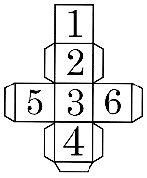
Answer
From numbers 1 to 6
Prime numbers = 2, 3, 5.
Composite numbers = 4, 6.
Probability of getting a prime number = .
Probability of getting a composite number
= .
Probability of getting a composite number to probability of getting a prime number = = 2 : 3.
Hence, option 1 is the correct option.
From a pack of 52 playing cards, one card is drawn at random. What is the probability that the card drawn is a ten or a spade?
Answer
A standard deck of playing cards contains 52 cards.
Total number of outcomes = 52
There are 13 spade cards and 4 tens in a deck, Ten of Spades is a card that is both a spade and a ten.
Hence, no. of cards that are tens or spades = 13 Spades + 3 Tens
Let E be the event of choosing a ten or a spade , then
The number of favorable outcomes to the event E = 16
∴ P(E) =
Hence, option 3 is the correct option.
A card is drawn at random from a pack of 52 playing cards. The probability of drawing a card which is neither a spade nor a king, is:
Answer
A standard deck of playing cards contains 52 cards.
Total number of outcomes = 52
There are 13 spade cards and each suit has 1 king.
So, the other 3 suits apart from spade has kings.
∴ Total no. of spade and king cards = 13 + 3 = 16.
Hence, no. of cards other than spade and king = 52 - 16 = 36.
Let E be the event of choosing neither a spade nor a king, then
The number of favorable outcomes to the event E = 36
∴ P(E) =
Hence, option 4 is the correct option.
A card is drawn at random from a well-shuffled pack of 52 cards. The probability that the drawn card is neither a king nor a queen, is:
Answer
A standard deck of playing cards contains 52 cards.
Total number of outcomes = 52
There are 4 kings and 4 queens in a standard deck.
∴ Total number of kings and queens = 4 + 4 = 8.
∴ Number of cards that are neither a king nor a queen = 52 - 8 = 44.
Let E be the event of drawing a card which is neither a king nor a queen, then
The number of favorable outcomes to the event E = 44
∴ P(E) =
Hence, option 4 is the correct option.
What is the probability that a randomly chosen leap year has 52 Sundays?
Answer
In a leap year, there are 366 days.
366 days = 52 weeks + 2 days
The 7 possible pairs for the 2 extra days are:(Monday, Tuesday)(Tuesday, Wednesday)(Wednesday, Thursday)(Thursday, Friday)(Friday, Saturday)(Saturday, Sunday)(Sunday, Monday)
Total number of possible outcomes = 7
Number of outcomes where a Sunday occurs = 2 [(Saturday, Sunday) and (Sunday, Monday)]
Number of outcomes where a Sunday does not occur = 7 - 2 = 5. {i.e,(Mon, Tue), (Tue, Wed), (Wed, Thu), (Thu, Fri), (Fri, Sat)}
Let E be the event that a leap year has exactly 52 Sundays,
∴ P(E) =
Hence, option 3 is the correct option.
The probability that a leap year has 53 Sundays is:
Answer
In a leap year, there are 366 days.
366 days = 52 weeks + 2 days
These 2 days can be (Mon, Tue), (Tue, Wed), (Wed, Thu), (Thu, Fri), (Fri, Sat), (Sat, Sun), and (Sun, Mon).
Total number of possible outcomes = 7
Number of favourable outcomes (Getting Sunday as one of the extra days) = 2 (i.e., (Sat, Sun), (Sun, Mon)).
Let E be the event that a leap year has 53 Sundays.
∴ P(E) =
Hence, option 2 is the correct option.
The probability of a non-leap year having 53 Mondays is:
Answer
In a non-leap year (an ordinary year), there are 365 days.
365 days = 52 weeks + 1 day
This 1 extra day can be any of the following 7 possibilities: {Monday, Tuesday, Wednesday, Thursday, Friday, Saturday, Sunday}
Total number of possible outcomes = 7
Number of favourable outcomes (The extra day being a Monday) = 1 (i.e., {Monday}).
Let E be the event that a non-leap year has 53 Mondays,
∴ P(E) =
Hence, option 1 is the correct option.
In a simultaneous throw of two coins, the probability of getting at least one head is:
Answer
When two coins are thrown simultaneously, the possible outcomes are: {(H, H), (H, T), (T, H), (T, T)}
Total number of outcomes = 4
Let E be the event of getting at least one head,
E = {(H, H), (H, T), (T, H)}
The number of favorable outcomes to the event E = 3
∴ P(E) =
Hence, option 4 is the correct option.
Two fair coins are tossed simultaneously. What is the probability of getting at most one tail?
Answer
When two coins are tossed simultaneously, the possible outcomes are: {(H, H), (H, T), (T, H), (T, T)}
Total number of outcomes = 4
Let E be the event of getting at most one tail,
E = {(H, H), (H, T), (T, H)}
The number of favorable outcomes to the event E = 3
∴ P(E) =
Hence, option 3 is the correct option.
Three unbiased coins are tossed together. What is the probability of getting at least two heads?
Answer
When three coins are tossed together, the possible outcomes are: {(H, H, H), (H, H, T), (H, T, H), (T, H, H), (H, T, T), (T, H, T), (T, T, H), (T, T, T)}
Total number of outcomes = 8
Let E be the event of getting at least two heads,
E={(H, H, H), (H, H, T), (H, T, H), (T, H, H)}
The number of favorable outcomes to the event E = 4
∴ P(E) =
Hence, option 1 is the correct option.
If three different coins are tossed together, find the probability of getting two heads.
Answer
When three coins are tossed together, the possible outcomes are: {(H, H, H), (H, H, T), (H, T, H), (T, H, H), (H, T, T), (T, H, T), (T, T, H), (T, T, T)}
Total number of outcomes = 8
Let E be the event of getting exactly two heads,
E = {(H, H, T), (H, T, H), (T, H, H)}
The number of favorable outcomes to the event E = 3
∴ P(E) =
Hence, option 1 is the correct option.
Three unbiased coins are tossed together. What is the probability of getting at most two heads?
Answer
When three coins are tossed together, the possible outcomes are: {(H, H, H), (H, H, T), (H, T, H), (T, H, H), (H, T, T), (T, H, T), (T, T, H), (T, T, T)}
Total number of outcomes = 8
Let E be the event of getting at most two heads,
E = {(H, H, T), (H, T, H), (T, H, H), (H, T, T), (T, H, T), (T, T, H), (T, T, T)}
The number of favorable outcomes to the event E = 7
∴ P(E) =
Hence, option 4 is the correct option.
In a simultaneous throw of two dice, what is the probability of getting a total of 7?
Answer
When two dice are thrown simultaneously, each die has 6 possible outcomes.
Total number of outcomes = 36
Let E be the event of getting a total of 7,
E = {(1, 6), (2, 5), (3, 4), (4, 3), (5, 2), (6, 1)}
The number of favorable outcomes to the event E = 6
∴ P(E) =
Hence, option 1 is the correct option.
Two different dice are rolled together. The probability of getting a sum of 9 is:
Answer
When two dice are thrown simultaneously, each die has 6 possible outcomes.
Total number of outcomes = 36
Let E be the event of getting a sum of 9,
E = {(3, 6), (4, 5), (5, 4), (6, 3)}
The number of favorable outcomes to the event E = 4
∴ P(E) =
Hence, option 3 is the correct option.
In a simultaneous throw of two dice, what is the probability of getting a doublet?
Answer
When two dice are thrown simultaneously, each die has 6 possible outcomes.
Total number of outcomes = 36
Let E be the event of getting a doublet,
E = {(1, 1), (2, 2), (3, 3), (4, 4), (5, 5), (6, 6)}
The number of favorable outcomes to the event E = 6
∴ P(E) =
Hence, option 3 is the correct option.
In a simultaneous throw of two dice, what is the probability of getting a total of 10 or 11?
Answer
When two dice are thrown simultaneously, each die has 6 possible outcomes.
Total number of outcomes = 36
Let E be the event of getting a total of 10 or 11,
E = {(4, 6), (5, 5), (6, 4), (5, 6), (6, 5)}
The number of favorable outcomes to the event E = 5
∴ P(E) =
Hence, option 4 is the correct option.
Two dice are thrown simultaneously. What is the probability of getting two numbers whose product is even?
Answer
When two dice are thrown simultaneously, each die has 6 possible outcomes.
Total number of outcomes = 36
Let E be the event of getting a product that is even,
The outcomes where both numbers are odd are: (1, 1), (1, 3), (1, 5), (3, 1), (3, 3), (3, 5), (5, 1), (5, 3), (5, 5)
Number of outcomes with an odd product = 9
∴ Number of outcomes with an even product = 36 - 9 = 27.
The number of favorable outcomes to the event E = 27
∴ P(E) =
Hence, option 2 is the correct option.
Two different dice are rolled together. The probability that the product of the numbers appeared is less than 18 is:
Answer
When two dice are thrown simultaneously, each die has 6 possible outcomes.
Total number of outcomes = 36
The pairs with a product ≥ 18 = {(3, 6), (4, 5), (4, 6), (5, 4), (5, 5), (5, 6), (6, 3), (6, 4), (6, 5), (6, 6)}
Total number of outcomes where product ≥ 18 = 10
∴ Total number of outcomes where product is less than 18 = 36 - 10 = 26.
Let E be the event that the product is less than 18, then
The number of favorable outcomes to the event E = 26
Hence, option 4 is the correct option.
A bag contains 14 balls out of which x are white. If 6 more white balls are added to the bag, the probability of drawing a white ball is . The value of x is:
4
6
8
10
Answer
Given,
The bag contains 14 balls.
Number of white balls = x
When 6 more white balls are added:
New number of white balls = x + 6
Total number of balls = 14 + 6 = 20
The probability of drawing a white ball now is .
∴
2(x + 6) = 20
x + 6 =
x + 6 = 10
x = 10 - 6
x = 4
Hence, option 1 is the correct option.
The king and queen of diamonds are removed from a pack of well-shuffled cards. One card is selected at random from the remaining cards. The probability of getting the king of clubs is:
Answer
A standard deck of cards contains 52 cards.
In this case, 2 cards (the King of Diamonds and the Queen of Diamonds) are removed from the deck.
Total number of outcomes = 50
Let E be the event of getting the card king of clubs,
The number of favorable outcomes to the event E = 1
Hence, option 3 is the correct option.
A bag contains 5 red balls and some blue balls. If the probability of drawing a blue ball from the bag is thrice that of a red ball, the number of blue balls in the bag is:
10
15
20
25
Answer
Let the number of blue balls in the bag be x.
Total number of balls in bag = x + 5
The probability of drawing a red ball and a blue ball are:
The probability of drawing a blue ball is thrice (3 times) that of a red ball: Pb = 3 × Pr
Substituting values we get:
The number of blue balls in the bag is 15.
Hence, option 2 is the correct option.
The probability of getting a defective pen in a lot of 600 is 0.045. The number of defective pens in the lot is :
27
270
36
360
Answer
The total number of pens in the lot is 600. Let no. of defective pens be x.
The probability of getting a defective pen, P(E) = 0.045.
Hence, option 1 is the correct option.
Aditya has a bag containing some black and some white balls. The probability of a randomly chosen ball from this bag being white is . If 5 white balls are added and 5 black balls are removed from the bag, the probability of choosing a white ball changes to . The total number of balls in the bag is:
10
25
45
50
Answer
Let W be the initial number of white balls and B be the initial number of black balls. The total number of balls,
T = W + B
Given,
The probability of picking a white ball is .
Since 5 white balls are added and 5 black balls are removed,
The total number of balls remain same and number of white balls increase W + 5.
Given,
The new probability choosing a white ball is .
Hence, option 2 is the correct option.
Directions Two different dice are rolled together.
Based on this information, answer the following questions:
49. The probability that the sum of the two numbers on the top of the dice is at least 10 is:
(a)
(b)
(c)
(d)
50.The probability of getting two different numbers on the two dice is:
(a)
(b)
(c)
(d)
51.The probability that the product of the two numbers on the top of the dice is at most 12 is:
(a)
(b)
(c)
(d)
52.The probability of getting a multiple of 2 on one die and a multiple of 3 on the other is:
(a)
(b)
(c)
(d)
Answer
49.When two dice are thrown simultaneously, each die has 6 possible outcomes.
Total number of outcomes = 36
Let E be the event of getting the the sum is at least 10,
E = {(4, 6), (5, 5), (6, 4), (5, 6), (6, 5), (6, 6)}
The number of favorable outcomes to the event E = 6
Hence, option (d) is the correct option.
50. When two dice are thrown simultaneously, each die has 6 possible outcomes.
Total number of outcomes = 36
Let A be the event of getting the same number on both dice (doubles),
A = {(1, 1), (2, 2), (3, 3), (4, 4), (5, 5), (6, 6)}
Number of outcomes for A = 6
Let E be the event of getting two different numbers on the two dice,
Number of favorable outcomes to the event E = 36 - 6 = 30
Hence, option (b) is the correct option.
51. When two dice are thrown simultaneously, each die has 6 possible outcomes.
Total number of outcomes = 36
Let E be the event that the product of the two numbers is at most 12,
E = {(1, 1), (1, 2), (1, 3), (1, 4), (1, 5), (1, 6), (2, 1), (2, 2), (2, 3), (2, 4), (2, 5), (2, 6), (3, 1), (3, 2), (3, 3), (3, 4), (4, 1), (4, 2), (4, 3), (5, 1), (5, 2), (6, 1), (6, 2)}
The number of favorable outcomes to the event E = 23
Hence, option (c) is the correct option.
52. When two dice are thrown simultaneously, each die has 6 possible outcomes.
Total number of outcomes = 36
Let E be the event of getting a multiple of 2 on one die and a multiple of 3 on the other,
E = {(2, 3), (2, 6), (4, 3), (4, 6), (6, 3), (6, 6), (3, 2), (3, 4), (3, 6), (6, 2), (6, 4)}
The number of favorable outcomes to the event E = 11
Hence, option (c) is the correct option.
Directions A bag contains 5 yellow, 6 red, 3 white and n black balls. The probability of drawing a white ball from the bag is .
Based on this information, answer the following questions:
53.How many black balls are there in the bag?
(a) 6
(b) 7
(c) 8
(d) 9
54.If a ball is picked at random from the bag, what is the probability that the chosen ball is not black?
(a)
(b)
(c)
(d)
55.If a ball is picked at random from the bag, what is the probability that it is either yellow or black?
(a)
(b)
(c)
(d)
56.If 5 more blue balls are added to the bag and one red ball is removed from it, what is the probability of picking up a red ball if a ball is picked up at random from the bag?
(a)
(b)
(c)
(d)
Answer
53. Total number of balls in bag = 5 yellow + 6 red + 3 white + n black = 14 + n
Let E be the event of drawing a white ball.
The number of favorable outcomes (white balls) = 3
Hence, option (b) is the correct option.
54. Total number of balls in bag = 21
Let E be the event that the ball is not black.
Number of favorable outcomes (yellow + red + white) = 5 + 6 + 3 = 14
Hence, option (a) is the correct option.
55. Total number of outcomes = 21
Let E be the event that the ball is either yellow or black.
Number of favorable outcomes (5 yellow + 7 black) = 12
Hence, option (b) is the correct option.
56.Total number of balls in bag = 21
After adding 5 blue balls and removing 1 red ball,
Total number of balls in bag = 25
Number of red balls remaining = 5
Let E be the event of picking a red ball.
The number of favorable outcomes = 5
Hence, option (b) is the correct option.
Directions
Three unbiased coins are tossed simultaneously.
Based on this information, answer the following questions:
57.The probability of getting at least one head is:
(a)
(b)
(c)
(d)
58.The probability of getting at least two tails is:
(a)
(b)
(c)
(d)
59.The probability of getting at most two heads is:
(a)
(b)
(c)
(d)
60.The probability of getting two tails is:
(a)
(b)
(c)
(d)
Answer
57. When three unbiased coins are tossed simultaneously, each coin has 2 possible outcomes
Total number of outcomes = 8
Let E be the event of getting at least one head.
E = {HHH, HHT, HTH, THH, HTT, THT, TTH}
The number of favorable outcomes to the event E = 7
Hence, option (d) is the correct option.
58. Total number of outcomes = 8
Let E be the event of getting at least two tails.
E = {HTT, THT, TTH, TTT}
The number of favorable outcomes to the event E = 4
Hence, option (c) is the correct option.
59. Total number of outcomes = 8
Let E be the event of getting at most two heads.
E = {HHT, HTH, THH, HTT, THT, TTH, TTT}
The number of favorable outcomes to the event E = 7
Hence, option (d) is the correct option.
60. Total number of outcomes = 8
Let E be the event of getting exactly two tails.
E = {HTT, THT, TTH}
The number of favorable outcomes to the event E = 3
Hence, option (a) is the correct option.