
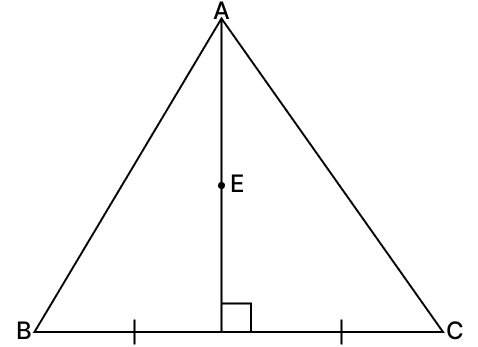
Assertion (A): In the figure, D is the mid-point of BC and AD ⟂ BC. If E lies on AD, then BE = CE.
Reason (R): Every point on the perpendicular bisector of a line segment is equidistant from its end points.
Both A and R are true, and R is the correct explanation of A.
Both A and R are true, but R is not the correct explanation of A.
A is true, but R is false.
A is false, but R is true.
Answer
Since D is the mid-point of BC and AD ⟂ BC, AD is the perpendicular bisector of BC.
The point E lies on AD, i.e. on the perpendicular bisector of BC.
∴ BE = CE
So, Assertion (A) is true.
We know that every point on the perpendicular bisector of a line segment is equidistant from its end points.
So, Reason (R) is true, and it correctly explains why BE = CE.
Both (A) and (R) are true, and (R) is the correct explanation of (A).
Hence, option 1 is the correct option.
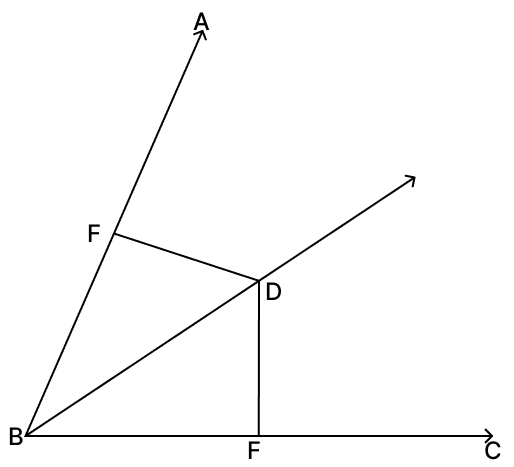
Assertion (A): In the figure, ∠ABD = ∠CBD, so DE = DF.
Reason (R): Every point on the angle bisector of two intersecting lines is equidistant from the lines.
Both A and R are true, and R is the correct explanation of A.
Both A and R are true, but R is not the correct explanation of A.
A is true, but R is false.
A is false, but R is true.
Answer
Since ∠ABD = ∠CBD, BD is the bisector of ∠ABC, so D lies on the angle bisector of the two arms BA and BC.
In the figure, DE and DF are the perpendicular distances from D to BA and BC respectively.
We know that every point on the angle bisector of two intersecting lines is equidistant from the lines.
∴ DE = DF
So, Assertion (A) is true.
Reason (R) is also true, and it correctly explains why DE = DF.
Both (A) and (R) are true, and (R) is the correct explanation of (A).
Hence, option 1 is the correct option.