
Case Study I
A spiral is made up of successive semicircles, with centers alternately at A and B, starting with center at A, of radii 0.5 cm, 1 cm, 1.5 cm, 2 cm, ...... as shown in the given figure.
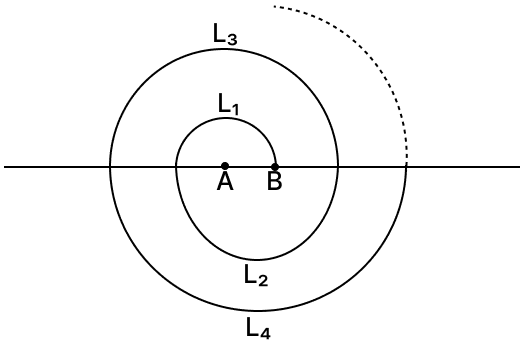
Based on this information, answer the following questions:
(Take π = )
What is the radius of the 9th semicircle?
(a) 4 cm
(b) 4.5 cm
(c) 3.5 cm
(d) 5 cmThe length of the 15th semicircle is :
(a) 8π cm
(b) 7π cm
(c) 7.5π cm
(d) 6.5π cmThe difference of lengths of the 19th and 12th semicircles is :
(a) 3.5π cm
(b) 3 cm
(c) 4π cm
(d) 4.5π cmThe total length of the spiral made up of first 7 consecutive semicircles is:
(a) 38 cm
(b) 42 cm
(c) 44 cm
(d) 46 cmThe lengths of the semicircles form an A.P. What is the common difference of this A.P.?
(a) 0.5π cm
(b) π cm
(c) 0.25π cm
(d) 1.25π cm
Answer
1. 0.5 cm, 1.0 cm, 1.5 cm, 2.0 cm, ....
The radius are in A.P. with
a = 0.5 cm
d = 1.0 - 0.5 = 0.5 cm
n = 9
We know that,
⇒ an = a + (n - 1)d
⇒ r9 = 0.5 + (9 - 1)0.5
= 0.5 + (8)0.5
= 0.5 + 4
= 4.5 cm
Hence, option (b) is the correct option.
2. Calculating the radius of 15th semicircle.
We know that,
⇒ an = a + (n - 1)d
⇒ r15 = 0.5 + (15 - 1)0.5
= 0.5 + 14(0.5)
= 0.5 + 7
= 7.5 cm
By formula,
Length of a semicircle = πr
= 7.5π cm
Hence, option (c) is the correct option.
3. We know that,
Length of a semicircle = πr
The lengths are: 0.5π cm, 1.0π cm, 1.5π cm, 2.0π cm,.... in an A.P. with,
a = 0.5π cm
d = 1.0π cm - 0.5π cm = 0.5π
The difference of lengths of the 19th and 12th semicircles is:
L19 - L12 = πr19 - πr12
= π(r19 - r12)
We know that,
an = a + (n - 1)d
⇒ r19 = 0.5π + (19 - 1)0.5π
= 0.5π + 18(0.5π)
= 0.5π + 9π
= 9.5π cm.
⇒ r12 = 0.5π + (12 - 1)0.5π
= 0.5π + 11(0.5π)
= 0.5π + 5.5π
= 6π cm.
L19 - L12 = (9.5π - 6π)
= 3.5π cm.
Hence, option (a) is the correct option.
4. The lengths are: 0.5π cm, 1.0π cm, 1.5π cm, 2.0π cm,....in an A.P.
a = 0.5π cm
d = 1.0π cm - 0.5π cm = 0.5π
The total length is the sum of the first 7 lengths S7.
We know that,
⇒ Sn = [2a + (n - 1)d]
⇒ S7 = [2(0.5π) + (7 - 1)(0.5π)]
= 3.5[1π + 6(0.5π)]
= 3.5[1π + 3π]
= 3.5(4π)
= 14π cm.
Total length = 14π cm
=
= 44 cm.
Hence, option (c) is the correct option.
5. 0.5π cm, 1.0π cm, 1.5π cm, 2.0π cm, ....
d = 1.0π + 0.5π = 0.5 π cm.
Common difference of the A.P. of lengths = 0.5π cm.
Hence, option (a) is the correct option.
Case Study II
The production of TV sets in a factory increases uniformly by a fixed number every year.
It produced 16000 sets in the 6th year and 22600 in the 9th year.
Based on this information, answer the following questions:
The production of the TV sets during the first year was :
(a) 4000
(b) 4500
(c) 5000
(d) 5500What was the uniform increase in the production of TV sets every year?
(a) 1800
(b) 2400
(c) 1600
(d) 2200The production of the TV sets during the 8th year was:
(a) 20000
(b) 20400
(c) 21200
(d) 22800The total production of the TV sets during first 6 years was:
(a) 56000
(b) 72000
(c) 66000
(d) 63000The average production of the TV sets during first 6 years was:
(a) 10500
(b) 11000
(c) 11500
(d) 12000
Answer
1. Since, production of TV sets in a factory increases uniformly by a fixed number every year. The production in each year forms an A.P.
Let production of the TV sets during the first year be a and the common difference in production each year be d.
We know that,
an = a + (n - 1)d
Given,
Production in the 6th year = 16000.
⇒ a6 = a + (6 - 1)d
⇒ 16000 = a + 5d
⇒ a + 5d = 16000 ....(1)
Given,
Production in the 9th year = 22600.
⇒ a9 = a + (9 - 1)d
⇒ 22600 = a + 8d
⇒ a + 8d = 22600 ....(2)
Subtracting Eq. (1) from Eq. (2), we get :
⇒ a + 8d - (a + 5d) = 22600 - 16000
⇒ a + 8d - a - 5d = 6600
⇒ 3d = 6600
⇒ d =
⇒ d = 2200.
Substituting d in equation (1), we get :
⇒ a + 5(2200) = 16000
⇒ a + 11000 = 16000
⇒ a = 16000 - 11000
⇒ a = 5000.
Hence, option (c) is the correct option.
2. From question (1),
The uniform increase is the common difference, d.
d = 2200.
Hence, option (d) is the correct option.
3. Given,
The production of TV sets in each year forms an A.P.: 5000, 7200, 9400, .....
a = 5000
n = 8
d = 2200
We know that,
an = a + (n - 1)d
⇒ a8 = 5000 + (8 - 1)2200
= 5000 + 7(2200)
= 5000 + 15400
= 20400.
Production of the TV sets during the 8th year = 20400.
Hence, option (b) is the correct option.
4. Given,
The production of TV sets in each year forms an A.P.: 5000, 7200, 9400.....
a = 5000
l = 16000
n = 6
We know that,
Sn = (a + l)
⇒ S6 = (5000 + 16000)
= 3 × (21000)
= 63000.
Total production of the TV sets during first 6 years = 63000
Hence, option (d) is the correct option.
5. From part 4 we have,
S6 = 63000
The average production is the total production divided by the number of years:
Average =
=
= 10500.
Hence, option (a) is the correct option.
Case Study III
200 logs are stacked in the following manner:
20 logs in the bottom row, 19 in the next row, 18 in the next row and so on.
Based on this information, answer the following questions:
In how many rows these 200 logs are placed?
(a) 25
(b) 20
(c) 16
(d) 14The number of logs in the top row is:
(a) 1
(b) 5
(c) 3
(d) 8The number of logs in the 8th row from the bottom is:
(a) 14
(b) 11
(c) 12
(d) 13Total number of logs in the first six rows from the bottom is:
(a) 105
(b) 95
(c) 85
(d) 75The number of logs in the 5th row from the top is:
(a) 8
(b) 9
(c) 7
(d) 10
Answer
1. Given,
Logs stacked in rows form an A.P.: 20, 19, 18.....
Sn = 200
a = 20
d = 19 - 20 = -1
We know that,
Sn = [2a + (n - 1)d]
Let 200 logs be stacked in n rows.
⇒ 200 = [2(20) + (n - 1)(-1)]
⇒ 200 × 2 = n[40 - n + 1]
⇒ 400 = n[41 - n]
⇒ 400 = 41n - n2
⇒ n2 - 41n + 400 = 0
⇒ n2 - 16n - 25n + 400 = 0
⇒ n(n - 16) - 25(n - 16) = 0
⇒ (n - 25)(n - 16) = 0
⇒ (n - 25) = 0 or (n - 16) = 0
⇒ n = 25 or n = 16.
If n = 25, a25 = a + 24d = 20 + 24(-1) = -4 (Impossible, the 25th row would have –4 logs).
If n = 16, a16 = a + 15d = 20 + 15(-1) = 5 (Valid).
The number of rows is 16.
Hence, option (c) is the correct option.
2. Given,
Logs stacked in rows form an A.P.: 20, 19, 18, .....
a = 20
n = 16 (16 total rows of logs in the stack i.e top row is 16th.)
d = -1
We know that,
an = a + (n - 1)d
⇒ a16 = 20 + (16 - 1)(-1)
= 20 + 15(-1)
= 20 - 15
= 5.
The number of logs in the top row is 5.
Hence, option (b) is the correct option.
3. Given,
Logs stacked in rows form an A.P.: 20, 19, 18.....
a = 20
Total rows = 16
n = 8, (A.P. starts from bottom only)
d = -1
We know that,
⇒ an = a + (n - 1)d
⇒ a8 = 20 + (8 - 1)(-1)
= 20 + 7(-1)
= 20 - 7
= 13.
The number of logs in the 8th row from the bottom is 13.
Hence, option (d) is the correct option.
4. Given,
Logs stacked in rows form an A.P.: 20, 19, 18, .....
a = 20
d = -1
n = 6
We know that,
Sn = [2a + (n - 1)d]
⇒ S6 = [2(20) + (6 - 1)(-1)]
= 3(40 - 5)
= 3 × (35)
= 105.
Total number of logs in the first six rows from the bottom is 105.
Hence, option (a) is the correct option.
5. The 5th row from the top is the (16 - 5 + 1) = 12th row from the bottom (a12):
Logs stacked in rows form an A.P.: 20, 19, 18.....
We know that,
an = a + (n - 1)d
⇒ a12 = 20 + (12 - 1)(-1)
= 20 - 11
= 9.
Hence, option (b) is the correct option.