
Assertion (A) : Slant height of a cone of height 4 cm and radius 3 cm is (4 + 3) cm = 7 cm.
Reason (R) : Curved surface area of a cone of radius r and slant height l is πrl.
Both A and R are true, and R is the correct explanation of A.
Both A and R are true, but R is not the correct explanation of A.
A is true, but R is false.
A is false, but R is true.
Answer
Given, radius r = 3 cm and height h = 4 cm.
By formula, l2 = h2 + r2 = 42 + 32 = 16 + 9 = 25
⇒ l = = 5 cm.
So, the slant height is 5 cm, not (4 + 3) = 7 cm.
∴ Assertion (A) is false.
The curved surface area of a cone of radius r and slant height l is πrl.
∴ Reason (R) is true.
Hence, option 4 is the correct option.
Assertion (A) : The maximum volume of a cone that can be carved out of a solid hemisphere of radius r is πr3.
Reason (R) : For a cone of radius r and height h, slant height is given by .
Both A and R are true, and R is the correct explanation of A.
Both A and R are true, but R is not the correct explanation of A.
A is true, but R is false.
A is false, but R is true.
Answer
The cone of maximum volume that can be carved out of a solid hemisphere of radius r has the same base radius r and the same height r.
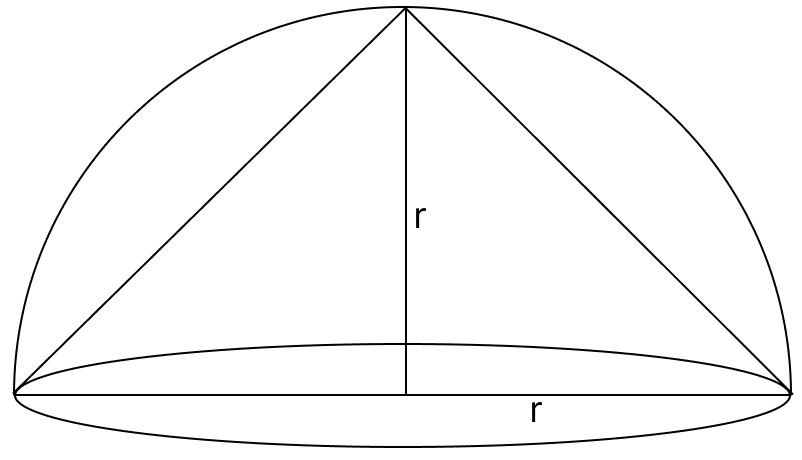
Volume of cone = πr2h = πr2 × r = πr3.
∴ Assertion (A) is true.
For a cone of radius r and height h, slant height l = .
∴ Reason (R) is true.
Reason (R) is a correct statement, but it states the slant-height formula, which is not used to establish the maximum volume in the Assertion. So, R is not the correct explanation of A.
Hence, option 2 is the correct option.
Assertion (A) : The total surface area of a right circular cone of slant height 13 cm and radius 5 cm is 90 π cm2.
Reason (R) : Curved surface area of a right circular cone is given by πr(l + r).
Both A and R are true, and R is the correct explanation of A.
Both A and R are true, but R is not the correct explanation of A.
A is true, but R is false.
A is false, but R is true.
Answer
Given, radius r = 5 cm and slant height l = 13 cm.
Total surface area of cone = πr(l + r) = π × 5 × (13 + 5) = π × 5 × 18 = 90π cm2.
∴ Assertion (A) is true.
The expression πr(l + r) is the formula for the total surface area of a cone, whereas the curved surface area of a cone is πrl. So, Reason (R) wrongly calls πr(l + r) the curved surface area.
∴ Reason (R) is false.
Hence, option 3 is the correct option.
Assertion (A) : Two solid spheres of radii 2 cm and 4 cm are melted and recast into a cone of radius 6 cm. The height of the cone so obtained will be 8 cm.
Reason (R) : When we convert one solid into another, the volume of the two solids remains the same.
Both A and R are true, and R is the correct explanation of A.
Both A and R are true, but R is not the correct explanation of A.
A is true, but R is false.
A is false, but R is true.
Answer
Total volume of the two spheres = π(2)3 + π(4)3 = π(8 + 64) = π × 72 = 96π cm3.
Let the height of the cone be h cm. Radius of cone = 6 cm.
Volume of cone = π(6)2h = 12πh.
On recasting, the volume remains the same.
⇒ 12πh = 96π ⇒ h = 8 cm.
∴ Assertion (A) is true.
When one solid is converted (melted and recast) into another, the volume remains unchanged, and this is exactly the principle used to find the height.
∴ Reason (R) is true and is the correct explanation of A.
Hence, option 1 is the correct option.
A solid sphere is cut into two identical hemispheres.
Assertion (A): The total volume of two hemispheres is equal to the volume of the original sphere.
Reason (R): The total surface area of two hemispheres together is equal to the surface area of the original sphere.
Both A and R are true, and R is the correct explanation of A.
Both A and R are true, but R is not the correct explanation of A.
A is true, but R is false.
A is false, but R is true.
Answer
By formula,
Volume of sphere =
Given,
A solid sphere is cut into two identical hemispheres.
Volume of hemisphere =
Volume of two identical hemispheres =
=
Thus, volume of a sphere = volume of two identical hemispheres.
So assertion (A) is true.
We know that,
Surface area of sphere = 4πr2
When a sphere is cut into two hemispheres, two new flat circular surfaces are created,
Surface area of a single hemisphere = Curved surface area + Area of its flat circular face
= 2πr2 + πr2
= 3πr2
Total surface area of two hemispheres = 2 × 3πr2 = 6πr2.
Thus, the surface area of the original sphere ≠ the total surface area of the two hemispheres.
So reason (R) is false.
(A) is true, (R) is false.
Hence, option 3 is the correct option.