KnowledgeBoat Logo
|
OPEN IN APP

Chapter 2

Relations and Functions — Exercise 2.5

Class - 11 ML Aggarwal Understanding ISC Mathematics


Exercise 2.5

Question 1

Solve the following equations for xx:

(i) [2x−3]=5[2x - 3] = 5

(ii) [2x+1]=−2[2x + 1] = -2

(iii) [2−3x]=5[2 - 3x] = 5.

Answer

We know that,

[⋅][\cdot] denotes the greatest integer function and for an integer nn,

[k]=n[k] = n ⇔ n≤k<n+1n \le k \lt n + 1.

(i) [2x−3]=5[2x - 3] = 5

⇒ 5≤2x−3<65 \le 2x - 3 \lt 6

⇒ 5+3≤2x<6+35 + 3 \le 2x \lt 6 + 3

⇒ 8≤2x<98 \le 2x \lt 9

⇒ 4≤x<924 \le x \lt \dfrac{9}{2}

Hence, x∈[4,92)\bm{x \in \left[4, \dfrac{9}{2}\right)}.

(ii) [2x+1]=−2[2x + 1] = -2

⇒ −2≤2x+1<−1-2 \le 2x + 1 \lt -1

⇒ −2−1≤2x<−1−1-2 - 1 \le 2x \lt -1 - 1

⇒ −3≤2x<−2-3 \le 2x \lt -2

⇒ −32≤x<−1-\dfrac{3}{2} \le x \lt -1

Hence, x∈[−32,−1)\bm{x \in \left[-\dfrac{3}{2}, -1\right)}.

(iii) [2−3x]=5[2 - 3x] = 5

⇒ 5≤2−3x<65 \le 2 - 3x \lt 6

⇒ 5−2≤−3x<6−25 - 2 \le -3x \lt 6 - 2

⇒ 3≤−3x<43 \le -3x \lt 4

Dividing throughout by −3-3 and reversing the inequalities,

⇒ −1≥x>−43-1 \ge x \gt -\dfrac{4}{3}

⇒ −43<x≤−1-\dfrac{4}{3} \lt x \le -1

Hence, x∈(−43,−1]\bm{x \in \left(-\dfrac{4}{3}, -1\right]}.

Question 2

If f(x)=log⁡(1+x1−x)f(x) = \log\left(\dfrac{1 + x}{1 - x}\right), then show that f(x)+f(y)=f(x+y1+xy)f(x) + f(y) = f\left(\dfrac{x + y}{1 + xy}\right).

Answer

Given,

f(x)=log⁡(1+x1−x)f(x) = \log\left(\dfrac{1 + x}{1 - x}\right)

Taking L.H.S.,

f(x)+f(y)=log⁡(1+x1−x)+log⁡(1+y1−y)f(x) + f(y) = \log\left(\dfrac{1 + x}{1 - x}\right) + \log\left(\dfrac{1 + y}{1 - y}\right)

We know that, log⁡m+log⁡n=log⁡(mn)\log m + \log n = \log (mn).

⇒ f(x)+f(y)=log⁡(1+x1−x×1+y1−y)f(x) + f(y) = \log\left(\dfrac{1 + x}{1 - x} \times \dfrac{1 + y}{1 - y}\right)

⇒ f(x)+f(y)=log⁡[(1+x)(1+y)(1−x)(1−y)]f(x) + f(y) = \log\left[\dfrac{(1 + x)(1 + y)}{(1 - x)(1 - y)}\right] ...........(1)

Taking R.H.S.,

f(x+y1+xy)=log⁡(1+x+y1+xy1−x+y1+xy)f\left(\dfrac{x + y}{1 + xy}\right) = \log\left(\dfrac{1 + \dfrac{x + y}{1 + xy}}{1 - \dfrac{x + y}{1 + xy}}\right)

⇒ f(x+y1+xy)=log⁡(1+xy+x+y1+xy1+xy−x−y1+xy)f\left(\dfrac{x + y}{1 + xy}\right) = \log\left(\dfrac{\dfrac{1 + xy + x + y}{1 + xy}}{\dfrac{1 + xy - x - y}{1 + xy}}\right)

⇒ f(x+y1+xy)=log⁡(1+xy+x+y1+xy−x−y)f\left(\dfrac{x + y}{1 + xy}\right) = \log\left(\dfrac{1 + xy + x + y}{1 + xy - x - y}\right)

⇒ f(x+y1+xy)=log⁡[(1+x)+y(1+x)(1−x)−y(1−x)]f\left(\dfrac{x + y}{1 + xy}\right) = \log\left[\dfrac{(1 + x) + y(1 + x)}{(1 - x) - y(1 - x)}\right]

⇒ f(x+y1+xy)=log⁡[(1+x)(1+y)(1−x)(1−y)]f\left(\dfrac{x + y}{1 + xy}\right) = \log\left[\dfrac{(1 + x)(1 + y)}{(1 - x)(1 - y)}\right] ...........(2)

From equations (1) and (2), we get:

f(x)+f(y)=f(x+y1+xy)f(x) + f(y) = f\left(\dfrac{x + y}{1 + xy}\right)

Hence, proved that f(x)+f(y)=f(x+y1+xy)\bm{f(x) + f(y) = f\left(\dfrac{x + y}{1 + xy}\right)}.

Question 3

If f(x)=9x9x+3f(x) = \dfrac{9^x}{9^x + 3}, then show that f(x)+f(1−x)=1f(x) + f(1 - x) = 1.

Answer

Given,

f(x)=9x9x+3f(x) = \dfrac{9^x}{9^x + 3}

Replacing xx by 1−x1 - x,

f(1−x)=91−x91−x+3f(1 - x) = \dfrac{9^{1 - x}}{9^{1 - x} + 3}

⇒ f(1−x)=99x99x+3f(1 - x) = \dfrac{\dfrac{9}{9^x}}{\dfrac{9}{9^x} + 3}

Multiplying the numerator and the denominator by 9x9^x,

⇒ f(1−x)=99+3×9xf(1 - x) = \dfrac{9}{9 + 3 \times 9^x}

⇒ f(1−x)=93(3+9x)f(1 - x) = \dfrac{9}{3(3 + 9^x)}

⇒ f(1−x)=39x+3f(1 - x) = \dfrac{3}{9^x + 3}

∴ f(x)+f(1−x)=9x9x+3+39x+3f(x) + f(1 - x) = \dfrac{9^x}{9^x + 3} + \dfrac{3}{9^x + 3}

⇒ f(x)+f(1−x)=9x+39x+3f(x) + f(1 - x) = \dfrac{9^x + 3}{9^x + 3}

⇒ f(x)+f(1−x)=1f(x) + f(1 - x) = 1

Hence, proved that f(x)+f(1−x)=1\bm{f(x) + f(1 - x) = 1}.

Question 4

Find the domain of the following functions:

(i) log⁡(4x−3)\log(4x - 3)

(ii) 1log⁡(9−x2)\dfrac{1}{\log(9 - x^2)}.

Answer

We know that,

log⁡k\log k is a real number only when k>0k \gt 0.

(i) log⁡(4x−3)\log(4x - 3)

For log⁡(4x−3)\log(4x - 3) to be a real number,

⇒ 4x−3>04x - 3 \gt 0

⇒ 4x>34x \gt 3

⇒ x>34x \gt \dfrac{3}{4}

Hence, domain =(34,∞)\bm{= \left(\dfrac{3}{4}, \infty\right)}.

(ii) 1log⁡(9−x2)\dfrac{1}{\log(9 - x^2)}

For log⁡(9−x2)\log(9 - x^2) to be a real number,

⇒ 9−x2>09 - x^2 \gt 0

⇒ x2<9x^2 \lt 9

⇒ −3<x<3-3 \lt x \lt 3

Also, the denominator must not be zero.

⇒ log⁡(9−x2)≠0\log(9 - x^2) \ne 0

⇒ 9−x2≠19 - x^2 \ne 1

⇒ x2≠8x^2 \ne 8

⇒ x≠±22x \ne \pm 2\sqrt{2}

Both 222\sqrt{2} and −22-2\sqrt{2} lie between −3-3 and 3, so they must be excluded.

Hence, domain =(−3,3)−−22,22\bm{= (-3, 3) - {-2\sqrt{2}, 2\sqrt{2}}}.

Question 5

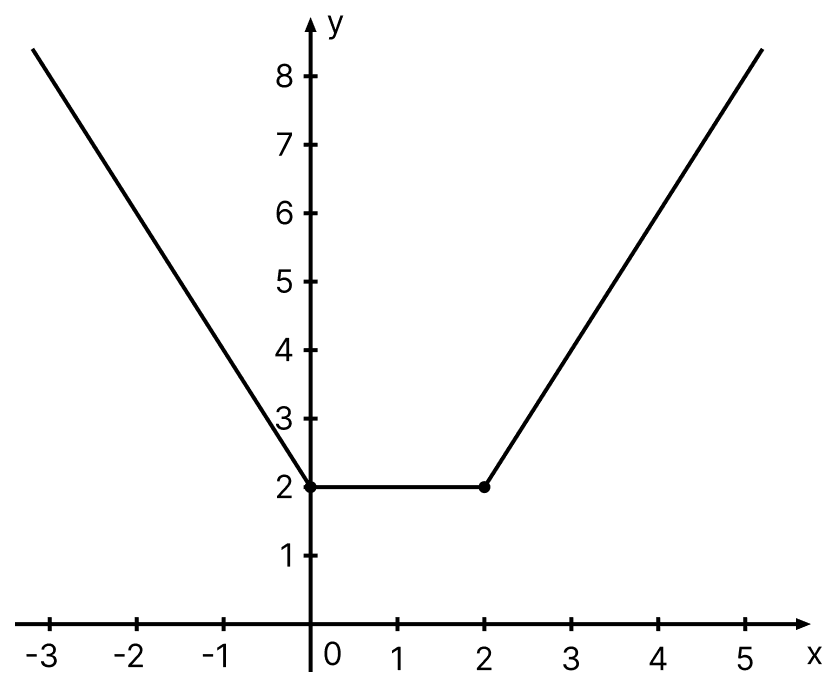
Draw the graph of the function f(x)=∣x∣+∣x−2∣f(x) = |x| + |x - 2|. Hence find its range.

Answer

Given,

f(x)=∣x∣+∣x−2∣f(x) = |x| + |x - 2|

We know that,

∣x∣={x,if x≥0−x,if x<0|x| = \begin{cases} x, & \text{if } x \ge 0 \\[1em] -x, & \text{if } x \lt 0 \end{cases}

and

∣x−2∣={x−2,if x≥2−(x−2),if x<2|x - 2| = \begin{cases} x - 2, & \text{if } x \ge 2 \\[1em] -(x - 2), & \text{if } x \lt 2 \end{cases}

When x<0x \lt 0, f(x)=−x+(2−x)=2−2xf(x) = -x + (2 - x) = 2 - 2x

When 0≤x<20 \le x \lt 2, f(x)=x+(2−x)=2f(x) = x + (2 - x) = 2

When x≥2x \ge 2, f(x)=x+(x−2)=2x−2f(x) = x + (x - 2) = 2x - 2

∴ f(x)f(x) can be written as

f(x)={2−2x,x<02,0≤x<22x−2,x≥2f(x) = \begin{cases} 2 - 2x, & x \lt 0 \\[1em] 2, & 0 \le x \lt 2 \\[1em] 2x - 2, & x \ge 2 \end{cases}

Plotting these three pieces, we get the following graph.

Draw the graph of the function f(x) = |x| + |x - 2|. Hence find its range. Relations-and-Functions, ML Aggarwal Understanding Mathematics Solutions ICSE Class 11.

From the graph, the lowest value taken by f(x)f(x) is 2 (taken along the whole segment from x=0x = 0 to x=2x = 2) and f(x)f(x) increases without limit as xx moves away from this segment on either side.

Hence, range of f=[2,∞)\bm{f = [2, \infty)}.

Question 6(a)

Draw rough sketch (graph) of the function

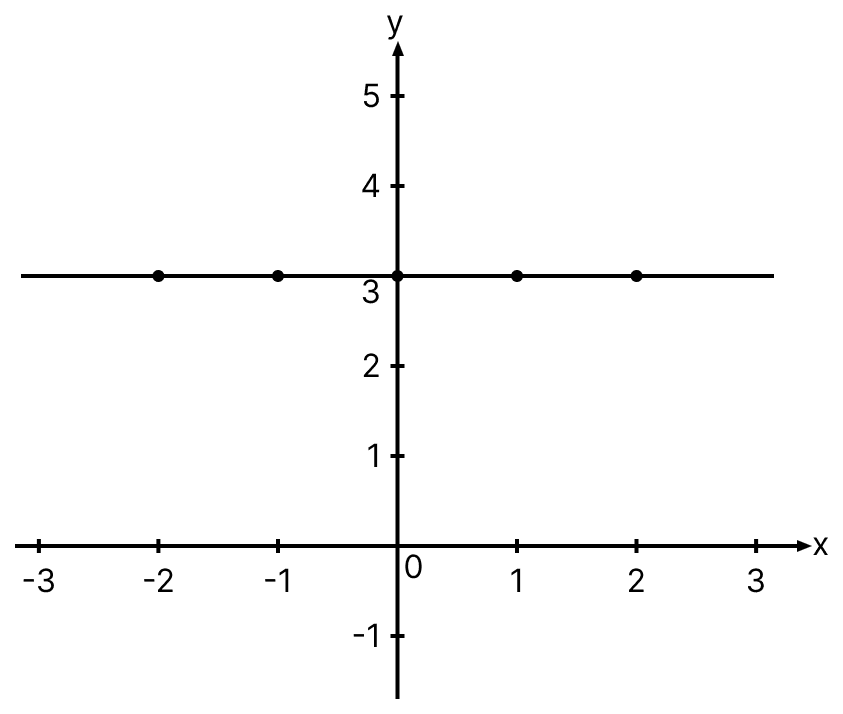
f(x)=3f(x) = 3

Answer

Here f(x)f(x) takes the value 3 for every real value of xx, so the graph is a straight line parallel to the xx-axis at a distance of 3 units above it.

Taking a few values of xx,

when x=−2x = -2, f(x)=3f(x) = 3; when x=−1x = -1, f(x)=3f(x) = 3; when x=0x = 0, f(x)=3f(x) = 3; when x=1x = 1, f(x)=3f(x) = 3; when x=2x = 2, f(x)=3f(x) = 3.

Plotting the points (−2,3)(-2, 3), (−1,3)(-1, 3), (0,3)(0, 3), (1,3)(1, 3), (2,3)(2, 3) and joining them, we get the following graph.

Draw rough sketch (graph) of the function f(x) = 3. Relations-and-Functions, ML Aggarwal Understanding Mathematics Solutions ICSE Class 11.

Hence, the graph of f(x)=3\bm{f(x) = 3} is the horizontal straight line drawn above.

Question 6(b)

Draw rough sketch (graph) of the function

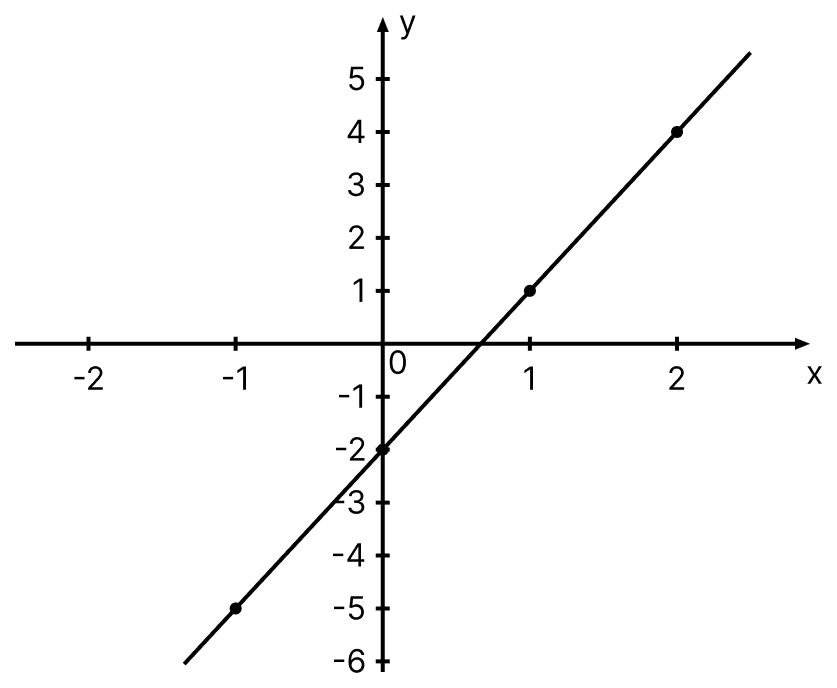
f(x)=3x−2f(x) = 3x - 2

Answer

This is of the form f(x)=mx+cf(x) = mx + c, so the graph is a straight line.

Taking a few values of xx,

when x=−1x = -1, f(x)=3(−1)−2=−5f(x) = 3(-1) - 2 = -5; when x=0x = 0, f(x)=−2f(x) = -2; when x=1x = 1, f(x)=1f(x) = 1; when x=2x = 2, f(x)=4f(x) = 4.

Plotting the points (−1,−5)(-1, -5), (0,−2)(0, -2), (1,1)(1, 1), (2,4)(2, 4) and joining them, we get a straight line.

Draw rough sketch (graph) of the function f(x) = 3x - 2. Relations-and-Functions, ML Aggarwal Understanding Mathematics Solutions ICSE Class 11.

Hence, the graph of f(x)=3x−2\bm{f(x) = 3x - 2} is the straight line drawn above.

Question 6(c)

Draw rough sketch (graph) of the function

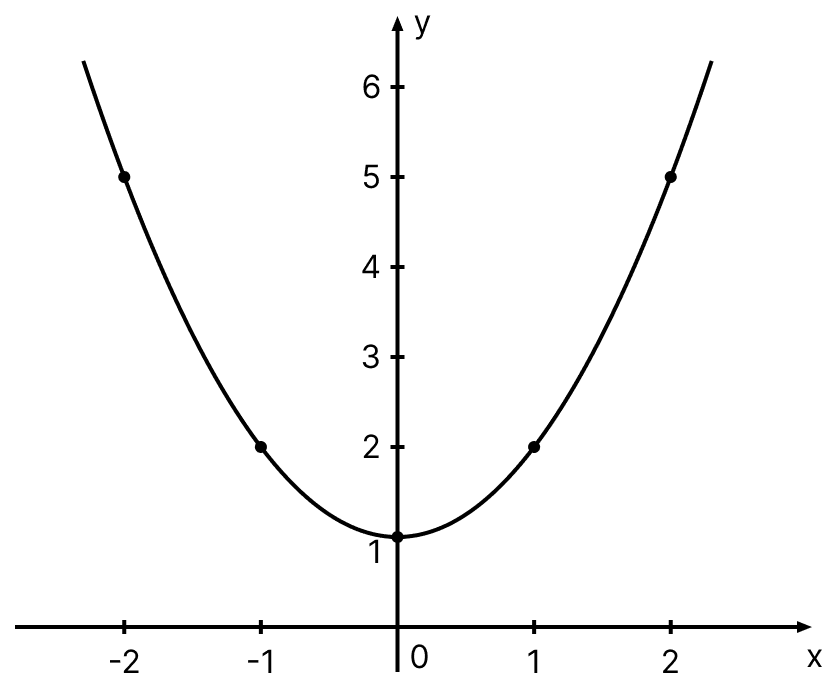
f(x)=x2+1f(x) = x^2 + 1

Answer

Taking a few values of xx,

when x=−2x = -2, f(x)=(−2)2+1=5f(x) = (-2)^2 + 1 = 5; when x=−1x = -1, f(x)=2f(x) = 2; when x=0x = 0, f(x)=1f(x) = 1; when x=1x = 1, f(x)=2f(x) = 2; when x=2x = 2, f(x)=5f(x) = 5.

Plotting the points (−2,5)(-2, 5), (−1,2)(-1, 2), (0,1)(0, 1), (1,2)(1, 2), (2,5)(2, 5) and joining them by a free-hand smooth curve, we get a parabola opening upwards with its lowest point at (0,1)(0, 1).

Draw rough sketch (graph) of the function f(x) = x^2 + 1. Relations-and-Functions, ML Aggarwal Understanding Mathematics Solutions ICSE Class 11.

Hence, the graph of f(x)=x2+1\bm{f(x) = x^2 + 1} is the parabola drawn above.

Question 6(d)

Draw rough sketch (graph) of the function

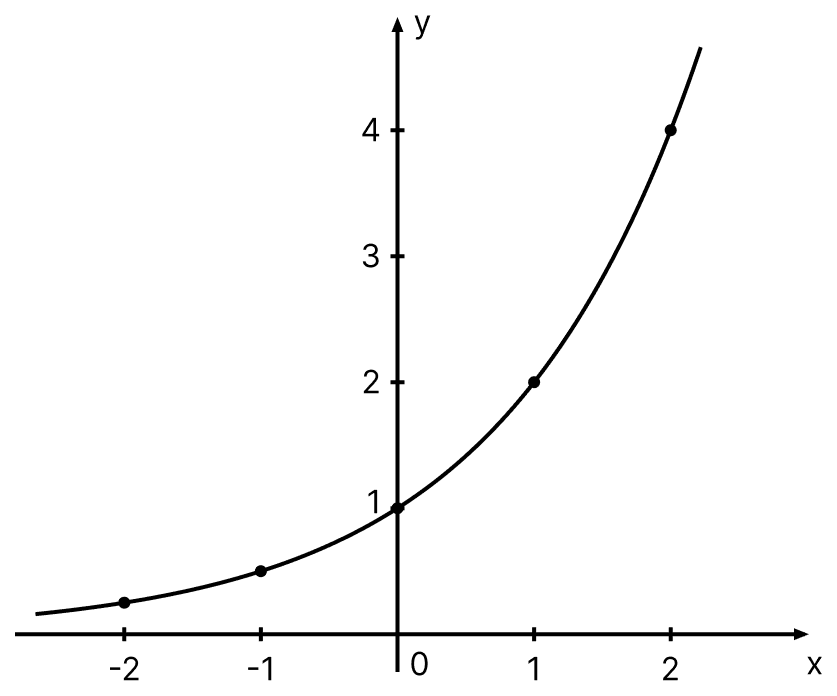
f(x)=2xf(x) = 2^x

Answer

Taking a few values of xx,

when x=−2x = -2, f(x)=2−2=14f(x) = 2^{-2} = \dfrac{1}{4}; when x=−1x = -1, f(x)=12f(x) = \dfrac{1}{2}; when x=0x = 0, f(x)=1f(x) = 1; when x=1x = 1, f(x)=2f(x) = 2; when x=2x = 2, f(x)=4f(x) = 4.

Plotting the points (−2,14)\left(-2, \dfrac{1}{4}\right), (−1,12)\left(-1, \dfrac{1}{2}\right), (0,1)(0, 1), (1,2)(1, 2), (2,4)(2, 4) and joining them by a free-hand smooth curve, we get an increasing curve which lies wholly above the xx-axis and passes through (0,1)(0, 1).

Draw rough sketch (graph) of the function f(x) = 2^x. Relations-and-Functions, ML Aggarwal Understanding Mathematics Solutions ICSE Class 11.

Hence, the graph of f(x)=2x\bm{f(x) = 2^x} is the exponential curve drawn above.

Question 6(e)

Draw rough sketch (graph) of the function

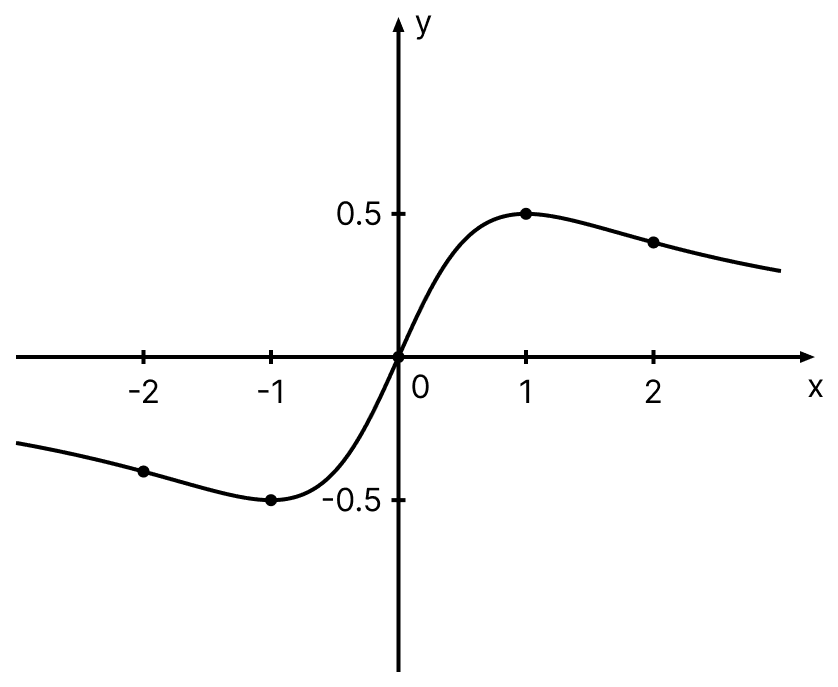
f(x)=x1+x2f(x) = \dfrac{x}{1 + x^2}

Answer

Taking a few values of xx,

when x=−2x = -2, f(x)=−21+4=−25f(x) = \dfrac{-2}{1 + 4} = -\dfrac{2}{5}; when x=−1x = -1, f(x)=−12f(x) = -\dfrac{1}{2}; when x=0x = 0, f(x)=0f(x) = 0; when x=1x = 1, f(x)=12f(x) = \dfrac{1}{2}; when x=2x = 2, f(x)=25f(x) = \dfrac{2}{5}.

As f(−x)=−f(x)f(-x) = -f(x), the curve is symmetrical about the origin. It passes through the origin, rises to the highest point (1,12)\left(1, \dfrac{1}{2}\right) and then falls towards the xx-axis.

Draw rough sketch (graph) of the function f(x) = x/1 + x^2. Relations-and-Functions, ML Aggarwal Understanding Mathematics Solutions ICSE Class 11.

Hence, the graph of f(x)=x1+x2\bm{f(x) = \dfrac{x}{1 + x^2}} is the curve drawn above.

PrevNext