
If A = {1, 2, 3}, B = {4, 5} and C = {5, 6}, then verify that
(i) A × (B ∪ C) = (A × B) ∪ (A × C)
(ii) A × (B ∩ C) = (A × B) ∩ (A × C)
(iii) A × (B − C) = (A × B) − (A × C).
Answer
Given,
A = {1, 2, 3}, B = {4, 5} and C = {5, 6}
First we find A × B and A × C.
A × B = {(1, 4), (1, 5), (2, 4), (2, 5), (3, 4), (3, 5)} and
A × C = {(1, 5), (1, 6), (2, 5), (2, 6), (3, 5), (3, 6)}
(i) A × (B ∪ C) = (A × B) ∪ (A × C)
Collecting all the elements which belong to B or C or both,
⇒ B ∪ C = {4, 5, 6}
∴ A × (B ∪ C) = {(1, 4), (1, 5), (1, 6), (2, 4), (2, 5), (2, 6), (3, 4), (3, 5), (3, 6)} ...........(1)
Collecting all the ordered pairs which belong to A × B or A × C or both,
∴ (A × B) ∪ (A × C) = {(1, 4), (1, 5), (1, 6), (2, 4), (2, 5), (2, 6), (3, 4), (3, 5), (3, 6)} ...........(2)
From equations (1) and (2), we get
Hence, A × (B ∪ C) = (A × B) ∪ (A × C).
(ii) A × (B ∩ C) = (A × B) ∩ (A × C)
The only element common to B and C is 5.
⇒ B ∩ C = {5}
∴ A × (B ∩ C) = {(1, 5), (2, 5), (3, 5)} ...........(1)
The ordered pairs common to A × B and A × C are (1, 5), (2, 5) and (3, 5).
∴ (A × B) ∩ (A × C) = {(1, 5), (2, 5), (3, 5)} ...........(2)
From equations (1) and (2), we get
Hence, A × (B ∩ C) = (A × B) ∩ (A × C).
(iii) A × (B − C) = (A × B) − (A × C)
Removing from B the element 5 which also belongs to C,
⇒ B − C = {4}
∴ A × (B − C) = {(1, 4), (2, 4), (3, 4)} ...........(1)
Removing from A × B the ordered pairs (1, 5), (2, 5) and (3, 5) which also belong to A × C,
∴ (A × B) − (A × C) = {(1, 4), (2, 4), (3, 4)} ...........(2)
From equations (1) and (2), we get
Hence, A × (B − C) = (A × B) − (A × C).
Let A = {2, 4, 6, 8} and B = {0, 6, 8, 9, 10}. Find the elements of (A ∩ B) × (A − B) corresponding to the relation 'is a multiple of'.
Answer
Given,
A = {2, 4, 6, 8} and B = {0, 6, 8, 9, 10}
The elements common to A and B are 6 and 8.
⇒ A ∩ B = {6, 8}
Removing from A the elements 6 and 8 which also belong to B,
⇒ A − B = {2, 4}
∴ (A ∩ B) × (A − B) = {(6, 2), (6, 4), (8, 2), (8, 4)}
Now we pick out those ordered pairs (x, y) in which x is a multiple of y.
6 is a multiple of 2, so (6, 2) is taken,
6 is not a multiple of 4, so (6, 4) is left out,
8 is a multiple of 2, so (8, 2) is taken,
8 is a multiple of 4, so (8, 4) is taken.
Thus, the corresponding ordered pairs are (6, 2), (8, 2) and (8, 4).
Hence, the required elements are (6, 2), (8, 2) and (8, 4).
Let A = {6, 7, 8, 10}, B = {2, 4, 5}, a ∈ A, b ∈ B and R be the relation from A to B defined by a R b if and only if a is divisible by b. Write R in the roster form.
Answer
Given,
A = {6, 7, 8, 10} and B = {2, 4, 5}
R = {(a, b) : a ∈ A, b ∈ B and a is divisible by b}
Taking each element of A in turn and choosing those elements of B which divide it,
when a = 6, 6 is divisible by 2 only, so b = 2,
when a = 7, 7 is not divisible by 2, 4 or 5,
when a = 8, 8 is divisible by 2 and 4, so b = 2, 4,
when a = 10, 10 is divisible by 2 and 5, so b = 2, 5.
Thus, the corresponding ordered pairs are (6, 2), (8, 2), (8, 4), (10, 2) and (10, 5).
Hence, R = {(6, 2), (8, 2), (8, 4), (10, 2), (10, 5)}.
Let R = {(x, y) ; x + 2y < 6, x, y ∈ N}
(i) Find the domain and the range of R
(ii) Write R as a set of ordered pairs.
Answer
Given,
R = {(x, y) : x + 2y < 6, x, y ∈ N}
As x and y are natural numbers, the least value of each of them is 1.
Taking each value of y in turn,
when y = 1, x + 2 < 6 ⇒ x < 4 ⇒ x = 1, 2, 3,
when y = 2, x + 4 < 6 ⇒ x < 2 ⇒ x = 1,
when y = 3, x + 6 < 6 ⇒ x < 0, which is not possible for x ∈ N.
For all the values of y greater than 3 also, there is no natural number x satisfying the condition.
Thus, the corresponding ordered pairs are (1, 1), (1, 2), (2, 1) and (3, 1).
∴ R = {(1, 1), (1, 2), (2, 1), (3, 1)}
(i) The first components of the ordered pairs of R are 1, 1, 2 and 3, and the second components are 1, 2, 1 and 1.
Hence, domain of R = {1, 2, 3} and range of R = {1, 2}.
(ii) Hence, R = {(1, 1), (1, 2), (2, 1), (3, 1)}.
Let R = {(x, y) ; y = x + 1 and y ∈ {0, 1, 2, 3, 4, 5}}.
(i) List the elements of R.
(ii) Represent R by an arrow diagram.
Answer
Given,
R = {(x, y) : y = x + 1 and y ∈ {0, 1, 2, 3, 4, 5}}
y = x + 1 ⇒ x = y − 1
(i) Taking each value of y in turn,
when y = 0, x = −1,
when y = 1, x = 0,
when y = 2, x = 1,
when y = 3, x = 2,
when y = 4, x = 3,
when y = 5, x = 4.
Thus, the corresponding ordered pairs are (−1, 0), (0, 1), (1, 2), (2, 3), (3, 4) and (4, 5).
Hence, R = {(−1, 0), (0, 1), (1, 2), (2, 3), (3, 4), (4, 5)}.
(ii) We write the first components −1, 0, 1, 2, 3, 4 in one closed figure and the second components 0, 1, 2, 3, 4, 5 in another, and join x to y by an arrow whenever (x, y) ∈ R.
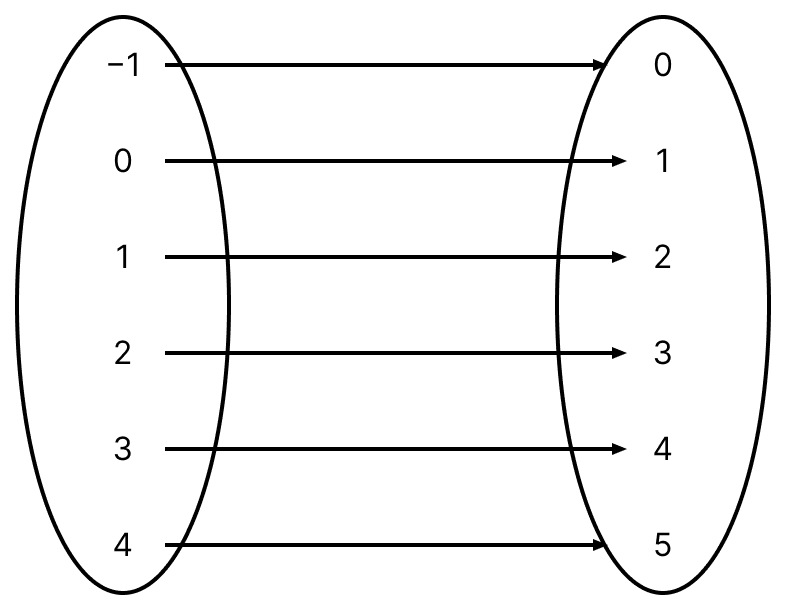
Hence, R is represented by the arrow diagram given above.
Let be the subset of defined by . Is a function from to ? Justify your answer.
Answer
Given,
We know that,
A relation is a function only when every element of its domain has one and only one image.
A rational number can be written as a fraction in many different ways, and the rule of takes the numerator of the fraction as the image.
Taking , , we get the ordered pair
⇒
Taking , , we get the ordered pair
⇒
But , so the same element of has two different images 1 and 2.
Hence, is not a function from to , because the element of has two different images 1 and 2.
Let f : X → Y be defined by f(x) = x2 for all x ∈ X where X = {−2, −1, 0, 1, 2, 3} and Y = {0, 1, 4, 7, 9, 10}.
Write the relation f in the roster form. Is f a function?
Answer
Given,
f(x) = x2, X = {−2, −1, 0, 1, 2, 3} and Y = {0, 1, 4, 7, 9, 10}
Substituting each value of x,
f(−2) = (−2)2 = 4,
f(−1) = (−1)2 = 1,
f(0) = 02 = 0,
f(1) = 12 = 1,
f(2) = 22 = 4,
f(3) = 32 = 9.
Each of these images 4, 1, 0, 1, 4 and 9 belongs to Y.
Thus, the corresponding ordered pairs are (−2, 4), (−1, 1), (0, 0), (1, 1), (2, 4) and (3, 9).
∴ f = {(−2, 4), (−1, 1), (0, 0), (1, 1), (2, 4), (3, 9)}
Each of the six elements of X occurs exactly once as a first component, so every element of X has one and only one image in Y.
Hence, f = {(−2, 4), (−1, 1), (0, 0), (1, 1), (2, 4), (3, 9)} and f is a function.
Is g = {(1, 1), (2, 3), (3, 5), (4, 7)} a function? If this is described by the relation g(x) = αx + β, then what values should be assigned to α and β?
Answer
Given,
g = {(1, 1), (2, 3), (3, 5), (4, 7)}
The first components 1, 2, 3 and 4 are all different, so every element of the domain has one and only one image.
∴ g is a function.
Given, g(x) = αx + β
As (1, 1) ∈ g, g(1) = 1.
⇒ α(1) + β = 1
⇒ α + β = 1 ...........(1)
As (2, 3) ∈ g, g(2) = 3.
⇒ α(2) + β = 3
⇒ 2α + β = 3 ...........(2)
Subtracting equation (1) from equation (2), we get :
⇒ 2α + β − (α + β) = 3 − 1
⇒ α = 2
Substituting α = 2 in equation (1), we get :
⇒ 2 + β = 1
⇒ β = 1 − 2 = −1
Checking with the remaining pairs, g(3) = 2(3) − 1 = 5 and g(4) = 2(4) − 1 = 7, which agree with the given ordered pairs.
Hence, g is a function and α = 2, β = −1.
Determine a quadratic function '' defined by
if , and .
Answer
Given,
As ,
⇒
⇒
As ,
⇒
⇒
⇒ ...........(1)
As ,
⇒
⇒
⇒ ...........(2)
Substituting in equation (1), we get :
⇒
⇒
⇒
⇒
Substituting in equation (2), we get :
⇒
Hence, .
Find the domain and the range of the function . Also find and the numbers which are associated with the number in its range.
Answer
Given,
For every real value of , is a real number.
∴
For , let ...........(1)
We know that for every real number .
⇒
⇒
⇒
⇒
∴
Now,
The numbers associated with are the values of for which .
On putting in equation (1), we get :
⇒
⇒
⇒
⇒
⇒
Hence, domain of , range of , and the numbers associated with are 3 and .
Find the domain and the range of the following functions:
Answer
For to be a real number,
⇒
⇒
∴ Domain
Let .
As ,
⇒
⇒
∴ Range
Hence, domain and range .
Find the domain and the range of the following functions:
Answer
For to be a real number,
⇒
⇒
⇒
∴ Domain
Let .
As , we have
⇒
⇒
⇒
∴ Range
Hence, domain and range .
Find the domain and the range of the following functions:
.
Answer
is defined for every real value of , so is a real number for every real value of .
∴ Domain
Let .
We know that .
⇒
⇒
⇒
∴ Range
Hence, domain and range .
Draw the graph of the function
Hence, find its range.
Answer
Given,
For , , which is a straight line.
when , ; when , .
As approaches 0 from the left, approaches 1, but the value 1 is not taken since is not included in this piece.
For , , which is also a straight line.
when , ; when , .
Plotting the two pieces, we get the following graph.
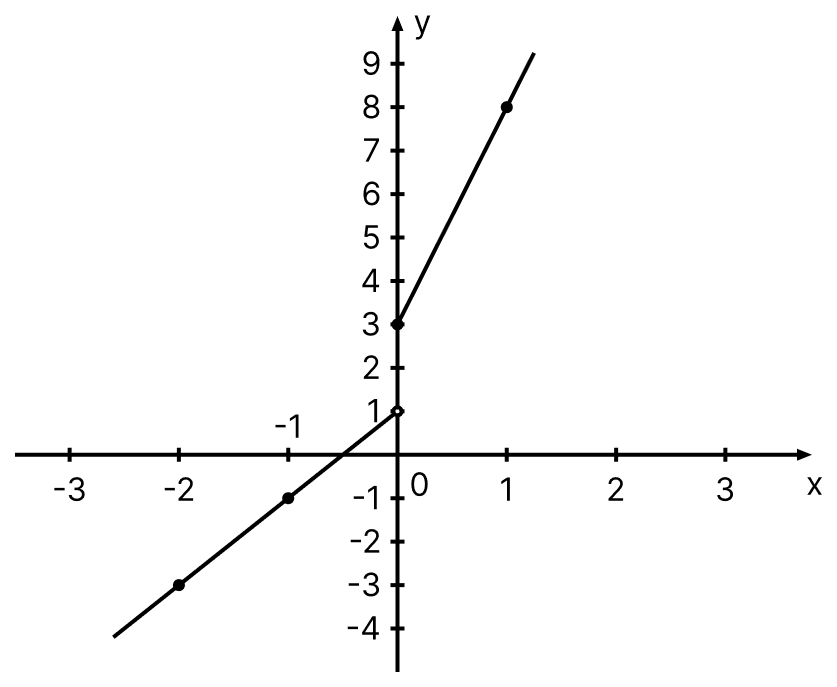
From the graph,
for , ⇒ , so takes every value less than 1,
for , ⇒ , so takes every value from 3 upwards.
Hence, range of .
If and are two real valued functions, find the function .
Answer
Given,
and
Both and are defined for every real value of , so the domain of each of them is .
⇒
⇒
Hence, , .
If and are two real valued functions, find the function .
Answer
Given,
and
Both and are defined for every real value of , so the domain of each of them is .
⇒
⇒
⇒
Hence, , .
If and are two real valued functions, find the function .
Answer
Given,
and
Both and are defined for every real value of , so the domain of each of them is .
⇒
⇒
⇒
Hence, , .
If and are two real valued functions, find the function .
Answer
Given,
and
Both and are defined for every real value of , so the domain of each of them is .
, where .
Here when or , so these values must be excluded.
⇒
Hence, , , .
If and are two real valued functions, find the function .
Answer
Given,
and
Both and are defined for every real value of , so the domain of each of them is .
, where .
Here when , so this value must be excluded.
⇒
Hence, , , .
If and are two real valued functions, find the function .
Answer
Given,
and
Both and are defined for every real value of , so the domain of each of them is .
⇒
⇒
⇒
⇒
Hence, , .