
If A = {1, 2, 3, 4, 5, 6} and B = {2, 4, 6, 8}, find
(i) A ∪ B
(ii) A ∩ B
(iii) A − B
(iv) B − A.
Answer
Given,
A = {1, 2, 3, 4, 5, 6} and B = {2, 4, 6, 8}
(i) A ∪ B
A ∪ B is the set of all the elements which belong to A or B or both. Collecting all such elements and writing each of them only once,
A ∪ B = {1, 2, 3, 4, 5, 6, 8}
Hence, A ∪ B = {1, 2, 3, 4, 5, 6, 8}.
(ii) A ∩ B
A ∩ B is the set of all the elements which belong to both A and B. The elements common to A and B are 2, 4 and 6.
∴ A ∩ B = {2, 4, 6}
Hence, A ∩ B = {2, 4, 6}.
(iii) A − B
A − B is the set of all the elements which belong to A but do not belong to B. Removing 2, 4, 6 from A, the remaining elements are 1, 3 and 5.
∴ A − B = {1, 3, 5}
Hence, A − B = {1, 3, 5}.
(iv) B − A
B − A is the set of all the elements which belong to B but do not belong to A. Removing 2, 4, 6 from B, the remaining element is 8.
∴ B − A = {8}
Hence, B − A = {8}.
If A = {1, 2, 3, 4, 5, 6} and B = {2, 4, 5, 6, 8, 9, 10}, then find A Δ B.
Answer
Given,
A = {1, 2, 3, 4, 5, 6} and B = {2, 4, 5, 6, 8, 9, 10}
The symmetric difference of A and B is the set of all elements which belong to A or B but do not belong to A ∩ B, and
A Δ B = (A − B) ∪ (B − A)
Now, the elements of A which do not belong to B are 1 and 3.
∴ A − B = {1, 3}
The elements of B which do not belong to A are 8, 9 and 10.
∴ B − A = {8, 9, 10}
∴ A Δ B = (A − B) ∪ (B − A) = {1, 3} ∪ {8, 9, 10} = {1, 3, 8, 9, 10}
Hence, A Δ B = {1, 3, 8, 9, 10}.
If A = {x : x is a natural number and 1 < x ≤ 6} and B = {x : x is a natural number and 6 < x < 10}, find
(i) A ∪ B
(ii) A ∩ B
(iii) A − B
(iv) B − A.
Answer
For the set A, x is a natural number with 1 < x ≤ 6, so x = 2, 3, 4, 5, 6.
∴ A = {2, 3, 4, 5, 6}
For the set B, x is a natural number with 6 < x < 10, so x = 7, 8, 9.
∴ B = {7, 8, 9}
(i) A ∪ B
Collecting all the elements which belong to A or B or both,
A ∪ B = {2, 3, 4, 5, 6, 7, 8, 9}
Hence, A ∪ B = {2, 3, 4, 5, 6, 7, 8, 9}.
(ii) A ∩ B
There is no element which belongs to both A and B, so A and B are disjoint sets.
∴ A ∩ B = φ
Hence, A ∩ B = φ.
(iii) A − B
As no element of A belongs to B, no element of A has to be removed.
∴ A − B = {2, 3, 4, 5, 6} = A
Hence, A − B = A = {2, 3, 4, 5, 6}.
(iv) B − A
As no element of B belongs to A, no element of B has to be removed.
∴ B − A = {7, 8, 9} = B
Hence, B − A = B = {7, 8, 9}.
Which of the following pairs of sets are disjoint?
(i) {a, e, i, o, u} and {c, d, e, f}
(ii) {2, 6, 10, 14, 18} and {3, 7, 11, 15}
(iii) {1, 2, 3, 4} and {x : x is a natural number and 4 ≤ x ≤ 6}
(iv) {x : x is an even integer} and {x : x is an odd integer}.
Answer
Two sets A and B are called disjoint if A ∩ B = φ i.e. if they have no element in common.
(i) {a, e, i, o, u} and {c, d, e, f}
Let A = {a, e, i, o, u} and B = {c, d, e, f}.
The letter e belongs to both the sets, so A ∩ B = {e} ≠ φ.
Hence, this pair of sets is not disjoint.
(ii) {2, 6, 10, 14, 18} and {3, 7, 11, 15}
Let A = {2, 6, 10, 14, 18} and B = {3, 7, 11, 15}.
No element of A is a member of B, so A ∩ B = φ.
Hence, this pair of sets is disjoint.
(iii) {1, 2, 3, 4} and {x : x is a natural number and 4 ≤ x ≤ 6}
Let A = {1, 2, 3, 4} and B = {x : x is a natural number and 4 ≤ x ≤ 6} = {4, 5, 6}.
The number 4 belongs to both the sets, so A ∩ B = {4} ≠ φ.
Hence, this pair of sets is not disjoint.
(iv) {x : x is an even integer} and {x : x is an odd integer}
Let A = {x : x is an even integer} and B = {x : x is an odd integer}.
An integer is either even or odd but never both, so no integer can belong to both A and B.
∴ A ∩ B = φ
Hence, this pair of sets is disjoint.
If ξ = {1, 2, 3, 4, 5, 6, 7, 8}, A = {1, 2, 3, 5, 6} and B = {2, 3, 4, 7, 8}, find the following:
(i) A ∪ B
(ii) A ∩ B
(iii) A − B
(iv) B − A
(v) A ∩ B'
(vi) (A ∪ B)'
(vii) A' ∩ B'
(viii) A' ∪ B
(ix) (A − B)'.
Answer
Given,
ξ = {1, 2, 3, 4, 5, 6, 7, 8}, A = {1, 2, 3, 5, 6} and B = {2, 3, 4, 7, 8}
The complement of a set is obtained by removing its elements from the universal set ξ.
∴ A' = ξ − A = {4, 7, 8} and B' = ξ − B = {1, 5, 6}
(i) A ∪ B
Collecting all the elements which belong to A or B or both,
A ∪ B = {1, 2, 3, 4, 5, 6, 7, 8} = ξ
Hence, A ∪ B = ξ = {1, 2, 3, 4, 5, 6, 7, 8}.
(ii) A ∩ B
The elements common to A and B are 2 and 3.
∴ A ∩ B = {2, 3}
Hence, A ∩ B = {2, 3}.
(iii) A − B
Removing from A the elements 2 and 3 which also belong to B,
A − B = {1, 5, 6}
Hence, A − B = {1, 5, 6}.
(iv) B − A
Removing from B the elements 2 and 3 which also belong to A,
B − A = {4, 7, 8}
Hence, B − A = {4, 7, 8}.
(v) A ∩ B'
Here B' = {1, 5, 6} and A = {1, 2, 3, 5, 6}.
The elements common to A and B' are 1, 5 and 6.
∴ A ∩ B' = {1, 5, 6}
Hence, A ∩ B' = {1, 5, 6}.
(vi) (A ∪ B)'
From part (i), A ∪ B = ξ, so removing all the elements of ξ from ξ leaves nothing.
∴ (A ∪ B)' = ξ − ξ = φ
Hence, (A ∪ B)' = φ.
(vii) A' ∩ B'
Here A' = {4, 7, 8} and B' = {1, 5, 6}.
There is no element common to A' and B'.
∴ A' ∩ B' = φ
Hence, A' ∩ B' = φ.
(viii) A' ∪ B
Here A' = {4, 7, 8} and B = {2, 3, 4, 7, 8}.
Collecting all the elements which belong to A' or B or both,
A' ∪ B = {2, 3, 4, 7, 8}
Hence, A' ∪ B = {2, 3, 4, 7, 8}.
(ix) (A − B)'
From part (iii), A − B = {1, 5, 6}.
Removing the elements 1, 5, 6 from ξ,
(A − B)' = {2, 3, 4, 7, 8}
Hence, (A − B)' = {2, 3, 4, 7, 8}.
If A and B are two sets such that A ⊂ B, then what is
(i) A ∪ B?
(ii) A ∩ B?
Answer
Given,
A ⊂ B, so every member of A is also a member of B.
(i) A ∪ B
A ∪ B is the set of all the elements which belong to A or B or both. Since every element of A already belongs to B, no new element is contributed by A.
∴ A ∪ B = B
Hence, A ∪ B = B.
(ii) A ∩ B
A ∩ B is the set of all the elements which belong to both A and B. Since every element of A also belongs to B, all the elements of A are common to A and B, and no element outside A can be common.
∴ A ∩ B = A
Hence, A ∩ B = A.
Taking the set of natural numbers as the universal set, write the complements of the following sets:
(i) A = {x : x is an odd natural number}
(ii) B = {x : x is an even natural number}
(iii) C = {x : x is a multiple of 5}
(iv) D = {x : x is divisible by 2 and 3}
(v) E = {x : x is a perfect cube}
(vi) F = {x : x + 5 = 8}
(vii) G = {x : x ≥ 7}
(viii) H = {x : 3x − 1 < 14}.
Answer
Here ξ = N. It is understood that A, B, C, D, E, F, G and H are all subsets of N, and the complement of a set consists of those natural numbers which do not belong to the set.
(i) A = {x : x is an odd natural number}
A natural number which is not odd is even.
Hence, A' = {x : x is an even natural number}.
(ii) B = {x : x is an even natural number}
A natural number which is not even is odd.
Hence, B' = {x : x is an odd natural number}.
(iii) C = {x : x is a multiple of 5}
Hence, C' = {x : x ∈ N and x is not a multiple of 5}.
(iv) D = {x : x is divisible by 2 and 3}
A natural number divisible by both 2 and 3 must be divisible by their L.C.M., which is 6.
∴ D = {x : x ∈ N and x is divisible by 6}
Hence, D' = {x : x ∈ N and x is not divisible by 6}.
(v) E = {x : x is a perfect cube}
Hence, E' = {x : x ∈ N and x is not a perfect cube}.
(vi) F = {x : x + 5 = 8}
Given,
x + 5 = 8 ⇒ x = 3, so F = {3}.
The complement of F consists of all natural numbers other than 3.
Hence, F' = {x : x ∈ N and x ≠ 3}.
(vii) G = {x : x ≥ 7}
Given,
G = {x : x ≥ 7} = {7, 8, 9, 10, .....}
The natural numbers which are not greater than or equal to 7 are 1, 2, 3, 4, 5, 6.
Hence, G' = {1, 2, 3, 4, 5, 6}.
(viii) H = {x : 3x − 1 < 14}
Given,
3x − 1 < 14
⇒ 3x < 15
⇒ x < 5
∴ H = {1, 2, 3, 4}
The natural numbers which are not less than 5 are 5, 6, 7, .....
Hence, H' = {x : x ∈ N and x ≥ 5}.
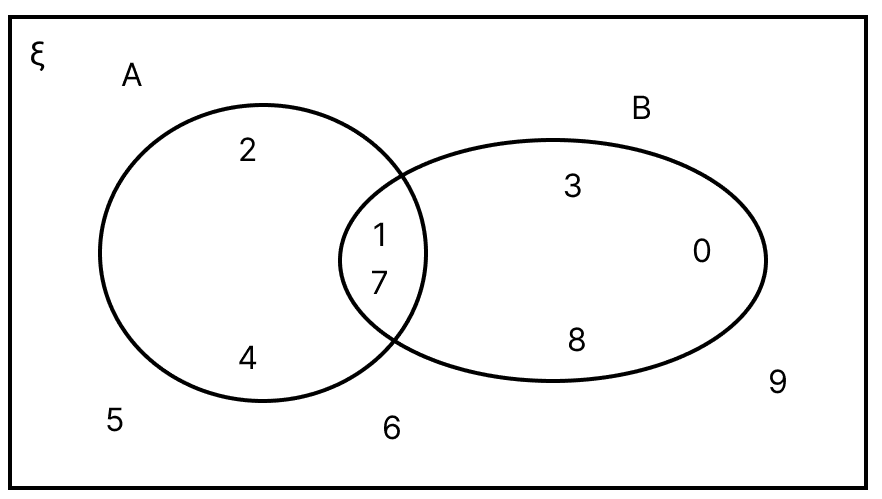
From the adjoining Venn diagram, determine the following sets:
(i) A ∪ B
(ii) A ∩ B
(iii) A − B
(iv) (A ∩ B)'.
Answer
From the given Venn diagram,
ξ = {0, 1, 2, 3, 4, 5, 6, 7, 8, 9}
A = {1, 2, 4, 7} (the elements written inside the circle A)
B = {0, 1, 3, 7, 8} (the elements written inside the circle B)
(i) A ∪ B
Collecting all the elements which belong to A or B or both,
A ∪ B = {0, 1, 2, 3, 4, 7, 8}
Hence, A ∪ B = {0, 1, 2, 3, 4, 7, 8}.
(ii) A ∩ B
The elements lying in the common (overlapping) region of the two circles are 1 and 7.
∴ A ∩ B = {1, 7}
Hence, A ∩ B = {1, 7}.
(iii) A − B
Removing from A the elements 1 and 7 which also belong to B,
A − B = {2, 4}
Hence, A − B = {2, 4}.
(iv) (A ∩ B)'
From part (ii), A ∩ B = {1, 7}.
Removing the elements 1 and 7 from ξ,
(A ∩ B)' = {0, 2, 3, 4, 5, 6, 8, 9}
Hence, (A ∩ B)' = {0, 2, 3, 4, 5, 6, 8, 9}.
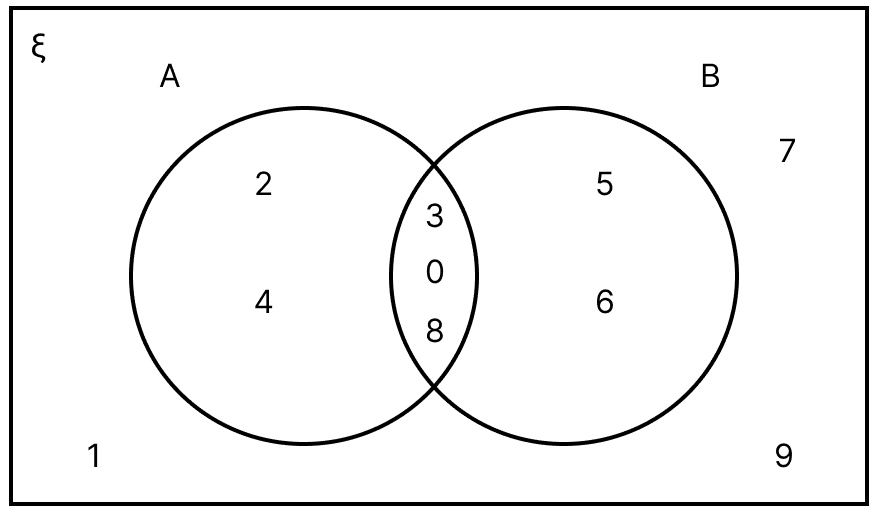
From the adjoining Venn diagram, write the following:
(i) A'
(ii) B'
(iii) (A ∩ B)'.
Answer
From the given Venn diagram,
ξ = {0, 1, 2, 3, 4, 5, 6, 7, 8, 9}
A = {0, 2, 3, 4, 8} (the elements written inside the circle A)
B = {0, 3, 5, 6, 8} (the elements written inside the circle B)
(i) A'
A' consists of those elements of ξ which do not belong to A. Removing 0, 2, 3, 4, 8 from ξ,
A' = {1, 5, 6, 7, 9}
Hence, A' = {1, 5, 6, 7, 9}.
(ii) B'
B' consists of those elements of ξ which do not belong to B. Removing 0, 3, 5, 6, 8 from ξ,
B' = {1, 2, 4, 7, 9}
Hence, B' = {1, 2, 4, 7, 9}.
(iii) (A ∩ B)'
The elements lying in the common region of the two circles are 0, 3 and 8.
∴ A ∩ B = {0, 3, 8}
Removing 0, 3 and 8 from ξ,
(A ∩ B)' = {1, 2, 4, 5, 6, 7, 9}
Hence, (A ∩ B)' = {1, 2, 4, 5, 6, 7, 9}.
Let ξ = {x : x ∈ N and x < 10}, A = {x : x = 2y + 1 and y ∈ N} and B = {x : x = 3y − 1 and y ∈ N}, list the elements of A' ∪ B.
Answer
Given,
ξ = {x : x ∈ N and x < 10} = {1, 2, 3, 4, 5, 6, 7, 8, 9}
It is understood that A and B are subsets of ξ, so their members are to be taken only from ξ.
For the set A, x = 2y + 1 where y ∈ N.
Putting y = 1, 2, 3, 4, we get x = 3, 5, 7, 9 and for y = 5 we get x = 11 which does not belong to ξ.
∴ A = {3, 5, 7, 9}
For the set B, x = 3y − 1 where y ∈ N.
Putting y = 1, 2, 3, we get x = 2, 5, 8 and for y = 4 we get x = 11 which does not belong to ξ.
∴ B = {2, 5, 8}
Now, A' consists of those elements of ξ which do not belong to A.
∴ A' = ξ − A = {1, 2, 4, 6, 8}
∴ A' ∪ B = {1, 2, 4, 6, 8} ∪ {2, 5, 8} = {1, 2, 4, 5, 6, 8}
Hence, A' ∪ B = {1, 2, 4, 5, 6, 8}.
If ξ = {1, 2, 3, ..., 10}, A = {x : x is prime} and B = {x : x is even integer}, then write the following:
(i) A − B
(ii) A ∩ B'.
Answer
Given,
ξ = {1, 2, 3, ....., 10}
It is understood that A and B are subsets of ξ, so their members are to be taken only from ξ.
The prime numbers lying in ξ are 2, 3, 5 and 7.
∴ A = {2, 3, 5, 7}
The even integers lying in ξ are 2, 4, 6, 8 and 10.
∴ B = {2, 4, 6, 8, 10}
(i) A − B
Removing from A the element 2 which also belongs to B,
A − B = {3, 5, 7}
Hence, A − B = {3, 5, 7}.
(ii) A ∩ B'
B' consists of those elements of ξ which do not belong to B.
∴ B' = ξ − B = {1, 3, 5, 7, 9}
The elements common to A = {2, 3, 5, 7} and B' = {1, 3, 5, 7, 9} are 3, 5 and 7.
∴ A ∩ B' = {3, 5, 7}
Hence, A ∩ B' = {3, 5, 7}.
If ξ = {all digits in our decimal system}, A = {x : x is prime}, and B = {x : x2 < 25}, then write the following:
(i) B − A
(ii) A ∪ B
(iii) (A ∪ B)'.
Answer
In our decimal system every number is written with the help of the ten digits 0, 1, 2, ....., 9.
∴ ξ = {0, 1, 2, 3, 4, 5, 6, 7, 8, 9}
It is understood that A and B are subsets of ξ, so their members are to be taken only from ξ.
The prime numbers lying in ξ are 2, 3, 5 and 7.
∴ A = {2, 3, 5, 7}
For the set B, x2 < 25. The squares of 0, 1, 2, 3, 4 are 0, 1, 4, 9, 16 and each of these is less than 25, while 52 = 25 which is not less than 25.
∴ B = {0, 1, 2, 3, 4}
(i) B − A
Removing from B the elements 2 and 3 which also belong to A,
B − A = {0, 1, 4}
Hence, B − A = {0, 1, 4}.
(ii) A ∪ B
Collecting all the elements which belong to A or B or both,
A ∪ B = {0, 1, 2, 3, 4, 5, 7}
Hence, A ∪ B = {0, 1, 2, 3, 4, 5, 7}.
(iii) (A ∪ B)'
Removing the elements of A ∪ B from ξ, the elements left are 6, 8 and 9.
∴ (A ∪ B)' = {6, 8, 9}
Hence, (A ∪ B)' = {6, 8, 9}.
On the real axis, if A = (0, 3] and B = [2, 6], then write the following:
(i) A ∪ B
(ii) A ∩ B
(iii) A − B
(iv) B − A.
Answer
Given,
A = (0, 3] = {x : x ∈ R, 0 < x ≤ 3} and B = [2, 6] = {x : x ∈ R, 2 ≤ x ≤ 6}
The sets A and B on the real axis are represented below:
![On the real axis, if A = (0, 3] and B = [2, 6], then write the following:. Sets, ML Aggarwal Understanding Mathematics Solutions ICSE Class 11.](https://cdn1.knowledgeboat.com/img/mla11/q13-exercise-1-3-ans-1-ml-apc-maths-icse-class-11-c1-202609191533-1098x434.png)
(i) A ∪ B
A ∪ B is the set of all real numbers which belong to A or B or both. The two intervals overlap between 2 and 3, so together they cover all real numbers x with 0 < x ≤ 6, where 0 is excluded and 6 is included.
∴ A ∪ B = (0, 6]
Hence, A ∪ B = (0, 6].
(ii) A ∩ B
A ∩ B is the set of all real numbers which belong to both A and B. A real number lies in both the intervals only when 2 ≤ x ≤ 3, both 2 and 3 being included.
∴ A ∩ B = [2, 3]
Hence, A ∩ B = [2, 3].
(iii) A − B
A − B is the set of all real numbers which belong to A but do not belong to B. Removing from (0, 3] the part [2, 3], we are left with 0 < x < 2, where 0 is excluded and 2 is also excluded because 2 ∈ B.
∴ A − B = (0, 2)
Hence, A − B = (0, 2).
(iv) B − A
B − A is the set of all real numbers which belong to B but do not belong to A. Removing from [2, 6] the part [2, 3], we are left with 3 < x ≤ 6, where 3 is excluded because 3 ∈ A and 6 is included.
∴ B − A = (3, 6]
Hence, B − A = (3, 6].
On the real axis, if A = [−1, 1) and B = [0, 4], then find the following:
(i) A'
(ii) B'
(iii) A ∪ B
(iv) A ∩ B
(v) A − B
(vi) B − A.
Answer
Given,
A = [−1, 1) = {x : x ∈ R, −1 ≤ x < 1} and B = [0, 4] = {x : x ∈ R, 0 ≤ x ≤ 4}
Here the universal set is R, the set of all real numbers.
The sets A and B on the real axis are represented below:
![On the real axis, if A = [−1, 1) and B = [0, 4], then find the following:. Sets, ML Aggarwal Understanding Mathematics Solutions ICSE Class 11.](https://cdn1.knowledgeboat.com/img/mla11/q14-exercise-1-3-ans-1-ml-apc-maths-icse-class-11-c1-202609191533-1093x427.png)
(i) A'
A' consists of all real numbers which do not belong to A, i.e. all x < −1 together with all x ≥ 1. Note that −1 ∈ A so −1 is excluded from A', while 1 ∉ A so 1 is included in A'.
∴ A' = (−∞, −1) ∪ [1, ∞)
Hence, A' = (−∞, −1) ∪ [1, ∞).
(ii) B'
B' consists of all real numbers which do not belong to B, i.e. all x < 0 together with all x > 4. Note that both 0 and 4 belong to B, so both are excluded from B'.
∴ B' = (−∞, 0) ∪ (4, ∞)
Hence, B' = (−∞, 0) ∪ (4, ∞).
(iii) A ∪ B
The two intervals overlap between 0 and 1, so together they cover all real numbers x with −1 ≤ x ≤ 4, both −1 and 4 being included.
∴ A ∪ B = [−1, 4]
Hence, A ∪ B = [−1, 4].
(iv) A ∩ B
A real number lies in both the intervals only when 0 ≤ x < 1, where 0 is included and 1 is excluded because 1 ∉ A.
∴ A ∩ B = [0, 1)
Hence, A ∩ B = [0, 1).
(v) A − B
Removing from [−1, 1) the part [0, 1), we are left with −1 ≤ x < 0, where −1 is included and 0 is excluded because 0 ∈ B.
∴ A − B = [−1, 0)
Hence, A − B = [−1, 0).
(vi) B − A
Removing from [0, 4] the part [0, 1), we are left with 1 ≤ x ≤ 4, where 1 is included because 1 ∉ A, and 4 is included.
∴ B − A = [1, 4]
Hence, B − A = [1, 4].
If A = the set of letters in the word 'JAIPUR' and B = the set of letters in the word 'JODHPUR', find the following:
(i) A ∪ B
(ii) A ∩ B
(iii) A − B
(iv) B − A.
Also verify the following results:
(a) n(A ∪ B) = n(A) + n(B) − n(A ∩ B)
(b) n(A − B) = n(A) − n(A ∩ B) = n(A ∪ B) − n(B).
Answer
The letters of the word JAIPUR are J, A, I, P, U, R and the letters of the word JODHPUR are J, O, D, H, P, U, R.
∴ A = {J, A, I, P, U, R} and B = {J, O, D, H, P, U, R}
(i) A ∪ B
Collecting all the letters which belong to A or B or both, and writing each of them only once,
A ∪ B = {J, A, I, P, U, R, O, D, H}
Hence, A ∪ B = {J, A, I, P, U, R, O, D, H}.
(ii) A ∩ B
The letters common to A and B are J, P, U and R.
∴ A ∩ B = {J, P, U, R}
Hence, A ∩ B = {J, P, U, R}.
(iii) A − B
Removing from A the letters J, P, U, R which also belong to B,
A − B = {A, I}
Hence, A − B = {A, I}.
(iv) B − A
Removing from B the letters J, P, U, R which also belong to A,
B − A = {O, D, H}
Hence, B − A = {O, D, H}.
Verification
Counting the elements of the sets found above,
n(A) = 6, n(B) = 7, n(A ∪ B) = 9, n(A ∩ B) = 4, n(A − B) = 2
(a) n(A) + n(B) − n(A ∩ B) = 6 + 7 − 4 = 9 = n(A ∪ B)
Hence, the result n(A ∪ B) = n(A) + n(B) − n(A ∩ B) is verified.
(b) n(A) − n(A ∩ B) = 6 − 4 = 2 = n(A − B)
and n(A ∪ B) − n(B) = 9 − 7 = 2 = n(A − B)
Hence, the result n(A − B) = n(A) − n(A ∩ B) = n(A ∪ B) − n(B) is verified.
If ξ = {0, 1, 2, 3, 4, 5, 6, 7}, A = {2, 5, 7}, B = {0, 2, 3, 7} and C = {0, 3, 4, 6}, form the following sets:
(i) (A ∪ B)'
(ii) A − C
(iii) A ∩ (B ∪ C).
Answer
Given,
ξ = {0, 1, 2, 3, 4, 5, 6, 7}, A = {2, 5, 7}, B = {0, 2, 3, 7} and C = {0, 3, 4, 6}
(i) (A ∪ B)'
Collecting all the elements which belong to A or B or both,
A ∪ B = {0, 2, 3, 5, 7}
Removing these elements from ξ, the elements left are 1, 4 and 6.
∴ (A ∪ B)' = {1, 4, 6}
Hence, (A ∪ B)' = {1, 4, 6}.
(ii) A − C
A − C is the set of all the elements which belong to A but do not belong to C. None of the elements 2, 5, 7 of A belongs to C, so no element has to be removed.
∴ A − C = {2, 5, 7}
Hence, A − C = {2, 5, 7}.
(iii) A ∩ (B ∪ C)
First, collecting all the elements which belong to B or C or both,
B ∪ C = {0, 2, 3, 4, 6, 7}
Now, the elements common to A = {2, 5, 7} and B ∪ C = {0, 2, 3, 4, 6, 7} are 2 and 7.
∴ A ∩ (B ∪ C) = {2, 7}
Hence, A ∩ (B ∪ C) = {2, 7}.
Let A = {2x : x ∈ N and 1 ≤ x < 4}, B = {x + 2; x ∈ N and 2 ≤ x < 5} and C = {x : x ∈ N and 3 < x < 6}, determine the following:
(i) A ∩ B
(ii) A ∪ B
(iii) (A ∪ B) ∩ C.
Also verify that n(A ∪ B) = n(A) + n(B) − n(A ∩ B).
Answer
For the set A, x ∈ N and 1 ≤ x < 4, so x = 1, 2, 3.
Putting these values in 2x, we get 2, 4, 6.
∴ A = {2, 4, 6}
For the set B, x ∈ N and 2 ≤ x < 5, so x = 2, 3, 4.
Putting these values in x + 2, we get 4, 5, 6.
∴ B = {4, 5, 6}
For the set C, x ∈ N and 3 < x < 6, so x = 4, 5.
∴ C = {4, 5}
(i) A ∩ B
The elements common to A and B are 4 and 6.
∴ A ∩ B = {4, 6}
Hence, A ∩ B = {4, 6}.
(ii) A ∪ B
Collecting all the elements which belong to A or B or both,
A ∪ B = {2, 4, 5, 6}
Hence, A ∪ B = {2, 4, 5, 6}.
(iii) (A ∪ B) ∩ C
The elements common to A ∪ B = {2, 4, 5, 6} and C = {4, 5} are 4 and 5.
∴ (A ∪ B) ∩ C = {4, 5}
Hence, (A ∪ B) ∩ C = {4, 5}.
Verification
Counting the elements of the sets found above,
n(A) = 3, n(B) = 3, n(A ∪ B) = 4, n(A ∩ B) = 2
∴ n(A) + n(B) − n(A ∩ B) = 3 + 3 − 2 = 4 = n(A ∪ B)
Hence, the result n(A ∪ B) = n(A) + n(B) − n(A ∩ B) is verified.
If ξ = the set of all digits in our decimal system, A = {x : x is prime} and B = {x : x is a perfect square}, then verify the following results:
(i) A ∪ A' = ξ
(ii) A ∩ A' = φ
(iii) A − B = A ∩ B'
(iv) (A ∩ B)' = A' ∪ B'
(v) (A ∪ B)' = A' ∩ B'
(vi) (A')' = A.
Answer
In our decimal system every number is written with the help of the ten digits 0, 1, 2, ....., 9.
∴ ξ = {0, 1, 2, 3, 4, 5, 6, 7, 8, 9}
The prime numbers lying in ξ are 2, 3, 5 and 7.
∴ A = {2, 3, 5, 7}
The perfect squares lying in ξ are 0 = 02, 1 = 12, 4 = 22 and 9 = 32.
∴ B = {0, 1, 4, 9}
Taking complements with respect to ξ,
A' = ξ − A = {0, 1, 4, 6, 8, 9} and B' = ξ − B = {2, 3, 5, 6, 7, 8}
(i) A ∪ A' = ξ
A ∪ A' = {2, 3, 5, 7} ∪ {0, 1, 4, 6, 8, 9} = {0, 1, 2, 3, 4, 5, 6, 7, 8, 9} = ξ
Hence, the result A ∪ A' = ξ is verified.
(ii) A ∩ A' = φ
No element belongs to both A and A', because A' is formed by leaving out exactly the elements of A.
∴ A ∩ A' = φ
Hence, the result A ∩ A' = φ is verified.
(iii) A − B = A ∩ B'
None of the elements 2, 3, 5, 7 of A belongs to B, so
A − B = {2, 3, 5, 7}
Also, the elements common to A = {2, 3, 5, 7} and B' = {2, 3, 5, 6, 7, 8} are 2, 3, 5 and 7.
∴ A ∩ B' = {2, 3, 5, 7}
∴ A − B = A ∩ B'
Hence, the result A − B = A ∩ B' is verified.
(iv) (A ∩ B)' = A' ∪ B'
There is no element common to A and B, so A ∩ B = φ.
∴ (A ∩ B)' = φ' = ξ = {0, 1, 2, 3, 4, 5, 6, 7, 8, 9}
Also, A' ∪ B' = {0, 1, 4, 6, 8, 9} ∪ {2, 3, 5, 6, 7, 8} = {0, 1, 2, 3, 4, 5, 6, 7, 8, 9}
∴ (A ∩ B)' = A' ∪ B'
Hence, the result (A ∩ B)' = A' ∪ B' is verified.
(v) (A ∪ B)' = A' ∩ B'
A ∪ B = {2, 3, 5, 7} ∪ {0, 1, 4, 9} = {0, 1, 2, 3, 4, 5, 7, 9}
Removing these elements from ξ, the elements left are 6 and 8.
∴ (A ∪ B)' = {6, 8}
Also, the elements common to A' = {0, 1, 4, 6, 8, 9} and B' = {2, 3, 5, 6, 7, 8} are 6 and 8.
∴ A' ∩ B' = {6, 8}
∴ (A ∪ B)' = A' ∩ B'
Hence, the result (A ∪ B)' = A' ∩ B' is verified.
(vi) (A')' = A
Here A' = {0, 1, 4, 6, 8, 9}.
Removing the elements of A' from ξ, the elements left are 2, 3, 5 and 7.
∴ (A')' = {2, 3, 5, 7} = A
Hence, the result (A')' = A is verified.