
Which of the following relations are functions? Give reasons. If it is a function, determine its domain and range.
(i) {(1, 1), (1, 2), (1, 3), (1, 4)}
(ii) {(a, b), (b, c), (c, d), (d, e)}
(iii) {(1, 2), (3, 1), (1, 3), (4, 1)}
(iv) {(1, 2), (2, 2), (3, 2), (4, 2)}
(v) {(2, 1), (0, −1), (3, 1), (5, 4), (−1, 0), (3, 4), (1, 0)}
(vi) {(2, 1), (4, 2), (6, 3), (8, 4), (10, 3), (14, 7)}.
Answer
We know that,
A relation is a function if and only if no two different ordered pairs of the relation have the same first component.
(i) {(1, 1), (1, 2), (1, 3), (1, 4)}
The ordered pairs (1, 1) and (1, 2) have the same first component 1, so the element 1 has more than one image.
Hence, the given relation is not a function.
(ii) {(a, b), (b, c), (c, d), (d, e)}
The first components a, b, c, d are all different, so no element has more than one image.
The first components are a, b, c, d and the second components are b, c, d, e.
Hence, the given relation is a function whose domain = {a, b, c, d} and range = {b, c, d, e}.
(iii) {(1, 2), (3, 1), (1, 3), (4, 1)}
The ordered pairs (1, 2) and (1, 3) have the same first component 1, so the element 1 has two different images 2 and 3.
Hence, the given relation is not a function.
(iv) {(1, 2), (2, 2), (3, 2), (4, 2)}
The first components 1, 2, 3, 4 are all different, so no element has more than one image.
The first components are 1, 2, 3, 4 and the second component in each pair is 2.
Hence, the given relation is a function whose domain = {1, 2, 3, 4} and range = {2}.
(v) {(2, 1), (0, −1), (3, 1), (5, 4), (−1, 0), (3, 4), (1, 0)}
The ordered pairs (3, 1) and (3, 4) have the same first component 3, so the element 3 has two different images 1 and 4.
Hence, the given relation is not a function.
(vi) {(2, 1), (4, 2), (6, 3), (8, 4), (10, 3), (14, 7)}
The first components 2, 4, 6, 8, 10, 14 are all different, so no element has more than one image.
The first components are 2, 4, 6, 8, 10, 14 and the second components are 1, 2, 3, 4, 3, 7.
Hence, the given relation is a function whose domain = {2, 4, 6, 8, 10, 14} and range = {1, 2, 3, 4, 7}.
If X = {−4, 1, 2, 3} and Y = {a, b, c}, which of the following relations is a function from X to Y?
(i) {(−4, a), (1, a), (2, b)}
(ii) {(−4, b), (1, b), (2, a), (3, c)}
(iii) {(−4, a), (1, a), (2, b), (3, c), (1, b)}.
Answer
Given,
X = {−4, 1, 2, 3} and Y = {a, b, c}
We know that,
A relation from X to Y is a function from X to Y if and only if every element of X has one and only one image in Y.
(i) {(−4, a), (1, a), (2, b)}
The element 3 of X does not occur as the first component of any ordered pair, so 3 has no image.
Hence, the given relation is not a function from X to Y.
(ii) {(−4, b), (1, b), (2, a), (3, c)}
Each of the four elements −4, 1, 2 and 3 of X occurs exactly once as a first component, so every element of X has a unique image in Y.
Hence, the given relation is a function from X to Y.
(iii) {(−4, a), (1, a), (2, b), (3, c), (1, b)}
The ordered pairs (1, a) and (1, b) have the same first component 1, so the element 1 has two different images a and b.
Hence, the given relation is not a function from X to Y.
Let A = {1, 2, 3, 4}, B = {1, 5, 9, 11, 15, 16} and f = {(1, 5), (2, 9), (3, 1), (4, 5), (2, 11)}.
Are the following true?
(i) f is a relation from A to B.
(ii) f is a function from A to B?
Justify your answer in each case.
Answer
Given,
A = {1, 2, 3, 4}, B = {1, 5, 9, 11, 15, 16} and f = {(1, 5), (2, 9), (3, 1), (4, 5), (2, 11)}
(i) In each ordered pair of f, the first component 1, 2, 3, 4 or 2 belongs to A and the second component 5, 9, 1, 5 or 11 belongs to B, so every ordered pair of f is an element of A × B i.e. f ⊂ A × B.
Hence, the given statement is true.
(ii) The ordered pairs (2, 9) and (2, 11) have the same first component 2, so the element 2 of A has two different images 9 and 11 in B.
∴ f is not a function from A to B.
Hence, the given statement is not true.
Is the given relation a function? Justify your answer.
(i) f = {(x, x) : x ∈ R}
(ii) g = {(n, n2) : n is a positive integer}
(iii) h = {(x, 3) : x ∈ R}
Answer
We know that,
A relation is a function if and only if every element of its domain has one and only one image.
(i) f = {(x, x) : x ∈ R}
Every real number x occurs exactly once as a first component and its image is the unique real number x itself.
Hence, f is a function.
(ii) g = {(n, n2) : n is a positive integer}
Every positive integer n occurs exactly once as a first component and its image is the unique number n2, since a number has only one square.
Hence, g is a function.
(iii) h = {(x, 3) : x ∈ R}
Every real number x occurs exactly once as a first component and its image is the unique number 3. Different elements of the domain may have the same image, which is allowed in a function.
Hence, h is a function.
(i) A function 'f' is defined by f(x) = x2 + 1 where x ∈ {−1, 0, 1, 3}. List the elements of f.
(ii) If a function f is defined by f(x) = 2x − 1 where x ∈ {−2, 0, 3, 5}, then find its range.
Answer
(i) Substituting each value of x in f(x) = x2 + 1,
⇒ f(−1) = (−1)2 + 1 = 1 + 1 = 2,
⇒ f(0) = 02 + 1 = 0 + 1 = 1,
⇒ f(1) = 12 + 1 = 1 + 1 = 2,
⇒ f(3) = 32 + 1 = 9 + 1 = 10.
Thus, the corresponding ordered pairs are (−1, 2), (0, 1), (1, 2) and (3, 10).
Hence, f = {(−1, 2), (0, 1), (1, 2), (3, 10)}.
(ii) Substituting each value of x in f(x) = 2x − 1,
⇒ f(−2) = 2(−2) − 1 = −4 − 1 = −5,
⇒ f(0) = 2(0) − 1 = 0 − 1 = −1,
⇒ f(3) = 2(3) − 1 = 6 − 1 = 5,
⇒ f(5) = 2(5) − 1 = 10 − 1 = 9.
The range of f is the set of all these images.
Hence, range of f = {−5, −1, 5, 9}.
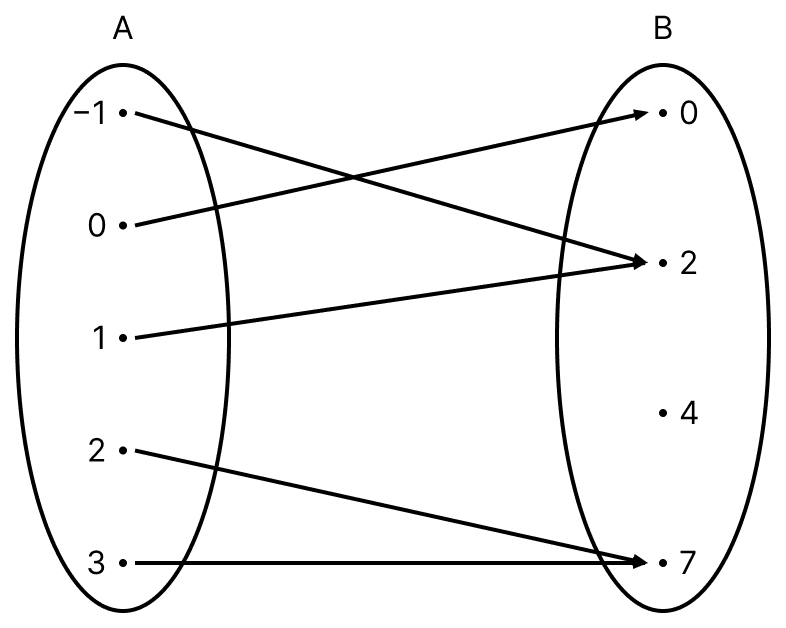
Does the adjacent arrow diagram represent a function? If so, write its range.
Answer
From the given arrow diagram,
A = {−1, 0, 1, 2, 3} and B = {0, 2, 4, 7}
and the arrows join −1 to 2, 0 to 0, 1 to 2, 2 to 7 and 3 to 7.
Each of the five elements −1, 0, 1, 2 and 3 of A has exactly one arrow starting from it, so every element of A has one and only one image in B.
∴ The given arrow diagram represents a function.
The images are 2, 0, 2, 7 and 7, so the range is the set of these images.
Hence, the given arrow diagram represents a function whose range = {0, 2, 7}.
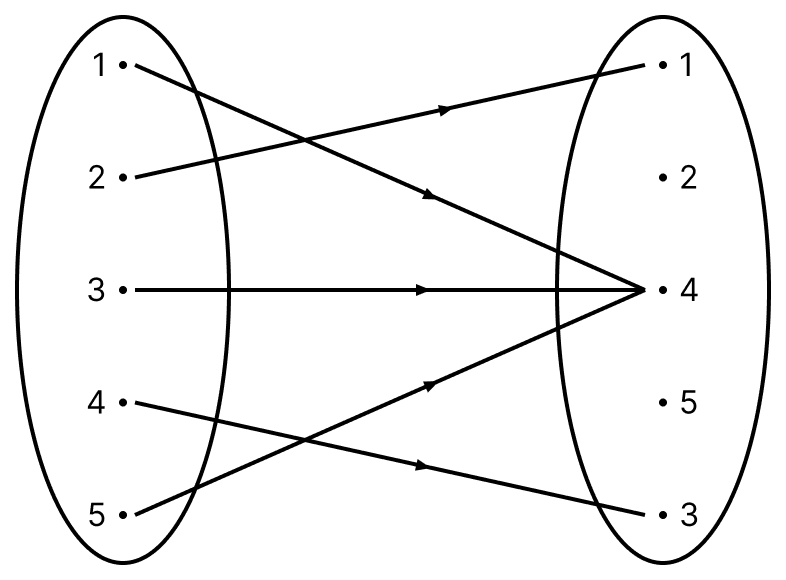
The adjacent arrow diagram represents a relation. Represent the relation in roster form. Is this relation a function? Give reasons for your answer.
Answer
From the given arrow diagram,
the arrows join 1 to 4, 2 to 1, 3 to 4, 4 to 3 and 5 to 4.
Thus, the corresponding ordered pairs are (1, 4), (2, 1), (3, 4), (4, 3) and (5, 4).
∴ The relation = {(1, 4), (2, 1), (3, 4), (4, 3), (5, 4)}
The first components 1, 2, 3, 4 and 5 are all different, so each element of the domain has a unique image in the codomain.
Hence, the relation in roster form is {(1, 4), (2, 1), (3, 4), (4, 3), (5, 4)} and it is a function, because each element of the domain has a unique image in the codomain.
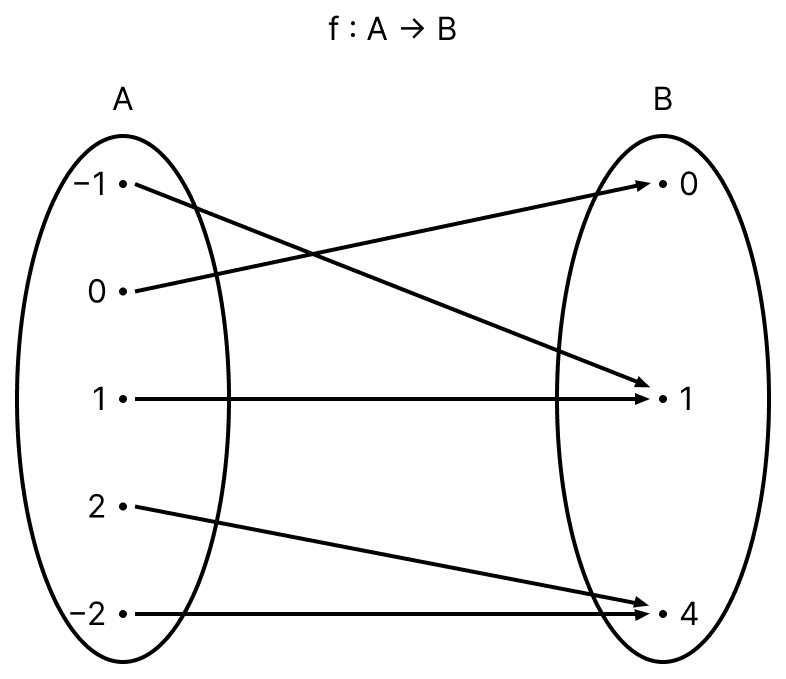
The adjacent arrow diagram represents a relation. List the pairs that satisfy the relation. Is this relation a function? Also find the rule (relation) for the above correspondence.
Answer
From the given arrow diagram,
A = {−1, 0, 1, 2, −2} and B = {0, 1, 4}
The arrows join −1 to 1, 0 to 0, 1 to 1, 2 to 4 and −2 to 4.
Thus, the corresponding ordered pairs are (−1, 1), (0, 0), (1, 1), (2, 4) and (−2, 4).
∴ The relation = {(−1, 1), (0, 0), (1, 1), (2, 4), (−2, 4)}
Each of the five elements of A has exactly one arrow starting from it, so every element of A has one and only one image in B.
∴ The given relation is a function.
Observing the pairs,
1 = (−1)2, 0 = 02, 1 = 12, 4 = 22, 4 = (−2)2
so in each pair the second component is the square of the first component.
Hence, the relation is {(−1, 1), (0, 0), (1, 1), (2, 4), (−2, 4)}, it is a function and the rule is f(x) = x2, x ∈ A.
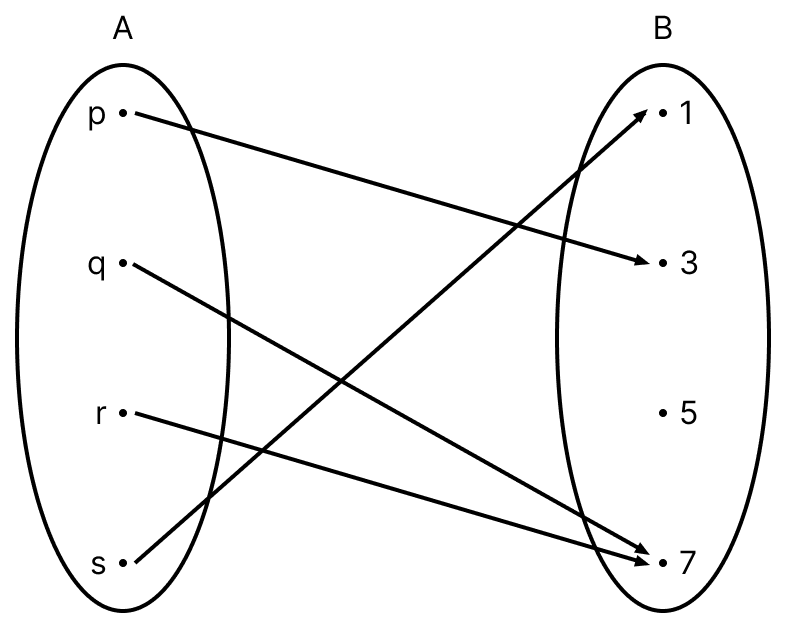
Write the relation represented by the adjoining diagram, by listing the ordered pairs. State the domain, the codomain and the range of the relation. Is the relation a function?
Answer
From the given arrow diagram,
A = {p, q, r, s} and B = {1, 3, 5, 7}
and the arrows join p to 3, q to 7, r to 7 and s to 1.
Thus, the corresponding ordered pairs are (p, 3), (q, 7), (r, 7) and (s, 1).
∴ The relation = {(p, 3), (q, 7), (r, 7), (s, 1)}
The first components are p, q, r, s, so the domain is A.
The relation is from A to B, so the codomain is B.
The images are 3, 7, 7 and 1, so the range is the set of these images.
Each of the four elements p, q, r and s of A has exactly one arrow starting from it, so every element of A has one and only one image in B.
Hence, the relation is {(p, 3), (q, 7), (r, 7), (s, 1)}, domain = {p, q, r, s}, codomain = {1, 3, 5, 7}, range = {1, 3, 7} and the relation is a function.
and .
(i) List the domain of .
(ii) List the range of .
(iii) Is a function?
Answer
Given,
and
Substituting each value of ,
when , ,
when , ,
when , ,
when , .
Thus, the corresponding ordered pairs are , , and .
∴
(i) The first components of the ordered pairs of are , , 1 and 2.
Hence, domain of .
(ii) The second components of the ordered pairs of are , , 1 and .
Hence, range of .
(iii) The first components , , 1 and 2 are all different, so every element of has one and only one image.
Hence, is a function.
Express the following function as a set of ordered pairs and find its range :
f : X → R defined by f(x) = x3 + 1, where X = {−1, 0, 3, 9, 7}.
Answer
Given,
f(x) = x3 + 1, where X = {−1, 0, 3, 9, 7}
Substituting each value of x,
f(−1) = (−1)3 + 1 = −1 + 1 = 0,
f(0) = 03 + 1 = 0 + 1 = 1,
f(3) = 33 + 1 = 27 + 1 = 28,
f(9) = 93 + 1 = 729 + 1 = 730,
f(7) = 73 + 1 = 343 + 1 = 344.
Thus, the corresponding ordered pairs are (−1, 0), (0, 1), (3, 28), (9, 730) and (7, 344).
∴ f = {(−1, 0), (0, 1), (3, 28), (9, 730), (7, 344)}
The range of f is the set of all these images.
Hence, f = {(−1, 0), (0, 1), (3, 28), (9, 730), (7, 344)} and range of f = {0, 1, 28, 730, 344}.
If f(x) = ax + b, where a and b are integers, f(−1) = −5 and f(3) = 3, find a and b.
Answer
Given,
f(x) = ax + b
As f(−1) = −5,
⇒ a(−1) + b = −5
⇒ −a + b = −5 ...........(1)
As f(3) = 3,
⇒ a(3) + b = 3
⇒ 3a + b = 3 ...........(2)
Subtracting equation (1) from equation (2), we get :
⇒ 3a + b − (−a + b) = 3 − (−5)
⇒ 3a + b + a − b = 3 + 5
⇒ 4a = 8
⇒ a = 2
Substituting a = 2 in equation (1), we get :
⇒ −2 + b = −5
⇒ b = −5 + 2 = −3
Hence, a = 2 and b = −3.
If and are ordered pairs which belong to the mapping where , find and .
Answer
Given,
i.e.
As belongs to , .
⇒
⇒
⇒
⇒
As belongs to , .
⇒
⇒
⇒
Hence, and .
If a function f from R to R is defined by f = {(x, 3x − 5) : x ∈ R}, find the values of a and b given that (a, 4) and (1, b) belong to f.
Answer
Given,
f = {(x, 3x − 5) : x ∈ R} i.e. f(x) = 3x − 5
As (a, 4) belongs to f, f(a) = 4.
⇒ 3a − 5 = 4
⇒ 3a = 4 + 5
⇒ 3a = 9
⇒ a = 3
As (1, b) belongs to f, f(1) = b.
⇒ b = 3(1) − 5
⇒ b = 3 − 5
⇒ b = −2
Hence, a = 3 and b = −2.