
Decide, among the following sets, which are subsets of which.
A = {x : x is a solution of x2 − 8x + 12 = 0}, B = {2, 4, 6},
C = {x : x is an even natural number}, D = {6}.
Answer
For the set A,
x2 − 8x + 12 = 0
⇒ x2 − 6x − 2x + 12 = 0
⇒ x(x − 6) − 2(x − 6) = 0
⇒ (x − 2)(x − 6) = 0
⇒ x − 2 = 0 or x − 6 = 0
⇒ x = 2 or x = 6
∴ A = {2, 6}
Given,
B = {2, 4, 6}, C = {2, 4, 6, 8, 10, .....} and D = {6}
Now we compare the sets one by one.
Both the members 2 and 6 of A belong to B, so A ⊂ B.
Both the members 2 and 6 of A are even natural numbers, so A ⊂ C.
Each of the members 2, 4 and 6 of B is an even natural number, so B ⊂ C.
The only member 6 of D belongs to A, to B and to C, so D ⊂ A, D ⊂ B and D ⊂ C.
Hence, A ⊂ B, A ⊂ C, B ⊂ C, D ⊂ A, D ⊂ B and D ⊂ C.
Let ξ = the set of all letters in the word 'TAMILNADU' and X = {x : x is a vowel and x ∈ ξ}
(i) Write ξ and X in the roster form.
(ii) Tell n(ξ) and n(X).
(iii) List all the proper subsets of X.
(iv) What is the cardinal number of the power set of X?
Answer
(i) The letters of the word TAMILNADU are T, A, M, I, L, N, A, D, U. While listing the elements of a set, each member is written only once, so the repeated letter A is written only once.
∴ ξ = {T, A, M, I, L, N, D, U}
The vowels in the English alphabet are A, E, I, O, U. Out of the elements of ξ, the vowels are A, I and U.
∴ X = {A, I, U}
Hence, ξ = {T, A, M, I, L, N, D, U} and X = {A, I, U}.
(ii) Counting the different elements, ξ has 8 elements and X has 3 elements.
Hence, n(ξ) = 8 and n(X) = 3.
(iii) Here n(X) = 3.
Number of subsets of X = 23 = 8
Number of proper subsets of X = 23 − 1 = 8 − 1 = 7
(The set X itself is a subset of X but not a proper subset of X, so it is left out.)
Hence, the proper subsets of X are φ, {A}, {I}, {U}, {A, I}, {A, U} and {I, U}.
(iv) The power set P(X) is the set formed by all the subsets of X, so the cardinal number of P(X) is the number of subsets of X.
∴ n(P(X)) = 2n(X) = 23 = 8
Hence, the cardinal number of the power set of X is 8.
Let A be the set of letters in the word "POOR". Write the power set of A.
Answer
The letters of the word POOR are P, O, O, R. While listing the elements of a set, each member is written only once, so the repeated letter O is written only once.
∴ A = {P, O, R} and n(A) = 3
Number of elements in P(A) = 2n(A) = 23 = 8
Writing down all the subsets of A, we have
The subset with no element : φ
The subsets with one element : {P}, {O}, {R}
The subsets with two elements : {P, O}, {P, R}, {O, R}
The subset with three elements : {P, O, R}
Hence, the power set of A is P(A) = {φ, {P}, {O}, {R}, {P, O}, {P, R}, {O, R}, {P, O, R}}.
Find the power sets of the following sets:
(i) {−1, 0, 1}
(ii) {0, 1, {0, 1}}.
Answer
(i) {−1, 0, 1}
Let A = {−1, 0, 1}, so n(A) = 3.
Number of elements in P(A) = 23 = 8
Writing down all the subsets of A, we have
The subset with no element : φ
The subsets with one element : {−1}, {0}, {1}
The subsets with two elements : {−1, 0}, {0, 1}, {−1, 1}
The subset with three elements : {−1, 0, 1}
Hence, P(A) = {φ, {−1}, {0}, {1}, {−1, 0}, {0, 1}, {−1, 1}, {−1, 0, 1}}.
(ii) {0, 1, {0, 1}}
Let B = {0, 1, {0, 1}}.
The elements of B are the numbers 0 and 1 and the set {0, 1}, so n(B) = 3.
Number of elements in P(B) = 23 = 8
Writing down all the subsets of B, we have
The subset with no element : φ
The subsets with one element : {0}, {1}, {{0, 1}}
The subsets with two elements : {0, 1}, {0, {0, 1}}, {1, {0, 1}}
The subset with three elements : {0, 1, {0, 1}}
Hence, P(B) = {φ, {0}, {1}, {{0, 1}}, {0, 1}, {0, {0, 1}}, {1, {0, 1}}, {0, 1, {0, 1}}}.
If A = {2, 3, 5, 7, 8}, B = {1, 5, 9} and A' = {1, 4, 6, 9}, verify that
(i) (A ∪ B)' = A' ∩ B'
(ii) B − A = A' ∩ B.
Answer
Given,
A = {2, 3, 5, 7, 8}, B = {1, 5, 9} and A' = {1, 4, 6, 9}
The universal set consists of the elements of A together with the elements of A'.
∴ ξ = A ∪ A' = {2, 3, 5, 7, 8} ∪ {1, 4, 6, 9} = {1, 2, 3, 4, 5, 6, 7, 8, 9}
∴ B' = ξ − B = {2, 3, 4, 6, 7, 8}
(i) (A ∪ B)' = A' ∩ B'
Collecting all the elements which belong to A or B or both,
A ∪ B = {1, 2, 3, 5, 7, 8, 9}
Removing these elements from ξ, the elements left are 4 and 6.
∴ (A ∪ B)' = {4, 6}
Now, the elements common to A' = {1, 4, 6, 9} and B' = {2, 3, 4, 6, 7, 8} are 4 and 6.
∴ A' ∩ B' = {4, 6}
∴ (A ∪ B)' = A' ∩ B'
Hence, the result (A ∪ B)' = A' ∩ B' is verified.
(ii) B − A = A' ∩ B
B − A is the set of all the elements which belong to B but do not belong to A. Removing 5 from B,
B − A = {1, 9}
Now, the elements common to A' = {1, 4, 6, 9} and B = {1, 5, 9} are 1 and 9.
∴ A' ∩ B = {1, 9}
∴ B − A = A' ∩ B
Hence, the result B − A = A' ∩ B is verified.
For all sets A, B and C, is A − (B − C) = (A − B) − C true ? Justify your answer.
Answer
No, the given statement is not true in general.
To justify it, we give an example. Let
A = {1, 2}, B = {2, 3} and C = {1, 3}
Taking the left hand side,
B − C = {2, 3} − {1, 3} = {2}
∴ A − (B − C) = {1, 2} − {2} = {1}
Taking the right hand side,
A − B = {1, 2} − {2, 3} = {1}
∴ (A − B) − C = {1} − {1, 3} = φ
Here A − (B − C) = {1} and (A − B) − C = φ, and {1} ≠ φ.
∴ A − (B − C) ≠ (A − B) − C
Hence, the statement A − (B − C) = (A − B) − C is not true for all sets A, B and C.
If n(ξ) = 30, n(A') = 15, n(B) = 5 and n(A ∩ B) = 3, find
(i) n(A)
(ii) n(A ∪ B)
(iii) n(A − B).
Answer
Given,
n(ξ) = 30, n(A') = 15, n(B) = 5 and n(A ∩ B) = 3
(i) n(A)
We know that,
n(A') = n(ξ) − n(A)
⇒ 15 = 30 − n(A)
⇒ n(A) = 30 − 15 = 15
Hence, n(A) = 15.
(ii) n(A ∪ B)
We know that,
n(A ∪ B) = n(A) + n(B) − n(A ∩ B)
⇒ n(A ∪ B) = 15 + 5 − 3 = 17
Hence, n(A ∪ B) = 17.
(iii) n(A − B)
The set A − B is obtained from A by removing the elements of A ∩ B.
∴ n(A − B) = n(A) − n(A ∩ B) = 15 − 3 = 12
Hence, n(A − B) = 12.
If n(ξ) = 40, n((A ∪ B)') = 12, n(A − B) = 10 and n(B − A) = 14, find
(i) n(A)
(ii) n(B)
(iii) n(A ∩ B).
Answer
Given,
n(ξ) = 40, n((A ∪ B)') = 12, n(A − B) = 10 and n(B − A) = 14
We know that,
n((A ∪ B)') = n(ξ) − n(A ∪ B)
⇒ 12 = 40 − n(A ∪ B)
⇒ n(A ∪ B) = 40 − 12 = 28
The sets A − B, A ∩ B and B − A are mutually disjoint and together they make up A ∪ B.
∴ n(A ∪ B) = n(A − B) + n(B − A) + n(A ∩ B)
⇒ 28 = 10 + 14 + n(A ∩ B)
⇒ 28 = 24 + n(A ∩ B)
⇒ n(A ∩ B) = 28 − 24 = 4
(i) n(A)
The set A is made up of the two disjoint parts A − B and A ∩ B.
∴ n(A) = n(A − B) + n(A ∩ B) = 10 + 4 = 14
Hence, n(A) = 14.
(ii) n(B)
The set B is made up of the two disjoint parts B − A and A ∩ B.
∴ n(B) = n(B − A) + n(A ∩ B) = 14 + 4 = 18
Hence, n(B) = 18.
(iii) n(A ∩ B)
From the working above, n(A ∩ B) = 4.
Hence, n(A ∩ B) = 4.
Two sets A and B are such that n(A ∪ B) = 18, n(A' ∩ B) = 3 and n(A ∩ B') = 5, find n(A ∩ B).
Answer
Given,
n(A ∪ B) = 18, n(A' ∩ B) = 3 and n(A ∩ B') = 5
We know that,
A ∩ B' = A − B and A' ∩ B = B − A
∴ n(A − B) = 5 and n(B − A) = 3
The sets A − B, A ∩ B and B − A are mutually disjoint and together they make up A ∪ B.
∴ n(A ∪ B) = n(A − B) + n(B − A) + n(A ∩ B)
⇒ 18 = 5 + 3 + n(A ∩ B)
⇒ 18 = 8 + n(A ∩ B)
⇒ n(A ∩ B) = 18 − 8 = 10
Hence, n(A ∩ B) = 10.
Two sets A and B are such that n(A ∪ B) = 21, n(A' ∩ B') = 9 and n(A ∩ B) = 7, find n((A ∩ B)').
Answer
Given,
n(A ∪ B) = 21, n(A' ∩ B') = 9 and n(A ∩ B) = 7
By De Morgan's law,
A' ∩ B' = (A ∪ B)'
∴ n((A ∪ B)') = 9
We know that,
n((A ∪ B)') = n(ξ) − n(A ∪ B)
⇒ 9 = n(ξ) − 21
⇒ n(ξ) = 21 + 9 = 30
Now, n((A ∩ B)') = n(ξ) − n(A ∩ B)
⇒ n((A ∩ B)') = 30 − 7 = 23
Hence, n((A ∩ B)') = 23.
If n(ξ) = 50, n(A) = 3x, n(B) = 2x and n(A ∩ B) = x = n((A ∪ B)'), find
(i) the value of x
(ii) n(A − B).
Answer
Given,
n(ξ) = 50, n(A) = 3x, n(B) = 2x and n(A ∩ B) = x = n((A ∪ B)')
(i) the value of x:
We know that,
n(A ∪ B) = n(A) + n(B) − n(A ∩ B)
⇒ n(A ∪ B) = 3x + 2x − x = 4x ...........(1)
Also we know that
n((A ∪ B)') = n(ξ) − n(A ∪ B)
⇒ x = 50 − n(A ∪ B)
⇒ n(A ∪ B) = 50 − x ...........(2)
From (1) and (2),
4x = 50 − x
⇒ 4x + x = 50
⇒ 5x = 50
⇒ x = 10
Hence, the value of x is 10.
(ii) n(A − B)
From part (i), x = 10.
∴ n(A) = 3x = 3 × 10 = 30 and n(A ∩ B) = x = 10
The set A − B is obtained from A by removing the elements of A ∩ B.
∴ n(A − B) = n(A) − n(A ∩ B) = 30 − 10 = 20
Hence, n(A − B) = 20.
If n(ξ) = 15, A and B are two sets such that A ⊂ B, n(A) = 8 and n(B) = 12, use Venn diagram to find the following:
(i) n(A')
(ii) n(B')
(iii) n(A ∩ B')
(iv) n(A' ∩ B).
Answer
Given,
n(ξ) = 15, A ⊂ B, n(A) = 8 and n(B) = 12
As A ⊂ B, the circle representing A lies completely inside the circle representing B, and both lie inside the rectangle representing ξ.
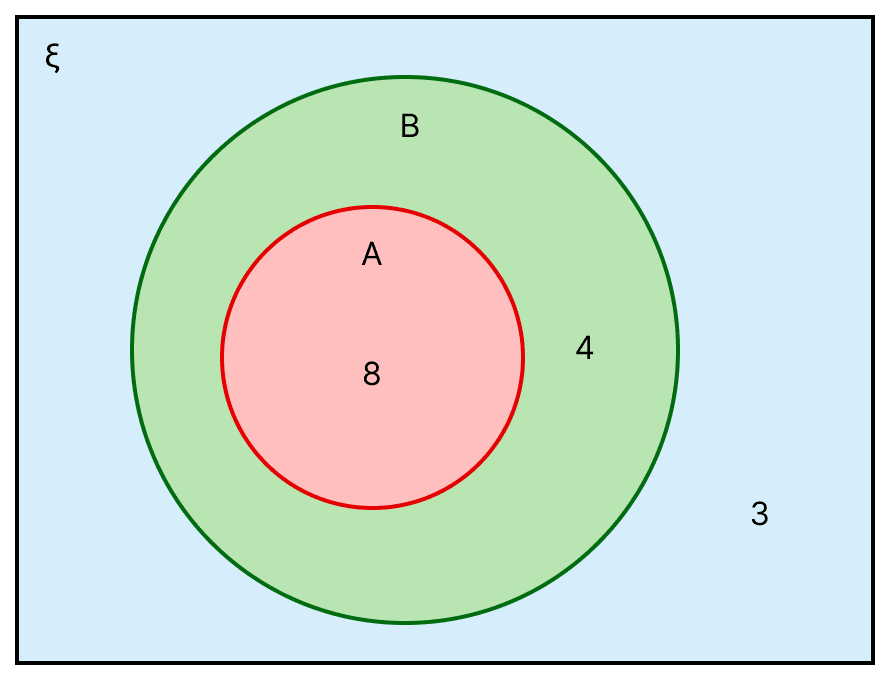
From the Venn diagram,
Number of elements in A = 8,
Number of elements in B but not in A = n(B) − n(A) = 12 − 8 = 4,
Number of elements outside B = n(ξ) − n(B) = 15 − 12 = 3.
(i) n(A')
We know that,
n(A') = n(ξ) − n(A) = 15 − 8 = 7
Hence, n(A') = 7.
(ii) n(B')
We know that,
n(B') = n(ξ) − n(B) = 15 − 12 = 3
Hence, n(B') = 3.
(iii) n(A ∩ B')
We know that,
A ∩ B' = A − B.
As A ⊂ B, every element of A is also an element of B, so there is no element which belongs to A but not to B.
∴ A ∩ B' = φ and so n(A ∩ B') = 0
Hence, n(A ∩ B') = 0.
(iv) n(A' ∩ B)
We know that,
A' ∩ B = B − A.
As A ⊂ B, we have
n(B − A) = n(B) − n(A) = 12 − 8 = 4
Hence, n(A' ∩ B) = 4.
If A and B are two sets such that n(A) = 10 and n(B) = 7, then find:
(i) the least value of n(A ∩ B)
(ii) the greatest value of n(A ∩ B)
(iii) the greatest value of n(A ∪ B)
(iv) the least value of n(A ∪ B).
Answer
Given,
n(A) = 10 and n(B) = 7
(i) The least value of n(A ∩ B):
The set A ∩ B has the smallest number of elements when A and B have no element in common, i.e. when they are disjoint. In that case A ∩ B = φ.
∴ The least value of n(A ∩ B) = 0
Hence, the least value of n(A ∩ B) is 0 and it occurs when A ∩ B = φ.
(ii) The greatest value of n(A ∩ B):
Since A ∩ B ⊂ B, we have
⇒ n(A ∩ B) ≤ n(B)
⇒ n(A ∩ B) ≤ 7
The value 7 is attained when every element of B is also an element of A, i.e. when B ⊂ A, for then A ∩ B = B.
∴ The greatest value of n(A ∩ B) = 7
Hence, the greatest value of n(A ∩ B) is 7 and it occurs when B ⊂ A.
(iii) The greatest value of n(A ∪ B):
We know that,
n(A ∪ B) = n(A) + n(B) − n(A ∩ B) = 10 + 7 − n(A ∩ B) = 17 − n(A ∩ B)
So n(A ∪ B) is greatest when n(A ∩ B) is least, and from part (i) the least value of n(A ∩ B) is 0.
∴ The greatest value of n(A ∪ B) = 17 − 0 = 17
Hence, the greatest value of n(A ∪ B) is 17 and it occurs when A ∩ B = φ.
(iv) The least value of n(A ∪ B):
From part (iii), n(A ∪ B) = 17 − n(A ∩ B).
So n(A ∪ B) is least when n(A ∩ B) is greatest, and from part (ii) the greatest value of n(A ∩ B) is 7.
∴ The least value of n(A ∪ B) = 17 − 7 = 10
Hence, the least value of n(A ∪ B) is 10 and it occurs when B ⊂ A.