
If A = {−1, 2, 5, 8}, B = {0, 1, 3, 6, 7} and R be the relation "is one less than" from A to B, then R as a set of ordered pairs is
{(−1, 0), (2, 3), (5, 6)}
{(−1, 0), (2, 1), (8, 7)}
{(0, 1), (2, 3), (6, 7)}
{(1, 2), (2, 3), (5, 6), (6, 7), (7, 8)}
Answer
Given,
A = {−1, 2, 5, 8} and B = {0, 1, 3, 6, 7}
R is the relation "is one less than" from A to B i.e. R = {(x, y) : x ∈ A, y ∈ B and y = x + 1}.
Taking each element of A in turn,
when x = −1, y = 0 ∈ B,
when x = 2, y = 3 ∈ B,
when x = 5, y = 6 ∈ B,
when x = 8, y = 9 ∉ B.
Thus, the corresponding ordered pairs are (−1, 0), (2, 3) and (5, 6).
∴ R = {(−1, 0), (2, 3), (5, 6)}
Hence, Option 1 is the correct option.
If R = {(x, y) : x, y ∈ W, 2x + y = 8}, then domain of R is
{0, 1, 2, 3, 4, 5}
{0, 1, 2, 3, 4, 5, 6}
{0, 1, 2, 3, 4}
{0, 1, 2, 3}
Answer
Given,
R = {(x, y) : x, y ∈ W, 2x + y = 8}
2x + y = 8 ⇒ y = 8 − 2x
Taking those whole numbers x for which y = 8 − 2x is also a whole number,
when x = 0, y = 8 ∈ W,
when x = 1, y = 6 ∈ W,
when x = 2, y = 4 ∈ W,
when x = 3, y = 2 ∈ W,
when x = 4, y = 0 ∈ W,
when x = 5, y = −2 ∉ W.
For all the values of x greater than 4, y = 8 − 2x is negative and so does not belong to W.
Thus, the corresponding ordered pairs are (0, 8), (1, 6), (2, 4), (3, 2) and (4, 0).
∴ R = {(0, 8), (1, 6), (2, 4), (3, 2), (4, 0)}
∴ Domain of R = {0, 1, 2, 3, 4}
Hence, Option 3 is the correct option.
If R = {(x, y) : x, y ∈ N, x + 2y = 21}, then range of R is
{1, 2, 3, ...... 7, 8}
{1, 2, 3, ...... 9, 10}
{1, 3, 5, 7 ...... 19}
{1, 3, 5, 7, ...... 15}
Answer
Given,
R = {(x, y) : x, y ∈ N, x + 2y = 21}
x + 2y = 21 ⇒ x = 21 − 2y
Taking those natural numbers y for which x = 21 − 2y is also a natural number,
when y = 1, x = 19 ∈ N,
when y = 2, x = 17 ∈ N,
......
when y = 10, x = 1 ∈ N,
when y = 11, x = −1 ∉ N.
For all the values of y greater than 10, x = 21 − 2y is negative and so does not belong to N.
So y takes the values 1, 2, 3, ......, 10 and the range of R is the set of these values of y.
∴ Range of R = {1, 2, 3, ......, 9, 10}
Hence, Option 2 is the correct option.
Let A = {1, 2, 3, 4, 5, 6} and R be the relation defined on A by R = {(x, y) : x, y ∈ A, x divides y}, then range of R is
{2, 3, 4, 5, 6}
{1, 2, 3, 4, 5}
{2, 4, 6}
{1, 2, 3, 4, 5, 6}
Answer
Given,
A = {1, 2, 3, 4, 5, 6} and R = {(x, y) : x, y ∈ A, x divides y}
The range of R is the set of all those elements y of A which are divisible by at least one element x of A.
Every element y of A is divisible by 1 ∈ A, so (1, y) ∈ R for every y ∈ A.
∴ Every element of A occurs as a second component.
∴ Range of R = {1, 2, 3, 4, 5, 6}
Hence, Option 4 is the correct option.
Let A = {3, 5} and B = {7, 11} and R be the relation from A to B defined as R = {(a, b) : a ∈ A, b ∈ B, a − b is odd}, then
R = A × B
R = φ
R ⊂ A × B
R ⊂ B × A
Answer
Given,
A = {3, 5} and B = {7, 11} and R = {(a, b) : a ∈ A, b ∈ B, a − b is odd}
All the elements of A and B are odd numbers, and the difference of two odd numbers is always even.
Checking each pair,
3 − 7 = −4, 3 − 11 = −8, 5 − 7 = −2, 5 − 11 = −6
and each of these is even, so no ordered pair satisfies the given condition.
∴ R = φ
Hence, Option 2 is the correct option.
Given R = {(x, y) : x, y ∈ Z, y = x − 3}, then which ordered pair belongs to R?
(1, 4)
(0, 3)
(5, 2)
(−4, 1)
Answer
Given,
R = {(x, y) : x, y ∈ Z, y = x − 3}
An ordered pair (x, y) belongs to R only when y = x − 3.
For (1, 4), x − 3 = 1 − 3 = −2 ≠ 4
For (0, 3), x − 3 = 0 − 3 = −3 ≠ 3
For (5, 2), x − 3 = 5 − 3 = 2, which is the second component.
For (−4, 1), x − 3 = −4 − 3 = −7 ≠ 1
∴ Only the ordered pair (5, 2) belongs to R.
Hence, Option 3 is the correct option.
If R = {(x, y) : x, y ∈ W, x2 + y2 = 169}, then domain of R is
{0, 5, 12, 13}
{−13, −12, −5, 0, 5, 12, 13}
{0, 1, 2, 3, ...... 13}
{0, ±1, ±2, ...... ±13}
Answer
Given,
R = {(x, y) : x, y ∈ W, x2 + y2 = 169}
As x and y are whole numbers, neither x2 nor y2 can exceed 169, so x can take the values 0, 1, 2, ....., 13 only.
Taking those values of x for which y2 = 169 − x2 is the square of a whole number,
when x = 0,
⇒ y2 = 169
⇒ y = 13 ∈ W
when x = 5,
⇒ y2 = 169 − 25 = 144
⇒ y = 12 ∈ W
when x = 12,
⇒ y2 = 169 − 144 = 25
⇒ y = 5 ∈ W
when x = 13,
⇒ y2 = 169 − 169 = 0
⇒ y = 0 ∈ W
For all the other values of x, 169 − x2 is not the square of a whole number.
Thus, the corresponding ordered pairs are (0, 13), (5, 12), (12, 5) and (13, 0).
∴ R = {(0, 13), (5, 12), (12, 5), (13, 0)}
∴ Domain of R = {0, 5, 12, 13}
Hence, Option 1 is the correct option.
If A = {a, b} and B = {x, y, z}, then the number of relations from B to A is
8
16
32
64
Answer
Given,
A = {a, b} and B = {x, y, z}
∴ n(A) = 2 and n(B) = 3
We know that,
Number of relations from B to A = 2n(B) × n(A)
∴ Number of relations from B to A = 23 × 2 = 26 = 64
Hence, Option 4 is the correct option.
Let n(A) = m and n(B) = n, then the number of non-empty relations from A to B is
mn
nm − 1
2mn − 1
2mn
Answer
Given,
n(A) = m and n(B) = n
∴ n(A × B) = n(A) × n(B) = mn
A relation from A to B is a subset of A × B, so the total number of relations from A to B is the number of subsets of A × B i.e. 2mn.
Out of these, exactly one relation, namely the empty relation φ, is not a non-empty relation.
∴ Number of non-empty relations from A to B = 2mn − 1
Hence, Option 3 is the correct option.
Let A be a finite set containing n elements, then the number of relations on A is
2n
2n2
n2
nn
Answer
Given,
A is a finite set containing n elements i.e. n(A) = n.
A relation on A is a relation from A to A, so it is a subset of A × A.
∴ n(A × A) = n(A) × n(A) = n × n = n2
∴ Number of relations on A = number of subsets of A × A = 2n2
Hence, Option 2 is the correct option.
If A = {2, 3, 4, 5, 6} and R is a relation on set A defined by R = {(x, y) : y = x + 2, x, y ∈ A}, then R is
{(2, 4), (3, 5), (4, 6)}
{(4, 2), (5, 3), (6, 4)}
{(2, 4), (5, 3), (4, 6)}
{(4, 2), (3, 5), (4, 6)}
Answer
Given,
A = {2, 3, 4, 5, 6} and R = {(x, y) : y = x + 2, x, y ∈ A}
Taking those elements x of A for which y = x + 2 also belongs to A,
when x = 2, y = 4 ∈ A,
when x = 3, y = 5 ∈ A,
when x = 4, y = 6 ∈ A,
when x = 5, y = 7 ∉ A,
when x = 6, y = 8 ∉ A.
Thus, the corresponding ordered pairs are (2, 4), (3, 5) and (4, 6).
∴ R = {(2, 4), (3, 5), (4, 6)}
Hence, Option 1 is the correct option.
Which of the following relations is a function?
R = {(4, 6), (3, 9), (−11, 6), (3, 11)}
R = {(1, 2), (2, 4), (2, 6), (3, 5)}
R = {(2, 1), (4, 3), (6, 5), (8, 7), (10, 9)}
R = {(0, 1), (1, 3), (2, 4), (3, 1), (3, 5)}
Answer
We know that,
A relation is a function if and only if no two different ordered pairs of the relation have the same first component.
In option 1, the pairs (3, 9) and (3, 11) have the same first component 3, so it is not a function.
In option 2, the pairs (2, 4) and (2, 6) have the same first component 2, so it is not a function.
In option 4, the pairs (3, 1) and (3, 5) have the same first component 3, so it is not a function.
In option 3, the first components 2, 4, 6, 8 and 10 are all different, so each element of the domain has a unique image.
Hence, Option 3 is the correct option.
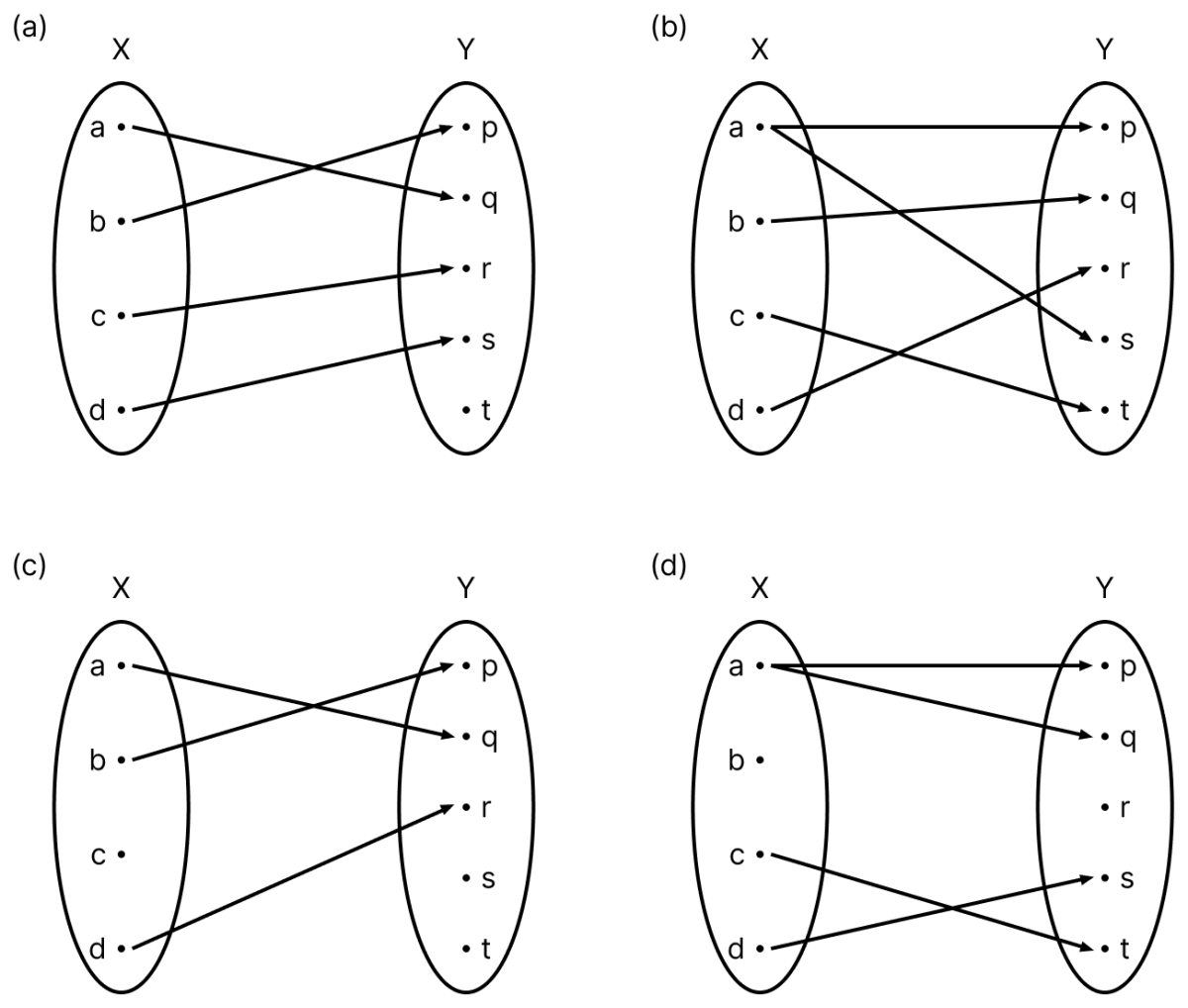
Which of the following arrow diagrams represents a function from X to Y?
Answer
We know that,
An arrow diagram represents a function from X to Y if and only if exactly one arrow starts from each element of X.
In the diagram of option 2, two arrows start from the element a of X, so the element a has two different images.
In the diagram of option 3, no arrow starts from the element c of X, so the element c has no image.
In the diagram of option 4, two arrows start from the element a of X and no arrow starts from the element b of X.
In the diagram of option 1, exactly one arrow starts from each of the elements a, b, c and d of X, so every element of X has one and only one image in Y.
Hence, Option 1 is the correct option.
Let A and B be two finite sets, then the number of functions from A to B is
n(A) · n(B)
2n(A) · n(B)
{n(A)}n(B)
{n(B)}n(A)
Answer
Let n(A) = p and n(B) = q.
Each element of A can be associated with any one of the q elements of B, so each element of A can be given an image in q ways.
As A has p elements and the choice for one element is independent of the choice for another,
Total number of functions from A to B = q × q × q ...... p times = qp
∴ Number of functions from A to B = {n(B)}n(A)
Hence, Option 4 is the correct option.
Let A be a finite set containing 3 elements, then the number of functions from A to A is
512
511
27
26
Answer
Given,
n(A) = 3
We know that,
Number of functions from a set A to a set B = {n(B)}n(A)
Here both the sets are A, so
Number of functions from A to A = {n(A)}n(A) = 33 = 27
Hence, Option 3 is the correct option.
The domain of the function defined by , (a > 0) is
Answer
Given,
, where .
For to be a real number,
⇒
⇒
⇒
∴
Hence, Option 2 is the correct option.
The domain of the function defined by is
Answer
Given,
For to be a real number,
⇒
⇒
⇒ or
∴
Hence, Option 3 is the correct option.
The domain of the function defined by is
Answer
Given,
is not defined when the denominator is zero.
⇒
⇒
⇒
⇒
⇒ or
∴
Hence, Option 3 is the correct option.
The domain of the function defined by is
Answer
Given,
For to be a real number, must be a real number and it must not be zero.
⇒
⇒
When , , so which is not greater than 0.
When , , so .
∴
Hence, Option 1 is the correct option.
The domain and range of the real function defined by are
Domain , Range
Domain , Range
Domain , Range
Domain , Range
Answer
Given,
is not defined when the denominator is zero.
⇒
⇒
⇒ or
∴
For , let
⇒ ,
⇒
For to be a real number,
⇒
⇒
⇒ or
∴
Hence, Option 2 is the correct option.
The domain and range of the real function defined by are
Domain , Range
Domain , Range
Domain , Range
Domain , Range
Answer
Given,
For to be a real number,
⇒
⇒
∴
For , let .
As ,
⇒
⇒
∴
Hence, Option 3 is the correct option.
The domain and range of the real function defined by are
Domain , Range
Domain , Range
Domain , Range
Domain , Range
Answer
Given,
is not defined when the denominator is zero.
⇒
⇒
∴
For every ,
So takes only the value .
∴
Hence, Option 1 is the correct option.
The domain and range of the real function defined by are
Domain , Range
Domain , Range
Domain , Range
Domain , Range
Answer
Given,
is not defined when the denominator is zero i.e. when i.e. when .
∴
When ,
⇒
When ,
⇒
So takes only the values 1 and .
∴
Hence, Option 3 is the correct option.
The domain and range of the function f given by f(x) = 2 − | x − 5 | are
Domain = R+, Range = (−∞, 1]
Domain = R, Range = (−∞, 2]
Domain = R+, Range = (−∞, 2]
Domain = R, Range = (−∞, 2)
Answer
Given,
f(x) = 2 − | x − 5 |
| x − 5 | is defined for every real value of x, so 2 − | x − 5 | is a real number for every real value of x.
∴ Domain of f = R
Let y = f(x), then
y = 2 − | x − 5 |
We know that | x − 5 | ≥ 0.
⇒ −| x − 5 | ≤ 0
⇒ 2 − | x − 5 | ≤ 2
⇒ y ≤ 2
∴ Range of f = (−∞, 2]
Hence, Option 2 is the correct option.
The domain of the function defined by is
Answer
Given,
For to be a real number,
⇒
⇒ ...........(1)
For to be a real number, must be a real number and it must not be zero.
⇒
⇒ or ...........(2)
The values of satisfying both the equations (1) and (2) are given by .
∴
Hence, Option 3 is the correct option.
The domain of the function defined by is
Answer
Given,
We know that, is a real number only when k > 0.
⇒
⇒
⇒
∴
Hence, Option 1 is the correct option.
The domain of the function is
Answer
Given,
For to be defined, the denominator must not be zero.
⇒
⇒ ...........(1)
For to be a real number,
⇒
⇒
⇒ or ...........(2)
From equation (2), and from equation (1), the values and 2 must be excluded from it.
∴
Hence, Option 2 is the correct option.
If [x]2 − 3[x] + 2 = 0, where [·] denotes the greatest integer function, then
x ∈ [2, 3]
x ∈ (1, 2]
x ∈ [1, 2]
x ∈ [1, 3)
Answer
Given,
[x]2 − 3[x] + 2 = 0
⇒ [x]2 − 2[x] − [x] + 2 = 0
⇒ [x]([x] − 2) − 1([x] − 2) = 0
⇒ ([x] − 2)([x] − 1) = 0
⇒ [x] = 2 or [x] = 1
We know that, [x] = n ⇔ n ≤ x < n + 1.
When [x] = 1, 1 ≤ x < 2 i.e. x ∈ [1, 2)
When [x] = 2, 2 ≤ x < 3 i.e. x ∈ [2, 3)
∴ x ∈ [1, 2) ∪ [2, 3) = [1, 3)
Hence, Option 4 is the correct option.
If f(x) = px + q, where p and q are integers f(−1) = 1 and f(2) = 13, then p and q are
p = 4, q = 5
p = −4, q = 5
p = −4, q = −5
p = 4, q = −5
Answer
Given,
f(x) = px + q
As f(−1) = 1,
⇒ p(−1) + q = 1
⇒ −p + q = 1 ...........(1)
As f(2) = 13,
⇒ p(2) + q = 13
⇒ 2p + q = 13 ...........(2)
Subtracting equation (1) from equation (2), we get :
⇒ 2p + q − (−p + q) = 13 − 1
⇒ 3p = 12
⇒ p = 4
Substituting p = 4 in equation (1), we get :
⇒ −4 + q = 1
⇒ q = 5
Hence, Option 1 is the correct option.
Let , then
None of these
Answer
Given,
Replacing by ,
Also,
⇒
⇒
We know that and , so .
⇒
⇒
⇒
Hence, Option 3 is the correct option.
The domain for which the functions defined by and are equal is
Answer
Given,
and
As the functions and are equal, .
⇒
⇒
⇒
⇒
⇒
⇒
⇒ or
∴ The required domain is
Hence, Option 3 is the correct option.
If , then is equal to
Answer
Given,
...........(1)
Replacing by in equation (1),
...........(2)
Multiplying equation (2) by 3,
⇒ ...........(3)
Adding equations (1) and (3), we get :
⇒
⇒
⇒
Substituting ,
⇒
⇒
⇒
Hence, Option 2 is the correct option.
Statement I: Domain of function f(x) = | x − 2 | + 1 is R − {2}
Statement II: Range of above function is [1, ∞)
Choose the correct answer from the following options:
Both Statements are true.
Both Statements are false.
Statement I is true, but Statement II is false.
Statement I is false, but Statement II is true.
Answer
Given,
f(x) = | x − 2 | + 1
| x − 2 | is defined for every real value of x, so | x − 2 | + 1 is a real number for every real value of x and no value of x has to be excluded.
∴ Domain of f = R
∴ Statement I is false.
Let y = f(x), then
y = | x − 2 | + 1
We know that | x − 2 | ≥ 0.
⇒ | x − 2 | + 1 ≥ 0 + 1
⇒ y ≥ 1
∴ Range of f = [1, ∞)
∴ Statement II is true.
Hence, Option 4 is the correct option.