
Which of the following collection of objects is not a set?
The collection of all even integers.
The collection of all months of a year beginning with letter J.
The collection of most talented writers of India.
The collection of all prime numbers less than 20.
Answer
Any well-defined collection of objects is called a set.
Given any integer, we can decide beyond doubt whether it is even or not, so option 1 is a set.
The months of a year beginning with the letter J are January, June and July, which are fixed beyond doubt, so option 2 is a set.
Given any number, we can decide beyond doubt whether it is prime and less than 20, so option 4 is a set.
But a writer considered most talented by one person may not be considered most talented by another, so the collection of most talented writers of India is not a well-defined collection of objects.
Hence, Option 3 is the correct option.
If A = {1, 2, 3, 4, 5}, then which of the following is not true ?
0 ∉ A
3 ∈ A
{3} ∈ A
{3} ⊂ A
Answer
Given,
A = {1, 2, 3, 4, 5}
The element 0 does not belong to A, while 3 belongs to A.
∴ The statements 0 ∉ A and 3 ∈ A are true.
{3} represents a set whose only member 3 belongs to A, so {3} is a subset of {1, 2, 3, 4, 5}.
∴ The statement {3} ⊂ A is true.
The elements of A are the numbers 1, 2, 3, 4, 5 and not the set {3}, so set {3} is not an element of A.
∴ The statement {3} ∈ A is not true.
Hence, Option 3 is the correct option.
Which of the following is a null set?
{x : x ∈ N, 2x − 1 = 3}
{x : x ∈ N, x2 < 20}
{x : x is an even prime greater than 2}
{x : x ∈ I, 3x + 7 = 1}
Answer
A set which does not contain any element is called the null set.
For option 1,
2x − 1 = 3
⇒ 2x = 3 + 1
⇒ 2x = 4
⇒ x = 2 ∈ N
So the set is {2}, which is not a null set.
For option 2, the squares 1, 4, 9, 16 of 1, 2, 3, 4 are less than 20, so the set is {1, 2, 3, 4}, which is not a null set.
For option 4,
3x + 7 = 1
⇒ 3x = 1 − 7
⇒ 3x = −6
⇒ x = −2 ∈ I
So the set is {−2}, which is not a null set.
For option 3, 2 is the only even prime number and every even number greater than 2 is divisible by 2, so it cannot be prime. Therefore this set contains no element.
Hence, Option 3 is the correct option.
Which of the following is a finite set?
{x : x = 2n, n ∈ N}
{x : x is a prime number}
{x : x ∈ N, x is a factor of 128}
{x : x ∈ I, x ≤ 7}
Answer
A set that contains a limited (definite) number of different elements is called a finite set.
For option 1, the set is {2, 4, 6, 8, .....}, which never comes to an end, so it is an infinite set.
For option 2, the prime numbers are 2, 3, 5, 7, 11, ....., which are infinite in number, so it is an infinite set.
For option 4, the set is {....., 4, 5, 6, 7} and the integers go on decreasing without end, so it is an infinite set.
For option 3, since 128 = 27, the factors of 128 are 1, 2, 4, 8, 16, 32, 64 and 128, which are 8 in number, a definite number.
Hence, Option 3 is the correct option.
Given sets A = {1, 3, 5, 7, 9}, B = {0, 2, 4, 6} and C = {7, 8, 9}. Which of the following may be taken as universal set for all the three sets A, B and C?
{0, 1, 2, 3, 4, 5, 6, 7, 8}
{1, 2, 3, 4, 5, 6, 7, 8, 9}
{1, 2, 3, 4, 5, 6, 7, 8, 9, 10}
{0, 1, 2, 3, 4, 5, 6, 7, 8, 9, 10}
Answer
A set that contains all the elements under consideration in a given problem is called the universal set. So every one of the sets A, B and C must be a subset of it.
In option 1, the element 9 ∈ A but 9 does not belong to it, so A is not its subset.
In option 2, the element 0 ∈ B but 0 does not belong to it, so B is not its subset.
In option 3, the element 0 ∈ B but 0 does not belong to it, so B is not its subset.
In option 4, the set is {0, 1, 2, 3, 4, 5, 6, 7, 8, 9, 10}. Every element of A, every element of B and every element of C belongs to it, so A ⊂ it, B ⊂ it and C ⊂ it.
Hence, Option 4 is the correct option.
Number of proper subsets of a set containing 4 elements is
42
42 − 1
24
24 − 1
Answer
If A is a set with n(A) = m, then the number of subsets of A is 2m.
The set A itself is a subset of A but it is not a proper subset of A, so it has to be left out.
∴ Number of proper subsets of A = 2m − 1
Here the set contains 4 elements, so m = 4.
∴ Number of proper subsets = 24 − 1 = 16 − 1 = 15
Hence, Option 4 is the correct option.
Which of the following is not correct?
N ⊂ R
N ⊂ Q
Q ⊂ R
N ⊂ T
Answer
We know that N ⊂ W ⊂ I ⊂ Q ⊂ R, so N ⊂ R, N ⊂ Q and Q ⊂ R are all correct.
Here T denotes the set of irrational numbers i.e. T = {x : x ∈ R and x ∉ Q}.
Every natural number n can be written as , so every natural number is a rational number and hence no natural number is irrational.
∴ N ⊄ T
Hence, Option 4 is the correct option.
On real axis if A = [1, 5] and B = [3, 9], then A − B is
(5, 9)
(1, 3)
[5, 9)
[1, 3)
Answer
Given,
A = [1, 5] = {x : x ∈ R, 1 ≤ x ≤ 5}
and B = [3, 9] = {x : x ∈ R, 3 ≤ x ≤ 9}
A − B is the set of all real numbers which belong to A but do not belong to B.
The part of A which also lies in B is 3 ≤ x ≤ 5. Removing this part from [1, 5], we are left with 1 ≤ x < 3, where 1 is included and 3 is excluded because 3 ∈ B.
∴ A − B = [1, 3)
Hence, Option 4 is the correct option.
If n(A − B) = 10, n(B − A) = 23, n(A ∪ B) = 50, then n(A ∩ B) is
7
17
27
33
Answer
Given,
n(A − B) = 10, n(B − A) = 23 and n(A ∪ B) = 50
The sets A − B, A ∩ B and B − A are mutually disjoint and together they make up A ∪ B.
∴ n(A ∪ B) = n(A − B) + n(B − A) + n(A ∩ B)
⇒ 50 = 10 + 23 + n(A ∩ B)
⇒ 50 = 33 + n(A ∩ B)
⇒ n(A ∩ B) = 50 − 33 = 17
Hence, Option 2 is the correct option.
Two finite sets A and B are such that A ⊂ B, then which of the following is not correct?
A ∪ B = B
A ∩ B = A
A − B = φ
B − A = φ
Answer
Given,
A ⊂ B, so every element of A is also an element of B.
As A contributes no new element to the union, A ∪ B = B, so option 1 is correct.
As all the elements of A are common to A and B, A ∩ B = A, so option 2 is correct.
As there is no element of A which does not belong to B, A − B = φ, so option 3 is correct.
But B may contain elements which do not belong to A, so B − A need not be φ.
For example, taking A = {1, 2} and B = {1, 2, 3}, we have A ⊂ B and B − A = {3} ≠ φ.
Hence, Option 4 is the correct option.
Two finite sets have m and n elements respectively. The total number of subsets of the first set is 192 more than the total number of subsets of the second set. The values of m and n respectively are
7, 6
8, 6
8, 5
9, 7
Answer
Let the two sets be A and B, then n(A) = m and n(B) = n, where m > n.
Number of subsets of A = 2m and number of subsets of B = 2n
Given,
The total number of subsets of the first set is 192 more than the total number of subsets of the second set.
⇒ 2m − 2n = 192
⇒ 2n(2m − n − 1) = 192
⇒ 2n(2m − n − 1) = 64 × 3 = 26 × 3
As 2m − n − 1 is an odd number and 2n is a power of 2, comparing both sides we get
2n = 26 and 2m − n − 1 = 3
⇒ n = 6 and 2m − n = 4 = 22
⇒ n = 6 and m − n = 2
⇒ n = 6 and m = 2 + 6 = 8
Hence, Option 2 is the correct option.
For any two sets A and B, A ∩ (A ∪ B) is equal to
A
B
φ
A ∩ B
Answer
By the absorption law,
A ∩ (A ∪ B) = (A ∪ φ) ∩ (A ∪ B) (∵ A ∪ φ = A)
= A ∪ (φ ∩ B) (Distributive law)
= A ∪ φ (∵ φ ∩ B = φ)
= A (∵ A ∪ φ = A)
Hence, Option 1 is the correct option.
The symmetric difference of A = {0, 1, 2} and B = {2, 3, 4} is
{0, 1}
{3, 4}
{0, 1, 3, 4}
{0, 1, 2, 3, 4}
Answer
Given,
A = {0, 1, 2} and B = {2, 3, 4}
We know that,
A Δ B = (A − B) ∪ (B − A)
The elements of A which do not belong to B are 0 and 1.
∴ A − B = {0, 1}
The elements of B which do not belong to A are 3 and 4.
∴ B − A = {3, 4}
∴ A Δ B = {0, 1} ∪ {3, 4} = {0, 1, 3, 4}
Hence, Option 3 is the correct option.
The symmetric difference of sets A and B is equal to
(A − B) ∪ A
(B − A) ∪ B
(A ∪ B) − (A ∩ B)
(A ∪ B) ∩ (A ∩ B)
Answer
By definition, the symmetric difference of two sets A and B is the set consisting of all elements which belong to A or B but do not belong to A ∩ B.
∴ A Δ B = {x : x ∈ A or x ∈ B but x ∉ A ∩ B}
= (A ∪ B) − (A ∩ B)
Option 1 is not correct, because (A − B) ∪ A = A by the absorption law, since A − B ⊂ A.
Option 2 is not correct, because (B − A) ∪ B = B by the absorption law, since B − A ⊂ B.
Option 4 is not correct, because A ∩ B ⊂ A ∪ B and so (A ∪ B) ∩ (A ∩ B) = A ∩ B.
Hence, Option 3 is the correct option.
The symmetric difference of sets A and B is not equal to
(A − B) ∩ (B − A)
(A − B) ∪ (B − A)
(A ∪ B) − (A ∩ B)
((A ∪ B) − B) ∪ ((A ∪ B) − A)
Answer
We know that,
A Δ B = (A ∪ B) − (A ∩ B) = (A − B) ∪ (B − A)
So options 2 and 3 are both equal to A Δ B.
For option 4, we have
(A ∪ B) − B = (A ∪ B) ∩ B' = (A ∩ B') ∪ (B ∩ B') = (A ∩ B') ∪ φ = A ∩ B' = A − B
and similarly (A ∪ B) − A = B − A.
∴ ((A ∪ B) − B) ∪ ((A ∪ B) − A) = (A − B) ∪ (B − A) = A Δ B, so option 4 is also equal to A Δ B.
For option 1, we know that the sets A − B and B − A are disjoint, since A − B contains only elements which do not belong to B while every element of B − A belongs to B.
∴ (A − B) ∩ (B − A) = φ, which is not equal to A Δ B in general.
Hence, Option 1 is the correct option.
For any two sets X and Y, X ∩ (X ∪ Y)' is equal to
X
Y
φ
X ∩ Y
Answer
X ∩ (X ∪ Y)' = X ∩ (X' ∩ Y') (De Morgan law)
= (X ∩ X') ∩ Y' (Associative law)
= φ ∩ Y' (∵ X ∩ X' = φ)
= φ (∵ φ ∩ Z = φ)
Hence, Option 3 is the correct option.
For any two sets A and B, ((A' ∪ B') − A)' is equal to
A
B
φ
A ∩ B
Answer
First we simplify (A' ∪ B') − A.
(A' ∪ B') − A = (A' ∪ B') ∩ A' (∵ X − Y = X ∩ Y')
= (A' ∩ A') ∪ (B' ∩ A') (Distributive law)
= A' ∪ (A' ∩ B') (∵ A' ∩ A' = A', Idempotent law)
= A' (Absorption law)
∴ ((A' ∪ B') − A)' = (A')' = A (Involution law)
Hence, Option 1 is the correct option.
For any two sets A and B, [B' ∪ (B' − A)]' is equal to
A
B
φ
A ∪ B
Answer
First we simplify (B' − A),
B' − A = B' ∩ A' (∵ X − Y = X ∩ Y')
∴ B' ∪ (B' − A) = B' ∪ (B' ∩ A') = B' (Absorption law)
∴ [B' ∪ (B' − A)]' = (B')' = B (Involution law)
Hence, Option 2 is the correct option.
For any three sets A, B and C, (A − B) ∩ (C − B) is equal to
A − (B ∩ C)
(A − C) ∩ B
(A ∩ C) − B
(A − B) ∩ C
Answer
Solving,
(A − B) ∩ (C − B) = (A ∩ B') ∩ (C ∩ B') (∵ X − Y = X ∩ Y')
= (A ∩ C) ∩ (B' ∩ B') (Commutative and Associative laws)
= (A ∩ C) ∩ B' (∵ B' ∩ B' = B', Idempotent law)
= (A ∩ C) − B (∵ X ∩ Y' = X − Y)
Hence, Option 3 is the correct option.
Let A and B are two disjoint sets and ξ be the universal set, then A' ∪ ((A ∪ B) ∩ B') is equal to
φ
ξ
A
B
Answer
Given,
A and B are disjoint sets, so A ∩ B = φ.
First we simplify (A ∪ B) ∩ B'.
(A ∪ B) ∩ B' = (A ∩ B') ∪ (B ∩ B') (Distributive law)
= (A ∩ B') ∪ φ (∵ B ∩ B' = φ)
= A ∩ B' (∵ X ∪ φ = X)
= A − B (∵ X ∩ Y' = X − Y)
As A ∩ B = φ, no element of A belongs to B, so on removing the elements of B from A nothing is removed.
∴ A − B = A
∴ A' ∪ ((A ∪ B) ∩ B') = A' ∪ A = ξ (∵ A ∪ A' = ξ)
Hence, Option 2 is the correct option.
Let S = set of points inside the square, T = set of points inside the triangle and C = the set of points inside the circle. If the triangle and circle intersect each other and are contained in a square. Then
S ∩ T ∩ C = φ
S ∪ T ∪ C = C
S ∪ T ∪ C = S
S ∪ T = S ∩ C
Answer
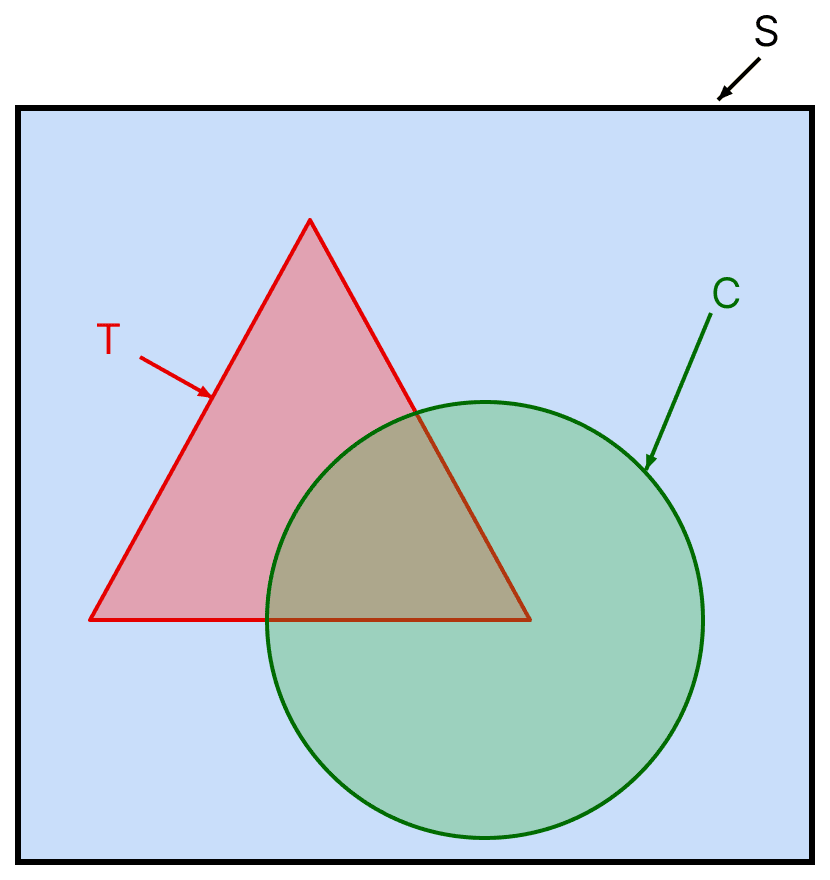
The triangle and the circle are contained in the square, so every point inside the triangle and every point inside the circle is also a point inside the square.
∴ T ⊂ S and C ⊂ S
As T and C contribute no new point to the union,
S ∪ T ∪ C = S
Option 1 is not correct, because the triangle and the circle intersect each other and their common region lies inside the square, so S ∩ T ∩ C ≠ φ.
Option 2 is not correct, because S ⊄ C.
Option 4 is not correct, because S ∪ T = S while S ∩ C = C, and S ≠ C.
Hence, Option 3 is the correct option.
If A = {(x, y) : y = , 0 ≠ x ∈ R}, B = {(x, y) : y = − x, x ∈ R}, then
A ∩ B = A
A ∩ B = B
A ∩ B = φ
A ∪ B = A
Answer
A ∩ B is the set of all those ordered pairs (x, y) which satisfy both the equations, so we solve them simultaneously.
and
⇒ = 1
⇒ = −1
The square of a real number can never be negative, so there is no real value of x satisfying this equation.
∴ There is no ordered pair common to A and B.
∴ A ∩ B = φ
Hence, Option 3 is the correct option.
If n(ξ) = 50, n(A) = 38, n(B) = 30, then the least value of n(A ∩ B) is
30
38
50
18
Answer
Given,
n(ξ) = 50, n(A) = 38 and n(B) = 30
It is understood that every set under consideration is a subset of ξ.
∴ A ∪ B ⊂ ξ
⇒ n(A ∪ B) ≤ n(ξ)
⇒ n(A ∪ B) ≤ 50
We know that,
n(A ∪ B) = n(A) + n(B) − n(A ∩ B)
⇒ n(A) + n(B) − n(A ∩ B) ≤ 50
⇒ 38 + 30 − n(A ∩ B) ≤ 50
⇒ 68 − 50 ≤ n(A ∩ B)
⇒ n(A ∩ B) ≥ 18
Hence, Option 4 is the correct option.
Let ξ = {1, 2, 3, ..., 40}, A = {x : x is divisible by 2 and 3} and B = {x : x = n2, n ∈ N}, then n(A) − n(B) is
0
1
2
3
Answer
Given,
ξ = {1, 2, 3, ....., 40}
It is understood that A and B are subsets of ξ, so their members are to be taken only from ξ.
A number divisible by both 2 and 3 must be divisible by their L.C.M., which is 6.
The multiples of 6 lying in ξ are 6, 12, 18, 24, 30 and 36.
∴ A = {6, 12, 18, 24, 30, 36} and so n(A) = 6
For the set B, x = n2 where n ∈ N. The squares lying in ξ are 1, 4, 9, 16, 25 and 36, since 72 = 49 > 40.
∴ B = {1, 4, 9, 16, 25, 36} and so n(B) = 6
∴ n(A) − n(B) = 6 − 6 = 0
Hence, Option 1 is the correct option.
Let A = {3, 6, 9} and B = {2, 4, 6, 8}. Now consider the following two statements:
Statement I. A ∩ B = {6}
Statement II. A − B = {3, 9, 2, 4, 8}
Choose the correct answer from the following options:
Both Statements are true.
Both Statements are false.
Statement I is true, but Statement II is false.
Statement I is false, but Statement II is true.
Answer
Given,
A = {3, 6, 9} and B = {2, 4, 6, 8}
Statement I: A ∩ B is the set of all the elements which belong to both A and B. The only element common to A and B is 6.
∴ A ∩ B = {6}
∴ Statement I is true.
Statement II: A − B is the set of all the elements which belong to A but do not belong to B. Removing 6 from A, the remaining elements are 3 and 9.
∴ A − B = {3, 9}
But the given Statement II says A − B = {3, 9, 2, 4, 8}, which is actually A Δ B and not A − B.
∴ Statement II is false.
Hence, Option 3 is the correct option.