
What is a Gaussian surface? A point charge of 2.0 μC is at the centre of a cubic Gaussian surface of side 1 m. What is the net electric flux through the surface?
Answer
Gaussian surface : A Gaussian surface is any closed surface, not passing through any point-charge, through which the flux of the electric field is calculated. It may be of any shape and may or may not enclose any charge.
Given,
- Point-charge at the centre of the cube, q = 2.0 μC = 2.0 × 10⁻⁶ C
- Side of the cubic Gaussian surface = 1 m
- ε0 = 8.85 × 10⁻¹² C2/N-m2
By Gauss' theorem, the electric flux through the closed surface of the cube is times the charge enclosed by it,
Substituting the values,
Hence the net electric flux through the surface is 2.26 × 10⁵ N-m2/C.
State Gauss's theorem. Draw a graph showing the variation of electric field, as one moves from the centre of a charged metal ball to a point on its surface and then to a far off outside point.
Answer
Gauss' theorem : The electric flux ΦE through any closed surface is equal to times the 'net' charge q enclosed by the surface,
Variation of electric field with distance :
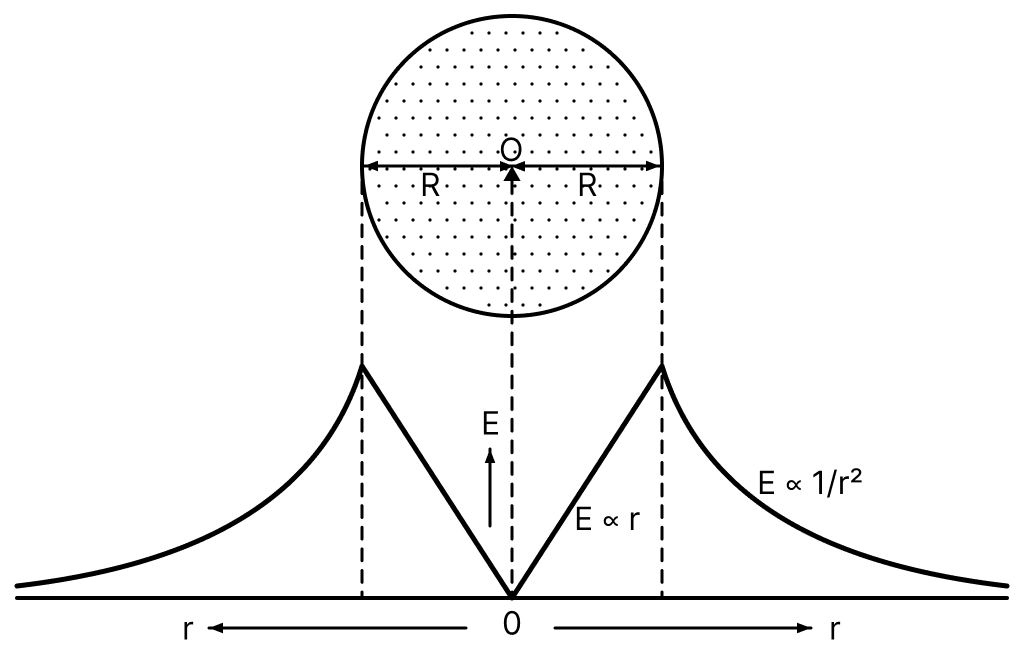
In a charged metal ball the entire charge resides on its surface, so the ball behaves just like a charged thin spherical shell.
(i) From the centre up to the surface (r < R) : A Gaussian surface drawn inside the ball encloses no charge, so by Gauss' theorem E = 0 at every interior point.
(ii) At the surface (r = R) : The field rises abruptly to its maximum value,
(iii) At a far-off outside point (r > R) : The ball behaves as if its whole charge were concentrated at its centre,
Hence the graph is zero from the centre up to the surface, is maximum at the surface and then decreases rapidly as outside the ball.
A Gaussian surface is chosen to obtain an expression for the electric field at a point due to a given charge configuration. It is a closed surface. State one essential property of such a chosen Gaussian surface.
Answer
The Gaussian surface should pass through the point at which the electric field is required.
Explanation:
Unless the chosen closed surface passes through that point, the electric field obtained from Gauss' theorem would not be the field at the required location.
The unit of electrostatic field E is volt/metre. Obtain the unit of electric flux.
Answer
By definition, the electric flux through a plane surface held in a uniform electric field is
So the unit of electric flux is the unit of E multiplied by the unit of area.
The unit of the electrostatic field E is volt/metre and the unit of area is metre2. Therefore
Hence the unit of electric flux is volt-metre (V-m).
An infinite line charge produces an electric field of 9.0 × 10⁴ N C-1 at a distance of 2.0 cm. What is the linear charge density?
Answer
Given,
- Electric field due to the infinite line charge, E = 9.0 × 10⁴ N C-1
- Distance from the line charge, r = 2.0 cm = 2.0 × 10⁻² m
- = 9.0 × 10⁹ N-m2/C2
The electric intensity due to an infinitely long line charge having linear charge density λ, at a point distant r from it, is
Substituting the values,
Hence the linear charge density is 0.1 μC/m.
Two point charges (+ e) and (− e) are kept inside a large metallic cube without touching its sides. Electric flux emerging out of the cube is :
- zero
Answer
zero
Reason — The two point-charges kept inside the metallic cube are + e and − e. The net charge enclosed by the cube is therefore
By Gauss' theorem, the electric flux through a closed surface is times the net charge enclosed by it,
Hence the electric flux emerging out of the cube is zero.
A large hollow metallic sphere has a positive charge of 35.4 μC at its centre. Find how much electric flux enumerates from the sphere.
Answer
Given,
- Positive charge at the centre of the hollow metallic sphere, q = 35.4 μC = 35.4 × 10⁻⁶ C
- ε0 = 8.85 × 10⁻¹² C2/N-m2
By Gauss' theorem, the electric flux emanating from the closed spherical surface is times the charge enclosed by it,
Substituting the values,
Hence the electric flux emanating from the sphere is 4 × 10⁶ Nm2/C.
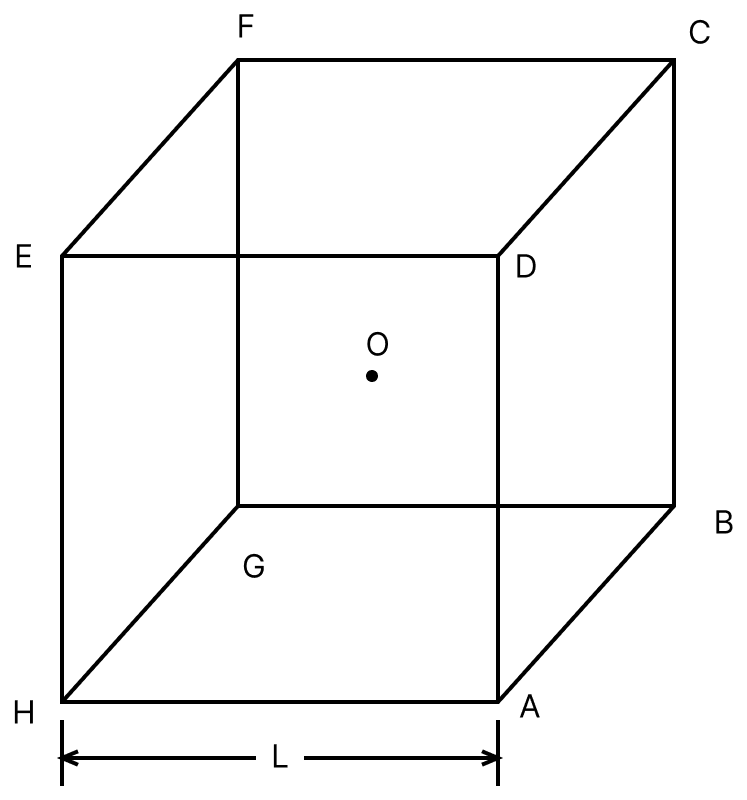
A short electric dipole (which consists of two point charges, + q and − q) is place at the centre O and inside a large cube (ABCDEFGH) of length L, as shown in figure. The electric flux, emanating through the cube is :
- zero
Answer
zero
Reason —
A short electric dipole consists of two point-charges, + q and − q, of equal magnitude and opposite sign. Both these charges lie inside the cube, since the dipole is placed at the centre O.
The net charge enclosed by the cube is therefore
By Gauss' theorem,
Hence the electric flux emanating through the cube is zero, whatever the length L of the cube.
State Gauss' theorem of electrostatic.
Answer
Gauss' theorem of electrostatics : The electric flux ΦE through any closed surface is equal to times the 'net' charge q enclosed by the surface.
Mathematically,
where ε0 is the permittivity of free space.
A closed surface in vacuum encloses charge − q and + 3q. The total electric flux emerging out of the surface is :
- zero
Answer
Reason — The charges enclosed by the closed surface are − q and + 3q. The net charge enclosed is the algebraic sum of all the charges within the surface,
By Gauss' theorem,
Choose the correct alternative of the question given below:
The intensity of electric field at a point which is at a perpendicular distance 'r' from an infinite line charge having linear charge density 'λ' is given by :
Answer
Reason — A coaxial cylindrical Gaussian surface of radius r and length l is drawn through the given point. The flux through the plane ends is zero, while over the curved surface E is constant in magnitude and directed radially outwards, so
The charge enclosed by this Gaussian surface is q = λl. Applying Gauss' theorem,
Writing ,
Thus the intensity varies inversely as the first power of the distance r, and not as r2.
Electric flux emanating from a sphere of radius 2 m is Φ. If radius of the sphere be made four times, without changing the charge enclosed, electric flux becomes :
- 2Φ
- remains Φ
Answer
remains Φ
Reason — By Gauss' theorem, the electric flux through a closed surface is
The electric flux passing through a closed surface depends only upon the net charge enclosed by the surface. Gauss' theorem is valid for a closed surface no matter what its shape or size, so the flux does not depend upon the radius of the sphere.
Here the charge enclosed is unchanged, so on making the radius four times, the electric flux still remains Φ.
The surface charge density of a large conducting sheet is 17.7 × 10⁻⁶ Cm-2. The electric field intensity at a point just outside the sheet is :
- 1 × 10⁴ NC-1
- 5 × 10⁴ NC-1
- 1 × 10⁵ NC-1
- 1 × 10⁶ NC-1
Answer
2 × 10⁶ NC-1 (not among the given options)
Reason —
Given,
- Surface charge density of the large conducting sheet, σ = 17.7 × 10⁻⁶ Cm-2
- ε0 = 8.85 × 10⁻¹² C2/N-m2
The electric field intensity just outside a charged conductor, at a place where its surface charge density is σ, is
The same result holds for a large conducting sheet of finite thickness. Substituting the values,
Note: The printed key gives option 4, 1 × 10⁶ NC-1, which is the value of for a thin sheet of charge; for a conducting sheet the chapter gives , so none of the options is correct.
A hollow sphere of radius R has a point charge Q at its centre. Electric flux emanating from it is Φ. If both the charge and the radius of the sphere be doubled, electric flux emanating from the sphere will :
- remain the same
- become 2Φ
- become 4Φ
- become 8Φ
Answer
become 2Φ
Reason — By Gauss' theorem, the electric flux emanating from the closed spherical surface is
The flux depends only upon the net charge enclosed and not upon the shape or the size of the surface. Hence doubling the radius of the sphere produces no change in the flux.
When the charge is doubled, that is Q′ = 2Q, the new flux is
Hence the electric flux emanating from the sphere becomes 2Φ.
Intensity of electric field at a point P which is at a perpendicular distance of 5 cm from an infinite line charge is 2.7 × 10⁴ Vm-1. Calculate linear charge density (λ) on the line charge.
Answer
Given,
- Intensity of electric field at the point P, E = 2.7 × 10⁴ Vm-1
- Perpendicular distance from the infinite line charge, r = 5 cm = 5 × 10⁻² m
- = 9.0 × 10⁹ N-m2/C2
The electric intensity due to an infinitely long line charge having linear charge density λ, at a point distant r from it, is
Substituting the values,
Hence the linear charge density on the line charge is 7.5 × 10⁻⁸ C/m.
(i) A hollow sphere of radius R has a point charge q at its centre. Electric flux emanating from the sphere is X. How will the electric flux change, if at all, when
(a) radius of the sphere is doubled?
(b) charge q is replaced by an electric dipole?
OR
(ii) In case of an infinite line charge, how does intensity of electric field at a point change, if at all, when
(a) charge on it is doubled?
(b) distance of the point is halved?
Answer
(i) The electric flux emanating from the sphere is, by Gauss' theorem,
(a) When the radius of the sphere is doubled : There is no change in the electric flux.
The electric flux passing through a closed surface depends only upon the net charge enclosed by the surface. Gauss' theorem is valid for a closed surface no matter what its shape or size, so the flux remains X.
(b) When the charge q is replaced by an electric dipole : The electric flux becomes zero.
An electric dipole consists of two equal and opposite charges, so the net charge enclosed by the sphere is zero, and hence
OR
(ii) The intensity of electric field at a point distant r from an infinite line charge of linear charge density λ is
(a) When the charge on it is doubled : The intensity of electric field is doubled.
Since , replacing λ by 2λ gives
(b) When the distance of the point is halved : The intensity of electric field is doubled.
Since , replacing r by gives
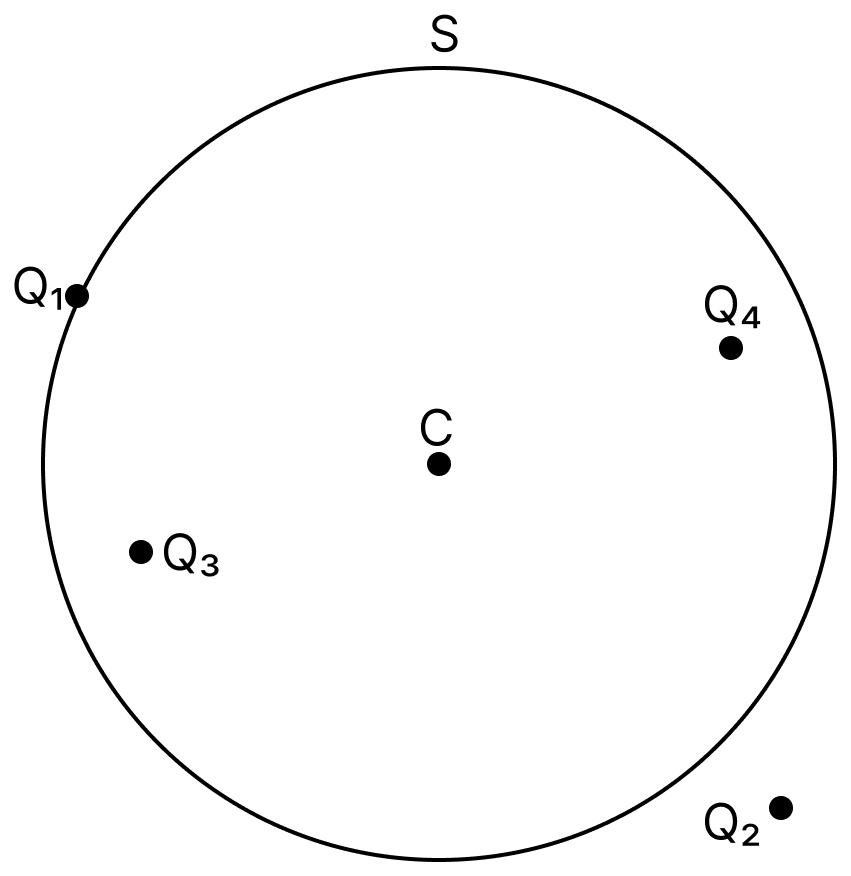
Figure shows four point charges Q1 = 100 μC, Q2 = − 200 μC, Q3 = 17.7 μC and Q4 = − 8.85 μC. Calculate the electric flux emanating from the hollow sphere S.
Answer
Given,
- Q1 = 100 μC, Q2 = − 200 μC, Q3 = 17.7 μC, Q4 = − 8.85 μC
- ε0 = 8.85 × 10⁻¹² C2/N-m2
From the figure, the charges Q3 and Q4 lie inside the hollow sphere S and Q2 lies outside it, while Q1 is drawn on the surface S. A Gaussian surface should not pass through any discrete charge, because the electric field at the location of the charge is not well defined; so, strictly, Gauss' theorem cannot be applied to S as drawn.
Taking Q1 to lie just outside S, as the printed answer does, Q1 and Q2 make no contribution, since the net electric flux through a closed surface due to a charge outside the surface is zero. The net charge enclosed by the sphere S is then
By Gauss' theorem,
Hence, taking Q1 to lie just outside S, the electric flux emanating from the hollow sphere S is 1 × 10⁶ V-m.
Note: The printed figure places Q1 on the surface S, where Gauss' theorem cannot be applied; the printed answer 1 × 10⁶ V-m is obtained only by treating Q1 as lying outside S.