
A glass prism placed in a homogeneous transparent medium will deviate a light ray :
- always towards its base
- always away from its base
- towards its base, only if the medium has a refractive index smaller than that of glass
- towards its base, only if the medium has a refractive index greater than that of glass
Answer
towards its base, only if the medium has a refractive index smaller than that of glass
Reason — A prism deviates a ray towards its base only when its material is optically denser than the surrounding medium. If the medium has a refractive index greater than that of glass, the ray bends away from the normal on entering and towards the normal on leaving, so it deviates away from the base.
The angle of minimum deviation for a prism is 30° and the angle of prism is 60°. The refractive index of the prism material is :
- 2
Answer
Reason — In the position of minimum deviation,
The refractive index of an equilateral prism is . The minimum deviation produced by the prism is :
- 30°
- 45°
- 60°
- 75°
Answer
60°
Reason — For an equilateral prism, A = 60°. In the position of minimum deviation,
A prism of refractive index has a refracting angle of 60°. The angle of incidence of a light ray suffering minimum deviation by the prism is :
- 30°
- 45°
- 60°
- 90°
Answer
45°
Reason — At minimum deviation,
By Snell's law at the first face,
The angle of minimum deviation produced by a prism made of glass of refractive index 1.5 is equal to the angle of prism. The angle of prism is :
(given : cos 41° = 0.75)
- 31°
- 41°
- 62°
- 82°
Answer
82°
Reason — Putting δm = A in the prism formula,
The refractive index of a glass prism depends upon :
- the angle of prism
- the angle of deviation of light ray
- the colour of incident light
- the intensity of incident light
Answer
the colour of incident light
Reason — The refractive index of a material is different for different colours of light, being maximum for violet and minimum for red. It does not depend on the angle of prism, the angle of deviation or the intensity of light.
In dispersion of white light by a prism :
- only angular spread occurs
- only angular deviation occurs
- both angular spread and angular deviation occur
- either angular spread or angular deviation for the mean colour occurs depending on the prism angle
Answer
both angular spread and angular deviation occur
Reason — Every colour, including the mean (yellow) colour, is deviated by the prism. As the refractive index of glass is different for each colour, the colours are deviated through different angles and spread out. So deviation and angular spread occur together.
The dispersion of light in a medium implies that :
- rays of different wavelengths travel with different speeds in the medium
- rays of different frequencies travel with different speeds in the medium
- the refractive index of the medium is different for different wavelengths
- all of the above
Answer
all of the above
Reason — Dispersion arises because lights of different colours, that is, of different wavelengths (or frequencies), travel with different speeds in the medium. Since , the refractive index is then different for different wavelengths. All three statements express the same fact.
When white light passes through a prism, the colour of the ray which is least deviated is :
- violet
- green
- yellow
- red
Answer
red
Reason — The refractive index of glass is least for red light, and the deviation produced by a prism increases with the refractive index, so the red ray suffers the least deviation.
The refractive index of glass is least for :
- red light
- yellow light
- green light
- violet light
Answer
red light
Reason — In glass, the speed of red light is maximum. Since , the refractive index of glass is least for red light.
The ratio of the refractive index of a prism material for red light to that for blue light is :
- less than 1
- 1
- more than 1
- less or more than 1 depending upon prism angle
Answer
less than 1
Reason — The refractive index of a material decreases as the wavelength increases. Red light has a longer wavelength than blue light, so nR < nB and their ratio is less than 1.
The critical angle of light passing from glass to air is minimum for :
- red light
- yellow light
- green light
- violet light
Answer
violet light
Reason — For glass-air interface, . The refractive index of glass is maximum for violet light, so sin C, and hence the critical angle C, is minimum for violet light.
For a prism kept in air, it is found that for an angle of incidence 60°, the refracting angle A, angle of deviation δ and angle of emergence 'e' become equal. Then the refractive index of the material of the prism is :
- 1.73
- 1.15
- 1.5
- 1.33
Answer
1.73
Reason — Here i = 60° and A = δ = e. Using i + e = A + δ,
So e = 60° = i, that is, the ray is in the position of minimum deviation with δm = 60°. Hence,
Refracting angle of a prism is A and refractive index of the material of the prism is . The angle of minimum deviation is :
- 180° − 3A
- 180° + 2A
- 90° − A
- 180° − 2A
Answer
180° − 2A
Reason — Using the prism formula with n = ,
A prism of refracting angle A = 3° has a refractive index μ = 1.5. A good estimate for the minimum angle of deviation (in degrees) is close to . Value of N is :
- 18
- 6
- 5
- 3
Answer
6
Reason — For a thin prism,
The angle of deviation through a prism is minimum when
A. Incident ray and emergent ray are symmetric to the prism.
B. The refracted ray inside the prism becomes parallel to its base.
C. Angle of incidence is equal to that of the angle of emergence.
D. When angle of emergence is double of the angle of incidence.
Choose the correct answer from the options given below :
- Statements (B) and (C) are true.
- Statements (A), (B) and (C) are true.
- Only statement (D) is true.
- Only statements (A) and (B) are true.
Answer
Statements (A), (B) and (C) are true.
Reason — At minimum deviation the angle of incidence equals the angle of emergence (C), so the ray passes symmetrically through the prism (A) and the refracted ray inside it travels parallel to the base (B). Statement (D) contradicts i = e, so it is false.
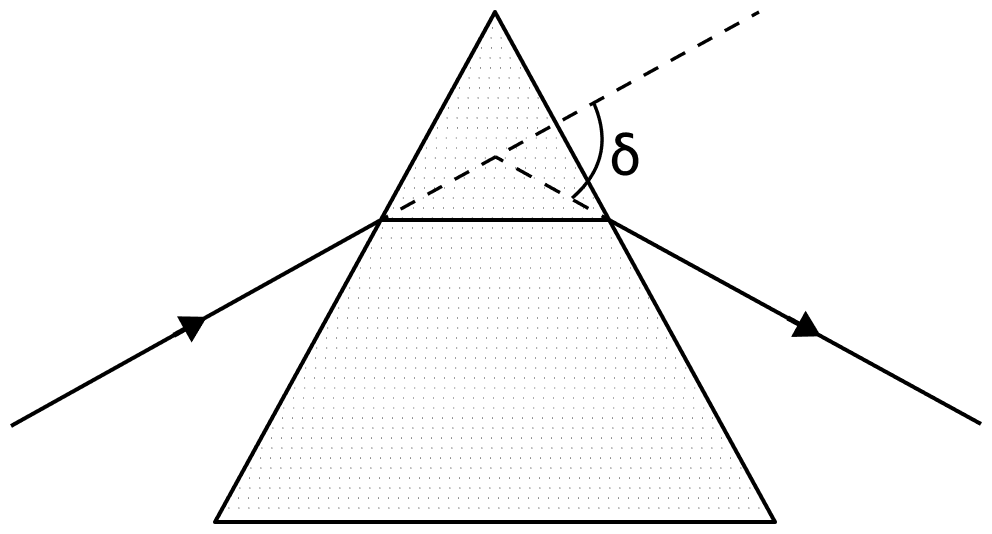
What is angle of deviation for a prism?
Answer
The angle between the incident ray produced forward and the emergent ray produced backward is called the angle of deviation (δ) of the prism.
Write the relation between the angle of emergence and the angle of deviation of a light ray passing through a prism.
Answer
Explanation: Here i is the angle of incidence, e the angle of emergence, A the refracting angle of the prism and δ the angle of deviation, so that δ = i + e − A.
A monochromatic ray of light falls on a regular prism under minimum deviation condition. What is the relation between angle of incidence and angle of emergence?
Answer
The angle of incidence is equal to the angle of emergence (i = e).
What is the angle of refraction made by a ray of light inside a regular (that is, an equilateral) glass prism in the minimum deviation case?
Answer
30°.
Explanation: In the minimum deviation position r = r' and r + r' = A, so
Is the angle of minimum deviation produced by a prism in a light ray different for different colours of light?
Answer
Yes.
Explanation: The refractive index of the prism material is different for different colours, being maximum for violet and minimum for red. As δm depends on the refractive index, it is largest for violet light and smallest for red light.
Does a prism laterally displace a ray incident upon it?
Answer
No.
Explanation: Lateral displacement occurs when the emergent ray is parallel to the incident ray, as in a glass slab with parallel faces. The refracting faces of a prism are inclined to each other, so the emergent ray is not parallel to the incident ray; the prism only deviates the ray through the angle δ.
On which factors does the deviation produced by a thin prism depend?
Answer
It depends upon the refractive index (n) of the material of the prism and the refracting angle (A) of the prism, since δ = (n − 1)A.
Does the angle of deviation depend on the angle of incidence for a thin prism?
Answer
No.
Explanation: For a thin prism δ = (n − 1)A, which contains only the refractive index and the refracting angle, not the angle of incidence.
What happens when white light passes through a prism?
Answer
The white light splits into its constituent colours, from violet (deviated most) to red (deviated least). This phenomenon is called dispersion of light.
For which spectral colour of light is the speed maximum in glass? For which minimum? What in vacuum?
Answer
In glass, the speed is maximum for red light and minimum for violet light. In vacuum, light of all colours travels with the same speed, 3 × 10⁸ m s-1.
For which colour of visible light the refractive index of a transparent material is maximum? For which minimum?
Answer
The refractive index is maximum for violet light and minimum for red light.
If rays of red, yellow, green and violet lights are allowed to fall on a prism, for which colour will the angle of deviation be maximum? For which colour will it be minimum?
Answer
Maximum for violet light, minimum for red light.
Explanation: The refractive index of glass is maximum for violet and minimum for red, and the deviation increases with the refractive index (for a thin prism, δ = (n − 1)A).
On what factors does the angular dispersion of a prism depend?
Answer
It depends upon the material of the prism (its refractive indices for the two colours) and the refracting angle (A) of the prism, since, for a thin prism, θ = (nV − nR)A.
The refractive indices of glass for yellow, green and red light are nY, nG and nR respectively. Arrange these in increasing order of values.
Answer
nR < nY < nG.
Explanation: The refractive index of a material increases from the red end to the violet end of the spectrum, in the order red, orange, yellow, green, blue, violet.
State the factors on which the deviation produced by a prism depends.
Answer
The angle of deviation produced by a prism depends upon :
- the angle of incidence of the ray,
- the refracting angle of the prism,
- the refractive index of the material of the prism, and
- the wavelength (colour) of the light used, since the refractive index changes with wavelength.
In the figure, ABCD is a ray of light passing through an equilateral glass prism (EFG), and suffering minimum deviation. Calculate : the angle of refraction at B, and the angle EBC (refractive index of glass is 1.5).
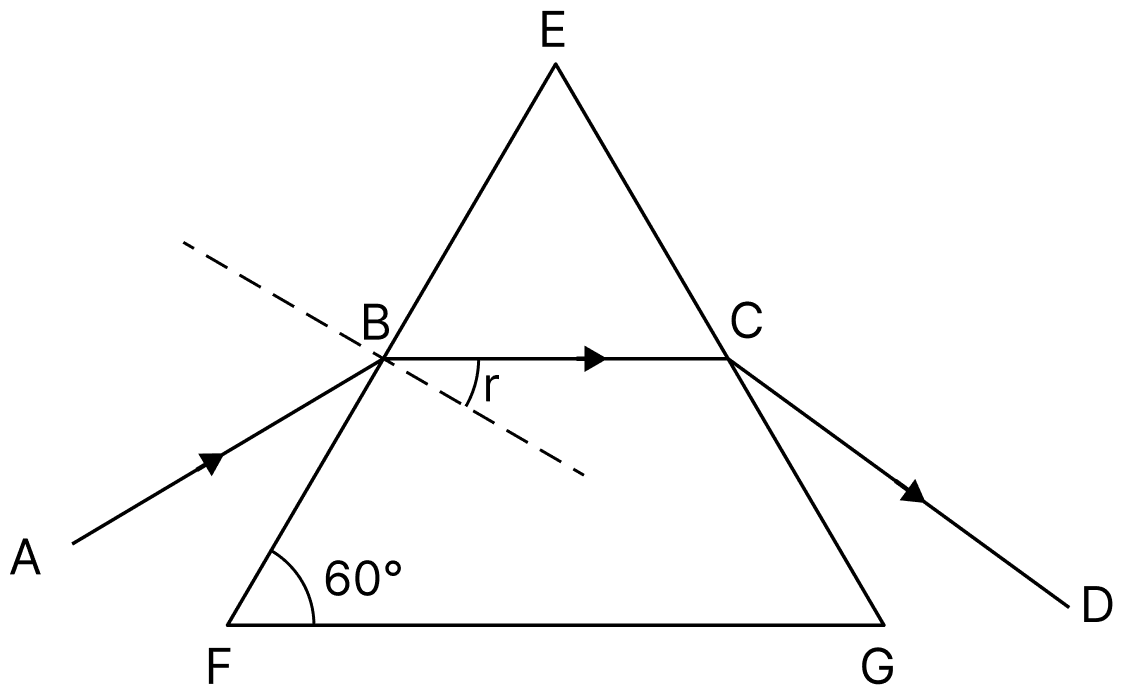
Answer
Given,
- Equilateral prism, so angle of prism A = 60°
- Refractive index of glass, n = 1.5
- The ray ABCD suffers minimum deviation
Angle of refraction at B :
In the position of minimum deviation, r = r' and r + r' = A. Therefore,
Angle EBC :
At minimum deviation, the refracted ray BC inside the prism travels parallel to the base FG. Taking EF as the transversal,
∠EBC = ∠EFG = 60° (corresponding angles)
This agrees with the angle of refraction, since the normal at B is perpendicular to EF :
Hence, the angle of refraction at B is 30° and ∠EBC = 60°.
A ray of light passing through a prism deviates towards the base of the prism. Can you think of a situation when the ray would deviate away from the base?
Answer
Yes. If the prism is immersed in a transparent liquid whose refractive index is greater than that of the material of the prism, the prism becomes optically rarer than its surroundings. The ray then bends away from the normal on entering the prism and towards the normal on leaving it, so it deviates away from the base.
How does the speed of light in glass change (a) on increasing the wavelength of light, (b) on increasing the intensity of light? Explain similarly for the speed of light in vacuum.
Answer
(a) On increasing the wavelength : The speed of light in glass increases. The refractive index of glass decreases as the wavelength increases (it is least for red light), and since , the speed increases.
(b) On increasing the intensity : The speed of light in glass does not change, because the refractive index of glass does not depend on the intensity of light.
In vacuum : Light of all wavelengths and all intensities travels with the same speed, 3 × 10⁸ m s-1. The speed of light in vacuum is an absolute constant.
Rays of red and blue light are incident on a given prism. Explain which will have the larger angle of minimum deviation.
Answer
Blue light will have the larger angle of minimum deviation.
In glass, blue light travels with a smaller speed than red light, so the refractive index of the prism is greater for blue light (nB > nR). For the same prism (same A),
so a larger refractive index gives a larger δm. Hence, blue light suffers the larger minimum deviation.
What is angular dispersion? Draw the path of a ray of white light passing through a prism and mark angular dispersion on it.
Answer
The angle between the emergent rays of any two colours is called the angular dispersion between those colours. For white light it is measured between the violet and red emergent rays,
where δv and δr are the deviations of the violet and red rays. For a thin prism of angle A, θ = (nv − nr)A.
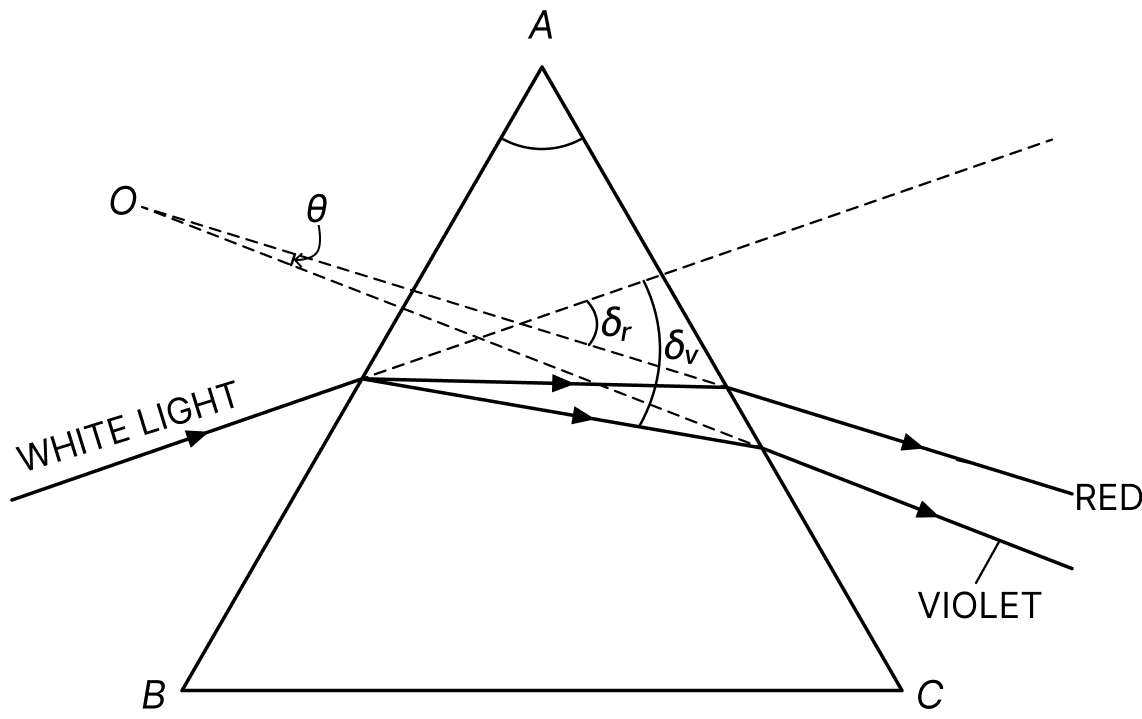
In the figure, white light falls on the face AB of the prism ABC. The red ray is deviated least (δr) and the violet ray most (δv); the angle θ between the emergent red and violet rays is the angular dispersion.
The refractive indices for crown and flint glasses for red and violet light are :
| Light | Crown | Flint |
|---|---|---|
| red | 1.515 | 1.644 |
| violet | 1.532 | 1.685 |
Which glass will be more suitable for spectacle lens and why?
Answer
Given,
- Crown glass : nR = 1.515, nV = 1.532
- Flint glass : nR = 1.644, nV = 1.685
For a thin prism of angle A, the angular dispersion is θ = (nV − nR)A. So, for a given angle, it is proportional to (nV − nR).
For crown glass :
For flint glass :
A spectacle lens should produce as little dispersion (colouring of the image) as possible. Crown glass disperses light much less than flint glass.
Hence, crown glass is more suitable for spectacle lens.
Why there is no dispersion in white light refracted through a rectangular glass slab?
Answer
A rectangular glass slab has parallel faces. White light is split into colours at the first face, but at the second face each colour is refracted back by an equal and opposite amount, so every colour emerges parallel to the incident ray. The emergent colours are thus parallel to one another and overlap to form white light again. Hence, no dispersion is observed.
Is there no dispersion even inside the glass slab?
Answer
No, dispersion does take place inside the slab. On entering the slab, the different colours of white light are refracted through different angles (the refractive index is different for each colour) and separate. As the faces of the slab are parallel, every colour emerges parallel to the incident ray, and the colours combine to form white light.
What is scattering of light? Write Rayleigh's criterion of scattering.
Answer
Scattering of light : When sunlight passes through the earth's atmosphere, the fine dust particles and air molecules absorb part of the light and give it out again in other directions. This is called scattering of light.
Rayleigh's criterion : The intensity of scattered light is inversely proportional to the fourth power of the wavelength, provided the size of the scatterer is smaller than the wavelength of light,
Why does the bluish colour predominate in a clear sky?
Answer
On looking at the clear sky, we receive sunlight scattered by fine dust particles, air molecules and water-vapour molecules of the atmosphere. By Rayleigh's law (scattering ∝ ), shorter wavelengths are scattered more; blue light, which is present in sunlight in larger proportion than violet, is scattered about ten times more than orange-red light. So the scattered light reaching our eye is mainly blue, and bluish colour predominates in the sky.
Sun looks reddish at sunset. Why?
Answer
At sunset the sun is near the horizon, so its rays reach the observer after travelling a maximum distance through the atmosphere. On the way, most of the blue and neighbouring colours are scattered out by air molecules and dust particles (scattering ∝ , and λblue < λred). The light reaching the observer is therefore mainly red, and the sun looks reddish.
Why do danger signals employ red light?
Answer
Red light has the longest wavelength in the visible spectrum, so it suffers the least scattering in the atmosphere (scattering ∝ ). It passes through air, dust, fog and mist with little loss, and a red signal can be seen clearly from a large distance.
Give reasons for the following observations on the surface of moon :
(i) sky appears dark,
(ii) a rainbow is never observed.
Answer
(i) The moon has no atmosphere, so there are no air molecules or dust particles to scatter sunlight. No scattered light reaches the eye from the sky, and the sky appears dark.
(ii) A rainbow is formed by dispersion and internal reflection of sunlight in water drops. There is no water vapour (no raindrops) on the moon, so a rainbow is never formed.
Consider a ray of light passing through a prism (angle A) in the position of minimum deviation (angle δ). Show that the angles of incidence and refraction are given by i = , r = .
Answer
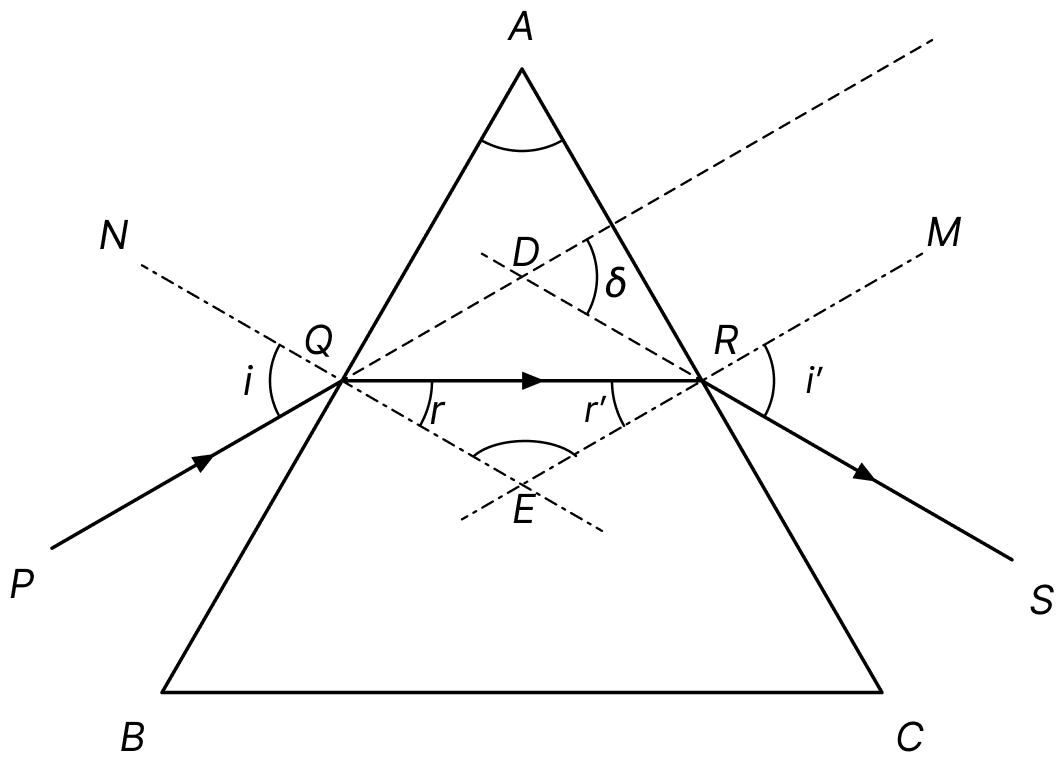
Let ABC be the principal section of a prism of refracting angle A. A ray PQ falls on the face AB at an angle of incidence i and is refracted along QR at an angle r. At the face AC, the angle of incidence is r' and the ray emerges along RS at an angle i'. The normals at Q and R meet at E, and the incident ray produced forward meets the emergent ray produced backward at D.
Angle of deviation : In triangle QDR, the exterior angle δ is the sum of the interior opposite angles,
In the quadrilateral AQER, ∠AQE = ∠ARE = 90°, so A + ∠QER = 180°. In triangle QER, r + r' + ∠QER = 180°. Hence,
and from Eq. (i),
Minimum deviation : If the path is reversed (SRQP), the angles of incidence and emergence interchange but the deviation remains the same. As minimum deviation occurs for only one angle of incidence, in this position i' = i. Snell's law at Q and R, , then gives r' = r.
Putting r' = r in Eq. (ii),
Putting i' = i in Eq. (iii), with δ as the minimum deviation,
Hence, in the position of minimum deviation, and .
Why is a ray of light deviated by a prism? Draw a graph showing the variation of the angle of deviation with the angle of incidence. Derive an expression for the refractive index of the material of the prism in terms of its refracting angle and the angle of minimum deviation.
Answer
Why a ray is deviated : On entering the prism, the ray passes from air into glass (denser) and bends towards the normal; on leaving, it passes from glass into air and bends away from the normal. Since the two refracting faces are inclined to each other, both bendings turn the ray towards the base and add up, instead of cancelling as in a parallel-sided slab. Hence, the emergent ray is deviated from the direction of the incident ray.
Graph of δ versus i :
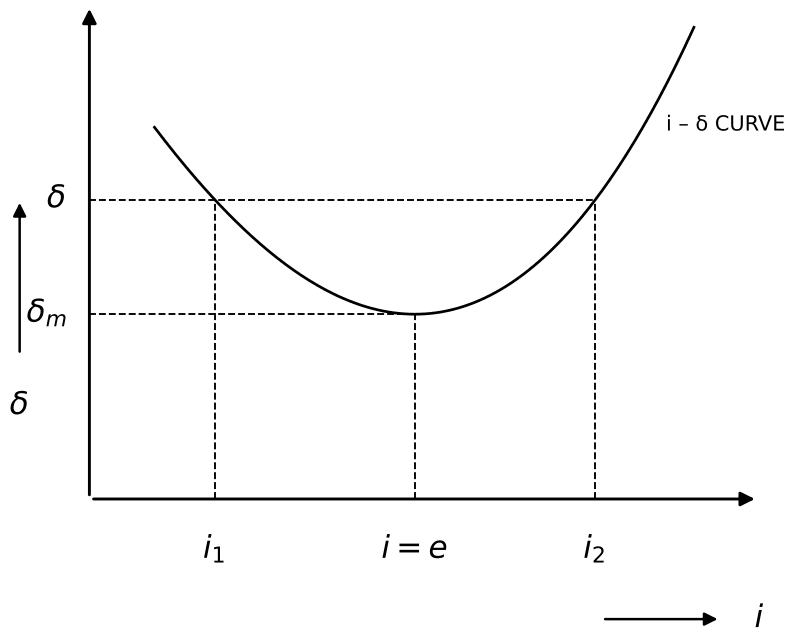
As the angle of incidence i increases, the angle of deviation δ first decreases, becomes minimum (δm) for one particular angle of incidence, at which i = i', and then increases again.
Expression for refractive index :
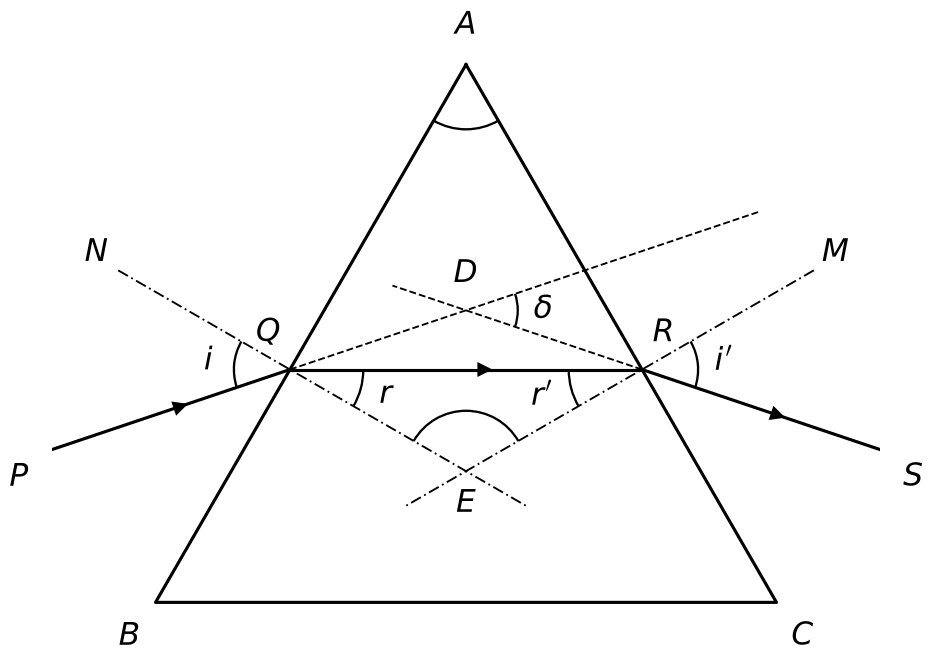
A ray PQ falls on the face AB of prism ABC (refracting angle A) at angle i, is refracted at angle r, meets the face AC at angle r' and emerges at angle i'. The deviations at the two faces are (i − r) and (i' − r'), so
In the quadrilateral AQER (E is the meeting point of the normals), ∠AQE = ∠ARE = 90°, so A + ∠QER = 180°; in triangle QER, r + r' + ∠QER = 180°. Therefore,
In the position of minimum deviation, i' = i and r' = r, and δ = δm. Eqs. (i) and (ii) then give
By Snell's law at the face AB, , so
This is the required expression for the refractive index of the material of the prism.
What is dispersion of light? Explain why white light is dispersed when passing through a prism.
Answer
Dispersion of light : The splitting of white light into its constituent colours on passing through a prism is called dispersion of light.
Cause : White light is a mixture of lights of different colours (wavelengths). In vacuum (or air) all colours travel with the same speed, 3 × 10⁸ m s-1, but in glass they travel with different speeds, violet light being the slowest and red light the fastest. Since , the refractive index of glass is different for different colours, maximum for violet and minimum for red (nV > nR).
The deviation produced by a prism depends on the refractive index; for a thin prism δ = (n − 1)A. Hence, each colour is deviated through a different angle, violet the most and red the least, and the colours emerge in different directions.
Thus, white light spreads out into a band of colours, from red (least deviated) through yellow, green and blue to violet (most deviated).
Define dispersive power of an optical medium. Obtain a formula for the dispersive power of the material of a prism in terms of refractive indices.
Answer
Dispersive power : When white light passes through a thin prism, the ratio of the angular dispersion between the violet and red emergent rays to the deviation of the mean (yellow) ray is called the dispersive power (ω) of the material of the prism.
Formula : Let nV, nR and nY be the refractive indices of the prism material for violet, red and yellow light, and A the refracting angle of the thin prism. Using δ = (n − 1)A for each colour,
The angular dispersion between the violet and red rays is
Therefore,
Hence, , which depends only on the material of the prism and not on its refracting angle.
Draw ray diagram to illustrate formation of primary rainbow (using single water drop only and a single incident ray, to show clearly refraction and total internal reflection, use at least four arrows).
Answer
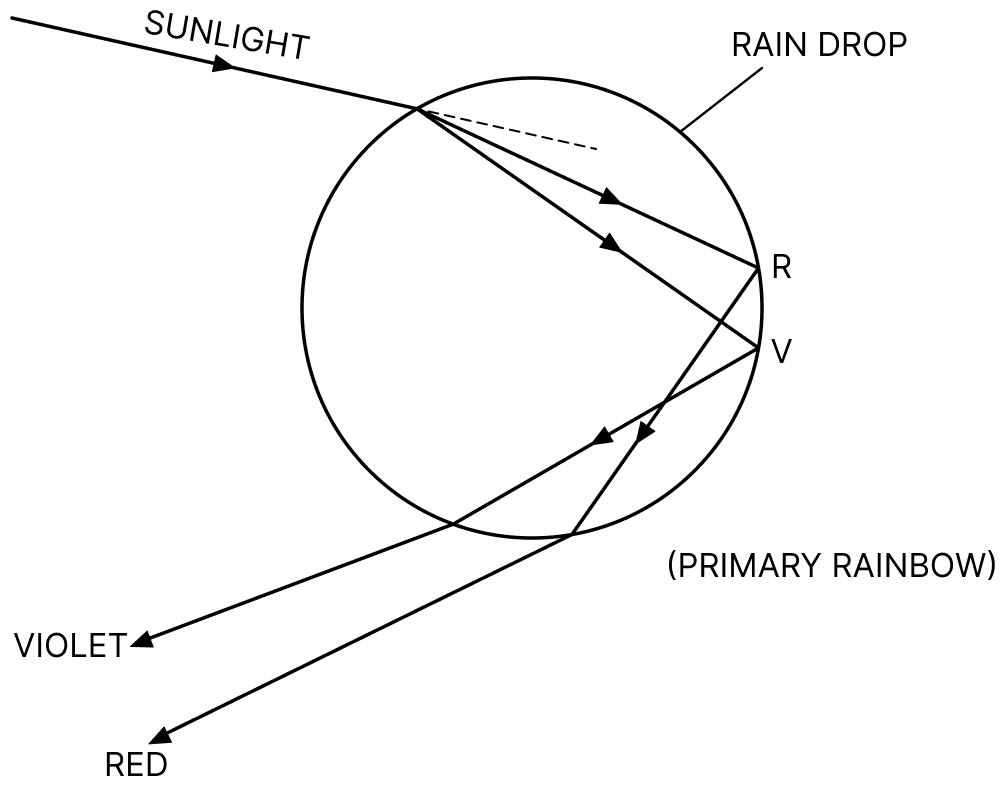
Formation of the primary rainbow in a single drop :
- A ray of sunlight enters the spherical water drop and is refracted at the first surface. As the refractive index of water is different for different colours, the light is dispersed into its colours.
- The dispersed rays strike the back surface of the drop and suffer one total internal reflection.
- On reaching the front surface again, the rays are refracted out of the drop into air, the violet and red rays emerging in different directions.
Rays emerging in the direction of minimum deviation give intense light. Red light reaches the observer at about 43° and violet light at about 41° to the line joining the sun and the observer, so the primary rainbow is red on its outer edge and violet on its inner edge.
Examiner assigns a task to a student, in which he has to find refractive index of the material of the prism by using spectrometer. After giving certain instructions, examiner ask some questions. State whether the responses of the student, in each case, are correct or incorrect. Give a reason for your answer.
(i) EXAMINER : How the refractive index of the material depends on the wavelength of light?
STUDENT : Refractive index decreases with increase in wavelength.
(ii) EXAMINER : To increase the minimum angle of deviation, light of which colour, will you prefer to use in place of yellow light?
STUDENT : I will prefer to use red light.
(iii) EXAMINER : Immerse the prism in water and observe the change (if any) in the refractive index of its material with respect to the surrounding.
STUDENT : Refractive index decreases.
Answer
(i) Correct. In glass, red light (longest wavelength) travels with the greatest speed and violet light (shortest wavelength) with the least. Since , the refractive index is least for red and greatest for violet, that is, it decreases with increase in wavelength.
(ii) Incorrect. Red light has a longer wavelength than yellow light, so nR < nY. For the same prism,
so a smaller refractive index gives a smaller δm; red light would decrease the minimum deviation. To increase δm, the student should use blue (or violet) light, for which the refractive index is greater than for yellow light.
(iii) Correct. In water, the refractive index of the prism material with respect to the surrounding is the ratio of the refractive indices of glass and water. Taking ang = 3/2 and anw = 4/3,
Since 1.125 < 1.5, the refractive index of the prism material decreases when the prism is immersed in water.
A ray of light passes through a prism of angle A and emerges out at an angle of emergence e. Show that
i + e = A + δ
and when angle of incidence (i) is equal to angle of emergence, show that deviation produced is minimum.
Answer
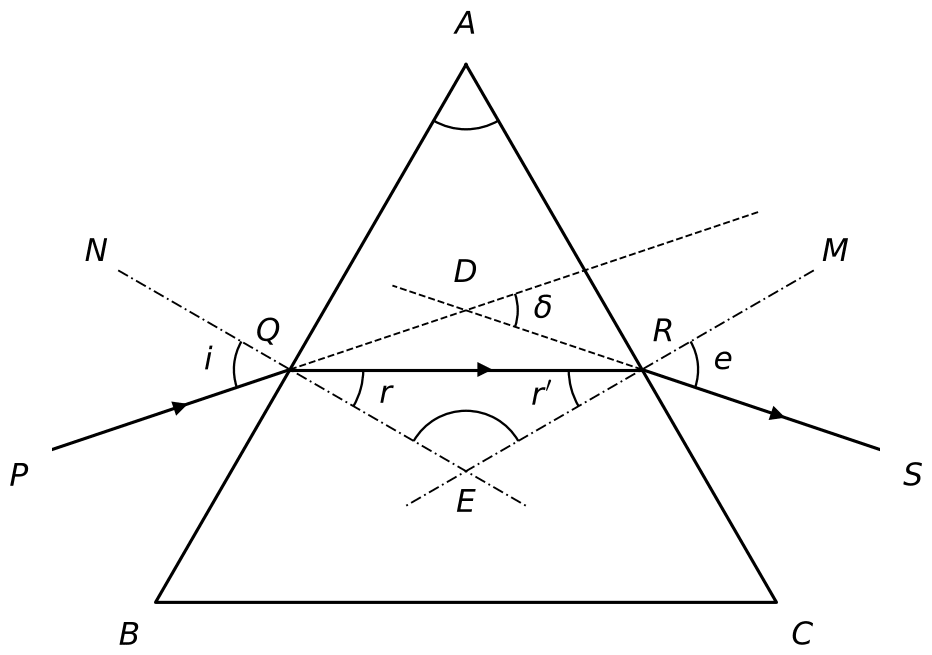
Let ABC be the principal section of a prism of refracting angle A. A ray PQ falls on the face AB at an angle of incidence i, is refracted along QR at an angle r, strikes the face AC at an angle r' and emerges along RS at an angle of emergence e. The normals at Q and R meet at E, and the incident ray produced forward meets the emergent ray produced backward at D. The angle between them is the angle of deviation δ.
To show i + e = A + δ :
At Q the ray turns through (i − r) and at R through (e − r'). In triangle QDR, the exterior angle δ is the sum of the two interior opposite angles,
In the quadrilateral AQER, ∠AQE = ∠ARE = 90°, so
In triangle QER,
Comparing Eqs. (ii) and (iii),
Substituting Eq. (iv) in Eq. (i),
Deviation is minimum when i = e :
By Eq. (v), δ depends on the angle of incidence. As i increases, δ first decreases, reaches a minimum value δm and then increases, so δm occurs for one and only one angle of incidence.
By the principle of reversibility of light, if the ray travels backward along SRQP, the angle of incidence becomes e and the angle of emergence becomes i, while the deviation δ = i + e − A remains the same. So, if the deviation is minimum for the angle of incidence i, it is also minimum for the angle of incidence e. Since minimum deviation occurs for only one angle of incidence, the two must be equal,
When i = e, Snell's law at the two faces (sin i = n sin r and sin e = n sin r') gives r = r', and Eq. (iv) gives r = r' = . This fixes a single angle of incidence, at which the ray passes symmetrically through the prism and the deviation δ = 2i − A is the minimum deviation δm. If the prism has equal base angles (in particular, if it is equilateral), the internal ray is also parallel to its base.
Hence, i + e = A + δ, and the deviation produced is minimum when the angle of incidence is equal to the angle of emergence.
What is minimum angle of deviation? Draw graph between angle of incidence and deviation produced in the path of incident ray passing through a prism. Why (i − δ) curve has two arms?
Answer
Minimum angle of deviation : As the angle of incidence on a prism is increased, the angle of deviation first decreases and then increases. The least value of the angle of deviation, obtained for one particular angle of incidence, is called the minimum angle of deviation (δm). In this position i = e and r = r' = . If the prism has equal base angles (in particular, if it is equilateral), the refracted ray inside it is also parallel to its base.
Graph :
The angle of incidence i is plotted along the x-axis and the angle of deviation δ along the y-axis. The deviation falls to δm at i = e and rises again on either side of it.
Why the (i − δ) curve has two arms : For a prism, δ = i + e − A. By the principle of reversibility of light, a ray incident at angle e emerges at angle i and suffers the same deviation δ as the ray incident at angle i. Hence, every value of deviation greater than δm is produced for two angles of incidence, i1 and i2, the angle of emergence for one being the angle of incidence for the other. One of these lies on the falling arm of the curve and the other on the rising arm. Only at minimum deviation do the two angles become equal (i1 = i2 = i = e), where the two arms meet. Therefore, the (i − δ) curve has two arms.
What do you understand by the term scattering of light? Why sky appears blue and dangerous signals are of red colour? Write Rayleigh's concept of scattering and relate it to above mentioned colours.
Answer
Scattering of light : When sunlight passes through the earth's atmosphere, the fine dust particles and air molecules absorb part of the light and give it out again in random directions. This is called scattering of light.
Rayleigh's law of scattering : The intensity of scattered light is inversely proportional to the fourth power of the wavelength, provided the size of the scatterer is smaller than the wavelength of light,
Thus, the shorter wavelengths are scattered much more than the longer ones. For violet light (λ ≈ 4000 Å) and red light (λ ≈ 7000 Å),
that is, violet light is scattered about ten times more than red light.
Why the sky appears blue : On looking at the sky, we receive sunlight scattered by air molecules, dust particles and water-vapour molecules. Blue light, which has a short wavelength and is present in sunlight in larger proportion than violet, is scattered strongly, about ten times more than orange-red light. So the scattered light reaching our eye is mainly blue, and the sky appears blue.
Why danger signals are red : Red light has the longest wavelength in the visible spectrum, so by Rayleigh's law it suffers the least scattering. It passes through the atmosphere, dust, fog and mist with little loss and can be seen clearly from a large distance. Hence, danger signals are red.
Define angular dispersion and dispersive power of an optical medium. Explain why deviation is maximum for violet colour and minimum for red colour also explain the dependence of deviation on the refractive index.
Answer
Angular dispersion : The angle between the emergent rays of any two colours is called the angular dispersion between those colours. For the violet and red rays through a thin prism of angle A,
Dispersive power : When white light passes through a thin prism, the ratio of the angular dispersion between the violet and red emergent rays to the deviation of the mean (yellow) ray is called the dispersive power (ω) of the material of the prism,
Why deviation is maximum for violet and minimum for red : In vacuum all colours travel with the same speed, but in glass violet light travels slowest and red light fastest. Since , the refractive index of glass is maximum for violet and minimum for red (nV > nR). As δ = (n − 1)A for a thin prism, violet light suffers the maximum deviation and red light the minimum.
Dependence of deviation on refractive index : For a thin prism, δ = (n − 1)A, so for a given refracting angle the deviation increases with (n − 1). For any prism, the relation
shows that, for a given A, a larger refractive index gives a larger minimum deviation. Thus, a material (or colour) of higher refractive index produces greater deviation.
Read the passage(s) and answer the following questions :
A prism is a wedge shaped portion of a transparent refracting medium bounded by two or three plane surfaces, inclined to each other at certain angle.
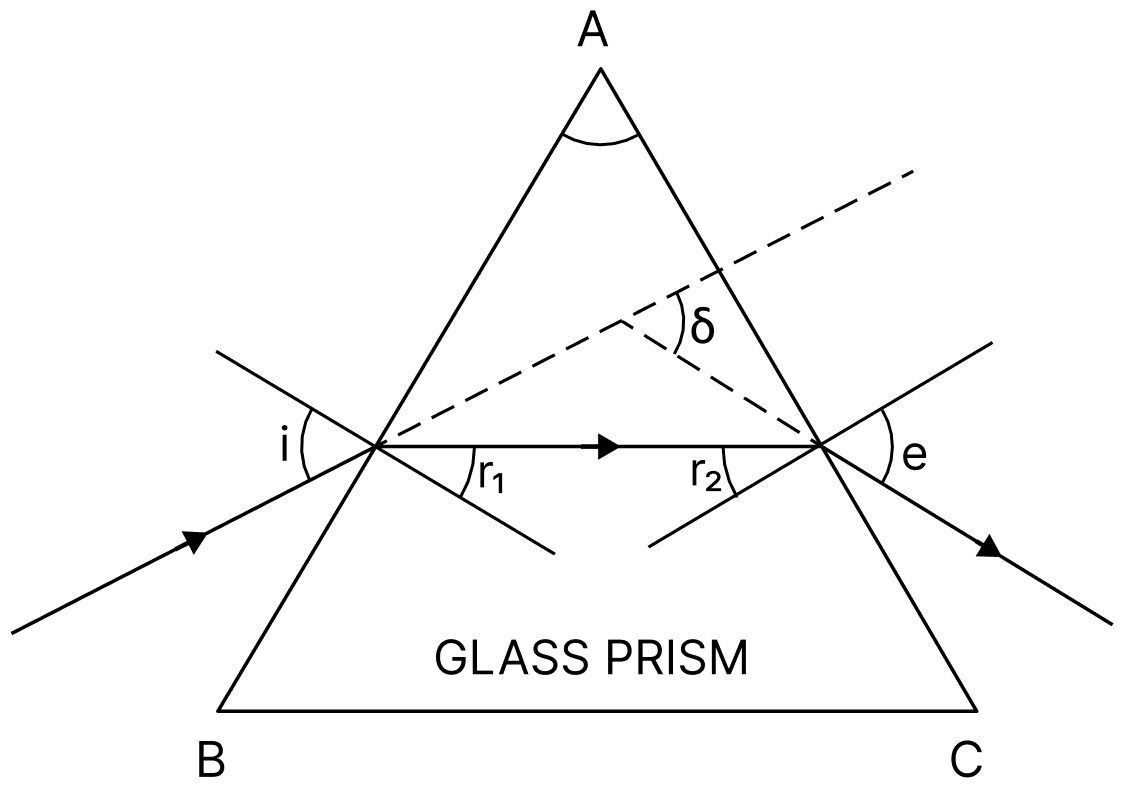
In a prism, sum of angle of incidence i and angle of emergence e is equal to the sum of angle of deviation δ and the angle of prism A.
i + e = δ + A
As i increases, δ first decreases, reaches a minimum value δmin and then increases; δmin is called the angle of minimum deviation. At minimum deviation ray passes symmetrically through the prism.
(i) What is relation among angles r1, r2 and A?
(ii) If e = Ki, then what will be the value of K when incident ray suffers minimum deviation as it emerges out of the prism?
(iii) Suppose the prism is a regular prism and incident ray suffers minimum deviation as it comes out of the prism, then what will be the angle between refracted ray inside the prism and base BC of the prism?
(iv) Figure shows the graph of angle of deviation δ versus angle of incidence i for a light ray striking a prism.
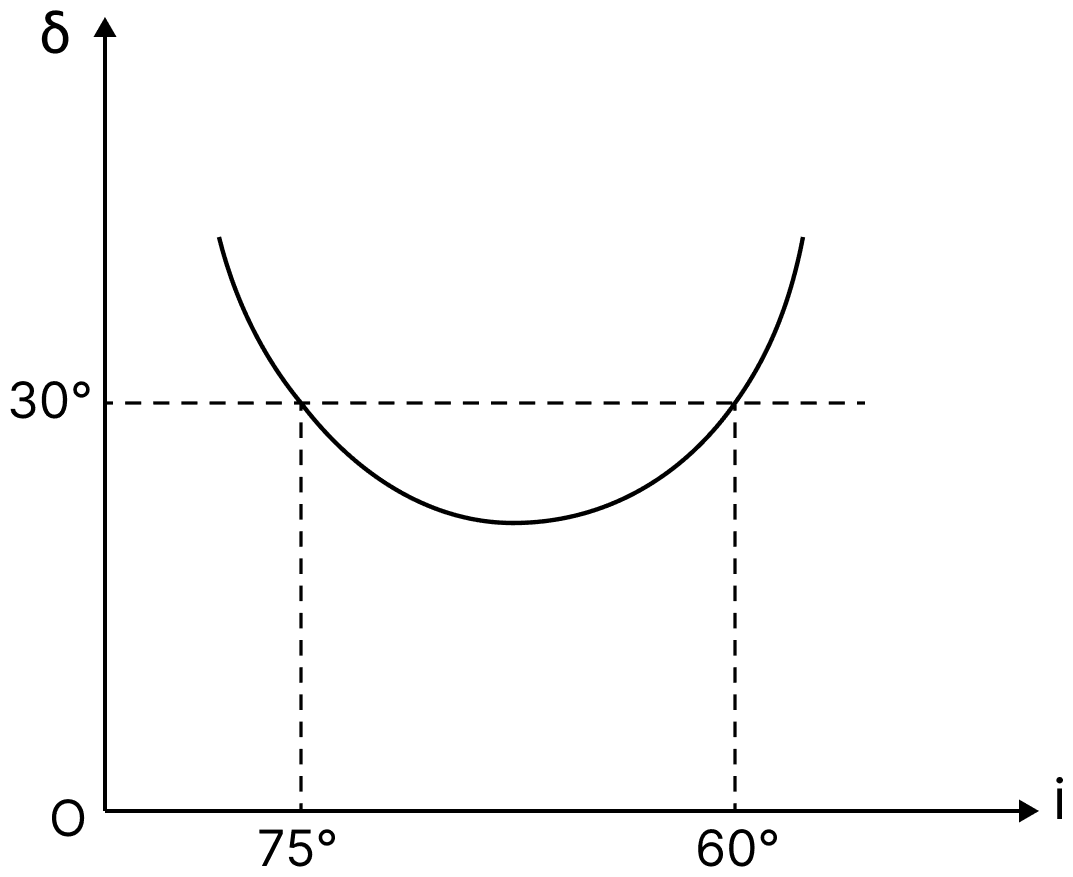
Calculate the value of the prism angle A.
(v) Write the expression for the minimum angle of deviation δm for a thin prism in terms of refractive index of the material (n) of the prism and the prism angle A.
Answer
(i) The angles of refraction at the two faces add up to the angle of prism,
(ii) At minimum deviation, the angle of emergence is equal to the angle of incidence, e = i. Comparing with e = Ki,
(iii) 0°. At minimum deviation the ray passes symmetrically through the prism, so for a regular (equilateral) prism the refracted ray inside is parallel to the base BC, and the angle between them is 0°.
(iv) From the graph, the same deviation δ = 30° is produced for two angles of incidence, 15° and 60°. By the principle of reversibility of light, these two angles are the angle of incidence and the angle of emergence of the same ray, so for i = 15°, e = 60° and δ = 30°. Using i + e = δ + A,
Hence, the prism angle A = 45°.
(v) For a thin prism,
Note: The left mark on the i-axis of the graph is printed as 75°, but it lies to the left of 60° and must be 15°, the value the textbook's own answer uses.