
Match the corresponding entries of column-1 with column-2 (where m is the magnification produced by the mirror).
| Column-1 | Column-2 | ||
|---|---|---|---|
| (A) | m = -2 | (p) | Convex mirror |
| (B) | (q) | Concave mirror | |
| (C) | m = +2 | (r) | Real image |
| (D) | (s) | Virtual image |
- A → q and r; B → q and r; C → q and s; D → p and s
- A → p and r; B → p and s; C → p and q; D → r and s
- A → p and s; B → q and r; C → q and s; D → q and r
- A → r and s; B → q and s; C → q and r; D → p and s
Answer
A → q and r; B → q and r; C → q and s; D → p and s
Reason — The magnification for a real image is negative and that for a virtual image is positive. A convex mirror forms only virtual and diminished images (0 < m < 1), while a concave mirror forms a virtual image only when it is magnified (m > 1).
Hence, m = −2 and give real images, which only a concave mirror forms (q and r); m = +2 is a virtual, magnified image of a concave mirror (q and s); and is a virtual, diminished image of a convex mirror (p and s).
A beam of light from a source L is incident normally on a plane mirror fixed at a certain distance x from the source. The beam is reflected back as a spot on a scale placed just above the source L. When the mirror is rotated through a small angle θ, the spot of the light is found to move through a distance y on the scale. The angle θ is given by :
Answer
Reason —
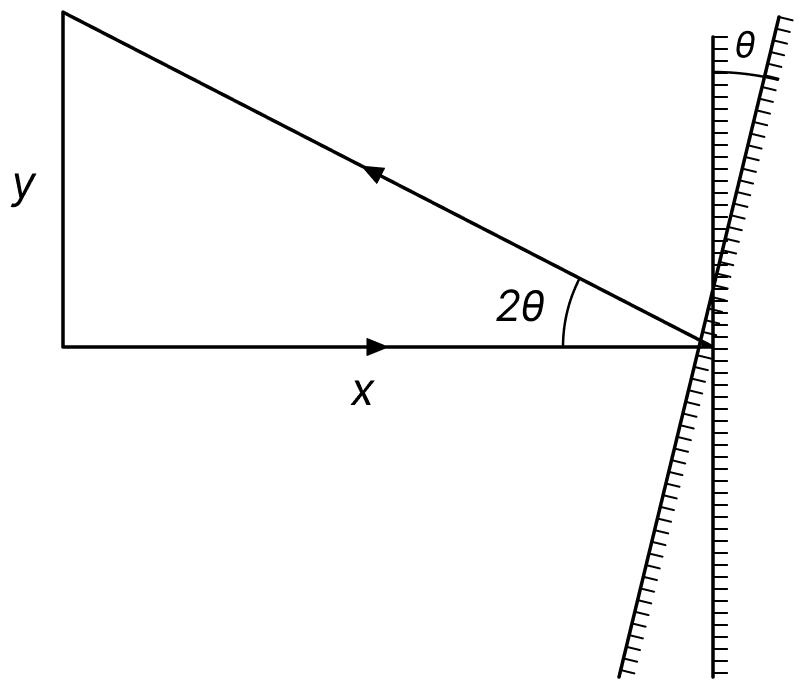
When a plane mirror is rotated through an angle θ, the reflected ray turns through 2θ. The reflected beam therefore makes an angle 2θ with the incident beam and, travelling a distance x back to the scale, shifts the spot by y. For a small angle,
An object is placed at a distance of 40 cm from a concave mirror of focal length 15 cm. If the object is displaced through a distance of 20 cm towards the mirror, the displacement of the image will be :
- 30 cm away from the mirror
- 36 cm towards the mirror
- 30 cm towards the mirror
- 36 cm away from the mirror
Answer
36 cm away from the mirror
Reason — Given,
- f = −15 cm (concave mirror)
- Initial object distance, u1 = −40 cm
- Final object distance, u2 = −(40 − 20) = −20 cm
From the mirror formula , for the initial position,
For the final position,
The image moves from 24 cm to 60 cm in front of the mirror, so its displacement is 60 − 24 = 36 cm away from the mirror.
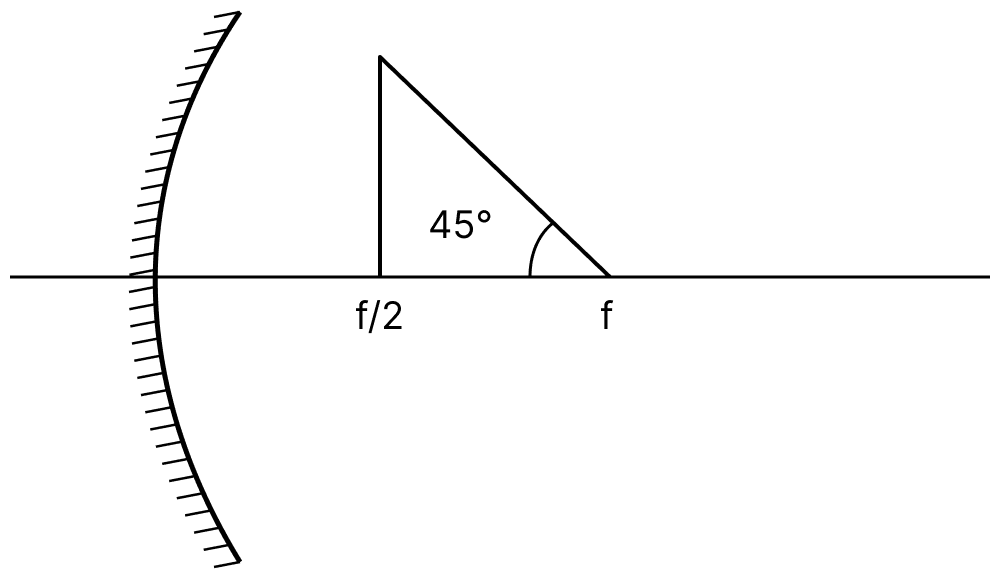
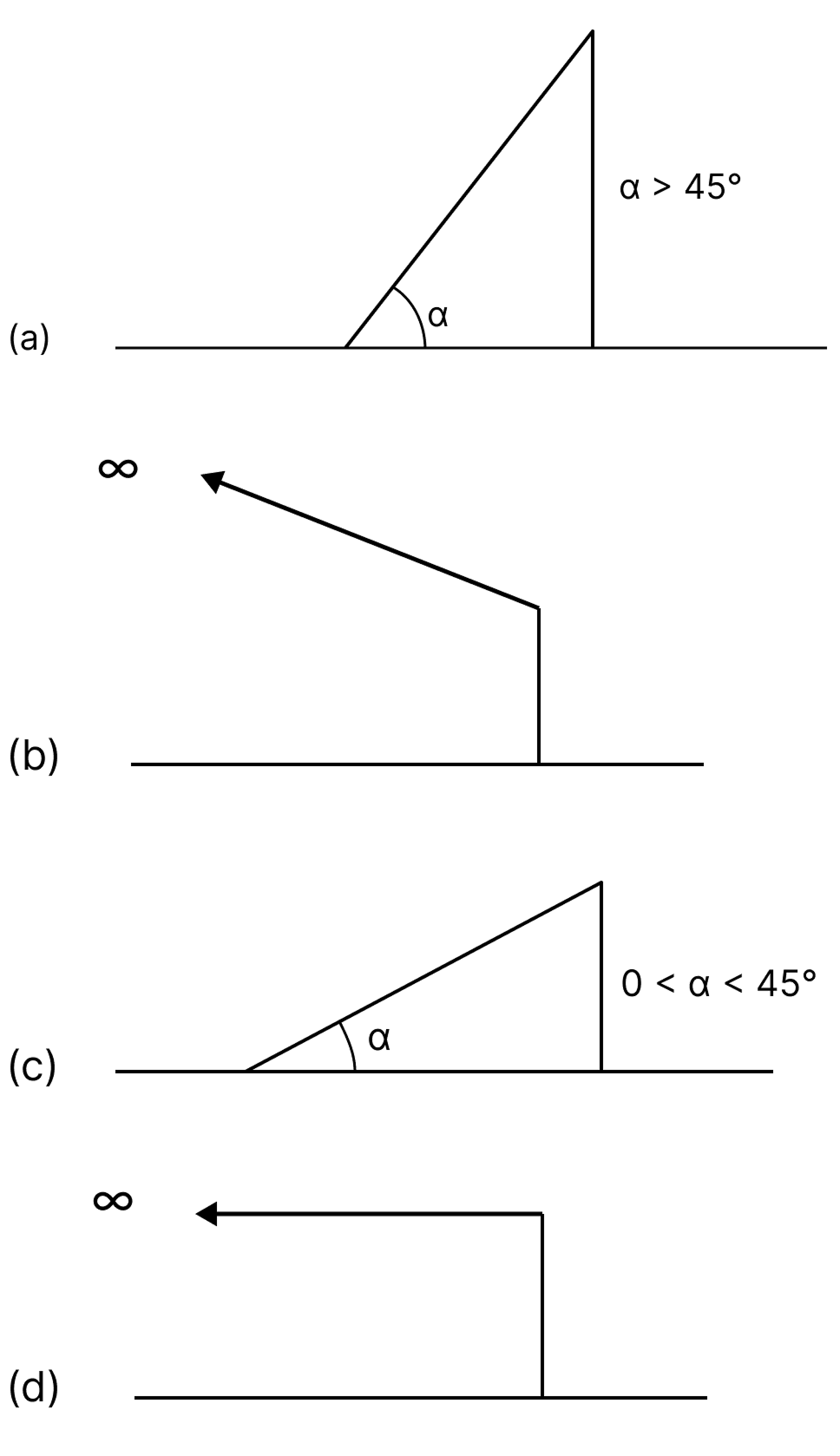
A wire is bent in the shape of a right angled triangle and is placed in front of a concave mirror of focal length f, as shown in the figure. Which of the figures shown in the four options qualitatively represent(s) the shape of the image of the bent wire? (These figures are not to scale).
Answer
Reason — Given,
- Focal length of the concave mirror = f, i.e. −f with sign
- The vertical arm AB of the wire stands at a distance from the pole, and the hypotenuse BC meets the principal axis at C, at a distance f from the pole
Since the angle at C is 45°, the height of AB is equal to AC, i.e. .
Image of AB : With , the mirror formula gives
So A'B' is a virtual, erect vertical line at a distance f behind the mirror, of height .
Image of BC : A point of BC at a distance x from the pole lies at a height (f − x) above the axis. With u = −x,
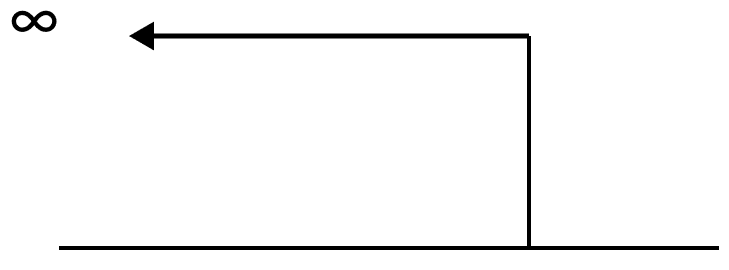
The height of its image is , the same for every point of BC, and v → ∞ as x → f. Hence BC forms a horizontal image at height f, starting from B' and extending to infinity, while the base AC on the axis forms its image along the axis.
The image is thus a vertical line with a horizontal line drawn from its top to infinity, which is the shape shown in option 4.
Two plane mirrors are inclined to each other such that a ray of light incident on the first mirror (M1) and parallel to the second mirror (M2) is finally reflected from the second mirror (M2) parallel to the first mirror (M1). The angle between the two mirrors will be :
- 90°
- 45°
- 75°
- 60°
Answer
60°
Reason — Let θ be the angle between the two mirrors.
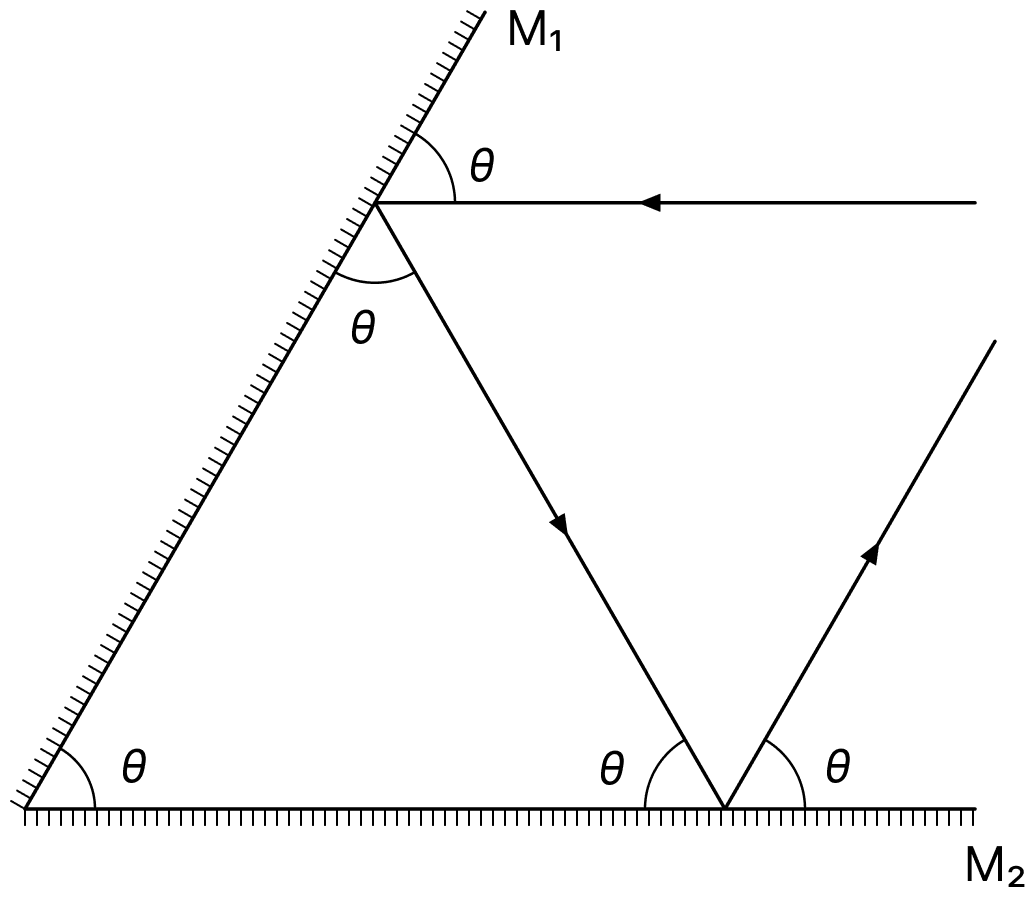
The incident ray is parallel to M2, so it makes an angle θ with M1; by the laws of reflection the reflected ray also makes an angle θ with M1. The ray finally reflected from M2 is parallel to M1, so it makes an angle θ with M2, and therefore the ray incident on M2 also makes an angle θ with M2.
The ray between the mirrors and the two mirrors thus form a triangle with each angle equal to θ,
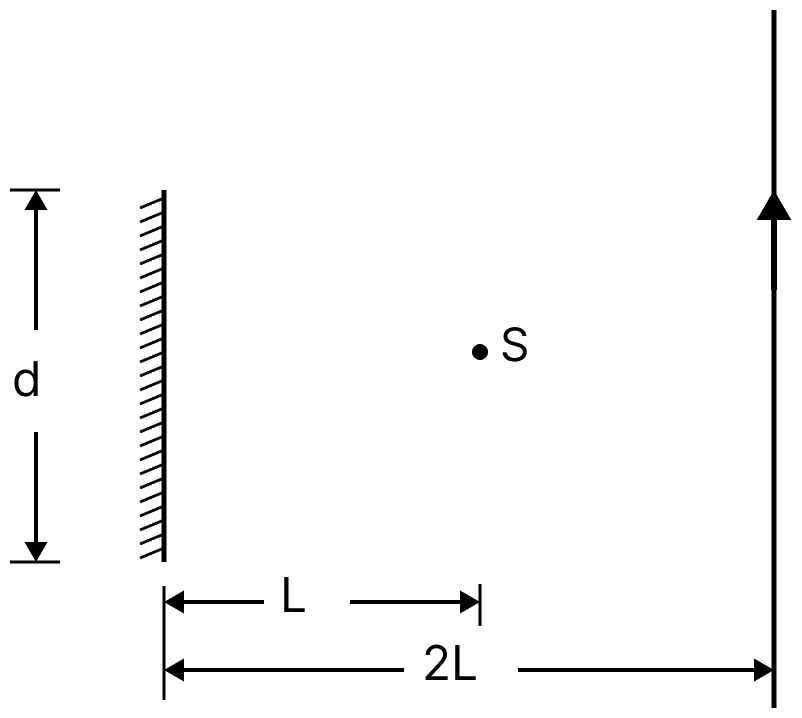
A point source of light, S is placed at a distance L in front of the centre of plane mirror of width d which is hanging vertically on a wall. A man walks in front of the mirror along a line parallel to the mirror, at a distance 2L as shown in fig. The distance over which the man can see the image of the light source in the mirror is :
- 3d
- d
- 2d
Answer
3d
Reason — Given,
- Distance of the source S from the mirror = L
- Width of the mirror = d
- Distance of the man's line from the mirror = 2L
The plane mirror forms the image I of S at a distance L behind the mirror. The reflected rays which can reach the man appear to come from I and pass through the edges A and B of the mirror.
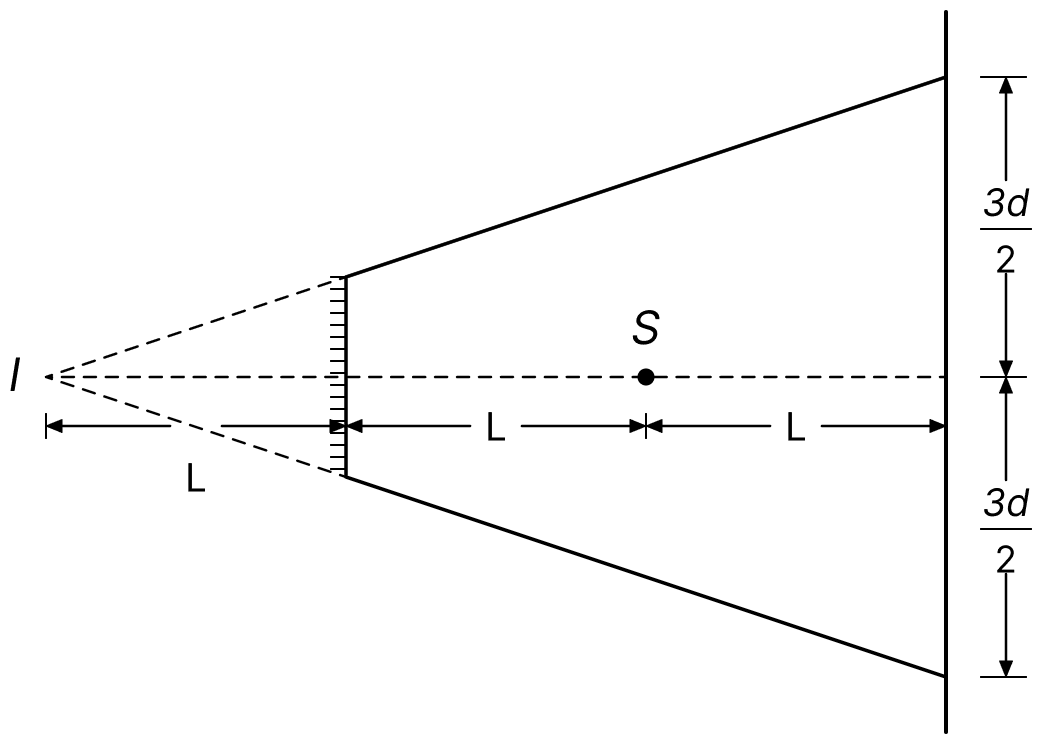
Let M be the centre of the mirror, O the point on the man's line opposite M, and P1 and P2 the extreme points on this line, with OP1 = OP2 = y. Then IM = L and IO = L + 2L = 3L. From the similar triangles AIM and P1IO,
The required distance is P1P2 = 2y = 3d.
A concave mirror for face viewing has focal length of 0.4 m. The distance at which you hold the mirror from your face in order to see your image upright with a magnification of 5 is :
- 1.60 m
- 0.24 m
- 0.16 m
- 0.32 m
Answer
0.32 m
Reason — Given,
- f = −0.4 m (concave mirror)
- m = +5 (upright, i.e. virtual and erect image)
Using the magnification formula ,
The mirror should be held at 0.32 m from the face.
An object is placed on the principal axis of a concave mirror at a distance of 1.5f (f is the focal length). The image will be at :
- 3f
- -3f
- 1.5f
- -1.5f
Answer
-3f
Reason — Given,
- Focal length of the concave mirror = −f (with sign)
From the mirror formula ,
The image is real and is formed at a distance 3f in front of the mirror.
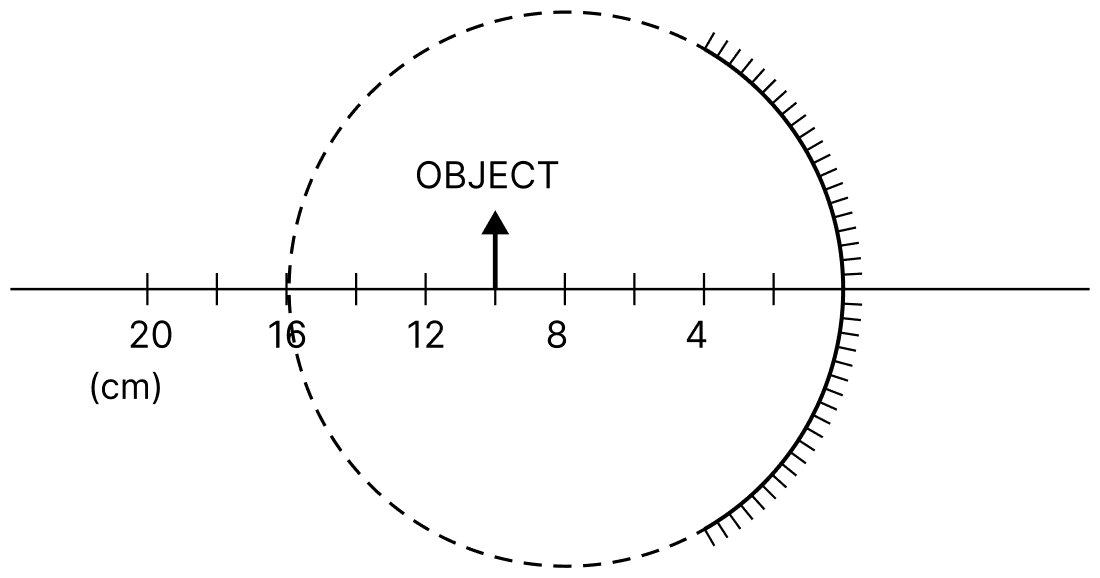
A spherical mirror is obtained as shown in the figure from a hollow glass sphere. If an object is positioned in front of the mirror, what will be the nature and magnification of the image of the object? (Figure drawn as schematic and not to scale.)
- Inverted, real and unmagnified
- Inverted, real and magnified
- Erect, virtual and magnified
- Erect, virtual and unmagnified
Answer
Inverted, real and unmagnified
Reason — Given (from the figure),
- The reflecting surface faces the object, so the mirror is concave; the sphere extends from the pole (0 cm) to the 16 cm mark, so R = 8 cm
- , i.e. f = −4 cm with sign
- The object is at the 10 cm mark, so u = −10 cm
From the mirror formula,
As m is negative the image is real and inverted, and as |m| < 1 it is smaller than the object, i.e. not magnified.
Note: "Unmagnified" in this option has to be read as "not magnified" — the image is diminished (|m| = ), not of the same size as the object.
Three plane mirrors form an equilateral triangle with each side of length L. There is a small hole at a distance l > 0 from one of the corners as shown in the figure. A ray of light is passed through the hole at an angle θ and can only come out through the same hole. The cross section of the mirror configuration and the ray of light lie on the same plane.
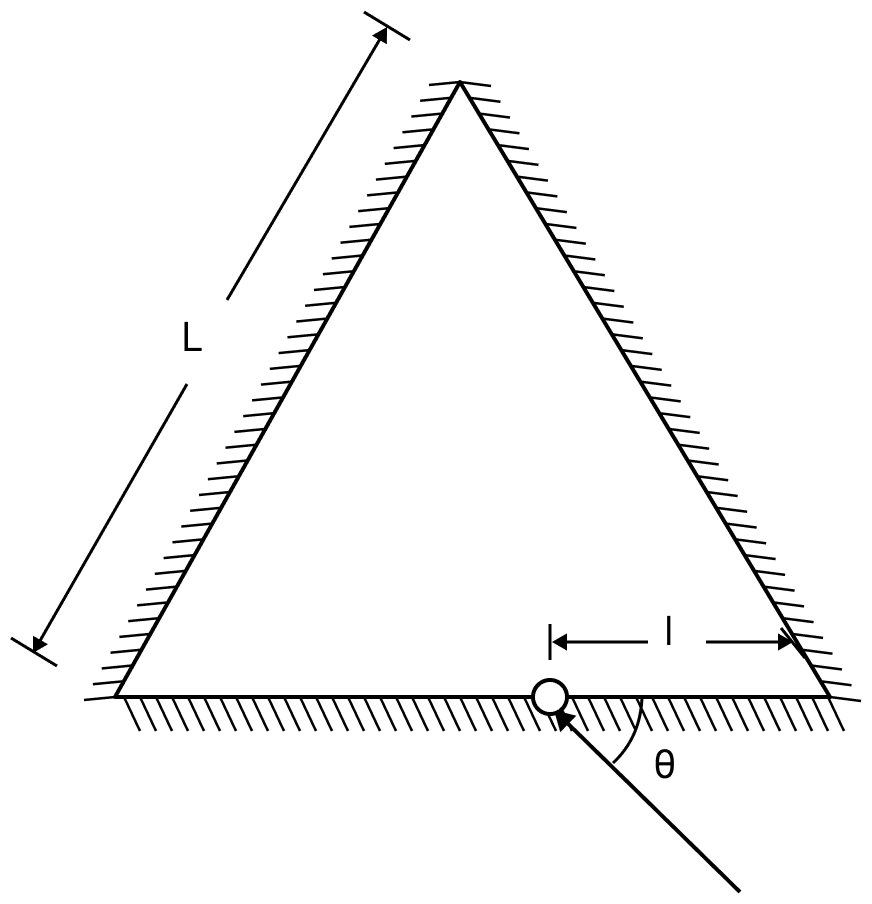
Which of the following statement(s) is (are) correct?
- The ray of light will come out for θ = 30°, for 0 < l < L
- There is an angle for at which the ray of light will come out after two reflections
- The ray of light will never come out for θ = 60°, and
- The ray of light will come out for θ = 60°, and 0 < l < after six reflections
Answer
The ray of light will come out for θ = 30°, for 0 < l < L
There is an angle for at which the ray of light will come out after two reflections
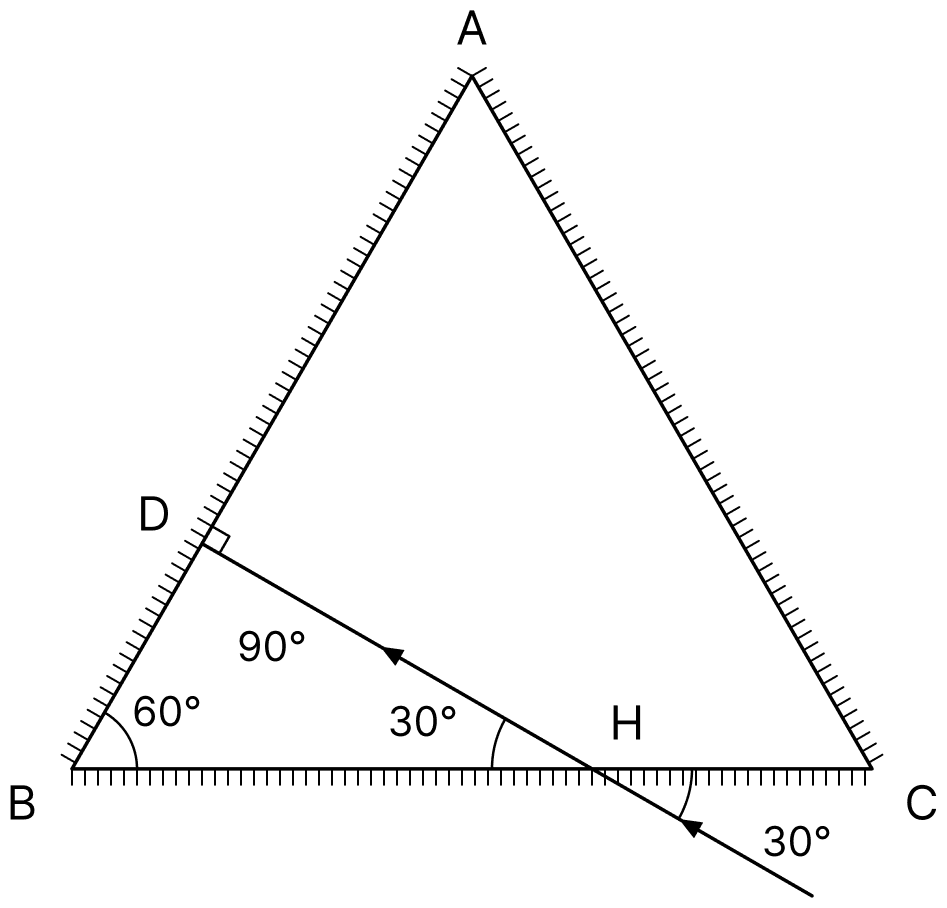
Reason — Let ABC be the triangle with BC the side carrying the hole H, B its left corner and C its right corner, so that HC = l. The ray enters at H making an angle θ with BC and travels towards the side AB.
Statement 1 : In the triangle formed by B, H and the point D where the ray meets AB, the angle at B is 60° and that at H is θ = 30°, so
The ray falls normally on AB, retraces its path and comes out through H, whatever the position of the hole. Hence statement 1 is correct.
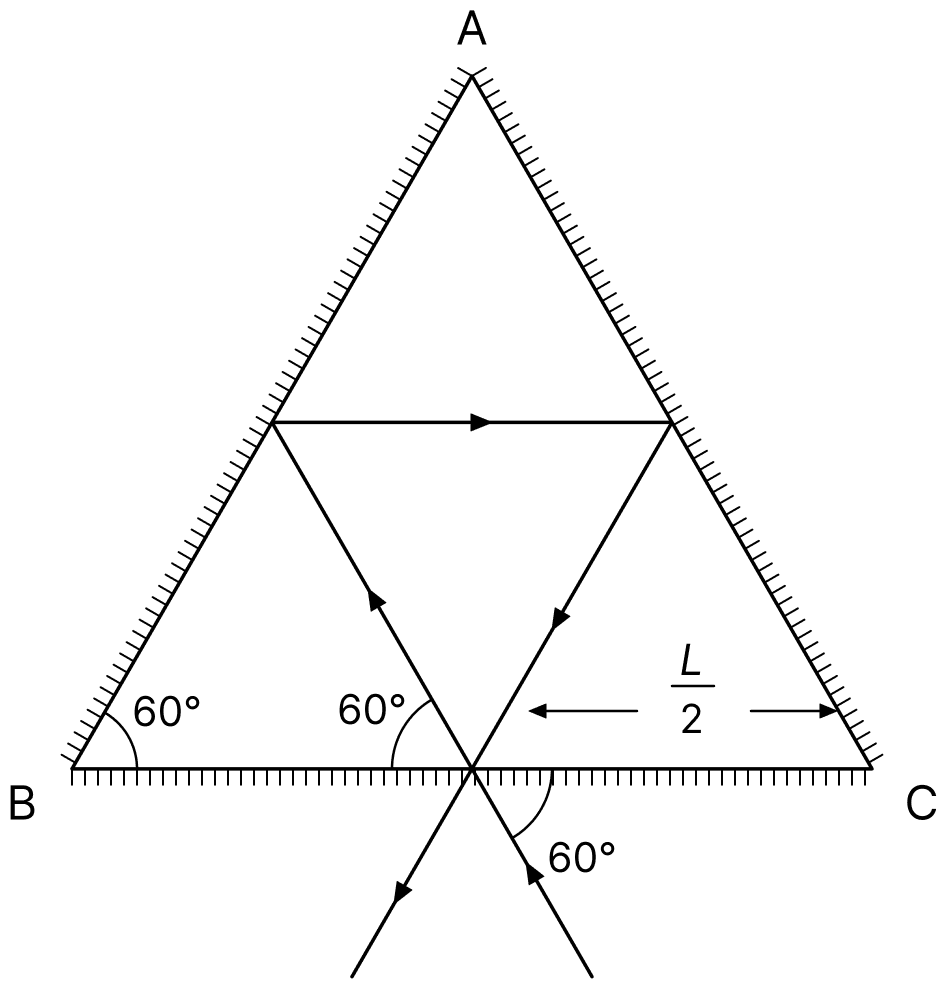
Statement 2 : For , H is the mid-point of BC. For θ = 60° the ray travels parallel to AC and meets AB at its mid-point. After reflection it travels parallel to BC to the mid-point of AC, and after the second reflection parallel to AB back to H. Hence statement 2 is correct.
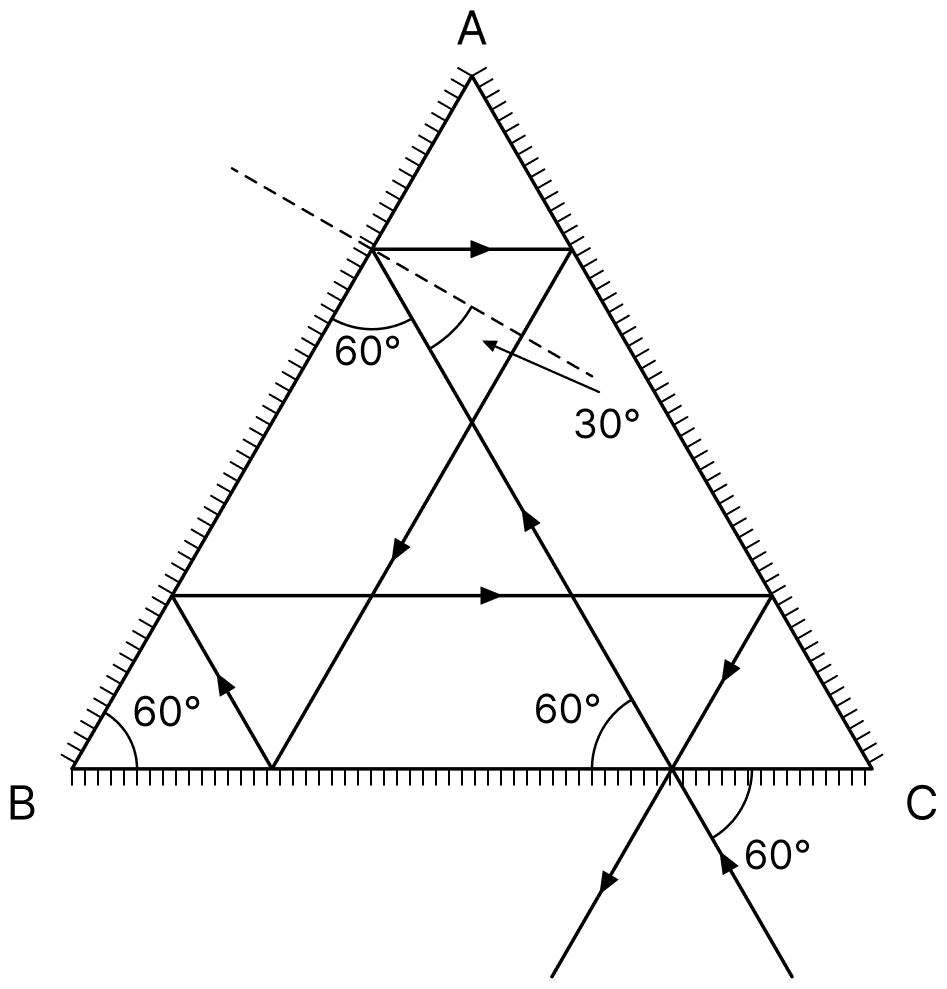
Statements 3 and 4 : For θ = 60° and any other position of the hole , the ray always travels parallel to one of the sides, and on tracing it, it returns to H after five reflections. So the ray does come out, and after five reflections, not six. Hence statements 3 and 4 are incorrect.
An object is placed at a distance of 12 cm in front of a plane mirror. The virtual and erect image is formed by the mirror. Now, the mirror is moved by 4 cm towards the stationary object. The distance by which the position of image would be shifted, will be :
- 2 cm towards mirror
- 4 cm towards mirror
- 8 cm away from mirror
- 8 cm towards mirror
Answer
8 cm towards mirror
Reason — Given,
- Initial distance of the object from the mirror = 12 cm
- Displacement of the mirror towards the object = 4 cm
A plane mirror forms the image as far behind the mirror as the object is in front of it. Initially the image is 12 cm behind the mirror, i.e. 24 cm from the object. After the shift the object is 12 − 4 = 8 cm from the mirror, so the image is 8 cm behind it, i.e. 16 cm from the object.
The image shifts through 8 cm (twice the displacement of the mirror) in the direction in which the mirror moves, i.e. towards the mirror.
If the distance between object and its two times magnified virtual image produced by a curved mirror is 15 cm, the focal length of the mirror must be :
- 15 cm
- -12 cm
- -10 cm
- cm
Answer
-10 cm
Reason — Given,
- Magnification, m = +2 (virtual and magnified image, so the mirror is concave)
- Distance between the object and the image = 15 cm
Let the object be at a distance x in front of the mirror, so u = −x. Then
The image is 2x behind the mirror, so the distance between the object and the image is
Hence u = −5 cm and v = +10 cm. From the mirror formula,
When an object is kept at a distance of 30 cm from a concave mirror, the image is formed at a distance of 10 cm from the mirror. If the object is moved with a speed of 9 cm s-1, the speed (in cm s-1) with which image moves at that instant is ............... cm s-1.
Answer
Given,
- Object distance, u = −30 cm
- Image distance, v = −10 cm (the image is diminished, so it is the real image formed by the concave mirror)
- Speed of the object, Vom = 9 cm s-1
The magnification is
The velocity of the image is related to the velocity of the object by
Substituting the values,
Hence, the image moves with a speed of 1 cm s-1 at that instant.
A point source of light S, placed at a distance 60 cm in front of the centre of a plane mirror of width 50 cm, hangs vertically to a wall. A man walks in front of the mirror along a line parallel to the mirror at a distance 1.2 m from it (see in the figure). The distance between the extreme points where he can see the image of the light source in the mirror is ............... cm.
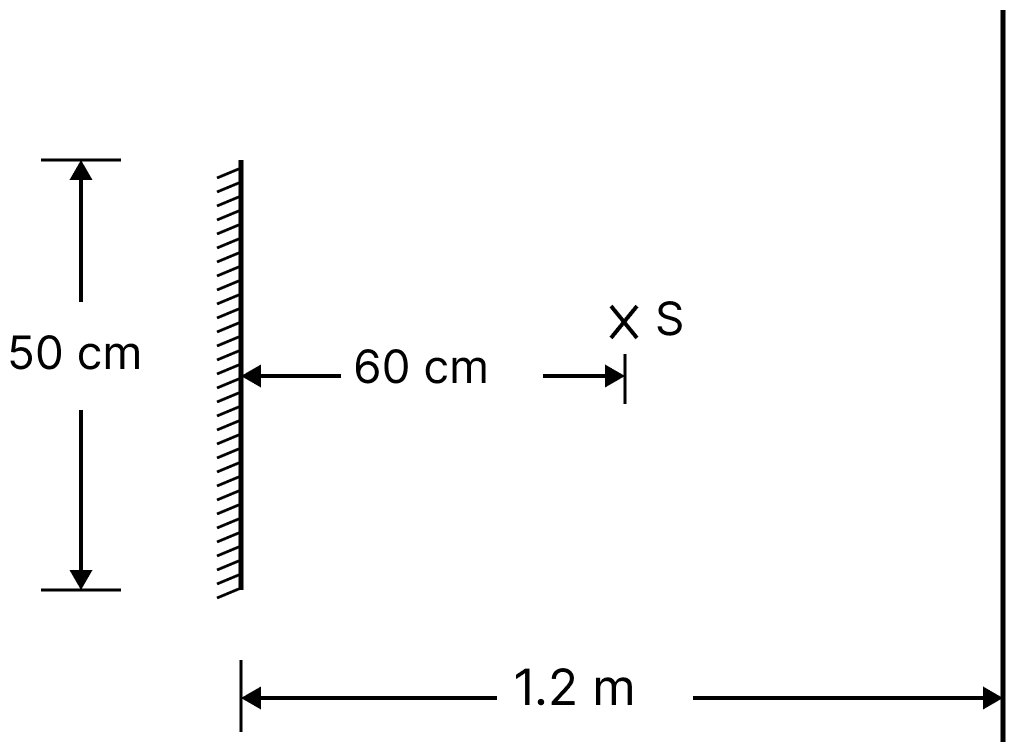
Answer
Given,
- Distance of the source S from the mirror = 60 cm
- Width of the mirror, AB = 50 cm
- Distance of the man's line from the mirror = 1.2 m = 120 cm
The plane mirror forms the image S' of S at 60 cm behind the mirror. The reflected rays which reach the man appear to come from S' and pass through the edges A and B of the mirror.
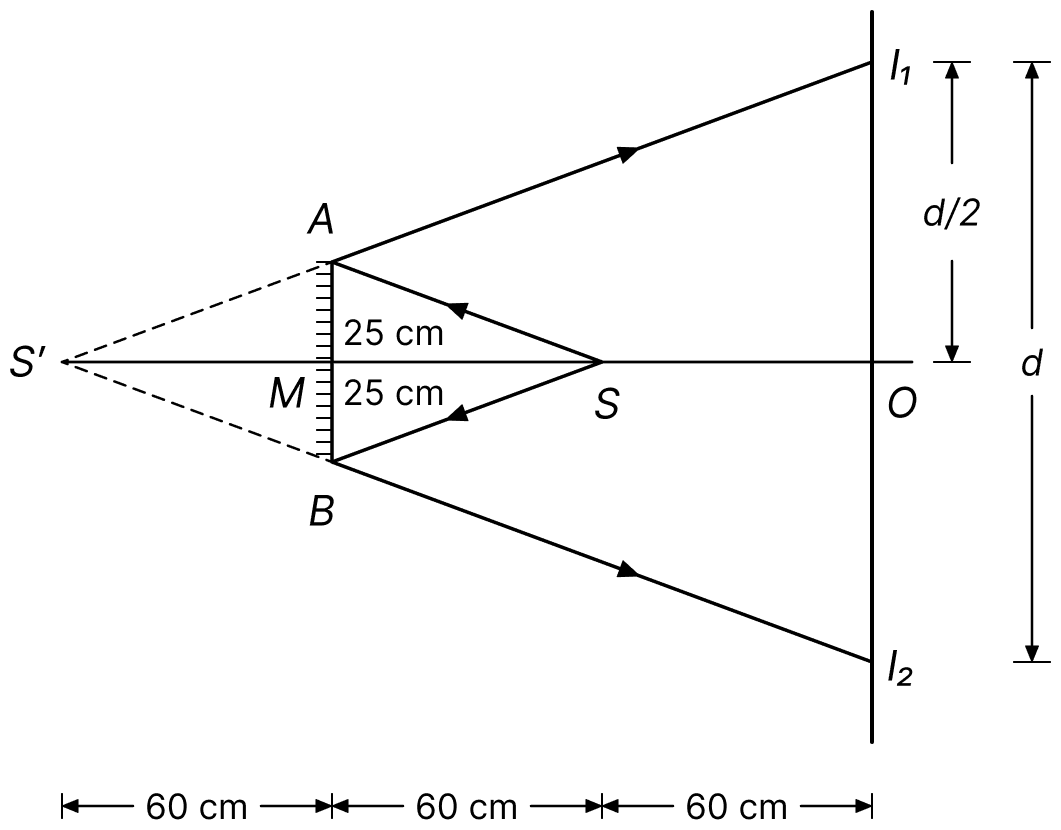
Let M be the centre of the mirror, O the point on the man's line opposite M, and I1 and I2 the extreme points on this line. Then AM = 25 cm, S'M = 60 cm and S'O = 60 + 120 = 180 cm.
From the similar triangles AS'M and I1S'O,
By symmetry, I2O = 75 cm. Therefore,
Hence, the distance between the extreme points where the man can see the image of the light source is 150 cm.
An object and a concave mirror of focal length f = 100 cm both move along the principal axis of the mirror with constant speeds. The object moves with speed vo = 15 cm s-1 towards the mirror with respect to a laboratory frame. The distance between the object and the mirror at a given moment is denoted by u. When u = 30 cm, the speed of the mirror vm is such that the image is instantaneously at rest with respect to the laboratory frame, and the object forms a real image. The magnitude of vm is ............... cm s-1.
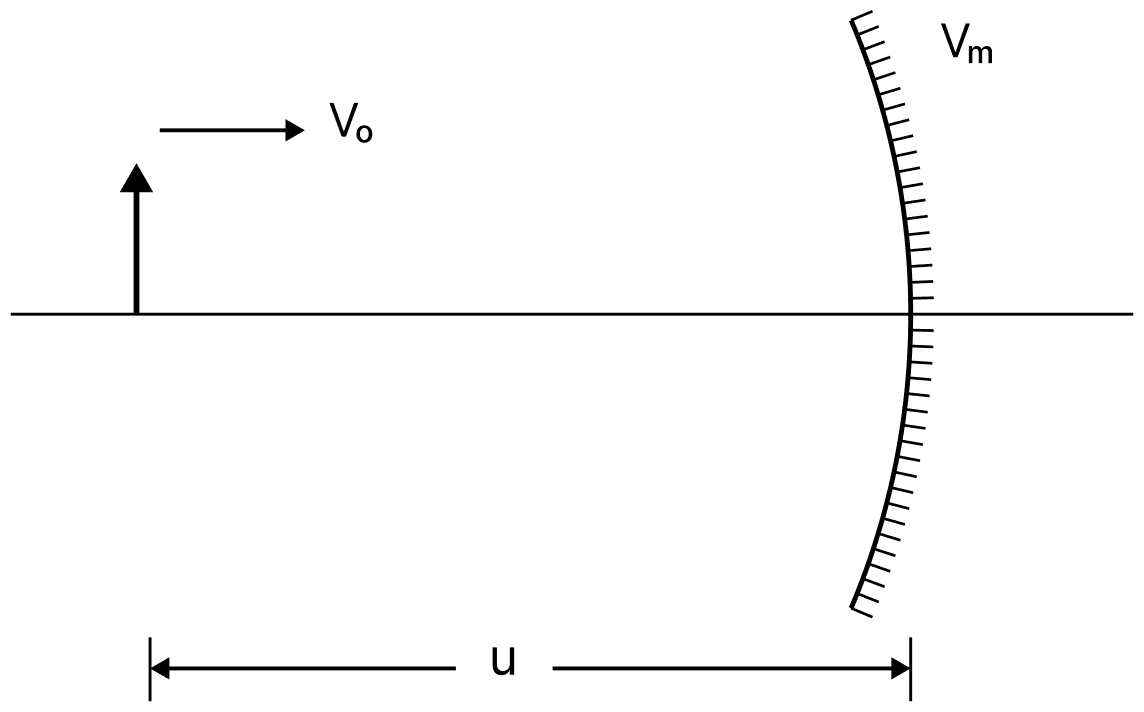
Answer
Given,
- Focal length of the concave mirror = 10 cm, so f = −10 cm (see Note)
- Speed of the object towards the mirror, vo = 15 cm s-1
- Object distance, u = −30 cm
- The object forms a real image which is instantaneously at rest
Image position : From the mirror formula,
Velocity of the mirror : Taking velocities along the direction of motion of the object as positive, let vi be the velocity of the image in the laboratory frame. The velocity of the image relative to the mirror is related to that of the object relative to the mirror by
As the image is instantaneously at rest, vi = 0,
The positive sign shows that the mirror moves in the same direction as the object.
Hence, the magnitude of vm is 3 cm s-1.
Note: The question prints f = 100 cm, for which the object at u = 30 cm would lie within the focus and form a virtual image; the intended value, used in the textbook's own solution, is f = 10 cm.
Two vertical parallel mirrors A and B are separated by 10 cm. A point object O is placed at a distance of 2 cm from mirror A. The distance of the second nearest image behind mirror A from the mirror A is ............... cm.
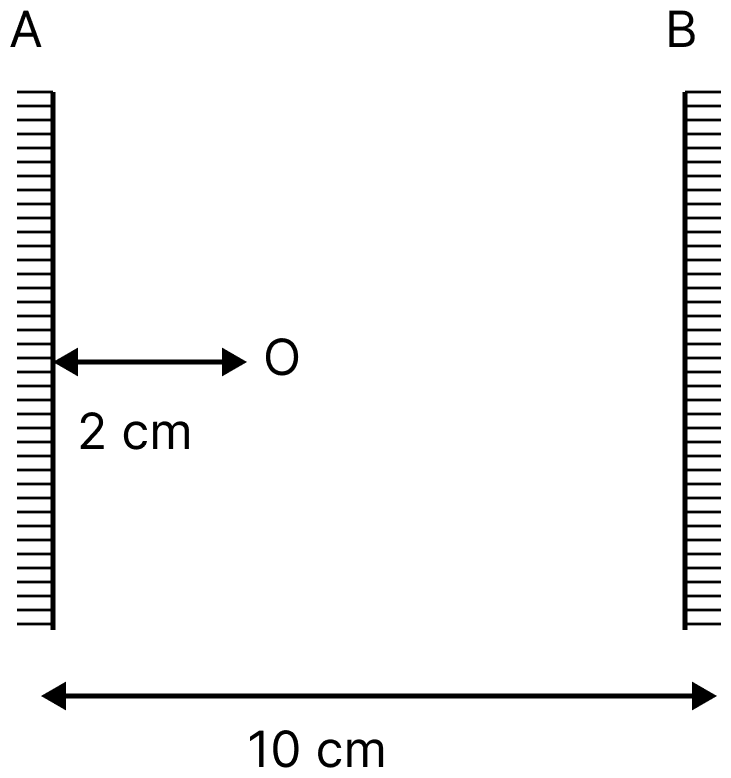
Answer
Given,
- Separation between the mirrors A and B = 10 cm
- Distance of the object O from A = 2 cm, so its distance from B = 8 cm
A plane mirror forms the image as far behind the mirror as the object (or image acting as object) is in front of it.
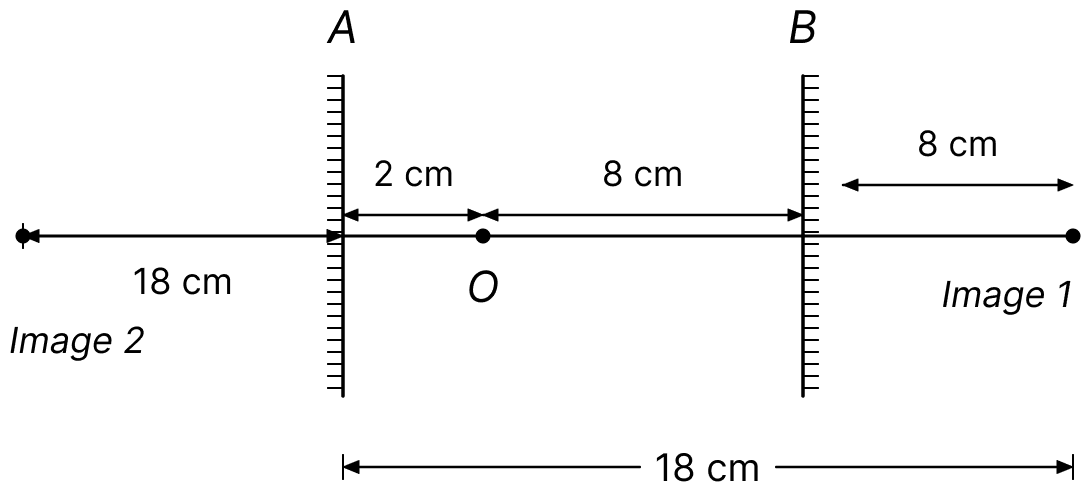
First (nearest) image behind A : Formed by direct reflection of O in A, at 2 cm behind A.
Second image behind A : The image of O in B is formed 8 cm behind B, i.e. at a distance 10 + 8 = 18 cm from A. Light reflected from B and then from A forms the image of this image in A, at 18 cm behind A. Every later image behind A lies farther away.
Hence, the distance of the second nearest image behind mirror A from the mirror A is 18 cm.
A thin cylindrical rod of length 10 cm is placed horizontally on the principal axis of a concave mirror of focal length 20 cm. The rod is placed in such a way that mid-point of the rod is at 40 cm from the pole of mirror. The length of the image formed by the mirror will be cm. The value of x is ............... .
Answer
Given,
- Length of the rod = 10 cm, with its mid-point at 40 cm from the pole
- f = −20 cm (concave mirror)
The ends of the rod are at 40 − 5 = 35 cm and 40 + 5 = 45 cm from the pole. Let A be the farther end and B the nearer end, so uA = −45 cm and uB = −35 cm.
Image of end A : From the mirror formula,
Image of end B :
Length of the image :
Comparing with cm,
Hence, the value of x is 32.