
What was the fissionable material used in the bomb dropped at Nagasaki (Japan) in the year 1945?
- Uranium
- Neptunium
- Helium
- Plutonium
Answer
Plutonium
Reason — The bomb dropped at Nagasaki was a fission bomb in which plutonium (94Pu239) was the fissionable material. The critical size of Pu239 is smaller than that of U235, and being chemically different from uranium it is easily separated, so it is used in nuclear bombs in place of U235.
The energy of thermal neutrons is of the order of:
- 1 MeV
- 1 eV
- 10-2 eV
- 10-4 eV
Answer
10-2 eV
Reason — Thermal neutrons are slow neutrons in thermal equilibrium with the moderator at ordinary temperature. Their energy is about 0.03 eV, which is of the order of 10-2 eV.
In a nuclear reactor:
- moderator is used to control the number of neutrons
- moderator is used to slow down the neutrons
- controller rods are used to slow down the neutrons
- coolant is used to slow down the neutrons
Answer
moderator is used to slow down the neutrons
Reason — The moderator slows down the fast fission neutrons to thermal energies through elastic collisions between its nuclei and the neutrons. The number of neutrons is controlled by the control rods, not by the moderator or the coolant.
The moderator in the nuclear reactor at Trombay is:
- uranium
- graphite
- heavy water
- cadmium
Answer
heavy water
Reason — The reactors at Trombay, such as the research reactor CIRUS (1960), use heavy water as the moderator. Heavy water has a low probability of absorbing neutrons and a high moderating ratio.
The controller rods in a nuclear reactor are made of:
- cadmium
- uranium
- graphite
- plutonium
Answer
cadmium
Reason — Control rods are made of cadmium (or boron) because cadmium has a high cross-section for absorbing slow (thermal) neutrons.
Cadmium rods are used in a nuclear reactor as:
- control rods
- fuel rods
- coolant
- moderator
Answer
control rods
Reason — Cadmium is a good absorber of slow neutrons. Cadmium rods pushed into the reactor absorb the excess neutrons and so control the fission rate.
During a nuclear fusion reaction:
- a heavy nucleus breaks into two fragments by itself
- a light nucleus bombarded by thermal neutrons breaks up
- a heavy nucleus bombarded by thermal neutrons breaks up
- two light nuclei combine to give a heavier nucleus and possibly other products
Answer
two light nuclei combine to give a heavier nucleus and possibly other products
Reason — In nuclear fusion, two or more very light nuclei fuse together to form a single heavier nucleus, releasing energy. Break-up of a heavy nucleus is fission, not fusion.
When two light nuclei of masses M1 and M2 fuse to form a nucleus of mass M, energy is emitted. In this process:
- M1 + M2 > M
- M1 + M2 < M
- M1 + M2 = M
- M1 + M2 > M2
Answer
M1 + M2 > M
Reason — In fusion the mass of the product nucleus is less than the sum of the masses of the fused nuclei, and the lost mass appears as energy,
Since energy is emitted, E > 0, so M1 + M2 > M.
The equation 4 1H1 → 2He4 + 2 +1β0 + 26 MeV represents:
- β-decay
- γ-decay
- fusion
- fission
Answer
fusion
Reason — Four hydrogen nuclei combine to form one helium nucleus, with the emission of two positrons and about 26 MeV of energy. Light nuclei combining into a heavier nucleus is nuclear fusion; this is the reaction by which the sun produces its energy.
The nuclear fusion is possible only at very high temperatures because at such temperatures:
- atoms are ionised
- atoms are disintegrated
- nuclei are disintegrated
- nuclei are so much energized that they are able to overcome the mutual repulsion
Answer
nuclei are so much energized that they are able to overcome the mutual repulsion
Reason — The nuclei to be fused are positively charged and repel one another strongly. They fuse only when they come very close with high kinetic energies (≈ 0.1 MeV), and such energies are available only at temperatures of the order of 108 K.
The hydrogen bomb is based on:
- nuclear fission only
- nuclear fusion only
- fission and fusion both
- radioactivity
Answer
fission and fusion both
Reason — A hydrogen bomb releases its energy by the fusion of heavy-hydrogen nuclei. The very high temperature needed to start this fusion is produced by exploding a nuclear-fission bomb inside it, so both processes are involved.
The sun obtains its radiant energy from:
- fission process
- disintegration process
- photoelectric process
- fusion process
Answer
fusion process
Reason — The source of the huge solar energy is the fusion of lighter nuclei. In the interior of the sun (about 2 × 10⁷ K), hydrogen nuclei fuse into helium nuclei through the carbon cycle and the proton-proton cycle.
Fission of nuclei is possible because the binding energy per nucleon in them:
- increases with mass number at low mass numbers
- decreases with mass number at low mass numbers
- increases with mass number at high mass numbers
- decreases with mass number at high mass numbers
Answer
decreases with mass number at high mass numbers
Reason — Heavy nuclei (A ≈ 240) have a binding energy of about 7.6 MeV per nucleon, while fission fragments (A ≈ 70 to 160) have about 8.5 MeV per nucleon. Since the binding energy per nucleon decreases with mass number at high mass numbers, splitting a heavy nucleus into two middle-order nuclei increases it by about 0.9 MeV per nucleon, and this energy is released.
Statement I: Energy is released when heavy nuclei undergo fission or light nuclei undergo fusion.
Statement II: For heavy nuclei, binding energy per nucleon increases with increasing Z while for light nuclei, it decreases with increasing Z.
- Statement I is true, Statement II is true; Statement II is not a correct explanation of Statement I.
- Statement I is true, Statement II is false.
- Statement I is false, Statement II is true.
- Statement I is true, Statement II is true; Statement II is a correct explanation of Statement I.
Answer
Statement I is true, Statement II is false.
Reason — Statement I is true, since in both fission of heavy nuclei and fusion of light nuclei the products have a greater binding energy per nucleon, so energy is released. Statement II is false: the trends are stated the wrong way round. For heavy nuclei the binding energy per nucleon decreases with increasing Z, while for light nuclei it increases with increasing Z.
In the nuclear fusion reaction,
21H + 31H → 42He + 10n
Given that the repulsive potential energy between the two nuclei is 7.7 × 10⁻¹⁴ J, the temperature at which the gases must be heated to initiate the reaction is nearly:
(Boltzmann's constant, k = 1.38 × 10⁻²³ J/K)
- 107 K
- 105 K
- 103 K
- 109 K
Answer
109 K
Reason — To initiate the reaction, the average kinetic energy of the nuclei, , must be about equal to the repulsive potential energy U between them,
which is of the order of 109 K.
What is nuclear fission? Give one representative equation.
Answer
Nuclear fission is the process in which a heavy nucleus, on capturing a slow (thermal) neutron, splits into two lighter nuclei of comparable masses, with the emission of two or three fast neutrons and a large amount of energy.
A representative equation is
92U235 + 0n1 → 56Ba141 + 36Kr92 + 3 0n1 + 200 MeV energy
What is nuclear fusion? Give one representative equation.
Answer
Nuclear fusion is the process in which two or more very light nuclei fuse together to form a single heavier nucleus, with the liberation of energy.
A representative equation is
1H3 + 1H2 → 2He4 + 0n1 + 17.6 MeV energy
What are thermal neutrons?
Answer
Thermal neutrons are slow neutrons which are in thermal equilibrium with the moderator at NTP. Their energy is about 0.03 eV.
Why is a definite minimum size of U235 essential for the phenomenon of nuclear fission?
Answer
If the size of the U235 piece is too small, most of the neutrons produced in fission escape through its surface before causing further fissions, and the chain reaction stops. Hence a minimum (critical) size is essential to sustain the chain reaction.
Name the reaction responsible for energy production in the sun.
Answer
Thermonuclear fusion.
Explanation:
In the interior of the sun, at about 2 × 10⁷ K, four hydrogen nuclei fuse together to form a helium nucleus through the proton-proton cycle and the carbon cycle, releasing about 26.7 MeV of energy for every helium nucleus formed.
Explain the term 'chain reaction' with a suitable example.
Answer
If a nuclear reaction itself produces the particles that initiated it, then under favourable conditions these particles initiate the same reaction in other nuclei, and the reaction keeps itself going. A chain of reactions is thus established, called a chain reaction.
Example : When a slow neutron strikes a U235 nucleus, the nucleus splits into two fragments with the emission of two or three fast neutrons and about 200 MeV of energy,
92U235 + 0n1 → 56Ba141 + 36Kr92 + 3 0n1 + Q
These neutrons fission other nearby U235 nuclei, which release still more neutrons. The number of fissions thus increases very fast, and the reaction continues until the whole uranium is consumed.
Why is U235, and not U238, suitable for maintaining a chain reaction?
Answer
U238 can be fissioned only by fast neutrons of energy above 1 MeV. The neutrons released in fission (≈ 2 MeV) have a much larger probability of being scattered by U238 than of fissioning it; their energy falls below 1 MeV and they are then absorbed by U238 without fission. Hence U238 cannot continue the chain reaction.
U235, on the other hand, is fissioned by slow and even by thermal neutrons. Thermal neutrons have a much higher probability of fissioning U235 than of being absorbed by U238, so U235 is able to maintain the chain reaction.
What is meant by 'critical mass' in nuclear chain reaction?
Answer
The minimum size of the fissionable material for which the multiplication factor K = 1, that is, for which the number of neutrons produced in fission just equals the number lost by absorption and by escape through the surface, is called the critical size. The mass of the fissionable material of critical size is called the critical mass.
It is the minimum mass needed to sustain a chain reaction. With less than the critical mass, too many neutrons escape and the chain reaction stops.
What is the difference between nuclear fission and radioactive disintegration?
Answer
| Radioactive disintegration | Nuclear fission |
|---|---|
| It is a spontaneous phenomenon. | It is not spontaneous; the heavy nucleus has to be bombarded by neutrons. |
| α- or β-particles are emitted, and the energy released (as γ-rays) is not very large. | The heavy nucleus breaks into two nearly equal lighter nuclei, and a very large energy (≈ 200 MeV) is liberated. |
| The atomic number changes by 1 or 2 and the mass number by 0 or 4. | The atomic number and the mass number are almost equally distributed between the two fragments. |
| Its rate cannot be controlled in any way. | Its rate can be controlled. |
Explain the role of the moderator in a nuclear reactor.
Answer
The fission of uranium in a reactor releases fast neutrons (≈ 2 MeV). Unless these fast neutrons are slowed down, their probability of fissioning 92U235 is negligible.
The moderator slows down the fast neutrons to thermal energies (≈ 0.03 eV). The fast neutrons collide repeatedly with the nuclei of the moderator and lose energy in these elastic collisions. The thermal neutrons so obtained have a very high probability of fissioning 92U235, and the chain reaction is sustained. Heavy water, graphite and beryllium oxide are used as moderators.
Explain the role of control rods in a nuclear reactor. Why are they made of cadmium?
Answer
For a controlled chain reaction, on the average only one neutron per fission should remain available for further fission. Control rods absorb the excess neutrons produced in each fission. When they are pushed into the reactor the fission rate decreases, and when they are pulled out the fission rate increases.
They are made of cadmium because cadmium has a high cross-section for absorbing slow (thermal) neutrons.
Both 92U235 and 94Pu239 are fissionable, but 94Pu239 is used more in bombs and reactors. Why?
Answer
(i) The separation of 92U235 from natural uranium, in which it is only 0.7%, is difficult and costly, and its use would soon deplete the uranium reserves.
(ii) 94Pu239 can be produced from the abundant 92U238 in reactors, and being chemically different from uranium, it is easily separated.
(iii) The critical size of 94Pu239 is smaller than that of 92U235 for the chain reaction.
Hence the use of Pu239 is more economical than that of U235.
What is the difference between thermal reactor and breeder reactor?
Answer
| Thermal reactor | Breeder reactor |
|---|---|
| Energy is produced by the fission of U235 by slow (thermal) neutrons. | Along with producing energy, it produces fissionable Pu239 from U238 and U233 from Th232. |
| It uses up U235, which is only 0.7% of natural uranium, leading to early depletion of uranium reserves. | It makes use of the abundant U238 and Th232. |
| The fissionable material produced is less than that consumed. | The fissionable material produced is more than that consumed. |
Explain briefly what is 'thermonuclear fusion'. Illustrate it by giving equation of nuclear reaction.
Answer
Fusion of light nuclei is possible only when the positively charged nuclei come very close together against their strong mutual repulsion. For this they need high kinetic energies (≈ 0.1 MeV), which are available only at a temperature of the order of 108 K. Since such very high temperatures are needed, the fusion of nuclei is called 'thermonuclear fusion', and the energy released is called thermonuclear energy.
For example,
1H3 + 1H2 → 2He4 + 0n1 + 17.6 MeV energy
The size of atom-bomb cannot be enlarged at will, whereas this can be done with hydrogen bomb, why?
Answer
In an atom-bomb the fissionable material (U235 or Pu239) cannot be kept in a single piece larger than the critical size, because such a piece would explode on its own by the chain reaction started by stray neutrons. The size of an atom-bomb is therefore limited by the critical mass.
Fusion has no critical size. Any amount of heavy hydrogen can be put in a hydrogen bomb, since the fusion starts only when the very high temperature is produced by the exploding fission bomb. Hence the size of a hydrogen bomb can be enlarged at will.
Why is it difficult to separate 92U235 from 92U238?
Answer
The isotopes 92U235 and 92U238 are chemically identical, so they can be separated only by a physical process based on atomic mass, such as diffusion. The ratio of their atomic masses is very close to 1, so the root-mean-square velocities of their atoms differ very little,
Hence a gaseous compound of uranium (UF6) has to be diffused thousands of times to separate them.
Complete the equation: 92U235 + 0n1 → ...............
Answer
92U235 + 0n1 → (92U236) → 56Ba141 + 36Kr92 + 3 0n1 + Q (energy)
Explanation:
The mass number (235 + 1 = 141 + 92 + 3 = 236) and the charge number (92 + 0 = 56 + 36 = 92) are balanced on both sides, and Q is about 200 MeV.
Heavy water is a suitable moderator in a nuclear reactor. Explain briefly why?
Answer
A moderator is most effective in slowing down neutrons when the mass of its nuclei is of the order of the mass of the neutron, because the neutron then loses a large part of its energy in each elastic collision. If the nucleus is too heavy, the neutron rebounds with almost the same speed.
Heavy water contains heavy-hydrogen nuclei (1H2), whose mass is of the order of the mass of the neutron. Moreover, heavy water has a low probability of absorbing neutrons. Hence heavy water slows down the neutrons most effectively and is a suitable moderator.
Neutrons can be slowed down even by ordinary water which has hydrogen-nuclei (1H1) having mass almost equal to that of neutron. Then, why is heavy water used for this purpose in a reactor?
Answer
Hydrogen nuclei of ordinary water have a greater probability of capturing the colliding neutrons than of merely slowing them down,
1H1 + 0n1 → 1H2 + γ
These captured neutrons are lost to the chain reaction. Heavy water has a negligible cross-section for neutron capture, so it slows down the neutrons without absorbing them. That is why heavy water is used, and a reactor using heavy water can work with natural uranium.
What are delayed neutrons? What is their role in a nuclear reactor?
Answer
Most of the fission neutrons are emitted promptly, but about 0.7% of them are emitted a few seconds after the fission, in the subsequent decays of the fission fragments. These are called delayed neutrons.
The delayed neutrons increase the overall average lifetime of the fission neutrons from about 10-3 s (prompt neutrons in a graphite reactor) to about 0.1 s. This gives sufficient time to adjust the control rods. If all the neutrons were prompt, the reactor would become supercritical and unmanageable.
What may be the safety problems that a nuclear engineer must cope with in reactor design?
Answer
(i) Safe disposal of the nuclear waste, which contains long-lived radioisotopes.
(ii) An efficient cooling system to prevent accidents due to excessive heating of the reactor core.
(iii) A thick concrete shield to protect the people working near the reactor from the intense radiation.
(iv) A safety device (shut-off rods) that enters the reactor automatically in an emergency and stops the chain reaction.
State the processes taking place in the following situations:
(i) When a slow neutron goes sufficiently close to a U235 nucleus.
(ii) When a neutron goes sufficiently close to a proton.
What will be the similarities and dissimilarities between these processes?
Answer
(i) Nuclear fission takes place: the U235 nucleus captures the slow neutron and splits into two lighter nuclei, along with 2 or 3 neutrons and energy.
(ii) Nuclear fusion takes place: the neutron and the proton fuse to form a deuteron,
1H1 + 0n1 → 1H2 + γ
Similarity : In both processes, the binding energy per nucleon of the product is greater, so mass is lost and energy is liberated.
Dissimilarity : In the first process, lighter nuclei are formed from a heavy nucleus; in the second, a heavier nucleus is formed from lighter particles.
Explain the process of nuclear fission due to bombardment by neutrons on uranium nuclei.
Answer
Natural uranium is a mixture of two isotopes, 92U238 and 92U235, in the ratio 145 : 1. The isotope 92U238 can be fissioned only by fast neutrons of energy above 1 MeV, while 92U235 can be fissioned by slow and even by thermal (≈ 0.03 eV) neutrons.
When a slow neutron strikes a 92U235 nucleus, it is captured and a new isotope 92U236 is formed. This isotope is highly unstable and at once breaks up into two fragments of comparable masses, with the emission of two or three fast neutrons and energy,
92U235 + 0n1 → (92U236) → 56Ba141 + 36Kr92 + 3 0n1 + Q (energy)
The fission fragments are radioactive isotopes of elements in the mass-number range of about 70 to 160, and they undergo several β-decays to reach stable end-products.
The binding energy per nucleon of the fragments (≈ 8.5 MeV) is greater than that of the heavy nucleus (≈ 7.6 MeV) by about 0.9 MeV, so about 200 MeV of energy is released per fission, mostly as the kinetic energy of the fragments and the neutrons.
What is meant by nuclear fission? The fission process itself is not a chain reaction, why? Explain what step is taken to obtain chain reaction.
Answer
Nuclear fission is the process in which a heavy nucleus, after capturing a thermal neutron, splits into two lighter nuclei of comparable masses, with the release of a few fast neutrons and a large amount of energy.
A single fission is not by itself a chain reaction; the reaction becomes a chain only if the neutrons it releases go on to fission other nuclei. In natural uranium this does not happen, for two reasons:
(i) The fission neutrons are fast (≈ 2 MeV). They are mostly scattered by 92U238, their energy falls below 1 MeV, and they are then absorbed by 92U238 without fission. The fissionable 92U235 is only 0.7% of natural uranium.
(ii) The fast neutrons travel about 10 cm before slowing down, so in a small block most of them escape without causing fission.
Steps taken to obtain a chain reaction :
(i) The fast neutrons are slowed down to thermal energies (≈ 0.03 eV) by a moderator such as graphite or heavy water. Their probability of absorption by 92U238 then becomes very low, while that of fissioning 92U235 becomes very high.
(ii) The size of the fissionable material is kept larger than the critical size, so that enough neutrons remain inside it to continue the reaction.
What is nuclear chain reaction? Explain, by example, what is the role of critical mass in it.
Answer
When a nuclear reaction produces the same particles which initiated it, the reaction can continue by itself in other nuclei. Such a self-propagating chain of reactions is called a nuclear chain reaction.
Example : A slow neutron splits a 92U235 nucleus, releasing about 200 MeV and two or three fast neutrons. These neutrons fission nearby 92U235 nuclei, which release more neutrons, and so on. The number of fissions increases very fast.
Role of critical mass : Let r be the radius of a piece of fissionable substance. In a certain time-interval let N neutrons be produced by fission, A be absorbed within the substance without causing fission, and L escape through its surface. N and A are proportional to the volume, while L is proportional to the surface area,
Substituting these,
where is a new constant. The chain reaction continues only if N > A + L, that is,
Thus the size of the substance must exceed a critical size , and the corresponding mass is the critical mass. Below it, too many neutrons escape and the chain reaction stops; that is why fissionable substances are stored as small balls, well below the critical size. At or above the critical mass the chain reaction is sustained.
Explain 'critical mass' and 'controlled chain reaction' in reference to a nuclear reactor.
Answer
Critical mass : The minimum size of the fissionable material for which the multiplication factor K = 1 is called its critical size, and the corresponding mass is called the critical mass. At this size the number of neutrons produced in fission just equals the number lost by absorption and by escape through the surface. Below the critical mass the chain reaction stops, so the fuel in a reactor must be at least of critical mass.
Controlled chain reaction : In a chain reaction, if extra neutrons are absorbed at each stage so that on the average only one neutron per fission remains available for further fission (K = 1), the reaction proceeds at a steady rate. This is called a controlled chain reaction.
In a nuclear reactor, this is achieved by cadmium control rods, which absorb the excess neutrons. When the rods are pushed into the reactor, the fission rate decreases; when they are pulled out, it increases. The energy is thus released at a steady, controlled rate and not as an explosion.
What are the nuclear fusion and fission processes? Explain qualitatively on the basis of binding energy, why energy is released in a fission process?
Answer
Nuclear fusion : The process in which two or more very light nuclei fuse together to form a single heavier nucleus, with the release of energy.
Nuclear fission : The process in which a heavy nucleus, after capturing a thermal neutron, splits into two lighter nuclei of comparable masses, with the release of a few neutrons and a large amount of energy.
Energy release in fission : On the binding energy curve, heavy nuclei with mass numbers near 240 have a binding energy of about 7.6 MeV per nucleon, while the fission fragments (mass numbers 70 to 160) have about 8.5 MeV per nucleon. The fragments are therefore more tightly bound, by about 0.9 MeV per nucleon. This increase in binding energy appears as a loss of mass, and the lost mass is released as energy. For a compound nucleus U236,
that is, roughly 200 MeV is released per fission.
What is nuclear fusion? How does it differ from nuclear fission? Give an example of nuclear fusion in nature.
Answer
Nuclear fusion is the process in which two or more very light nuclei, moving at very high speeds, fuse together to form a single heavier nucleus. The mass of the product nucleus is less than the sum of the masses of the fused nuclei, and the lost mass is released as energy.
| Nuclear fission | Nuclear fusion |
|---|---|
| A heavy nucleus breaks into two lighter nuclei of nearly comparable masses. | Two or more lighter nuclei fuse together to form a heavier nucleus. |
| It takes place at normal temperature and pressure. | It requires extremely high temperature and pressure. |
| Harmful radioactive wastes are produced. | The products are harmless. |
| The energy released can be controlled. | The energy released cannot be controlled at present. |
| The energy released per unit mass is smaller. | The energy released per unit mass is much larger. |
Example in nature : The energy of the sun and the stars is produced by the fusion of four hydrogen nuclei into a helium nucleus,
4 1H1 → 2He4 + 2 +1β0 + 2ν + 26.7 MeV
How is energy being produced continuously in sun? Give reactions. Why do these reactions not occur at normal temperatures?
Answer
The interior of the sun is at about 2 × 10⁷ K. At this temperature all the atoms are completely ionised into a hot plasma, and hydrogen nuclei continuously fuse into helium nuclei. In the sun this takes place mainly through the proton-proton cycle:
1H1 + 1H1 → 1H2 + +1β0 + ν ...(i)
1H2 + 1H1 → 2He3 + γ ...(ii)
2He3 + 2He3 → 2He4 + 1H1 + 1H1 ...(iii)
Reactions (i) and (ii) must occur twice for reaction (iii) to take place. Multiplying them by 2 and adding all three,
4 1H1 → 2He4 + 2 +1β0 + 2ν + γ (energy)
About 26.7 MeV is released for every helium nucleus formed. The carbon cycle, in which carbon acts as a catalyst, gives the same net result. Enormous numbers of such fusions take place continuously in the sun.
Why not at normal temperatures : The nuclei are positively charged and repel one another strongly. To fuse, they must come very close with high kinetic energies (≈ 0.1 MeV), which they possess only at temperatures of millions of kelvin. At normal temperatures their kinetic energies are far too small to overcome this repulsion.
What is nuclear fusion? Describe how the sun is emitting huge amount of energy (in the form of heat and light) continuously for billions of years (no reaction equations are required)?
Answer
Nuclear fusion is the process in which two or more very light nuclei, moving at very high speeds, fuse together to form a single heavier nucleus, with the release of energy.
Chemical reactions, gravitational contraction and radioactive decay are all far too weak to supply the sun's energy for billions of years. The source of the huge solar energy is the fusion of lighter nuclei.
About 90% of the solar mass is hydrogen and helium. The interior of the sun is at about 2 × 10⁷ K, where all the atoms are completely ionised into a hot plasma. In this plasma, hydrogen nuclei continuously fuse into helium nuclei through the carbon cycle and the proton-proton cycle. In each fusion the mass of the helium nucleus formed is less than that of the four hydrogen nuclei, and the lost mass is released as energy (about 26.7 MeV per helium nucleus).
An enormous number of such fusions take place every second, so the sun radiates energy at about 4 × 1026 J s-1, losing about 4 × 10⁹ kg of mass per second. This is very small compared with the solar mass of about 2 × 1030 kg. Hence the sun has been emitting heat and light for billions of years and will continue to do so for a very long time.
Explain energy generation in stars.
Answer
Stellar energy is the energy obtained continuously from the sun and the stars. Its source is the thermonuclear fusion of hydrogen nuclei into helium nuclei in the very hot interiors of the stars (≈ 107 K), where matter exists as a completely ionised plasma. Four hydrogen nuclei fuse into one helium nucleus through either of two cycles.
Carbon cycle (Bethe, 1939) : Carbon acts as a catalyst in a cycle of six reactions:
6C12 + 1H1 → 7N13 + γ
7N13 → 6C13 + +1β0 + ν
6C13 + 1H1 → 7N14 + γ
7N14 + 1H1 → 8O15 + γ
8O15 → 7N15 + +1β0 + ν
7N15 + 1H1 → 6C12 + 2He4
On adding,
4 1H1 → 2He4 + 2 +1β0 + 2ν + γ (energy)
The 6C12 nucleus that starts the cycle reappears at the end. About 24.7 MeV is released, and the annihilation of the two positrons with two electrons adds about 2 MeV, so about 26.7 MeV is released per helium nucleus formed.
Proton-proton cycle : Hydrogen nuclei fuse step by step (1H1 → 1H2 → 2He3 → 2He4), with the same net result and nearly the same energy.
The carbon cycle is more efficient at high temperatures and the proton-proton cycle at lower temperatures. Hence stars hotter than the sun obtain their energy largely from the carbon cycle, while the sun and cooler stars obtain it mainly from the proton-proton cycle.
A class XII student submits his Physics project assigned on the topic 'NUCLEAR REACTOR'. During evaluation, the examiner asks some questions to the student. State whether the responses of the student, in each case, are correct or incorrect. Give a reason for your answer.
(i) EXAMINER: How does a moderator work during nuclear fission reaction?
STUDENT: Moderator slows down highly energetic neutrons to thermal energies through elastic collisions between its nuclei and the fission neutrons. The thermal neutrons have a very high probability of fissioning U235 nuclei.
(ii) EXAMINER: What is the function of control rods?
STUDENT: Control rods absorb excess of neutrons.
(iii) EXAMINER: What is the function of coolant in a nuclear reactor?
STUDENT: Coolant stops the working of nuclear reactor.
Answer
(i) The response of the student is correct. In the fission of U235 highly energetic (fast) neutrons are produced. The moderator slows them down to thermal energies by elastic collisions, and thermal neutrons are far more efficient than fast neutrons in causing fission of 92U235 nuclei.
(ii) The response of the student is correct. Control rods of cadmium absorb the excess neutrons, so that on the average only one neutron per fission causes further fission. In this way they control the rate of the fission reaction.
(iii) The response of the student is incorrect. The coolant does not stop the reactor; it carries away the large amount of heat produced in the fission process and transfers it to the working liquid, keeping the reactor core cool. The reactor is stopped by pushing in the control rods (shut-off rods).
The energy of the thermal neutrons required for the fission of U235 nuclei is of the order of 0.025 eV. However, the neutrons produced in the fission of U235 possess quite large energy as compared to the energy of thermal neutrons. As these neutrons escape the U235 block without causing the fission of U235 nuclei. Due to this, in a nuclear reactor, it is important that the energy of neutrons is absorbed, and some neutrons are also absorbed.
Name the substance:
(i) used to absorb the energy of the neutrons.
(ii) used for absorbing neutrons.
(iii) Write condition when U235 is said to be of critical size.
Answer
(i) The energy of the neutrons is absorbed by the moderator, which is heavy water or graphite. The fast neutrons lose their energy in elastic collisions with its nuclei and are slowed down to thermal energies.
(ii) Neutrons are absorbed by cadmium rods (control rods), since cadmium has a high cross-section for absorbing slow neutrons.
(iii) U235 is said to be of critical size when the number of neutrons produced per second by fission is equal to the number of neutrons lost per second from the block, by absorption and by escape, so that the multiplication factor K = 1.
What do you understand by process of nuclear fission due to bombardment of thermal neutrons? Why these neutrons are called thermal neutrons? How much energy in electron-volt is possessed by these neutrons?
Answer
When a thermal neutron strikes a 92U235 nucleus, it is captured and the unstable nucleus 92U236 is formed. This at once splits into two lighter nuclei of comparable masses, with the emission of two or three fast neutrons and about 200 MeV of energy,
92U235 + 0n1 → (92U236) → 56Ba141 + 36Kr92 + 3 0n1 + Q (energy)
The energy is released because the binding energy per nucleon of the fragments (≈ 8.5 MeV) is greater than that of the heavy nucleus (≈ 7.6 MeV). The fragments are radioactive and undergo several β-decays to reach stable products. The neutrons released can fission further 92U235 nuclei after being slowed down, giving a chain reaction.
Why called thermal neutrons : These are slow neutrons which have been slowed down by the moderator until they are in thermal equilibrium with it at ordinary temperature. Their kinetic energy is then of the same order as the thermal energy kT of the molecules of the moderator, so they are called thermal neutrons.
Energy of thermal neutrons : At ordinary temperature, T ≈ 300 K,
Hence, thermal neutrons possess an energy of about 0.025 to 0.03 eV.
How much energy is released in one fission (in MeV)? Why is it difficult to sustain a chain reaction? Write some constructive use of nuclear fission.
Answer
Energy released in one fission : Heavy nuclei (A ≈ 240) have a binding energy of about 7.6 MeV per nucleon, while the fission fragments have about 8.5 MeV per nucleon. Thus about 0.9 MeV per nucleon is released. For the compound nucleus U236,
Hence, roughly 200 MeV of energy is released in one fission.
Difficulty in sustaining a chain reaction :
(i) The fission neutrons are fast (≈ 2 MeV) and have a much larger probability of being scattered by 92U238 than of fissioning it. Their energy falls below 1 MeV, and they are then absorbed by 92U238 without fission. The fissionable 92U235 is only 0.7% of natural uranium. This difficulty is overcome by slowing the neutrons to thermal energies with a moderator.
(ii) The fast neutrons travel about 10 cm before slowing down. If the block is small, most of them escape without causing fission. Hence the size of the fissionable material must exceed the critical size.
Constructive uses of nuclear fission :
(i) Generation of electricity in nuclear power stations, and propulsion of ships and submarines.
(ii) Production of Pu239, a better fissionable material, from U238.
(iii) Production of artificial radio-isotopes for use in medicine, biology, agriculture, industry and research.
(iv) Production of neutron beams for studying artificial disintegration of elements.
Draw a labelled diagram of nuclear reactor and explain the use of various parts. Name a material used as a moderator.
Answer
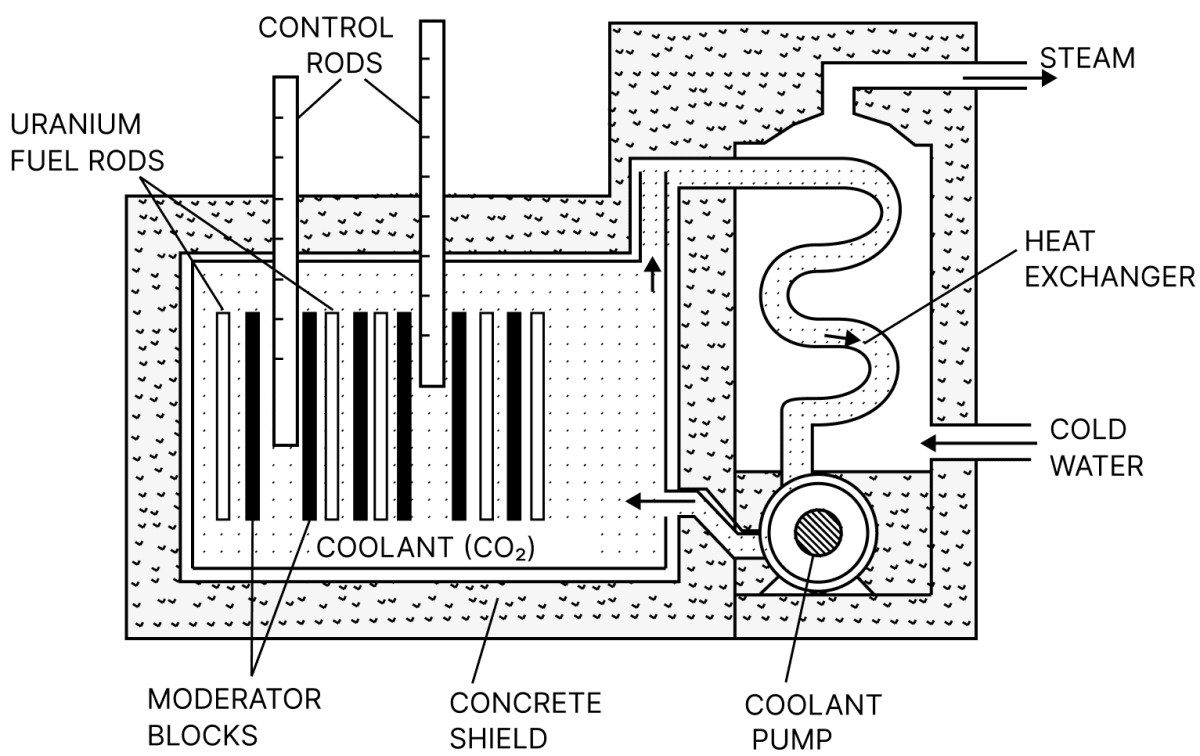
A nuclear reactor is a device in which a self-sustaining controlled chain reaction is produced in a fissionable material. Its main parts and their uses are:
(i) Fuel : Rods of uranium enriched with U235 (or Pu239), covered with close-fitting aluminium cylinders to prevent oxidation. The fission of the fuel produces the energy.
(ii) Moderator : Blocks of graphite (or heavy water) placed between the fuel rods. It slows down the fast fission neutrons to thermal energies by elastic collisions, so that they can fission U235.
(iii) Control rods : Rods of cadmium (or boron) which can be raised or lowered between the fuel rods. They absorb the excess neutrons and control the fission rate; pushing them in decreases the rate, and pulling them out increases it.
(iv) Coolant : CO2 gas, air or water pumped through the reactor. It carries away the heat produced by fission to a heat exchanger, where cold water is converted into steam to drive turbines for generating electricity.
(v) Shield : Thick concrete walls surrounding the reactor, which protect the people working near it from the intense radiation.
(vi) Safety device : Shut-off rods which enter the reactor automatically in an emergency and absorb the neutrons, so that the chain reaction stops.
Working : The reactor is started by pulling out the control rods. Stray neutrons fission U235 nuclei; the fast neutrons produced are slowed down by the moderator and cause further fissions, and a chain reaction starts. The cadmium rods are pushed in as needed so that the chain reaction stays under control.
Hence, heavy water (or graphite) is used as a moderator.
What is nuclear fusion? Write the required conditions for this reaction and explain why fusion bombs are more dangerous than fission bombs.
Answer
Nuclear fusion is the process in which two or more very light nuclei, moving at very high speeds, fuse together to form a single heavier nucleus, with the release of energy. For example,
1H2 + 1H2 → 1H3 + 1H1 + 4.0 MeV energy
1H3 + 1H2 → 2He4 + 0n1 + 17.6 MeV energy
Required conditions :
(i) Very high temperature : The nuclei are positively charged and repel each other strongly. They must have high kinetic energies (≈ 0.1 MeV) to overcome this repulsion, which needs a temperature of the order of 108 K.
(ii) Very high pressure : The nuclei must be brought very close together, so the fusing material must be at a very high pressure (density).
(iii) Confinement : At such temperatures the material is a completely ionised plasma, which must be held together long enough for fusion to occur.
Why fusion bombs are more dangerous :
(i) The energy released per unit mass of fuel is much larger in fusion. The fusion of three deuterons releases 21.6 MeV, that is, = 3.6 MeV per nucleon, whereas fission releases about ≈ 0.85 MeV per nucleon.
(ii) Fusion has no critical size, so a fusion bomb can be made as large as desired.
(iii) A fusion bomb is triggered by a fission bomb, so it also produces radioactive fallout.
The first hydrogen bomb (1954) was about 1000 times more powerful than the fission bomb dropped on Hiroshima.
Read the passage(s) and answer the following questions:
India built its first nuclear reactor, Apsara, at Trombay, Maharashtra, in the year 1956.
It was used mainly to generate electric power. Nuclear reactors are also used to produce radio-isotopes which are used in the fields of research, medicine, agriculture, etc. Unlike thermal power stations, nuclear power stations don't cause atmospheric pollution. Still, there is opposition to installing them as there is an apprehension that there may be a radiation leakage which can be harmful to the people living nearby.
(i) In a nuclear reactor, what is the function of cadmium rods?
(ii) In a nuclear reactor, which material is used as a moderator?
(iii) Give any one balanced equation representing the nuclear fission reaction.
(iv) What is 'critical mass' in nuclear chain reaction?
(v) What is the essential difference between the working of a nuclear reactor and that of a fission bomb?
Answer
(i) Cadmium rods are the control rods. They absorb the excess neutrons produced in fission and so control the rate of the fission reaction.
(ii) Heavy water is used as a moderator. (Graphite is also used.)
(iii) 92U235 + 0n1 → 56Ba141 + 36Kr92 + 3 0n1 + Q (energy)
(iv) Critical mass is the minimum mass of the fissionable substance which is necessary to sustain the chain reaction. For this mass, the multiplication factor K = 1.
(v) In a nuclear reactor, the fission chain reaction is controlled (K = 1), so energy is released at a steady rate. In a fission bomb the chain reaction is uncontrolled (K > 1), so the energy is released almost at once as an explosion.