
Which of the following does not support the wave nature of light?
- Interference
- Diffraction
- Polarisation
- Photoelectric effect
Answer
Photoelectric effect
Reason — Interference, diffraction and polarisation are all explained by the wave theory of light. The photoelectric effect can be explained only by regarding light as a stream of particles (photons), so it supports the corpuscular nature of light, not its wave nature.
Which of the following properties of light conclusively support(s) wave nature of light?
- Light obeys laws of reflection
- Light shows interference
- Light shows photoelectric effect
- Speed of light in water is greater than that in vacuum
Answer
Light shows interference
Reason — Interference is shown only by waves, so it conclusively supports the wave nature of light. The laws of reflection are explained by the corpuscular theory as well, and so do not decide between the two theories.
A plane wavefront is generated by :
- point source
- line source
- extended source
- distant source
Answer
distant source
Reason — A source sends out spherical wavefronts. At a very large distance from the source the radius of the wavefront is so large that a small portion of it is practically plane.
Two points are situated at the same distance from a light source but in opposite directions. The phase difference between the light waves from the two points will be :
- zero
- π
- none of these
Answer
zero
Reason — Both points are at the same distance from the source, so the disturbance reaches them at the same instant. They lie on the same spherical wavefront, and all points on a wavefront oscillate in the same phase.
The speed of light in vacuum depends upon :
- wavelength
- frequency
- motion of observer
- none of these
Answer
none of these
Reason — The speed of light in vacuum is a universal constant (c = 3 × 10⁸ m s-1). It is the same for all wavelengths and frequencies and does not depend on the motion of the observer.
The colour of light that travels slowest in glass is :
- red
- green
- violet
- yellow
Answer
violet
Reason — The refractive index of glass is maximum for violet light. Since , the speed of violet light in glass is the least.
The index of refraction of a medium is 1.5. If the speed of light in air is 3.0 × 10⁸ ms-1, then its speed in the medium will be :
- 2.0 × 10⁸ ms-1
- 1.2 × 10⁸ ms-1
- 4.0 × 10⁸ ms-1
- 3.2 × 10⁸ ms-1
Answer
2.0 × 10⁸ ms-1
Reason — Speed of light in the medium,
When light passes from air to glass, then :
- the wavelength increases
- the wavelength decreases
- the frequency increases
- nothing is changed
Answer
the wavelength decreases
Reason — On going from air to glass the frequency of light does not change, but its speed decreases. As , the wavelength also decreases .
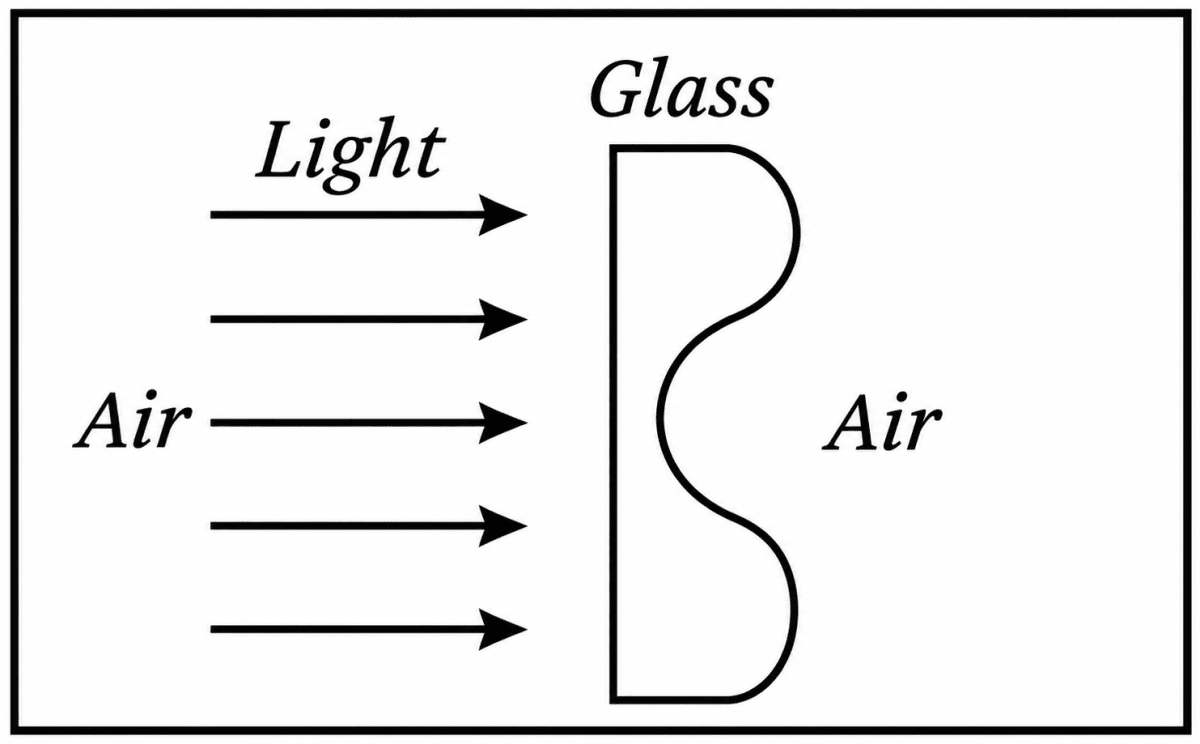
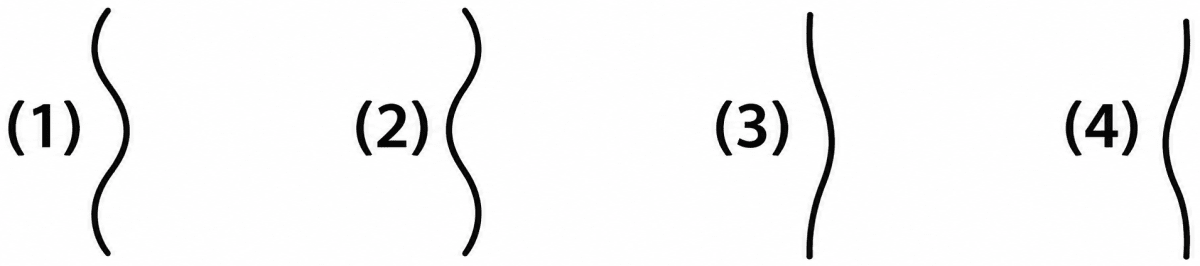
A parallel beam of light strikes a piece of transparent glass having cross-section as shown in the given figure. Correct shape of the emergent wavefront will be (figures are schematic and not drawn to scale) :
Answer
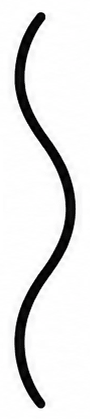
Reason — The glass is thinnest in the middle (the concave portion) and thicker in the two convex portions above and below it. Light travels slower in glass, so the parts of the wavefront crossing the thicker convex portions are delayed more, while the middle part, crossing the least thickness of glass, emerges ahead. Each convex portion converges its own part of the beam, so the emergent wavefront is made of two curved parts that meet in a point leading in the middle, as shown in the first option.
A plane wavefront is incident on a concave mirror of radius of curvature R. The radius of the reflected wavefront will be :
- 2R
- R
Answer
Reason — A concave mirror turns an incident plane wavefront into a spherical converging wavefront whose centre is the focus of the mirror. Just after reflection, its radius is equal to the focal length, .
Name one phenomenon each showing the wave nature and corpuscular nature of light respectively.
Answer
Wave nature — interference of light.
Corpuscular nature — photoelectric effect.
Why does light appear to travel in straight lines in spite of its wave nature?
Answer
The wavelength of light is very small compared with the size of ordinary obstacles and openings. Hence the bending of light around them is negligible, and light appears to travel in straight lines.
With what type of source of light are cylindrical wavefronts associated?
Answer
A line source of light, such as a fine rectangular slit.
What is internationally accepted value of velocity of light in vacuum? (All nine digits).
Answer
299792458 ms-1.
A ray of monochromatic light travelling in vacuum with speed c, wavelength λ and frequency f, enters into a medium of refractive index 1.5. What will be its new speed, wavelength and frequency?
Answer
New speed = , new wavelength = and frequency = f (unchanged).
Explanation:
The frequency is decided by the source, so it remains f in the medium. The speed in the medium is
and the new wavelength is
Out of speed, frequency, wavelength and amplitude, which parameter(s) does (do) not change on (i) reflection, (ii) refraction?
Answer
(i) On reflection — speed, frequency and wavelength do not change.
(ii) On refraction — only the frequency does not change.
Explanation:
The amplitude changes in both cases because the energy of the incident light is shared between the reflected and the refracted light.
Is the speed of light in glass independent of the colour of light? Out of red and violet light which one travels slower in a glass prism?
Answer
No. Violet light travels slower in a glass prism.
Explanation:
The refractive index of glass depends on the colour of light and is greater for violet light than for red light (nV > nR). As , vV < vR.
Give the ratio of velocities of light of wavelengths 4000 Å and 8000 Å in vacuum.
Answer
1 : 1.
Explanation:
In vacuum, light of all wavelengths travels with the same speed c.
A monochromatic beam of light travelling in vacuum enters a medium of refractive index n. What is the relation between the wavelengths of the incident and the refracted light waves?
Answer
, i.e., .
Explanation:
The frequency does not change on refraction, while the speed decreases from c to . As , the wavelength also becomes n times smaller.
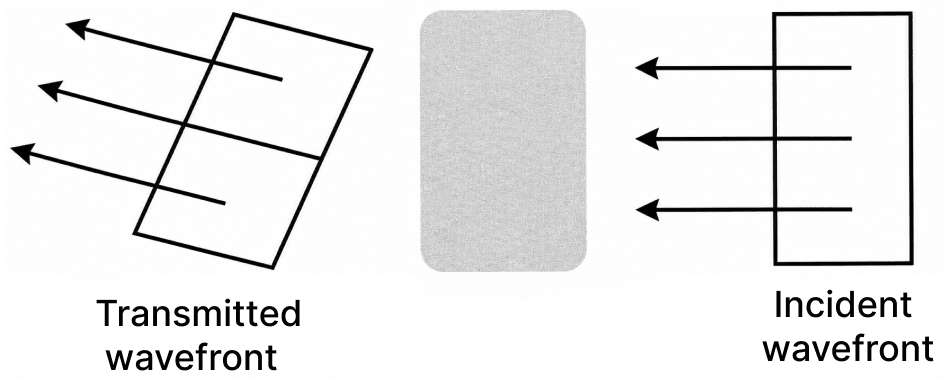
Redraw the diagram with the correct orientation of the obscured (hidden) optical device, so that when a plane wavefront is incident upon it, the transmitted wavefront matches the depicted figures.
Answer
The hidden device is a thin prism placed with its base upward (vertex pointing downward).
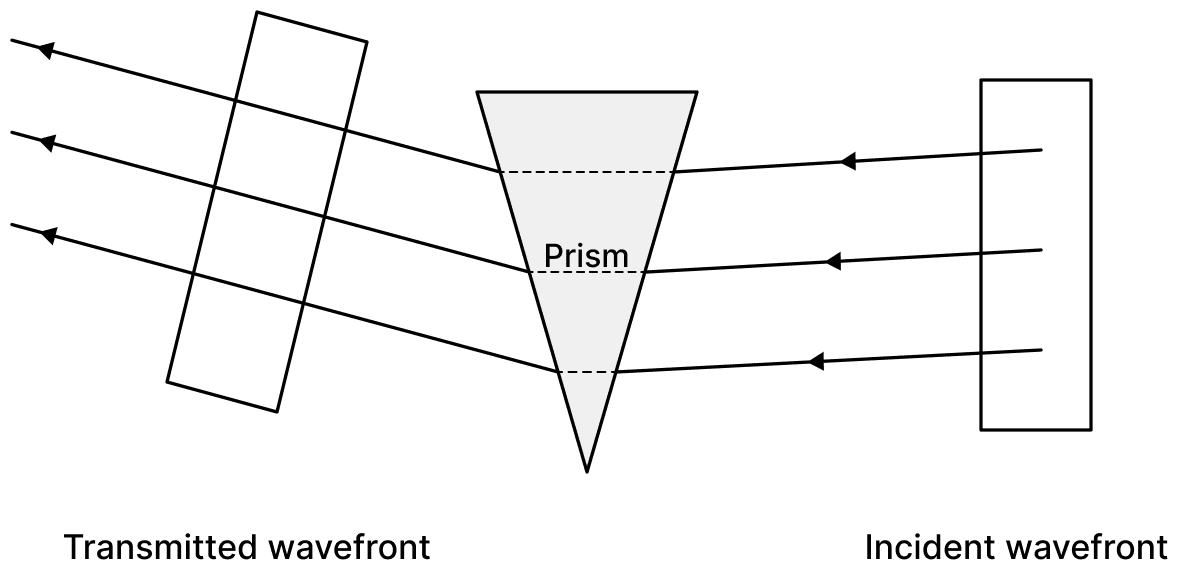
A plane wavefront remains plane after passing through a prism, but its direction is deviated towards the base of the prism. The upper part of the wavefront passes through the thicker part of the prism near the base and is delayed more, so the transmitted wavefront turns and the rays bend upward. Hence the base of the prism must face upward.
Define wavefront. How is it related to the direction of the corresponding rays?
Answer
A wavefront is a surface drawn in a medium such that all the particles of the medium lying on it oscillate in the same phase.
In a homogeneous isotropic medium, the wavefront is perpendicular to the direction of propagation of the wave. Hence the rays are always normal to the wavefront.
When monochromatic light is incident on a surface separating two media, both the reflected and the refracted light have same frequency as the incident light. Why?
Answer
Reflection and refraction take place because the incident light interacts with the atoms of the surface. The incident light makes these atoms undergo forced oscillations at its own frequency. The oscillating atoms then emit light of the same frequency. Hence both the reflected and the refracted light have the same frequency as the incident light.
When light travels from a rarer to a denser medium, it loses speed. Does this loss imply a reduction in energy carried by the light waves?
Answer
No. The energy carried by a wave depends on its frequency and amplitude, not on its speed.
When light passes from a rarer to a denser medium, a part of it is reflected at the boundary, so the refracted wave carries less energy than the incident wave. This reduction in energy is due to reflection, not due to the decrease in speed.
A light pulse is sent through a medium. Will it retain its shape?
Answer
No. A light pulse is made up of waves of a large range of wavelengths. In a medium these waves travel with different speeds, so they spread apart as the pulse advances. Hence the pulse does not retain its shape while travelling through the medium.
What is the geometrical shape of the wavefront for : (i) light diverging from a point-source, (ii) light emerging out of a convex lens when a point-source is placed at the focus of the lens, (iii) the portion of wavefront of light from a distant star intercepted by the earth, (iv) sunlight focussed by a convex lens?
Answer
(i) Spherical (diverging).
(ii) Plane.
(iii) Plane — the earth intercepts only a very small part of a spherical wavefront of very large radius, which is practically plane.
(iv) Spherical (converging towards the focus).
Sketch the wavefronts corresponding to : (i) converging rays, (ii) diverging rays.
Answer
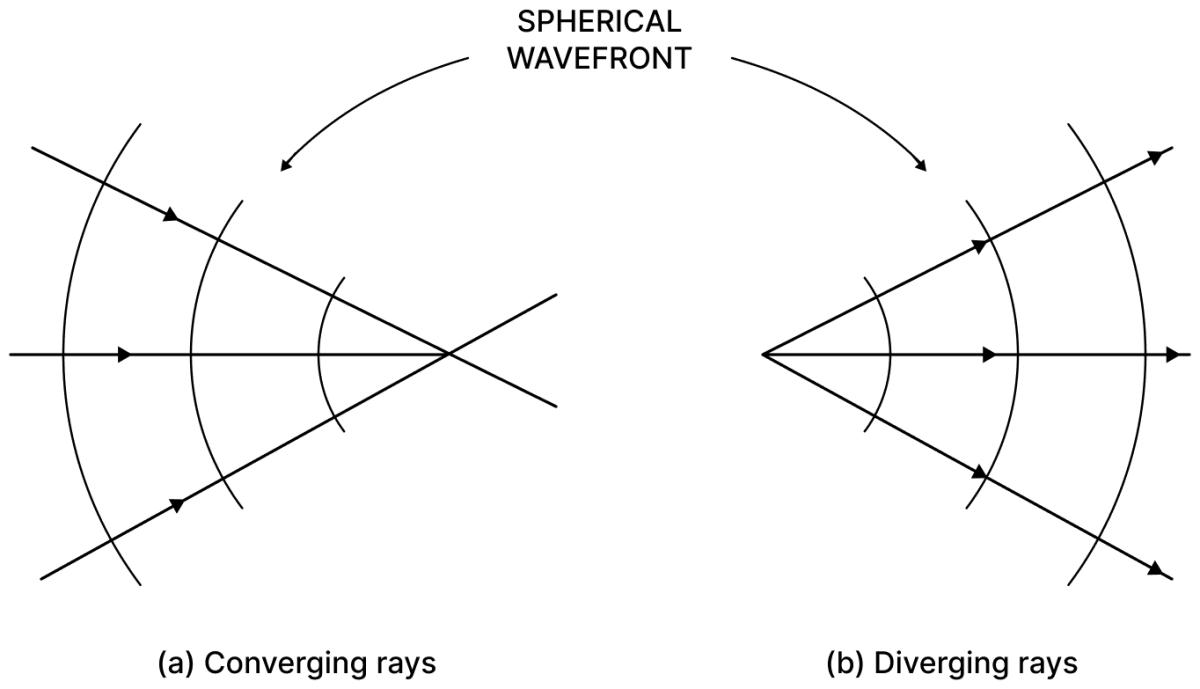
(i) Converging rays — the wavefronts are spherical, with their centre at the point where the rays meet. Their radius decreases as they advance.
(ii) Diverging rays — the wavefronts are spherical, with their centre at the point from which the rays diverge. Their radius increases as they advance.
Why is the contribution of the wavelets lying on the back of the wavefront zero?
Answer
According to Huygens' principle, the intensity of a secondary wavelet in a direction making an angle θ with the forward normal to the wavefront is proportional to (1 + cos θ).
For the backward direction, θ = 180°, so and .
Thus the intensity of the secondary wavelets falls to zero in the backward direction, so they make no contribution on the back of the wavefront and no backward wavefront is observed.
Does the speed of light : (a) in vacuum, (b) in an isotropic medium, depend upon : (i) nature of source, (ii) direction of propagation, (iii) intensity of the wave, (iv) motion of the source/observer, (v) wavelength?
Answer
| Factor | (a) In vacuum | (b) In an isotropic medium |
|---|---|---|
| (i) Nature of source | Does not depend | Does not depend |
| (ii) Direction of propagation | Does not depend | Does not depend |
| (iii) Intensity of the wave | Does not depend | Does not depend |
| (iv) Motion of source/observer | Does not depend | Depends on the motion of the observer relative to the medium, but not on the motion of the source |
| (v) Wavelength | Does not depend | Depends; the speed is smaller for smaller wavelength |
The speed of light in vacuum is a universal constant, whereas in a medium it is , and n depends on wavelength.
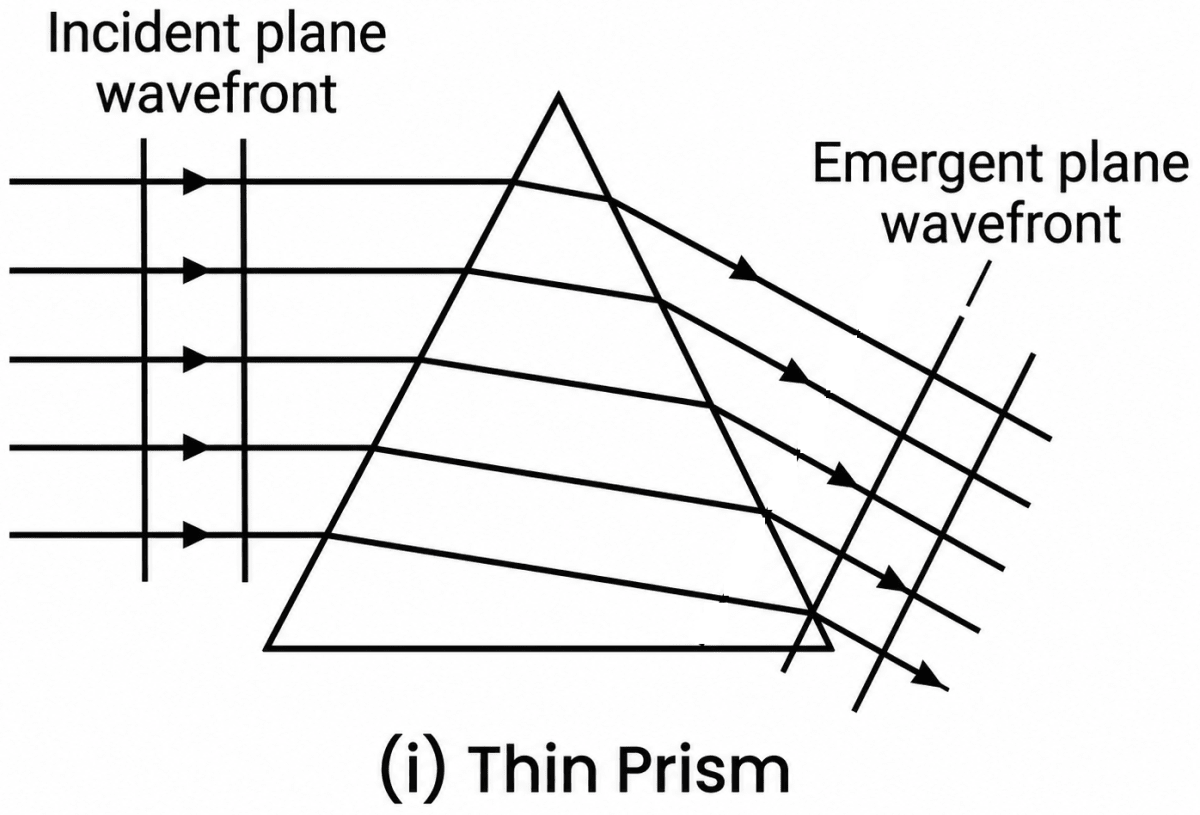
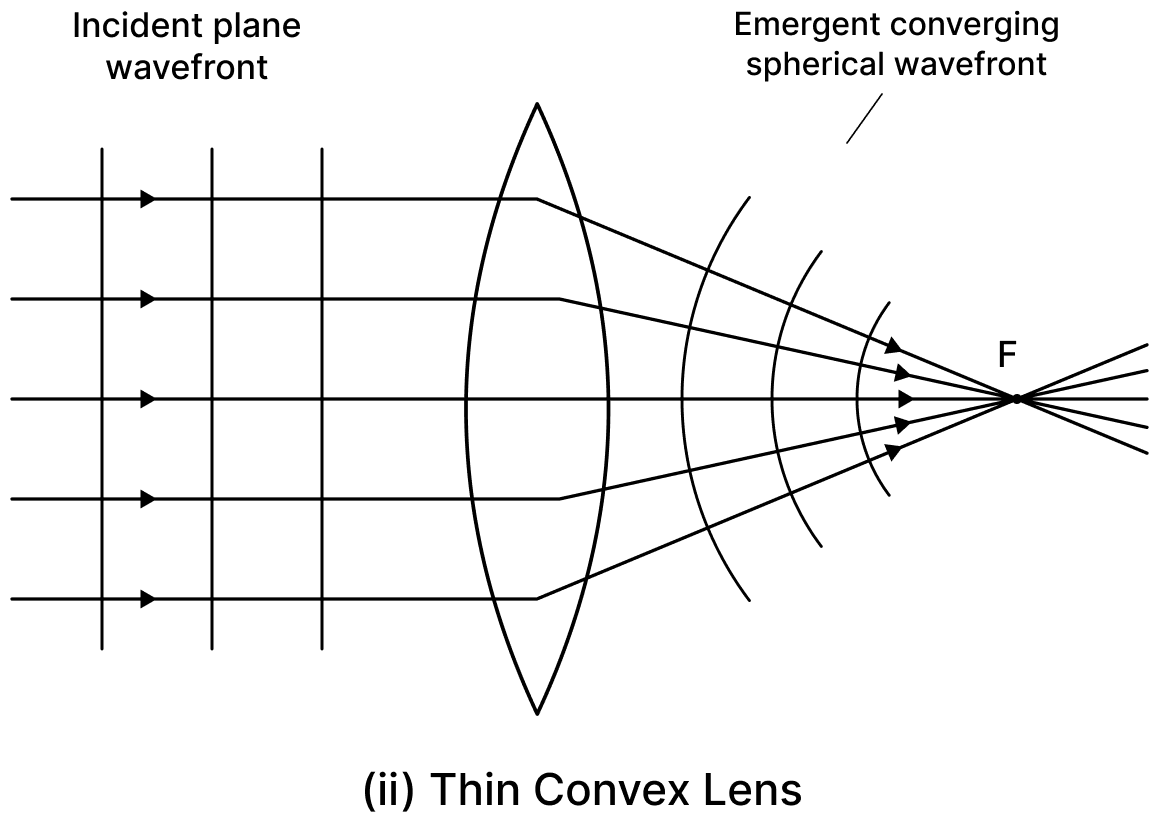
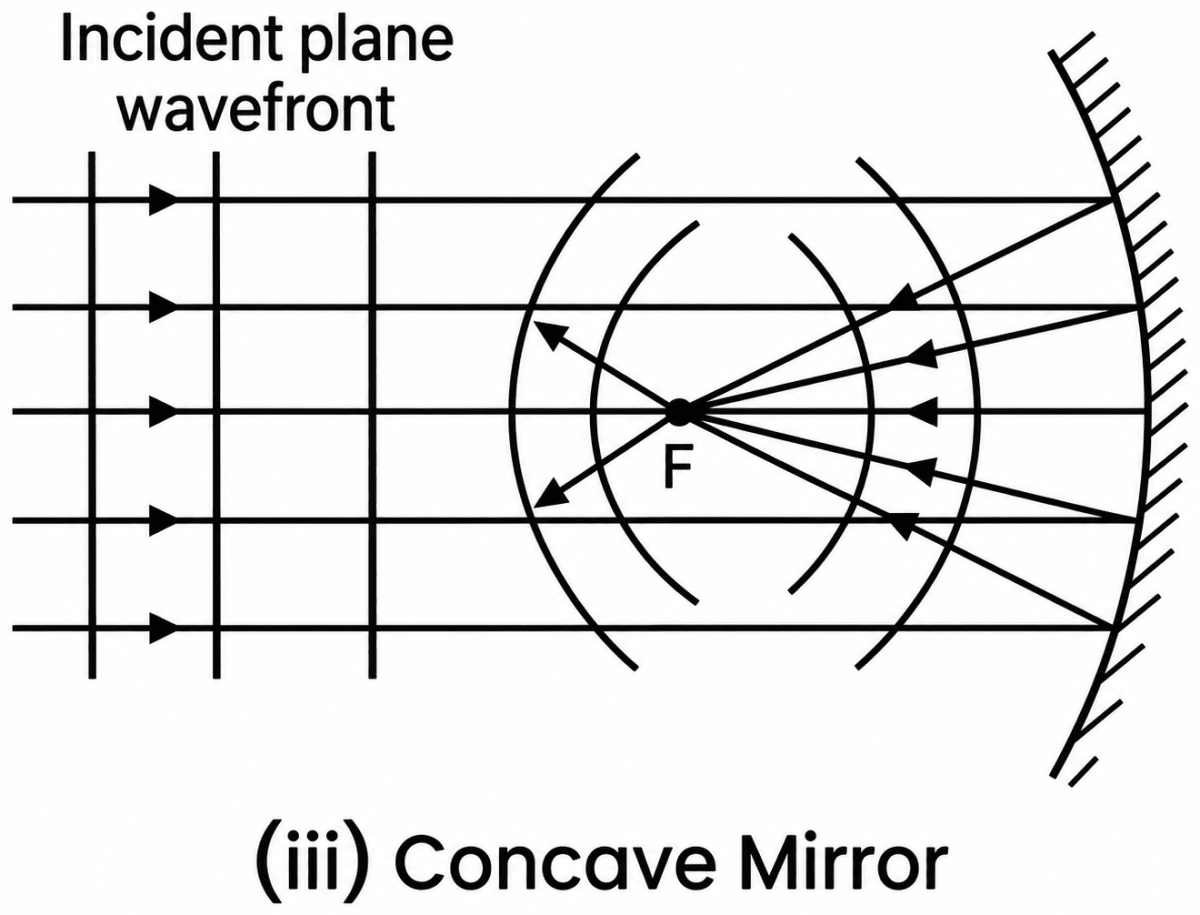
Draw the diagrams to show the behaviour of plane wavefronts as they pass through : (i) a thin prism, (ii) a thin convex lens and (iii) concave mirror.
Answer
(i) Thin prism : The emergent wavefront remains plane but is deviated towards the base of the prism, because the part of the wavefront passing through the thicker portion near the base is delayed more.
(ii) Thin convex lens : The central part of the wavefront passes through the greatest thickness of glass and is delayed most. The emergent wavefront is therefore spherical and converging, with its centre at the focus and radius equal to the focal length.
(iii) Concave mirror : The reflected wavefront is spherical and converging, with its centre at the focus of the mirror and radius equal to the focal length.
Compare Maxwell's electromagnetic theory with Huygens' wave theory of light.
Answer
Both theories treat light as a wave motion. They differ as follows :
| Maxwell's electromagnetic theory | Huygens' wave theory |
|---|---|
| Light is an electromagnetic wave. | Light is a wave travelling through a medium, like a mechanical wave. |
| No material medium is needed; light can travel through vacuum. | A medium is necessary for the propagation of light. |
| No hypothetical medium has to be assumed. | Huygens had to assume an all-pervading hypothetical medium, the 'luminiferous ether'. |
Figure shows a wavefront 'P' passing through two optical devices A and B and emerging as Q and then as R.
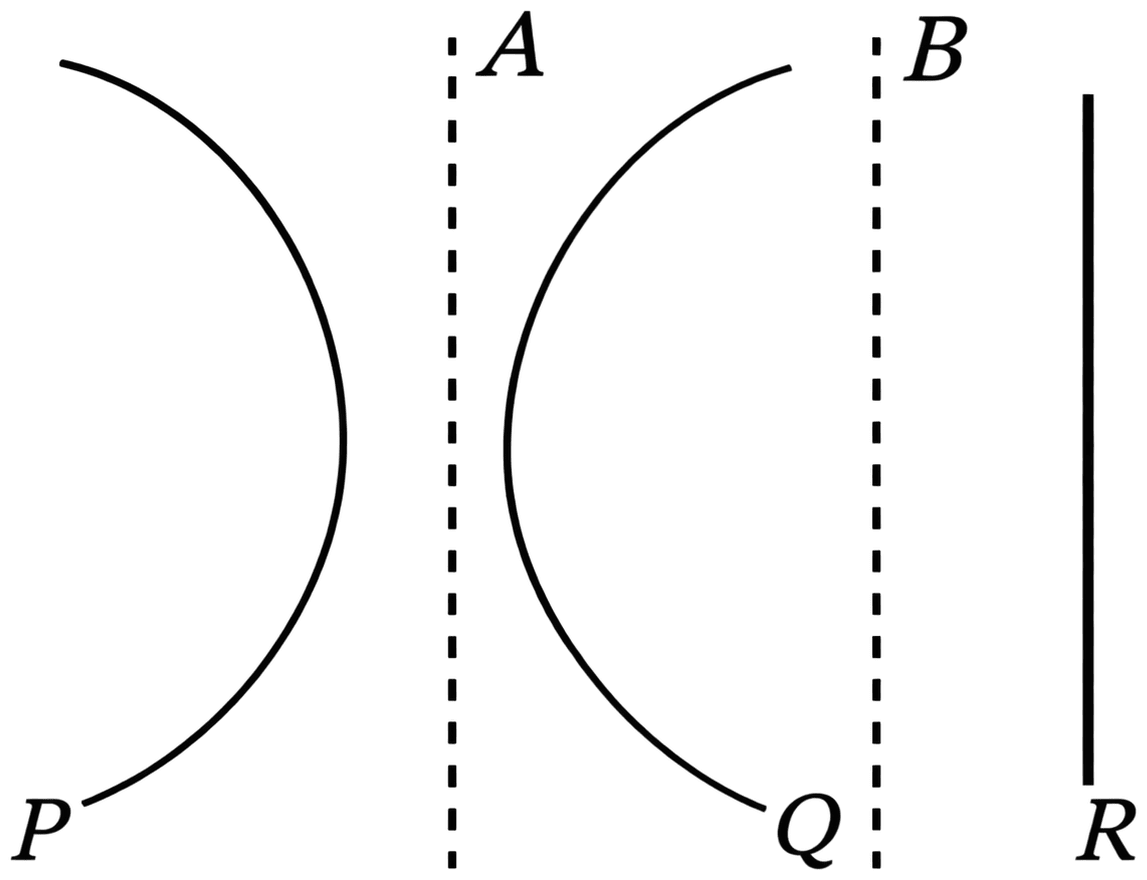
Recognize the possible optical devices.
Answer
A — a convergent (convex) lens; B — a divergent (concave) lens.
Explanation:
P is a diverging spherical wavefront. After passing through A it emerges as Q, a converging spherical wavefront, so A converges light — a convex lens. B changes the converging wavefront Q into the plane wavefront R, so B diverges light — a concave lens whose focus lies at the point towards which Q was converging.
Derive Snell's law of refraction using Huygens' wave theory.
Answer
Let SS' be a plane surface separating medium 1 and medium 2, in which the speeds of light are v1 and v2 respectively (v1 > v2). Let AB be a plane wavefront incident obliquely on SS', with its edge A just touching the surface. The incident rays a, b, c are normal to AB.
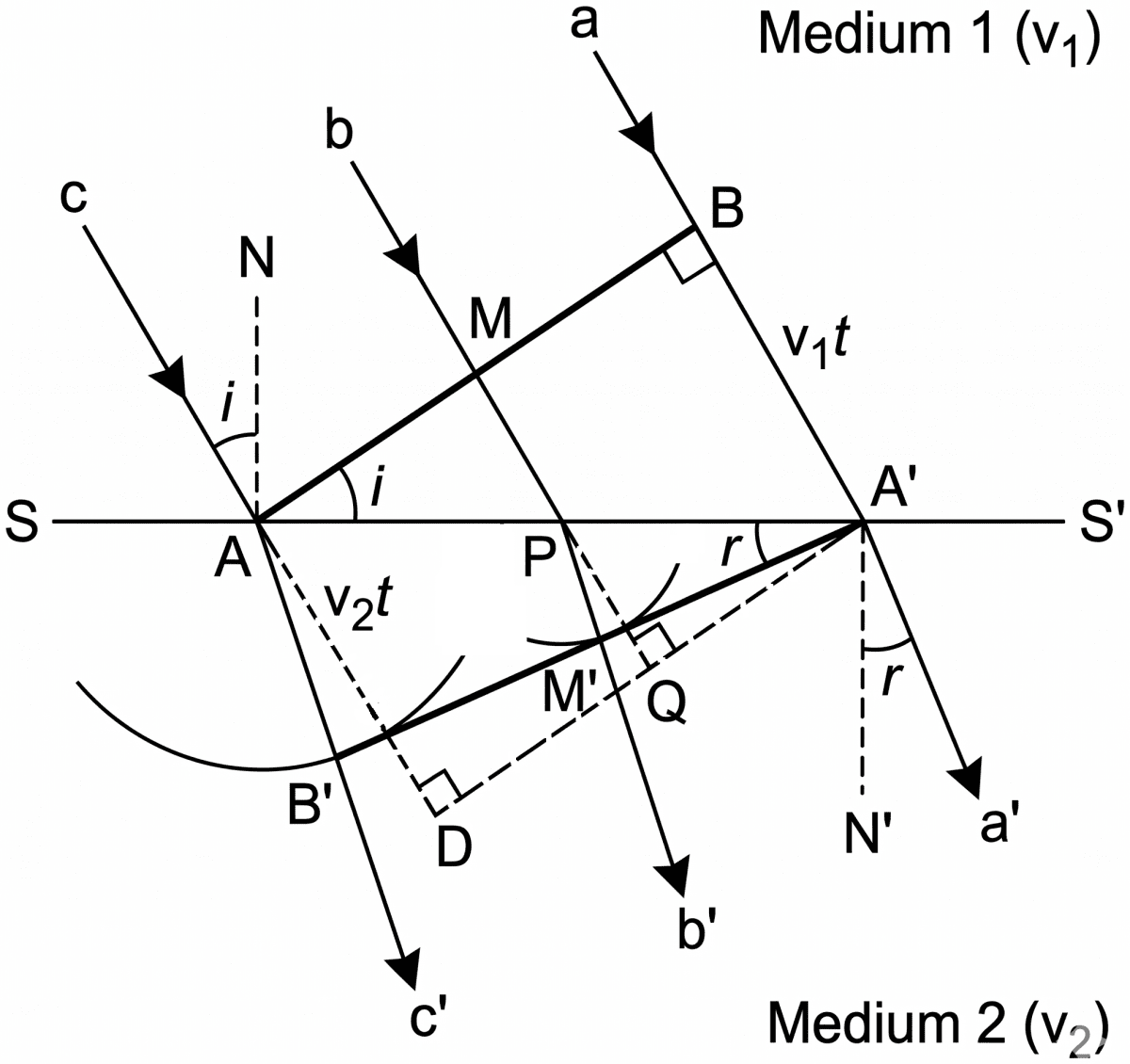
Let t be the time taken by the edge B of the wavefront to reach the point A' on the surface. Then,
BA' = v1t ...(i)
As the wavefront advances, the points of SS' between A and A' are struck one after another and become sources of secondary wavelets in medium 2. In time t, the wavelet from A travels in medium 2 a distance
AB' = v2t ...(ii)
whereas the wavelet from A' has just started. Wavelets from points between A and A' start later and have proportionally smaller radii.
Draw a tangent A'B' from A' to the wavelet from A. It is the common tangent (envelope) to all the secondary wavelets, so A'B' is the refracted wavefront. The rays a', b', c' drawn normal to A'B' are the refracted rays.
Deduction of the law : Since the angle between two lines equals the angle between their normals, the angle of incidence i and the angle of refraction r are
i = ∠BAA' and r = ∠AA'B'
In right-angled ΔABA', ...(iii)
In right-angled ΔAB'A', ...(iv)
Dividing (iii) by (iv) and using (i) and (ii),
For a given pair of media, v1 and v2 are constant, so
Also, AB, A'B' and SS' all lie in the plane of the paper, so the incident ray, the refracted ray and the normal at the point of incidence lie in the same plane.
Hence, Snell's law of refraction is derived from Huygens' wave theory.
State Huygens' principle. Use it to derive Snell's law of refraction for a parallel beam incident on the plane surface of a refracting medium. Give proper diagram.
Answer
Huygens' principle :
(i) Every particle of the medium lying on a wavefront acts as a new source of disturbance, from which fresh waves called secondary wavelets originate.
(ii) The secondary wavelets spread out in all directions with the speed of light in that medium.
(iii) The envelope of the secondary wavelets in the forward direction at any instant gives the new position of the wavefront at that instant.
Derivation of Snell's law :
Let SS' be the plane surface separating medium 1 (speed of light v1) and medium 2 (speed of light v2), with v1 > v2. A parallel beam of light falls obliquely on SS', so the incident wavefront AB is plane and the incident rays are normal to it. The edge A of the wavefront touches the surface first.
Let the edge B reach the point A' of the surface in time t, so that
BA' = v1t ...(i)
During this time, the points between A and A' are reached one after another and send out secondary wavelets into medium 2. The wavelet from A acquires a radius
AB' = v2t ...(ii)
while the wavelet from A' is just starting. The tangent A'B' drawn from A' to the wavelet from A touches all these wavelets, so by Huygens' principle A'B' is the refracted wavefront.
The angle of incidence i is the angle between the wavefront AB and the surface, and the angle of refraction r is the angle between the refracted wavefront A'B' and the surface :
i = ∠BAA' and r = ∠AA'B'
From right-angled ΔABA' and ΔAB'A',
Therefore, using (i) and (ii),
Since v1 and v2 are constant for the two media, is a constant, called the refractive index of medium 2 with respect to medium 1 (1n2). As the incident ray, the refracted ray and the normal all lie in the plane of the paper, they lie in the same plane.
Hence, , which is Snell's law of refraction.
Read the passage(s) and answer the following questions :
Huygens, the Dutch physicist and astronomer of the seventeenth century, gave a beautiful geometrical description of wave propagation. Consider a source of light S, placed in an isotropic medium. This source sends out waves in all directions, which propagate with the same speed c in these directions. After time 't' the disturbance will lie on the surface of a sphere of radius ct. This spherical surface is called as wavefront. Huygens' idea is that we can think of every oscillating point on a wavefront as a new source of waves. According to Huygens' principle, what we observe is the result of adding up the waves from all these new sources.
A wavefront is defined as the surface of constant phase. The speed with which the wavefront moves outward from the source is called the phase speed. The energy of the wave travel in a direction perpendicular to the wavefront.
(i) What is the phase difference between any two points lying on a wavefront?
(ii) Which type of wavefronts are produced by a point source and linear source of light?
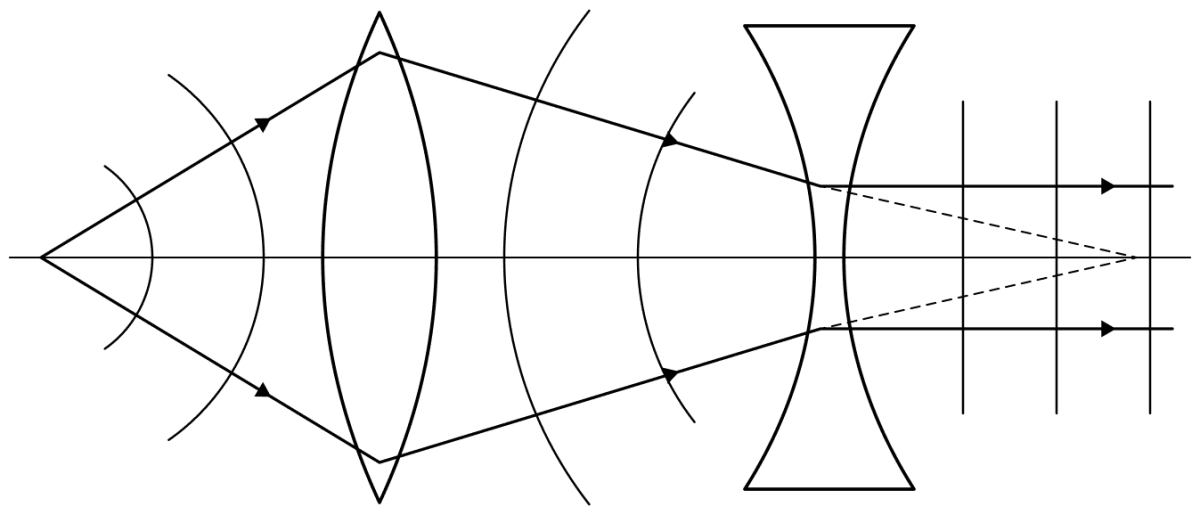
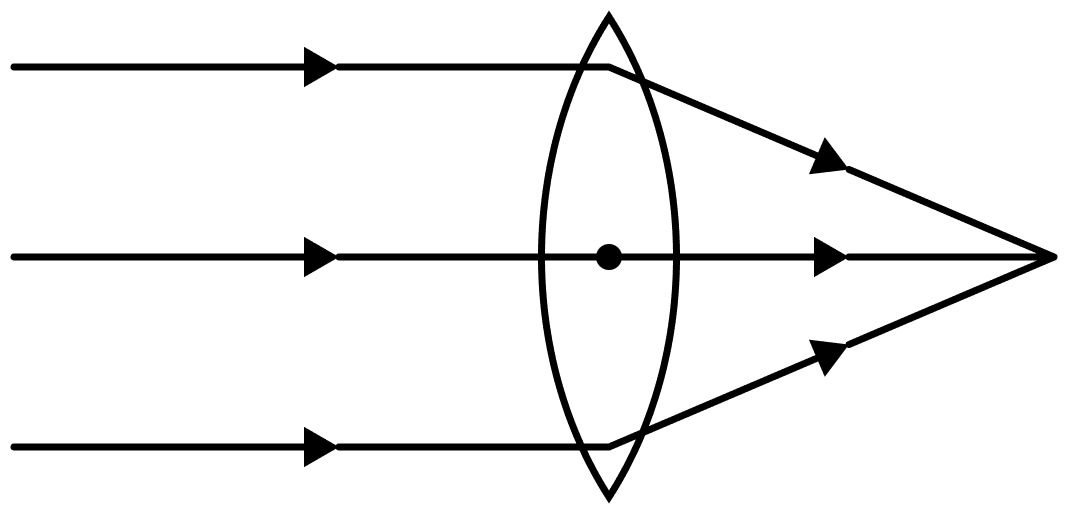
(iii) Draw the wavefronts for incident and emergent rays in the given ray diagram.
(iv) Light always travel, making an angle 'θ' with the wavefront. What is the value of θ?
(v) In Huygens' theory, light waves are considered as longitudinal waves, which require a medium to travel. Is this statement true or false?
Answer
(i) Zero. A wavefront is a surface of constant phase, so all points lying on it are in the same phase.
(ii) A point source produces spherical wavefronts, and a linear source produces cylindrical wavefronts.
(iii) The incident rays are parallel, so the incident wavefronts are plane and perpendicular to the rays. After the convex lens the rays converge to the focus, so the emergent wavefronts are spherical and converging, with their centre at the focus.
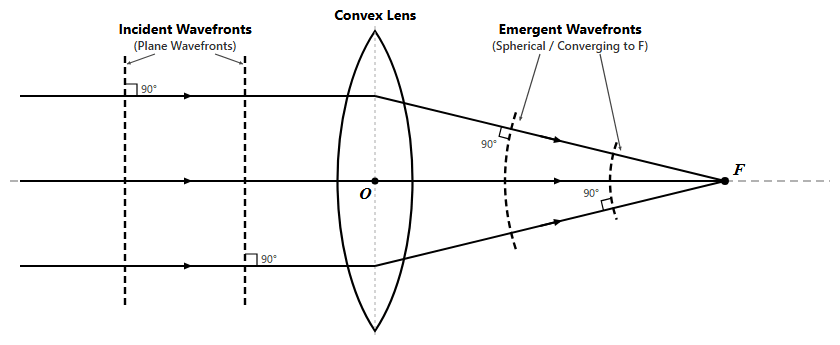
(iv) θ = 90°. The energy of the wave travels perpendicular to the wavefront, so a ray is always normal to the wavefront.
(v) True. In Huygens' theory, light waves were treated as mechanical (longitudinal) waves which need a medium for propagation. This is why Huygens assumed an all-pervading hypothetical medium, the 'luminiferous ether'.