
Express the unit of electric potential in terms of the base units of SI.
Answer
The SI unit of electric potential in terms of the base units is kg m2 s-3 A-1.
Explanation:
The electric potential is defined as
Hence
Two positive charges of 10 μC each are situated 10 cm apart from each other. What is the increase in the electrostatic potential energy of the system when the two charges are brought closer by 2 cm? Express your answer in S.I. unit.
Answer
Given,
- q1 = q2 = 10 μC = 10 × 10-6 C
- Initial separation, r1 = 10 cm = 0.10 m
- Final separation, r2 = 10 − 2 = 8 cm = 0.08 m
The electrostatic potential energy of a system of two point charges is
The increase in potential energy is
Hence, the increase in the electrostatic potential energy is 2.25 J.
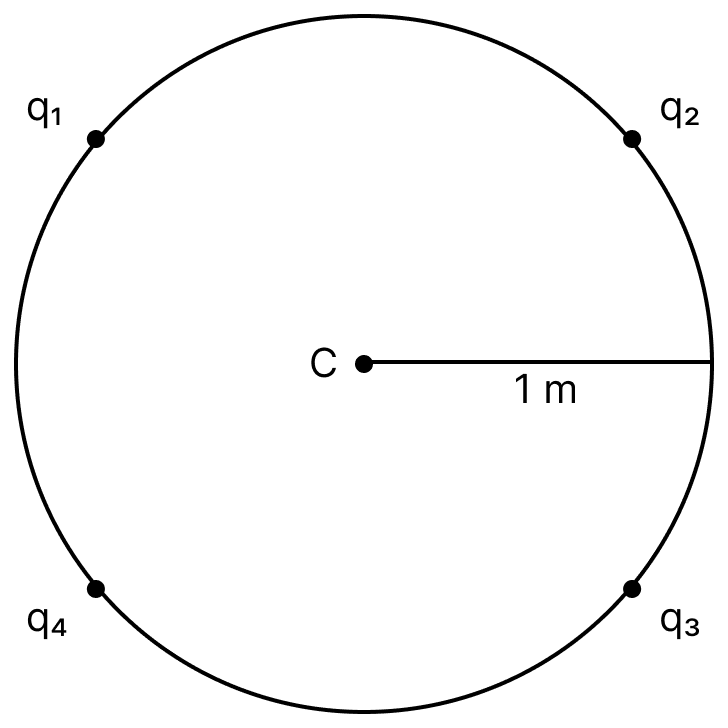
The charge q1 = 3 μC, q2 = 4 μC and q3 = 7 μC are placed on the circumference of a circle of radius 1.0 m as shown in the fig. What is the value of charge q4 placed on the same circle if the potential at the centre, VC = 0?
Answer
Given,
- q1 = 3 μC, q2 = 4 μC, q3 = 7 μC
- Radius of the circle, r = 1.0 m
All the four charges lie on the circumference, so each is at the same distance r from the centre. Since potential is a scalar quantity,
This requires
Hence, the value of the charge q4 is − 14 μC.
An ionised helium particle (+2e) is situated at the origin (0, 0). How much work is done in taking an electron from x = 3 cm to x = 6 cm?
Answer
Given,
- Source charge, q = + 2e = 3.2 × 10⁻¹⁹ C at the origin
- Initial position, r1 = 3 cm = 0.03 m; final position, r2 = 6 cm = 0.06 m
- Charge on the electron, q0 = − 1.6 × 10⁻¹⁹ C
The potentials at the two points are
The work done is
Hence, the work done is 7.68 × 10⁻²⁷ J.
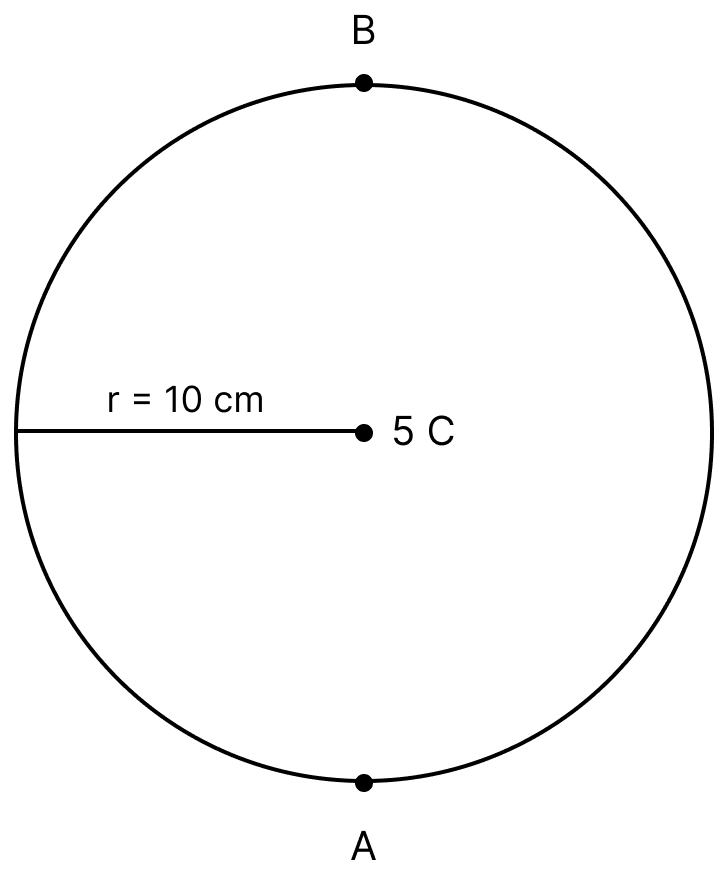
A charge of 5 C is placed at the centre of a circle of radius 10 cm, as shown in the figure. Calculate the work done in moving a charge of 2 C from point A to B on the circumference of the circle.
Answer
Given,
- Charge at the centre, Q = 5 C
- Radius of the circle, r = 10 cm
- Charge moved, q = 2 C
Both A and B lie on the circumference of the circle whose centre carries the charge of 5 C, so both are at the same distance r from it. Hence the circumference is an equipotential surface,
The work done is
Hence, the work done in moving the charge from A to B is zero.
What is the work done in turning an electric dipole through 360°?
Answer
The work done in turning an electric dipole through 360° is zero.
Explanation:
The work done in rotating an electric dipole through an angle θ from the direction of the field is
For θ = 360°,
The dipole returns to its original position, so there is no change in its potential energy.
What will be the nature of electric potential at a point where the electric field E = 0?
Answer
At a point where E = 0 the potential gradient is zero, so the electric potential there has a stationary value (a maximum, a minimum, or locally flat); it is not necessarily zero.
Explanation:
The electric field is the negative potential gradient,
So E = 0 at a point tells us only that the potential gradient vanishes there; the potential is stationary at that point. It does not follow that V = 0, nor that V is constant throughout a region — the potential is uniform over a region only when E = 0 at every point of that region.
For example, inside a charged hollow metallic sphere the electric field is zero everywhere, so there the potential is indeed constant throughout, having the non-zero value .
Three equal charges of 5.0 μC each are placed at the three vertices of an equilateral triangle of side 5.0 cm each. Calculate the electrostatic potential energy of the system of charges.
Answer
Given,
- Each charge, q = 5.0 μC = 5.0 × 10⁻⁶ C
- Side of the triangle, a = 5.0 cm = 0.05 m
The number of pairs is , and every pair is separated by the same distance a. Hence
Substituting the values,
Hence, the electrostatic potential energy of the system is 13.5 J.
How much kinetic energy is gained by an electron, when it moves through a potential difference of 1000 V? Give your answer in joule.
Answer
Given,
- Charge on the electron, e = 1.6 × 10⁻¹⁹ C
- Potential difference, V = 1000 V
The kinetic energy gained is equal to the work done on the electron,
Hence, the kinetic energy gained by the electron is 1.6 × 10⁻¹⁶ J.
An electron revolves around the nucleus of hydrogen atom in a circular orbit of radius 5 × 10-11 m. Calculate :
(i) intensity of electric field of the nucleus at the position of the electron.
(ii) electrostatic potential energy of the hydrogen nucleus and electron system.
Answer
Given,
- Radius of the orbit, r = 5 × 10-11 m
- Charge on the hydrogen nucleus, Ze = 1.6 × 10⁻¹⁹ C (Z = 1)
- Charge on the electron, e = 1.6 × 10⁻¹⁹ C
(i) Intensity of the electric field of the nucleus :
(ii) Electrostatic potential energy of the system :
Hence, E = 5.76 × 10¹¹ N C-1 and U = − 4.6 × 10⁻¹⁸ J.
Note: The textbook answer key prints the unit of the answer to part (i) as joule. The intensity of the electric field is measured in N C-1 (or V m-1); the numerical value 5.76 × 10¹¹ is correct.
How much work is done in taking an electron around a nucleus in a circular path?
Answer
No work is done in this process.
Explanation:
The electrostatic force of attraction which furnishes the centripetal force always remains perpendicular to the direction of the velocity of the electron. Also, the circular orbit is an equipotential surface, so the potential difference between any two of its points is zero and
Three point charges Q1 = 25 μC, Q2 = 50 μC and Q3 = 100 μC, are kept at the corners A, B and C respectively of an equilateral triangle ABC having each side equal to 7.5 m. Calculate the total electrostatic potential energy of the system.
Answer
Given,
- Q1 = 25 μC, Q2 = 50 μC, Q3 = 100 μC
- Each side of the equilateral triangle, a = 7.5 m
The total electrostatic potential energy is the algebraic sum of the energies of all the three pairs, each pair being separated by the same distance a,
Substituting the values,
Hence, the total electrostatic potential energy of the system is 10.5 J.
Two point charges of 10 C each are kept at distance of 3 m in vacuum. Calculate their electrostatic potential energy.
Answer
Given,
- q1 = q2 = 10 C
- Separation, r = 3 m
The electrostatic potential energy of the system is
Hence, the electrostatic potential energy is 3 × 10¹¹ J.
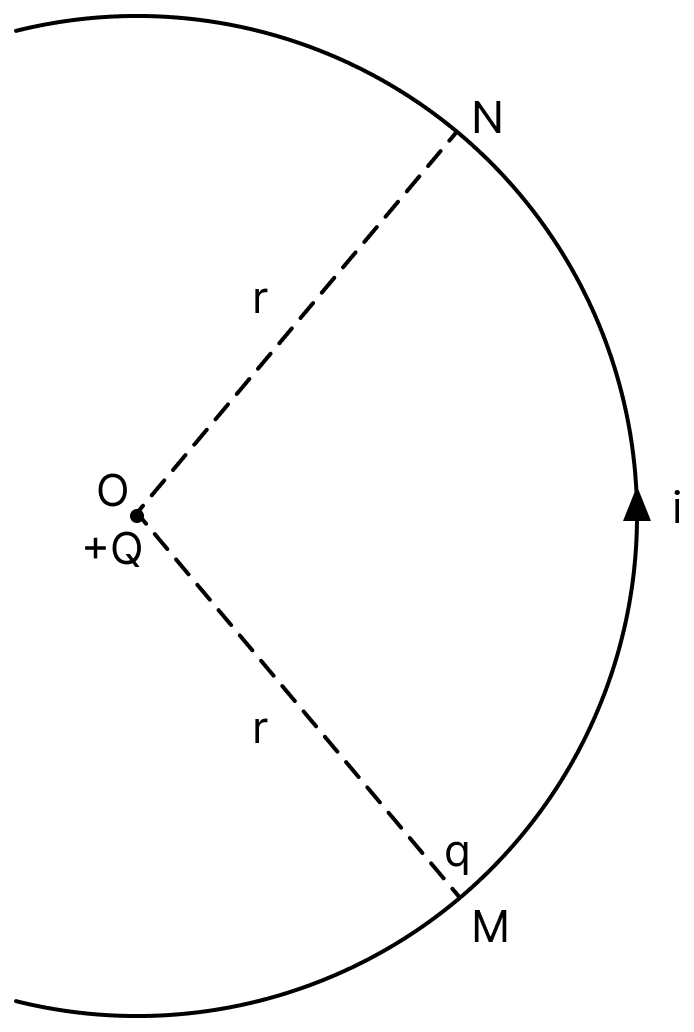
In the given figure a charge Q is fixed. Another charge q is moved along a circular arc MN of radius r around it, from the point M to the point N such that the length of the arc MN = l. The work done in this process is :
- zero
Answer
zero
Reason — The points M and N both lie on a circular arc of radius r drawn about the fixed charge Q, so each is at the same distance r from Q. Hence
The arc is thus part of an equipotential surface, and the work done is
The length l of the arc is irrelevant, since no work is done in moving a charge along an equipotential surface.
The electric potential energy of a system of two positive point charges of 1 μC each placed in air 1 m apart is :
- 9 × 10³ J
- 9 × 10⁹ J
- 9 × 10⁻³ J
- 9 × 10⁻³ eV
Answer
9 × 10⁻³ J
Reason —
Given, q1 = q2 = 1 μC = 1 × 10⁻⁶ C and r = 1 m.
Derive an expression for the electric potential at a point which is at a distance r from a charge Q?
Answer
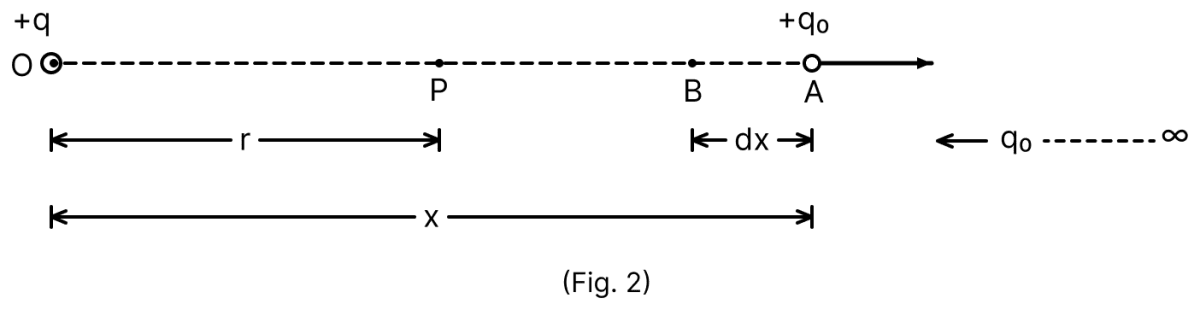
Let a positive point charge + Q be fixed at a point O in vacuum, and let P be the point, a distance r from O, whose potential is required. The potential at P is the work done per unit charge in carrying a positive test charge + q0 from infinity up to P.
Imagine the test charge + q0 momentarily at a point A, a distance x from O and lying beyond P (so that x > r). By Coulomb’s law the force on it has magnitude
This force is directed radially away from O. When the charge is pushed inward through a small displacement dx to a neighbouring point B, the element of work done is
the minus sign appearing because the displacement dx is opposite to the direction of the force.
Summing these elements as the charge moves from infinity (x = ∞) in to P (x = r) gives the total work
The potential at P is this work per unit test charge,
Hence, the electric potential at a point distant r from the charge Q is .
Define equipotential surface.
Answer
Any surface over which the electric potential is same everywhere is called an equipotential surface.
Explanation:
An equipotential surface may be the surface of a charged body or simply a surface in space; for example, the surface of a conductor is an equipotential surface. No work is done in moving a charge between any two points on such a surface, and the electric field is everywhere at right angles to it.
A point charge 'q' is kept at each of the vertices of an equilateral triangle having each side 'a'. Total electrostatic potential energy of the system is:
Answer
Reason — There are three pairs of charges, and each pair is separated by the same distance a. The potential energy of each pair is , and these add algebraically,
In an electric dipole, what is the locus of a point of zero potential?
Answer
The locus is the perpendicular bisector of the dipole, that is, the equatorial line of the dipole.
Explanation:
Every point on this line is equidistant from the charges + q and − q, so the potentials due to them are equal and opposite and cancel out. This also follows from , which vanishes for θ = 90°.
Obtain an expression for electric potential 'V' at a point in end-on-position, i.e., axial position of an electric dipole.
Answer
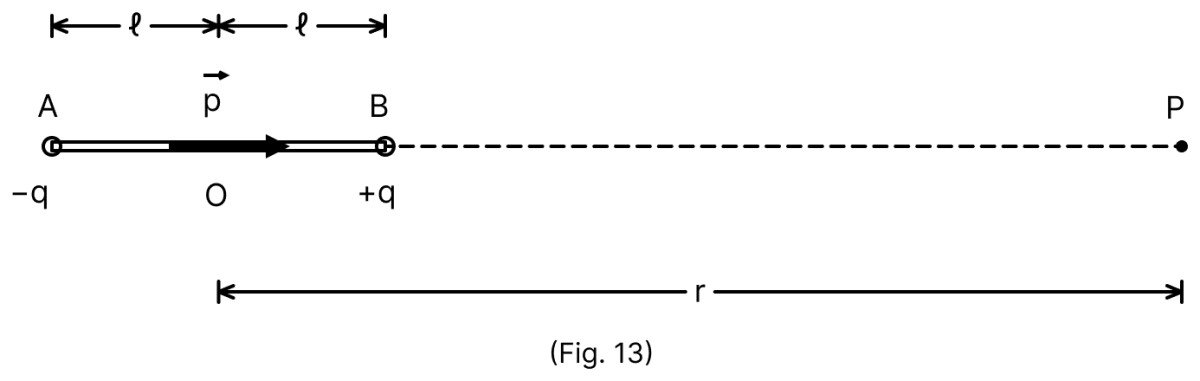
Consider a dipole AB made up of charges − q and + q coulomb separated by a small distance 2l in vacuum, and let P lie on the axis of the dipole at a distance r from its mid-point O.
The point P is nearer the charge + q, at a distance (r − l) from it, and farther from the charge − q, at a distance (r + l) from it. The potential produced at P by the charge + q is therefore
while the charge − q contributes
Potential is a scalar, so the resultant potential at P is the algebraic sum of the two,
Writing the electric dipole moment p = 2ql, this becomes
For a point far from the dipole (r >> 2l), l2 is negligible in comparison with r2, and the potential reduces to the short-dipole result
Electric potential at a point on the axial line of a short electric dipole is :
- directly proportional to distance
- inversely proportional to distance
- inversely proportional to square of the distance
- directly proportional to square of the distance
Answer
inversely proportional to square of the distance
Reason — For a short dipole (r >> 2l) the potential at a point on the axial line is
Hence . This is unlike the potential due to a single point charge, for which .
Consider a point P on the perpendicular bisector of an electric dipole. At point P :
- electric field is zero
- electric potential is zero
- electric field is perpendicular to the axis of the dipole
- potential gradient is zero
Answer
electric potential is zero
Reason — The perpendicular bisector of a dipole is its equatorial line. Every point on it is equidistant from + q and − q, so the potentials due to the two charges are equal in magnitude but opposite in sign,
The electric field, however, is not zero there; it is directed antiparallel to the dipole axis. Hence the potential gradient along the axial direction is also not zero.
Three point charges Q, Q and q are kept at the vertices A, B and C respectively of an equilateral triangle ABC having each side equal to a. Electrostatic potential energy of the system is zero. This is possible if q is equal to :
- Q
Answer
Reason —
Given, charges Q, Q and q at the vertices of an equilateral triangle of side a, with U = 0.
There are three pairs, all separated by the distance a,
Putting U = 0,
Since Q ≠ 0,
Calculate electric potential at a point P which is at a distance of 9 cm from a point charge of 50 μC.
Answer
Given,
- Charge, q = 50 μC = 50 × 10-6 C
- Distance, r = 9 cm = 0.09 m
The potential due to a point charge is
Hence, the electric potential at the point P is 5 × 10⁶ V.
How much work has to be done in moving a charge 'q' from a point A to a point B on an equipotential surface, where AB = 10 cm?
Answer
Zero.
Explanation:
The potential is the same at every point of an equipotential surface, so VA = VB. Hence
The result is independent of the distance AB, since the electric field is everywhere normal to the equipotential surface and has no component along it.
Two point charges, each having a charge Q, are kept at points A and B such that AB = a. How much work has to be done in bringing a third point charge q = Q from infinity to the point C such that ABC is an equilateral triangle? Explain your answer in brief.
Answer
Given,
- Two charges, each Q, at A and B with AB = a
- The third charge q = Q is brought to C, where ABC is equilateral, so CA = CB = a
Since ABC is an equilateral triangle, the point C is at a distance a from each of the charges. As potential is a scalar, the potential at C due to the two charges is
The work done in bringing the charge q = Q from infinity (where the potential is zero) to C is
Hence, the work done is . The work is positive because the third charge is also positive and must be pushed against the repulsion of the two charges already present.