
Obtain an expression for the kinetic energy of the electron in the Bohr's model of hydrogen atom (Z = 1). Start from equating the electrostatic force with the centripetal force required and then use the quantisation condition for angular momentum.
Answer
Let an electron of mass m and charge −e revolve with speed v in a circular orbit of radius r around the hydrogen nucleus of charge +e (Z = 1).
The electrostatic force of attraction between the nucleus and the electron provides the necessary centripetal force,
Hence, the kinetic energy of the electron is
By Bohr's quantisation condition, the angular momentum of the electron is an integral multiple of ,
Squaring Eq. (iii) and dividing it by Eq. (i),
Substituting this value of r in Eq. (ii),
Hence, the kinetic energy of the electron in the nth orbit of hydrogen atom is , where n = 1, 2, 3, ...
The energy of the first Bohr's orbit is −27.2 eV. What will be the energy in the third orbit?
Answer
Given,
- Energy of the first orbit, E1 = −27.2 eV
- n = 3
According to Bohr's theory, the energy of the electron in the nth orbit varies as ,
For the third orbit,
Hence, the energy in the third orbit is −3.02 eV.
In a hydrogen atom, a transition of electrons takes place from 3rd orbit to 2nd orbit. Calculate the wavelength of the emitted photon. To which spectral series will this photon belong?
Answer
Given,
- Initial orbit, n2 = 3
- Final orbit, n1 = 2
- Taking Rydberg's constant, R = 1.097 × 10⁷ m-1
By Bohr's formula for hydrogen atom,
Substituting the values,
Since the electron comes down to the second energy level (n1 = 2), the emitted line belongs to the Balmer series, which lies in the visible region.
Hence, the wavelength of the emitted photon is 656.3 nm and it belongs to the Balmer series.
From Bohr's energy quantisation formula, determine the largest wavelength in the Balmer series of hydrogen atom spectrum.
Answer
According to Bohr's theory, the energy of the electron in the nth orbit of hydrogen atom is
In the Balmer series the electron comes down to n = 2. The largest wavelength corresponds to the smallest energy difference, that is, to the transition from n = 3 to n = 2.
Taking R = 1.097 × 10⁷ m-1,
Hence, the largest wavelength in the Balmer series is 656.3 nm.
For Bohr's model of the hydrogen atom, the energy of the electron in ground state is found to be −13.6 eV.
(i) Draw energy level diagram for the hydrogen atom and mark the values of energy in eV from n = 2 to n = ∞.
(ii) Obtain the maximum energy of photon emitted by the hydrogen atom in eV.
Answer
(i) Energy level diagram :
The energy of the electron in the nth orbit is
which gives the following energies :
| n | 1 | 2 | 3 | 4 | 5 | ∞ |
|---|---|---|---|---|---|---|
| En (eV) | −13.6 | −3.4 | −1.51 | −0.85 | −0.54 | 0 |
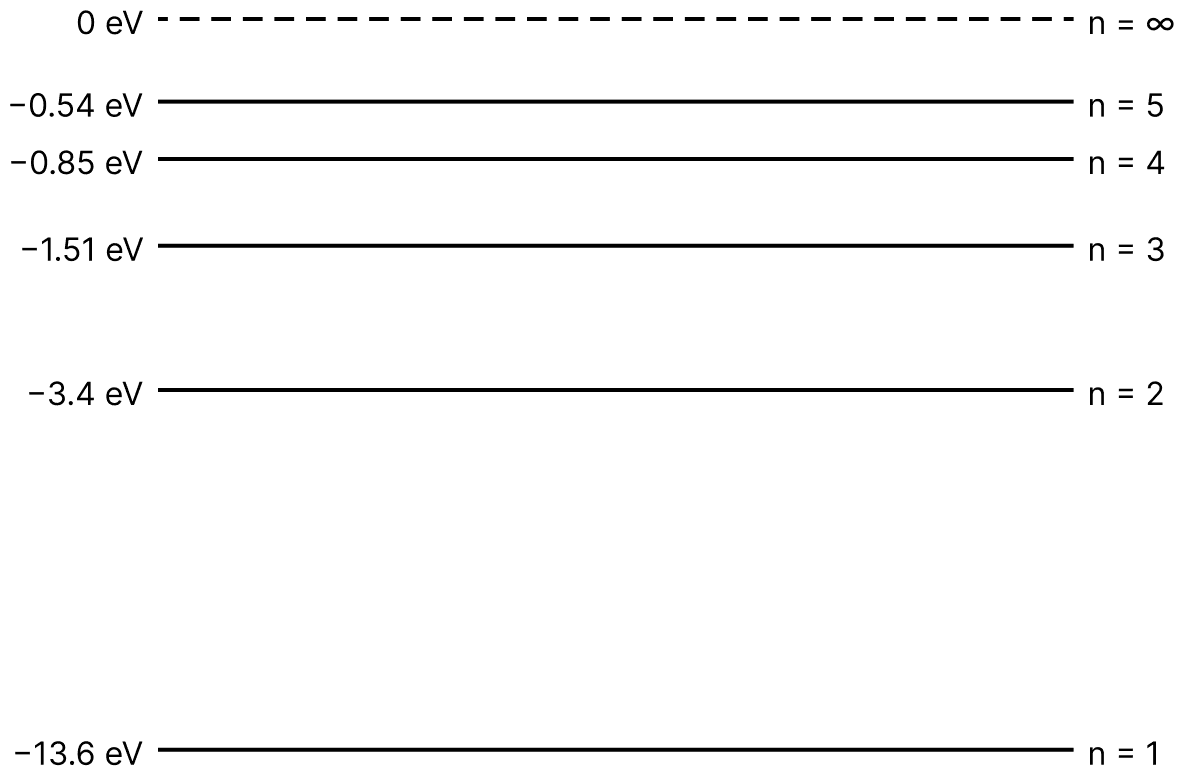
Each energy level is drawn as a horizontal line marked with its energy. The levels crowd closer together as n increases and converge to the level n = ∞ at 0 eV.
(ii) Maximum energy of photon :
The photon of maximum energy is emitted when the electron falls from n = ∞ to the ground state n = 1.
Hence, the maximum energy of photon emitted by the hydrogen atom is 13.6 eV.
If a hydrogen atom goes from III excited state to II excited state, what kind of radiation is emitted?
Answer
Infrared radiation.
Explanation:
The III excited state is n = 4 and the II excited state is n = 3. A transition ending on the third energy level belongs to the Paschen series, whose lines lie in the infrared region. The energy of the emitted photon is
and its wavelength is
which lies in the infrared region.
Alpha particles having kinetic energy 1.8 MeV each are incident on a thin gold foil, from a large distance. Applying the principle of conservation of energy, find the closest distance of approach of the alpha particle from the gold nucleus. (Atomic number of gold = 79)
Answer
Given,
- Kinetic energy of α-particle, K = 1.8 MeV
- Atomic number of gold, Z = 79
- Charge on α-particle = 2e, charge on gold nucleus = Ze
- = 9.0 × 10⁹ N m2 C-2, e = 1.6 × 10⁻¹⁹ C
Converting the kinetic energy into joule,
At the distance of closest approach r0, the α-particle is momentarily stopped and its whole kinetic energy is converted into electrostatic potential energy. By the principle of conservation of energy,
Substituting the values,
Hence, the closest distance of approach of the alpha particle from the gold nucleus is 12.64 × 10⁻¹⁴ m.
Wavelength of 1st line (Hα) of Balmer series of hydrogen is 656.3 nm. Find the wavelength of its 2nd line (Hβ).
Answer
Given,
- Wavelength of Hα line, λα = 656.3 nm
For the Balmer series of hydrogen,
The Hα line corresponds to n = 3 and the Hβ line to n = 4.
Dividing Eq. (i) by Eq. (ii),
Therefore,
Hence, the wavelength of the 2nd line (Hβ) is 486.15 nm.
Draw a level diagram of hydrogen, shown by a downward or an upward arrow, a transition which results in:
(i) emission line of Balmer series.
(ii) emission line of Lyman series.
(iii) absorption line of Lyman series.
Answer
In the energy level diagram, the levels n = 1, 2, 3, ... of the hydrogen atom are drawn as horizontal lines. A downward arrow shows emission (electron falls to a lower level) and an upward arrow shows absorption (electron rises to a higher level).
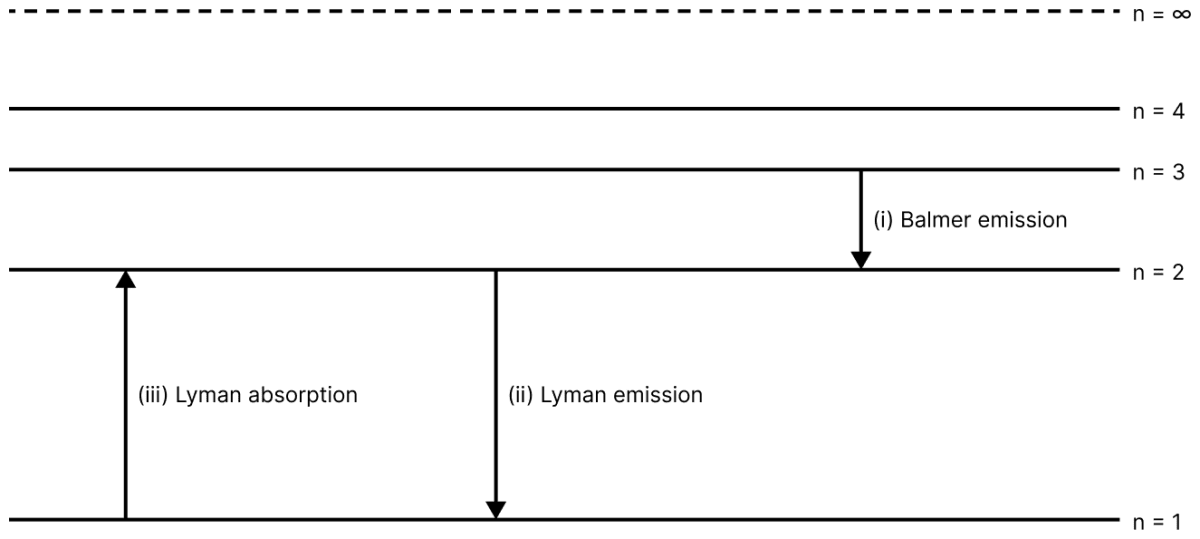
(i) Emission line of Balmer series : a downward arrow from n = 3 (or any higher level) to n = 2.
(ii) Emission line of Lyman series : a downward arrow from n = 2 (or any higher level) to n = 1.
(iii) Absorption line of Lyman series : an upward arrow from n = 1 to n = 2 (or any higher level).
Find the angular momentum of an electron when it is in the second Bohr's orbit of hydrogen atom.
Answer
Given,
- n = 2
- Taking Planck's constant, h = 6.6 × 10⁻³⁴ J s
According to Bohr's quantisation condition,
For the second orbit,
Hence, the angular momentum of the electron in the second Bohr orbit is = 2.1 × 10⁻³⁴ kg m2 s-1.
Write Bohr's formula to calculate wavelength (λ) of visible light emitted by hydrogen and explain the meaning of each and every symbol used.
Answer
According to Bohr's theory, the wavelength λ of the radiation emitted by a hydrogen atom is given by
For visible light (Balmer series), n1 = 2 and n2 = 3, 4, 5, ...
The meaning of the symbols :
- λ = wavelength of the emitted radiation; is called the wave number.
- R = Rydberg's constant, = 1.097 × 10⁷ m-1, where m and e are the mass and charge of the electron, ε0 is the permittivity of free space, c is the speed of light and h is Planck's constant.
- n1 = principal quantum number of the lower orbit to which the electron jumps (n1 = 2 for visible light).
- n2 = principal quantum number of the higher orbit from which the electron jumps (n2 > n1).
Energy levels of H-atom are given by
where, n = principal quantum number. Calculate the wavelength of electromagnetic radiation emitted by hydrogen atom resulting from the transition n = 2 to n = 1.
Answer
Given,
- eV
- Transition from n = 2 to n = 1
The energy of the emitted photon is
The wavelength of the emitted radiation is , which, with ΔE in eV, becomes
Hence, the wavelength of the emitted electromagnetic radiation is 121.3 nm.
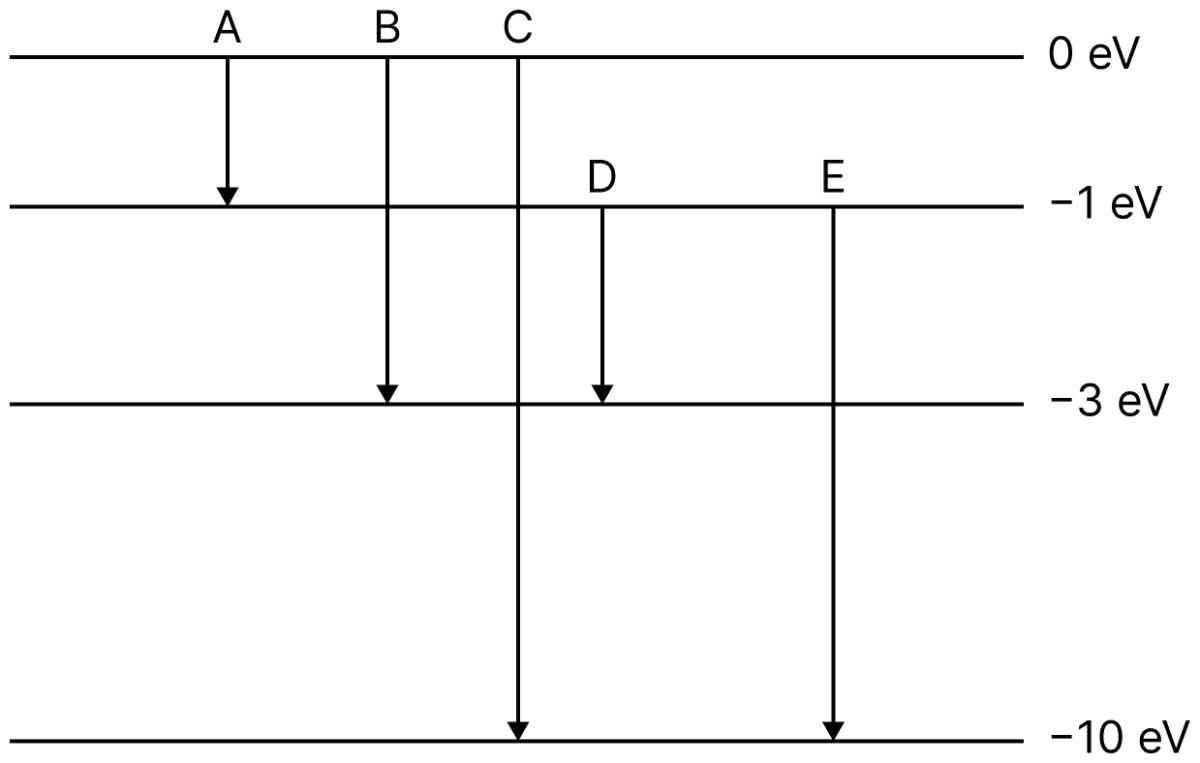
The energy levels of an atom of a certain element are shown in the adjoining figure. Which one of the transitions A, B, C, D or E will result in the emission of photons of electromagnetic radiation of wavelength 618.75 nm? Support your answer with mathematical calculations.
Answer
Given,
- Wavelength of the emitted photon, λ = 618.75 nm
The energy of a photon of wavelength λ is
Substituting λ = 618.75 nm,
From the figure, the energy released in each transition is :
| Transition | From (eV) | To (eV) | Energy released (eV) |
|---|---|---|---|
| A | 0 | −1 | 1 |
| B | 0 | −3 | 3 |
| C | 0 | −10 | 10 |
| D | −1 | −3 | 2 |
| E | −1 | −10 | 9 |
Only the transition D releases 2 eV.
Hence, the transition D results in the emission of photons of wavelength 618.75 nm.
State the postulates of Bohr's model of hydrogen atom. Hence, derive the expression for the radius of nth orbit of electrons.
Answer
Postulates of Bohr's model :
(i) The electrons revolve around the nucleus only in certain circular orbits, called stationary orbits. The necessary centripetal force is provided by the electrostatic force of attraction between the nucleus and the electron.
(ii) In a stationary orbit, the angular momentum of the electron is an integral multiple of ,
This is Bohr's quantisation condition.
(iii) While revolving in a stationary orbit, the electron does not radiate energy in spite of its acceleration, so the atom remains stable.
(iv) When the electron jumps from a higher orbit of energy E2 to a lower orbit of energy E1, it emits a single photon of frequency ν given by hν = E2 − E1 (Bohr's frequency condition).
Radius of the nth orbit :
Let an electron of mass m and charge −e revolve with speed v in an orbit of radius r around the hydrogen nucleus of charge +e. The electrostatic attraction provides the centripetal force,
From the second postulate,
Squaring Eq. (ii) and dividing it by Eq. (i),
Thus rn ∝ n2. For n = 1 this gives the Bohr radius, r1 = 0.53 Å, so that rn = (0.53) n2 Å.
Hence, the radius of the nth orbit of hydrogen atom is .
Wavelength of the first lines of the Lyman series, Paschen series and Balmer series, in hydrogen spectrum are denoted by λL, λP and λB respectively. Arrange these wavelengths in increasing order.
Answer
λL < λB < λP
Explanation:
The first lines of the Lyman, Balmer and Paschen series arise from the transitions 2 → 1, 3 → 2 and 4 → 3 respectively. Using ,
Hence, in increasing order, λL < λB < λP.
How are various lines of Lyman series formed? Explain on the basis of Bohr's theory.
Answer
According to Bohr's theory, the energy of the hydrogen atom in the nth level is . When the atom receives energy, its electron rises to a higher energy level, but it returns within about 10-8 second, emitting a photon of energy equal to the difference of the two levels.
The Lyman series is formed when the electron comes down from any higher energy level n2 = 2, 3, 4, ... to the first (lowest) energy level n1 = 1. The frequency of the emitted photon is given by
so that the wavelengths of the lines are
Each value of n gives one line of the series. The transition 2 → 1 gives the longest wavelength (1216 Å) and the transition ∞ → 1 gives the shortest wavelength, the series limit (912 Å). Since these energy differences are large, all the lines of the Lyman series lie in the ultraviolet region.
Total energy of an electron in the ground state of hydrogen atom is −13.6 eV. Its total energy when hydrogen atom is in the first excited state, is:
- +13.6 eV
- +3.4 eV
- −3.4 eV
- −54.4 eV
Answer
−3.4 eV
Reason — In the first excited state, n = 2. Since ,
Calculate angular momentum of an electron in the third Bohr orbit of hydrogen atom.
Answer
Given,
- n = 3
- Taking Planck's constant, h = 6.6 × 10⁻³⁴ J s
According to Bohr's quantisation condition,
For the third orbit,
Hence, the angular momentum of the electron in the third Bohr orbit is = 3.15 × 10⁻³⁴ kg m2 s-1.
Draw energy level diagram for hydrogen atom, showing first four energy levels corresponding to n = 1, 2, 3 and 4. Show transitions responsible for:
(i) absorption spectrum of Lyman series.
(ii) emission spectrum of Balmer series.
Answer
The energies of the first four levels, from eV, are :
| n | 1 | 2 | 3 | 4 |
|---|---|---|---|---|
| En (eV) | −13.6 | −3.4 | −1.51 | −0.85 |
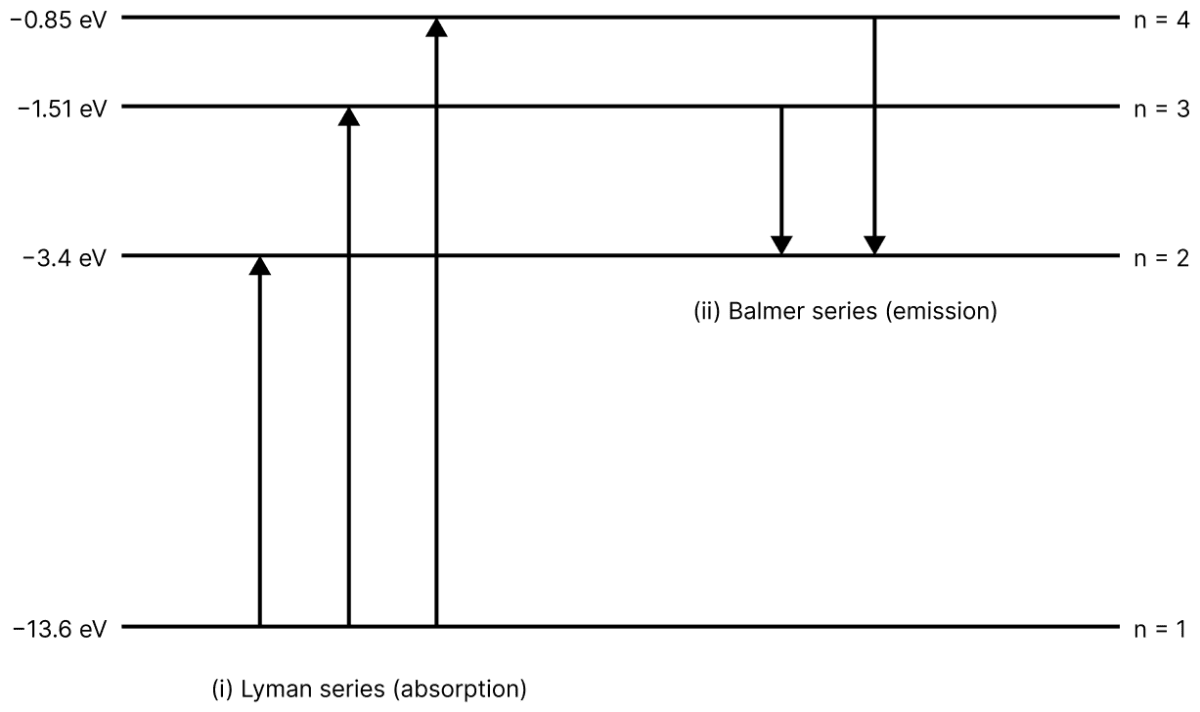
(i) Absorption spectrum of Lyman series : shown by upward arrows starting from n = 1 and ending on n = 2, n = 3 and n = 4. At ordinary temperature almost all atoms are in the ground state, so absorption starts only from n = 1.
(ii) Emission spectrum of Balmer series : shown by downward arrows from n = 3 and n = 4 ending on n = 2.
According to Bohr, 'angular momentum of an orbiting electron is quantised'. What is meant by this statement?
Answer
It means that an electron can revolve round the nucleus only in those certain discrete (stationary) orbits of definite radii for which its angular momentum is an integral multiple of ,
The angular momentum can therefore take only the values , ... and no value in between.
Calculate the shortest wavelength of electromagnetic radiation present in Balmer series of hydrogen spectrum.
Answer
Given,
- Taking Rydberg's constant, R = 1.097 × 10⁷ m-1
The shortest wavelength (series limit) of the Balmer series corresponds to the transition from n2 = ∞ to n1 = 2.
Substituting,
Hence, the shortest wavelength in the Balmer series is 364.6 nm.
In Bohr's model of hydrogen atom, radius of the first orbit of an electron is r0. Then, radius of the third orbit is:
- r0
- 3r0
- 9r0
Answer
9r0
Reason — In Bohr's model, rn ∝ n2. Hence, for the third orbit, r3 = 32 × r0 = 9r0.
Name the series in the atomic spectra of the hydrogen atom that falls in the ultra violet region.
Answer
Lyman series.
Explanation:
The Lyman series is obtained when the electron comes down from any higher level (n2 = 2, 3, 4, ...) to the first level (n1 = 1). These transitions involve large energy differences, so the lines (912 Å to 1216 Å) lie in the ultraviolet region.
What conclusion is drawn from Rutherford's scattering experiment of α-particles?
Answer
The following conclusions were drawn from the α-particle scattering experiment :
(i) Most of the α-particles passed through the gold foil undeflected. Hence, most of the space inside the atom is empty.
(ii) A very few α-particles (about 1 in 20000) were scattered through angles greater than 90°. Hence, the whole of the positive charge and almost the entire mass of the atom are concentrated in an extremely small region at the centre of the atom, called the nucleus. The radius of the nucleus is of the order of 10-14 m, while that of the atom is of the order of 10-10 m.
(iii) The electrons revolve around the nucleus, and the scattering of α-particles by the nucleus obeys Coulomb's law even at atomic distances.
Draw the energy level diagram of hydrogen atom and show the transitions responsible for:
(i) absorption lines of Lyman series.
(ii) emission lines of Balmer series.
Answer
The energies of the levels of the hydrogen atom, from eV, are −13.6 eV (n = 1), −3.4 eV (n = 2), −1.51 eV (n = 3), −0.85 eV (n = 4) and 0 eV (n = ∞).
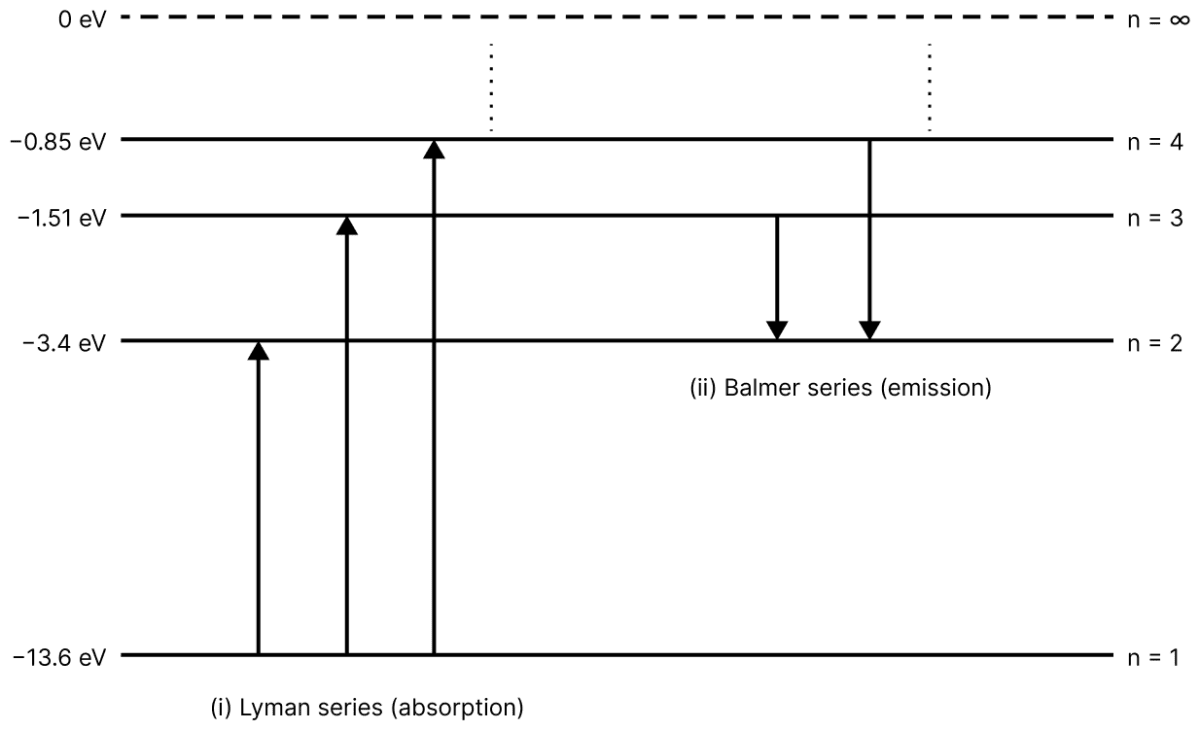
(i) Absorption lines of Lyman series : upward arrows from the ground level n = 1 to the levels n = 2, 3, 4, ...
(ii) Emission lines of Balmer series : downward arrows from the levels n = 3, 4, 5, ... to the level n = 2.
State the postulate of Bohr's regarding:
(i) angular momentum of an electron.
(ii) emission of photon.
Answer
(i) Angular momentum of an electron : An electron can revolve only in those orbits (stationary orbits) in which its angular momentum is an integral multiple of ,
where h is Planck's constant.
(ii) Emission of photon : When an electron jumps from a higher orbit of energy E2 to a lower orbit of energy E1, it emits a single photon whose frequency ν is given by
This is Bohr's frequency condition.
If EP and EK represent potential energy and kinetic energy respectively of an orbital electron, then according to Bohr's theory:
- EK = −EP/2
- EK = EP
- EK = −2EP
- EK = 2EP
Answer
EK = −EP/2
Reason — For an electron in an orbit of radius r,
Hence, .
On the basis of Bohr's theory derive the expression for the velocity of electron in the nth orbit of hydrogen atom.
Answer
Let an electron of mass m and charge −e revolve with speed v in the nth orbit of radius r around the hydrogen nucleus of charge +e.
The electrostatic force of attraction provides the necessary centripetal force,
By Bohr's quantisation condition,
Dividing Eq. (i) by Eq. (ii),
This may be written as
so that v ∝ ; the speed in the first orbit is .
Hence, the velocity of the electron in the nth orbit of hydrogen atom is .
Angular momentum of an electron orbiting in the 3rd Bohr orbit of a hydrogen atom is:
- h/2π
- 2h/2π
- 3h/2π
- 4h/2π
Answer
3h/2π
Reason — By Bohr's quantisation condition, L = . For the 3rd orbit, n = 3, so L = .
Name a series of lines of hydrogen spectrum which lies in:
(a) visible region,
(b) UV region.
Answer
(a) Balmer series
(b) Lyman series
Explanation:
Lines of the Balmer series are emitted when the electron comes down to the second level (n1 = 2) and lie in the visible region. Lines of the Lyman series are emitted when the electron comes down to the first level (n1 = 1) and lie in the ultraviolet region.
(a) Total energy of an electron orbiting around the nucleus of an atom is always negative. What is the physical significance of this?
(b) Calculate the wavelength of the first line (Hα) of Balmer series. (R = 1.097 × 10⁷ m-1)
Answer
(a) The negative total energy shows that the electron is bound to the nucleus by the attractive electrostatic force and cannot leave the atom on its own. To make the electron free, that is, to make its total energy zero, energy equal to the magnitude of its total energy has to be supplied from outside. For example, 13.6 eV is required to free the electron from the ground state of hydrogen atom.
(b) Given,
- Rydberg's constant, R = 1.097 × 10⁷ m-1
- For the Hα line, n1 = 2 and n2 = 3
By Bohr's formula,
Substituting,
Hence, the wavelength of the first line (Hα) of Balmer series is 6563 Å (656.3 nm).
(a) What is the velocity of an electron in the 3rd orbit of hydrogen atom if its velocity in the 1st orbit is v0?
(b) Radius of the 1st orbit of hydrogen atom is r0. What will be the radius of the 4th orbit?
Answer
(a) In Bohr's model, the velocity of the electron in the nth orbit is , so vn ∝ .
Hence, the velocity of the electron in the 3rd orbit is .
(b) The radius of the nth orbit is , so rn ∝ n2.
Hence, the radius of the 4th orbit is 16r0.
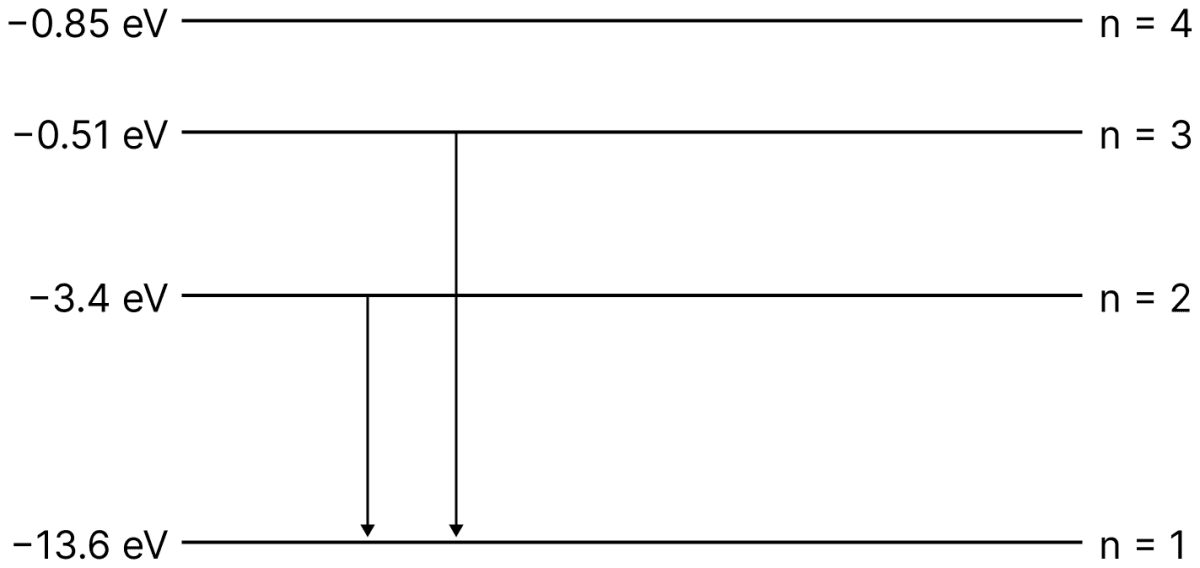
Figure shows the energy level diagram for hydrogen atom. From the transitions shown, identify:
(i) the series of lines obtained.
(ii) the region of electromagnetic spectrum it lies in.
Answer
(i) Lyman series
(ii) Ultraviolet region
Explanation:
Both the transitions shown (n = 2 → n = 1 and n = 3 → n = 1) end on the ground level n = 1, so the lines belong to the Lyman series. The photon energies are 13.6 − 3.4 = 10.2 eV and 13.6 − 1.51 = 12.09 eV, giving wavelengths of about 121.3 nm and 102.4 nm, which lie in the ultraviolet region.
Note: The figure marks the level n = 3 as −0.51 eV; from eV its correct value is −1.51 eV. This does not affect the answer.
(a) (i) Write two major drawbacks of Rutherford's model of an atom.
(ii) State how any one of these drawbacks was overcome by Bohr in his model of the atom.
(b) Using Bohr's second postulate of quantization of orbital angular momentum, show that the circumference of the nth orbit of an electron is equal to 'n' times the de-Broglie wavelength associated with it.
Answer
(a) (i) Drawbacks of Rutherford's model :
Stability of atom : An electron revolving around the nucleus has centripetal acceleration and, according to electrodynamics, should continuously radiate electromagnetic waves. Losing energy, it should spiral inwards and finally fall into the nucleus. Thus the atom could not remain stable.
Line spectrum : As the radius of the orbit changes continuously, the frequency of revolution also changes, so the atom should emit radiation of all frequencies, that is, a continuous spectrum. Atoms actually emit a line spectrum of definite frequencies.
(ii) Removal of the first drawback : Bohr postulated that electrons can revolve only in certain privileged (stationary) orbits in which they do not radiate energy in spite of their acceleration. Radiation is emitted only when the electron jumps from one orbit to another. This gives stability to the atom.
(b) According to Bohr's second postulate,
By de-Broglie hypothesis, the wavelength associated with the electron is
Substituting Eq. (ii) in Eq. (i),
Hence, the circumference (2πrn) of the nth orbit is equal to n times the de-Broglie wavelength of the electron.