
Fraunhofer diffraction from a single slit of width 1.0 μm is observed with light of wavelength 500 nm. Calculate the half angular width of the central maximum.
Answer
Given,
- Width of the slit, e = 1.0 μm = 1.0 × 10⁻⁶ m
- Wavelength of light, λ = 500 nm = 5 × 10⁻⁷ m
The half angular width θ of the central maximum is the angular position of the first minimum, given by
Therefore,
Hence, the half angular width of the central maximum is 30°.
Obtain the relation, a sin θ = λ for the first minimum of the diffraction pattern of a single slit of width a using light of wavelength λ.
Answer
A parallel beam of monochromatic light of wavelength λ is incident normally on a narrow slit AB of width a. The diffracted light is focussed by a convex lens on a screen placed in its focal plane.
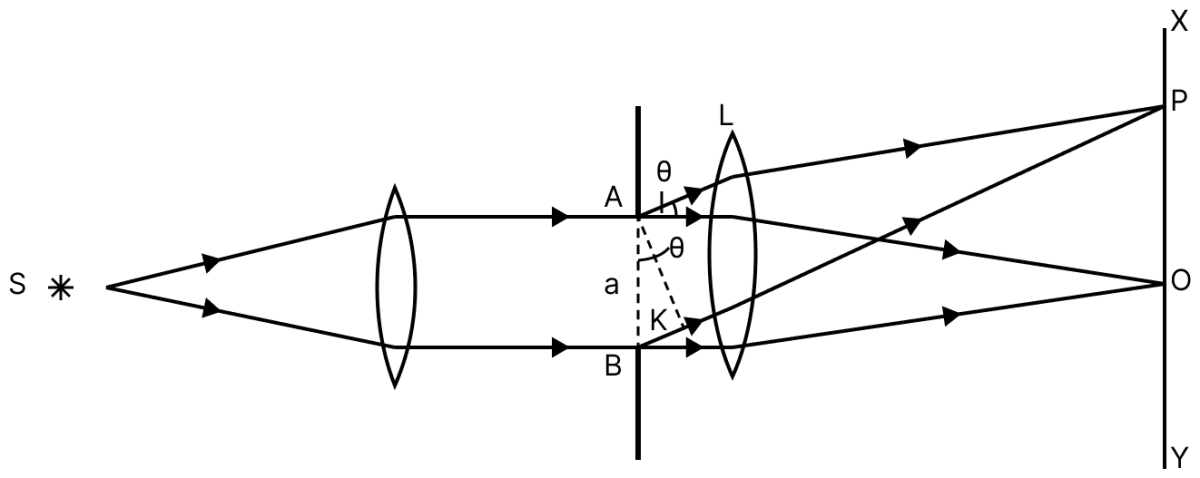
Path difference : Consider the wavelets diffracted through an angle θ, which are focussed at a point P on the screen. Draw AK perpendicular to BK. The optical paths from the plane AK to the point P are equal, so the path difference between the wavelets from the two edges A and B of the slit is
Condition for the first minimum : Let BK = λ. Divide the slit AB into two equal halves, each containing N wavelets (1, 2, 3, ... N and N + 1, N + 2, ... 2N). The wavelets from corresponding points of the two halves (1 and N + 1, 2 and N + 2, and so on) have a path difference of . Hence, they interfere destructively in pairs and the point P is dark. This is the first minimum.
Putting BK = λ in Eq. (i),
This is the required relation for the first minimum.
Light of wavelength 600 nm falls normally on a slit of width 1.2 μm producing Fraunhofer diffraction pattern on a screen. Calculate the angular position of the first minimum and the angular width of the central maximum.
Answer
Given,
- Wavelength of light, λ = 600 nm = 6 × 10⁻⁷ m
- Width of the slit, e = 1.2 μm = 1.2 × 10⁻⁶ m
Angular position of the first minimum :
The first minimum occurs at an angle θ given by e sin θ = λ.
Angular width of the central maximum :
The angular width of the central maximum is the angle between the first minima on the two sides of it.
Hence, the first minimum is at 30° and the angular width of the central maximum is 60°.
Fraunhofer diffraction from a single-slit of width 1.24 × 10⁻⁶ m is observed with light of wavelength 6200 Å. Calculate the angular width of the central maximum.
Answer
Given,
- Width of the slit, e = 1.24 × 10⁻⁶ m
- Wavelength of light, λ = 6200 Å = 6.2 × 10⁻⁷ m
The angular spread θ of the central maximum on either side is given by sin θ = .
The angular width of the central maximum is
Hence, the angular width of the central maximum is 60°.
In a single-slit diffraction pattern, how does the angular width of central maximum change, when :
(i) the slit width is increased.
(ii) light of smaller wavelength is used.
Answer
(i) The angular width of the central maximum decreases.
(ii) The angular width of the central maximum decreases.
Explanation:
The angular width of the central maximum is 2θ, where sin θ = . For small θ, 2θ = . So it varies inversely as the slit width e and directly as the wavelength λ.
Determine the angular separation between the central maximum and the first order maximum of the diffraction pattern due to a single-slit of width 0.25 mm when light of wavelength 5890 Å is incident on it normally.
Answer
Given,
- Width of the slit, e = 0.25 mm = 0.25 × 10⁻³ m
- Wavelength of light, λ = 5890 Å = 5.890 × 10⁻⁷ m
The angular position θ of the first-order (subsidiary) maximum with respect to the central maximum is 'roughly' given by
Therefore,
Since sin θ is very small, θ is also very small and sin θ = θ (in radian).
Hence, the angular separation between the central maximum and the first order maximum is 0.0035 rad.
For observing Fraunhofer diffraction from a single-slit, what type of wavefront should be incident on the slit?
Answer
Plane wavefront.
Explanation:
In Fraunhofer diffraction the source is effectively at infinity. This is achieved by placing the source at the focus of a convex lens, so that a plane wavefront falls normally on the slit.
A parallel beam of monochromatic light of wavelength 500 nm is incident normally on a rectangular slit. The angular width of the central bright fringe of Fraunhofer diffraction is found to be 60°. Find the width of the slit in metre.
Answer
Given,
- Wavelength of light, λ = 500 nm = 5 × 10⁻⁷ m
- Angular width of the central maximum, 2θ = 60°, so θ = 30°
The first minimum on either side of the central maximum is given by e sin θ = λ.
Hence, the width of the slit is 1.0 × 10⁻⁶ m.
State one similarity and one difference between interference and diffraction of light.
Answer
Similarity : Both interference and diffraction demonstrate the wave nature of light.
Difference : Interference is due to superposition of light waves coming from two coherent sources, whereas diffraction is due to interference of secondary wavelets coming from different points of the same wavefront.
In Fraunhofer single slit diffraction experiment, how does semi-angular width θ of the central bright fringe depend on slit width 'e'?
Answer
The semi-angular width θ is inversely proportional to the slit width e.
Explanation:
The first minimum on either side of the central bright fringe occurs at e sin θ = λ. As θ is small, sin θ = θ, so
For a given wavelength, θ increases when the slit is made narrower and decreases when it is made wider.
What will be the effect of the width of the central bright fringe in the diffraction pattern of a single slit if :
(i) monochromatic light of smaller wavelength is used.
(ii) slit is made narrower.
Answer
(i) The width of the central bright fringe decreases.
(ii) The width of the central bright fringe increases.
Explanation:
The linear width of the central bright fringe is , where D is the distance of the screen from the slit. It varies directly as the wavelength λ and inversely as the slit width e.
In Fraunhofer diffraction, how is the angular width of the central bright fringe affected when slit separation is increased?
Answer
The angular width of the central bright fringe decreases.
Explanation:
The angular width of the central bright fringe is 2θ = , where e is the width of the slit. As e increases, 2θ decreases.
Note: Only one slit is involved here, so 'slit separation' is taken to mean the slit width e.
Draw a labelled graph of intensity of diffraction of light (I) versus angle (θ) in the Fraunhofer diffraction experiment for a single-slit diffraction.
Answer
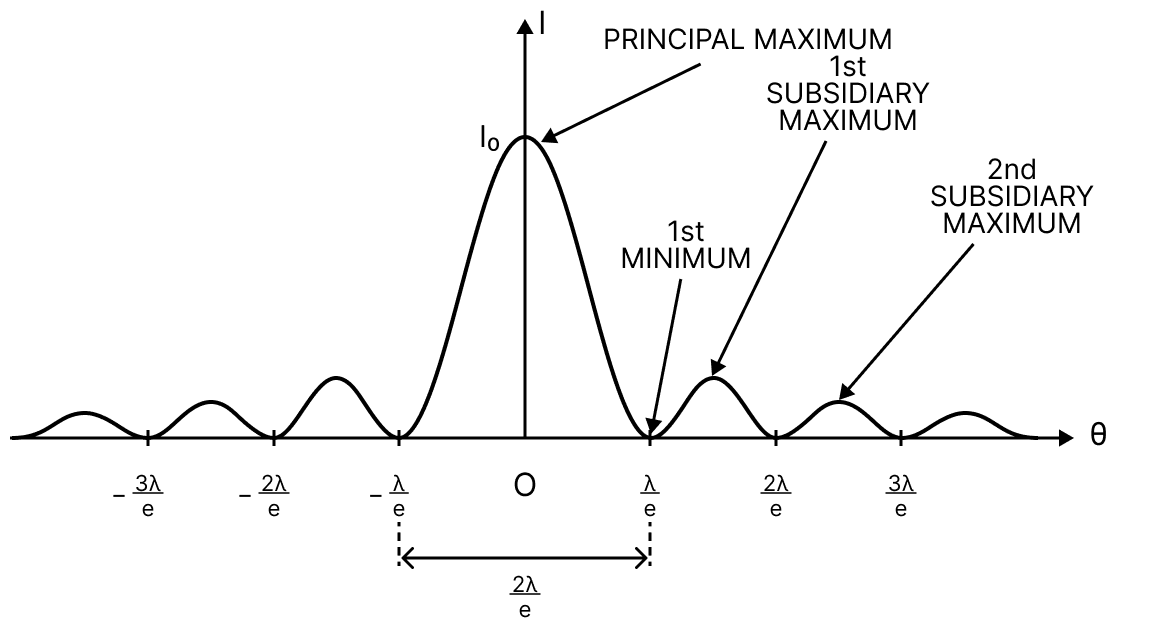
The graph shows the following features :
- The principal (central) maximum lies at θ = 0 and has the greatest intensity.
- The minima (zero intensity) lie at θ = ± , ± , ± , ... on both sides.
- The 1st and 2nd subsidiary maxima lie roughly at θ = ± , ± , ... and their intensity falls off rapidly.
- The central maximum is twice as wide as each subsidiary maximum.
A parallel beam of monochromatic light of wavelength 700 nm is incident normally on a rectangular slit. The angular width of the central bright fringe of Fraunhofer diffraction is found to be 60°. Find the width of slit.
Answer
Given,
- Wavelength of light, λ = 700 nm = 7 × 10⁻⁷ m
- Angular width of the central maximum, 2θ = 60°, so θ = 30°
The half angular width of the central maximum is given by sin θ = .
Hence, the width of the slit is 1.4 × 10⁻⁶ m (= 1.4 μm).
Calculate the angular width of the central maxima obtained in Fraunhofer diffraction when monochromatic light of wavelength 550 nm falls normally on a rectangular slit of width 1.1 × 10⁻⁴ cm.
Answer
Given,
- Wavelength of light, λ = 550 nm = 5.5 × 10⁻⁷ m
- Width of the slit, e = 1.1 × 10⁻⁴ cm = 1.1 × 10⁻⁶ m
The angular spread θ of the central maximum on either side is given by sin θ = .
The angular width of the central maximum is
Hence, the angular width of the central maximum is 60°.
What is meant by diffraction of light?
Answer
The bending of light round the corners of obstacles or apertures, whose size is comparable to the wavelength of light, so that light enters the region of geometrical shadow, is called diffraction of light.
State any one difference between interference and diffraction of light.
Answer
In an interference pattern, all bright fringes are of the same intensity, whereas in a diffraction pattern, the intensity of successive bright fringes goes on decreasing.
In a single slit Fraunhofer diffraction experiment, how does the angular width of central maximum changes when the slit width is increased?
Answer
The angular width of the central maximum decreases.
Explanation:
The angular width of the central maximum is 2θ = , which is inversely proportional to the slit width e. So, on increasing e, the central maximum becomes narrower.
Read the passage given below and answer the questions that follow.
In the year 1801, Thomas Young, a British scientist performed an experiment using monochromatic light incident on two narrow, identical and rectangular slits. He obtained a series of alternate bright and dark bands called fringes. A German scientist, Fraunhofer performed another experiment using only one slit. He also got a series of alternate bright and dark fringes. Both these phenomena could not be explained by Corpuscular theory of light put forward by Sir Isaac Newton. Hence, scientists had to apply wave theory of light which was put forward by Christian Huygen, who was a contemporary of Newton.
(i) From Young's double-slit experiment, what do you infer about the nature of light?
(ii) In Young's double-slit experiment, what will happen if :
(a) screen is brought closer to the two slits?
(b) one of the slits is closed?
(iii) What is the phenomenon discovered by Fraunhofer called?
(iv) State any one difference between the phenomenon discovered by Young and that by Fraunhofer.
Answer
(i) Light has a wave nature.
(ii) (a) The fringe width decreases, because fringe width β = is directly proportional to the distance D of the screen from the slits.
(b) The interference pattern disappears and the diffraction pattern of the single open slit is observed on the screen.
(iii) Diffraction of light (Fraunhofer diffraction due to a single-slit).
(iv) In Young's experiment, all the bright fringes are of equal intensity, whereas in Fraunhofer's experiment, the central bright fringe is the brightest and the intensity of successive bright fringes goes on decreasing.
Draw a labelled graph showing the variation in intensity of light with distance in a single-slit Fraunhofer diffraction experiment.
Answer
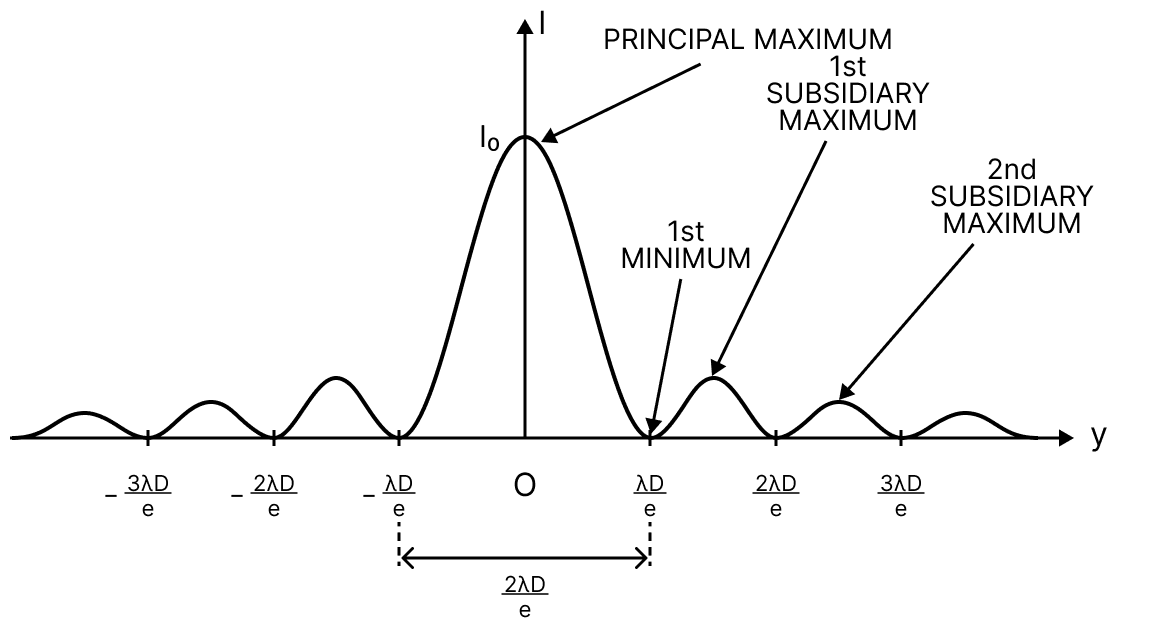
Here y is the distance of a point on the screen from the centre O of the pattern, D is the distance of the screen from the slit and e is the slit width. The graph shows the following features :
- The central maximum lies at y = 0 and has the greatest intensity.
- The minima lie at y = ± , ± , ± , ... on both sides.
- The subsidiary maxima lie roughly at y = ± , ± , ... and their intensity falls off rapidly.
- The linear width of the central maximum is , twice that of each subsidiary maximum.