An electron falls from rest through a vertical distance h in a uniform and vertically upward directed electric field E. The direction of electric field is now reversed, keeping its magnitude the same. A proton is allowed to fall from rest in it through the same vertical distance h. The time of fall of the electron, in comparison to the time of falls of the proton is :
smaller
equal
10 times greater
5 times greater
Answer
smaller
Reason —
Given, both the particles fall from rest through the same vertical distance h, the magnitude of the electric field being the same in the two cases.
The electric force on a particle of charge q is F = qE, so its acceleration is
a=mqE
Starting from rest and covering a distance h,
h=21at2h=21(mqE)t2t=qE2hm⇒t∝m
since h, q and E are the same for the electron and for the proton. The mass of the electron is much smaller than that of the proton, so the time of fall of the electron is smaller than that of the proton.
Question 2
Two point charges A and B, having charges +Q and −Q respectively, are placed at certain distance apart and force acting between them is F. If 25% charge of A is transferred to B, then force between the charges becomes :
916F
34F
F
169F
Answer
169F
Reason —
Given, the charges are + Q and − Q, a distance r apart, and the force between them is
F=4πε01r2Q2
When 25% of the charge of A is transferred to B, the charge transferred is 4Q, so the new charges are
QA=Q−4QQA=43QQB=−Q+4QQB=−43Q
The separation is unchanged, so the new force is
F′=4πε01r2(43Q)2F′=169×4πε01r2Q2F′=169F
Question 3
Three charges +Q, q, +Q are placed respectively at distance 0,2d and d from the origin on the X-axis. If the net force experienced by +Q placed at x = 0 is zero, then value of q is :
2+Q
4+Q
2−Q
4−Q
Answer
4−Q
Reason —
Given, + Q at x = 0, q at x=2d and + Q at x = d.
The charge + Q at x = 0 experiences
a repulsion due to the charge + Q at x = d, at a distance d,
F1=4πε01d2Q2
a force due to the charge q at a distance 2d,
F2=4πε01(2d)2QqF2=4πε01d24Qq
For the net force on the charge at x = 0 to be zero, these two must cancel,
d2Q2+d24Qq=0Q+4q=0q=−4Q
Question 4
Two point charges q1(10μC) and q2 (−25 μC) are placed on the X-axis at x = 1 m and x = 4 m, respectively. The electric field (in V/m) at a point y = 3 m on Y-axis is (take4πε01=9×10⁹N-m2C−2)
(63i^−27j^)×102
(81i^−81j^)×102
(−81i^+81j^)×102
(−63i^+27j^)×102
Answer
(63i^−27j^)×102
Reason —
Given, q1=10μC at (1 m, 0), q2=−25μC at (4 m, 0), and the point of observation is P (0, 3 m).
Four point charges −q, +q, +q and −q are placed on Y-axis at y = −2d, y = −d, y = +d and y = +2d, respectively. The magnitude of the electric field E at a point on the x-axis at X = D, with D >> d, will behave as :
E∝D1
E∝D31
E∝D21
E∝D41
Answer
E∝D41
Reason —
Given, the charges − q, + q, + q and − q are placed on the Y-axis at y = − 2d, − d, + d and + 2d respectively.
The charges + q at y = + d and − q at y = + 2d form one dipole, and the charges + q at y = − d and − q at y = − 2d form a second dipole of equal moment pointing in the opposite direction. The algebraic sum of all the charges is zero and the net dipole moment of the whole arrangement is also zero.
Such an arrangement of two equal and opposite dipoles is a quadrupole. Just as the field of a dipole falls off one power of distance faster than that of a point-charge, the field of a quadrupole falls off one power faster than that of a dipole,
point-charge:E∝D21,
dipole:E∝D31,
quadrupole:E∝D41
Hence at a point on the x-axis with D >> d, the field behaves as E∝D41.
Question 6
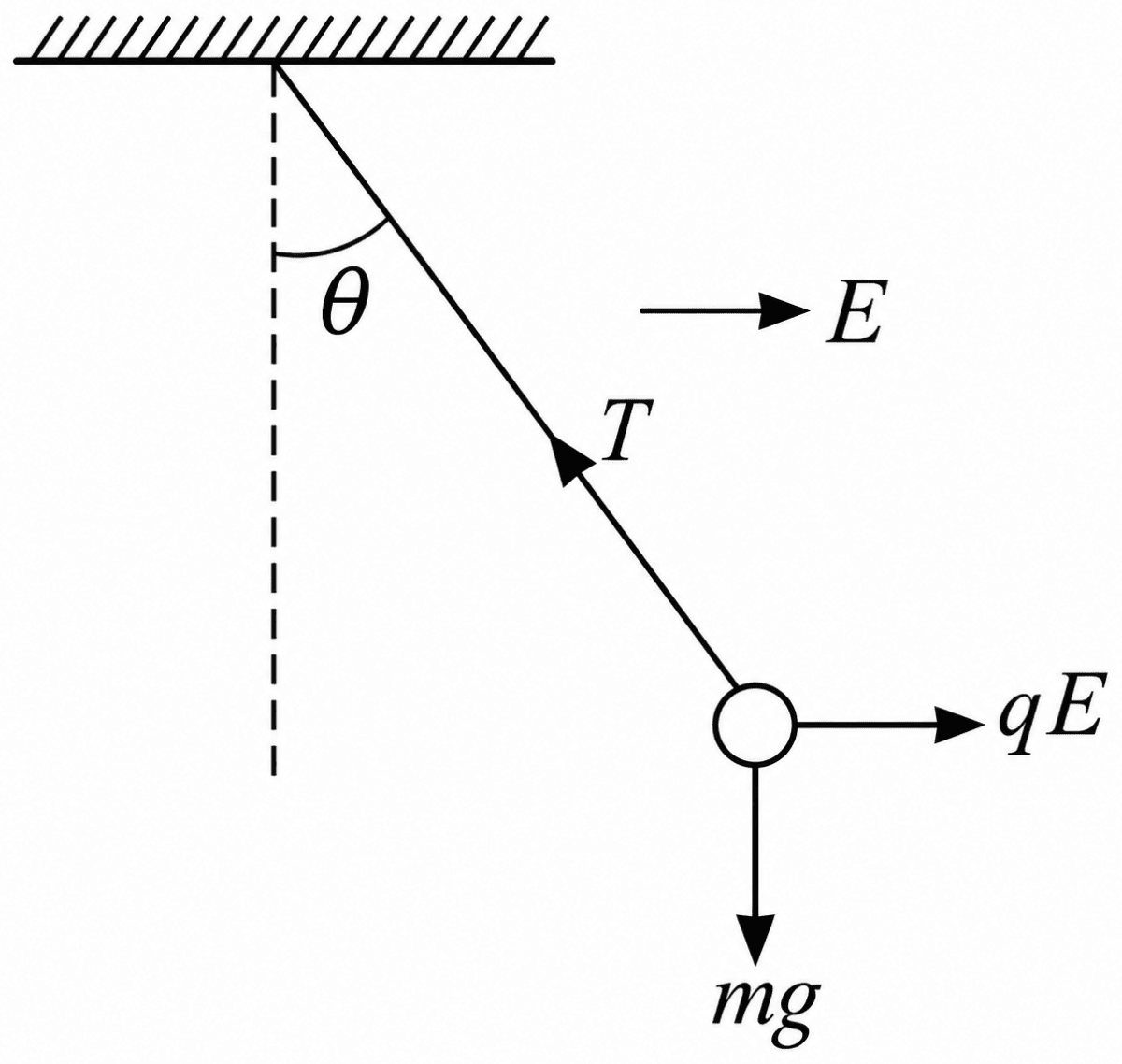
The bob of a simple pendulum has mass 2g and a charge of 5.0 μC. It is at rest in a uniform horizontal electric field of intensity 2000 V/m. At equilibrium, the angle that the pendulum makes with the vertical is : (take g = 10 m/s2)
tan-1(5.0)
tan-1(2.0)
tan-1(0.5)
tan-1(0.2)
Answer
tan-1(0.5)
Reason —
Given,
Mass of the bob, m = 2 g = 2 × 10⁻³ kg
Charge, q = 5.0 μC = 5.0 × 10⁻⁶ C
Electric field, E = 2000 V/m, horizontal
g = 10 m/s2
At equilibrium the string makes an angle θ with the vertical. Resolving the tension into horizontal and vertical components,
For a uniformly charged ring of radius R, the electric field on its axis has the largest magnitude at a distance h from its centre. Then, value of h is :
2R
R2
R
5R
Answer
2R
Reason —
The electric field on the axis of a uniformly charged ring of radius R, at a distance h from its centre, is
E=4πε01(R2+h2)3/2Qh
For E to be maximum, dhdE=0. Differentiating with respect to h,
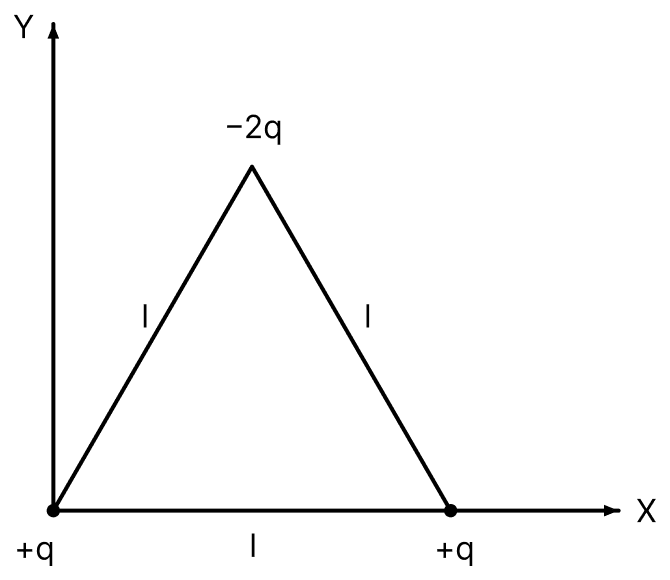
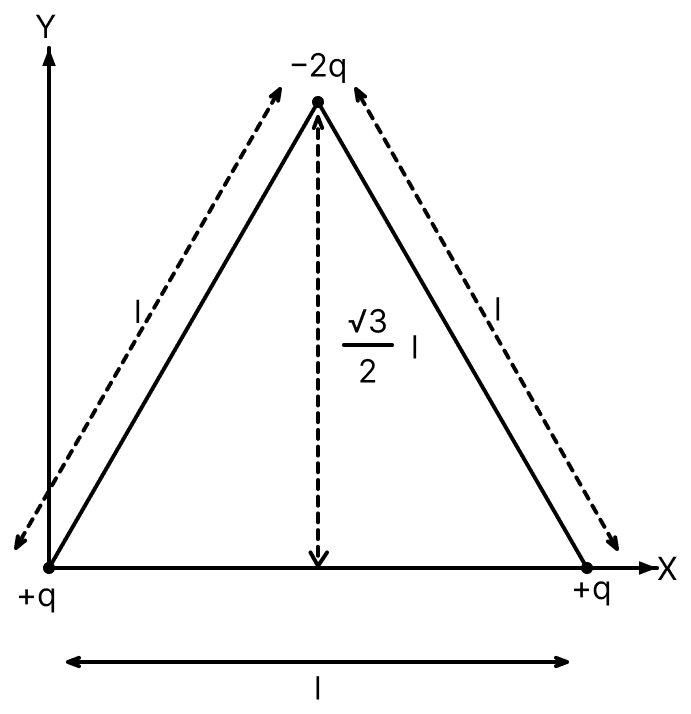
Determine the electric dipole moment of the system of three charges, placed on the vertices of an equilateral triangle as shown in the figure.
3,ql2j^−i^
2qlj^
−3,qlj^
(ql)2i^+j^
Answer
−3qlj^
Reason —
From the figure the charge + q lies at the origin, the second charge + q at (l, 0) and the charge − 2q at the apex (2l,23l) of the equilateral triangle of side l.
The dipole moment of a system of charges is p=∑qiri. Since the algebraic sum of the charges is q + q − 2q = 0, this is independent of the choice of origin.
x-component :
px=q(0)+q(l)+(−2q)(2l)px=ql−qlpx=0
y-component :
py=q(0)+q(0)+(−2q)(23l)py=−3qlp=−3qlj^
Question 9
An electric dipole is formed by two equal and opposite charges q with separation d. The charges have same mass m. It is kept in a uniform electric field E. If it is slightly rotated from its equilibrium orientation, then its angular frequency ω is :
2mdqE
2mdqE
md2qE
mdqE
Answer
md2qE
Reason —
Given, the two charges q are of mass m each and are separated by a distance d, so the dipole moment is p = qd.
Moment of inertia about the centre : Each charge is at a distance 2d from the mid-point,
I=2m(2d)2I=2md2
Restoring torque : When the dipole is rotated through a small angle θ from its equilibrium orientation,
τ=−pEsinθ≈−pEθ(for small θ)
This is of the form τ = − cθ, so the motion is angular simple harmonic with
ω=IpE
Substituting p = qd and I=2md2,
ω=2md2qdEω=md2qE
Question 10
A particle of charge q and mass m is subjected to an electric field E = E0 (1 − ax2) in the x-direction, where a and E0 are constants. Initially the particle was at rest at x = 0. Other than the initial position the kinetic energy of the particle becomes zero when the distance of the particle from the origin is :
a3
a2
a1
a
Answer
a3
Reason —
Given, E=E0(1−ax2) along the x-direction, and the particle of charge q starts from rest at x = 0.
The particle starts from rest and again comes to rest at some distance d, so its kinetic energy is zero at both positions. By the work-energy theorem the total work done by the electric force over this distance must be zero,
W=∫0dqEdxW=qE0∫0d(1−ax2)dxW=0
Carrying out the integration,
qE0[x−3ax3]0d=0d−3ad3=0d(1−3ad2)=0
Since d ≠ 0 (the initial position is excluded),
d2=a3d=a3
Question 11
The acceleration of an electron due to the mutual attraction between the electron and a proton when they are 1.6 Å apart is :
The electric field at a point on the equatorial plane at a distance r from the centre of a dipole having dipole moment p is given by :
(r >> separation of two charges forming the dipole, ε0 = permittivity of free space)
E=−4πε0r3p
E=4πε0r3p
E=4πε0r32p
E=−4πε0r2p
Answer
E=−4πε0r3p
Reason —
For a point in the broad-side-on position, that is, on the equatorial plane at a distance r from the centre of the dipole, the components of the two field intensities perpendicular to the dipole axis cancel while the parallel components add up, giving
E=4πε01(r2+l2)3/2p
Since r >> the separation of the two charges, l2 may be neglected in comparison with r2,
E=4πε01r3p
The direction of the field at every point of the equatorial line is antiparallel to the dipole axis, so a minus sign must be put in the vector form,
E=−4πε01r3p
Question 13
Consider the force F on a charge 'q' due to a uniformly charged spherical shell of radius R carrying charge Q distributed uniformly over it. Which one of the following statements is true for F, if 'q' is placed at distance r from the centre of the shell?
F=4πε01r2Qq for all r
F=4πε01R2qQ>F>0 for r < R
F=4πε01r2Qq for r > R
F=4πε01R2Qq for r < R
Answer
F=4πε01r2Qq for r > R
Reason —
A uniformly charged spherical shell behaves, for all points outside it, exactly as though its entire charge Q were concentrated at its centre. Hence for r > R the force on a charge q placed at a distance r from the centre is
F=4πε01r2Qq
For points inside the shell, that is, for r < R, the contributions of all the elements of the shell cancel exactly, so the field and hence the force is zero,
F=0for r<R
Question 14
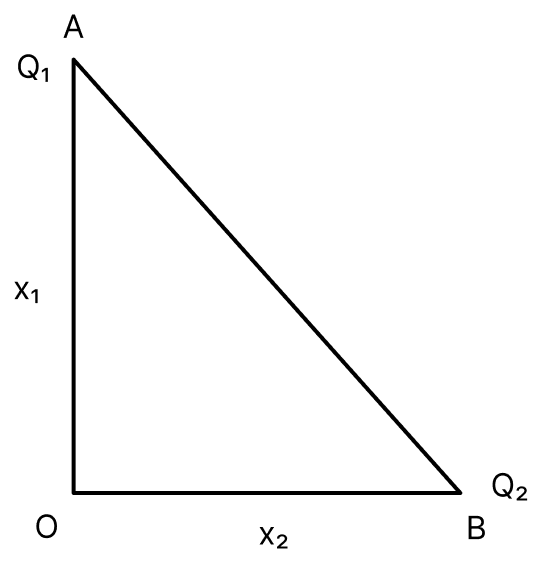
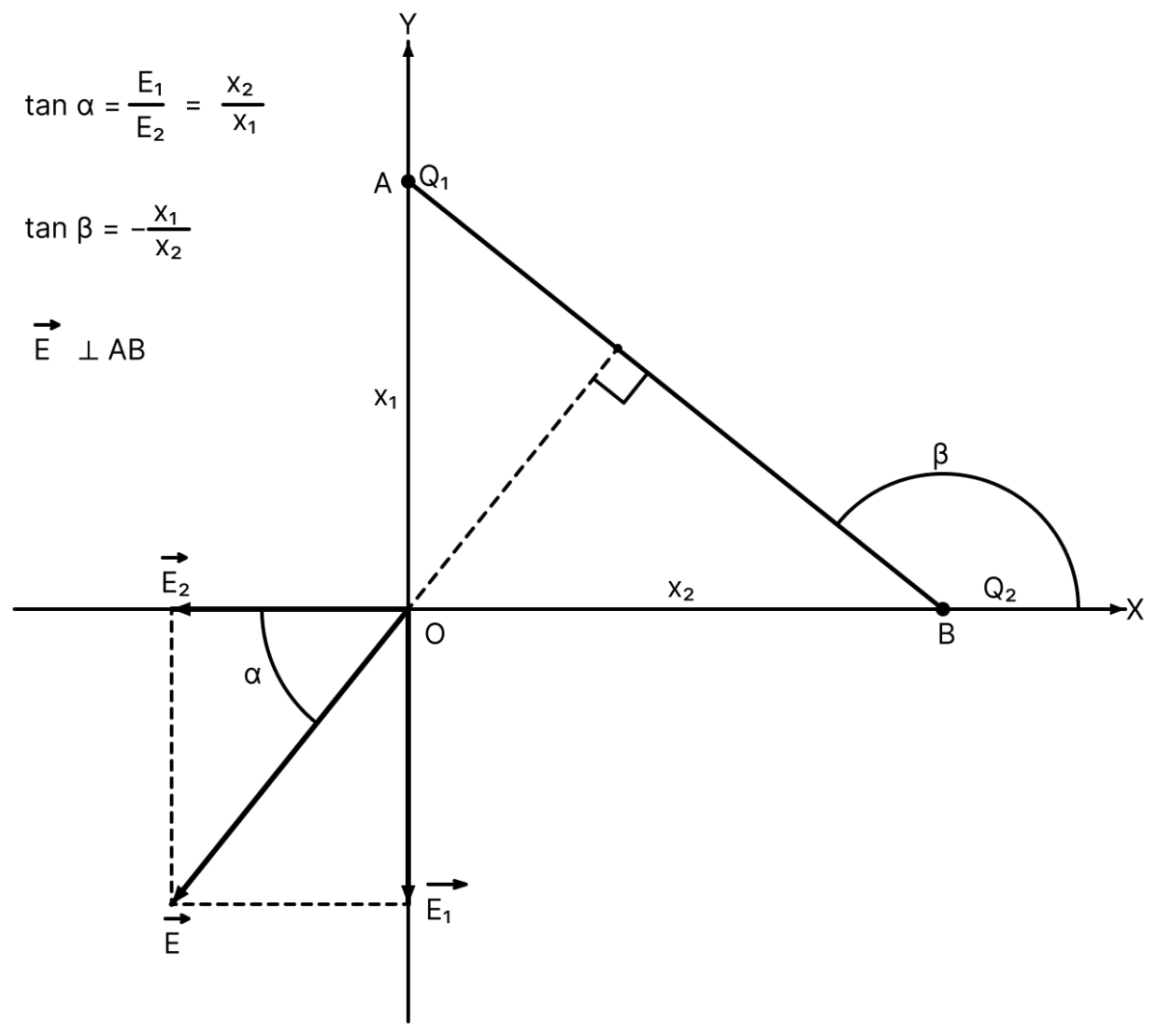
Charges Q1 and Q2 are at points A and B of a right angle triangle OAB (see figure). The resultant electric field at point O is perpendicular to the hypotenuse, then Q1/Q2 is proportional to :
x23x13
x12x22
x2x1
x1x2
Answer
x2x1
Reason —
Given, from the figure Q1 is at A on the y-axis at a distance x1 from O, and Q2 is at B on the x-axis at a distance x2 from O.
The field at O due to Q1 is directed along AO, that is, along the y-axis, and the field due to Q2 is directed along BO, that is, along the x-axis,
E1=4πε01x12Q1,E2=4πε01x22Q2
If the resultant field at O makes an angle α with the x-axis, then
tanα=E2E1
The hypotenuse AB makes an angle β with the x-axis such that
tanβ=x2−00−x1tanβ=−x2x1
For the resultant to be perpendicular to AB, the product of the two slopes must be − 1,
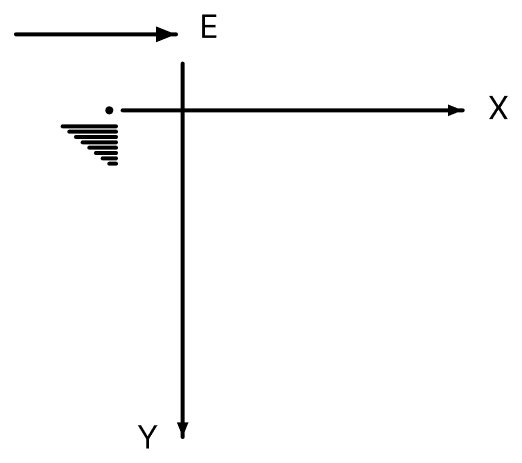
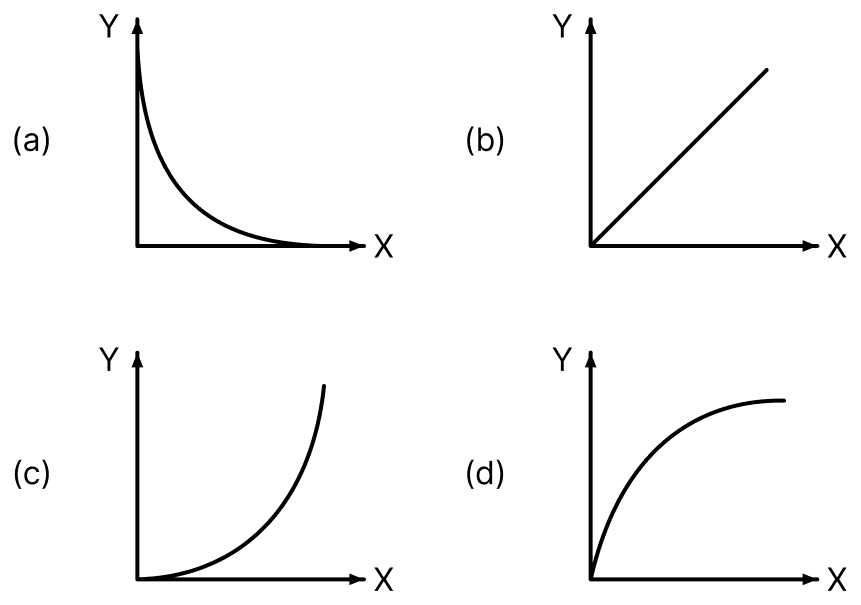
A small point mass carrying some positive charge on it, is released from the edge of a table. There is a uniform electric field in this region in the horizontal direction. Which of the following options then correctly describe the trajectory of the mass? (Curves are drawn schematically and are not to scale).
Answer
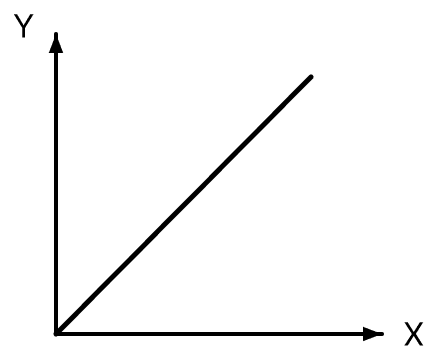
The straight line passing through the origin, that is, option 2.
Reason —
Given, the point mass carries a positive charge q and is released from rest at the edge of the table. The electric field E is uniform and horizontal, along the x-direction, while gravity acts vertically downwards along the y-direction.
Acceleration along the x-direction :
ax=mqE=a constant
Acceleration along the y-direction :
ay=g=a constant
Since the mass starts from rest, after a time t,
x=21axt2,y=21gt2
Dividing one by the other, t2 cancels,
xy=axgxy=qEmgxy=a constant
Hence y is directly proportional to x, and the trajectory of the mass is a straight line passing through the origin.
Note: Both accelerations are constant, so the ratio y/x is fixed and the path must be a straight line. The answer key printed with the question gives option 4, which shows a curved path; the correct option is 2.
Question 16
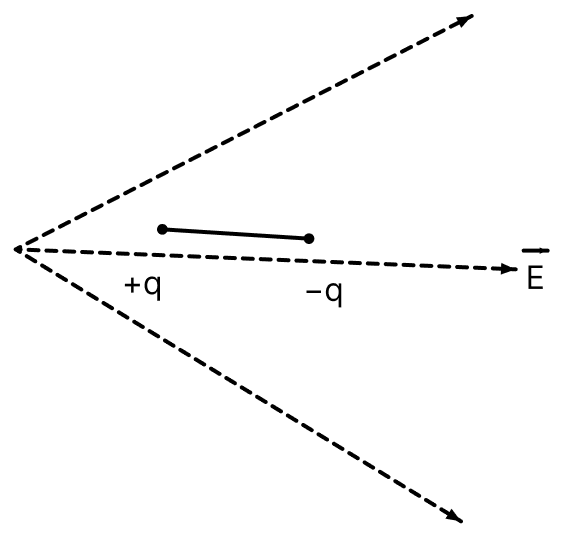
A dipole is placed in an electric field as shown. In which direction will it move?
Towards the right as its potential energy will increase.
Towards the left as its potential energy will increase.
Towards the right as its potential energy will decrease.
Towards the left as its potential energy will decrease.
Answer
Towards the right as its potential energy will decrease.
Reason —
From the figure the lines of force diverge towards the right, so they are crowded on the left and farther apart on the right. Hence the field is non-uniform, being stronger on the left and weaker on the right.
The dipole is placed with + q on the left and − q on the right, so the dipole moment p, which points from − q to + q, is directed towards the left, that is, antiparallel to E.
Net force : The charge + q lies in the stronger part of the field and experiences a force qE1 towards the right, while the charge − q lies in the weaker part and experiences a force qE2 towards the left. Since E1 > E2, the net force is towards the right.
Potential energy : For a dipole, U = − pE cos θ. Here θ = 180°, so U = + pE. As the dipole moves to the right, the field E becomes weaker, and hence U decreases.
Therefore the dipole moves towards the right and its potential energy decreases.
Question 17
Two identical tennis balls each having mass m and charge q are suspended from a fixed point by threads of length l. What is the equilibrium separation when each thread makes a small angle θ with the vertical?
d=(2πε0mgq2l)21
d=(2πε0mgq2l)31
d=(2πε0m2gq2l2)31
d=(2πε0m2g2q2l2)31
Answer
d=(2πε0mgq2l)31
Reason —
Given, two balls each of mass m and charge q hang from a common point by threads of length l, and each thread makes a small angle θ with the vertical. Let the equilibrium separation be d.
Forces on either ball : the weight mg vertically downwards, the tension T along the thread, and the electrostatic repulsion
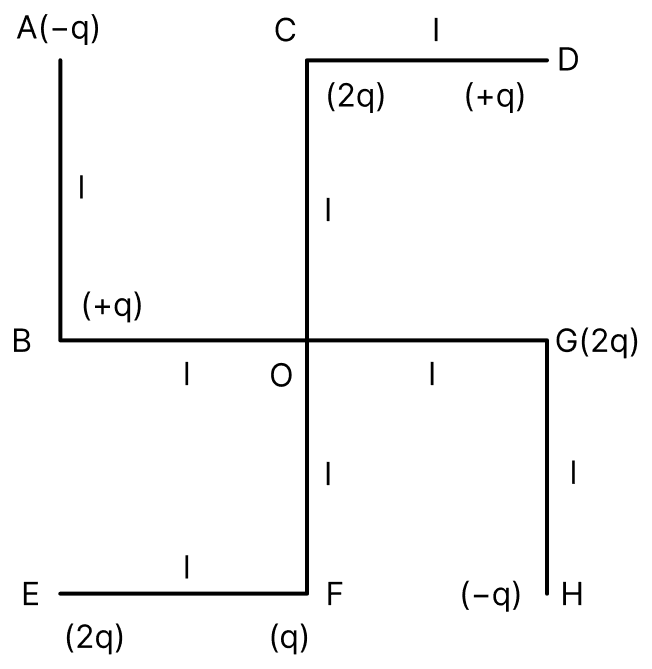
What will be the magnitude of electric field at point O as shown in figure? Each side of the figure is l and perpendicular to each other.
4πε01l2q
4πε01(2l2)q(22−1)
4πε0(2l)2q
4πε012l22q(2)
Answer
4πε01(2l2)q(22−1)
Reason —
Taking O as the origin, with the x-axis horizontal and the y-axis vertical, the positions and charges read off from the figure are
B (−l, 0) : + q, C (0, l) : + 2q, G (l, 0) : + 2q, F (0, −l) : + q — each at a distance l from O
A (−l, l) : − q, D (l, l) : + q, E (−l, −l) : + 2q, H (l, −l) : − q — each at a distance l2 from O
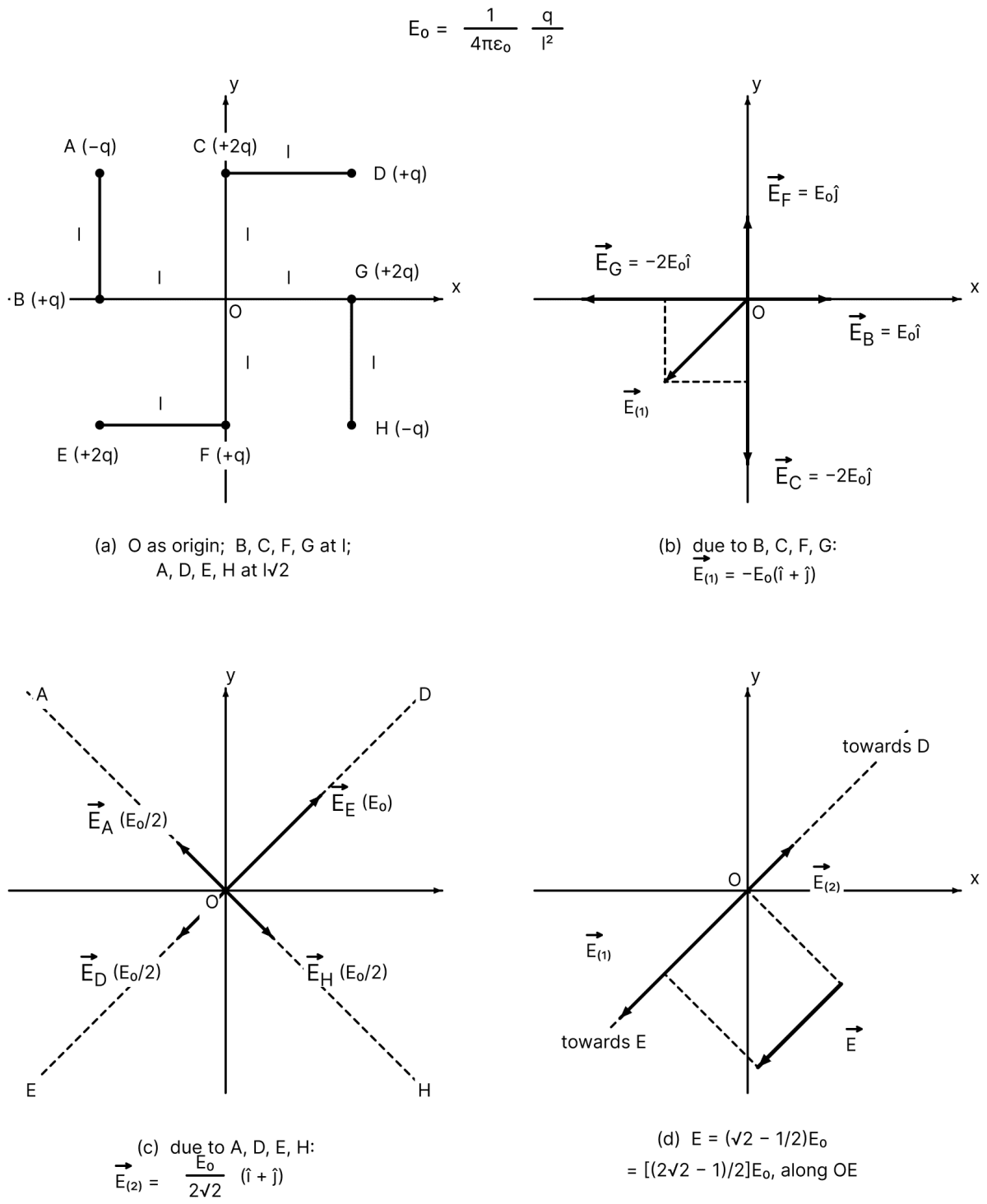
Let k=4πε01 and E0=l2kq.
Contribution of the four charges at a distance l : The field of a positive charge at O points away from that charge,
EB=E0i^,EC=−2E0j^,EG=−2E0i^,EF=E0j^
Adding these,
E(1)=(1−2)E0i^+(−2+1)E0j^E(1)=−E0(i^+j^)
Contribution of the four charges at a distance l2 : Here the magnitude of the field of a charge Q is 2l2kQ, and the unit vectors are along the diagonals,
Note: The answer key printed with the question gives option 4, which works out to 2E0; the value obtained above from the charges and positions shown in the figure is option 2.
Question 19
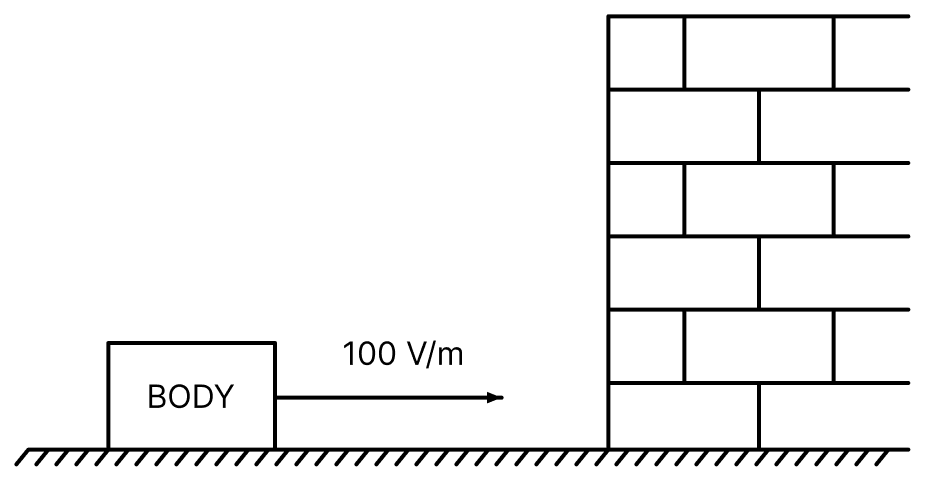
A body having specific charge 8 μC/g is resting on a frictionless plane at a distance 10 cm from the wall (as shown in the figure). It starts moving towards the wall when a uniform electric field of 100 V/m is applied horizontally towards the wall. If the collision of the body with the wall is perfectly elastic, then the time period of the motion will be :
0.5 s
1 s
2 s
3 s
Answer
1 s
Reason —
Given,
Specific charge, mq=8μC/g=10−38×10−6=8×10−3 C/kg
Electric field, E = 100 V/m
Distance from the wall, s = 10 cm = 0.1 m
Acceleration of the body :
a=mqEa=(mq)Ea=(8×10⁻³)(100)a=0.8m/s2
Time to reach the wall : The body starts from rest, so
s=21at20.1=21(0.8)t2t2=0.80.2t2=0.25t=0.5s
Time period : The collision with the wall is perfectly elastic, so the body rebounds with the same speed and is then retarded by the same electric force. It therefore takes an equal time of 0.5 s to return to its starting point, where it comes momentarily to rest, and the motion repeats.
T=2tT=2×0.5T=1s
Note: The printed figure labels the field as 10 V/m, but the question stem gives 100 V/m. The stem value is used; it gives the keyed answer, 1 s.
Question 20
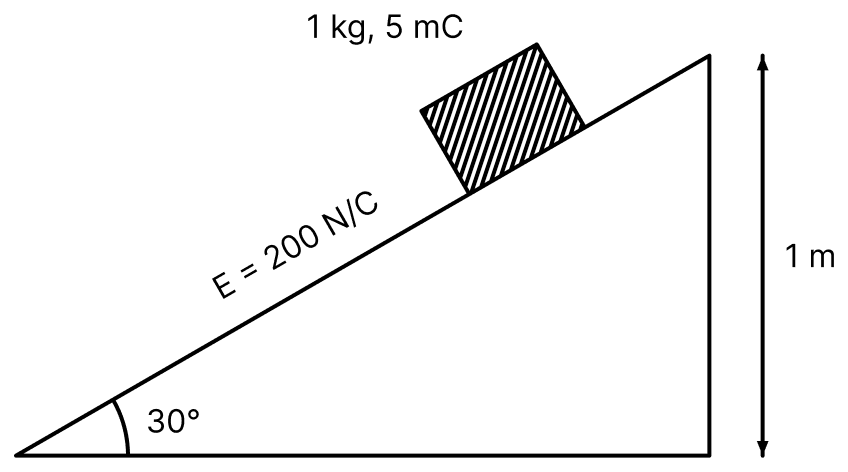
An inclined plane making an angle of 30° with the horizontal is placed in a uniform horizontal electric field 200 N/C as shown in the figure. A body of mass 1 kg and charge 5 mC is allowed to slide down from rest at a height of 1m. If the coefficient of friction is 0.2, find the time taken by the body to reach the bottom.
[Take, g=9.8m/s2,sin30°=21,cos30°=23]
0.92 s
0.46 s
2.3 s
1.3 s
Answer
1.3 s
Reason —
Given,
Angle of the incline, θ = 30°; height, h = 1 m
Mass, m = 1 kg; charge, q = 5 mC = 5 × 10⁻³ C
Horizontal electric field, E = 200 N/C
Coefficient of friction, μ = 0.2; g = 9.8 m/s2
Length of the incline :
L=sin30°hL=211L=2m
Electric force :
F=qEF=(5×10⁻³)(200)F=1N,directed horizontally
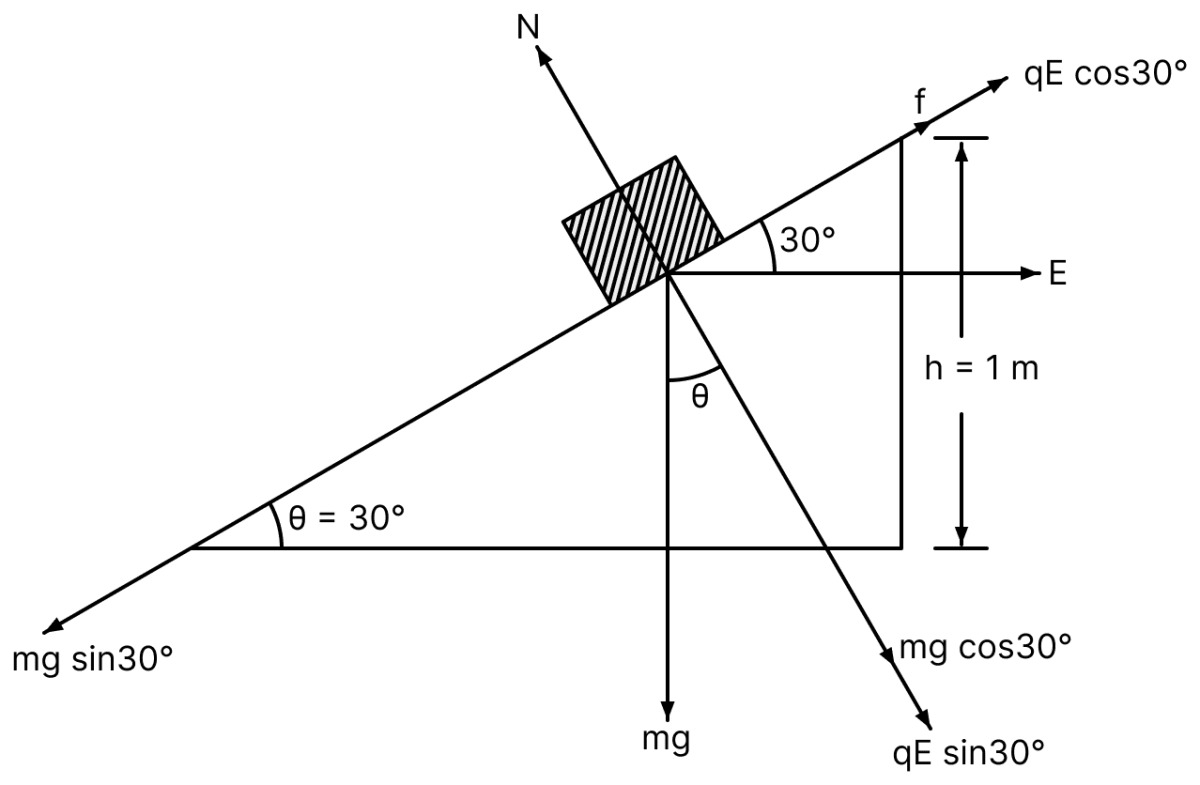
Forces along the incline : The component of the weight down the incline is mg sin θ, while the horizontal electric force has a component qE cos θ directed up the incline, since it opposes the sliding of the body.
Normal reaction : The normal reaction is the sum of the components of the weight and of the electric force perpendicular to the incline,
Time taken : Starting from rest and covering L = 2 m,
L=21at22=21(2.237)t2t2=2.2374t2=1.788t=1.3s
Question 21
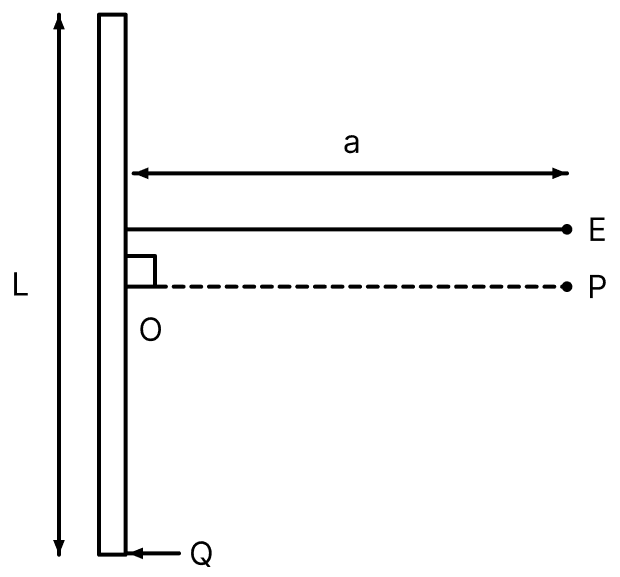
Find the electric field at point P (as shown in figure) on the perpendicular bisector of a uniformly charged thin wire of length L carrying a charge Q. The distance of the point P from the centre of the rod is a=23L.
4πε0L23Q
3πε0L2Q
23πε0L2Q
4πε0L2Q
Answer
23πε0L2Q
Reason —
Given, a thin wire of length L carries a charge Q, and the point P lies on its perpendicular bisector at a distance a=23L from the centre of the rod.
Linear charge density :
λ=LQ
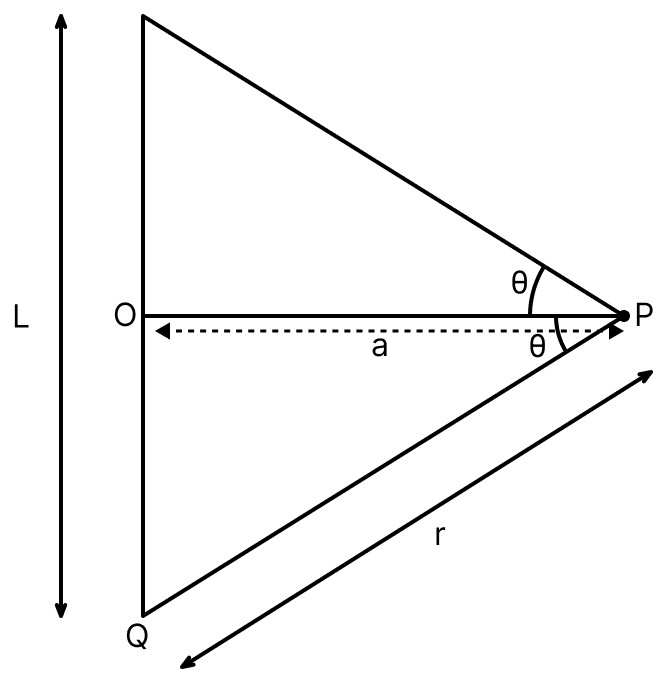
For a finite line-charge, the components of the field along the length cancel in pairs about the mid-point, and the field at a point on the perpendicular bisector is
E=4πε01a2λsinθ
where θ is the angle subtended at P by half the rod, so that
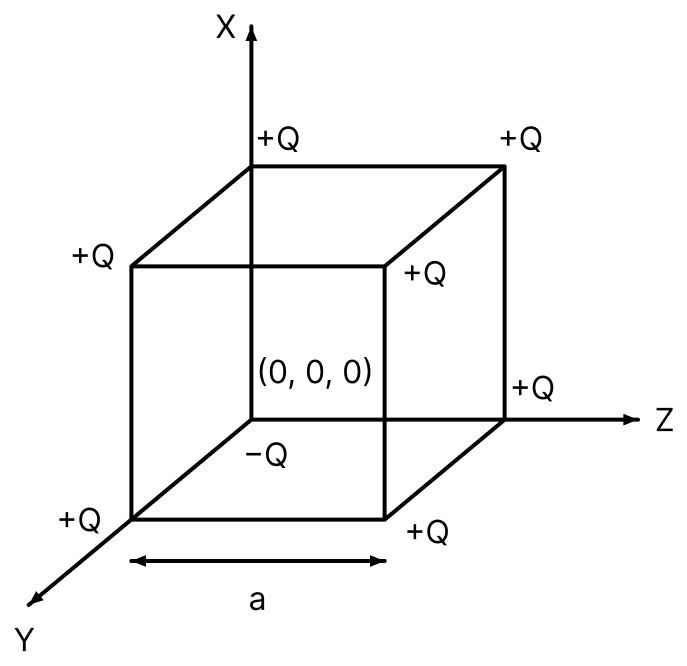
A cube of side a has point charges +Q located at each of its vertices except at the origin, where the charge is −Q. The electric field at the centre of cube is :
33πε0a2−Q(x^+y^+z^)
33πε0a2Q(x^+y^+z^)
33πε0a2−2Q(x^+y^+z^)
33πε0a22Q(x^+y^+z^)
Answer
33πε0a2−2Q(x^+y^+z^)
Reason —
Given, a cube of side a with a charge + Q at each of its eight vertices except the origin, where the charge is − Q.
If charges + Q were placed at all the eight vertices, the fields produced at the centre would cancel in pairs, since the charges at the ends of every body diagonal are equidistant from the centre and produce equal and opposite fields. The resultant would then be zero.
The actual arrangement is obtained from this by adding a charge − 2Q at the origin, since (+ Q) + (− 2Q) = − Q. Hence the field at the centre is simply the field due to a single charge − 2Q placed at the origin.
Distance of the centre from the origin : Half the body diagonal of the cube,
r=23ar2=43a2
Magnitude of the field :
E=4πε0143a22QE=4πε0×3a28QE=3πε0a22Q
Direction : The field of a negative charge points towards it, that is, from the centre towards the origin. The unit vector along this direction is −3(x^+y^+z^).
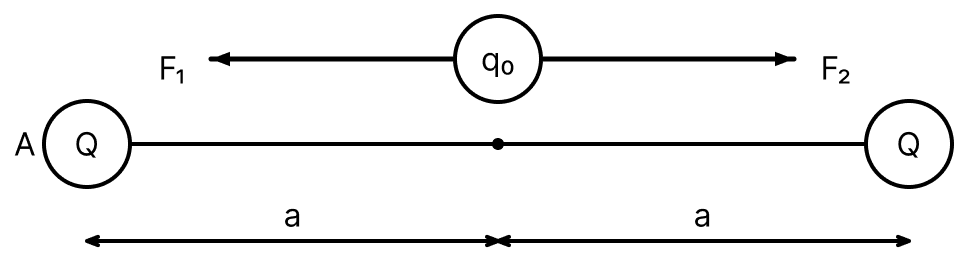
Two identical positive charge Q each are fixed at a distance of 2a apart from each other. Another point charge q0 with mass 'm' is placed at mid-point between two fixed charges. For a small displacement along the line joining the fixed charges, the charge q0 executes SHM. The time-period of oscillation of charge q0 will be :
q0Q4π3ε0ma3
4π3ε0ma3q0Q
q0Q2π3ε0ma3
q0Q8π3ε0ma3
Answer
q0Q4π3ε0ma3
Reason —
Given, two charges Q are fixed a distance 2a apart, and a charge q0 of mass m is placed at the mid-point, that is, at a distance a from each.
Let q0 be displaced through a small distance x towards the right-hand charge. Its distance from that charge becomes (a − x) and from the charge at A becomes (a + x). The force F1 due to the nearer charge acts towards the left and the force F2 due to the charge at A acts towards the right, so, taking the direction of the displacement as positive, the net force on q0 is
Two identical charged particles each having a mass 10 g and charge 2.0 × 10⁻⁷ C are placed on a horizontal table with a separation of L between them such that they stay in limited equilibrium. If the coefficient of friction between each particle and the table is 0.25, find the value of L. [Use g = 10 m s-2]
12 cm
10 cm
8 cm
5 cm
Answer
12 cm
Reason —
Given,
Mass of each particle, m = 10 g = 10 × 10-3 kg
Charge on each, q = 2.0 × 10⁻⁷ C
Coefficient of friction, μ = 0.25; g = 10 m s-2
The particles are in limiting equilibrium, so the electrostatic force of repulsion between them is just balanced by the limiting force of friction,
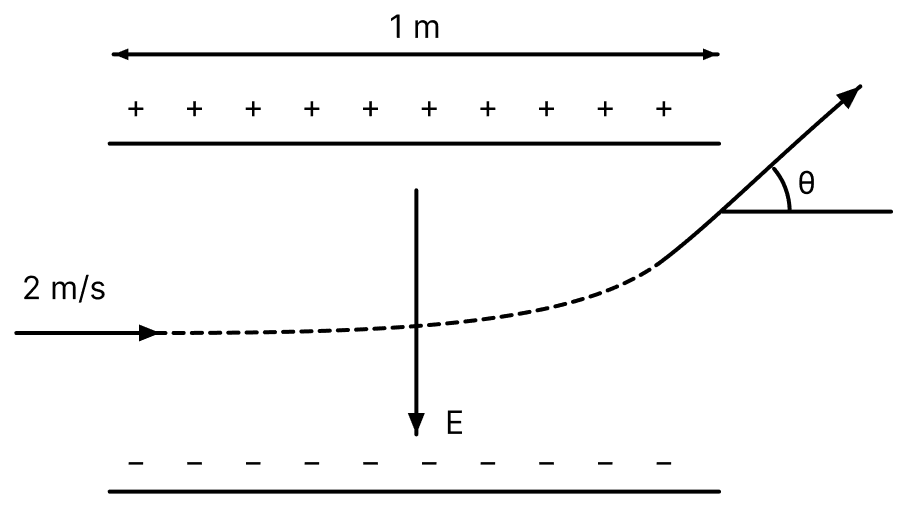
A uniform electric field E = (8m/e) V/m is created between two parallel plates of length 1 m as shown in figure, (where m = mass of electron and e = charge of electron). An electron enters the field symmetrically between the plates with a speed of 2 m/s. The angle of the deviation (θ) of the path of the electron as it comes out of the field will be ............... .
tan-1(4)
tan-1(2)
tan−1(31)
tan-1(3)
Answer
tan-1(2)
Reason —
Given,
Electric field, E=e8m V/m
Length of the plates, L = 1 m
Speed of entry, u = 2 m/s, parallel to the plates
Acceleration of the electron perpendicular to the plates :
a=meEa=me×e8ma=8m/s2
Time spent inside the field :
t=uLt=21t=0.5s
Velocity components as the electron leaves the field :
vx=uvx=2m/svy=atvy=8×0.5vy=4m/s
Angle of deviation :
tanθ=vxvytanθ=24tanθ=2θ=tan−1(2)
Question 26
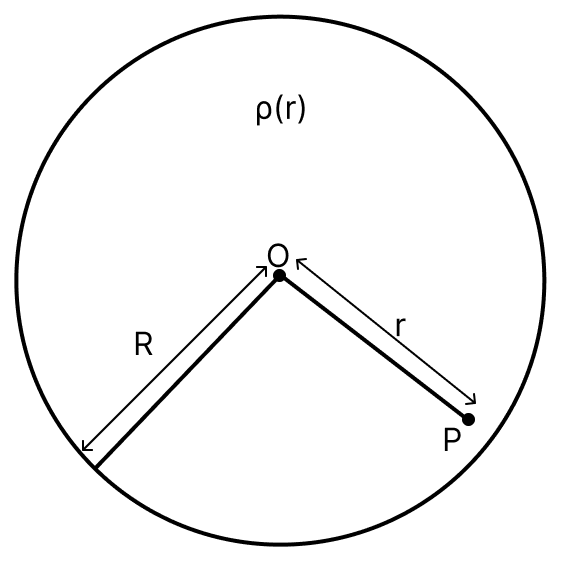
A spherically symmetric charge distribution is considered with charge density varying as
ρ(r)=⎩⎨⎧ρ0(43−Rr)zerofor r≤Rfor r>R
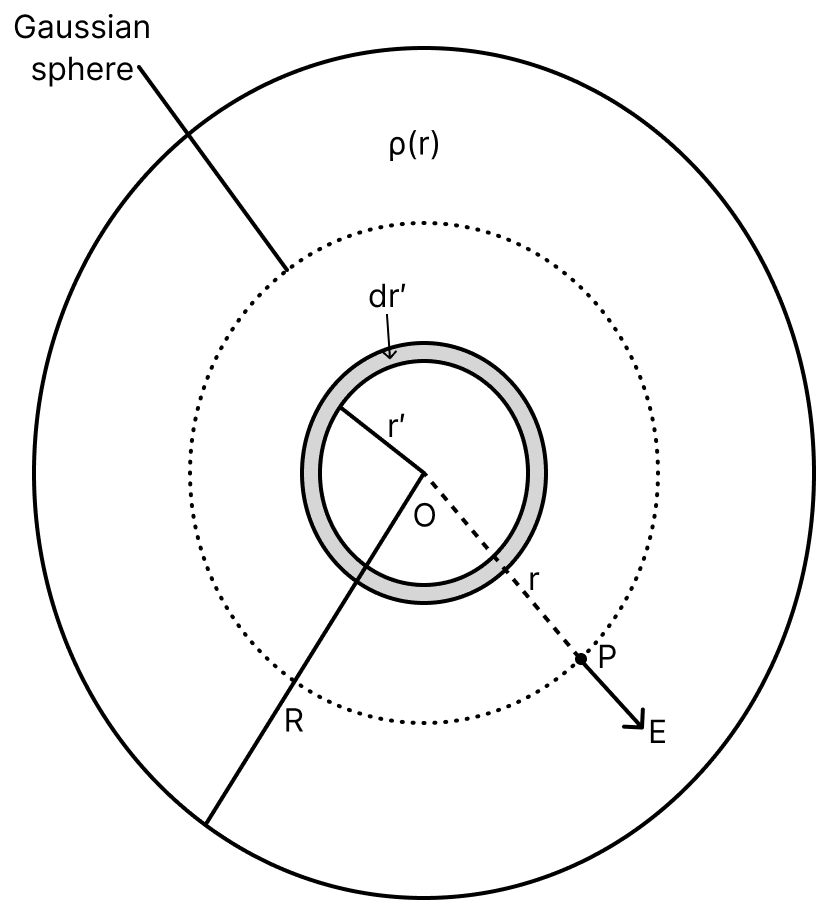
where, r(r < R) is the distance from the centre O (as shown in figure). The electric field at point P will be :
4ε0ρ0r(43−Rr)
3ε0ρ0r(43−Rr)
4ε0ρ0r(1−Rr)
5ε0ρ0r(1−Rr)
Answer
4ε0ρ0r(1−Rr)
Reason —
Given, ρ(r)=ρ0(43−Rr) for r ≤ R and zero for r > R.
Charge enclosed within a sphere of radius r : Taking a thin spherical shell of radius r′ and thickness dr′, of volume 4πr′2dr′,
A long cylindrical volume contains a uniformly distributed charge of density ρ. The radius of cylindrical volume is R. A charge particle (q) revolves around the cylinder in a circular path. The kinetic energy of the particle is :
4ε0ρqR2
2ε0ρqR2
4ε0R2qρ
qρ4ε0R2
Answer
4ε0ρqR2
Reason —
Given, a long cylinder of radius R carries a uniform volume charge density ρ, and a charge particle q revolves around it in a circular path of radius r (r > R).
Field outside the charged cylinder : For a length L of the cylinder the enclosed charge is ρπR2L, and by the cylindrical symmetry this behaves as a line-charge of linear density
λ=ρπR2
The field at a distance r from the axis of a line-charge is
E=2πε0rλE=2ε0rρR2
Condition for circular motion : The electrostatic force supplies the necessary centripetal force,
qE=rmv2q2ε0rρR2=rmv2mv2=2ε0qρR2
Kinetic energy :
K=21mv2K=21×2ε0qρR2K=4ε0ρqR2
Note that the result is independent of the radius r of the circular path.
Question 28
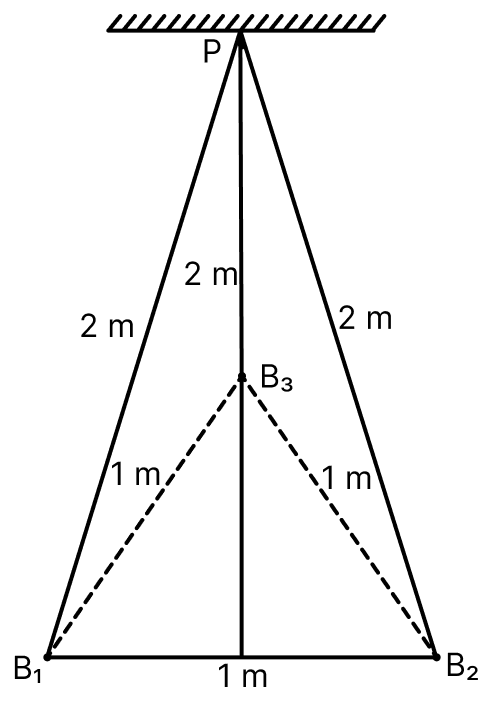
Three identical charged balls each of charge 2C are suspended from a common point P by silk threads of 2 m each (as shown in figure). They form an equilateral triangle of side 1 m. The ratio of net force on a charged ball to the force between any two charged balls will be :
1 : 1
1 : 4
3 : 2
3 : 1
Answer
3 : 1
Reason —
Given, three identical balls each of charge 2 C hang from a common point and form an equilateral triangle of side 1 m.
Force between any two balls :
F=4πε01(1)2(2)(2)F=4πε01×4
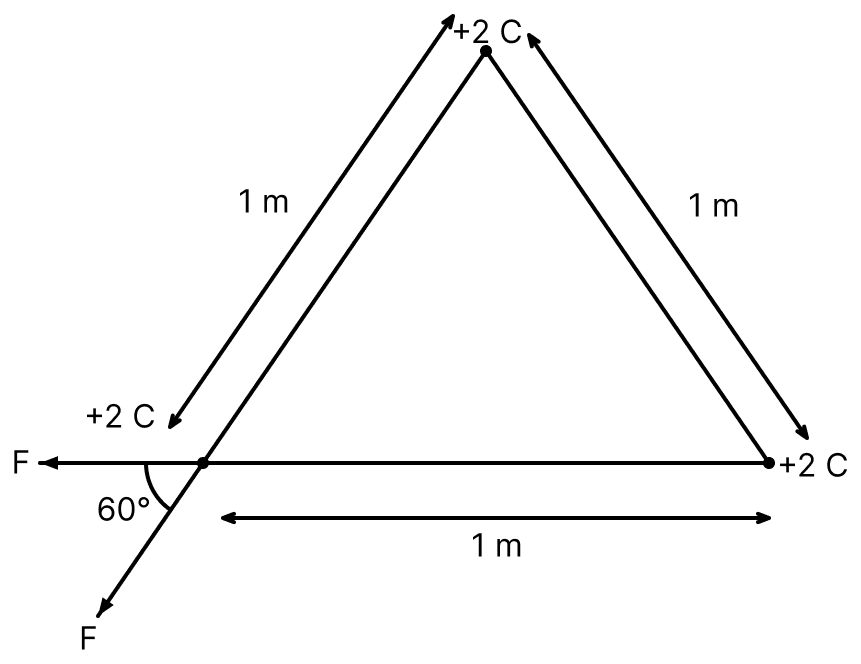
Net force on one ball : Each ball is repelled by the other two with forces of equal magnitude F, and the angle between these two forces is 60°, since the triangle is equilateral. Hence
A positive charge particle of 100 mg is thrown in opposite direction to a uniform electric field of strength 1 × 10⁵ NC-1. If the charge on the particle is 40 μC and the initial velocity is 200 ms-1, how much distance it will travel before coming to the rest momentarily?
1 m
5 m
10 m
0.5 m
Answer
0.5 m
Reason —
Given,
Mass, m = 100 mg = 100 × 10-6 kg = 1 × 10⁻⁴ kg
Charge, q = 40 μC = 40 × 10-6 C
Electric field, E = 1 × 10⁵ N C-1
Initial velocity, u = 200 m s-1, opposite to the field
Electric force on the particle :
F=qEF=(40×10−6)(1×10⁵)F=4N
Since the particle is thrown opposite to the field while the force on the positive charge is along the field, this force retards the particle.
Retardation :
a=mFa=1×10−44a=4×10⁴ms−2
Distance travelled before coming to rest : Using v2 = u2 − 2as with v = 0,
0=(200)2−2(4×10⁴)ss=8×1044×104s=0.5m
Question 30
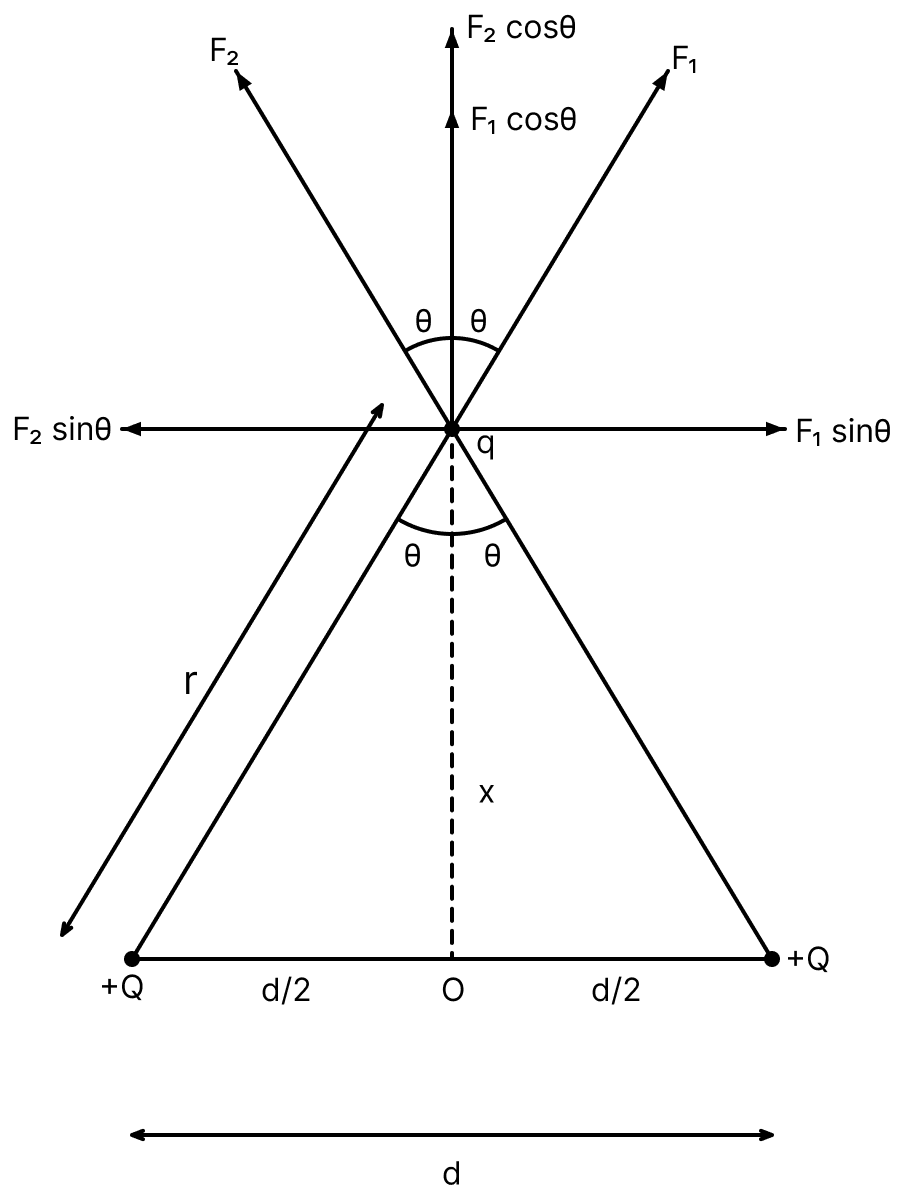
Two point-charges Q each are placed at a distance d apart. A third point-charge q is placed at a distance x from mid-point on the perpendicular bisector. The value of x at which charge q will experience the maximum Coulomb's force is :
x = d
x=2d
x=2d
x=22d
Answer
x=22d
Reason —
Given,
Two point-charges, each Q, separated by a distance d
Third charge q on the perpendicular bisector, at a distance x from the mid-point O
The distance of q from each of the two charges is
r=x2+4d2
By Coulomb's law, the magnitude of the force on q due to each charge is
F1=F2=4πε01(x2+4d2)Qq
If θ is the angle each force makes with the bisector, then the components perpendicular to the bisector are equal and opposite and cancel out, while the components along the bisector add up. Hence the resultant force is
Two point-charges −q and +q are placed at a distance of L, as shown in the figure. The magnitude of electric field intensity at a distance R(R >> L) varies as :
R61
R21
R31
R41
Answer
R31
Reason —
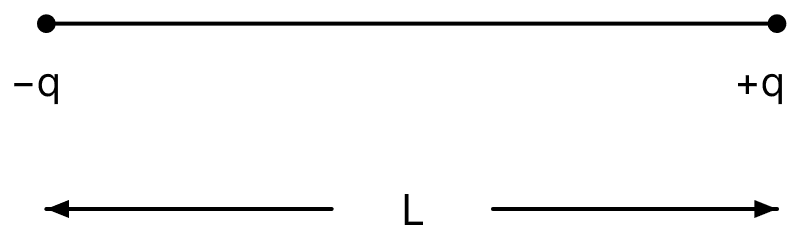
Given, the charges − q and + q are placed a distance L apart, so they form an electric dipole of moment
p=qL
For a point at a distance R from the dipole, with R >> L, the dipole behaves as a short dipole. The intensity of the electric field is then
E=4πε01R32p(axial),E=4πε01R3p(equatorial)
In either case
E∝R31
Question 32
A dipole comprises of two charged particles of identical magnitude q and opposite in nature. The mass 'm' of the positive charged particles is half of the mass of the negative charged particle. The two charges are separated by a distance 'l'. If the dipole is placed in a uniform electric field E; in such a way that dipole axis makes a very small angle with the electric field E. The angular frequency of the oscillations of the dipole when released is given by :
3ml8qE
ml8qE
3ml4qE
ml4qE
Answer
3ml4qE
Reason —
Given, the positive charge has mass m and the negative charge has mass 2m, the two charges being of magnitude q and separated by a distance l. Hence the dipole moment is
p=ql
Moment of inertia about the mid-point of the dipole : Each charge is at a distance 2l from the mid-point,
I=m(2l)2+2m(2l)2I=3m4l2I=43ml2
Restoring torque : When the dipole axis makes a very small angle θ with the field,
τ=−pEsinθ≈−pEθ
which is of the form τ = − cθ, so the oscillations are angular simple harmonic with
ω=IpE
Substituting the values,
ω=43ml2qlEω=3ml4qE
Question 33
An electric dipole is placed at an angle of 30° with an electric field of intensity 2 × 10⁵ NC-1. It experiences a torque equal to 4 Nm. Calculate the magnitude of charge on the dipole, if the dipole length is 2 cm.
4 mC
2 mC
8 mC
6 mC
Answer
2 mC
Reason —
Given,
Angle with the field, θ = 30°
Electric field, E = 2 × 10⁵ N C-1
Torque, τ = 4 N-m
Dipole length, 2l = 2 cm = 2 × 10⁻² m
The torque on a dipole placed in a uniform electric field is
τ=pEsinθp=Esinθτ
Substituting the values,
p=(2×10⁵)(21)4p=1×1054p=4×10⁻⁵C-m
Since p = q × 2l,
q=2lpq=2×10−24×10−5q=2×10⁻³Cq=2mC
Question 34
Two beads, each with charge q and mass m, are on a horizontal, frictionless, non-conducting, circular hoop of radius R. One of the beads is glued to the hoop at some point, while the other one performs small oscillations about its equilibrium position along the hoop. The square of the angular frequency of the small oscillations is given by [ε0 is the permittivity of free space] :
q2/(4πε0 R3m)
q2/(32 πε0R3m)
q2/(8πε0R3m)
q2/(16πε0R3m)
Answer
q2/(32 πε0R3m)
Reason —
Given, two beads each of charge q and mass m lie on a frictionless circular hoop of radius R, one of them being glued to the hoop.
Let the angular separation of the two beads, measured at the centre of the hoop, be θ. The straight-line distance between them is the chord
d=2Rsin2θ
Potential energy of the system :
U=4πε01dq2U=4πε012Rsin2θq2
U is least when sin2θ is greatest, that is, when θ = π. Hence the equilibrium position is the diametrically opposite point.
Let θ = π + φ, where φ is small. Then sin2θ=sin(2π+2ϕ)=cos2ϕ,
U=8πε0Rq2sec2ϕ≈8πε0Rq2(1+8ϕ2)
using secx≈1+2x2 for small x.
Angular simple harmonic motion : The moving bead travels along the hoop, so its moment of inertia about the centre is I = mR2. The effective torsional constant is
A particle of mass 1 mg and charge q is lying at the mid-point of two stationary particles kept at a distance 2 m when each is carrying same charge q. If the free charged particle is displaced from its equilibrium position through distance x (x << 1 m), the particle executes SHM. Its angular frequency of oscillation will be .......... × 105 rad/s, if q2 = 10C2.
Answer
Given,
Mass of the free particle, m = 1 mg = 1 × 10⁻⁶ kg
The two stationary particles are 2 m apart, so the free particle at the mid-point is at a distance a = 1 m from each
Each of the three particles carries the same charge q, with q2 = 10 C2
4πε01=9×10⁹ N-m2 C-2
Let the free particle be displaced through a small distance x from the mid-point, along the line joining the two fixed charges, towards one of them. Its distance from that charge becomes (a − x) and from the other becomes (a + x). The nearer charge pushes it back towards the mid-point with the larger force, so, taking the direction of the displacement as positive, the net force on it is
Since x << a, the term x2 may be neglected in comparison with a2,
F=−4πε0q2a44axF=−4πε0q2a34x
The force is proportional to the displacement and, being negative, is directed towards the mean position, so the motion is simple harmonic. Comparing with F = − mω2x,
Hence, the value to be filled in the blank is 6000.
Question 2
An infinite number of point-charges, each carrying 1 μC charge, are placed along the Y-axis at y = 1 m, 2 m, 4 m and 8 m.
The total force on a 1 C point-charge, placed at the origin, is x × 103 N. The value of x to the nearest integer, is ............... .
(Take,4πε01=9×10⁹N-m2/C2)
Answer
Given,
Point-charges of 1 μC = 1 × 10⁻⁶ C each, placed on the Y-axis at y = 1 m, 2 m, 4 m, 8 m, ... , the distances forming a geometric progression with common ratio 2
Test charge at the origin, q0 = 1 C
4πε01=9×10⁹ N-m2/C2
All the charges are of the same sign and lie on the same side of the origin, so all the forces on the charge at the origin are in the same direction and simply add up.
The series inside the bracket is an infinite geometric progression with first term 1 and common ratio 41. Its sum is
S=1−411S=34
Substituting the values,
F=(9×10⁹)(1×10⁻⁶)(1)×34F=9×103×34F=12×103N
Comparing with F = x × 103 N, we get x = 12.
Hence, the value of x to the nearest integer is 12.
Question 3
Two small spheres each of mass 10 mg are suspended from a point by threads 0.5 m long. They are equally charged and repel each other to a distance of 0.20 m. The charge on each of the sphere is 21a×10−8 C. The value of a will be ............... .
(Given, g = 10 ms-2)
Answer
Given,
Mass of each sphere, m = 10 mg = 10 × 10-6 kg = 1 × 10⁻⁵ kg
Length of each thread, l = 0.5 m
Separation of the spheres, x = 0.20 m
g = 10 m s-2
4πε01=9×10⁹ N-m2 C-2
Let θ be the angle each thread makes with the vertical, and q the charge on each sphere. Resolving the tension into components,
Note: The printed key gives 630 because its working treats 10 mg as 10 × 10-3 kg; using m = 10-5 kg gives a ≈ 20.
Question 4
A stream of a positively charged particles having mq=2×10¹¹Ckg−1 and velocity v0=3×10⁷i^ms−1 is deflected by an electric field 1.8j^ kV m-1. The electric field exists in a region of 10 cm along x direction. Due to the electric field, the deflection of the charge particles in the y direction is ............... mm.
Answer
Given,
Specific charge, mq=2×10¹¹ C kg-1
Initial velocity, v0=3×10⁷i^ m s-1
Electric field, E=1.8j^ kV m-1 = 1.8×10³j^ V m-1
Length of the field region along x, L = 10 cm = 0.1 m
The particles enter the field at right angles to it, so the motion along the x-direction is uniform while that along the y-direction is uniformly accelerated.
Hence, the deflection of the charge particles in the y direction is 2 mm.
Question 5
Two identical charged spheres are suspended by two strings of equal length. In equilibrium the string makes an angle of 37° with each other. When suspended in a liquid of density 0.7 g/cm3, the angle remains same. If density of material of the sphere is 1.4 g/cm3, the dielectric constant of the liquid is ............... .
(tan37°=43)
Answer
Given,
The angle between the two strings is 37°, so each string makes an angle θ=237° with the vertical
Density of the liquid, σ = 0.7 g/cm3
Density of the material of the spheres, ρ = 1.4 g/cm3
The angle remains the same in air and in the liquid
In air : If F is the force of repulsion and m the mass of each sphere,
tanθ=mgF…(i)
In the liquid : Two changes occur.
(a) The force of repulsion is reduced K times, where K is the dielectric constant of the liquid,
F′=KF
(b) The effective weight is reduced by the upthrust. If V is the volume of a sphere, the weight is Vρg and the upthrust is Vσg, so the apparent weight is
Equating (i) and (ii), since the angle is unchanged,
mgF=Kmg(1−ρσ)FK(1−ρσ)=1K=ρ−σρ
Substituting the values,
K=1.4−0.71.4K=0.71.4K=2
Hence, the dielectric constant of the liquid is 2.
Question 6
A thin metallic wire having cross sectional area of 10-4 m2 is used to make a ring of radius 30 cm. A positive charge of 2π C is uniformly distributed over the ring, while another positive charge of 30 pC is kept at the centre of the ring. The tension in the ring is ............... N, provided that the ring does not get deformed (neglect the influence of gravity).
(given4πε01=9×10⁹SI units)
Answer
Given,
Radius of the ring, R = 30 cm = 0.3 m
Charge distributed over the ring, Q = 2π C
Charge at the centre, q0 = 30 pC = 30 × 10-12 C
4πε01=9×10⁹ SI units
Linear charge density of the ring :
λ=2πRQλ=2πR2πλ=R1Cm−1
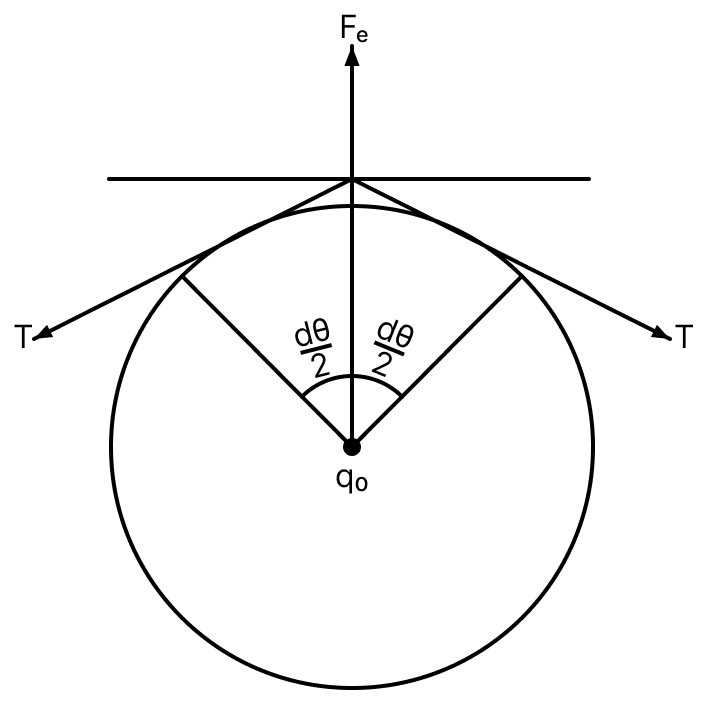
Outward force on a small element of the ring : Consider an element subtending a small angle dθ at the centre. Its length is R dθ and its charge is dQ = λR dθ. The central charge q0 repels it radially outwards with a force
dF=4πε01R2q0λRdθdF=4πε01Rq0λdθ
Condition of equilibrium of the element : The tension T acts along the ring at both ends of the element. Their resultant, directed inwards, is