An object is placed in front of a concave mirror of radius of curvature 40 cm at a distance of 10 cm. Find the position, nature and magnification of the image.
Answer
Given,
- Radius of curvature, R = 40 cm, so focal length f=−20 cm (concave mirror)
- Object distance, u=−10 cm
Applying the mirror formula v1+u1=f1,
v1=f1−u1=−201+101=20−1+2=201v=+20 cm
As v is positive, the image is formed behind the mirror, so it is virtual.
The magnification is
m=−uv=−(−10)20m=+2
The positive magnification shows that the image is erect and twice the size of the object.
Hence, the image is formed 20 cm behind the mirror; it is virtual, erect and magnified, and the magnification is +2.
A concave mirror has a radius of curvature 30 cm. How far must it be placed from a small object in order to give a five times magnified virtual image?
Answer
Given,
- Radius of curvature, R = 30 cm, so focal length f=−15 cm (concave mirror)
- Image is virtual and five times magnified, so m=+5
Since the image is virtual (erect), the magnification is positive. Thus,
−uv=+5v=−5u
Applying the mirror formula v1+u1=f1,
−5u1+u1=−1515u−1+5=−1515u4=−1515u=−60u=−12 cm
Hence, the object must be placed 12 cm in front of the mirror.
A concave mirror produces a real image of half the size of an object placed at 60 cm in front of it. Where should the object be placed to obtain a virtual image of double the size of the object?
Answer
Given,
- Object distance for the real image, u1=−60 cm
- Real image of half the size, so m1=−21 (inverted)
- Virtual image of double the size, so m2=+2 (erect)
Focal length of the mirror :
−u1v1=−21v1=2u1=2−60v1=−30 cm
Applying the mirror formula v1+u1=f1,
f1=−301−601=−602+1=−201f=−20 cm
Position of the object for the virtual image :
−u2v2=+2v2=−2u2
Again, from the mirror formula,
−2u21+u21=−2012u2−1+2=−2012u2=−20u2=−10 cm
As expected, the object lies between the focus and the pole, where a concave mirror forms a virtual, erect and magnified image.
Hence, the object should be placed 10 cm in front of the mirror.
Note: The textbook prints the answer as 15 cm in front of the mirror, which is incorrect. The given data fix f = −20 cm, whereas 15 cm would require f = −30 cm.
A 1 cm long flame is placed at a distance of 1.5 m from a wall. How far from the wall should a concave mirror be placed in order to obtain a 2 cm long flame on the same wall? What is the focal length of the mirror?
Answer
Given,
- Length of the flame (object), y1=1 cm
- Length of the flame obtained on the wall (image) = 2 cm
- Distance of the flame from the wall = 1.5 m
The image is obtained on the wall, so it is real and inverted, and the magnification is negative. Thus,
m=y1y2=1−2m=−2
and
−uv=−2v=2u
The flame lies between the mirror and the wall, both in front of the mirror. So the image (on the wall) is 1.5 m farther from the mirror than the object, that is,
v−u=−1.52u−u=−1.5u=−1.5 m
Therefore,
v=2u=2×(−1.5)v=−3 m
Applying the mirror formula v1+u1=f1,
f1=−31−1.51=−31−32=−1f=−1 m
Hence, the concave mirror should be placed 3 m from the wall (v = −3 m), and its focal length is 1 m (f = −1 m).
An object is placed first at a distance of 25 cm and then at a distance of 40 cm from a concave mirror. The magnification in the first case is four times than that in the second case, the image being real in both cases. What is the focal length of the mirror?
Answer
Given,
- Object distance in the first case, u1=−25 cm
- Object distance in the second case, u2=−40 cm
- m1=4m2, the image being real in both cases
Using the magnification formula m=f−uf,
m1=f+25f...(i)m2=f+40f...(ii)
Since m1=4m2,
f+25f=f+404ff+40=4(f+25)f+40=4f+100−3f=60f=−20 cm
Check : with f = −20 cm, Eqs. (i) and (ii) give
m1=−20+25−20m1=−4m2=−20+40−20m2=−1
Both magnifications are negative, so both images are real, as given.
Hence, the focal length of the mirror is 20 cm (f = −20 cm).
A concave mirror for face viewing has focal length 36.0 cm. Find the distance at which you should hold the mirror from your face in order to see your image upright with a magnification of 4.
Answer
Given,
- Focal length, f=−36.0 cm (concave mirror)
- Image is upright (virtual), so m=+4
Using the magnification formula m=f−uf,
4=−36.0−u−36.04(−36.0−u)=−36.0−144.0−4u=−36.0−4u=108.0u=−27.0 cm
Hence, the mirror should be held at a distance of 27.0 cm from the face.
An object is placed at a distance of 30 cm from a concave mirror of focal length 15 cm. If the object is displaced through a distance of 10 cm away from the mirror, find the displacement of the image.
Answer
Given,
- Focal length, f=−15 cm (concave mirror)
- Initial object distance, u1=−30 cm
- Object displaced 10 cm away from the mirror, so u2=−40 cm
Applying the mirror formula v1+u1=f1 in the initial position,
v11=f1−u11=−151+301=30−2+1=−301v1=−30 cm
In the displaced position,
v21=f1−u21=−151+401=120−8+3=−241v2=−24 cm
The displacement of the image is
v2−v1=−24−(−30)=+6 cm
The positive sign shows that the image shifts along the + X direction, that is, towards the mirror.
Hence, the image is displaced through 6 cm towards the mirror.
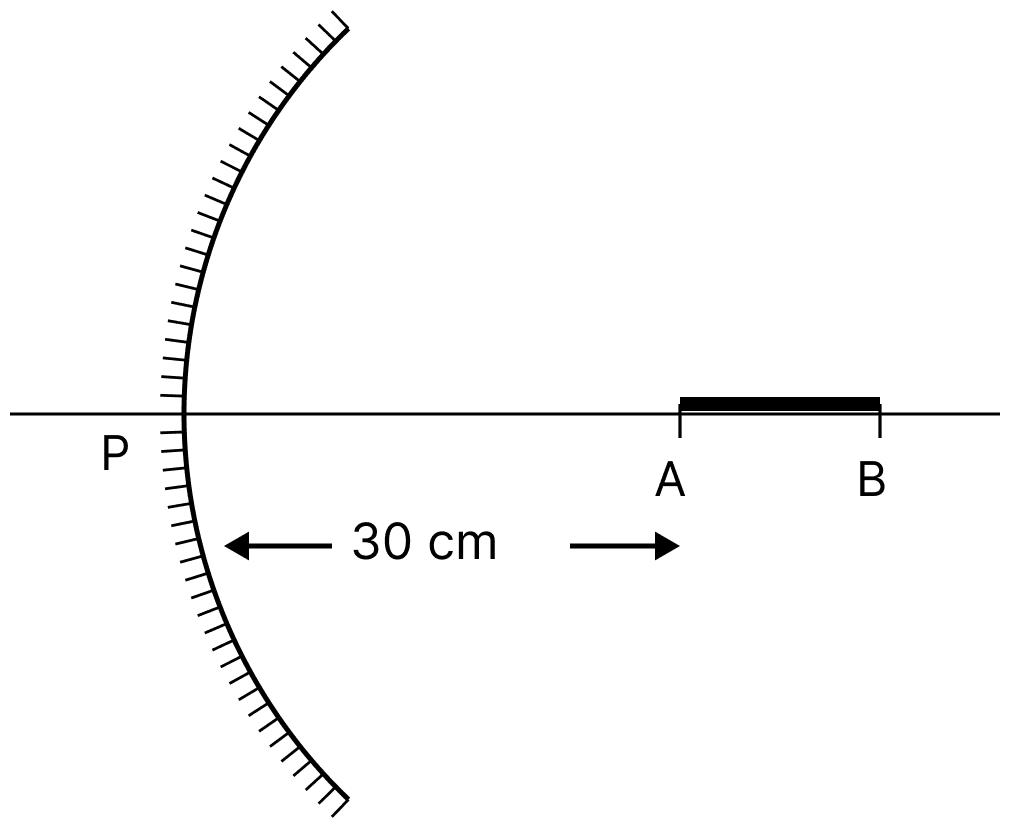
An object AB is placed along the axis of a concave mirror of focal length 10 cm. End A of the object is at 30 cm from the mirror. Find the length of the image, if :
(i) length of object is 5 cm.
(ii) length of object is 1 mm.
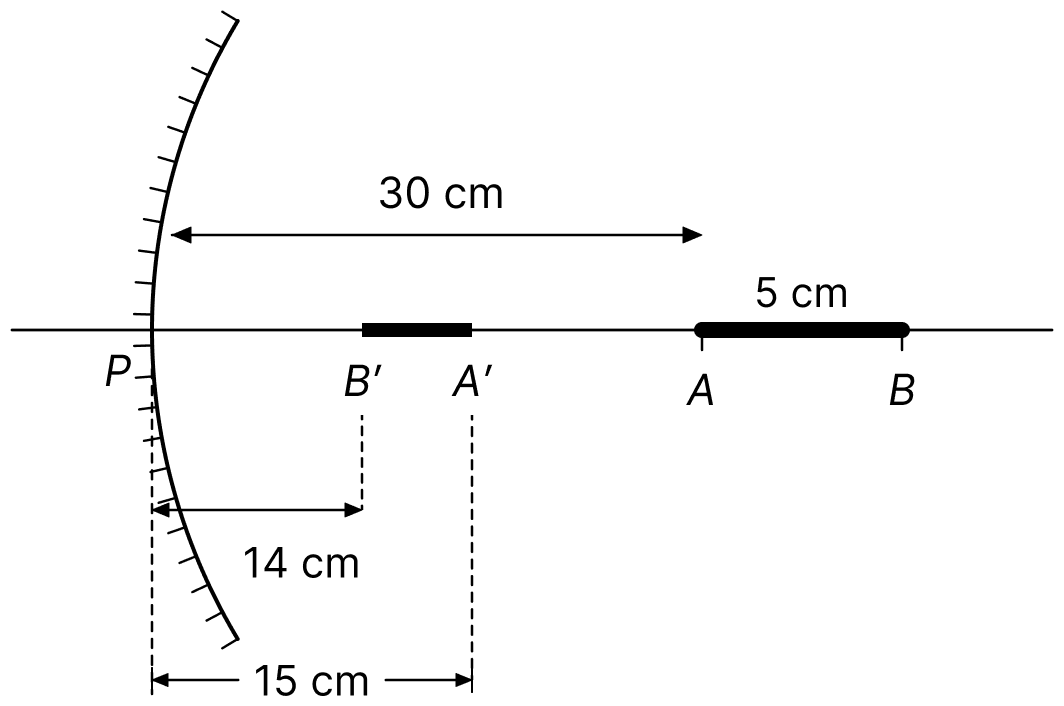
(iii) Show the image's position in case (i).
Answer
Given,
- Focal length, f=−10 cm (concave mirror)
- Distance of end A, uA=−30 cm (end A is nearer to the mirror)
(i) Length of object is 5 cm :
The end B is at a distance of 30 + 5 = 35 cm, so uB=−35 cm. As the object is not small, the image of each end is located separately by the mirror formula v1+u1=f1.
For the end A,
vA1=f1−uA1=−101+301=−302vA=−15 cm
For the end B,
vB1=f1−uB1=−101+351=70−7+2=−141vB=−14 cm
Length of the image,
∣vA−vB∣=∣−15−(−14)∣=1 cm
The image lies along the principal axis.
(ii) Length of object is 1 mm :
The object is now small, so the longitudinal magnification mL=dudv=−m2 may be used, where m is the lateral magnification at u = −30 cm, v = −15 cm.
m=−uAvA=−(−30)(−15)m=−21
Therefore,
mL=−m2=−(−21)2mL=−41
Length of the image,
∣dv∣=∣mL∣×∣du∣=41×1 mm=0.25 mm
(iii) Position of the image in case (i) :
The image A′ of the end A is formed at 15 cm and the image B′ of the end B at 14 cm in front of the mirror. The real image B′A′, 1 cm long, lies along the principal axis between the centre of curvature (20 cm) and the focus (10 cm). Its ends are reversed : the end B, farther from the mirror, has its image B′ nearer to the mirror.
Hence, the length of the image is (i) 1 cm along the principal axis and (ii) 0.25 mm; in case (i) the image extends from 14 cm to 15 cm in front of the mirror.
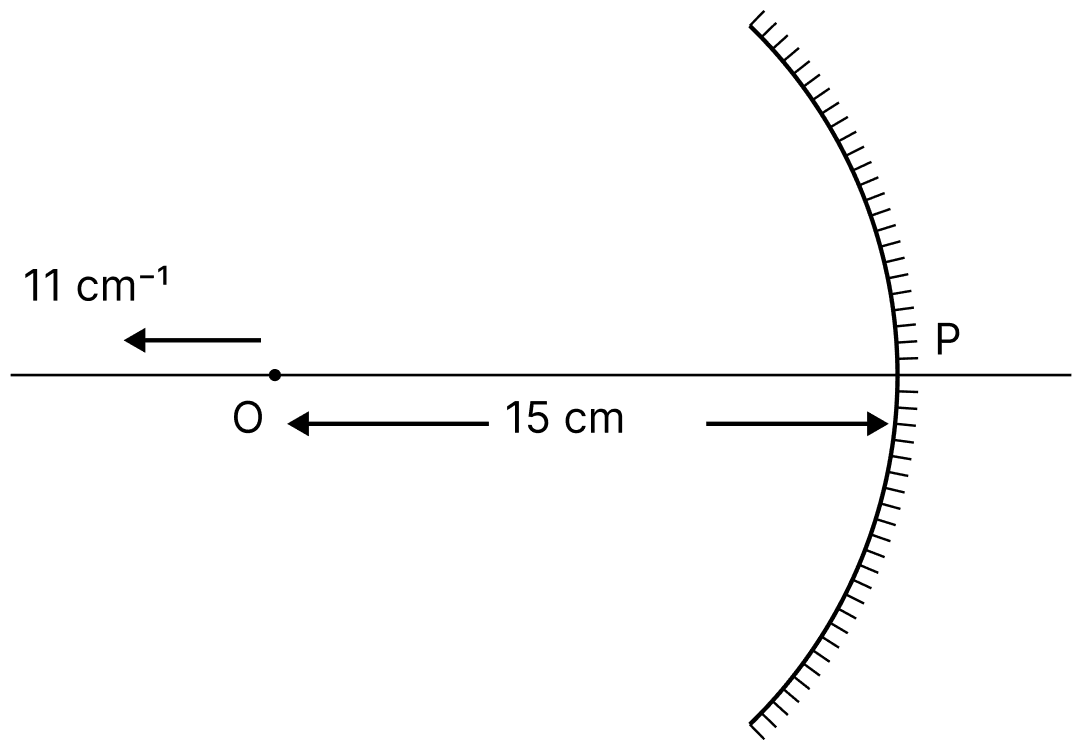
A concave mirror is of focal length 10 cm. An object is placed on the principal axis of the mirror and is moving away from it. When it is at a distance of 15 cm from the mirror, its speed is 11 cm s-1. Find the velocity of the image at this situation.
Answer
Given,
- Focal length, f=−10 cm (concave mirror)
- Object distance, u=−15 cm
- The object moves away from the mirror (along − X direction) with speed 11 cm s-1, so Vom=−11 cm s−1
Position of the image : Applying the mirror formula v1+u1=f1,
v1=f1−u1=−101+151=30−3+2=−301v=−30 cm
The lateral magnification is
m=−uv=−(−15)(−30)m=−2
Velocity of the image : Differentiating the mirror formula with respect to time (f is constant),
−v21dtdv−u21dtdu=0dtdv=−u2v2dtduVim=−u2v2 VomVim=−m2 Vom
where Vim=dtdv and Vom=dtdu are the velocities of the image and of the object (both with respect to the mirror), and u2v2=m2.
Substituting the values,
Vim=−(−2)2×(−11)=−4×(−11)Vim=+44 cm s−1
The positive sign shows that the image moves along the + X direction, that is, towards the mirror.
Hence, the velocity of the image is 44 cm s-1 towards the mirror.
An object is placed at 18 cm in front of a spherical mirror. The image is formed at 3.0 cm behind the mirror. Find the focal length and the nature of the mirror.
Answer
Given,
- Object distance, u=−18 cm
- Image distance, v=+3.0 cm (image behind the mirror)
Applying the mirror formula v1+u1=f1,
f1=3.01−181=186−1=185f=+3.6 cm
As the focal length is positive, the mirror is convex.
Hence, the focal length of the mirror is +3.6 cm and the mirror is convex.
An object is placed 15 cm away from a convex mirror of radius of curvature 90 cm. Find image's position and magnification.
Answer
Given,
- Radius of curvature, R = 90 cm, so focal length f=+45 cm (convex mirror)
- Object distance, u=−15 cm
Applying the mirror formula v1+u1=f1,
v1=f1−u1=451+151=451+3=454v=+11.25 cm
The image is formed behind the mirror. The magnification is
m=−uv=−(−15)11.25m=+0.75
Hence, the image is formed 11.25 cm behind the mirror and the magnification is +0.75.
A 2 cm long object is placed at a distance of 100 cm from a convex mirror of radius of curvature 50 cm. Find the position, nature and length of the image.
Answer
Given,
- Size of the object, y1=2 cm
- Object distance, u=−100 cm
- Radius of curvature, R = 50 cm, so focal length f=+25 cm (convex mirror)
Applying the mirror formula v1+u1=f1,
v1=f1−u1=251+1001=1004+1=201v=+20 cm
As v is positive, the image is formed behind the mirror and is virtual. The magnification is
m=−uv=−(−100)20m=+0.2
The size of the image is given by m=y1y2,
y2=m×y1=0.2×2y2=+0.4 cm
The positive sign shows that the image is erect.
Hence, the image is formed 20 cm behind the mirror; it is virtual, erect and diminished, and its length is 0.4 cm.
An object is placed in front of a convex mirror of radius of curvature 20 cm. Its image is formed 8 cm behind the mirror. Find the location of the object with respect to the mirror.
Answer
Given,
- Radius of curvature, R = 20 cm, so focal length f=+10 cm (convex mirror)
- Image distance, v=+8 cm (image behind the mirror)
Applying the mirror formula v1+u1=f1,
u1=f1−v1=101−81=404−5=−401u=−40 cm
Hence, the object is located 40 cm in front of the mirror.
The image formed by a convex mirror of focal length 30 cm is a quarter size of the object. Find the location of the object with respect to the mirror.
Answer
Given,
- Focal length, f=+30 cm (convex mirror)
- Image is a quarter size of the object
A convex mirror always forms a virtual image, so the magnification is positive. Thus,
−uv=+41u=−4v
Applying the mirror formula v1+u1=f1,
v1−4v1=3014v4−1=3014v=90v=+22.5 cm
Therefore,
u=−4v=−4×22.5u=−90 cm
Hence, the object is located 90 cm in front of the mirror.
The image formed by a convex mirror of radius of curvature 20 cm is half the size of the object. Find the position of the object and of its image.
Answer
Given,
- Radius of curvature, R = 20 cm, so focal length f=+10 cm (convex mirror)
- Image is half the size of the object
A convex mirror always forms a virtual, erect image, so the magnification is positive. Thus,
−uv=+21u=−2v
Applying the mirror formula v1+u1=f1,
v1−2v1=1012v2−1=1012v=10v=+5 cm
Therefore,
u=−2v=−2×5u=−10 cm
Hence, the object is at 10 cm in front of the mirror and its image is at 5 cm behind the mirror.
When an object is placed at a distance of 60 cm from a convex mirror, the magnification produced is 21. Where should the object be placed to obtain a magnification of 31?
Answer
Given,
- Object distance in the first case, u1=−60 cm, magnification m1=21
- Required magnification, m2=31
Using the magnification formula m=f−uf in the first case,
21=f+60ff+60=2ff=+60 cm
The focal length is positive, as expected for a convex mirror.
In the second case, with the object at distance u,
31=60−u6060−u=180u=−120 cm
Hence, the object should be placed 120 cm in front of the mirror.