
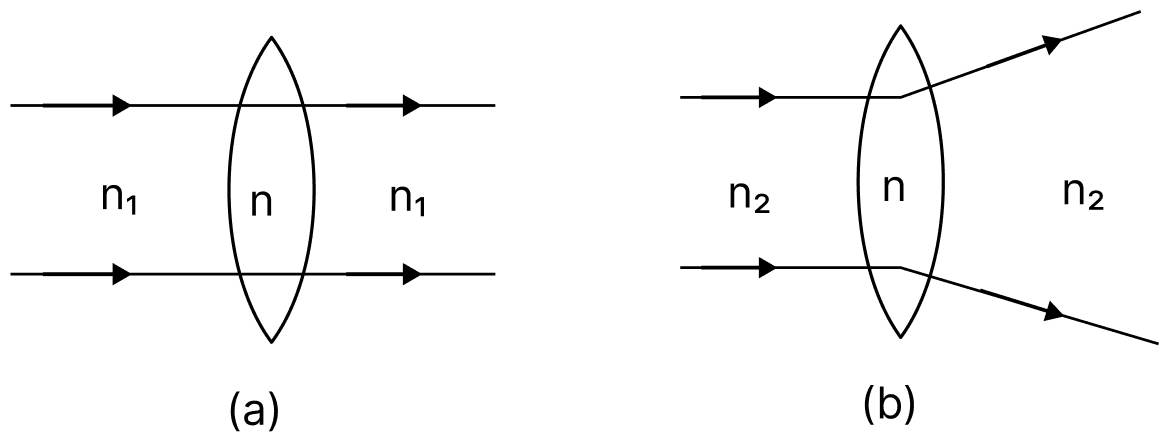
What is the relation between the refractive indices n, n1 and between n, n2, if the behaviour of light rays is as shown in the figures?
Answer
(a) n1 = n
(b) n2 > n
Explanation: (a) The rays pass through the lens undeviated, so the lens neither converges nor diverges them and its focal length is infinite. By the lens maker's formula this happens only when the refractive index of the lens material relative to the surrounding medium is 1, i.e., n1 = n.
(b) The convex lens diverges the rays, i.e., it behaves like a concave lens. The nature of a lens changes only when it is placed in a medium of refractive index greater than that of its material. Hence n2 > n.
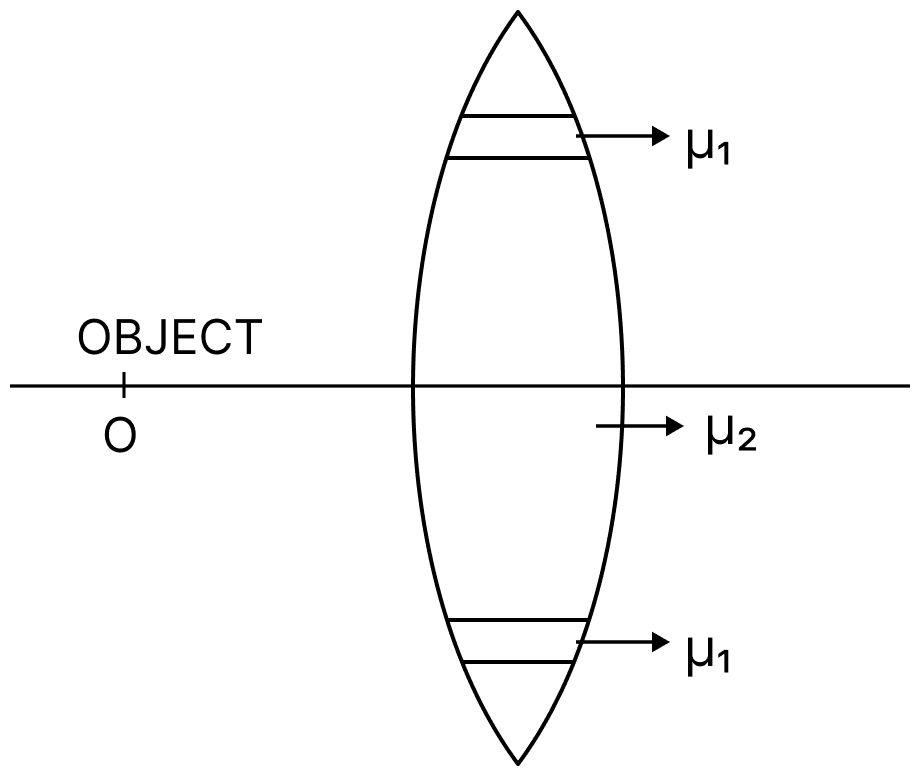
The lens shown in figure is made of two different materials of refractive indices μ1 and μ2, respectively. A point object is placed on the principal axis. How many images of the object will be formed by the lens (neglecting spherical and chromatic aberration)?
Answer
Two.
Explanation: The focal length of a lens depends on the refractive index of its material. The central part (μ2) and the outer parts (μ1) therefore have two different focal lengths, and the rays passing through them come to a focus at two different points. Hence two images of the point object are formed.
A plano-convex lens has radius of curvature 10 cm. Its focal length is 80 cm under water. Calculate the refractive index of the material of the lens, given refractive index of water is .
Answer
Given,
- Radius of curvature of the curved surface, R1 = 10 cm and of the plane surface, R2 = ∞
- Focal length in water, fw = 80 cm
- Refractive index of water, nw =
Let n be the refractive index of the material of the lens. Its refractive index with respect to water is
By the lens maker's formula,
Hence, the refractive index of the material of the lens is 1.5.
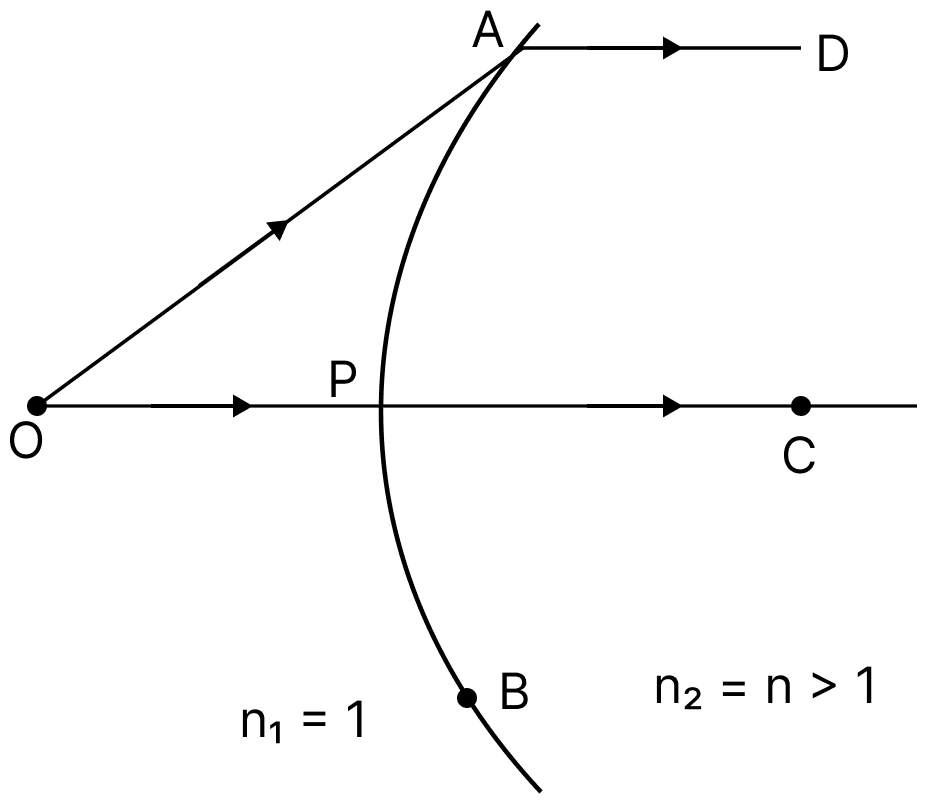
In the figure shown, O is a point object placed in air on the axis of a spherical surface APB of a glass block. OA is an incident ray. The direction of the refracted ray AD in the glass block is parallel to the principal axis PC, CP = CA = R is the radius of the spherical surface. Show that the object distance, PO = u = , (where n2 = n and n1 = 1).
Answer
Given,
- n1 = 1 (air) and n2 = n
- Radius of curvature of the convex surface, PC = R
- The refracted ray AD is parallel to the principal axis PC
For refraction at a spherical surface, with the object in the rarer medium,
Since the refracted ray AD travels parallel to the principal axis, the image of O is formed at infinity, i.e., v = ∞. Substituting,
The negative sign only shows that O lies to the left of the pole P, in air. Hence the object distance is
Hence, PO = u = in magnitude, i.e., O is the first focus of the refracting surface.
A convex lens of focal length f = 20 cm is combined with a diverging lens of power 6.5 D. What are the power and focal length of the combination?
Answer
Given,
- Focal length of the convex lens, f1 = +20 cm = +0.20 m
- Power of the diverging lens, P2 = -6.5 D
Power of the convex lens,
For lenses in contact, the powers are added,
The focal length of the combination is
Hence, the power of the combination is -1.5 D and its focal length is -66.7 cm, i.e., the combination behaves as a diverging lens.
See the given diagram.
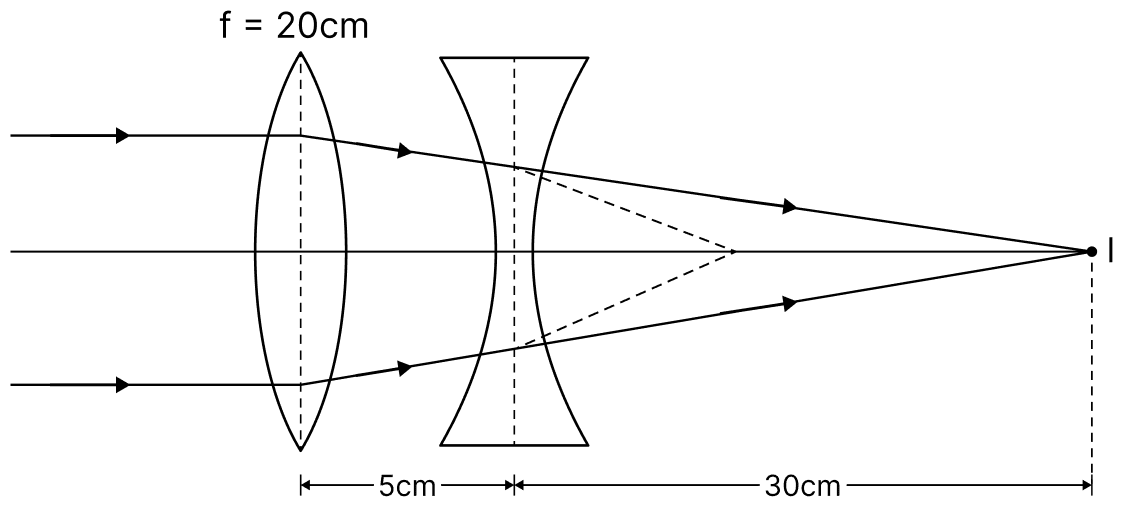
Calculate the focal length of concave lens with the help of above ray diagram. The focal length of convex lens is 20 cm.
Answer
Given,
- Focal length of the convex lens = 20 cm
- Distance between the convex and the concave lens = 5 cm
- Distance of the final image I from the concave lens = 30 cm
The parallel rays, after refraction through the convex lens, would converge at its second focus, 20 cm from it, i.e., (20 - 5) = 15 cm beyond the concave lens. This point acts as a virtual object for the concave lens, which forms the final image at I.
For the concave lens, u = +15 cm and v = +30 cm. By the lens formula,
Hence, the focal length of the concave lens is -30 cm.
A convex lens and a plane mirror are kept at a distance of 10 cm as shown in the diagram. Parallel rays incident on the convex lens after reflection from the mirror form an image at the optical centre. Complete the ray diagram and find out the focal length of the lens.
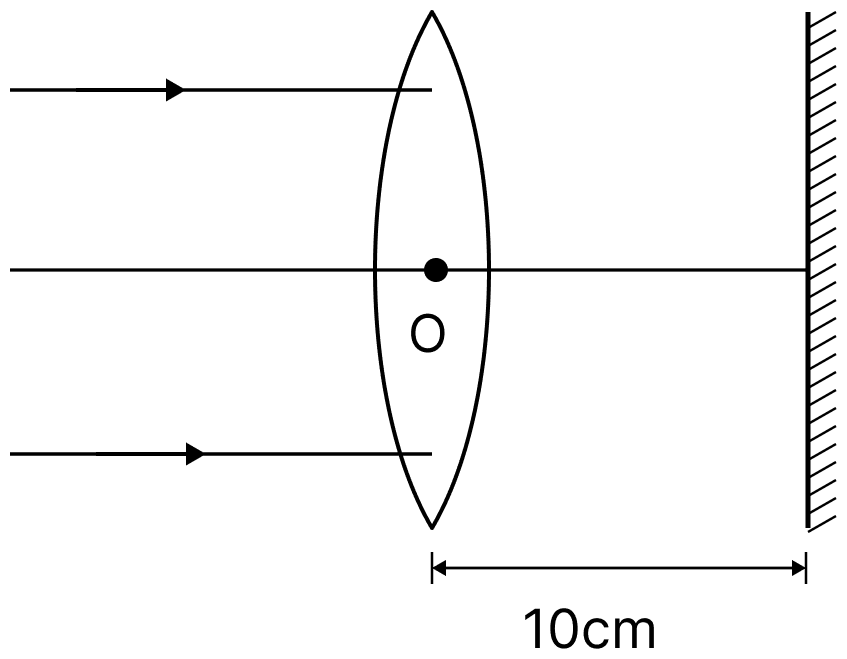
Answer
Given,
- Distance between the convex lens and the plane mirror = 10 cm
- Parallel rays, after refraction and reflection, form the image at the optical centre O
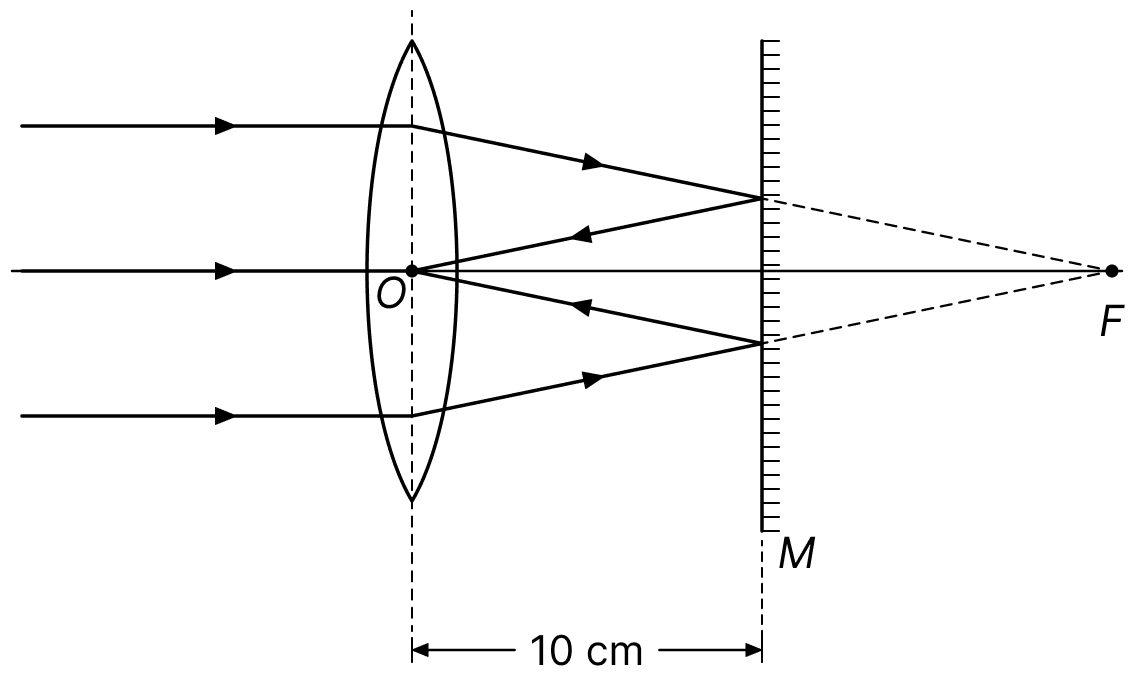
The parallel rays, after refraction through the lens, converge towards its second focus F. The plane mirror intercepts them before they meet, so F lies behind the mirror and acts as a virtual object for it. The plane mirror forms its real image as far in front of the mirror as F is behind it, and this image is at O.
Let f be the focal length of the lens. Then F is (f - 10) cm behind the mirror, and its image is (f - 10) cm in front of the mirror. As this image is at O, which is 10 cm in front of the mirror,
Hence, the focal length of the lens is 20 cm.
The sun glasses have curved surfaces, but their power is zero. Why?
Answer
The two surfaces of sun glasses are curved in the same direction and have equal radii of curvature, i.e., R1 = R2 = R. By the lens maker's formula,
So the focal length is infinite and the power is zero. The glasses neither converge nor diverge the light passing through them; they only reduce its intensity.
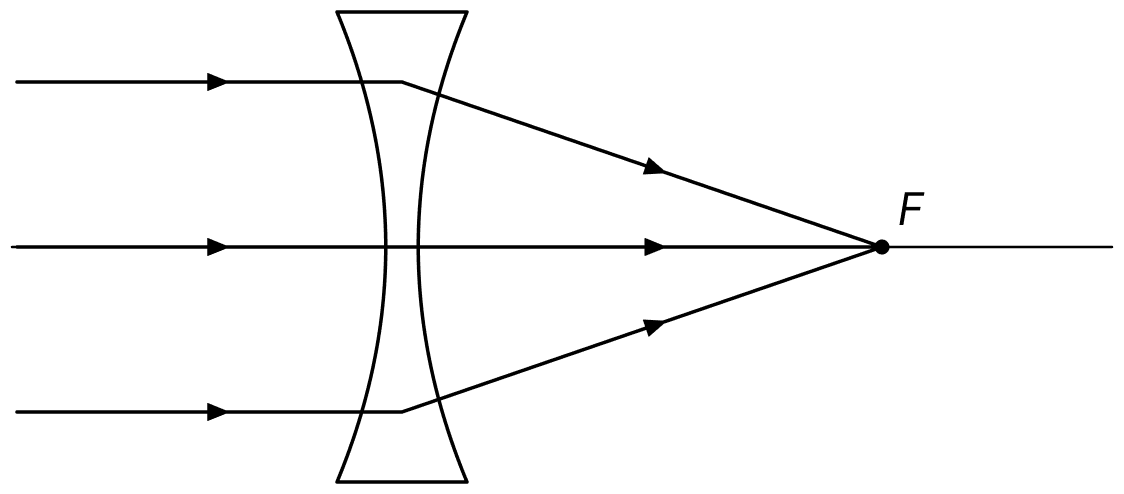
Refractive index of the material of a concave lens is μ. The lens is immersed in a medium of refractive index μ1 (μ1 > μ). A parallel beam of light is incident on the lens. Draw a diagram to show the path of emergent rays.
Answer
The refractive index of the material of the lens relative to the surrounding medium is , which is less than 1 because μ1 > μ. By the lens maker's formula,
Here is negative, and for a concave lens is also negative. So f is positive and the concave lens behaves as a converging lens in this medium. The parallel beam, after refraction, converges to a point F (the focus) on the other side of the lens.
A biconvex spherical lens has focal length 20 cm. If it is split into two halves to form two plano-convex lenses, what is the focal length of each plano-convex lens?
Answer
Given,
- Focal length of the biconvex lens, f = 20 cm
On splitting, the two plano-convex halves are identical, each of focal length f1. Placed back in contact, they reproduce the original lens. For thin lenses in contact,
Hence, the focal length of each plano-convex lens is 40 cm.
A plano-convex lens made of glass (n = 1.5) has a focal length 10 cm.
(i) Calculate the radius of curvature of its curved surface.
(ii) If an identical plano-convex lens is placed in contact with the first (plane surface facing each other), what will be the power (in dioptres) of the combination?
Answer
Given,
- Refractive index, n = 1.5
- Focal length, f = 10 cm
(i) Radius of curvature :
For a plano-convex lens, R1 = R and R2 = ∞. By the lens maker's formula,
(ii) Power of the combination :
Each lens has f = 10 cm = 0.1 m. For lenses in contact, P = P1 + P2,
Hence, (i) the radius of curvature of the curved surface is 5 cm and (ii) the power of the combination is 20 D.
A thin converging lens of focal length 15 cm is kept in contact with a thin diverging lens of focal length 20 cm. Find the focal length of this combination.
Answer
Given,
- Focal length of the converging lens, f1 = +15 cm
- Focal length of the diverging lens, f2 = -20 cm
For two thin lenses in contact,
Hence, the focal length of the combination is 60 cm, and the combination behaves as a converging lens.
A thin convex lens which is made of glass (refractive index 1.5) has a focal length of 20 cm. It is now completely immersed in a transparent liquid having refractive index 1.75. Find the new focal length of the lens.
Answer
Given,
- Refractive index of glass, ang = 1.5
- Focal length in air, fa = 20 cm
- Refractive index of the liquid, anl = 1.75
By the lens maker's formula, in air and in the liquid,
Dividing Eq. (i) by Eq. (ii),
The refractive index of glass with respect to the liquid is
Therefore,
Hence, the new focal length of the lens is -70 cm; in this liquid the convex lens behaves as a diverging lens.
An equi-convex lens of glass having focal length of 10 cm is split into two identical plano-convex lenses each having focal length f1 as shown in the figure. Find the value of f1.
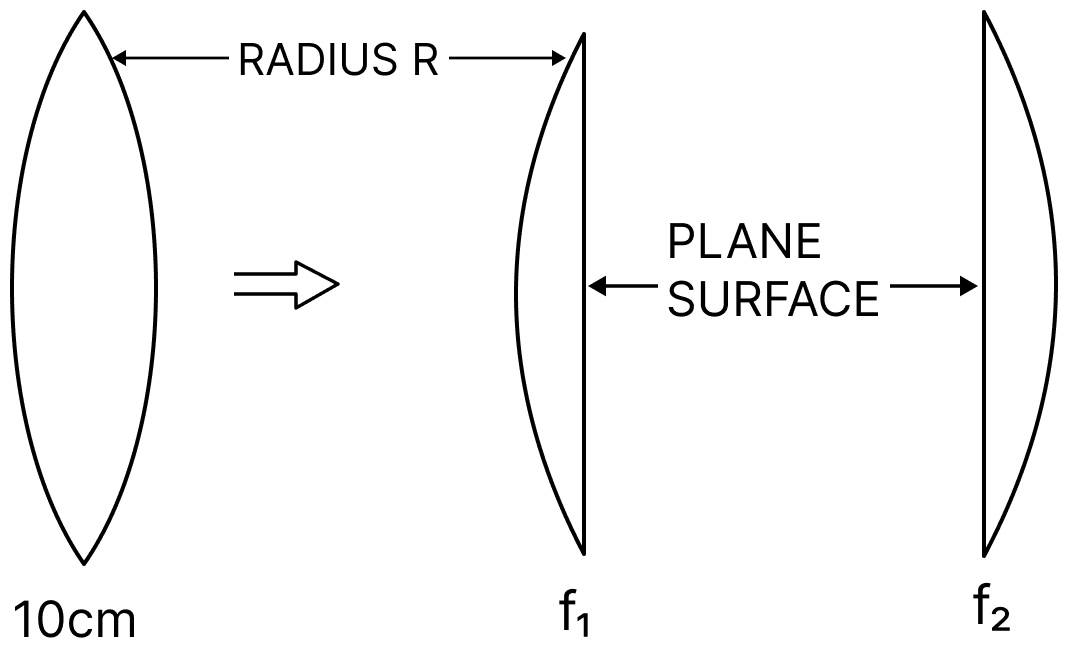
Answer
Given,
- Focal length of the equi-convex lens, f = 10 cm
The two identical plano-convex lenses, each of focal length f1, when placed in contact, make up the original equi-convex lens. For thin lenses in contact,
Hence, the value of f1 is 20 cm.
An illuminated point object O is kept 20 cm from a thin convex lens L1 of focal length 15 cm as shown below. A thin diverging lens L2 of focal length 25 cm is kept co-axially with the first lens and 35 cm from it as shown in the figure.
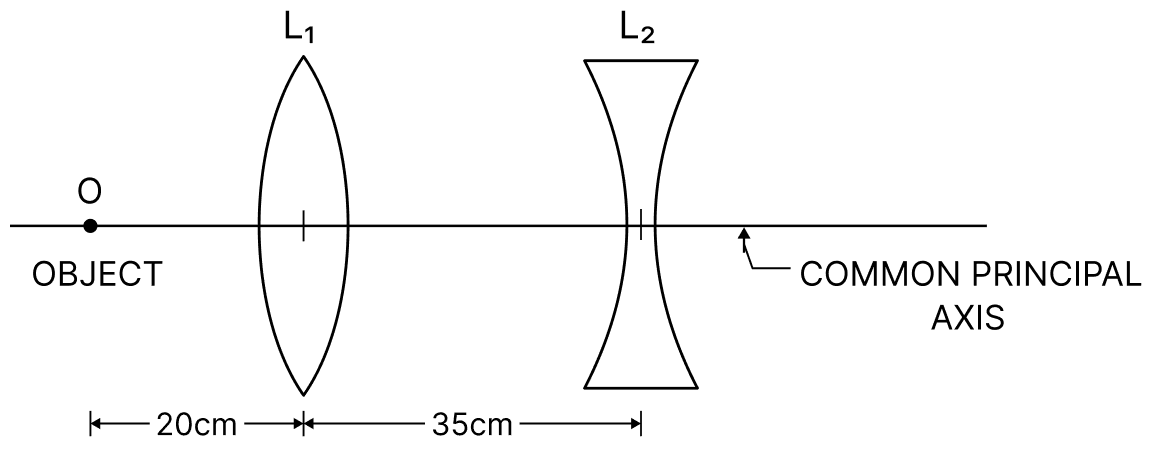
Find the position of the final image formed by this combination of lenses.
Answer
Given,
- For L1 : u1 = -20 cm, f1 = +15 cm
- For L2 : f2 = -25 cm
- Distance between L1 and L2 = 35 cm
Image formed by L1 :
By the lens formula ,
This image is 60 cm to the right of L1, i.e., (60 - 35) = 25 cm to the right of L2. It acts as a virtual object for L2, so u2 = +25 cm.
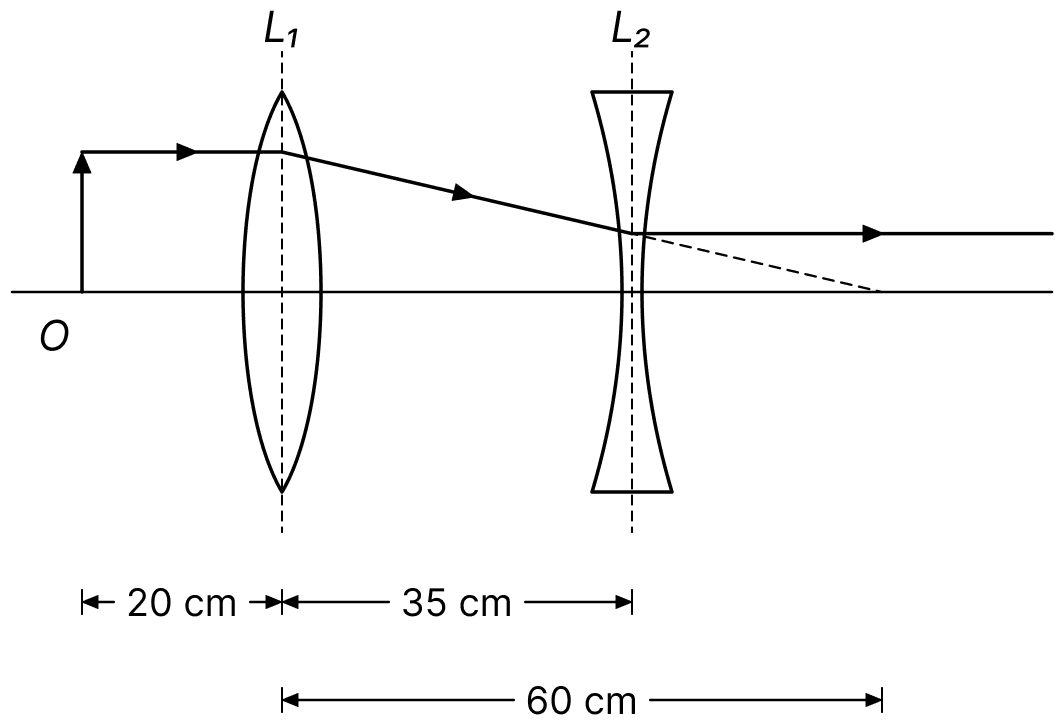
Image formed by L2 :
Hence, the final image is formed at infinity; the rays emerge from L2 parallel to the common principal axis.
Where should an object be kept on the principal axis of a convex lens of focal length 20 cm in order to get an image, which is double of the size of the object?
Answer
Given,
- Focal length, f = +20 cm
- Size of image = 2 × size of object
The linear magnification of a lens is .
For a real (inverted) image, m = -2 :
So v = -2u. By the lens formula,
For a virtual (erect) image, m = +2 :
So v = 2u. Then,
Hence, the object should be kept 30 cm in front of the lens to get a real image, or 10 cm in front of the lens to get a virtual image, of double the size.
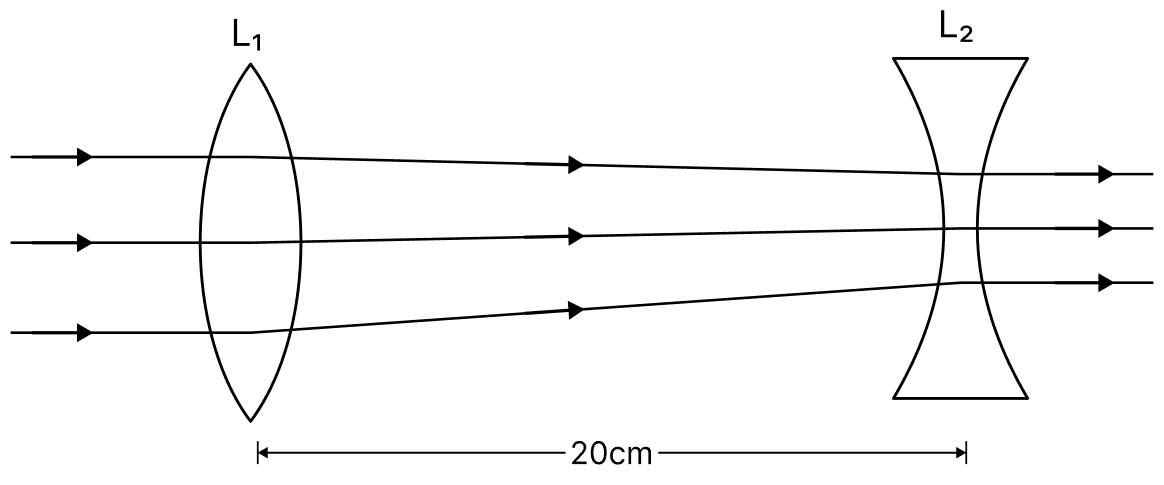
A thin convex lens (L1) of focal length 80 cm and a thin concave lens (L2) of focal length f are kept coaxially, 20 cm apart as shown in figure. When a narrow and parallel beam of light is incident on the convex lens, beam emerging from the concave lens is also a parallel beam. Find the value of f.
Answer
Given,
- Focal length of L1 = 80 cm
- Distance between L1 and L2 = 20 cm
- The incident and the emergent beams are both parallel
The parallel beam, after refraction through L1, converges towards its focus, 80 cm from L1, i.e., (80 - 20) = 60 cm beyond L2. This point is a virtual object for L2, so u = +60 cm. As the emergent beam is parallel, v = ∞. By the lens formula,
Hence, the focal length of the concave lens is f = -60 cm.
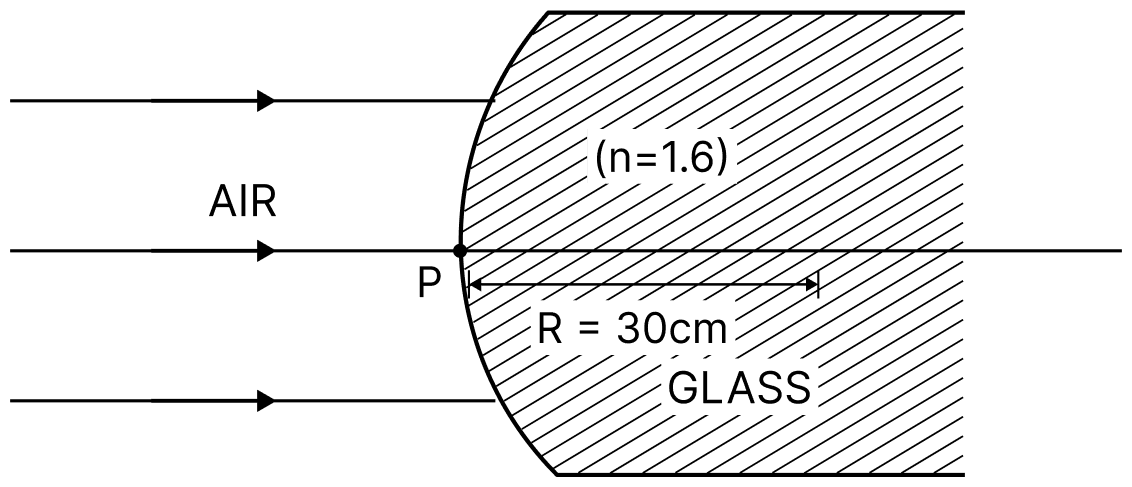
Given figure shows a parallel beam of monochromatic light incident on a convex spherical surface (radius of curvature R = 30 cm) which separates glass (refractive index = 1.6) from air. Find the position of the image formed due to refraction of light at this single spherical surface.
Answer
Given,
- n1 = 1 (air), n2 = 1.6 (glass)
- Radius of curvature, R = +30 cm
- Incident beam is parallel, u = -∞
For refraction at a spherical surface, with the object in the rarer medium,
Hence, the image is formed in the glass at 80 cm on the right side of P.
Find the focal length and nature of a lens whose optical power is -5 D.
Answer
Given,
- Power, P = -5 D
The power of a lens is the reciprocal of its focal length in metre,
The focal length is negative, so the lens is concave.
Hence, the focal length is -0.2 m (-20 cm) and the lens is concave (diverging).
A convex lens L and a plane mirror M are arranged as shown in the figure.
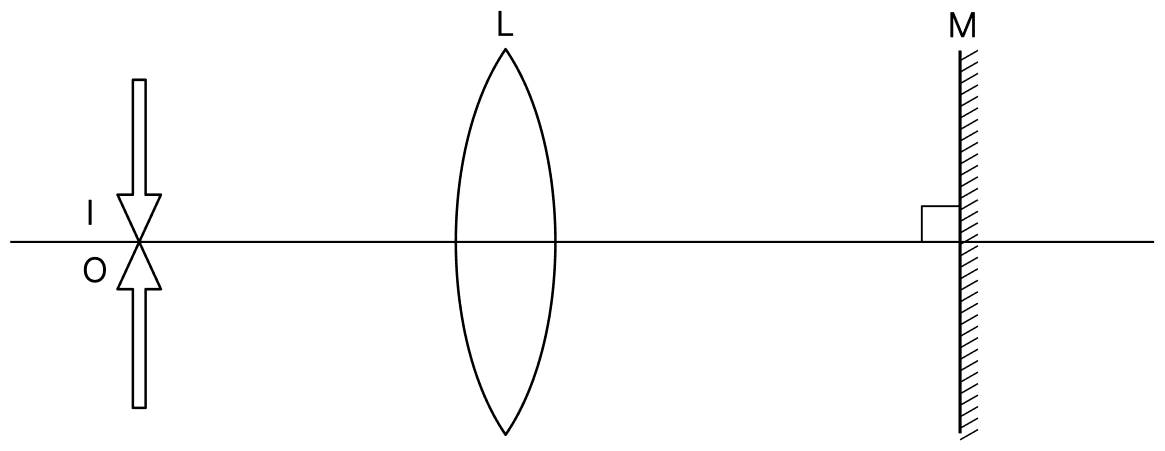
Position of object pin O is adjusted in such a way that the inverted image I formed by the lens mirror combination coincides with the object pin O. Explain how and when this happens.
Answer
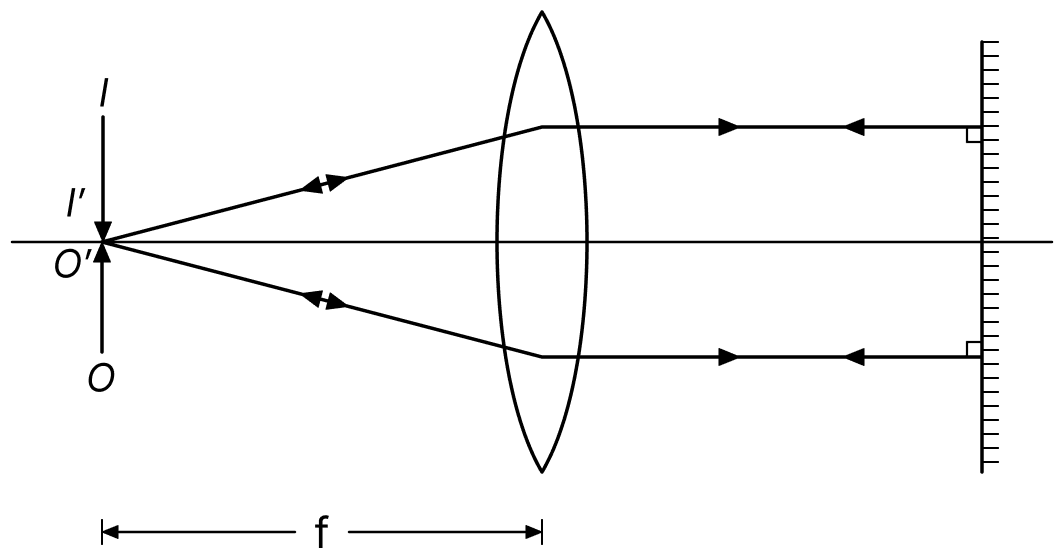
This happens when the object pin O is placed at the principal focus of the convex lens L.
The rays starting from a point at the focus emerge from the lens parallel to the principal axis. These parallel rays fall normally on the plane mirror M, which is perpendicular to the axis, and are reflected back along their own paths. Retracing their path through the lens, they converge again at the focus. Hence the image I is formed at the position of O itself.
Rays from the upper part of the pin return below the axis and vice versa, so the image is inverted. The distance of O from the lens then gives the focal length of the lens; it does not depend on the distance between L and M.
How does focal length of a convex lens change with increase in wavelength of incident light?
Answer
The focal length of a convex lens increases with increase in the wavelength of the incident light.
Explanation: The refractive index n of the material of the lens decreases as the wavelength increases. By the lens maker's formula, , so a smaller value of n gives a larger focal length.
The given figure shows the positions of a point object O, two lenses, a plane mirror and the final image I which coincides with the object. The focal length of the convex lens is 20 cm. Calculate the focal length of the concave lens.
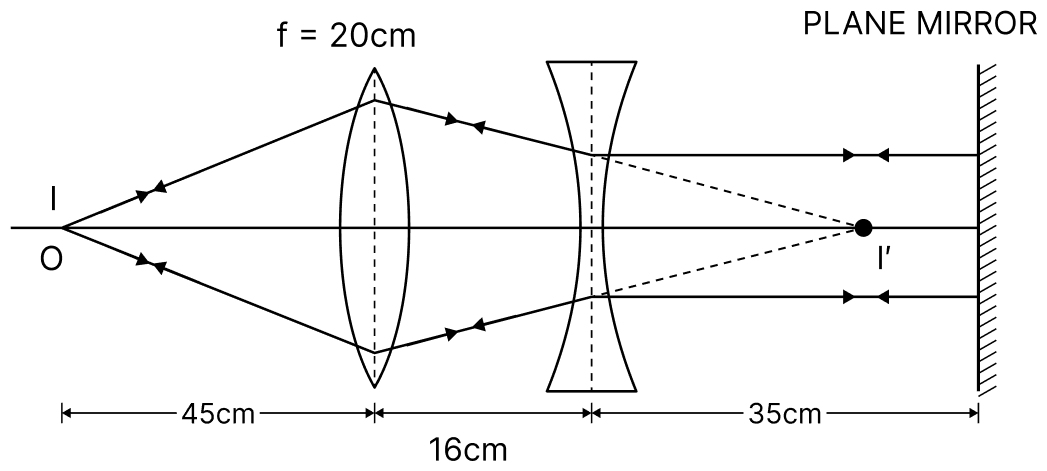
Answer
Given,
- Focal length of the convex lens = 20 cm
- Distance of O from the convex lens = 45 cm
- Distance between the two lenses = 16 cm
The final image I coincides with O, so the rays retrace their path. This happens only when the rays fall normally on the plane mirror, i.e., when they emerge from the concave lens parallel to the principal axis. Hence the image I' formed by the convex lens must lie at the focus of the concave lens.
Image formed by the convex lens :
u = -45 cm and f = +20 cm. By the lens formula,
So I' is (36 - 16) = 20 cm beyond the concave lens.
Focal length of the concave lens :
For the concave lens, I' is a virtual object at u = +20 cm and the emergent rays are parallel, v = ∞,
Hence, the focal length of the concave lens is -20 cm.
A point object O is placed at a distance of 15 cm from a convex lens L of focal length 10 cm as shown in the figure given below. On the other side of the lens, a convex mirror M is placed such that its distance from the lens is equal to the focal length of the lens. The final image formed by this combination is observed to coincide with the object O. Find the focal length of the convex mirror.
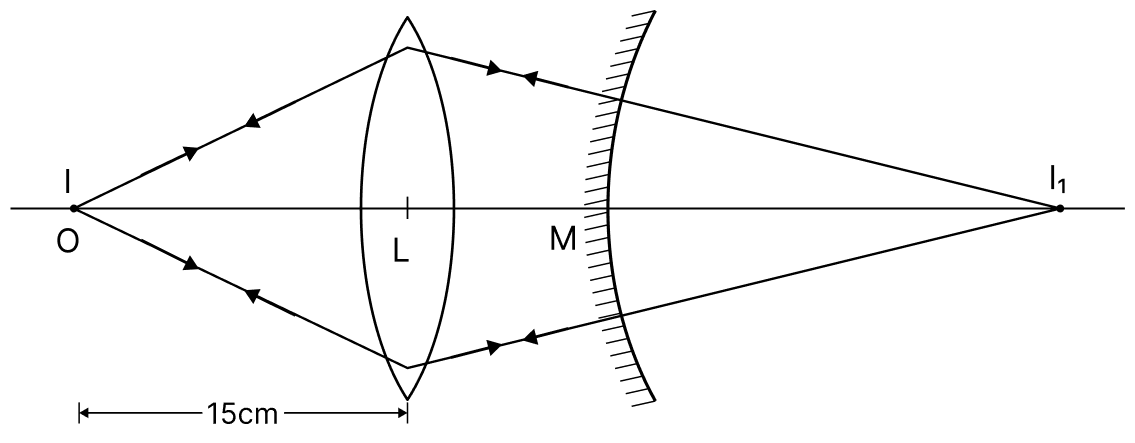
Answer
Given,
- Focal length of the convex lens, f = 10 cm
- Object distance, u = -15 cm
- Distance between the lens and the convex mirror = 10 cm
Image formed by the lens :
So the lens alone would form the image I1 at 30 cm from it, i.e., (30 - 10) = 20 cm behind the mirror.
Since the final image coincides with O, the rays retrace their path, i.e., they fall normally on the convex mirror. The rays converging towards I1 therefore travel along the radii of the mirror, so I1 is the centre of curvature of the mirror.
Hence, the focal length of the convex mirror is 10 cm.
State how focal length of a glass lens (refractive index 1.5) changes when it is completely immersed in :
(i) water (refractive index = 1.33)
(ii) a liquid (refractive index = 1.65)
Answer
(i) In water, the focal length increases to about 3.9 times its value in air (fliq = 3.9 fair) and the nature of the lens is unchanged.
(ii) In the liquid of refractive index 1.65, the focal length becomes about -5.5 times its value in air (fliq = -5.5 fair), i.e., the nature of the lens changes: a converging lens behaves as a diverging lens and vice versa.
Explanation: By the lens maker's formula, the radii of curvature being the same in both media,
(i) For water,
(ii) For the liquid,
Two thin lenses having optical powers of -10 D and + 6 D are placed in contact with each other. The focal length of the combination is :
- +0.25 cm
- -0.25 cm
- +0.25 m
- -0.25 m
Answer
-0.25 m
Reason — For thin lenses in contact, the powers are added,
Therefore,
A converging lens of focal length 40 cm is kept in contact with a diverging lens of focal length 30 cm. Find the focal length of the combination.
Answer
Given,
- Focal length of the converging lens, f1 = +40 cm
- Focal length of the diverging lens, f2 = -30 cm
For two thin lenses in contact,
Hence, the focal length of the combination is -120 cm, and the combination behaves as a diverging lens.
A biconvex lens made of glass (refractive index 1.5) has two spherical surfaces having radii 20 cm and 30 cm. Calculate the focal length.
Answer
Given,
- Refractive index, n = 1.5
- For a biconvex lens, R1 = +20 cm and R2 = -30 cm
By the lens maker's formula,
Hence, the focal length of the lens is 24 cm.
Calculate the focal length of a convex lens whose radii of curvature of two surfaces is 10 cm and 15 cm respectively and its refractive index is 1.5.
Answer
Given,
- Refractive index, n = 1.5
- For a convex (biconvex) lens, R1 = +10 cm and R2 = -15 cm
By the lens maker's formula,
Hence, the focal length of the convex lens is 12 cm.
Where will you keep an object in front of a convex lens in order to get a virtual and magnified image?
Answer
The object should be kept between the optical centre and the first focus of the convex lens, i.e., at a distance less than its focal length.
Explanation: For such a position, the rays after refraction diverge and appear to come from a point on the same side of the lens as the object. The image so formed is virtual, erect and magnified, as in a simple microscope.
Derive an expression for refraction at a single (convex spherical) surface, i.e., a relation between u, v, R, n1 (rarer medium) and n2 (denser medium), where the terms have their usual meaning.
Answer
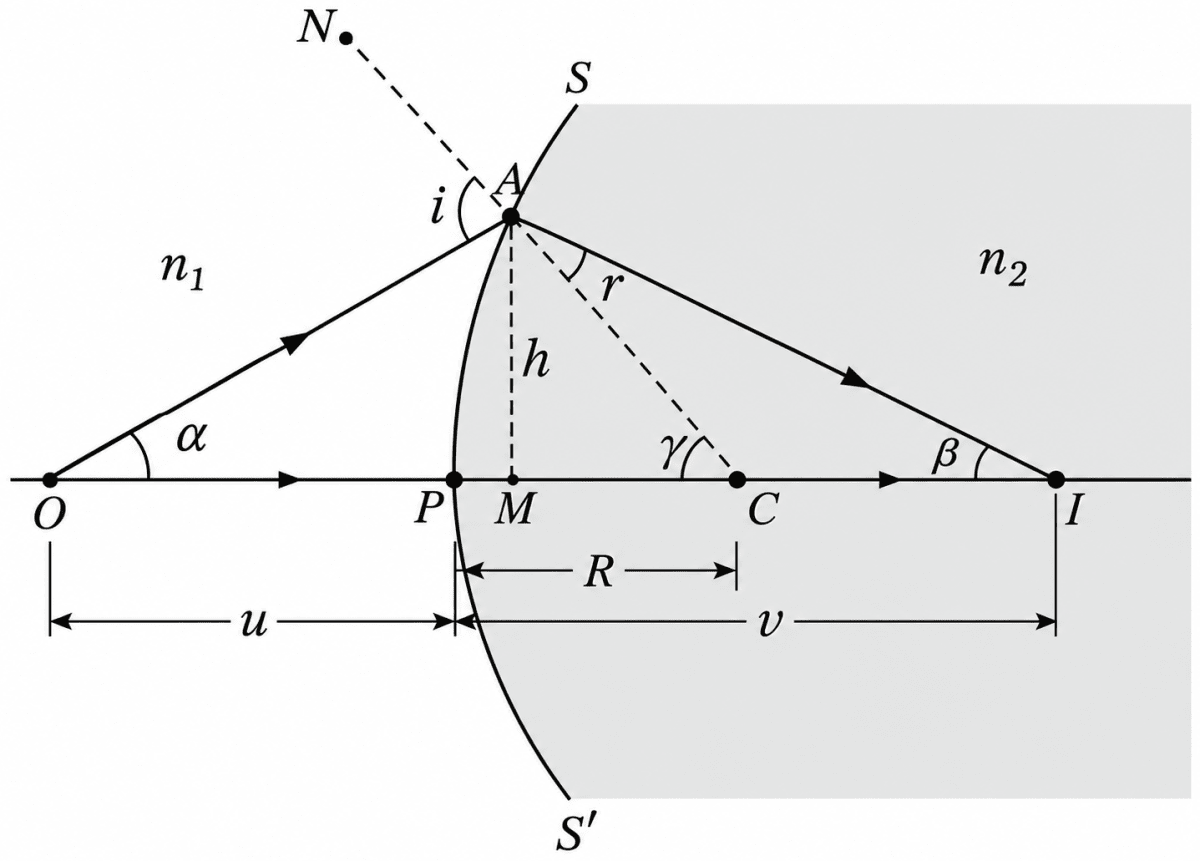
Let SPS' be a convex spherical surface separating a rarer medium of refractive index n1 from a denser medium of refractive index n2. Let P be its pole, C its centre of curvature and PC = R its radius of curvature.
A point object O is placed on the principal axis. The ray OA, after refraction at A, bends towards the normal CAN and goes along AI. The ray OP falls normally on the surface and goes undeviated. The two refracted rays meet at I, which is the real image of O.
Let the angle of incidence ∠OAN = i, the angle of refraction ∠IAC = r, and let α, β and γ be the angles made by OA, IA and CA with the principal axis. Let AM = h be the perpendicular from A on the axis. By the coordinate geometry sign convention, PO = -u, PI = +v and PC = +R.
In ΔCOA, the exterior angle i is
In ΔCIA,
By Snell's law,
For a surface of small aperture, A is close to P and the angles i and r are small, so sin i ≈ i and sin r ≈ r (in radian). Hence,
Substituting the values of i and r from Eqs. (i) and (ii),
For small aperture, M is very close to P and the angles α, β and γ are small, so each may be replaced by its tangent,
Substituting these values in Eq. (iii),
This is the required relation between u, v, R, n1 and n2 for refraction at a single convex spherical surface.
Two thin lenses having optical powers of -8 D and +12 D are placed in contact with each other. The focal length of this combination is :
- +0.25 m
- -0.25 m
- +0.25 cm
- -0.25 cm
Answer
+0.25 m
Reason — For thin lenses in contact, the powers are added,
Therefore,
Starting with an expression for refraction at a single spherical surface, obtain lens maker's formula.
Answer
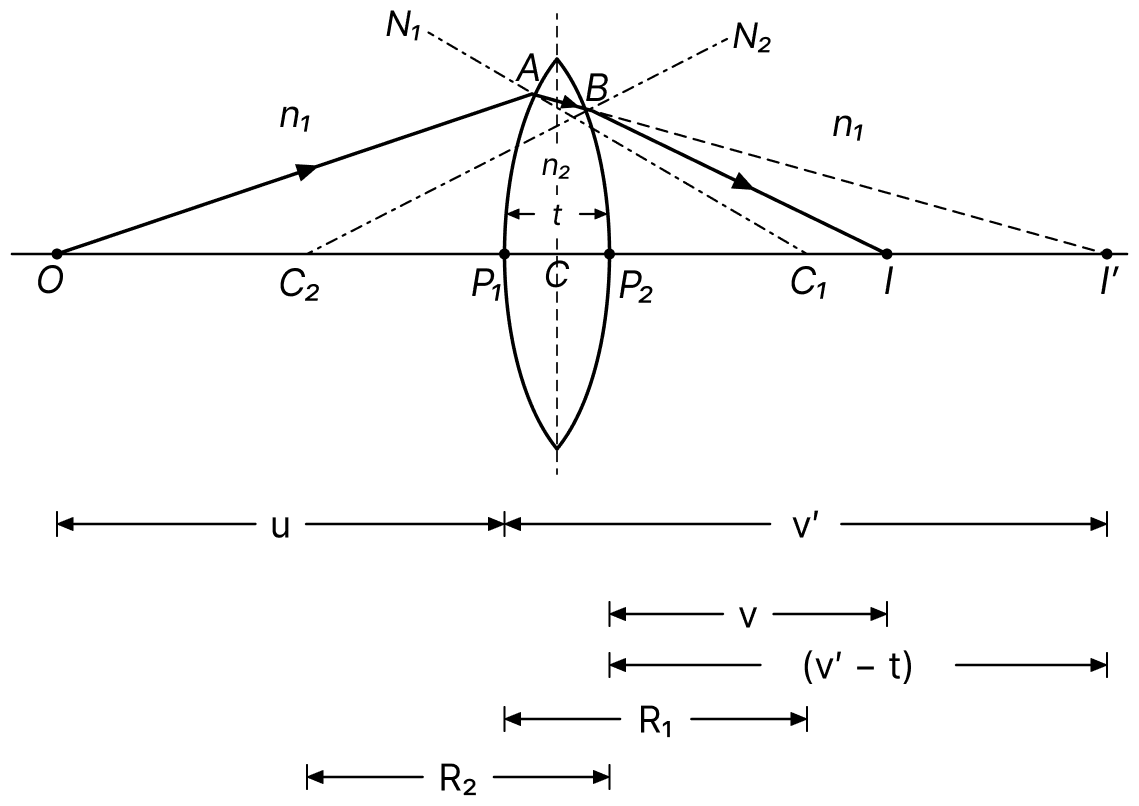
Consider a thin convex lens made of glass of refractive index n2, placed in a rarer medium of refractive index n1. Let P1 and P2 be the poles, C1 and C2 the centres of curvature, and R1 (= P1C1) and R2 (= P2C2) the radii of curvature of its first and second surfaces. Let t (= P1P2) be its thickness. A point object O is placed on the principal axis at a distance u from P1.
Refraction at the first surface :
The ray OA in the medium n1 is refracted into the medium n2 along AB. If the second surface were absent, it would meet the axis at I', the image of O due to the first surface, at a distance v' from P1. Using the relation for refraction at a spherical surface,
Refraction at the second surface :
The ray AB is incident on the second surface and is refracted into the medium n1, meeting the axis at I, the final image, at a distance v from P2. For this surface, I' acts as a virtual object at a distance (v' - t) from P2. As the refraction is from the denser medium n2 to the rarer medium n1, n1 and n2 are interchanged in the relation,
For a thin lens, t is negligible compared with v', so
Combining the two :
Adding Eqs. (i) and (ii),
Dividing both sides by n1,
Putting = n, the refractive index of the material of the lens with respect to the surrounding medium,
When the object is at infinity (u = -∞), the image is formed at the principal focus (v = f). Then from Eq. (iii),
This is the lens maker's formula.
State the position and nature of the image formed by a thin convex lens (i.e., a simple microscope) when an object is kept on its principal axis, between its optical centre (O) and focus (F). [Ray diagram is not required.]
Answer
The image is formed on the same side of the lens as the object, farther from the lens than the object (behind it). It is virtual, erect and larger than the object (magnified).
Note: The textbook prints the position as "between infinity and first focus". This holds only when the object is farther than f/2 from the lens; for an object nearer the lens, the image lies inside the focal length.
When two thin lenses are kept in contact, prove that their combined or effective focal length F is given by :
where the terms have their usual meaning.
Answer
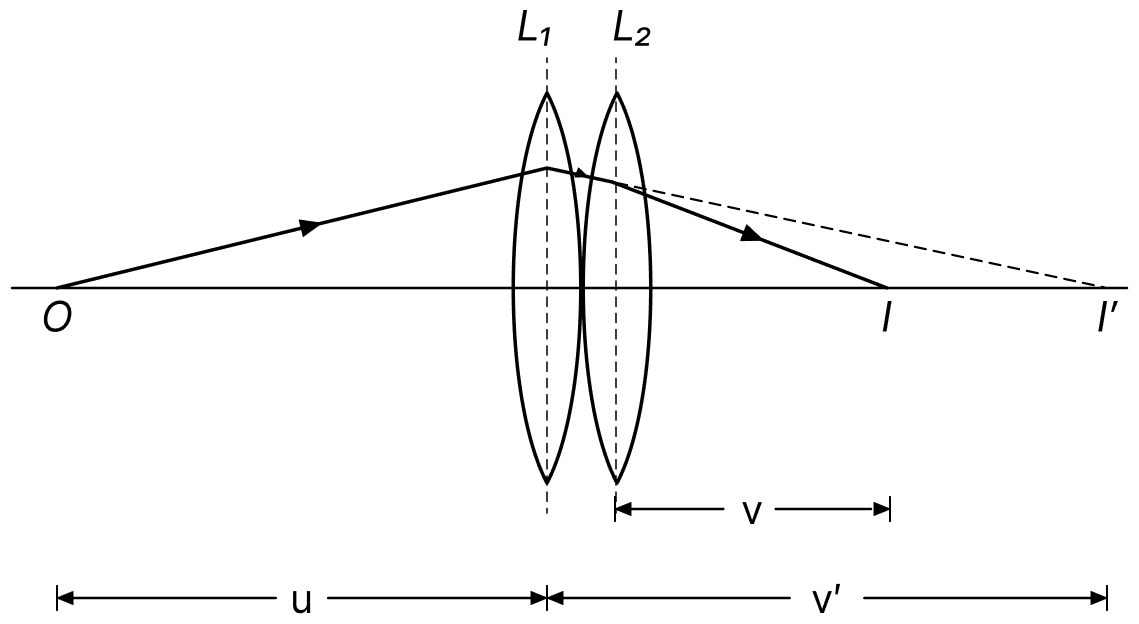
Let two thin lenses L1 and L2 of focal lengths f1 and f2 be placed in contact, with a common principal axis. A point object O is placed on the axis at a distance u from L1.
Image formed by L1 :
L1 alone would form the image I' of O at a distance v'. By the lens formula,
Image formed by L2 :
I' serves as a virtual object for L2, which forms the final image I at a distance v. The lenses being thin and in contact, both distances are measured from the same point, so
Adding Eqs. (i) and (ii),
If the two lenses are replaced by a single lens of focal length F which forms the image of O at the same point I, then
Comparing Eqs. (iii) and (iv),
This is the required relation. It holds for any combination of thin convex and concave lenses in contact, f1 and f2 being put with their proper signs.
A biconvex lens made of glass (refractive index 1.5) has two spherical surfaces having radii 10 cm and 20 cm. Calculate its focal length.
Answer
Given,
- Refractive index, n = 1.5
- For a biconvex lens, R1 = +10 cm and R2 = -20 cm
By the lens maker's formula,
Hence, the focal length of the lens is 13.3 cm.
Which one is greater: focal length of a lens for blue colour (fb) or focal length of the lens for red colour (fr)? Explain in brief.
Answer
The focal length of the lens for red colour (fr) is greater.
By the lens maker's formula, for red and blue light,
R1 and R2 are the same for both colours, but the refractive index of glass is less for red light than for blue light (nr < nb). So (nr - 1) < (nb - 1), giving .
Hence, fr > fb.
Show that the effective power or equivalent power P of two thin lenses kept in contact with each other is given by :
P = P1 + P2
Answer
Let two thin lenses of focal lengths f1 and f2 be placed in contact, and let a point object be at a distance u from the first lens. The first lens alone forms its image at v', which acts as a virtual object for the second lens; this forms the final image at v. By the lens formula,
Adding Eqs. (i) and (ii),
If F is the focal length of the single lens equivalent to the combination, . Hence,
The power of a lens is the reciprocal of its focal length (in metre), so , and . Substituting in Eq. (iii),
Hence, the equivalent power of two thin lenses in contact is the sum of their individual powers.
A student is performing an experiment to determine focal length of a convex lens by using lens formula, i.e., by no parallax method. The examiner gives some instructions to the student. The student responds to each instruction as per her understanding of the experiment. State whether the student's response is correct or incorrect. Give a reason for your answer.
(i) EXAMINER : Image formed by the lens is magnified. Reduce the size of the image.
STUDENT moves the lens towards the object pin.
(ii) EXAMINER : Plot a graph of against .
STUDENT takes on Y-axis and on X-axis.
(iii) EXAMINER : Write the relation between the optical power (P) and the focal length (f) of the convex lens.
STUDENT writes P = 2f.
Answer
(i) Incorrect.
The magnification produced by the lens is . Moving the lens towards the object pin decreases the object distance u and increases the image distance v, so the image becomes larger. To reduce the size of the image, u has to be increased, i.e., the lens must be moved away from the object pin.
(ii) Correct.
In this experiment u is the independent variable, set by the student, and v is the dependent variable, found by removing parallax. So (1/v) is taken on the Y-axis and (1/u) on the X-axis.
(iii) Incorrect.
The optical power of a lens is the reciprocal of its focal length (in metre), , not P = 2f.