
Electrons initially at rest, are passed through a potential difference of 2 kV. Calculate their:
(i) final velocity,
(ii) de-Broglie wavelength.
Answer
Given,
- Potential difference, V = 2 kV = 2000 V
- Charge of electron, e = 1.6 × 10⁻¹⁹ C
- Mass of electron, me = 9.1 × 10⁻³¹ kg
(i) Final velocity :
An electron accelerated from rest through a potential difference of V volt acquires kinetic energy K = eV. Hence,
Substituting the values,
(ii) de-Broglie wavelength :
The de-Broglie wavelength of an electron accelerated through a potential difference of V volt is given by
Hence, the final velocity of the electrons is 2.65 × 10⁷ m s-1 and their de-Broglie wavelength is 0.274 Å.
de-Broglie wavelength of electrons of kinetic energy E is λ. What will be its value, if kinetic energy of electrons made 4 E?
Answer
Given,
- Initial kinetic energy = E, initial de-Broglie wavelength = λ
- New kinetic energy = 4E
The de-Broglie wavelength of a particle of mass m having kinetic energy E is
Let λ' be the de-Broglie wavelength when the kinetic energy is made 4E. Then,
Hence, the de-Broglie wavelength becomes , i.e., half of its initial value.
Which one of the following graphs in figure represents variation of de-Broglie wavelength (λ) of a particle having linear momentum (p)?
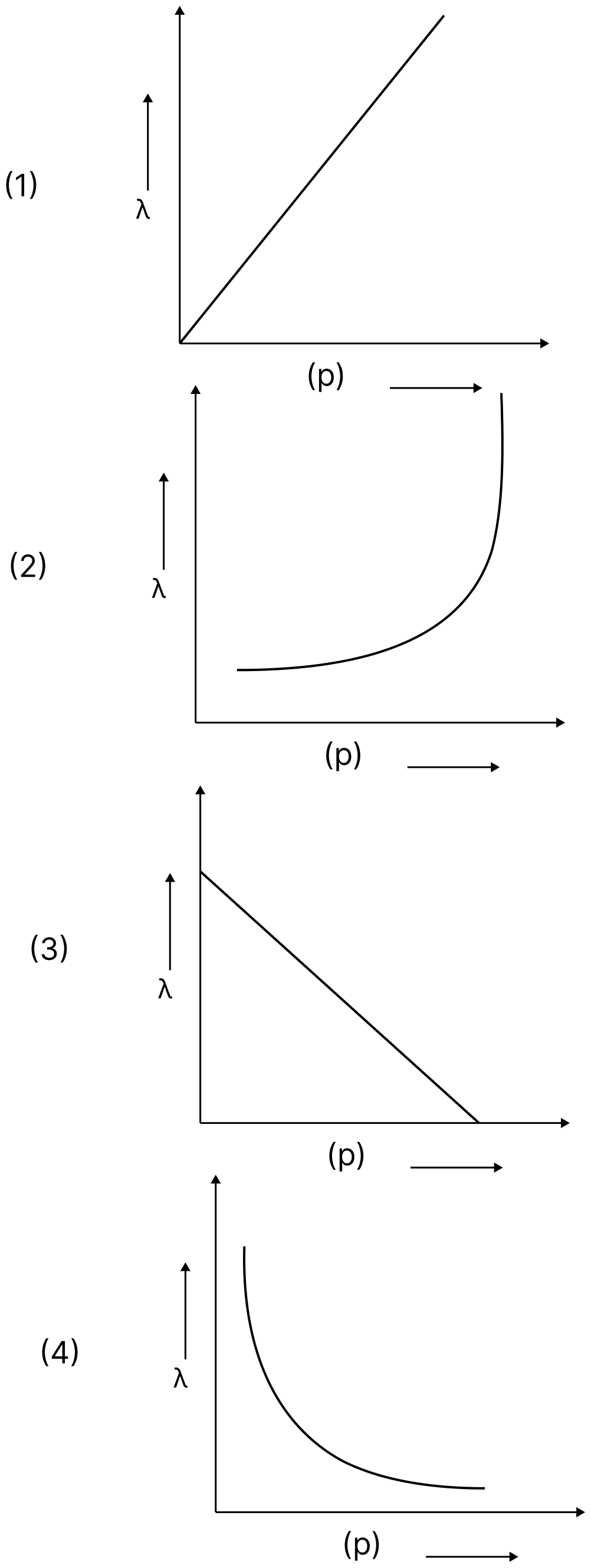
Answer
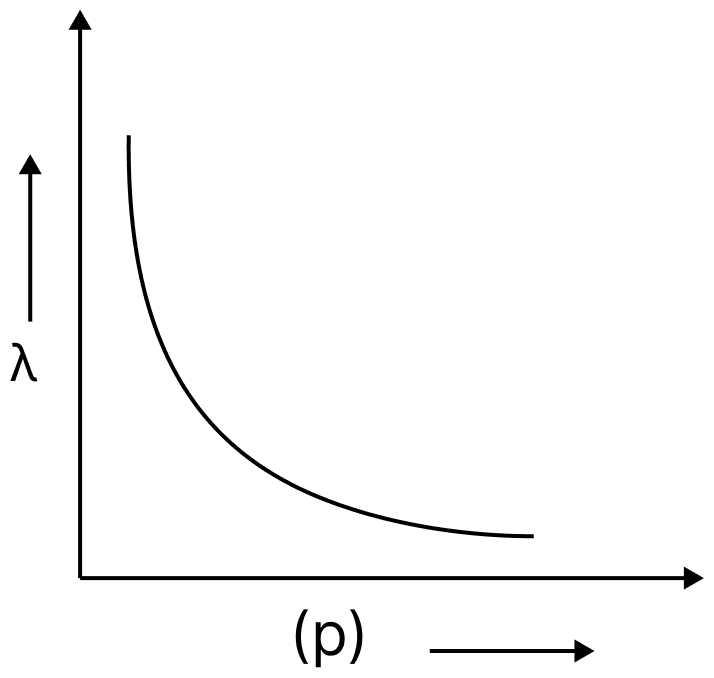
Reason — From the de-Broglie relation, , so λp = h = constant. Thus λ is inversely proportional to p and the graph of λ versus p is a rectangular hyperbola, as shown in graph 4.
What is the relation between wavelength and momentum of moving electrons?
Answer
Explanation:
According to de-Broglie, the wavelength of the matter wave associated with an electron of mass m moving with velocity v (momentum p = mv) is , where h is Planck's constant. Thus the wavelength is inversely proportional to the momentum of the moving electron.
Name the phenomena or an experiment which proves wave nature of particle.
Answer
Davisson and Germer experiment (diffraction of electrons).
Explanation:
In this experiment a beam of electrons accelerated through a potential difference falls on a nickel crystal and is diffracted by it. Diffraction is a wave phenomenon, so the experiment proves the wave nature of moving particles.
(i) State how de-Broglie wavelength (λ) of moving particles varies with their linear momentum (p).
(ii) State any one phenomenon in which moving particles exhibit wave nature.
Answer
(i) The de-Broglie wavelength of a moving particle is inversely proportional to its linear momentum,
so that λp = h = constant and the graph of λ versus p is a rectangular hyperbola.
(ii) Diffraction of electrons by a crystal, as observed in the Davisson and Germer experiment.
Find the de-Broglie wavelength of electrons moving with a speed of 7 × 10⁶ ms-1.
[h = 6.6 × 10⁻³⁴ J-s, me = 9.1 × 10⁻³¹ kg]
Answer
Given,
- Speed of electrons, v = 7 × 10⁶ m s-1
- h = 6.6 × 10⁻³⁴ J-s
- me = 9.1 × 10⁻³¹ kg
The de-Broglie wavelength of an electron of mass me moving with speed v is
Hence, the de-Broglie wavelength of the electrons is 1.036 Å.
What conclusions can be drawn from Davisson and Germer's experiment?
Answer
(i) A beam of electrons is diffracted by a nickel crystal just like X-rays. Since diffraction is a wave phenomenon, moving electrons have a wave nature, i.e., matter waves exist.
(ii) For 54 volt electrons the diffracted beam is most intense at φ = 50°. The wavelength obtained from Bragg's equation, λ = 2d sin θ = 2(0.91 Å) sin 65° = 1.65 Å, is in excellent agreement with the de-Broglie wavelength = 1.67 Å.
(iii) This close agreement between the measured and the predicted wavelengths confirms the de-Broglie relation , establishing that moving material particles have a wave nature.
The graph of de-Broglie wavelength (λ) of a moving electron versus its velocity (v) is:
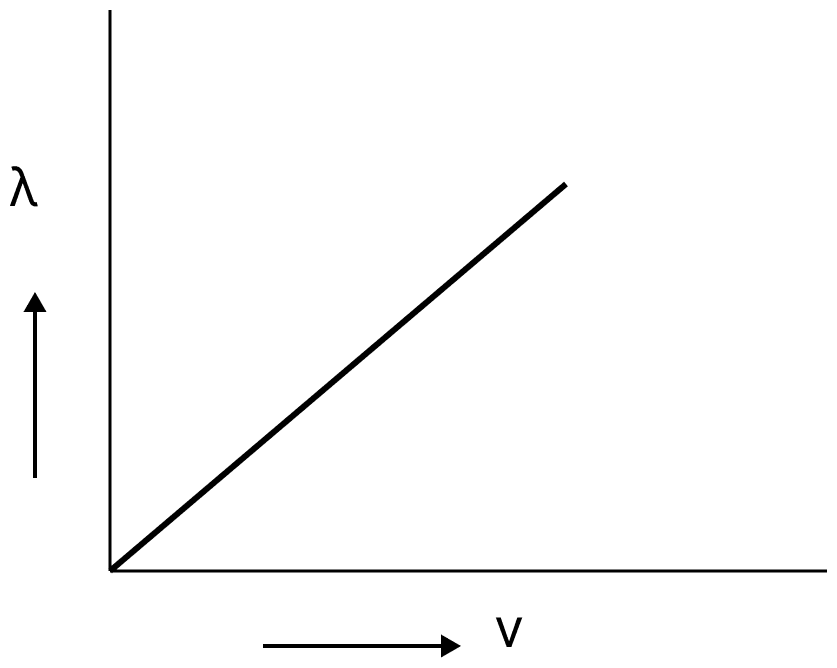
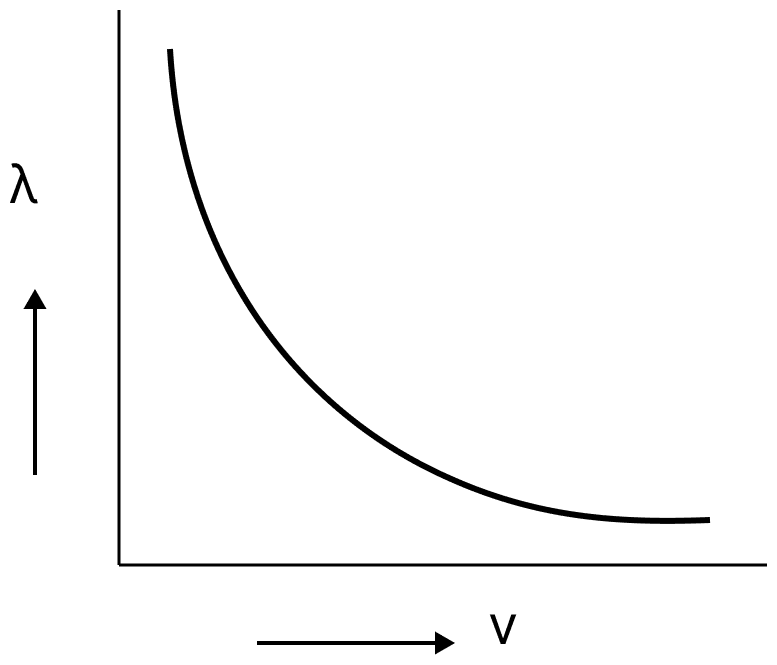
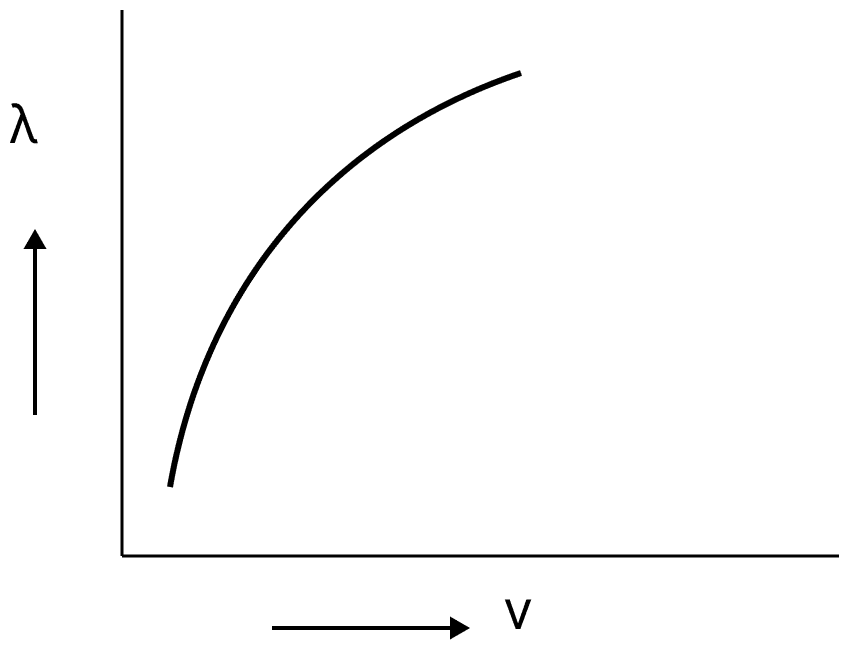
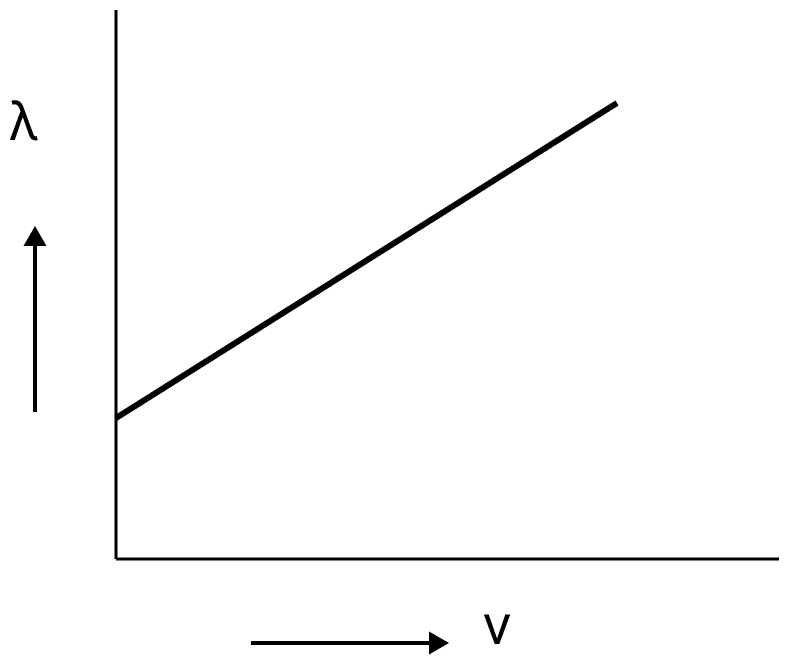
Answer
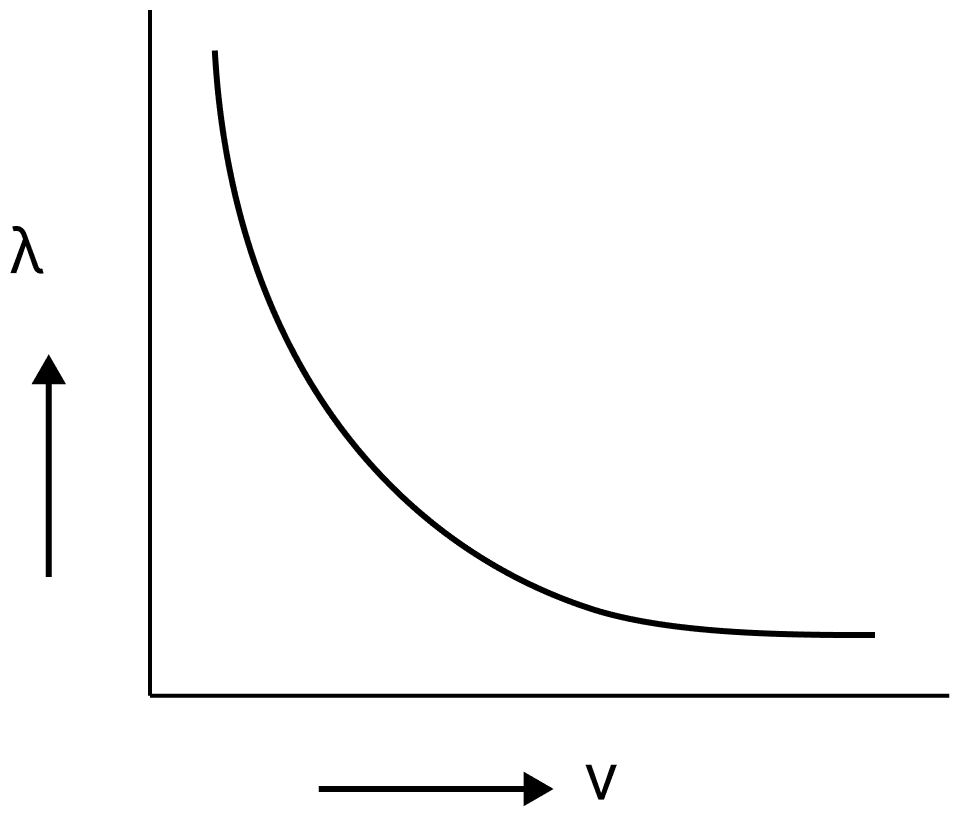
Reason — The de-Broglie wavelength of the electron is . For an electron m is constant, so λ ∝ , i.e., λv = constant. Hence the graph of λ versus v is a rectangular hyperbola, as shown in graph 2.
What are matter waves?
Answer
The waves associated with moving material particles (such as electrons, protons and neutrons) are called matter waves or de-Broglie waves. The wavelength of the matter wave associated with a particle of mass m moving with velocity v is
The de-Broglie wavelength does not depend on whether the particle is charged or uncharged, whereas electromagnetic waves are produced only by accelerated charged particles. Hence matter waves are not electromagnetic in nature.
State de-Broglie hypothesis.
Answer
de-Broglie hypothesis : Since radiation has a dual (wave-particle) nature and nature loves symmetry, all material particles in motion must also have a wave nature. The wavelength of the wave associated with a moving particle of momentum p is
where h is Planck's constant, m is the mass and v is the velocity of the particle.
Matter waves are:
- waves associated with moving particles
- waves associated with stationary particles
- waves associated with any charged particles
- waves associated with electrons only
Answer
waves associated with moving particles
Reason — The de-Broglie wavelength is . For a stationary particle v = 0, so λ = ∞, i.e., no wave is associated with it. Matter waves are associated with every moving particle, whether charged or uncharged, and not with electrons alone.
If the de-Broglie wavelengths for a proton and for an "α" particle are equal, then the ratio of their velocities (vp : vα) is:
(mass of an α particle = 4 times mass of a proton)
- 4 : 1
- 2 : 1
- 1 : 2
- 1 : 4
Answer
4 : 1
Reason — Since the de-Broglie wavelengths are equal,
The de-Broglie wavelength (λ) associated with a moving electron having kinetic energy (E) is given by:
Answer
Reason — Kinetic energy E = , so p = . Hence,