
Calculate the energy equivalent (in MeV) of one twelfth of the mass of one atom of carbon-12.
Answer
Given,
- Mass of one atom of carbon-12 = 12 u (by definition of the unified atomic mass unit)
- 1 u = 1.66054 × 10⁻²⁷ kg
- Speed of light, c = 2.9979 × 10⁸ m s-1
- 1 MeV = 1.6022 × 10⁻¹³ J
One twelfth of the mass of one atom of carbon-12 is one unified atomic mass unit,
By Einstein's energy-mass relation, E = mc2,
Hence, the energy equivalent of one twelfth of the mass of a carbon-12 atom is 931.5 MeV.
Draw a sketch to show the variation of binding energy per nucleon with mass number. What special features of this curve predict the possibility of energy release in nuclear fusion and fission reactions?
Answer
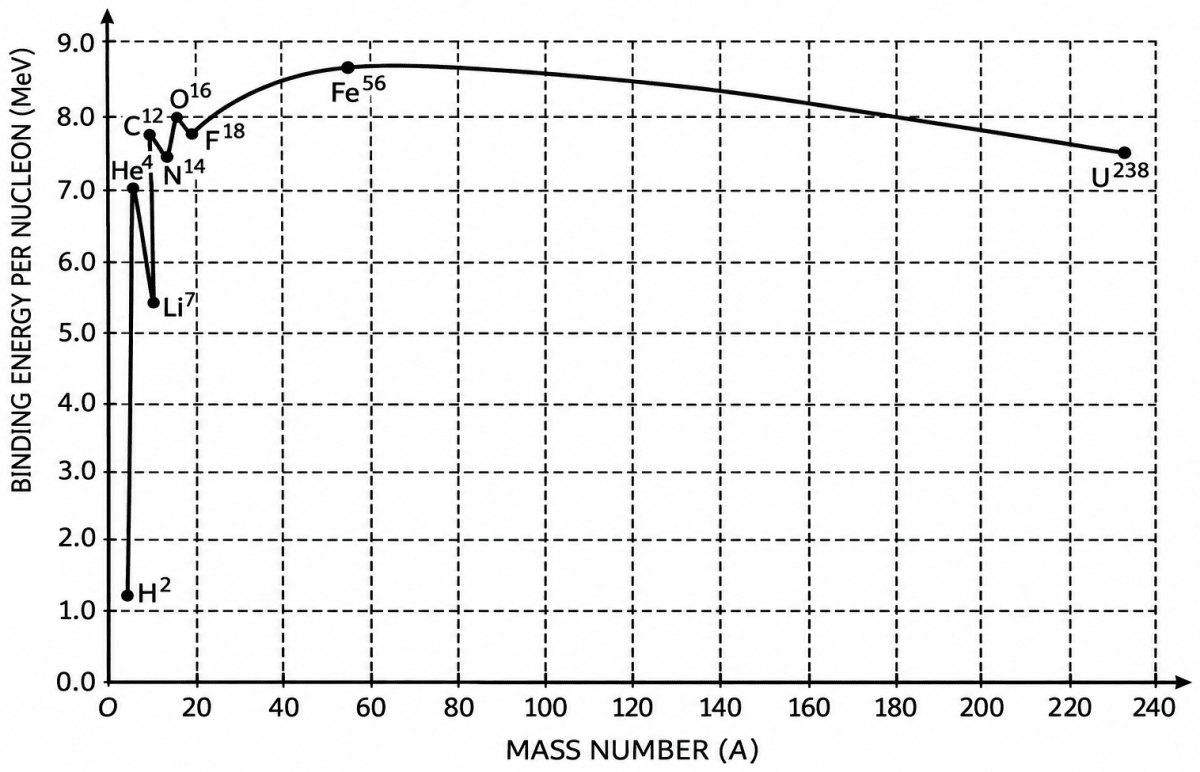
The graph between the average binding energy per nucleon and the mass number A of different nuclei is called the binding energy curve. Its special features are :
(i) Low value for light nuclei : For light nuclei (A < 20) the binding energy per nucleon is low and rises sharply with A; for 21H it is only about 1.1 MeV.
(ii) Flat maximum : The curve has an almost flat maximum of about 8.5 MeV per nucleon from A = 50 to A = 80. Iron (56Fe), with about 8.8 MeV per nucleon, has maximum stability.
(iii) Slow fall for heavy nuclei : Beyond A = 80 the binding energy per nucleon decreases slowly, to about 7.6 MeV for 238U.
Possibility of energy release :
- Fusion : When two very light nuclei (such as 2H) combine to form a heavier nucleus (such as 4He), the binding energy per nucleon increases sharply. Hence energy is released.
- Fission : When a very heavy nucleus (such as 238U) splits into two lighter nuclei near the flat maximum, the binding energy per nucleon increases by about 1 MeV. Hence energy is released.
Value of one unified atomic mass unit is 1.66 × 10⁻²⁷ kg. Calculate the mass of one atom of C12 in kg.
Answer
Given,
- 1 u = 1.66 × 10⁻²⁷ kg
By definition, one unified atomic mass unit is one twelfth of the mass of one atom of C12. Hence the mass of one atom of C12 is 12 u.
Hence, the mass of one atom of C12 is 1.99 × 10⁻²⁶ kg.
A heavy nucleus X of mass number A = 240 and binding energy per nucleon = 7.6 MeV is split into two nearly equal fragments Y and Z of mass numbers A1 = 110 and A2 = 130. The binding energy of each one of these nuclei is 8.5 MeV per nucleon. Calculate the total binding energy of each of the nuclei X, Y and Z hence the energy Q released per fission in MeV.
Answer
Given,
- Nucleus X : A = 240, binding energy per nucleon = 7.6 MeV
- Nucleus Y : A1 = 110, binding energy per nucleon = 8.5 MeV
- Nucleus Z : A2 = 130, binding energy per nucleon = 8.5 MeV
The total binding energy of a nucleus is the product of its number of nucleons and its binding energy per nucleon.
The fragments Y and Z are more tightly bound than X, so the energy released per fission is the excess of their total binding energy over that of X.
Hence, the binding energies of X, Y and Z are 1824 MeV, 935 MeV and 1105 MeV respectively, and the energy released per fission is Q = 216 MeV.
Name the particles and radiation involved in a 'pair production'. Give equation relating them.
Answer
Particles : an electron (-1β0) and a positron (+1β0).
Radiation : a γ-ray photon of energy hν.
Equation :
The following equation represents a fusion reaction
21H + 31H → 42He + 10n + Q
where, Q is the energy released.
Mass of 21H atom = 2.014102 u, mass of 31H atom = 3.016050 u, mass of 42He atom = 4.002603 u and mass of neutron, 10n = 1.008665 u. Calculate the value of Q.
1 u ≡ 931 MeV
Answer
Given,
- m(21H) = 2.014102 u
- m(31H) = 3.016050 u
- m(42He) = 4.002603 u
- m(10n) = 1.008665 u
- 1 u ≡ 931 MeV
The energy released is the energy equivalent of the mass defect of the reaction, Q = (Δm) × 931 MeV.
Mass of the reactants,
Mass of the products,
Therefore,
Hence, the energy released in the reaction is Q = 17.581 MeV.
What is meant by 'mass defect' of a nucleus? How is it related with the 'binding energy' of the nucleus?
Answer
Mass defect : When the constituent nucleons of a nucleus are taken in the free state, their total mass is found to be greater than the rest-mass of the nucleus. The difference between the sum of the masses of the nucleons constituting a nucleus and the rest-mass of the nucleus is called the mass defect Δm. For a nucleus ZXA,
Relation with binding energy : The disappeared mass Δm reappears as an equivalent energy, which is liberated when the nucleus is formed and which must be supplied to break it into its nucleons. This energy is the binding energy of the nucleus,
If Δm is in u, Eb = Δm × 931.5 MeV.
Calculate the disintegration energy Q when a heavy nucleus of mass number A = 240 with binding energy per nucleon 7.6 MeV is split into two equal fragments of mass number A' = 120, each with B.E./nucleon 8.5 MeV.
Answer
Given,
- Heavy nucleus : A = 240, B.E./nucleon = 7.6 MeV
- Each fragment : A' = 120, B.E./nucleon = 8.5 MeV
The total binding energy of a nucleus is the product of its number of nucleons and its binding energy per nucleon.
The disintegration energy is the increase in the total binding energy,
Hence, the disintegration energy is Q = 216 MeV.
What is meant by 'atomic mass unit'? Calculate the equivalent energy in MeV of a unified atomic mass unit.
Answer
Atomic mass unit : The unified atomic mass unit (symbol u) is defined as one twelfth of the mass of one atom of carbon-12 (126C).
One mole (12 g) of carbon-12 contains NA = 6.02214 × 10²³ atoms, so
Equivalent energy : By Einstein's energy-mass relation, E = mc2. Taking c = 2.9979 × 10⁸ m s-1 and 1 MeV = 1.6022 × 10⁻¹³ J,
Hence, the energy equivalent of one unified atomic mass unit is 931.5 MeV.
Draw a labelled sketch to illustrate pair production.
Answer
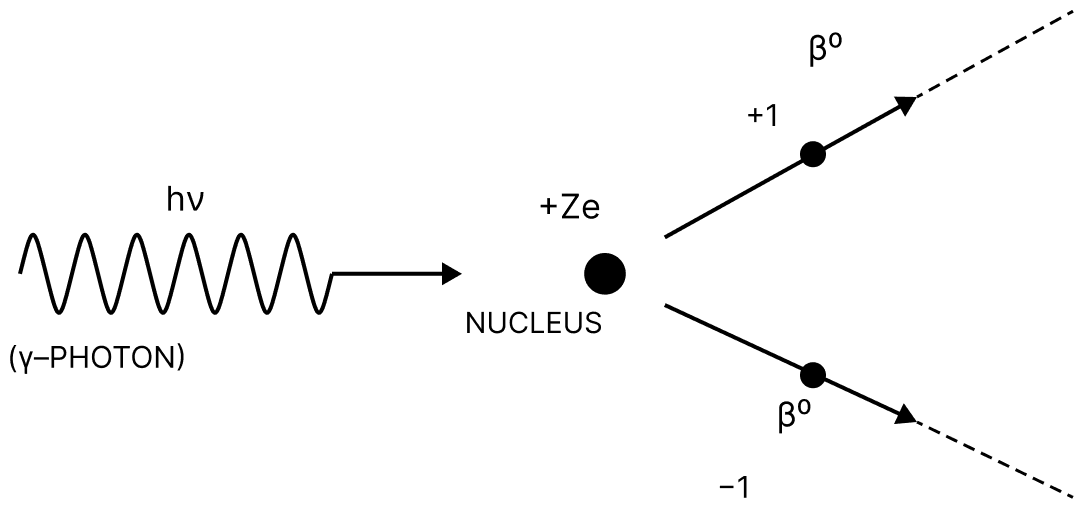
A γ-ray photon of energy hν (at least 1.02 MeV) falls on a heavy nucleus of charge +Ze and is absorbed. Its energy materialises into an electron (-1β0) and a positron (+1β0), which move away from the nucleus in different directions,
Draw a rough sketch showing the variation of binding energy per nucleon with mass number of various nuclei. Label the graph and state the region where the nuclei are most stable.
Answer
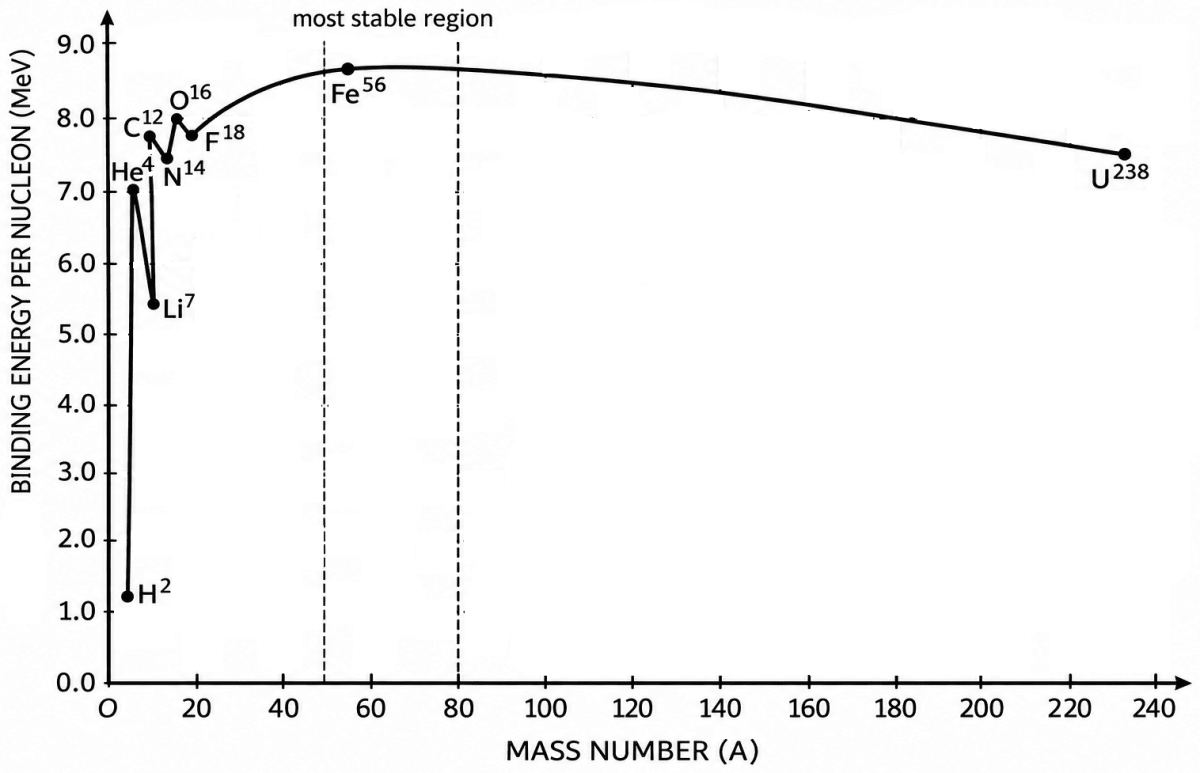
The mass number A is plotted along the x-axis and the average binding energy per nucleon (in MeV) along the y-axis. The points 2H, 4He, 12C, 16O, 56Fe and 238U are marked on the curve.
Region of maximum stability : The curve has an almost flat maximum, about 8.5 MeV per nucleon, from A = 50 to A = 80. The nuclei having mass number between 50 and 80 are the most stable; 56Fe, with about 8.8 MeV per nucleon, has maximum stability.
How much energy will be created if 1 g of matter is destroyed completely?
Answer
Given,
- Mass destroyed, Δm = 1 g = 1 × 10⁻³ kg
- Speed of light, c = 3.0 × 10⁸ m s-1
By Einstein's energy-mass relation,
Hence, 9 × 10¹³ J of energy will be created.
In the following nuclear reaction, calculate the energy released in MeV
21H + 21H → 32He + 10n
given that, mass of 21H = 2.015 u, mass of 32He = 3.017 u, and mass of 10n = 1.009 u.
Answer
Given,
- m(21H) = 2.015 u
- m(32He) = 3.017 u
- m(10n) = 1.009 u
- 1 u ≡ 931 MeV (taken)
The energy released is the energy equivalent of the mass defect, Q = (Δm) × 931 MeV.
Hence, the energy released in the reaction is 3.724 MeV.
Binding energy of a nucleus is of the order of :
- eV
- KeV
- MeV
- J
Answer
MeV
Reason — The nuclear binding energies range from about 2.224 MeV for the deuteron to about 1800 MeV for uranium, and the binding energy per nucleon is a few MeV (about 8 MeV for most nuclei). Hence the binding energy of a nucleus is of the order of MeV.
In a certain star, three α-particles undergo fusion in a single reaction to form 126C nucleus.
Calculate the energy released in this reaction in MeV.
Given,
m(42He) = 4.002604 u and
m(126C) = 12.000000 u.
1 u ≡ 931 MeV
Answer
Given,
- m(42He) = 4.002604 u
- m(126C) = 12.000000 u
- 1 u ≡ 931 MeV
The reaction is
The energy released is the energy equivalent of the mass defect, Q = (Δm) × 931 MeV.
Hence, the energy released in this reaction is 7.27 MeV.
Give an example where energy is converted into matter.
Answer
Pair production.
Explanation:
A γ-ray photon of energy at least 1.02 MeV falling on a heavy substance is absorbed by a nucleus, and its energy materialises as an electron and a positron,
Here energy is converted into mass.
The atomic mass of Uranium 23892U is 238.0508 u while that of Thorium 23490Th is 234.0436 u and that of Helium 42He is 4.0026 u, Alpha decay converts 23892U into 23490Th as shown
23892U → 23490Th + 42He + energy
Determine the energy released in this reaction.
(1 u ≡ 931 MeV)
Answer
Given,
- m(23892U) = 238.0508 u
- m(23490Th) = 234.0436 u
- m(42He) = 4.0026 u
- 1 u ≡ 931 MeV
The energy released is the energy equivalent of the mass defect,
Substituting the values,
Hence, the energy released in this reaction is 4.2826 MeV.
What is meant by pair production? Explain with the help of an example and a balanced equation.
Answer
Pair production : An energetic γ-ray photon falling on a heavy substance is absorbed by some nucleus of the substance, and its energy materialises as an electron and a positron. In this phenomenon energy is converted into mass. The balanced equation is
Both the charge (0 = −1 + 1) and the mass number (0 = 0 + 0) are balanced.
The rest-mass energy of each of the electron and the positron is m0c2 = 0.51 MeV. Hence the γ-photon must have energy at least 2 × 0.51 = 1.02 MeV; any energy in excess of this appears as the kinetic energy of the pair. The heavy nucleus is necessary for both energy and momentum to be conserved.
Example : A γ-photon of energy 2.26 MeV materialises into an electron-positron pair. Of this energy, 1.02 MeV is used up as the rest-mass energy of the pair, and the excess 2.26 − 1.02 = 1.24 MeV appears as the kinetic energy of the two particles, about 0.62 MeV each on the average. The positron in fact gets slightly more than half, since the nucleus repels it and attracts the electron.
Calculate mass defect and binding energy per nucleon of 2010Ne, given
Mass of 2010Ne = 19.992397 u
Mass of 11H = 1.007825 u
Mass of 10n = 1.008665 u
1 u × c2 = 931 MeV
Answer
Given,
- m(2010Ne) = 19.992397 u
- m(11H) = 1.007825 u
- m(10n) = 1.008665 u
- 1 u × c2 = 931 MeV
The nucleus of 2010Ne has Z = 10 protons and A − Z = 10 neutrons.
Mass defect :
Binding energy per nucleon :
Hence, the mass defect is 0.172503 u and the binding energy per nucleon of 2010Ne is 8.03 MeV.
What is the minimum energy which a gamma ray photon must possess in order to produce electron-positron pair?
Answer
1.02 MeV.
Explanation:
The rest-mass energy of each of the electron and the positron is m0c2 = 0.51 MeV. To create both particles, the γ-ray photon must supply at least
What is meant by the term binding energy of a nucleus?
Answer
The binding energy of a nucleus is the minimum energy required to separate its nucleons and place them at rest at infinite distance apart. It is equal to the energy equivalent of the mass defect Δm of the nucleus,
The same amount of energy is liberated when the nucleus is formed from its free nucleons.
What is meant by pair annihilation? Write a balanced equation for the same.
Answer
Pair annihilation : An electron and a positron that come very close together combine and annihilate each other, and two γ-photons are produced in their place. In this phenomenon mass is converted into energy. The balanced equation is
The energy of each γ-photon is 0.51 MeV, equal to the rest-mass energy m0c2 of the electron or the positron. Two photons, travelling in opposite directions, are produced so that both energy and momentum are conserved.
What is meant by mass defect?
Answer
When the constituent nucleons of a nucleus are taken in the free state, their total mass is found to be greater than the rest-mass of the nucleus. The difference between the sum of the masses of the nucleons constituting a nucleus and the rest-mass of the nucleus is called the mass defect Δm,
where Z is the atomic number, A the mass number and mN the mass of the nucleus.
Calculate binding energy of oxygen nucleus (168O) from the data given below :
Mass of a proton mp = 1.007825 u
Mass of a neutron mn = 1.008665 u
Mass of (168O) mo = 15.994915 u
1 u × c2 = 931 MeV
Answer
Given,
- mp = 1.007825 u
- mn = 1.008665 u
- mo = 15.994915 u
- 1 u × c2 = 931 MeV
The nucleus 168O has Z = 8 protons and A − Z = 8 neutrons. Its binding energy is
Mass defect :
Binding energy :
Hence, the binding energy of the oxygen nucleus 168O is 127.55 MeV.
Note: The textbook prints 127.62 MeV, which corresponds to 1 u × c2 = 931.5 MeV; with the given 1 u × c2 = 931 MeV, the binding energy is 127.55 MeV.
What is the significance of binding energy per nucleon of a nucleus of a radioactive element?
Answer
The binding energy per nucleon is a measure of the stability of a nucleus; higher the binding energy per nucleon, more stable is the nucleus.
The nuclei of radioactive elements (heavier than 83Bi209) have a comparatively low binding energy per nucleon, about 7.6 MeV for uranium. Such a low binding energy per nucleon cannot hold out against the Coulomb repulsion between their many protons, so these nuclei are unstable and disintegrate spontaneously, emitting α- or β-particles, to form nuclei of higher binding energy per nucleon.
Sketch a graph showing the variation of binding energy per nucleon of a nucleus with its mass number.
Answer
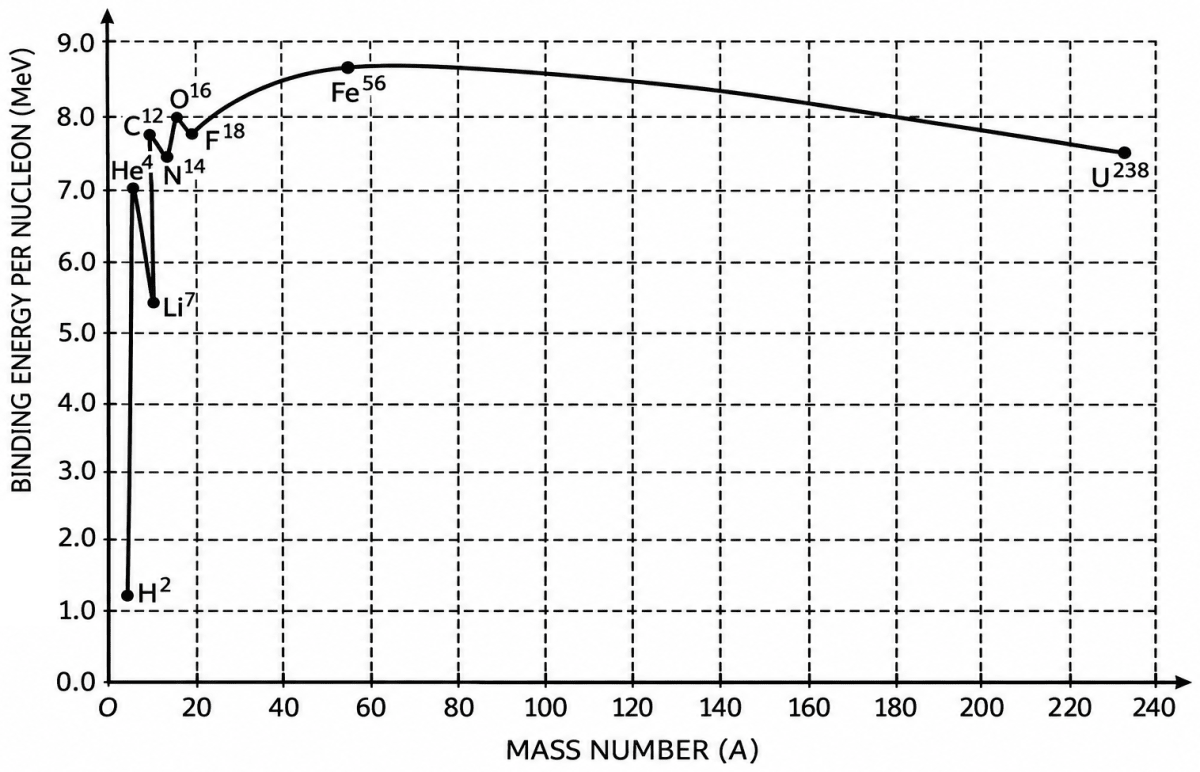
The binding energy per nucleon is low for light nuclei and rises sharply up to about A = 20, with subsidiary peaks at 4He, 12C and 16O. It reaches an almost flat maximum of about 8.5 MeV from A = 50 to A = 80 (about 8.8 MeV for 56Fe) and then decreases slowly to about 7.6 MeV for 238U.
The amount of energy released in annihilation of an electron and a positron pair is :
- 1.02 eV
- 1.02 J
- 1.02 KeV
- 1.02 MeV
Answer
1.02 MeV
Reason — In annihilation, the rest-masses of the electron and the positron are converted wholly into energy. The rest-mass energy of each is m0c2 = 0.51 MeV, so the energy released is 2 × 0.51 = 1.02 MeV, carried away by two γ-photons of 0.51 MeV each.
The binding energy of a beryllium isotope (94Be) is 6.03 MeV. What is the binding energy per nucleon of this isotope?
Answer
Given,
- Binding energy of 94Be, Eb = 6.03 MeV
- Mass number, A = 9
Hence, the binding energy per nucleon of 94Be is 0.67 MeV.
Note: The same question appears in the chapter's Very Short Answer section with 60.3 MeV, giving 6.7 MeV per nucleon; the 6.03 MeV printed here is evidently a misprint, and the answer follows the data as given.
Calculate the energy released when an electron annihilates a positron.
Answer
Given (standard values, as used in the chapter),
- Rest-mass of electron = rest-mass of positron, m0 = 9.1 × 10⁻³¹ kg
- Speed of light, c = 3.0 × 10⁸ m s-1
- 1 MeV = 1.6 × 10⁻¹³ J
The annihilation equation is
The mass lost in the process is
By Einstein's energy-mass relation,
Hence, the energy released when an electron annihilates a positron is 1.02 MeV.
The difference between the total mass of the nucleons (i.e., protons and neutrons) and the mass of the nucleus is known as :
- atomic mass unit
- binding energy of the nucleus
- mass defect
- binding energy per nucleon
Answer
mass defect
Reason — By definition, the difference between the sum of the masses of the nucleons constituting a nucleus and the rest-mass of the nucleus is called the mass defect, Δm = Zmp + (A − Z)mn − mN.
What is meant by "binding energy per nucleon" of a nucleus? State its physical significance.
Answer
Binding energy per nucleon : It is the total binding energy of a nucleus divided by the number of nucleons in it, Ebn = . It is the average energy required to remove a nucleon from the nucleus to infinite distance.
Physical significance : It is a measure of the stability of the nucleus; higher the binding energy per nucleon, more stable is the nucleus. Nuclei with mass number between 50 and 80 (about 8.5 MeV per nucleon) are the most stable.
Calculate the energy released in the following nuclear fusion reaction:
21H + 21H → 42He + energy
Mass of 21H = 2.014102 u
Mass of 42He = 4.002604 u
Answer
Given,
- m(21H) = 2.014102 u
- m(42He) = 4.002604 u
- 1 u × c2 = 931.5 MeV
The energy released is the energy equivalent of the mass defect.
Hence, the energy released in the fusion reaction is 23.85 MeV.
Note: The textbook prints 23.83 MeV, which corresponds to 1 u ≡ 931 MeV; the chapter's own Example 5 solves this reaction with 931.5 MeV.
A heavy nucleus A of mass number 250 has a binding energy of 8 MeV per nucleon. It gets split into two fragments B and C having mass numbers 110 and 140 respectively. The binding energy per nucleon of B and C is 8.5 MeV per nucleon. Calculate the energy released per fission in MeV.
Answer
Given,
- Nucleus A : mass number 250, binding energy per nucleon = 8 MeV
- Fragment B : mass number 110, fragment C : mass number 140
- Binding energy per nucleon of B and C = 8.5 MeV
The total binding energy of a nucleus is the product of its number of nucleons and its binding energy per nucleon.
The energy released per fission is the increase in the total binding energy,
Hence, the energy released per fission is 125 MeV.
Calculate the amount of energy in MeV released in the process of fusion, when four hydrogen nuclei combine to form a helium nucleus.
(Neglect the masses of electrons and neutrinos)
Answer
Given (standard values, as no data is supplied),
- m(11H) = 1.0078 u
- m(42He) = 4.0026 u
- 1 u ≡ 931.5 MeV
In the fusion process four hydrogen nuclei combine to form a helium nucleus, together with two positrons and two neutrinos,
Neglecting the masses of the electrons (positrons) and the neutrinos, the mass defect is
Hence, the energy released in the process is 26.64 MeV.
Note: The question supplies no masses; the standard values listed above, which reproduce the printed answer, have been used.