
The magnetic susceptibility is negative for :
- diamagnetic material only
- paramagnetic material only
- ferromagnetic material only
- paramagnetic and ferromagnetic materials
Answer
diamagnetic material only
Reason — A diamagnetic material is magnetised opposite to the magnetising field, so M and H are opposite and χ = M/H is negative. For paramagnetic and ferromagnetic materials χ is positive.
Hysteresis loops for two magnetic materials A and B are given below :
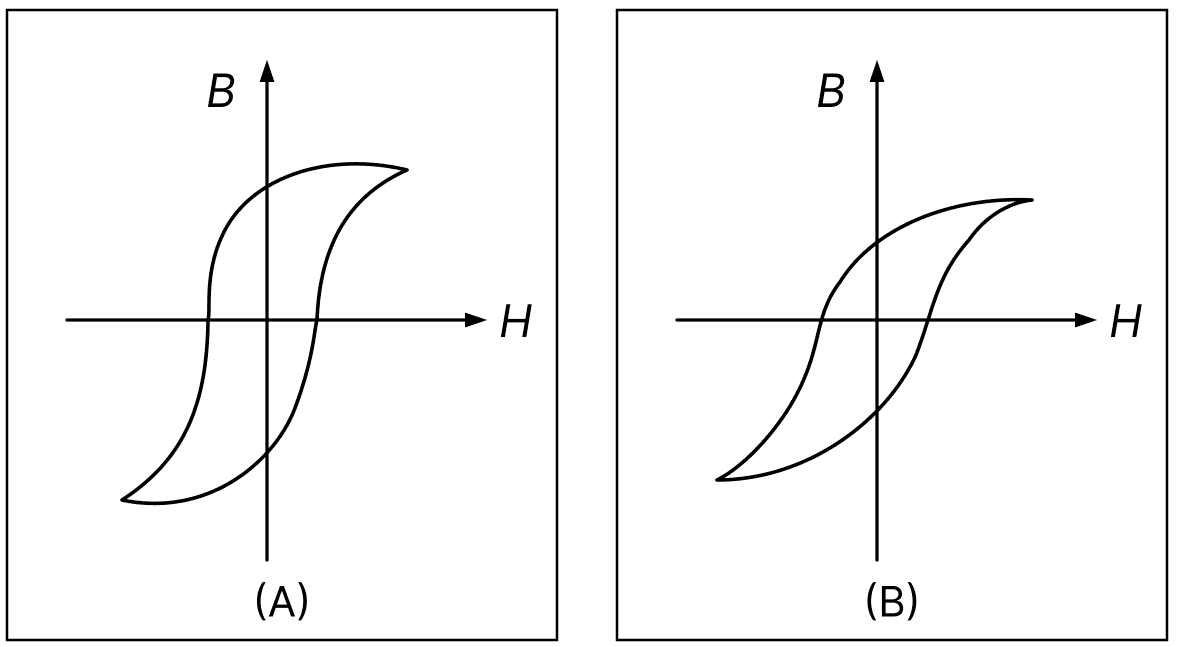
These materials are used to make magnets for electric generators, transformer core and electromagnet core. Then it is proper to use :
- A for electromagnets and B for electric generators
- A for transformers and B for electric generators
- B for electromagnets and transformers
- A for electric generators and transformers
Answer
B for electromagnets and transformers
Reason — The cores of electromagnets and transformers go through repeated cycles of magnetisation, so they need a material with small hysteresis loss (loop of small area) and low retentivity and coercivity, so that they are easily magnetised and demagnetised. Loop B is narrower than loop A, so material B suits them.
A thin diamagnetic rod is placed vertically between the poles of an electromagnet. When the current in the electromagnet is switched on, then the diamagnetic rod is pushed up, out of the horizontal magnetic field. Hence the rod gains gravitational potential energy. The work required to do this comes from :
- the current source
- the induced electric field due to the changing magnetic field
- the lattice structure of the material of the rod
- the magnetic field
Answer
the current source
Reason — On switching on the current, the energy of the magnetic field set up between the poles is supplied by the current source. The diamagnetic rod tends to move from the stronger to the weaker part of the field and is pushed up; the work done in raising it also comes from the current source.
A paramagnetic substance in the form of a cube with sides 1 cm has a magnetic dipole moment of 20 × 10-6 J/T when a magnetic intensity of 60 × 103 A/m is applied. Its magnetic susceptibility is :
- 2.3 × 10⁻²
- 3.3 × 10⁻²
- 3.3 × 10⁻⁴
- 4.3 × 10⁻²
Answer
3.3 × 10⁻⁴
Reason — Volume of the cube, V = (10-2 m)3 = 10-6 m3. Using M = m/V and χ = M/H,
A bar-magnet is demagnetized by inserting it inside a solenoid of length 0.2 m, 100 turns, and carrying a current of 5.2 A. The coercivity of the bar-magnet is :
- 1200 A/m
- 2600 A/m
- 520 A/m
- 285 A/m
Answer
2600 A/m
Reason — The magnet is demagnetised when the magnetic intensity H = nI = (N/l)I of the solenoid equals its coercivity.
Which of the following combinations has the dimension of electrical resistance (ε0 is the permittivity of vacuum and μ0 is the permeability of vacuum)?
Answer
Reason — With [μ0] = [MLT-2A-2] and [ε0] = [M-1L-3T4A2],
This is the dimensional formula of resistance (R = V/I).
A paramagnetic material has 1028 atoms/m3. Its magnetic susceptibility at temperature 350 K is 2.8 × 10⁻⁴. Its susceptibility at 300 K is :
- 3.726 × 10⁻⁴
- 3.672 × 10⁻⁴
- 2.672 × 10⁻⁴
- 3.267 × 10⁻⁴
Answer
3.267 × 10⁻⁴
Reason — By Curie's law, χ ∝ 1/T.
Magnetic materials used for making permanent magnets (P) and magnets in a transformer (T) have different properties of the following, which property best matches for the type of magnet required?
- T : Large retentivity, small coercivity
- P : Large retentivity, large coercivity
- P : Small retentivity, large coercivity
- T : Large retentivity, large coercivity
Answer
P : Large retentivity, large coercivity
Reason — A permanent magnet must be strong (high retentivity) and its magnetisation must not be wiped out by stray fields, mechanical ill-treatment or temperature changes (high coercivity). A transformer core instead needs low hysteresis loss and high permeability.
A paramagnetic sample shows a net magnetisation of 6 A/m when it is placed in an external magnetic field of 0.4 T at a temperature of 4 K. When the sample is placed in an external magnetic field of 0.3 T at a temperature of 24 K, then the magnetisation will be :
- 1 A/m
- 0.75 A/m
- 4 A/m
- 2.25 A/m
Answer
0.75 A/m
Reason — By Curie's law, the magnetisation is proportional to the applied field and inversely proportional to the kelvin temperature.
Following plots show magnetisation (M) vs magnetising field (H) and magnetic susceptibility (χ) vs temperature (T) graph :
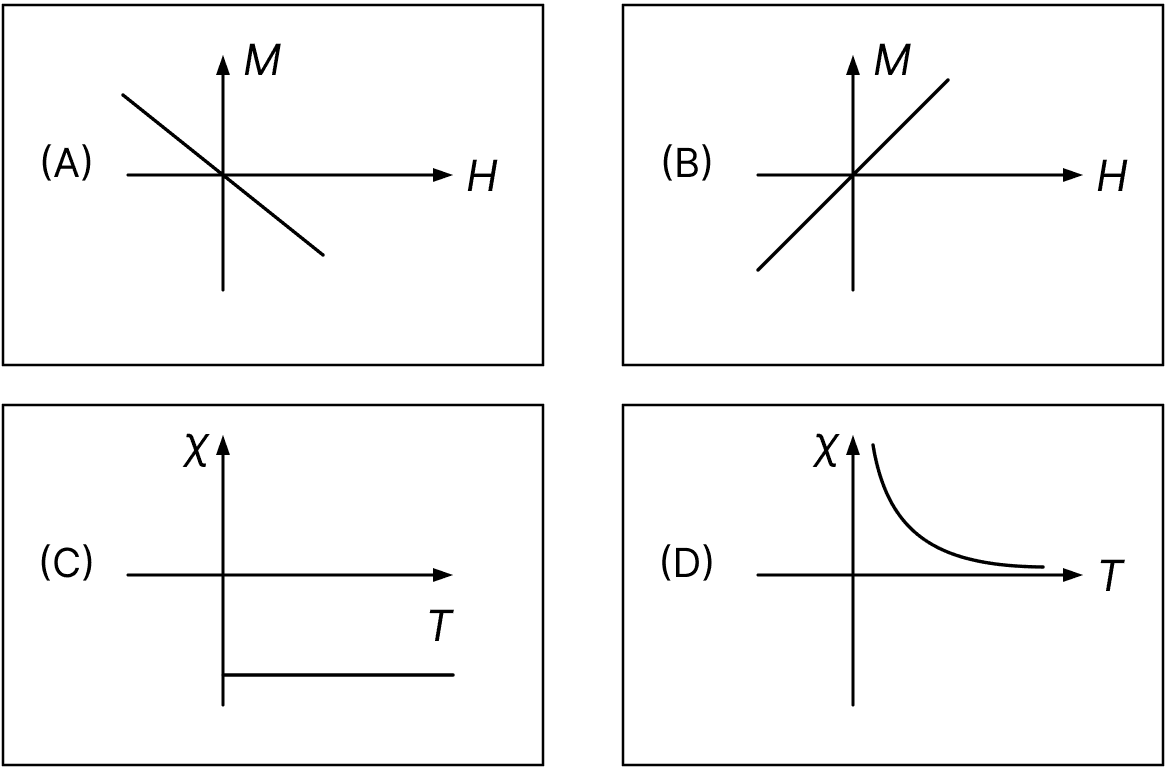
Which of the following combinations will be represented by a diamagnetic material?
- (B), (C)
- (B), (D)
- (A), (D)
- (A), (C)
Answer
(A), (C)
Reason — For a diamagnetic material χ is small and negative, so M = χH is a straight line through the origin with negative slope — graph (A). Its susceptibility is independent of temperature, so χ versus T is a straight line parallel to the T-axis below it — graph (C).
Statement I : The ferromagnetic property depends on temperature. At high temperature, ferromagnet becomes paramagnet.
Statement II : At high temperature, the domain wall area of a ferromagnetic substance increases.
In the light of the above statements, choose the most appropriate answer from the given options.
- Both Statement I and Statement II are true.
- Both Statement I and Statement II are false.
- Statement I is true but Statement II is false.
- Statement I is false but Statement II is true.
Answer
Statement I is true but Statement II is false.
Reason — Ferromagnetism decreases with rise in temperature and above the Curie temperature a ferromagnet becomes paramagnetic, so Statement I is true. At high temperature thermal agitation disorients the magnetic dipoles and the domains are destroyed; the domain wall area does not increase, so Statement II is false.
Which of the following statements are correct?
(A) Electric monopoles do not exist whereas magnetic monopoles exist.
(B) Magnetic field lines due to a solenoid at its ends and outside cannot be completely straight and confined.
(C) Magnetic field lines are completely confined within a toroid.
(D) Magnetic field lines inside a bar magnet are not parallel.
(E) χ = −1 is the condition for a perfect diamagnetic material, where χ is its magnetic susceptibility.
Choose the correct answer from the given options :
- (A) and (B)
- (B) and (D)
- (B) and (C)
- (C) and (E)
Answer
(C) and (E)
Reason — The field lines of a toroid are completely confined within its core (C), and a perfect diamagnetic material has χ = −1 (E).
Note: Statement (B) is also correct, so option 3 likewise lists only correct statements; the answer given follows the printed key (d).
A soft ferromagnetic material is placed in an external magnetic field. The magnetic domains :
- decrease in size and changes orientation
- increase in size but no change in orientation
- may increase or decrease in size and change its orientation
- have no relation with external magnetic field
Answer
may increase or decrease in size and change its orientation
Reason — In an external field, the domains oriented favourably with respect to the field increase in size, those oriented opposite to it decrease in size, and the domains also rotate towards the direction of the field.
In a ferromagnetic material, below the Curie temperature, a domain is defined as :
- a macroscopic region with consecutive magnetic dipoles oriented in opposite direction
- a macroscopic region with randomly oriented magnetic dipoles
- a macroscopic region with saturation magnetisation
- a macroscopic region with zero magnetisation
Answer
a macroscopic region with saturation magnetisation
Reason — Below the Curie temperature, the magnetic moments of the 1017 to 1021 atoms of a domain are aligned in the same direction by mutual interaction, so each domain is in a state of magnetic saturation even without an external field.
The soft-iron is a suitable material for making an electromagnet. This is because soft-iron has :
- low coercivity and high retentivity
- low coercivity and low permeability
- high permeability and low retentivity
- high permeability and high retentivity
Answer
high permeability and low retentivity
Reason — The core of an electromagnet must give a strong field at a low magnetising current (high permeability) and must lose its magnetism when the current is switched off (low retentivity).
Following are two statements :
Statement I : Susceptibilities of paramagnetic and ferromagnetic substances increase with decrease in temperature.
Statement II : Diamagnetism is a result of orbital motions of electrons developing magnetic moments opposite to the applied magnetic field.
Choose the correct answer from the given options :
- Both Statement I and Statement II are true.
- Both Statement I and Statement II are false.
- Statement I is true but Statement II is false.
- Statement I is false but Statement II is true.
Answer
Both Statement I and Statement II are true.
Reason — For paramagnetic substances , and for ferromagnetic substances above the Curie temperature ; in both, χ increases as the temperature decreases. In diamagnetic substances the external field modifies the motion of the paired electrons (Lenz's law), inducing magnetic moments opposite to the applied field. So both statements are true.
The susceptibility of a paramagnetic material is 99. The permeability of the material in Wb/A-m, is :
[Permeability of free space (μ0) = 4π × 10-7 Wb/A-m]
- 4π × 10-7
- 4π × 10-4
- 4π × 10-5
- 4π × 10-6
Answer
4π × 10-5
Reason — Using μ = μ0(1 + χ),
The net magnetic flux through any closed surface is :
- infinity
- negative
- zero
- positive
Answer
zero
Reason — Magnetic monopoles do not exist and magnetic field lines form closed loops, so every line entering a closed surface also leaves it. Hence, the net magnetic flux through any closed surface is zero (Gauss's law in magnetism).
Given below are two statements : one is labelled as Assertion A and the other is labelled as Reason R.
Assertion A : Electromagnets are made of soft iron.
Reason R : Soft iron has high permeability and low retentivity.
In the light of above statements choose the most appropriate answer from the options given here.
- Both A and R are correct and R is not the correct explanation of A.
- Both A and R are correct and R is the correct explanation of A.
- A is not correct but R is correct.
- A is correct but R is not correct.
Answer
Both A and R are correct and R is the correct explanation of A.
Reason — The core of an electromagnet must have high permeability, to give a strong field at low magnetising fields, and low retentivity, so that it loses its magnetism when the current is switched off. Soft iron has both properties, which is why electromagnets are made of it.
Following are two statements :
Statement I : For diamagnetic substance, −1 ≤ χ < 0, where χ is the magnetic susceptibility.
Statement II : Diamagnetic substances when in an external magnetic field, tend to move from stronger to weaker part of the field.
In the light of above statements, choose the correct answer from the given options.
- Both Statement I and Statement II are true.
- Statement I is correct but Statement II is false.
- Both Statement I and Statement II are false.
- Statement I is incorrect but Statement II is true.
Answer
Both Statement I and Statement II are true.
Reason — A diamagnetic substance has a small negative susceptibility, whose lowest value is −1 for a perfect diamagnet (superconductor), so −1 ≤ χ < 0. In a non-uniform field, a diamagnetic substance tends to move from the stronger to the weaker part of the field.
Match List-I with List-II.
| List-I (Material) | List-II (Susceptibility (χ)) |
|---|---|
| A. Diamagnetic | I. χ = 0 |
| B. Ferromagnetic | II. 0 > χ ≥ −1 |
| C. Paramagnetic | III. χ >> 1 |
| D. Non-magnetic | IV. 0 < χ < ε (ε is a small positive number) |
Choose the correct answer from the given options :
- A-II, B-III, C-IV, D-I
- A-II, B-I, C-III, D-IV
- A-III, B-II, C-I, D-IV
- A-IV, B-III, C-II, D-I
Answer
A-II, B-III, C-IV, D-I
Reason — Diamagnetic materials have small negative χ with −1 as its lower limit (II); ferromagnetic materials have very large positive χ (III); paramagnetic materials have small positive χ (IV); a non-magnetic medium such as vacuum has χ = 0 (I).
A long solenoid with 1000 turns/m has a core material with relative permeability 500 and volume 103 cm3. If the core material is replaced by another material having relative permeability of 750 with same volume maintaining same current of 0.75 A in the solenoid, the fractional change in the magnetic moment of the core would be approximately . Find the value of x.
Answer
Given,
- Number of turns per unit length, n = 1000 turns/m
- Initial relative permeability, μr1 = 500
- Final relative permeability, μr2 = 750
- Volume of core, V = 103 cm3
- Current, I = 0.75 A
The magnetic intensity inside the solenoid, H = nI, is the same in both cases. The magnetic moment of the core is
Since n, I and V do not change, m ∝ (μr − 1). Hence, the fractional change in the magnetic moment is
Comparing with ,
Hence, the value of x is 250.
The value of aluminium susceptibility is 2.2 × 10⁻⁵. The percentage increase in the magnetic field if space within a current carrying toroid is filled with aluminium is . Then the value of x is ............... .
Answer
Given,
- Susceptibility of aluminium, χ = 2.2 × 10⁻⁵
The magnetic intensity H = nI inside the toroid is unchanged when aluminium is filled in. Without aluminium B0 = μ0H, and with aluminium B = μ0(1 + χ)H, so
Percentage increase in the magnetic field,
Hence, the value of x is 22.
The coercivity of a magnet is 5 × 10³ A/m. The amount of current required to be passed in a solenoid of length 30 cm and the number of turns 150, so that the magnet gets demagnetised when inside the solenoid is ............... A.
Answer
Given,
- Coercivity, H = 5 × 10³ A/m
- Length of solenoid, l = 30 cm = 0.3 m
- Number of turns, N = 150
The magnet gets demagnetised when the magnetic intensity inside the solenoid equals its coercivity, H = I. Therefore,
Hence, the current required is 10 A.