Calculate the number of electrons to have a total negative charge of 1 C.
Answer
Given,
Total negative charge, q = 1 C
Charge on one electron, e = 1.6 × 10⁻¹⁹ C
By the quantisation of charge, q = ne, where n is the number of electrons.
n=eqn=1.6×10−191n=6.25×10¹⁸
Hence, 6.25 × 10¹⁸ electrons are required.
Question 2
6.25 × 10¹² electrons are removed from a glass rod. (i) What is the magnitude and nature of charge acquired by the glass rod? (ii) What will be the change in the mass of the rod? (mass of electron = 9.0 × 10⁻³¹ kg)
Answer
Given,
Number of electrons removed, n = 6.25 × 10¹²
Charge on one electron, e = 1.6 × 10⁻¹⁹ C
Mass of one electron, me = 9.0 × 10⁻³¹ kg
(i) Charge acquired by the glass rod :
Removal of electrons leaves a deficiency of electrons, so the rod becomes positively charged. By the quantisation of charge,
q=neq=6.25×1012×1.6×10−19q=1.0×10⁻⁶Cq=1.0μC
Hence, the rod acquires a charge of 1.0 μC, which is positive.
(ii) Change in the mass of the rod :
Since the electrons carry away their mass with them, the mass of the rod decreases by
Δm=nmeΔm=6.25×1012×9.0×10−31Δm=5.625×10⁻¹⁸kg
Hence, the mass of the rod decreases by 5.625 × 10⁻¹⁸ kg.
Question 3
Is the law of conservation of charge is valid in the following reaction?
20Ca44+1H1⟶21Sc44+0n1
Answer
Yes, the law of conservation of charge is obeyed in the given reaction.
Explanation: By the law of conservation of charge, the total charge of an isolated system remains constant before and after the reaction.
The charge of a nucleus is Ze, where Z is the atomic number written as the subscript.
Total charge before the reaction :
qi=(20e)+(1e)qi=21e
Total charge after the reaction :
qf=(21e)+(0)qf=21e
Since qi = qf, the net charge is the same before and after the reaction.
Question 4
Calculate the Coulombian force between a proton and an electron separated by 0.8 × 10⁻¹⁵ m.
Hence, the separation is 5.1 m for two electrons and 0.117 m for two protons.
Question 6
Two positive charges distant 0.1 m apart, repel each other with a force of 18 N. If the sum of the charges be 9 micro-coulomb (μC), then calculate their separate values.
The distance between two negatively-charged dust particles is 1 mm and they repel each other with a force of 4.0 × 10⁻⁵ N. If the charge on one particle is 4 times that of the other, then find out the number of electrons charging them separately. The charge on electron is (35) × 10-19 C.
Answer
Given,
Separation, r = 1 mm = 1 × 10⁻³ m
Force of repulsion, F = 4.0 × 10⁻⁵ N
If the charge on one particle is q, that on the other is 4q
Hence, the two particles carry 2 × 10⁸ and 8 × 10⁸ electrons respectively.
Question 8
Two point-charges of +2 μC and +6 μC repel each other with a force of 12 N. If each is given an additional charge of −4 μC, then what will be the new force?
Answer
Given,
Initial charges, q1 = + 2 μC and q2 = + 6 μC
Initial force of repulsion, F = 12 N
Additional charge given to each = − 4 μC
New charges :
q1′=2μC−4μCq1′=−2μCq2′=6μC−4μCq2′=+2μC
Since the separation r remains unchanged, by Coulomb's law the magnitude of the force ∣F∣∝∣q1q2∣,
Hence, the new force is 4 N, and it is a force of attraction since the charges are now of opposite signs.
Question 9
Two identical metallic balls A and B have charges +40 and −10 μC respectively. The distance between them is 2.0 m. What is the magnitude and type of force acting between them? They are touched to each other and again separated by a distance of 2.0 m from each other. Calculate the new force between them. What will be the force if one ball is connected to earth?
Both the balls now carry like charges, so this is a force of repulsion.
If one ball is connected to earth : Its charge flows to the earth and it becomes uncharged. With one of the charges reduced to zero, the force between the balls is zero.
Hence, the forces are 0.90 N (attraction), 0.51 N (repulsion) and zero respectively.
Question 10
Two similarly and equally charged identical metal spheres A and B repel each other with a force of 2.0 × 10⁻⁵ N. A third identical, uncharged sphere C is touched with A and then placed at the mid-point between A and B. What is net electric force on C?
Answer
Given,
Spheres A and B carry equal charges, each q, separated by a distance r
Force of repulsion between A and B, F = 2.0 × 10⁻⁵ N
Sphere C is identical and initially uncharged
F=4πε01r2q2F=2.0×10⁻⁵N…(i)
Charge after C touches A : Since A and C are identical, the charge q is shared equally,
qA=qC=2q
The charge on B remains q. The sphere C is now placed at the mid-point, so it is at a distance 2r from both A and B.
Force on C due to A :
F1=4πε01(2r)2(2q)(2q)F1=4πε01r2q2F1=F(directed from A to B)
Force on C due to B :
F2=4πε01(2r)2(2q)(q)F2=4πε01r22q2F2=2F(directed from B to A)
Net force on C : The two forces are oppositely directed,
Fnet=2F−FFnet=FFnet=2.0×10⁻⁵N
Hence, the net electric force on C is 2.0 × 10⁻⁵ N, directed towards A.
Question 11
A particle having a charge of 2.0 × 10⁻⁴ C is placed directly below and at a separation of 10 cm from the bob of a simple pendulum of mass 100 g. What charge should the bob be given so that the string becomes loose?
Answer
Given,
Charge placed below the bob, Q = 2.0 × 10⁻⁴ C
Separation, r = 10 cm = 0.10 m
Mass of the bob, m = 100 g = 0.1 kg
g = 9.8 m s-2
The string becomes loose when its tension falls to zero. This happens when the upward electrostatic force of repulsion on the bob just balances its weight,
Hence, the bob should be given a charge of 5.4 × 10⁻⁹ C, of the same sign as Q so that the force is repulsive.
Question 12
Ten positively charged particles are kept fixed on the x-axis at points x = 10 cm, 20 cm, 30 cm, ....., 100 cm. The first particle has a charge 1.0 × 10⁻⁸ C, the second 8 × 10⁻⁸ C, the third 27 × 10-8 C and so on. The tenth particle has charge 1000 × 10-8 C. Find the magnitude of the electric force acting on a 1 C charge placed at the origin.
Answer
Given,
The nth particle is at xn = 10n cm = 0.1n m, with n = 1, 2, 3, ..., 10
The charges are 1 × 10⁻⁸ C, 8 × 10⁻⁸ C, 27 × 10-8 C, ..., 1000 × 10-8 C, that is, qn = n3 × 10-8 C
Test charge at the origin, q0 = 1 C
All the charges are positive and lie on the same side of the origin, so by the principle of superposition all the forces on the charge at the origin are in the same direction and simply add up.
Hence, the magnitude of the electric force on the 1 C charge at the origin is 4.95 × 10⁵ N.
Question 13
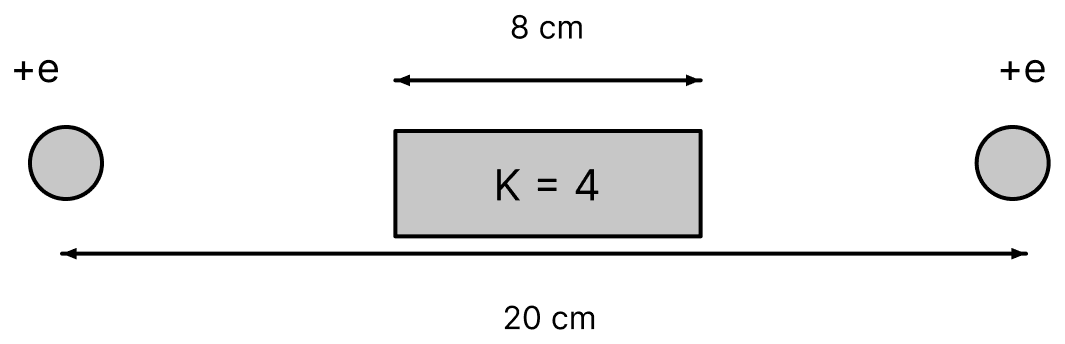
Two charges +e and +e are static at distance 20 cm apart. Space of 8 cm width is filled with dielectric K = 4, in rest of the part there is vacuum. Find the force between the two given charges.
Answer
Given,
Each charge = + e = 1.6 × 10⁻¹⁹ C
Separation, r = 20 cm = 0.20 m
Thickness of the dielectric slab, t = 8 cm = 0.08 m
Dielectric constant, K = 4
When the space between the charges is partly filled with a dielectric slab of thickness t and dielectric constant K, the slab is equivalent to an air distance tK. Hence the effective separation in air is
Hence, the force between the two charges is 2.94 × 10⁻²⁷ N.
Question 14
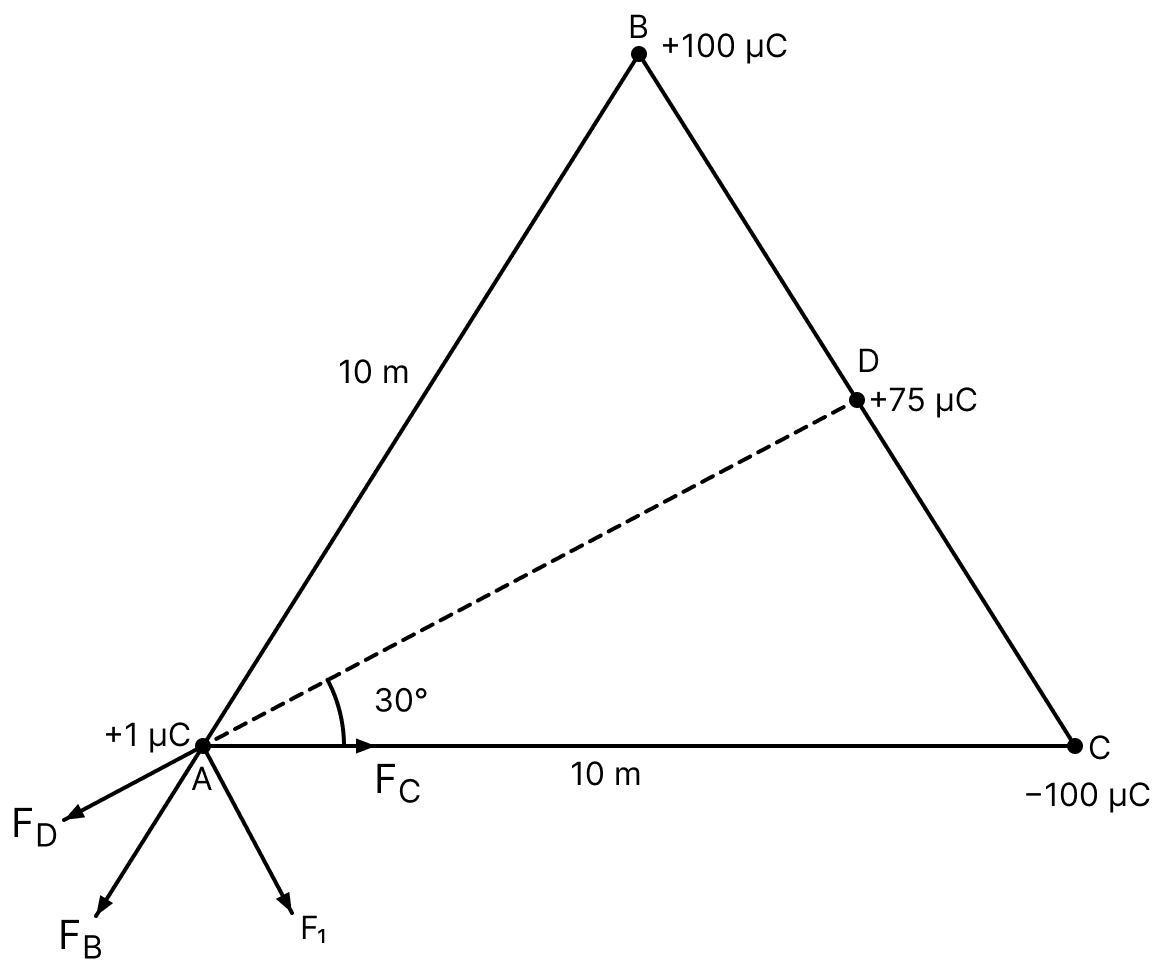
ABC is an equilateral triangle of side 10 m and D is the mid-point of BC. Charges of +100, −100 and +75 μC are placed at B, C and D respectively. Find the force on a +1 μC charge placed at A.
Answer
Given,
ABC is an equilateral triangle of side 10 m, D is the mid-point of BC
qB = + 100 μC, qC = − 100 μC, qD = + 75 μC
Test charge at A, q = + 1 μC
Distances : AB = AC = 10 m, and AD is the altitude of the equilateral triangle,
AD=23×10AD=53m(AD)2=75m2
Force due to the charge at B : It is a repulsion, directed along BA,
Resultant force at A : F1 and FD are equal in magnitude and mutually perpendicular,
F=F12+FD2F=2×9×10−3F=92×10−3N
and it makes an angle
tanθ=F1FDtanθ=1θ=45°
Hence, the force on the + 1 μC charge at A is 92×10−3 N, acting at 45° to a line parallel to BC.
Question 15
Two point-charges of 1.0 μC and −0.25 μC are placed in air at a distance of 0.40 m from each other. Find out at which point on the line joining the two charges should a third charge be placed so that no force acts upon it?
Answer
Given,
q1 = 1.0 μC, q2 = − 0.25 μC
Separation, r = 0.40 m
Since the two charges are of opposite signs, the point of zero force cannot lie between them. It must lie outside the two charges, on the side of the smaller charge q2.
Let the third charge be placed at a distance x from q2, so that its distance from q1 is (0.40 + x).
For no force to act on the third charge, the two forces on it must be equal in magnitude,
Hence, the third charge should be placed outside the second charge, at a distance of 0.40 m from the − 0.25 μC charge (that is, 0.80 m from the 1.0 μC charge).
Question 16
Two point-charges +9e and +e are placed at a distance of 16 cm from each other. At what point between these charges should a third charge q be placed so that it remains in equilibrium?
Answer
Given,
q1 = + 9e, q2 = + e
Separation, r = 16 cm
Both the charges are positive, so the third charge q can remain in equilibrium only at a point between them, where the two forces on it are oppositely directed.
Let q be placed at a distance x from the charge + 9e, so that its distance from + e is (16 − x) cm.
For the equilibrium of q,
4πε01x2(9e)q=4πε01(16−x)2(e)qx29=(16−x)21
Taking the square root of both sides,
x3=16−x13(16−x)=x48−3x=x4x=48x=12cm
Hence, the third charge should be placed at a distance of 12 cm from the charge + 9e (and 4 cm from the charge + e).
Question 17
Three point-charges q1, q2 and q3 are in line at equal distances. q2 and q3 are opposite in sign. Find the magnitude and sign of q1, if the net force on q3 is zero.
Answer
Given,
q1, q2 and q3 lie in a line at equal distances, say d apart
q2 and q3 are opposite in sign
Net force on q3 is zero
The distance of q3 from q2 is d and from q1 is 2d.
For the net force on q3 to be zero, the forces due to q1 and q2 must be equal in magnitude and opposite in direction,
Hence the magnitude of q1 is four times that of q2, and its sign is opposite to that of q2. Since q2 and q3 are opposite in sign, q1 has the same sign as q3.
Hence, q1 has a magnitude four times that of q2 and its sign is the same as that of q3.
Question 18
Two free particles with charges +q and +4q are at a distance L apart. A third charge is placed so that the entire system is in equilibrium. (a) Find the location, magnitude and nature of the third charge. (b) Show that the equilibrium is unstable.
Answer
Given,
Charges + q and + 4q, a distance L apart
(a) Location, magnitude and nature of the third charge :
The third charge Q must lie between the two charges, since only there can the two forces on it be oppositely directed. Let it be at a distance x from + q, so that its distance from + 4q is (L − x).
Thus Q is at a distance 3L from + q and 32L from + 4q.
For the entire system to be in equilibrium, the charge + q must also be in equilibrium. The forces on it are the repulsion due to + 4q at a distance L and the force due to Q at a distance 3L,
Hence, the third charge is −94q, that is, it is negative, and it is placed at a distance 3L from + q and 32L from + 4q.
(b) The equilibrium is unstable :
Suppose the negative charge Q is displaced slightly along the line towards + q. The distance from + q decreases and the distance from + 4q increases, so the attraction due to + q increases while that due to + 4q decreases. The net force on Q is then towards + q, that is, in the direction of the displacement itself, and Q moves still farther from its equilibrium position.
Since the net force does not bring the charge back to its original position, the equilibrium is unstable.
Question 19
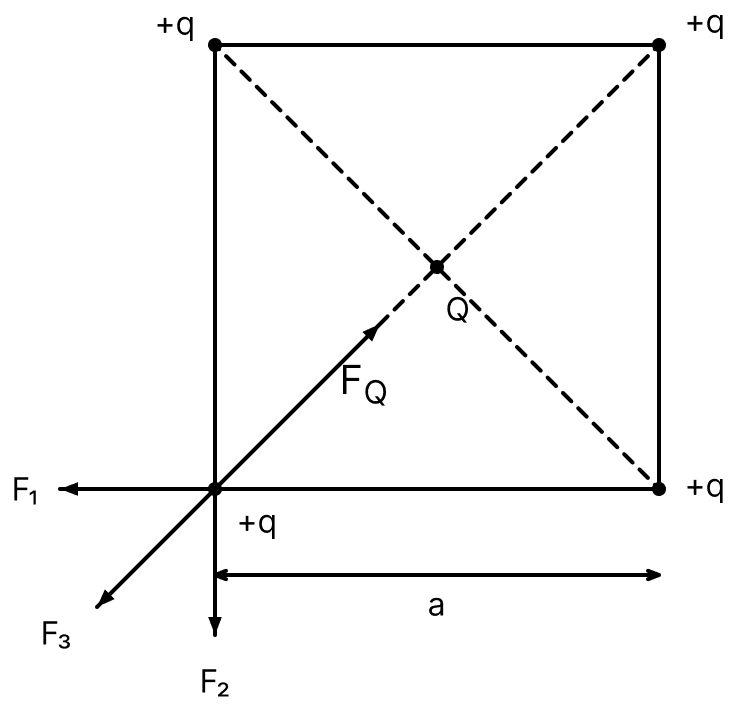
At each of the four corners of a square of side a, a charge +q is placed freely. What charge should be placed at the centre of the square so that the whole system be in equilibrium?
Answer
Given,
Four charges +q at the corners of a square of side a
A charge Q is to be placed at the centre
Consider the charge +q at the lower-left corner. The distances of the other charges from it are
a for the two adjacent corners,
a2 for the opposite corner,
2a for the centre of the square.
Forces due to the other three corner charges : Let k=4πε01.
The two adjacent charges exert repulsions F1 and F2, each of magnitude a2kq2, and their components along the diagonal are each a2kq2cos45∘. The charge at the opposite corner exerts a repulsion F3 = 2a2kq2 directly along the diagonal.
Hence the resultant outward force F along the diagonal is
F=2×a2kq2×21+2a2kq2F=a2kq2(2+21)
Force due to the charge at the centre : It acts along the diagonal, of magnitude
FQ=(2a)2kq∣Q∣FQ=a22kq∣Q∣
Condition of equilibrium : FQ must be directed inwards and must balance F,
Hence, the electric field intensity at P is 144(4j^+3k^) N C-1.
Question 22
Two point-charges q1 = + 0.2 C and q2 = + 0.4 C are 0.1 m apart. Find the electric field at (i) mid-point between the charges, (ii) a point on the line joining q1 and q2 such that it is 0.05 m away from q2 and 0.15 m away from q1.
Answer
Given,
q1 = + 0.2 C, q2 = + 0.4 C
Separation = 0.1 m
(i) At the mid-point : The mid-point is 0.05 m from each charge. Both the charges are positive, so their fields there are oppositely directed.
Hence, the field at the mid-point is 7.20 × 10¹¹ N C-1, directed towards q1.
(ii) At a point 0.15 m from q1 and 0.05 m from q2 : This point lies on the line joining the charges, beyond q2. Here both fields are directed away from the charges, that is, in the same direction.
Hence, the field at this point is 1.52 × 10¹² N C-1, directed away from q1 and q2 both.
Question 23
Electric charges ± 1000 μC are placed at points A and B, respectively at a distance of 2 m from each other. Calculate the electric fields at (i) mid-point of the line AB and (ii) at a point at equal distances of 4 m from each charge.
Answer
Given,
qA = + 1000 μC = 1 × 10⁻³ C at A, qB = − 1000 μC = − 1 × 10⁻³ C at B
AB = 2 m
(i) At the mid-point of AB : The mid-point is 1 m from each charge. The field due to the positive charge is directed away from A and that due to the negative charge is directed towards B, so both are along AB and they add up.
Hence, the field at the mid-point is 1.8 × 10⁷ N C-1, directed along AB.
(ii) At a point equidistant, 4 m, from each charge : Such a point lies on the right bisector of AB, that is, in the broad-side-on position of the dipole. Here r = 4 m and half the dipole length is l = 1 m.
Hence, the field at this point is 2.8 × 10⁵ N C-1, directed parallel to AB.
Question 24
A body having an excess of 106 electrons is placed in an electric field of 1000 NC-1 towards East. Find out the magnitude and direction of the force acting on the body.
Answer
Given,
Excess of electrons, n = 106
Charge on one electron, e = 1.6 × 10⁻¹⁹ C
Electric field, E = 1000 N C-1, directed towards East
Charge on the body : An excess of electrons means the body carries a negative charge,
q=−neq=−106×1.6×10−19q=−1.6×10⁻¹³C
Force on the body : Taking the direction of the field, towards East, as positive, E = + 1000 N C-1,
F=qEF=(−1.6×10⁻¹³)(+1000)F=−1.6×10⁻¹⁰N
The negative sign shows that the force on the body is directed opposite to the electric field.
Hence, the force is 1.6 × 10⁻¹⁰ N, directed towards West.
Question 25
A stationary oil drop between two parallel plates has a charge of 3.2 × 10⁻¹⁹ C and a weight of 1.6 × 10⁻¹⁴ N. Find the electric field acting on the drop.
Answer
Given,
Charge on the oil drop, q = 3.2 × 10⁻¹⁹ C
Weight of the drop, mg = 1.6 × 10⁻¹⁴ N
The drop is stationary between the plates, so the upward electric force on it must balance its weight,
qE=mgE=qmgE=3.2×10−191.6×10⁻¹⁴E=5.0×10⁴NC−1
Hence, the electric field acting on the drop is 5.0 × 10⁴ N C-1.
Question 26
A system has two charges qA = + 0.25 μC and qB = − 0.25 μC at points A (0, 0, −15 cm) and B (0, 0, +15 cm) respectively. Find the total charge and electric dipole moment of the system.
Answer
Given,
qA = + 0.25 μC = + 0.25 × 10⁻⁶ C at A (0, 0, −15 cm)
qB = − 0.25 μC = − 0.25 × 10⁻⁶ C at B (0, 0, +15 cm)
Total charge :
qA+qB=(+0.25μC)+(−0.25μC)qA+qB=0
Hence, the total charge of the system is zero.
Electric dipole moment : The two charges are equal and opposite, so they form an electric dipole. The separation between them is
The dipole moment is directed from the negative charge towards the positive charge, that is, from B (0, 0, + 15 cm) to A (0, 0, − 15 cm).
Hence, the total charge is zero and the electric dipole moment is 7.5 × 10⁻⁸ C-m, directed along the − Z axis.
Question 27
Two charges of +2.4 μC and −2.4 μC are at a distance 2.5 × 10⁻³ m apart from each other. Determine the magnitude of the electric field in the broad-side-on position at a distance of 0.30 m from this dipole. If the dipole be rotated through 90°, then what will be the intensity of the field?
Answer
Given,
Charges of the dipole, q = 2.4 μC = 2.4 × 10⁻⁶ C
Separation, 2l = 2.5 × 10⁻³ m
Distance of the point, r = 0.30 m
Electric dipole moment :
p=q×2lp=(2.4×10⁻⁶)(2.5×10⁻³)p=6.0×10⁻⁹C-m
Field in the broad-side-on position : Since r >> l, the dipole is a short dipole,
When the dipole is rotated through 90° : The given point, which was on the equatorial line, now lies on the axis of the dipole at the same distance r. Hence
Hence, the intensity is 2.0 × 10³ N C-1 before rotation and 4.0 × 10³ N C-1 after rotation.
Question 28
Two point-charges of +1 μC and −1 μC are kept at a distance of 2 cm. They form an electric dipole. This dipole is situated in a uniform electric field of 1 × 10⁵ N-C-1, with dipole moment vector p making an angle of 30° with the field. Calculate (i) the magnitude of electric dipole moment and (ii) the torque acting on the dipole. (iii) When would be the torque maximum? How much?
The torque τ = pE sin θ is maximum when sin θ = 1, that is, when θ = 90°, so that the dipole is normal to the field.
τmax=pEτmax=(2×10⁻⁸)(1×10⁵)τmax=2×10⁻³N-m
Hence, p = 2 × 10⁻⁸ C-m, τ = 1 × 10⁻³ N-m, and the torque is maximum, 2 × 10⁻³ N-m, when the dipole is normal to the field (θ = 90°).
Question 29
An electric dipole, when held at 30° with respect to a uniform electric field of 104 N/C, experiences a torque of 9 × 10-26 N-m. Calculate the moment of the dipole.
Answer
Given,
Angle between the dipole and the field, θ = 30°
Electric field, E = 104 N C-1
Torque, τ = 9 × 10-26 N-m
The torque acting on an electric dipole placed in a uniform electric field is
Hence, the moment of the dipole is 1.8 × 10⁻²⁹ C-m.
Question 30
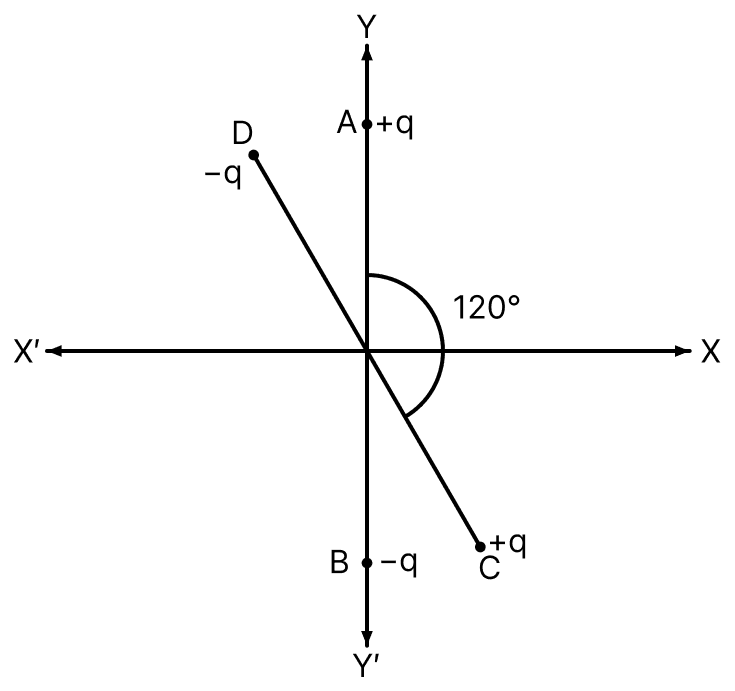
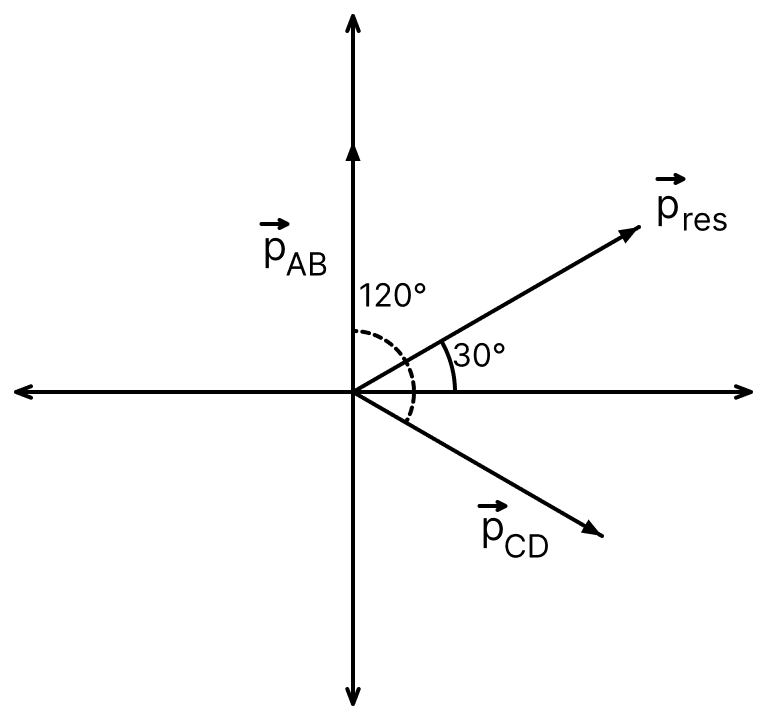
Two small identical electrical dipoles AB and CD, each of dipole moment 'p' are kept at an angle of 120° as shown in the figure. What is the resultant dipole moment of this combination? If this system is subjected to electric field (E) directed along +X direction, what will be the magnitude and direction of the torque acting on this?
Answer
Given,
Two identical dipoles AB and CD, each of dipole moment p
Angle between them, 2α = 120°
Uniform electric field Edirected along + X
Resultant dipole moment : The two dipole moments are equal in magnitude and are inclined at 120° to each other. Their resultant is
Since the two dipole moments are equal, the resultant bisects the angle between them. Using the stated angle of 120°, pAB (from B to A) lies along + Y and pCD (from D to C) lies at 30° below + X, as in the vector diagram above, which is drawn to this stated angle. Hence the bisector makes an angle of 30° with the + X axis, measured in the anticlockwise direction.
Torque acting on the combination : The angle between pres and Eis θ = 30°,
τ=presEsinθτ=pEsin30°τ=21pE
The torque τ=pres×Eis perpendicular to the plane of the figure. Since pres lies in the XY plane above the X-axis and Eis along + X, the torque is directed along the negative Z-direction.
Hence, the resultant dipole moment is p, at an angle of 30° with the + X axis in the anticlockwise direction, and the torque is 21pE along the negative Z-direction.
Note: The textbook's sketch is schematic — its line CD is drawn steeper than the marked 120° — so the working uses the stated angle of 120°.