
When the light of frequency 2ν0 (where ν0 is threshold frequency), is incident on a metal plate, the maximum velocity of electrons emitted is v1. When the frequency of the incident radiation is increased to 5ν0, the maximum velocity of electrons emitted from the same plate is v2. The ratio of v1 to v2 is :
- 1 : 2
- 3 : 1
- 4 : 1
- 1 : 4
Answer
1 : 2
Reason — By Einstein's photoelectric equation, .
Dividing Eq. (i) by Eq. (ii),
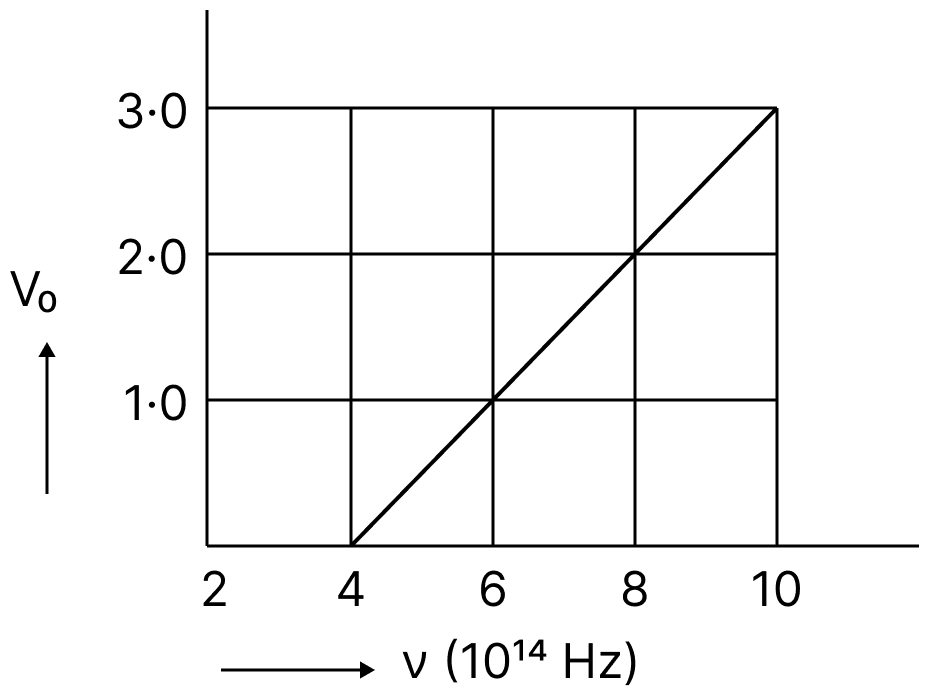
The stopping potential V0 (in volt) as a function of frequency (ν) for a sodium emitter, is shown in the figure. The work function of sodium, from the data plotted in the figure, will be :
(Given : Planck's constant (h) = 6.63 × 10⁻³⁴ Js, electron charge e = 1.6 × 10⁻¹⁹ C)
- 1.95 eV
- 2.12 eV
- 1.82 eV
- 1.66 eV
Answer
1.66 eV
Reason — From the figure, the line meets the frequency axis (V0 = 0) at ν0 = 4 × 10¹⁴ Hz, the threshold frequency. Hence,
Surface of certain metal is first illuminated with light of wavelength λ1 = 350 nm and then, by light of wavelength λ2 = 540 nm. It is found that the maximum speed of the photoelectrons in the two cases differ by a factor of 2. The work function of the metal (in eV) is close to :
- 1.8
- 1.4
- 2.5
- 5.6
Answer
1.8
Reason — The longer wavelength λ2 gives the smaller speed. Let it be v, so the speed for λ1 is 2v. By Einstein's equation,
Dividing,
In a photoelectric experiment, the wavelength of the light incident on a metal is changed from 300 nm to 400 nm. The decrease in the stopping potential is close to :
- 0.5 V
- 1.0 V
- 2.0 V
- 1.5 V
Answer
1.0 V
Reason — For the two wavelengths, and . Subtracting,
In a photoelectric effect experiment, the threshold wavelength of light is 380 nm. If the wavelength of incident light is 260 nm, the maximum kinetic energy of emitted electrons will be :
- 3.0 eV
- 1.5 eV
- 4.5 eV
- 15.1 eV
Answer
1.5 eV
Reason — The work function is eV and the photon energy is eV. Hence,
Light is incident normally on a completely absorbing surface with an energy flux of 25 W cm-2. If the surface has an area of 25 cm2, the momentum transferred to the surface in 40 minute time duration will be :
- 6.3 × 10⁻⁴ Ns
- 5.0 × 10⁻³ Ns
- 1.4 × 10⁻⁶ Ns
- 3.5 × 10⁻⁶ Ns
Answer
5.0 × 10⁻³ Ns
Reason — For complete absorption, the force on the surface is . With I = 25 × 104 W m-2, A = 25 × 10-4 m2 and Δt = 40 × 60 s,
50 W/m2 energy density of sunlight is normally incident on the surface of a solar panel. Some part of incident energy (25%) is reflected from the surface and the rest is absorbed. The force exerted on 1 m2 surface area will be close to (c = 3 × 10⁸ m/s) :
- 15 × 10-8 N
- 35 × 10-8 N
- 10 × 10-8 N
- 20 × 10-8 N
Answer
20 × 10-8 N
Reason — The reflected 25% transfers momentum per unit area per second and the absorbed 75% transfers . With I = 50 W m-2 and A = 1 m2,
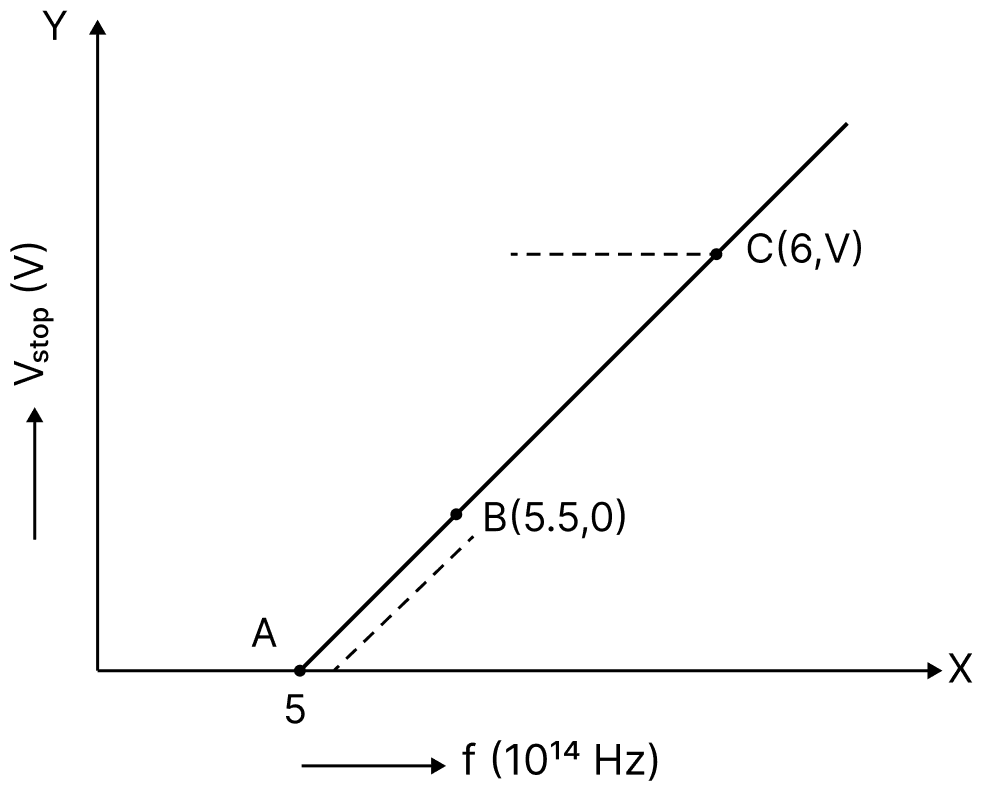
Given figure shows few data points in a photoelectric effect experiment for a certain metal. The minimum energy for ejection of electron from its surface is : (Planck's constant h = 6.62 × 10⁻³⁴ Js)
- 2.59 eV
- 2.27 eV
- 1.93 eV
- 2.10 eV
Answer
2.27 eV
Reason — From , the frequency at which Vstop = 0 is the threshold frequency. The data point B(5.5, 0) gives f0 = 5.5 × 10¹⁴ Hz. The minimum energy for ejection is the work function,
This is closest to 2.27 eV.
Note: In the printed figure the line is drawn through A (5 × 10¹⁴ Hz) on the frequency axis, which conflicts with the labelled data point B(5.5, 0). The answer key and options correspond to B, so f0 = 5.5 × 10¹⁴ Hz is used.
Two sources of light emit X-rays of wavelength 1 nm and visible light of wavelength 500 nm, respectively. Both the sources emit light of the same power 200 W. The ratio of the number density of photons of X-rays to the number density of photons of the visible light of the given wavelengths is :
- 500
- 250
Answer
Reason — For a source of power P, the number of photons emitted per second is . Both beams travel at speed c, so the number density of photons is proportional to N. With equal powers,
The number of photons per second on an average emitted by the source of monochromatic light of wavelength 600 nm, when it delivers the power of 3.3 × 10⁻³ watt will be (h = 6.6 × 10⁻³⁴ Js) :
- 1015
- 1018
- 1017
- 1016
Answer
1016
Reason — If n photons are emitted per second, . Hence,
A monochromatic neon lamp with wavelength of 670.5 nm illuminates a photo-sensitive material which has a stopping voltage of 0.48 V. What will be the stopping voltage if the source light is changed with another source of wavelength of 474.6 nm?
- 0.96 V
- 1.25 V
- 0.24 V
- 1.5 V
Answer
1.25 V
Reason — For the two sources, and . Subtracting,
When radiation of wavelength λ is incident on a metallic surface, the stopping potential of ejected photoelectrons is 4.8 V. If the same surface is illuminated by radiation of double the previous wavelength, then the stopping potential becomes 1.6 V. The threshold wavelength of the metal is :
- 2λ
- 4λ
- 8λ
- 6λ
Answer
4λ
Reason — By Einstein's equation, .
Dividing Eq. (i) by Eq. (ii),
When light of a given wavelength is incident on a metallic surface, the minimum potential needed to stop the emitted photoelectrons is 6.0 V. This potential drops to 0.6 V if another source with wavelength four times that of the first one and intensity half of the first one is used. What are the wavelength of the first source and the work function of the metal, respectively?
[Take = 1.24 × 10⁻⁶ J m C-1]
- 1.72 × 10⁻⁷ m, 1.20 eV
- 1.72 × 10⁻⁷ m, 5.60 eV
- 3.78 × 10⁻⁷ m, 5.60 eV
- 3.78 × 10⁻⁷ m, 1.20 eV
Answer
1.72 × 10⁻⁷ m, 1.20 eV
Reason — The stopping potential does not depend on intensity, so the change of intensity can be ignored. By Einstein's equation,
Dividing Eq. (i) by Eq. (ii),
From Eq. (i), = 1.2 + 6 = 7.2 V, so
Given below are two statements :
Statement I: Stopping potential in photoelectric effect does not depend on the power of the light source.
Statement II: For a given metal, the maximum kinetic energy of the photoelectron depends on the wavelength of the incident light.
In the light of the above statements, choose the most appropriate answer from the options given below :
- Both Statement I and Statement II are incorrect.
- Statement I is correct but Statement II is incorrect.
- Both Statement I and Statement II are correct.
- Statement I is incorrect but Statement II is correct.
Answer
Both Statement I and Statement II are correct.
Reason — The stopping potential is . It depends only on the wavelength (frequency) of the light and the work function, not on the power or intensity of the source, so Statement I is correct. For a given metal, depends on λ, so Statement II is also correct.
The threshold wavelength for photoelectric emission from a material is 5500 Å. Photoelectrons will be emitted, when this material is illuminated with monochromatic radiation from a :
- 75 W infra-red lamp
- 10 W infra-red lamp
- 75 W ultra-violet lamp
- 10 W ultra-violet lamp
Answer
75 W ultra-violet lamp
10 W ultra-violet lamp
Reason — Photoelectrons are emitted only if the wavelength of the incident radiation is less than the threshold wavelength 5500 Å (550 nm). Infra-red light has wavelengths longer than about 780 nm, so neither infra-red lamp can cause emission, whatever its power. Ultra-violet light has wavelengths shorter than 400 nm, so both ultra-violet lamps emit photoelectrons; the power of the lamp affects only the number of photoelectrons.
Note: The textbook key prints only option (c). Since emission depends on wavelength and not on power, option (d), the 10 W ultra-violet lamp, is equally correct, as the textbook's own hint also states.
If a source of electromagnetic radiation having power 15 kW produces 1016 photons per second, the radiation belongs to a part of spectrum is :
(Take Planck constant, h = 6 × 10-34 Js)
- Microwaves
- Gamma rays
- Radio wave
- Ultraviolet rays
Answer
Gamma rays
Reason — Power P = , where n is the number of photons per second. Hence,
A wavelength of about 10-13 m lies in the range of gamma rays.
The work functions of caesium (Cs), potassium (K) and sodium (Na) are 2.14 eV, 2.30 eV and 2.75 eV respectively. If incident electromagnetic radiation has an incident energy of 2.20 eV, which of these photosensitive surface may emit photoelectrons?
- K only
- Na only
- Cs only
- Both Na and K
Answer
Cs only
Reason — Photoelectrons are emitted only when the energy of the incident photon is greater than the work function of the surface. Since 2.20 eV exceeds only WCs = 2.14 eV (and is less than WK = 2.30 eV and WNa = 2.75 eV), only caesium emits photoelectrons.
An object is placed in a medium of refractive index 3. An electromagnetic wave of intensity 6 × 10⁸ W/m2 falls normally on the object and it is absorbed completely. The radiation pressure on the object would be (speed of light in free space = 3 × 10⁸ m/s) :
- 36 Nm-2
- 18 Nm-2
- 6 Nm-2
- 2 Nm-2
Answer
6 Nm-2
Reason — In a medium of refractive index n, the wave travels with speed . For complete absorption, the radiation pressure is
In a photoelectric effect experiment, a light of frequency 1.5 times the threshold frequency is made to fall on the surface of photosensitive material. Now if the frequency is halved and intensity is doubled, the number of photo electrons emitted will be :
- doubled
- quadrupled
- zero
- halved
Answer
zero
Reason — When the frequency is halved, the new frequency is = 0.75ν0, which is less than the threshold frequency. No photoelectrons are emitted, whatever be the intensity, so doubling the intensity has no effect.
Given below are two statements :
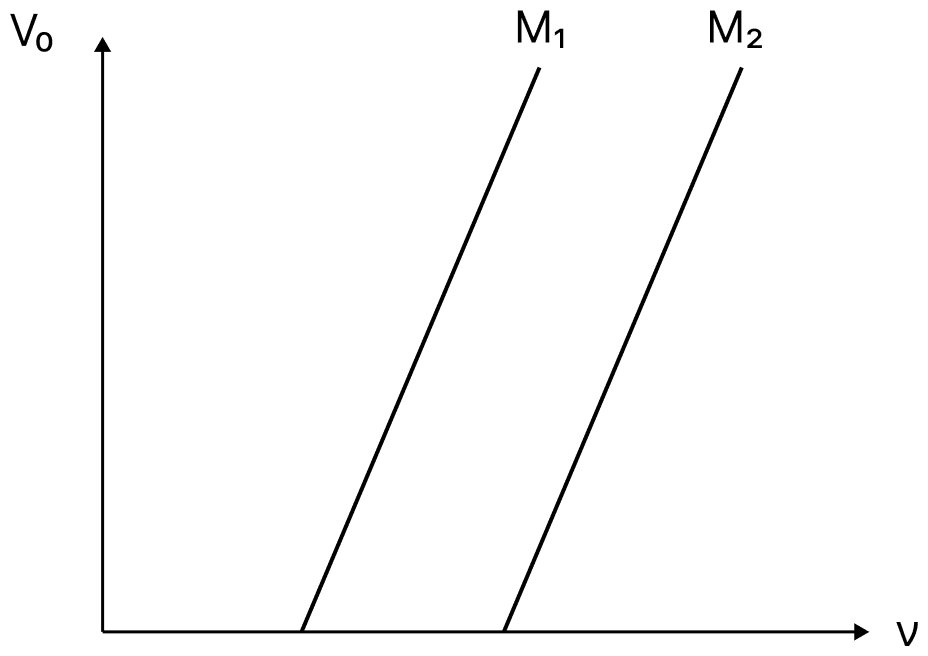
Statement-I: Figure shows the variation of stopping potential with frequency (ν) for the two photosensitive materials M1 and M2. The slope gives value of , where h is Planck's constant, e is the charge of electron.
Statement-II: M2 will emit photoelectrons of greater kinetic energy for the incident radiation having same frequency.
In the light of the above statements, choose the most appropriate answer from the options given below.
- Statement-I is correct and Statement-II is incorrect.
- Statement-I is incorrect but Statement-II is correct.
- Both Statement-I and Statement-II are incorrect.
- Both Statement-I and Statement-II are correct.
Answer
Statement-I is correct and Statement-II is incorrect.
Reason — From eV0 = hν − φ, , so the slope of each line is and Statement-I is correct. M2 has the higher threshold frequency and hence the greater work function, so for the same frequency its photoelectrons have smaller kinetic energy (Kmax = hν − φ). Statement-II is incorrect.
If c is the velocity of light in free space, the correct statements about photon among the following are :
A. The energy of a photon is E = hν.
B. The velocity of a photon is c.
C. The momentum of a photon, .
D. In a photon-electron collision, both total energy and total momentum are conserved.
E. Photon possesses positive charge.
Choose the correct answer from the given options:
- A and B
- A, B, C and D
- A, C and D
- A, B, D and E
Answer
A, B, C and D
Reason — A photon has energy E = hν, travels with speed c in free space and has momentum . In a photon-electron collision, total energy and total momentum are conserved. So A, B, C and D are correct. A photon is electrically neutral, so E is incorrect.
The surface of a metal is illuminated alternately with photons of energies E1 = 4 eV and E2 = 2.5 eV, respectively. The ratio of maximum speeds of the photoelectrons emitted in the two cases is 2. The work function of the metal in (eV) is ............... .
Answer
Given,
- E1 = 4 eV, E2 = 2.5 eV
- = 2
Let φ be the work function. By Einstein's photoelectric equation,
Dividing Eq. (i) by Eq. (ii),
Hence, the work function of the metal is 2 eV.
When radiation of wavelength λ is used to illuminate a metallic surface, the stopping potential is V. When the same surface is illuminated with radiation of wavelength 3λ, the stopping potential is . If the threshold wavelength for the metallic surface is nλ then value of n will be ............... .
Answer
Given,
- Wavelength λ gives stopping potential V
- Wavelength 3λ gives stopping potential
- Threshold wavelength = nλ
By Einstein's photoelectric equation,
Multiplying Eq. (ii) by 4 and equating with Eq. (i),
Since ,
Hence, n = 9.
Two streams of photons, possessing energies equal to twice and ten times the work function of material are incident on the metal surface successively. The value of ratio of maximum velocities of the photoelectrons emitted in the two respective cases is X : Y. The value of X is ............... .
Answer
Given,
- Energy of first stream, E1 = 2φ0
- Energy of second stream, E2 = 10φ0
By Einstein's photoelectric equation,
Dividing Eq. (i) by Eq. (ii),
Hence, the value of X is 1.
In a photo-emission experiment, the maximum kinetic energies of photoelectrons from metals P, Q and R are EP, EQ and ER, respectively and they are related by EP = 2EQ = 2ER. In this experiment, the same source of monochromatic light is used for metals P and Q while a different source of monochromatic light is used for the metal R. The work functions for metals P, Q and R are 4.0 eV, 4.5 eV and 5.5 eV, respectively. The energy of the incident photon used for metal R, in eV, is ............... .
Answer
Given,
- Work functions : φP = 4.0 eV, φQ = 4.5 eV, φR = 5.5 eV
- EP = 2EQ = 2ER
- The same photon energy E1 is used for P and Q
By Einstein's photoelectric equation,
Subtracting Eq. (ii) from Eq. (i),
Since ER = EQ, ER = 0.5 eV. The energy of the photon used for R is
Hence, the energy of the incident photon used for metal R is 6 eV.
A light beam of wavelength 500 nm is incident on a metal having work function of 1.25 eV, placed in a magnetic field of intensity B. The electrons emitted perpendicular to the magnetic field B, with maximum kinetic energy are bent into circular arc of radius 30 cm. The value of B is ............... × 10-7 T.
(Take, hc = 20 × 10-26 J-m, mass of electron = 9 × 10-31 kg)
Answer
Given,
- Wavelength, λ = 500 nm = 500 × 10-9 m
- Work function, φ0 = 1.25 eV
- Radius of arc, r = 30 cm = 30 × 10-2 m
- hc = 20 × 10-26 J m, m = 9 × 10-31 kg, e = 1.6 × 10⁻¹⁹ C
By Einstein's photoelectric equation, the maximum kinetic energy is
The momentum of the electron is
For circular motion in the magnetic field, . Hence,
Hence, the required value is 125.
If 2.5 × 10⁻⁶ N average force is exerted by a light wave on a non-reflecting surface of 30 cm2 area during 40 min of time span, the energy flux of light just before it falls on the surface is ............... W/cm2.
(Round off to the nearest integer. Assume complete absorption and normal incidence conditions are there.)
Answer
Given,
- Average force, F = 2.5 × 10⁻⁶ N
- Area, A = 30 cm2
- Time, t = 40 min
- c = 3 × 10⁸ m s-1
For complete absorption and normal incidence, the force is , where I is the energy flux. Hence,
The force does not depend on the time span, so the 40 min is not needed.
Hence, the energy flux of light is 25 W/cm2.
Photon of 3.2 eV and 1.4 eV are bombarded on metal with work function 0.8 eV. If the ratio of maximum velocities of ejected electrons are n : 1, then the value of n will be ............... .
Answer
Given,
- Photon energies, E1 = 3.2 eV, E2 = 1.4 eV
- Work function, φ = 0.8 eV
By Einstein's photoelectric equation, Kmax = E − φ.
Since ,
Hence, n = 2.
A hydrogen-like atom has atomic number Z. Photons emitted in the electronic transitions from level n = 4 to level n = 3 in these atoms are used to perform photoelectric effect experiment on a target metal. The maximum kinetic energy of the photoelectrons generated is 1.95 eV. If the photoelectric threshold wavelength for the target metal is 310 nm, the value of Z is ............... .
[Given hc = 1240 eV-nm and Rhc = 13.6 eV, where R is the Rydberg constant, h is the Planck's constant and c is the speed of light in vacuum]
Answer
Given,
- Transition : n = 4 to n = 3 in a hydrogen-like atom of atomic number Z
- Maximum kinetic energy, Kmax = 1.95 eV
- Threshold wavelength, λ0 = 310 nm
- hc = 1240 eV nm, Rhc = 13.6 eV
The work function of the target metal is
By Einstein's photoelectric equation, the energy of the photon is
For the transition from n = 4 to n = 3,
Hence, the value of Z is 3.