
A rectangular frame of area 10 m2 is placed in a uniform electric field of 20 N-C-1, with normal drawn on the surface of the frame making 60° angle with the direction of field. The electric flux through the frame is :
- 100 Vm
- 200 Vm
- Vm
- Vm
Answer
100 Vm
Reason —
Given,
- Area of the frame, A = 10 m2
- Electric field, E = 20 N-C-1
- Angle between the normal to the frame and the field, θ = 60°
The electric flux through a plane surface placed in a uniform electric field is
Substituting the values,
A closed surface has n electric dipoles located inside it. The net electric flux emerging through the surface is :
- zero
Answer
zero
Reason —
Given,
- Number of electric dipoles located inside the closed surface = n
An electric dipole consists of two equal and opposite point-charges, + q and − q. The net charge of one dipole is therefore
For n such dipoles lying inside the closed surface, the algebraic sum of all the charges enclosed is again zero.
By Gauss' theorem, the electric flux through a closed surface is times the net charge enclosed by it,
Hence the net electric flux emerging through the surface is zero.
The nucleus of hydrogen atom is a sphere of radius 10-15 m. The electric field at the surface of the nucleus is :
- 14.4 × 10⁴ Vm-1
- 14.4 × 10¹⁰ Vm-1
- 14.4 × 10¹⁹ Vm-1
- 14.4 × 10²⁰ Vm-1
Answer
14.4 × 10²⁰ Vm-1
Reason —
Given,
- Radius of the nucleus of hydrogen atom, R = 10-15 m
- Charge on the nucleus (a single proton), q = 1.6 × 10⁻¹⁹ C
- = 9.0 × 10⁹ N-m2/C2
The nucleus is a uniformly charged sphere, so for a point on its surface the entire charge behaves as if concentrated at its centre,
Substituting the values,
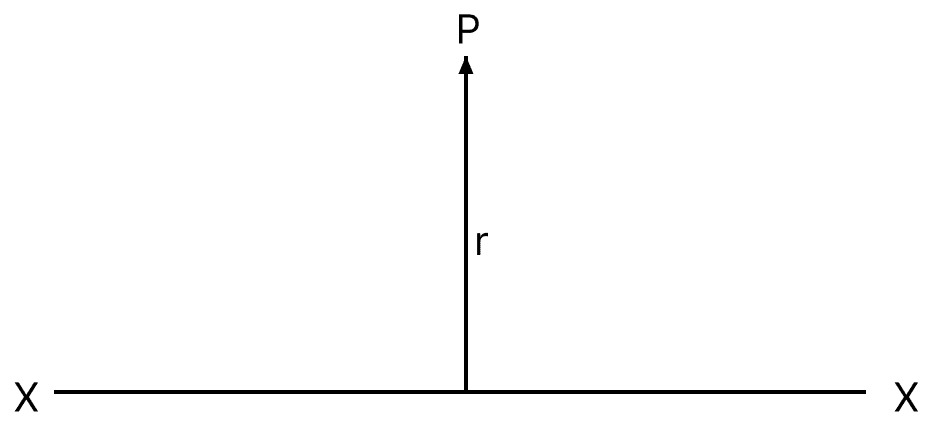
Electric field intensity E at a point P (see figure) at a perpendicular distance r from an infinitely long linear charge X-X having linear charge density λ is given by :
Answer
Reason —
Given,
- Linear charge density of the infinitely long linear charge X-X = λ
- Perpendicular distance of the point P from the linear charge = r
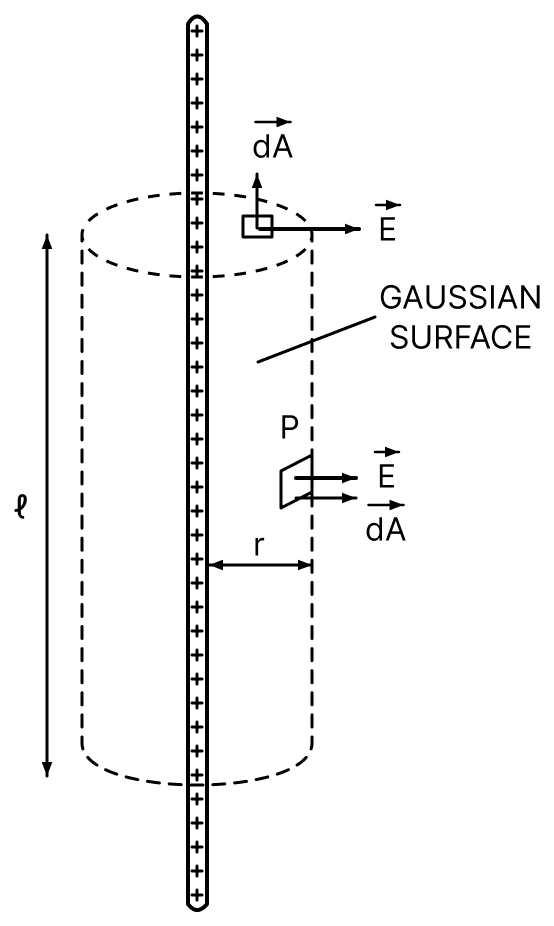
For the infinitely long linear charge, a coaxial cylindrical Gaussian surface of length l and radius r is drawn through the point P. The flux through the plane ends is zero, and over the curved surface E is constant and normal to the surface, so
The charge enclosed by this Gaussian surface is q = λl. Applying Gauss' theorem,
Writing ,
Thus the intensity is inversely proportional to the distance r from the linear charge, and not to r2.
Two parallel large thin metal sheets have equal surface charge densities 26.4 × 10⁻¹² C/m2 of opposite signs. The electric field between these sheets is :
- 1.5 N/C
- 1.5 × 10⁻⁶ N/C
- 3 × 10⁻¹⁰ N/C
- 3 N/C
Answer
3 N/C
Reason —
Given,
- Surface charge density of each sheet, σ = 26.4 × 10⁻¹² C/m2, of opposite signs
- ε0 = 8.85 × 10⁻¹² C2/N-m2
For two parallel sheets carrying equal and opposite charge densities, the intensities due to the two sheets are in the same direction at a point between them. Hence
Substituting the values,
The electric flux through the surface :
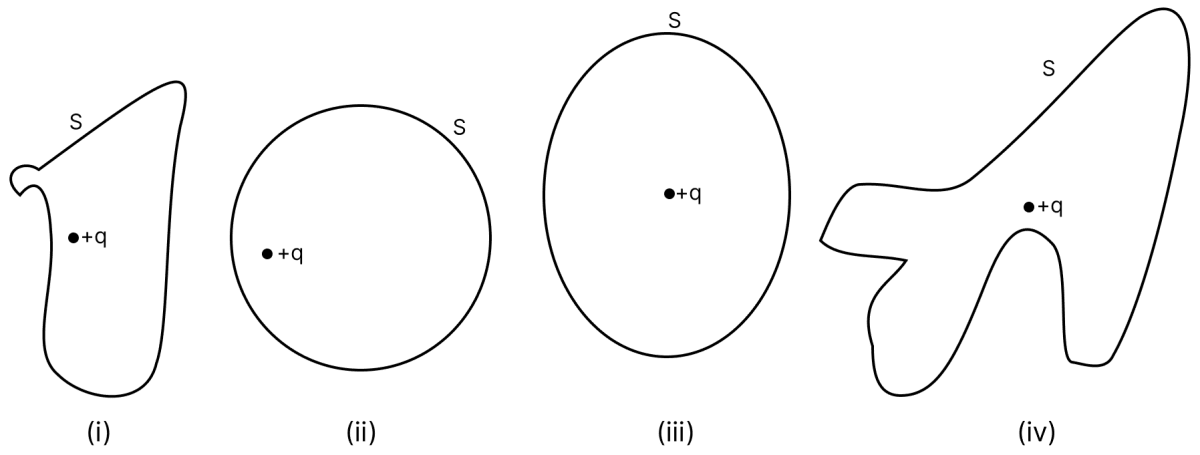
- in fig. (iv) is the largest
- in fig. (iii) is the least
- in fig. (ii) is same as fig. (iii) but is smaller than fig. (iv)
- is the same for all the figures
Answer
is the same for all the figures
Reason —
In each of the four figures the same charge + q lies inside the closed surface S, only the shape of the surface being different.
By Gauss' theorem,
Gauss' theorem is valid for a closed surface no matter what its shape or size, and the flux passing through it depends only upon the net charge enclosed. It does not depend upon the shape of the surface or on the position of the charge inside it. Hence the electric flux is the same for all four figures.
Five charges q1, q2, q3, q4 and q5 are fixed at their positions as shown in figure. S is a Gaussian surface. The Gauss' law is given by
Which of the following statements is correct?
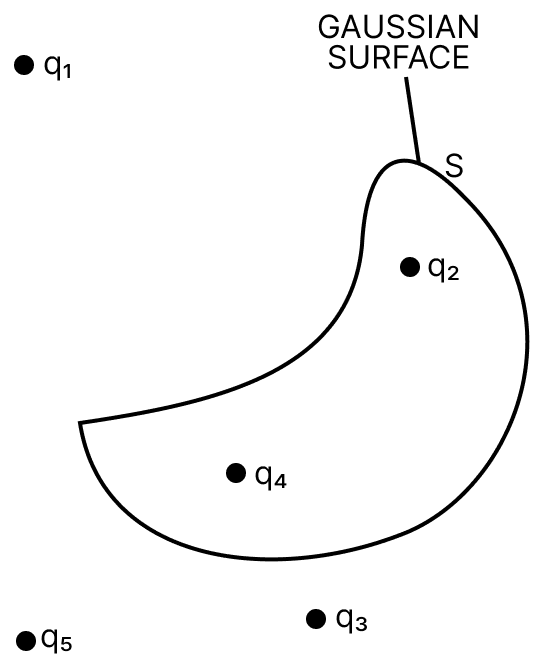
- E on the LHS of the above equation will have a contribution from q1, q5 and q3 while q on the RHS will have a contribution from q2 and q4 only.
- E on the LHS of the above equation will have a contribution from all charges while q on the RHS will have a contribution from q2 and q4 only.
- E on the LHS of the earlier equation will have a contribution from all charges while q on the RHS will have a contribution from q1, q3 and q5 only.
- Both E on the LHS and q on the RHS will have contributions from q2 and q4 only.
Answer
E on the LHS of the above equation will have a contribution from all charges while q on the RHS will have a contribution from q2 and q4 only.
Reason —
on S is the resultant field of all five charges. Only q2 and q4 lie inside S, so q = q2 + q4 on the right-hand side of Gauss' law.
If over a surface, then :
- the electric field inside the surface and on it is zero
- the electric field inside the surface is necessarily uniform
- the number of flux lines entering the surface must be equal to the number of flux lines leaving it
- none of the above
Answer
the number of flux lines entering the surface must be equal to the number of flux lines leaving it
Reason — The electric flux is a measure of the number of lines of force passing through a surface. It is positive for the lines of force leaving the surface and negative for those entering the surface.
If
then the positive and the negative contributions cancel exactly, which means that the number of flux lines entering the surface is equal to the number of flux lines leaving it.
Refer to the arrangement of charges in figure and a Gaussian surface of radius R with Q at the centre. Then :
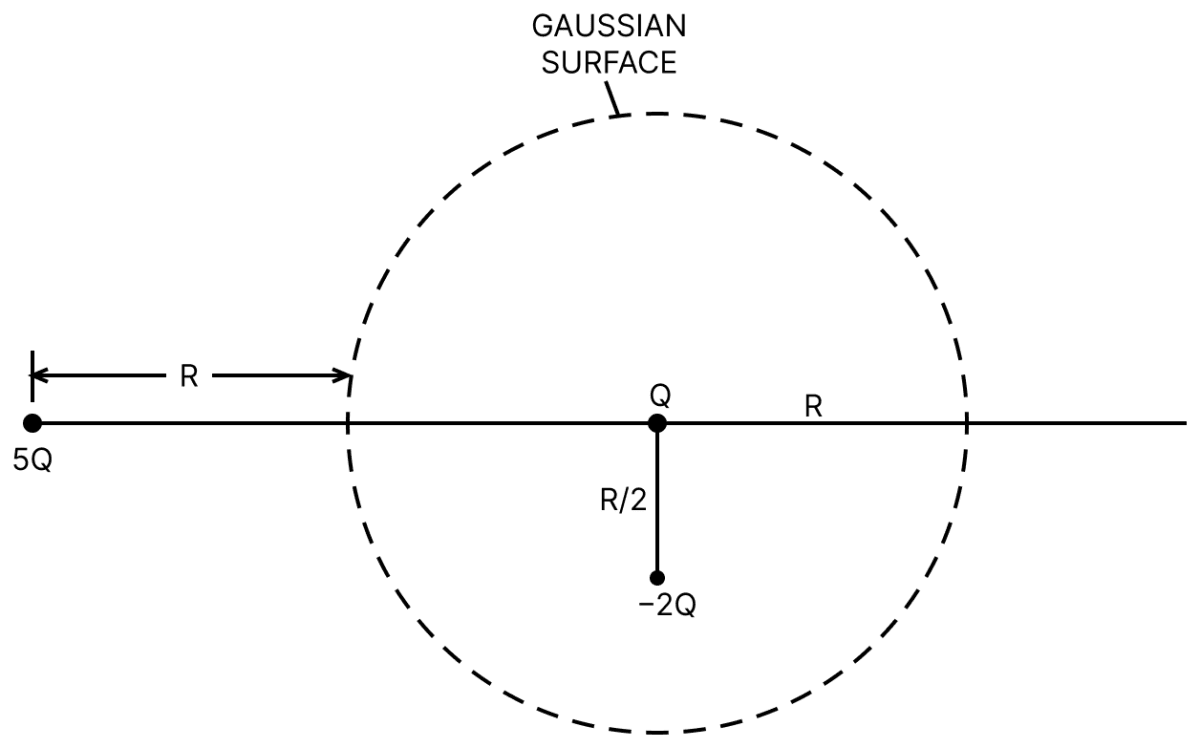
- total flux through the surface of the sphere is
- field on the surface of the sphere is
- flux through the surface of sphere due to 5Q is non-zero
- field on the surface of sphere due to −2Q is same everywhere
Answer
total flux through the surface of the sphere is
Reason —
Given,
- Radius of the Gaussian surface = R
- Charges inside the surface : Q (at the centre) and − 2Q (at a distance from the centre)
- Charge outside the surface : 5Q (at a distance 2R from the centre)
The net charge enclosed is
By Gauss' theorem,
A charge Q is situated at the corner A of a cube, the electric flux through the cube is :
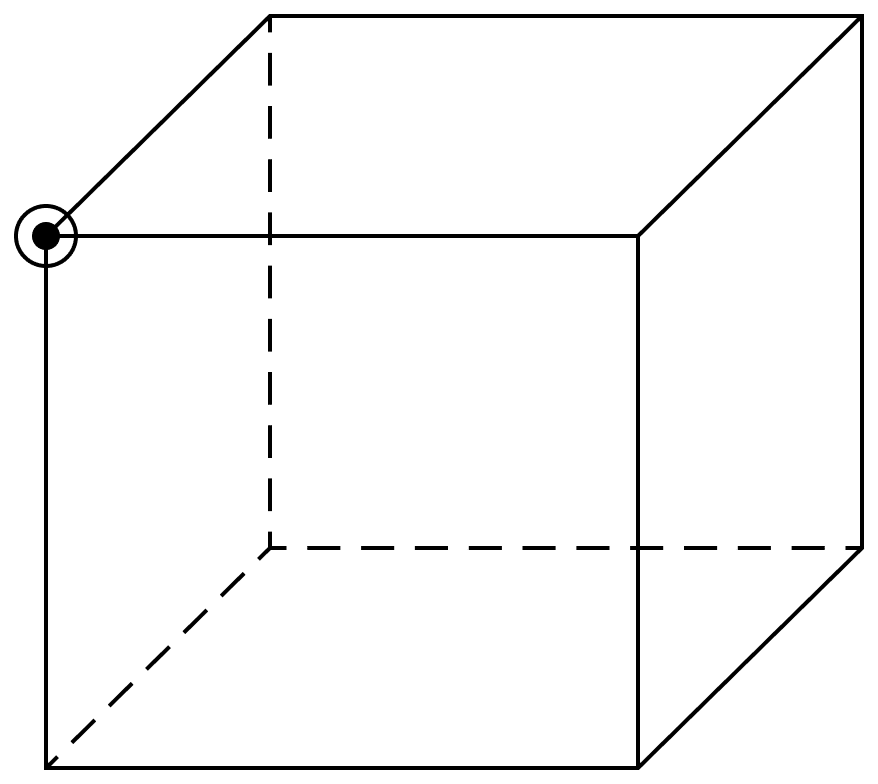
Answer
Reason —
Given,
- Charge Q situated at the corner A of the cube
A charge placed at a corner of a cube is shared by eight such cubes meeting at that corner. To enclose the charge Q completely, eight identical cubes have to be placed around the corner A, so that the charge lies at the centre of the large cube so formed.
By Gauss' theorem, the total flux through this complete closed arrangement is . By symmetry this flux is shared equally by the eight cubes. Hence the flux through the given cube is
A body is in the form of a right circular cone of dielectric material with base radius R and height h is placed with its base on a horizontal table. A horizontal electric field E penetrates the cone. The electric flux that enters the body is :
- ERh
- zero
Answer
ERh
Reason —
Given,
- Base radius of the cone = R, height of the cone = h
- The cone stands with its base on a horizontal table, so its axis is vertical
- The electric field E is horizontal and hence parallel to the base
The cone together with its base forms a closed surface enclosing no charge, so the total flux through it is zero. As the base is horizontal and E is horizontal, the flux through the base is zero. Hence the flux entering the curved surface is equal in magnitude to the flux leaving it.
The flux entering the body is
Viewed along the direction of the field, the cone projects as a triangle of base 2R and height h. Therefore
Note: The printed key selects option 2, . The projected area is Rh, so the correct answer is option 3, ERh.
Situation is shown in figure, find the flux linked with the surfaces A, B, C ?
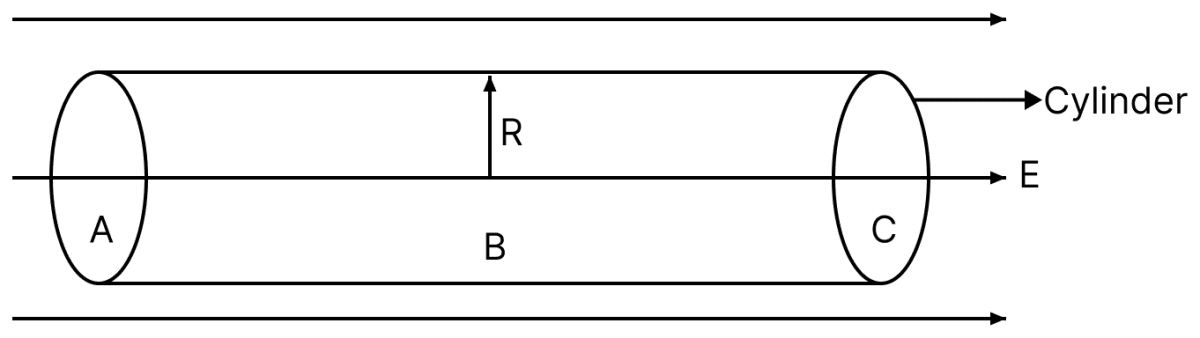
- φA = − EπR2, φB = 0, φC = EπR2
- φA = EπR2, φB = − EπR2, φC = 0
- φA = − EπR2, φB = EπR2, φC = − EπR2
- None of the above
Answer
φA = − EπR2, φB = 0, φC = EπR2
Reason —
Given,
- Radius of the cylinder = R, its axis parallel to the uniform electric field E
- A : left plane face, B : curved surface, C : right plane face
The area of each plane face is πR2.
Surface A : The outward drawn normal points opposite to , so θ = 180°,
Surface B : For every area element of the curved surface the outward drawn normal is at right angles to , so θ = 90°,
Surface C : The outward drawn normal is along , so θ = 0,
The total flux through the closed cylinder is + + = 0, as it should be, since no charge is enclosed.
Find the electric flux through the surface of the hemisphere :
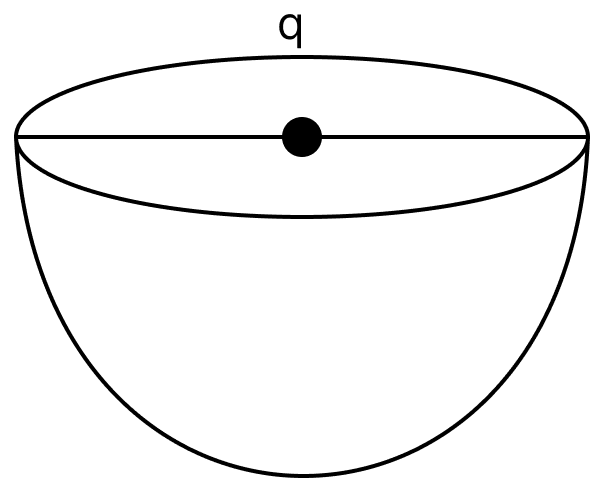
Answer
Reason —
Given,
- Point-charge q at the centre of the circular rim of the hemisphere (from the figure)
This point is the centre of the sphere of which this hemisphere is one half.
The solid angle subtended by a complete closed surface at a point inside it is 4π steradian, and the total flux from the charge is . The hemispherical surface subtends half of this solid angle, that is 2π steradian, at the charge.
Hence the flux through the hemispherical surface is half of the total flux,
A hollow cylinder has a charge q coulomb within it. If φ is the electric flux in unit of volt-meter associated with the curved surface 'B', the flux linked with the plane surface 'A' in unit of volt-meter will be :
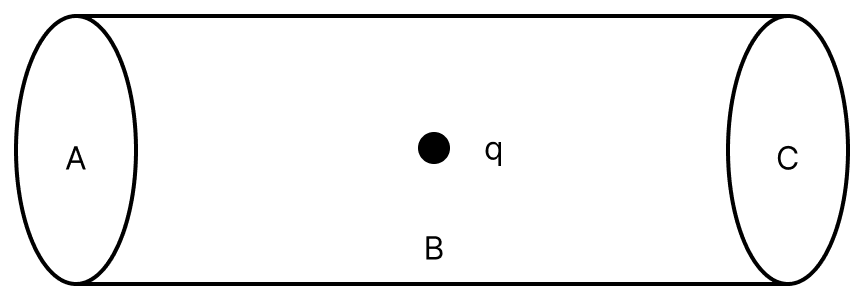
Answer
Reason —
Given,
- Charge enclosed within the hollow cylinder = q, placed centrally (from the figure)
- Electric flux through the curved surface B = φ
- A and C are the two plane surfaces
The hollow cylinder is a closed surface made up of the curved surface B and the two plane surfaces A and C.
By Gauss' theorem, the total flux through the closed cylinder is
The two plane surfaces A and C are situated symmetrically with respect to the charge, so the flux through each of them is the same, that is = . Also = is given. Therefore
A hemispherical body of radius R is placed in a uniform electric field E. What is the flux linked with the curved surface if field is parallel to base?
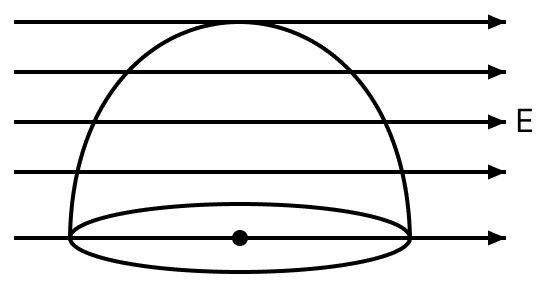
- zero
- EπR5
- EπR7
- EπR6
Answer
zero
Reason —
Given,
- Radius of the hemispherical body = R
- Uniform electric field E, parallel to the base
The curved surface together with the plane base forms a closed surface enclosing no charge. Hence by Gauss' theorem the total flux through it is zero,
The outward drawn normal to the plane base is perpendicular to the base and therefore perpendicular to , so
The flux linked with the curved surface is therefore zero.
A long string with a charge per unit length λ passes through an imaginary cube of edge 'a'. The maximum flux of the electric field through the cube will be :
- zero
Answer
Reason —
Given,
- Linear charge density of the string, λ
- Edge of the imaginary cube, a
By Gauss' theorem, the flux through the cube is times the charge enclosed by it. The charge enclosed is λ times the length of the string lying inside the cube. Hence the flux is maximum when this length is maximum.
The greatest length of a straight line that can lie within a cube of edge a is its body diagonal,
The charge enclosed is then
It is not convenient to use a spherical Gaussian surface to find the electric field due to an electric dipole using Gauss's theorem because :
- Gauss's law fails in this case.
- This problem does not have spherical symmetry.
- Coulomb's law is more fundamental than Gauss's law.
- Spherical Gaussian surface will alter the dipole moment.
Answer
This problem does not have spherical symmetry.
Reason — Gauss' theorem is mainly used for a symmetrical charge distribution. To obtain the electric field from it, the Gaussian surface is chosen to match the symmetry of the source, so that over the whole surface the field is everywhere normal to it and has the same magnitude. Only then can E be taken out of the integral .
An electric dipole consists of two equal and opposite point-charges separated by a small distance. Its field is not the same in magnitude at all points of a spherical surface drawn about it, and is not everywhere normal to that surface. The charge distribution has no spherical symmetry.
Gauss' theorem itself does not fail here; it remains valid for any closed surface. It is merely not convenient for finding E in this case.
Consider the charge configuration and spherical Gaussian surface as shown in the figure. While calculating the flux of the electric field over the spherical surface, the electric field will be due to :
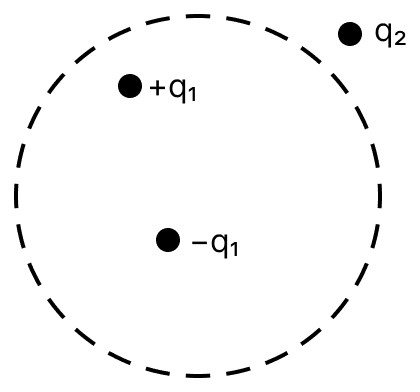
- q2
- Only the positive charges
- All the charges
- q1 and − q1
Answer
All the charges
Reason —
The field at any point of a Gaussian surface is set up jointly by all the charges present, whether they lie inside the surface or outside it.
Hence in calculating the flux , the field appearing in the integral is the resultant field of + q1, − q1 and q2, that is, of all the charges shown.
It should be noted, however, that the value of the flux depends only on the charges present inside the surface, since the net flux due to a charge outside a closed surface is zero.
The electric field in a certain region is acting radially outward and is given by E = Ar. A charge contained in a sphere of radius 'a' centred at the origin of the field will be given by :
Answer
Reason —
Given,
- Electric field acting radially outward, E = Ar
- Radius of the sphere centred at the origin = a
Since the field is radial and depends only on r, it has the same magnitude at every point of a sphere of radius a and is normal to it. At the surface of this sphere,
The electric flux through the spherical surface is
By Gauss' theorem, . Therefore the charge contained in the sphere is
A hemispherical body of radius R is placed in a uniform electric field E. What is the flux linked with the curved surface if field is perpendicular to base?
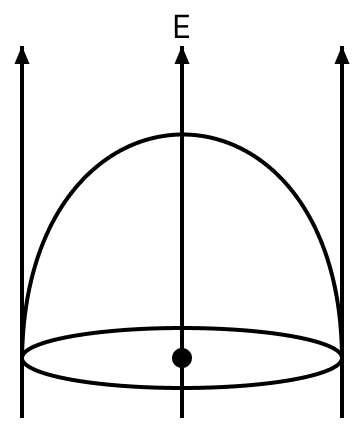
- EπR
- EπR2
- EπR4
- EπR3
Answer
EπR2
Reason —
Given,
- Radius of the hemispherical body = R
- Uniform electric field E, perpendicular to the circular base (upward, as shown in the figure)
The curved surface together with the plane base forms a closed surface enclosing no charge, so by Gauss' theorem the total flux through it is zero. Hence the magnitude of the flux through the curved surface equals that through the plane base.
The base is a circle of area πR2 whose normal is along . Therefore
A charge q is uniformly distributed on a ring of radius r. A sphere of an equal radius is constructed with its centre lying on the periphery of the ring. The flux of electric field through the surface of the sphere will be :
Answer
Reason —
Given,
- Charge q distributed uniformly on a ring of radius r
- A sphere of the same radius r is constructed with its centre C lying on the periphery of the ring
Let O be the centre of the ring and C a point on the ring itself, taken as the centre of the sphere. Consider a point P on the ring such that ∠POC = θ. Since O is the centre of the ring, both P and C lie at a distance r from O, so the chord PC of the ring is
The point P lies inside the sphere if PC < r, that is
Measuring θ on either side of OC, the arc of the ring lying inside the sphere subtends an angle of 2 × 60° = 120° at the centre O. As the charge is uniformly distributed, the charge enclosed by the sphere is
By Gauss' theorem,
What is the use of Gaussian surface?
Answer
A Gaussian surface is used to compute easily the electric field intensity due to certain charge systems or charged bodies, in cases where the use of Coulomb's law is quite difficult.
Explanation:
By choosing a closed surface having the same symmetry as the charge distribution, the field becomes normal to the surface and constant in magnitude over it, so that Gauss' theorem gives E at once.
A Gaussian surface is chosen to obtain an expression for the electric field at a point due to a given charge configuration. It is a closed surface. State one essential property of such a chosen Gaussian surface.
Answer
The Gaussian surface should pass through the point at which the electric field is required.
Explanation:
Unless the surface passes through that point, the field obtained from Gauss' theorem would not be the field at the required location.
How do the expressions for electric fields just outside a sheet of charge and a charged conductor differ?
Answer
The field due to a charged conductor is twice that due to a sheet of charge.
Explanation:
Just outside a sheet of charge of surface charge density σ,
while just outside a charged conductor of surface charge density σ,
A sphere S1 encloses a charge q. There is a larger concentric sphere S2, with no additional charge between S1 and S2. Find the ratio of electric flux through S1 and S2.
Answer
The ratio of the electric flux through S1 and S2 is 1 : 1.
Explanation:
By Gauss' theorem, the flux through a closed surface is times the net charge enclosed by it. There is no additional charge between S1 and S2, so both the spheres enclose the same charge q.
The flux does not depend upon the shape or the size of the surface enclosing the charge.
If Coulomb's law involved 1 / r3 dependence (instead of 1 / r2), would Gauss' law still valid?
Answer
No, Gauss' law would not remain valid.
Explanation:
Gauss' theorem is valid for all vector fields obeying the inverse square law. If Coulomb's law involved a dependence, or any other power of r except 2, then the electric flux through a sphere of radius r would depend upon r also, instead of depending only on the charge enclosed. Hence Gauss' law would not hold.
State Gauss' law in electrostatics.
Answer
Gauss' law in electrostatics : The electric flux ΦE through any closed surface is equal to times the 'net' charge q enclosed by the surface.
Mathematically,
where ε0 is the permittivity of free space. This is the integral form of Gauss' theorem.
What is a Gaussian surface?
Answer
A Gaussian surface is any closed surface, not passing through any point-charge, through which the flux of the electric field is calculated.
Explanation:
It is an arbitrary closed surface in three dimensional space. It may be of any shape and may or may not enclose any charge. The surface of a sphere, a cylinder or a cube are examples of valid Gaussian surfaces, whereas a disc surface or a square surface cannot be used as a Gaussian surface since these are not closed.
A point-charge is placed at the centre of a closed Gaussian spherical surface. How is electric flux ΦE through the surface affected when
(i) the sphere is replaced by a cylinder of the same or different volume?
(ii) the charge is shifted from the centre to some other place inside the sphere?
(iii) a second charge is placed inside the sphere?
(iv) the charge is replaced by an electric dipole?
Answer
(i) The electric flux ΦE will not be affected. Gauss' theorem is valid for a closed surface no matter what its shape or size, so the flux does not depend upon the shape or the volume of the surface enclosing the charge.
(ii) ΦE will not be affected. The flux passing through a closed surface depends only upon the net charge enclosed by the surface and not upon the position of the charge inside it.
(iii) ΦE will change. Since , where q is the net charge, taking the sign of the charge into account, the flux is an additive quantity and alters when a second charge is placed inside.
(iv) ΦE will become zero. An electric dipole consists of two equal and opposite charges, so that the net charge enclosed by the surface is zero.
Suppose a Gaussian surface does not have any net charge inside it. Does it mean that the electric intensity is necessarily zero at all points on the surface? Is the converse true?
Answer
No, the electric intensity is not necessarily zero at all points on the surface.
When the net charge q inside a Gaussian surface is zero, Gauss' law gives
This does not mean that is zero at every point of the surface. For example, if is non-zero but at right angles to the area vector at all points of the surface, the value of is still zero.
The converse is, however, true. If is zero at every point on the Gaussian surface, then the flux through the surface is zero, and Gauss' law then predicts that there must be no net charge inside the Gaussian surface.
State Gauss' theorem. Draw a graph showing the variation of electric field, as one moves from the centre of a charged metal ball to a point on its surface and then to a far-off outside point.
Answer
Gauss' theorem : The electric flux ΦE through any closed surface is equal to times the 'net' charge q enclosed by the surface,
Variation of electric field with distance :
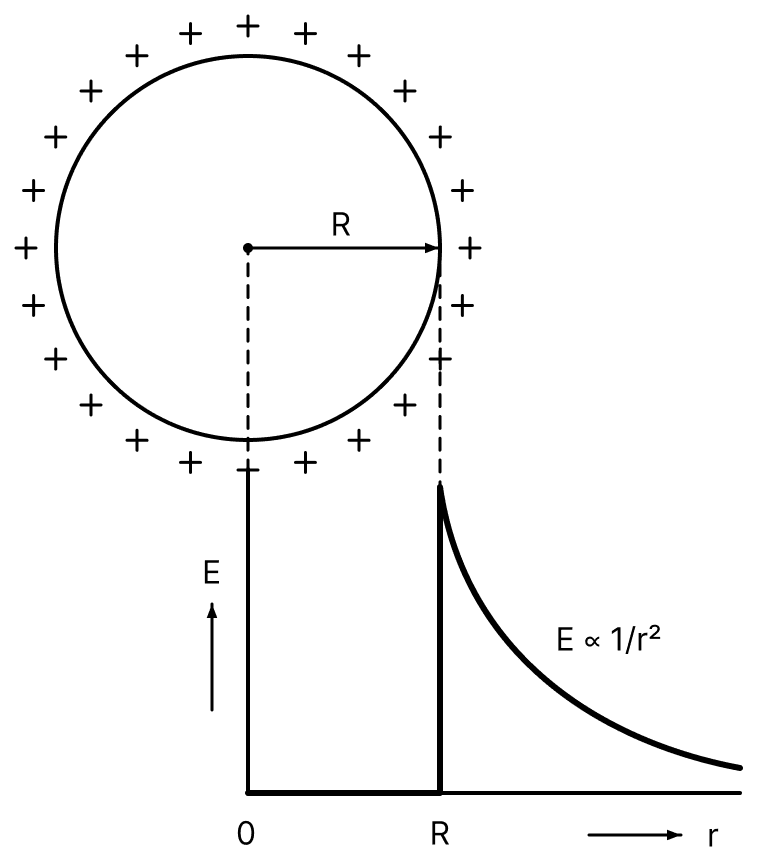
In a charged metal ball the entire charge resides on the surface, so the ball behaves just like a charged thin spherical shell.
(i) Inside the ball (r < R) : A Gaussian surface drawn inside encloses no charge, so E = 0 everywhere.
(ii) At the surface (r = R) : The field is maximum,
(iii) Outside the ball (r > R) : The ball behaves as if its whole charge were concentrated at the centre, so
Hence the graph is zero from the centre up to the surface, rises abruptly to its maximum value at the surface and then decreases rapidly as at outside points.
A cylinder is immersed in a uniform electric field E with its axis parallel to the field. Show that the electric flux through the cylinder is zero.
Answer
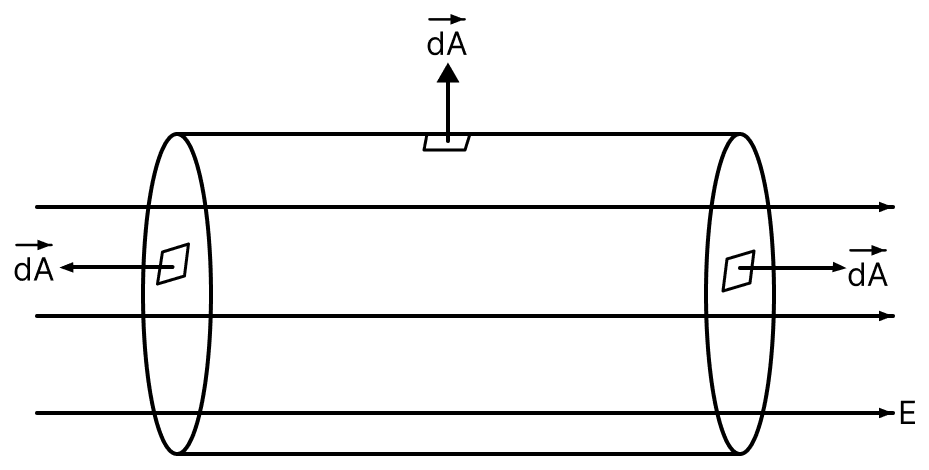
The cylinder is immersed in the uniform field with its axis parallel to the field. The flux through the whole cylinder is the sum of the fluxes through the left plane face, the right plane face and the curved surface,
Drawing the outward normals, the angle between and is 180° for all area elements on the left face, 0 for all elements on the right face and 90° for all elements on the curved surface. Therefore
Hence the electric flux through the cylinder is zero. This is expected from Gauss' theorem also, since the cylinder encloses no charge.
A cylindrical Gaussian surface has its axis along an infinite line of uniformly distributed positive charges, as shown.
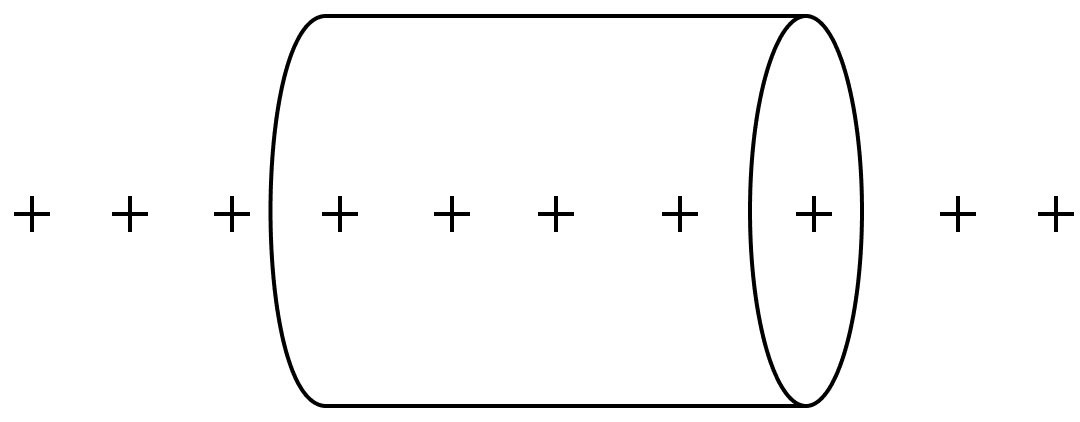
(i) For which surface is the electric flux zero?
(ii) Over which surface is zero?
(iii) Over which surface is constant?
(iv) Over which surface does vary?
Answer
The electric field at a point distant r from the infinite line charge is
directed radially outwards.
(i) The electric flux is zero for the two plane faces of the cylinder, because for these faces the angle between the field vector and the area vector is 90°.
(ii) is not zero over any of the surfaces. It cannot be zero at a finite distance from the line charge.
(iii) is constant over the curved surface of the cylinder, because every point of the curved surface is at the same perpendicular distance from the infinite line charge.
(iv) varies over the plane faces of the cylinder, since different points of a plane face are at different distances from the line charge, and E decreases as the distance increases.
Charge q is enclosed in a hollow cylinder. If the electric flux through the curved surface of the cylinder is ΦC, then determine the electric flux through either plane surface of the cylinder.
Answer
Given,
- Charge enclosed in the hollow cylinder = q
- Electric flux through the curved surface of the cylinder = ΦC
Let the electric flux through each plane surface be ΦP. The hollow cylinder is a closed surface made up of the curved surface and the two plane surfaces, so the total flux through the cylinder is
Hence by Gauss' theorem,
Hence the electric flux through either plane surface of the cylinder is .
Use Gauss' law to show that electric field does not exist inside a charged conductor.
Answer
Gauss' law states that the electric flux through any closed surface is equal to times the net charge within the surface,
Let a Gaussian surface be drawn entirely within the material of a charged conductor. The charge given to a conductor does not reside inside it; the entire charge lies on its surface. Hence the charge enclosed by this Gaussian surface is q = 0, and
Since such a Gaussian surface may be drawn about every interior point of the conductor, the field must vanish at each of them.
Hence the electric field does not exist inside a charged conductor, that is, = 0.
A sensitive instrument which is to be saved from external electric fields in its environment is covered fully by a metallic surface. Why?
Answer
Since the electric field inside a charged conductor is zero, electric lines of force cannot get into the empty space enclosed by a hollow conductor. A conductor can therefore act as an electrostatic shield.
When the sensitive instrument is covered fully by a metallic surface, the lines of force of the external fields pass along the outside of the surface and do not enter inside it. The field inside the metallic covering remains zero, so the instrument placed within it remains safe from the external electric fields.
This phenomenon is known as electrostatic shielding.
A spherical conducting shell of inner radius r1 and outer radius r2 has a charge Q. A charge q is placed at the centre of the shell. Compute surface charge densities on the inner and the outer surfaces of the shell.
Answer
Given,
- Inner radius of the spherical conducting shell = r1, outer radius = r2
- Charge on the shell = Q
- Charge placed at the centre of the shell = q
The charge Q given to the conducting shell resides on its outer surface. The charge q placed at the centre induces a charge − q on the inner surface of the shell and a charge + q on its outer surface.
Inner surface : The charge on the inner surface is − q and its area is . Hence the surface charge density is
Outer surface : The total charge on the outer surface is (Q + q) and its area is . Hence
Hence the surface charge densities on the inner and the outer surfaces of the shell are and respectively.
A charged oil-drop of mass m is suspended in equilibrium between two horizontal conducting plates, each of area A metre2 and having charges + q and − q coulomb. Find the charge on the drop.
Answer
Given,
- Mass of the oil-drop = m
- Area of each conducting plate = A metre2
- Charges on the plates = + q and − q coulomb
Let the charge on the drop be q′ coulomb. The drop is suspended in equilibrium, so the upward electric force on it balances its weight,
where E is the electric field between the plates.
The surface charge density on each plate is . The field between two parallel conducting plates carrying equal and opposite charges is
Substituting equation (ii) in equation (i),
Hence the charge on the drop is coulomb.
A large non-conducting plate has a charge q distributed uniformly over its surface. The electric field at a point just outside the plate is E. If the plate be replaced by an identical metallic plate, what will be the field at the same point?
Answer
The field will remain unchanged, that is, it will still be E.
Explanation:
Let the surface area of the plate be A.
Non-conducting plate : The charge q is distributed uniformly over its surface, so the surface charge density is . The field just outside a sheet of charge is
Metallic plate : The charge q now spreads over both the surfaces of the plate, so the surface charge density is . The field just outside a charged conductor is
which is the same as before.
A plane surface of area 10 m2 is placed in the X-Z plane where an electric field N-C-1 exists. Calculate the electric flux passing through the surface.
Answer
Given,
- Area of the plane surface, A = 10 m2, lying in the X-Z plane
- Electric field, N-C-1
The surface lies in the X-Z plane, so the normal to the surface is along the Y-axis. Hence the area vector is
The electric flux through the surface is
Substituting the values,
Since , and ,
Hence the electric flux passing through the surface is 40 V-m.
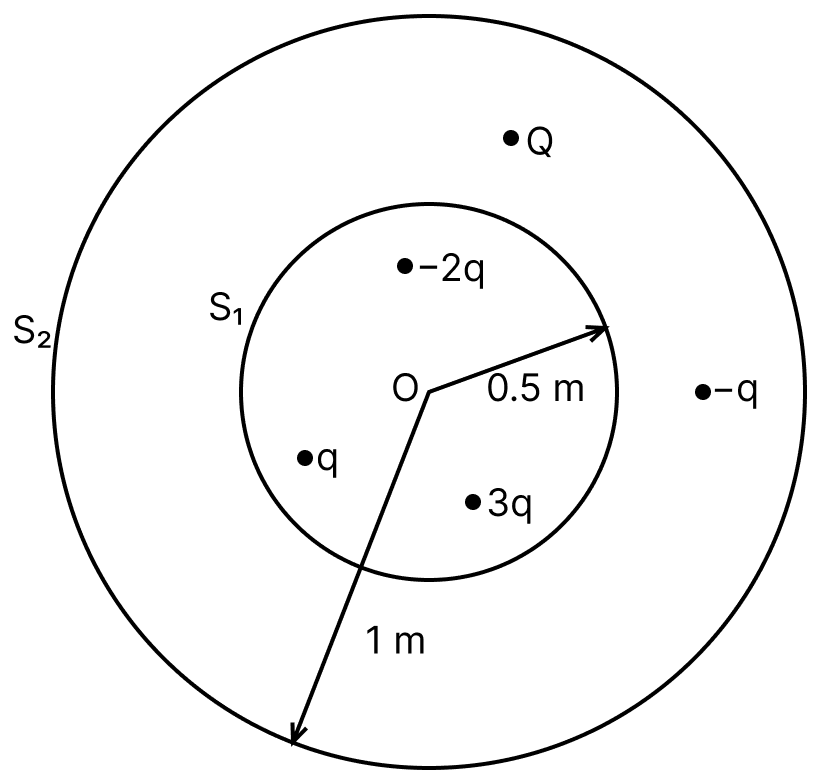
In the figure charges are enclosed by spherical surfaces S1 and S2. If the electric flux through surface S2 is four times that of electric flux through S1, find relation between Q and q.
Answer
Given,
- Charges enclosed by S1 : q, − 2q and 3q
- Charges enclosed by S2 : q, − 2q, 3q, Q and − q
- Φ2 = 4Φ1
Flux through S1 :
Flux through S2 :
Using Φ2 = 4Φ1,
Hence the required relation is Q = 7q.
Define electric flux and electric flux density. What is meant by negative flux? Explain with diagram. Write SI unit and dimensions of electric flux.
Answer
Electric flux : The electric flux is a measure of the number of lines of force passing through some surface held in the electric field. It is denoted by ΦE.
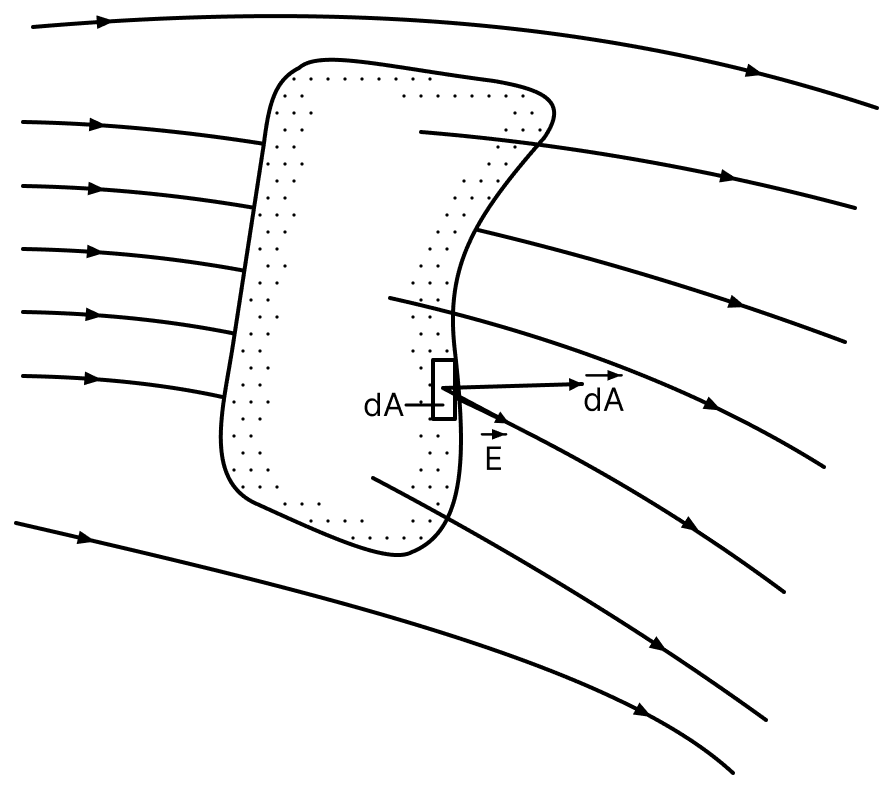
If is a small area element of a surface placed in a field , the scalar product is the electric flux through the element, and for the entire surface
The electric flux linked with a surface is therefore obtained by integrating the normal component of the electric field over that surface. For a plane surface of area A held in a uniform field, the normal to it making an angle θ with the field,
Electric flux density : In an electric field, the ratio of the electric flux ΦE through a surface to the area A of the surface is called the electric flux density at the location of the surface,
For a plane surface normal to the electric field, ΦE = EA, so that
Its unit is the same as that of the electric field. Electric flux is a scalar, but the electric flux density is a vector quantity.
Negative flux : The electric flux is positive for the lines of force pointing outwards, that is, leaving the surface, and negative for those pointing inwards, that is, entering the surface.

For field lines entering a plane surface normally, θ = 180° and
The negative sign therefore shows that the lines of force are entering the surface.
SI unit of electric flux : From ΦE = EA cos θ,
As E is also expressed in V/m, another SI unit of ΦE is
Dimensions of electric flux :
Derive, using Gauss' theorem, an expression for the electric field of an infinitely long line of charge having a uniform charge density of λ coulomb/metre.
Answer
Consider an infinitely long, uniformly charged wire (taken as positive) whose linear charge density, that is, charge per unit length, is λ coulomb/metre. The electric intensity is to be found at a point P at a perpendicular distance r metre from the wire.
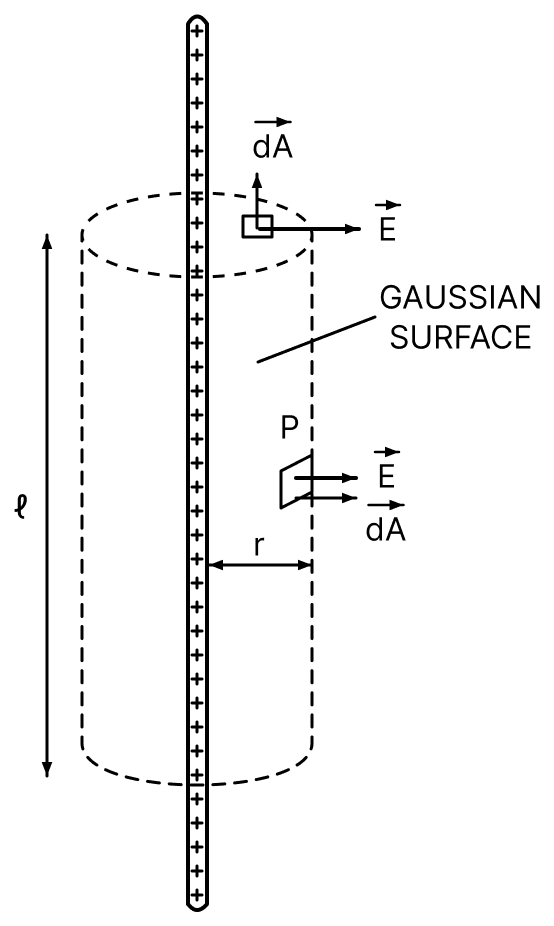
Through P, take a coaxial cylindrical Gaussian surface of radius r and length l. Every point of its curved surface is at the same distance r from the wire, so by symmetry the field has the same magnitude E at all these points and points radially outwards. The area vector of any element dA of the curved surface is also radially outward, so and point the same way. Therefore
Hence the electric flux through the curved surface of the Gaussian surface is
On each plane end the area vector is parallel to the wire while is perpendicular to it, so there and the plane ends contribute no flux. The total flux through the Gaussian surface is therefore
But by Gauss' theorem this must be , where q is the net charge enclosed by the Gaussian surface. Here q = λl, so that
Comparing equations (i) and (ii),
In vector notation,
where is the unit vector in the direction of r. The direction of is radially outwards for a positive charge.
Hence the electric field of a linear charge is inversely proportional to the perpendicular distance r from it and, for a positive charge distribution, points perpendicularly away from the linear charge.
State Gauss' theorem. Give its mathematical expression. Derive an expression for the electric field intensity at any point due to an infinite plane sheet of charge of uniform charge density σ coulomb/metre2.
Answer
Gauss' theorem : The electric flux ΦE through any closed surface is equal to times the 'net' charge q enclosed by the surface.
Mathematical expression :
where ε0 is the permittivity of free space.
Electric field due to an infinite plane sheet of charge :
Consider a thin sheet of charge of infinite extent, with surface charge density (charge per unit area) σ. The electric intensity is required at a point P at a distance r from the sheet.
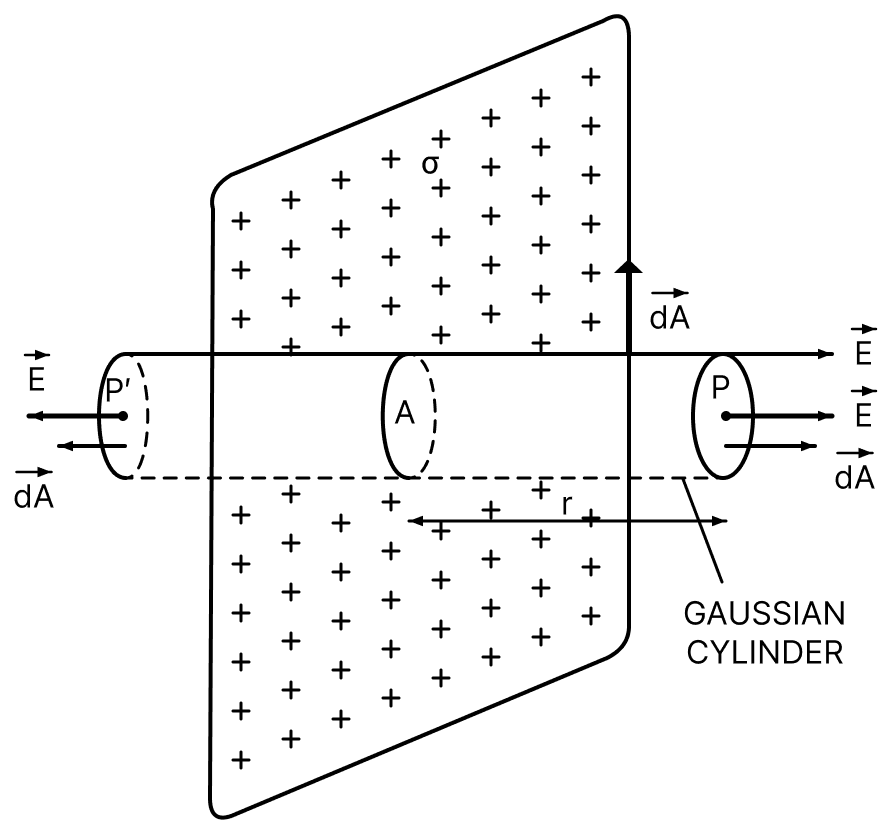
Take P′ as the mirror image of P on the other side of the sheet. The Gaussian surface is a cylinder that passes through the sheet, its two plane ends, each of area A, lying parallel to the sheet and passing through P and P′.
As the sheet extends to infinity, near it on either side is perpendicular to the sheet, pointing outwards for a positively charged sheet. It is therefore normal to the plane ends of the cylinder and parallel to its curved surface, and it has equal magnitude at P and P′. The flux through the two plane ends is then
Since and are parallel, , so that
But E is the same for all points on a plane end. Therefore
The flux through the curved surface of the Gaussian cylinder is zero, because and are at right angles everywhere on the curved surface. Hence the total flux through the Gaussian cylinder is
By Gauss' theorem, , where q is the net charge enclosed by the Gaussian cylinder. Here q = σA, and so
Comparing equations (i) and (ii),
The result does not contain r, so the field has the same value at all points 'close' to the sheet, for any sheet of charge. Moving farther from the sheet brings more of its charge into view, and this makes up for the weakening of the field with distance.
at any point is directed away from the sheet of positive charge. If the sheet be of negative charge, then would be directed towards the sheet.
Derive expression for the electric field 'just' outside a charged 'conductor'.
Answer
Gauss' law connects the electric field just outside a charged conductor in equilibrium with the charge distributed over its surface.
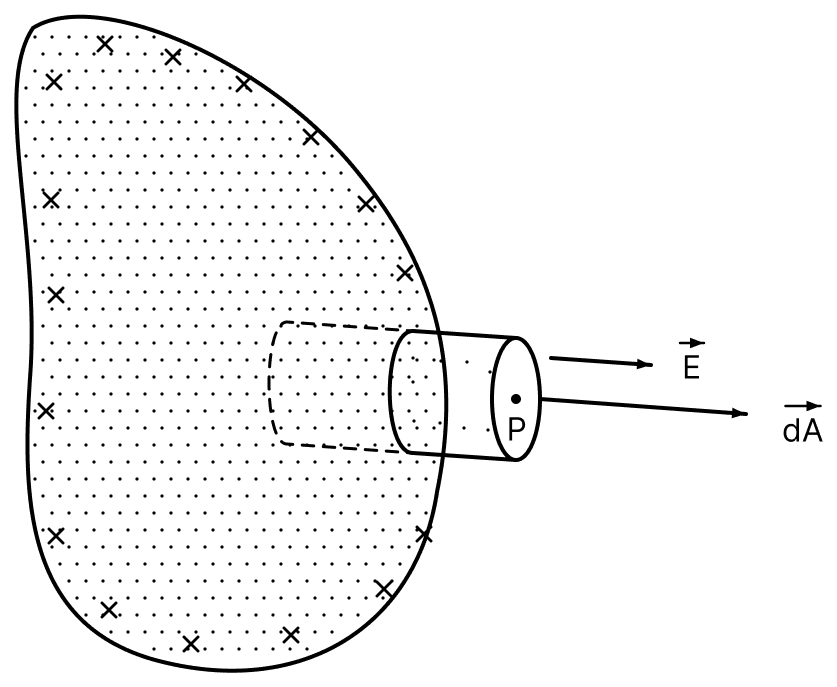
Consider a positively charged conductor in vacuum or in air. All the charge given to a conductor resides on its surface, and in equilibrium the electric field at the surface is normal to it. Because the conductor is irregular in shape, the surface charge density varies from place to place.
To find the field at a point P just outside the conductor, where the surface charge density is σ, a small closed cylinder is taken as the Gaussian surface. One plane face, of area A, passes through P; the other, also of area A, lies inside the conductor, parallel to its surface.
The inner plane face contributes no flux because the electric field inside a charged conductor is zero, and the curved surface contributes none because and are perpendicular over it. Only the outer plane face through P contributes, so the flux through the Gaussian cylinder is
But from Gauss' law, , where q (= σA) is the net charge enclosed by the Gaussian surface, and so
Now, from equations (i) and (ii),
This field is directed away from the conductor. If the conductor were negatively charged, E would be directed towards the conductor.
What do you understand by Gaussian surface? Is always closed surface? Derive Coulomb's law by using Gauss' law.
Answer
Gaussian surface : A Gaussian surface is an arbitrary closed surface in three dimensional space through which the flux of a vector field (the gravitational field, the electric field or the magnetic field) is calculated. The surface of a sphere, a cylinder or a cube are examples of valid Gaussian surfaces, while a disc surface or a square surface cannot be used as a Gaussian surface.
Is it always a closed surface? Yes. It is an essential property of a Gaussian surface that it should be a closed surface, so that a clear distinction can be made between points that are inside the surface, on the surface and outside the surface.
Deduction of Coulomb's law from Gauss' law :
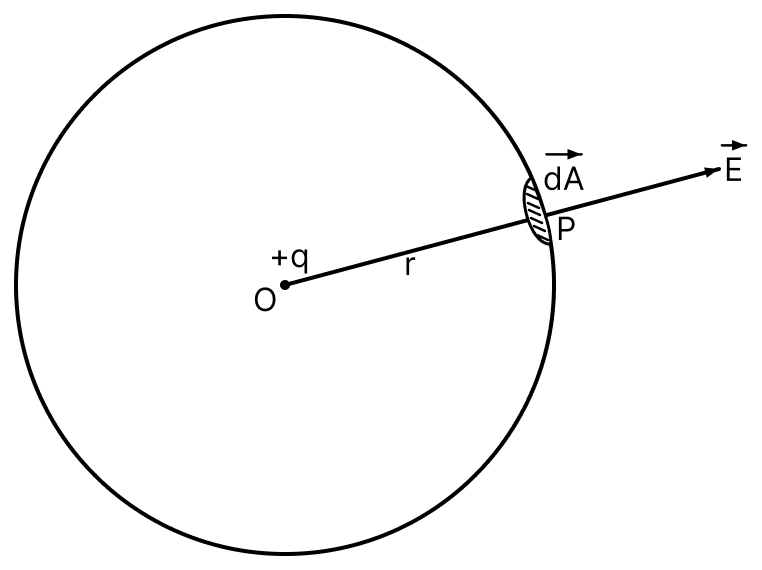
A point charge + q is placed at O, and its field is required at a point P at a distance r from O. All points at the same distance from O have the same field magnitude, so the Gaussian surface chosen is a sphere of radius r centred at O and passing through P. For a small element of this sphere around P, with area vector , the electric flux is
Therefore, the electric flux through the entire Gaussian surface is
But A = 4πr2 = surface area of the spherical Gaussian surface,
But from Gauss' theorem,
From equations (i) and (ii),
This is the expression for the electric intensity at P due to the point charge placed at O.
Now place a test charge q0 at P. The electric force acting on it is
This represents Coulomb's law.
State Gauss' theorem in electrostatics. Prove it for an asymmetric curved surface.
Answer
Gauss' theorem in electrostatics : The electric flux ΦE through any closed surface is equal to times the 'net' charge q enclosed by the surface. That is,
where ε0 is the permittivity of free space.
Proof for an asymmetric curved surface :
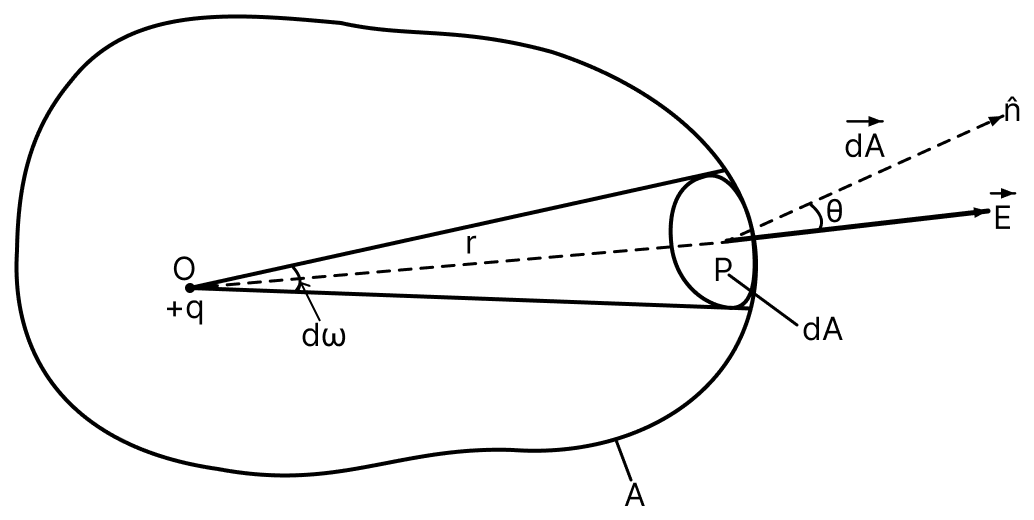
Consider a point-charge + q at O, enclosed by a closed surface A of arbitrary shape. Take a small area element dA around a point P of the surface, with OP = r, and represent it by the vector along its outward normal.
The field at P due to + q is directed along OP, so the normal electric flux through the element dA is
where θ is the angle between the vectors and .
Now,
The quantity is the solid angle dω that the element dA subtends at O. Hence
Integrating over the whole closed surface A gives the total normal electric flux ΦE,
The whole closed surface A subtends a total solid angle steradian at O, and this is true for a closed surface of any shape enclosing the point.
Hence Gauss' theorem is proved. The shape of the surface never enters the argument, so the theorem holds for an asymmetric curved surface as well.
The examiner asked a student to perform an experiment that demonstrates Gauss' law for electric fields. He gives requisite instructions to the student and asks some questions. State whether the responses of the student, in each case are correct or incorrect. Give a reason for your answer.
(i) EXAMINER : Except Gauss' law, is there any other law, which is an equivalent way of describing the relation between charge and electric field in static condition?
STUDENT : Yes, it's Coulomb's law.
(ii) EXAMINER : A point charge + q is at the centre of the spherical Gaussian surface, to make the outgoing flux double, what can you do?
STUDENT : If I make the radius of the Gaussian surface half of the previous value, electric flux becomes double.
(iii) EXAMINER : A plane surface of area 10-2 m2, parallel to xy plane is placed in electric field N/C. Find electric flux linked with the given plane.
STUDENT : Electric flux V-m.
Answer
(i) The response of the student is correct.
Coulomb's law is an equivalent way of describing the relation between charge and electric field in static condition. Gauss' theorem and Coulomb's law are complementary to each other; in fact Coulomb's law can be deduced from Gauss' law and vice versa.
The difference is that Gauss' law can be applied conveniently to a uniform charge distribution having symmetry only, whereas Coulomb's law can be applied even if there is no symmetry.
(ii) The response of the student is incorrect.
The electric flux through a Gaussian surface is
The flux depends only upon the charge enclosed, and does not depend upon the shape or the size of the Gaussian surface. Halving the radius of the spherical Gaussian surface therefore leaves the flux unchanged.
To make the outgoing flux double, the charge enclosed must be doubled.
(iii) The response of the student is correct.
Given,
- Area of the plane surface, A = 10-2 m2, parallel to the xy plane
- Electric field, N/C
The surface is parallel to the xy plane, so its area vector is along the z-axis,
which is exactly what the student has written.
State Gauss' theorem in electrostatics.
Apply this theorem to derive an expression for the electric intensity due to an infinite sheet of charge and hence deduce the expression for electric intensity due to two parallel oppositely charged thin infinite sheets of charge at a point (i) between the sheets, (ii) outside the sheets.
Answer
Gauss' theorem in electrostatics : The electric flux ΦE through any closed surface is equal to times the 'net' charge q enclosed by the surface,
where ε0 is the permittivity of free space.
Electric intensity due to an infinite sheet of charge :
Consider a thin sheet of charge of infinite extent with surface charge density σ, and a point P at a distance r from it where the electric intensity is required.
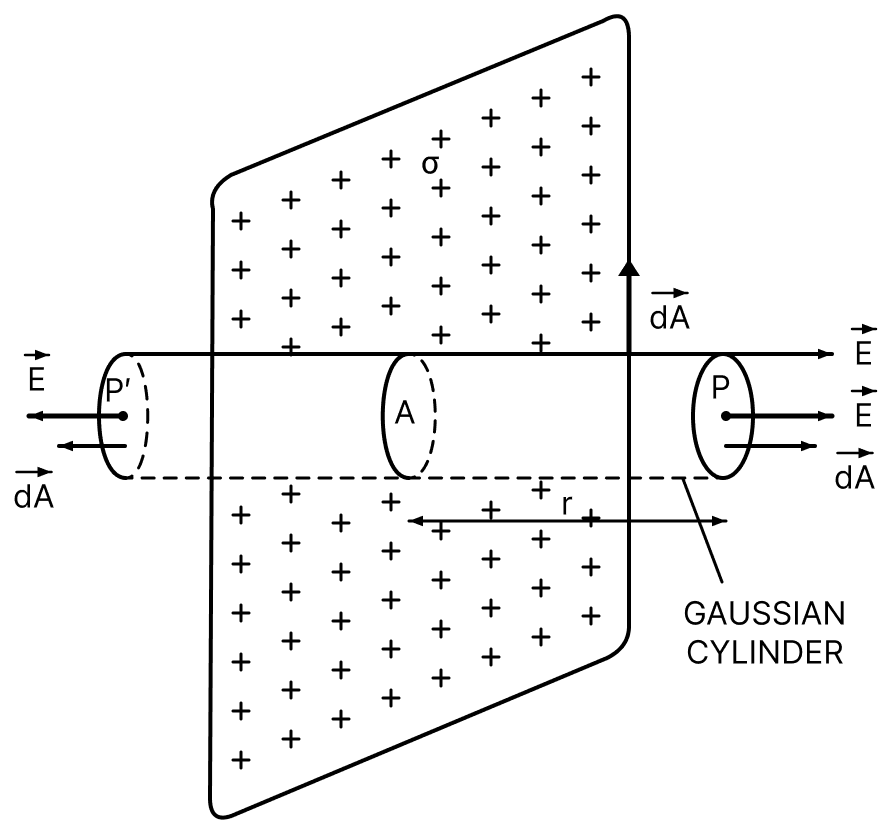
With P′ as the mirror image of P on the other side of the sheet, the Gaussian surface taken is a cylinder passing through the sheet, whose plane ends, each of area A, are parallel to the sheet and pass through P and P′.
Because the sheet is infinite, close to it on either side is perpendicular to the sheet, pointing outwards for a positively charged sheet. Hence is normal to the plane ends, parallel to the curved surface, and equal in magnitude at P and P′. The flux through the two plane ends is therefore
The flux through the curved surface is zero, because there and are at right angles. Hence the total flux through the Gaussian cylinder is
By Gauss' theorem, with the enclosed charge q = σA,
Comparing equations (i) and (ii),
This is independent of r, so the electric intensity is the same at all points close to the sheet.
Electric intensity due to two parallel oppositely charged thin infinite sheets :
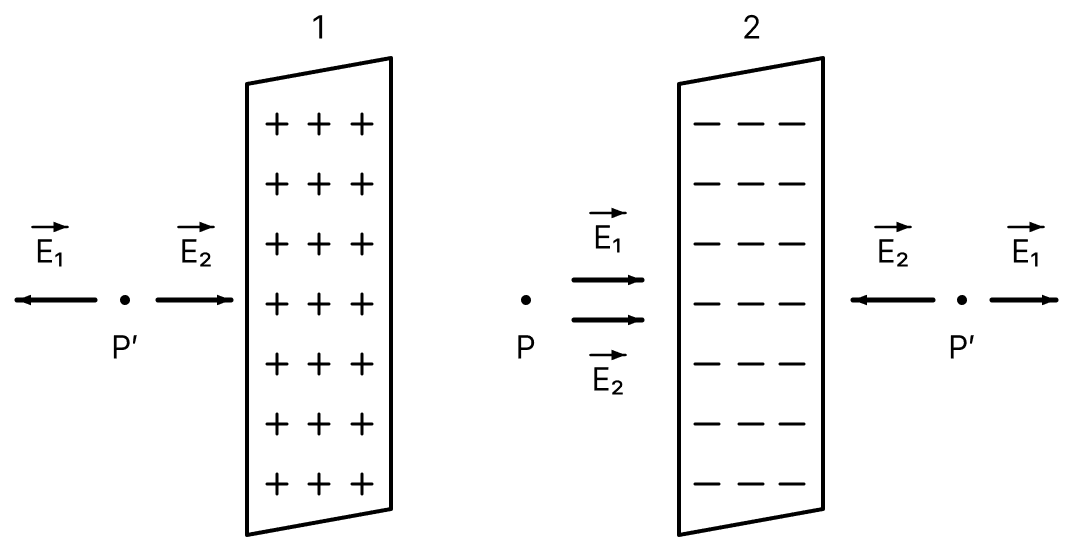
Let us now consider two sheets 1 and 2 carrying charges of equal magnitude and opposite sign, of charge densities σ1 = + σ and σ2 = − σ. Let and be the electric intensities at any point due to sheets 1 and 2 respectively, each of magnitude .
(i) At a point P in between the sheets :
Here is directed away from sheet 1 and is directed towards sheet 2, so the two are in the same direction. The resultant intensity is
The magnitude of E is free from the position of the point P between the sheets. Hence the electric field between the sheets, except near the edges, is uniform everywhere and independent of the separation between the sheets. It points from the positive towards the negative sheet.
(ii) At a point P′ outside the sheets :
Here is directed away from sheet 1 and is directed towards sheet 2, so the two are oppositely directed. The resultant intensity is
Thus a uniform electric field is confined to the region between the sheets, and the field outside them is zero. Such a pair of sheets is therefore used to obtain a uniform field in a limited region of space, provided the sheets are much larger in linear dimensions than their separation.
Using Gauss' theorem derive an expression for the electric intensity due to a charged thin spherical shell at (i) external point, (ii) surface point, (iii) internal point.
Draw the graph showing the variation of electric intensity obtained as above with distance from the centre.
Answer
Consider a thin, isolated spherical shell of centre O and radius R, with a charge + q spread uniformly over its surface.
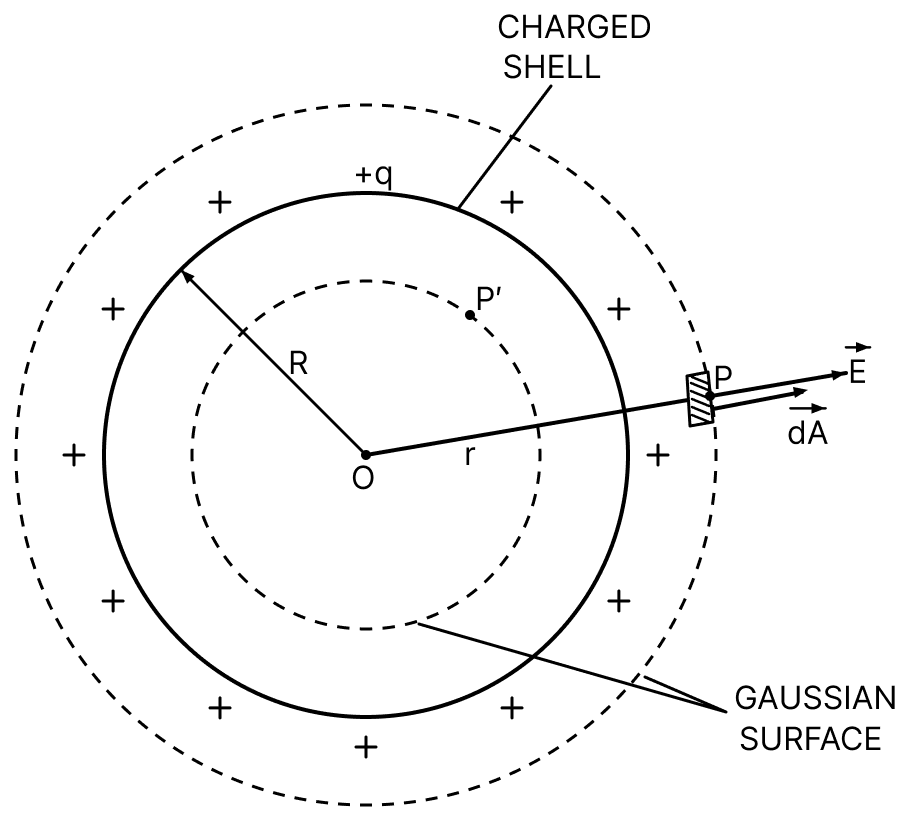
(i) At an external point :
The electric intensity is required at a point P at a distance r (> R) from the centre O.
The Gaussian surface taken is a sphere of radius r, concentric with the shell and passing through P. Every point of this sphere is at the same distance from the charged shell, so by spherical symmetry the field has the same magnitude E all over it and is directed radially outwards.
For an area element dA around P, both and the area vector point radially outwards, so the angle between them is zero and the electric flux through the element is
The flux through the entire Gaussian surface is
But, by Gauss' theorem, , where q is the total charge enclosed by the Gaussian surface. Therefore
\text E(4\pi \text r^2) = \dfrac{\text q}{\epsilon_0} \\[1em] \text E = \dfrac{1}{4\pi\epsilon_0}\dfrac{\text q}{\text r^2} \qquad (\text{for r > R}) \qquad \dots(\text i)
This has the same form as the electric intensity of a point-charge q at a distance r. Hence, for points 'outside' it, the charged spherical shell behaves as if its whole charge were concentrated at its centre.
If σ be the uniform charge density at the surface of the shell, then q = 4πR2σ. Substituting this value of q in equation (i),
(ii) At the surface :
If the point P lies just on the surface of the shell, then r = R. Equations (i) and (ii) now give
(iii) At an internal point :
For points inside the shell, such as P′, the Gaussian surface through P′ does not enclose any charge, since the entire charge lies on the surface of the shell. Hence, according to Gauss' theorem,
The electric field intensity is zero everywhere inside the charged shell.
Graph :
The electric field is zero everywhere inside the shell (from r = 0 to r = R), is maximum at the surface of the shell where it equals , and then decreases rapidly outside the shell as .
In case of a metallic (conducting) sphere, the entire charge will lie on the surface and it will behave just like a shell.
Surface charge density is defined as charge per unit surface area of surface charge distribution. Two large, thin metal plates are parallel and close to each other. On their inner faces, the plates have surface charge densities of opposite signs having magnitude of 17.7 × 10⁻²² Cm-2 as shown. The intensity of electric field at a point between plates A and B is , where ε0 = permittivity of free space.
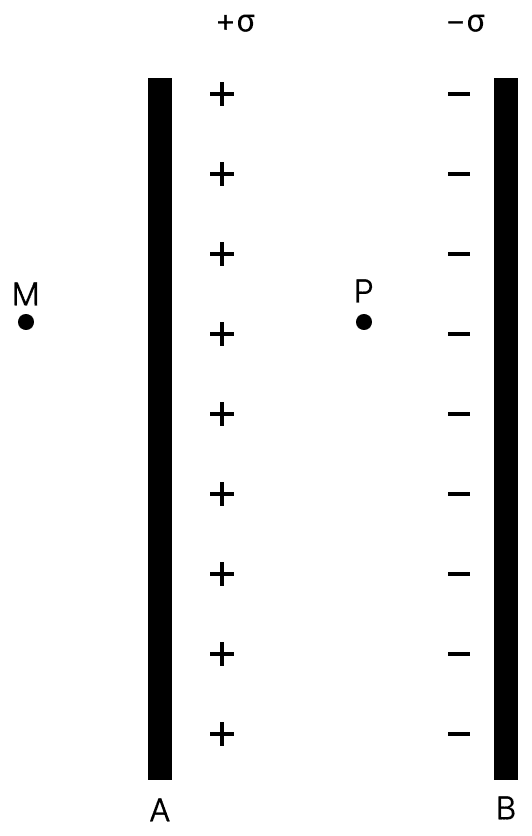
(i) Find the magnitude of resultant electric field E in the outer region of the first plate, i.e., at point M.
(ii) Find magnitude and direction of electric field at point P due to plate B.
(iii) Find magnitude of resultant field at the point P.
(iv) In order to estimate the electric field due to a thin infinitely long straight uniformly charged wire, what should be convenient shape of the considered Gaussian surface?
Answer
Given,
- Magnitude of the surface charge density on the inner faces of the plates, σ = 17.7 × 10⁻²² Cm-2, of opposite signs
- ε0 = 8.85 × 10⁻¹² C2/N-m2
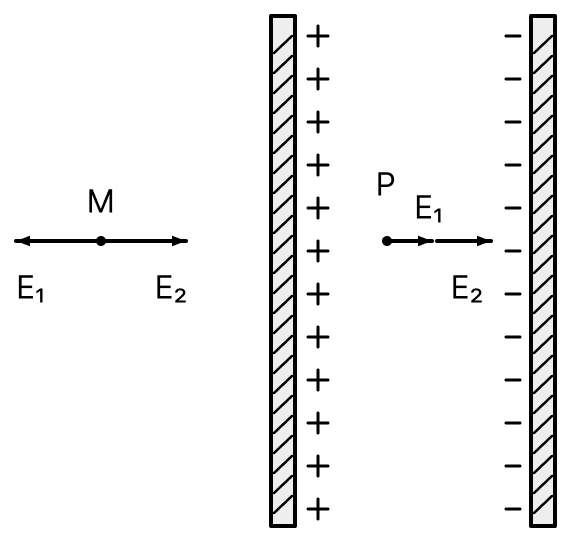
From the figure, plate A carries + σ and plate B carries − σ. The point M lies in the outer region of plate A and the point P lies between the plates.
The magnitude of the electric field due to each plate alone is
Substituting the values,
(i) Resultant field at the point M :
At a point outside the two plates, the field due to the positively charged plate A is directed away from A while the field due to the negatively charged plate B is directed towards B. The two are therefore oppositely directed and equal in magnitude, so
Hence the resultant electric field at the point M is zero.
(ii) Field at the point P due to plate B :
Plate B carries a negative charge, so the field due to it is directed towards plate B.
Hence the electric field at P due to plate B is 1 × 10⁻¹⁰ N/C, directed from A towards B.
(iii) Resultant field at the point P :
At a point between the plates, the field due to A is directed away from A (that is, from A towards B) and the field due to B is directed towards B (again from A towards B). The two are in the same direction, so
Hence the magnitude of the resultant field at the point P is 2 × 10⁻¹⁰ N/C, directed from plate A towards plate B.
(iv) For a thin infinitely long straight uniformly charged wire, the field is the same in magnitude at all points equidistant from the wire and is directed radially outwards. The Gaussian surface must have a shape according to this symmetry, so the convenient shape is a cylindrical Gaussian surface drawn coaxially with the wire.
Faraday Cage : A Faraday cage or Faraday shield is an enclosure made of a conducting material. The fields within a conductor cancel out with any external fields, so the electric field within the enclosure is zero. These Faraday cages act as big hollow conductors you can put things in to shield them from electrical fields. Any electrical shocks the cage receives, pass harmlessly around the outside of the cage.
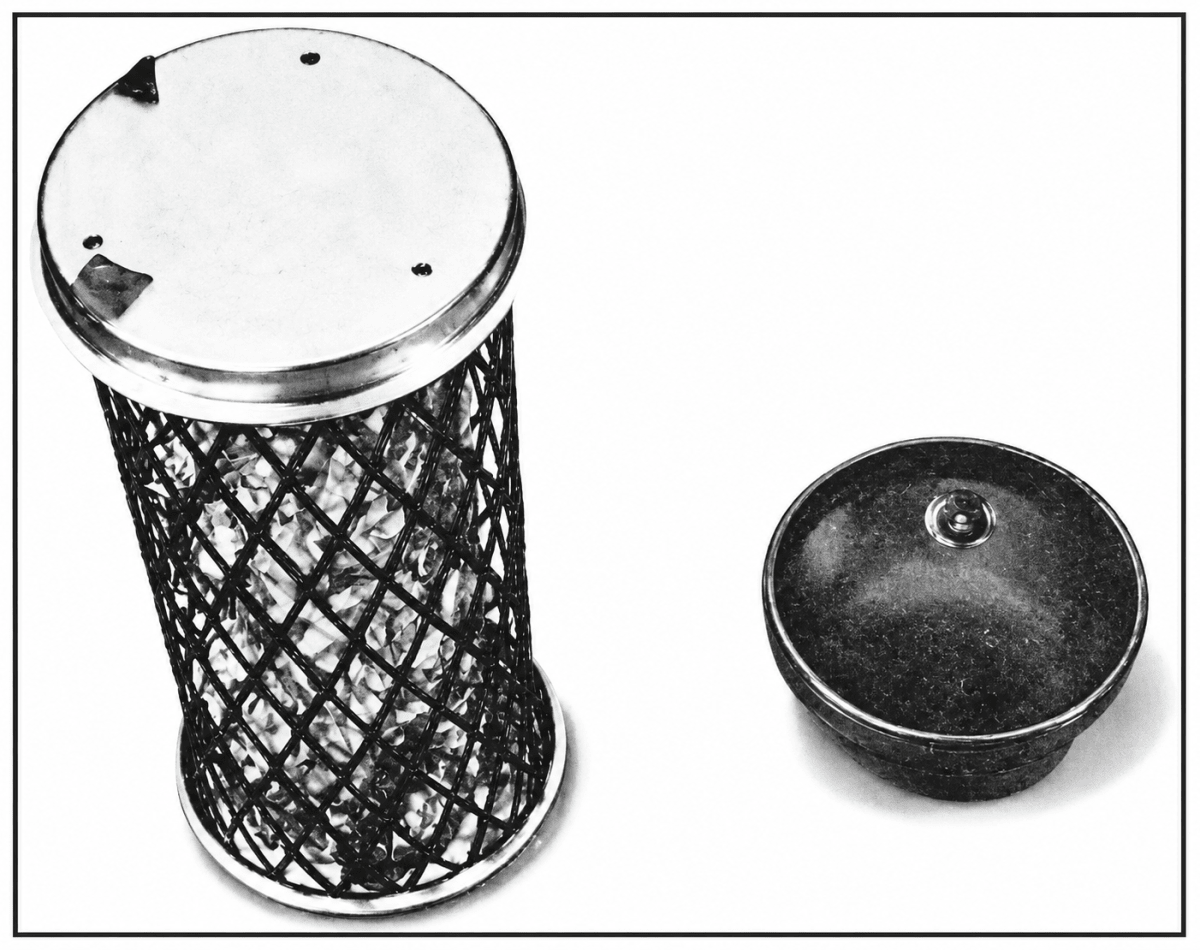
(i) Which of the following material can be used to make a Faraday cage?
- Plastic
- Glass
- Copper
- Wood
(ii) Example of a real-world Faraday cage is :
- car
- plastic box
- lightning rod
- metal rod
(iii) What is the electrical force inside a Faraday cage when it is struck by lightning?
- The same as the lightning
- Half that of the lightning
- Zero
- A quarter of the lightning
(iv) A point charge of 2 μC is placed at centre of Faraday cage in the shape of cube with surface of 9 cm edge. Net electric flux linked with the cube will be :
- 1.9 × 10⁵ Nm2/C entering the surface
- 1.9 × 10⁵ Nm2/C leaving the surface
- 2.26 × 10⁵ Nm2/C leaving the surface
- 2.26 × 10⁵ Nm2/C entering the surface
Answer
(i) Copper
Explanation:
A Faraday cage is an enclosure made of a conducting material. Copper is a conductor.
(ii) car
Explanation:
The metal body of a car acts as a big hollow conductor. The electric field within the enclosure is zero, so the occupants are shielded from external electric fields.
(iii) Zero
Explanation:
Since there is no electric field inside a charged conductor, electric lines of force cannot get into the empty space enclosed by a hollow conductor. Hence the field inside the cage is zero and the electrical shocks pass harmlessly around the outside of the cage. This is electrostatic shielding.
(iv) 2.26 × 10⁵ Nm2/C leaving the surface
Explanation:
Given,
- Point charge at the centre of the cube, q = 2 μC = 2 × 10⁻⁶ C
- Edge of the cube = 9 cm
- ε0 = 8.85 × 10⁻¹² C2/N-m2
By Gauss' theorem, the electric flux through the closed surface of the cube is times the charge enclosed by it,
Substituting the values,
Since the enclosed charge is positive, the flux is directed outwards, that is, leaving the surface. The edge of the cube does not enter the calculation, as the flux does not depend upon the shape or the size of the closed surface.