
When an α-particle of mass m moving with velocity v bombards on a heavy nucleus of charge 'Ze', its distance of closest approach from the nucleus depends on m as:
- m
Answer
Reason — At the distance of closest approach r0, the whole kinetic energy of the α-particle is converted into electrostatic potential energy,
For a given v and Z, r0 ∝ .
The value of Rydberg constant is 107 m-1. The wave number of the last line of the Balmer series in hydrogen spectrum will be:
- 0.025 × 10⁴ m-1
- 0.5 × 10⁷ m-1
- 0.25 × 10⁷ m-1
- 2.5 × 10⁷ m-1
Answer
0.25 × 10⁷ m-1
Reason — The last line of the Balmer series corresponds to the transition n2 = ∞ → n1 = 2. With R = 107 m-1,
The ratio of wavelengths of the last line of Balmer series and the last line of Lyman series is:
- 2
- 1
- 4
- 0.5
Answer
4
Reason — The last lines of the Balmer and Lyman series correspond to the transitions ∞ → 2 and ∞ → 1.
Hence, = 4.
Some energy levels of a molecule are shown in the figure. The ratio of the wavelengths r = λ1/λ2, is given by:
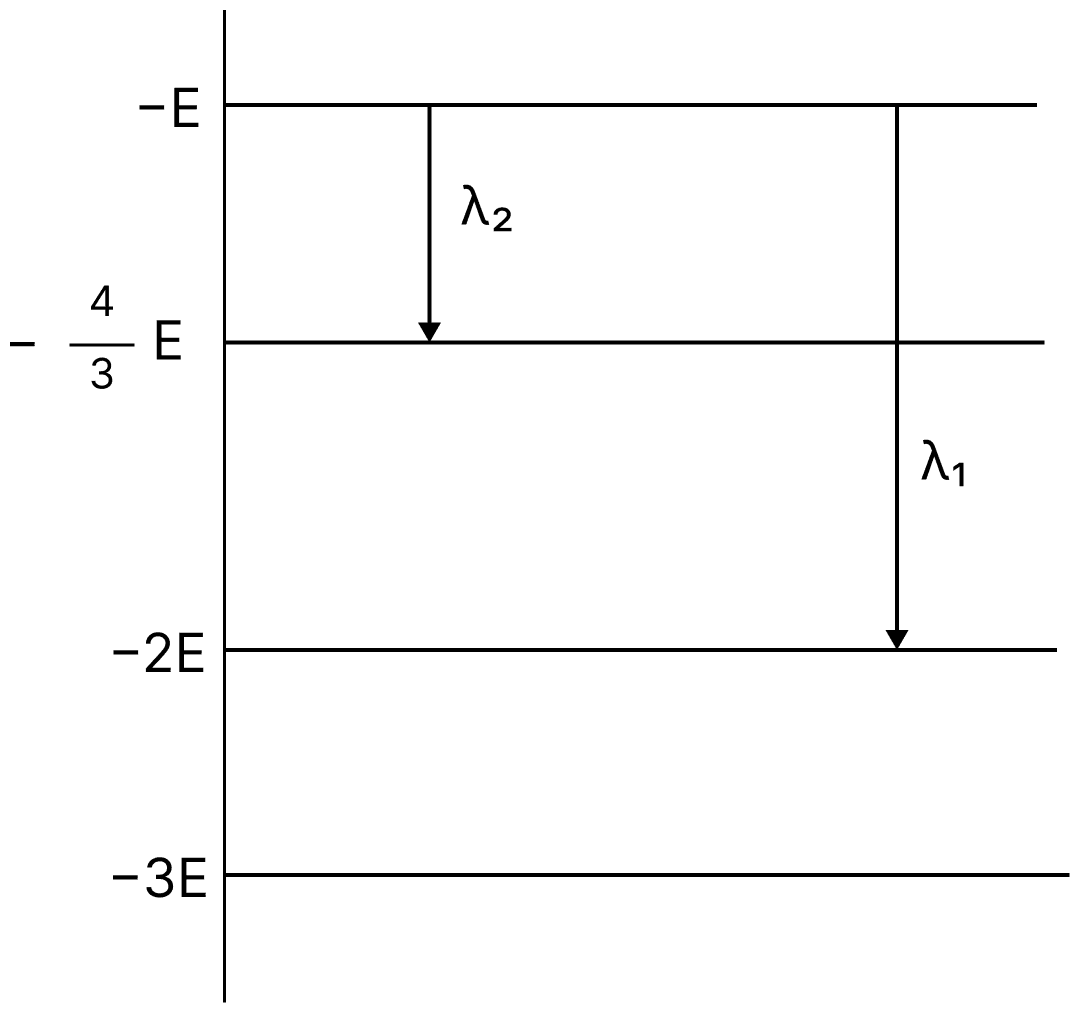
- r = 1/3
- r = 4/3
- r = 2/3
- r = 3/4
Answer
r = 1/3
Reason — From the figure, λ1 is emitted in the transition from −E to −2E and λ2 in the transition from −E to E.
Dividing Eq. (ii) by Eq. (i),
The ratio of kinetic energy to the total energy of an electron in a Bohr orbit of the hydrogen atom, is:
- 1 : 1
- 1 : −2
- 2 : −1
- 1 : −1
Answer
1 : −1
Reason — In a Bohr orbit, and the total energy = −K. Hence, K : E = 1 : −1.
An electron from various excited states of hydrogen atom emit radiation to come to the ground state. Let λn, λg be the de-Broglie wavelength of the electron in the nth state and the ground state respectively. Let Λn be the wavelength of the emitted photon in transition from the nth state to the ground state. For large n, (A, B are constants).
- Λn ≈ A + Bλn
- Λn2 ≈ A + Bλn2
- Λn2 ≈ λ
- Λn ≈ A +
Answer
Λn ≈ A +
Reason — For the electron, , so its kinetic energy is . Since the total energy is E = −k,
As λn ∝ n, for large n, λn ≫ λg. Expanding binomially and neglecting higher powers of ,
where and .
The total energy of an electron in an atom in an orbit is −3.4 eV. Its kinetic and potential energies are, respectively:
- 3.4 eV, −6.8 eV
- 3.4 eV, 3.4 eV
- −3.4 eV, −3.4 eV
- −3.4 eV, −6.8 eV
Answer
3.4 eV, −6.8 eV
Reason — In a Bohr orbit, K = −E and U = 2E. With E = −3.4 eV, K = 3.4 eV and U = 2 × (−3.4) = −6.8 eV.
A He+ ion is in its first excited state. Its ionization energy is:
- 6.04 eV
- 13.60 eV
- 54.40 eV
- 48.36 eV
Answer
13.60 eV
Reason — For He+, Z = 2, and in the first excited state n = 2.
The ionisation energy is the energy needed to raise it to zero, that is, 13.60 eV.
In Li++, electron in first Bohr orbit is excited to a level by a radiation of wavelength λ. When the ion gets de-excited to the ground state in all possible ways (including intermediate emissions), a total of six spectral lines are observed. What is the value of λ? (Given: h = 6.6 × 10⁻³⁴ Js; c = 3 × 10⁸ ms-1)
- 12.3 nm
- 10.8 nm
- 9.4 nm
- 11.4 nm
Answer
10.8 nm
Reason — Given,
- For Li++, Z = 3
- Number of spectral lines, N = 6
- h = 6.6 × 10⁻³⁴ J s, c = 3 × 10⁸ m s-1
The number of lines emitted from level n is . For N = 6, n = 4, so the radiation excites the electron from n = 1 to n = 4.
Therefore,
In a Franck-Hertz experiment, an electron of energy 5.6 eV passes through mercury vapour and emerges with an energy 0.7 eV. The minimum wavelength of photons emitted by mercury atoms is close to:
- 2020 nm
- 220 nm
- 250 nm
- 1700 nm
Answer
250 nm
Reason — The energy given to a mercury atom is ΔE = 5.6 − 0.7 = 4.9 eV. The photon of minimum wavelength carries this whole energy,
which is close to 250 nm.
A hydrogen atom, initially in the ground state is excited by absorbing a photon of wavelength 980 Å. The radius of the atom in the excited state, in terms of Bohr radius a0, will be: (hc = 12500 eV-Å)
- 9a0
- 25a0
- 4a0
- 16a0
Answer
16a0
Reason — Given,
- λ = 980 Å, hc = 12500 eV-Å
Energy of the absorbed photon,
Energy of the excited state,
Since , n2 = = 16, so n = 4. As r ∝ n2, the radius becomes 16a0.
The electron in a hydrogen atom first jumps from the third excited state to the second excited state and subsequently to the first excited state. The ratio of the respective wavelength, λ1/λ2, of the photons emitted in this process is:
- 22/5
- 7/5
- 9/7
- 20/7
Answer
20/7
Reason — The third, second and first excited states are n = 4, 3 and 2. Hence,
Dividing Eq. (ii) by Eq. (i),
An excited He+ ion emits two photons in succession, with wavelengths 108.5 nm and 30.4 nm, in making a transition to ground state. The quantum number n, corresponding to its initial excited state is: (for photon of wavelength λ, energy E = .)
- n = 4
- n = 6
- n = 5
- n = 7
Answer
n = 5
Reason — Given,
- For He+, Z = 2
- λ1 = 108.5 nm, λ2 = 30.4 nm
- eV
The total energy of the two photons equals the energy difference between level n and the ground level,
A free electron of 2.6 eV energy collides with a H+ ion. This results in the formation of a hydrogen atom in the first excited state and a photon is released. Find the frequency of the emitted photon. (h = 6.6 × 10⁻³⁴ Js)
- 1.45 × 10¹⁶ MHz
- 0.19 × 10¹⁵ MHz
- 1.45 × 10⁹ MHz
- 9.0 × 1027 MHz
Answer
1.45 × 10⁹ MHz
Reason — Given,
- Energy of free electron, E1 = 2.6 eV
- h = 6.6 × 10⁻³⁴ J s
The energy of the hydrogen atom in its first excited state (n = 2) is = −3.4 eV. The energy of the emitted photon is
Therefore,
Imagine that the electron in a hydrogen atom is replaced by a muon (μ). The mass of muon particle is 207 times that of an electron and charge is equal to the charge of an electron. The ionisation potential of this hydrogen atom will be:
- 13.6 eV
- 2815.2 eV
- 331.2 eV
- 27.2 eV
Answer
2815.2 eV
Reason — The ionisation energy of a hydrogen-like atom is , which is proportional to the mass of the orbiting particle when its charge is unchanged.
The recoil speed of a hydrogen atom after it emits a photon in going from n = 5 state to n = 1 state will be:
- 4.17 m/s
- 2.19 m/s
- 3.25 m/s
- 4.34 m/s
Answer
4.17 m/s
Reason — Given,
- n2 = 5, n1 = 1
- Taking R = 1.097 × 10⁷ m-1, h = 6.63 × 10⁻³⁴ J s and mass of hydrogen atom, mH = 1.67 × 10⁻²⁷ kg
Wavelength of the emitted photon,
By conservation of linear momentum, momentum of recoiled H-atom = momentum of photon,
which matches 4.17 m/s within rounding of the constants.
Note: The textbook's answer key gives option (d), 4.34 m/s, which comes from taking the mass of the hydrogen atom as 1.6 × 10⁻²⁷ kg and R = 1.09 × 10⁷ m-1. With mH = 1.67 × 10⁻²⁷ kg, as in the chapter's own Example 21, the recoil speed is ≈ 4.17 m/s, option (a).
Which of the following statement(s) is(are) correct about the spectrum of hydrogen atom?
- The ratio of the longest wavelength to the shortest wavelength in Balmer series is .
- There is an overlap between the wavelength ranges of Balmer and Paschen series.
- The wavelengths of Lyman series are given by λ0, where λ0 is the shortest wavelength of Lyman series and m is an integer.
- The wavelength ranges of Lyman and Balmer series do not overlap.
Answer
The ratio of the longest wavelength to the shortest wavelength in Balmer series is .
The wavelength ranges of Lyman and Balmer series do not overlap.
Reason — For the Balmer series, (3 → 2) and (∞ → 2), so their ratio is . Statement 1 is correct.
The ranges of the three series are : Lyman, to (912 Å to 1216 Å); Balmer, to (3646 Å to 6563 Å); Paschen, to (8204 Å to 18750 Å). Lyman and Balmer do not overlap, so statement 4 is correct, and Balmer and Paschen do not overlap either, so statement 2 is wrong.
For the Lyman series, and λ0 = , so , not . Statement 3 is wrong.
Let T1 and T2 be the energy of an electron in the first and second excited states of hydrogen atoms, respectively. According to the Bohr's model of an atom, the ratio T1 : T2 is:
- 9 : 4
- 1 : 4
- 4 : 1
- 4 : 9
Answer
9 : 4
Reason — Since , En ∝ . The first and second excited states are n = 2 and n = 3, so
Electron in the ground state of hydrogen atom absorbs 10.2 eV energy. Find the change in its angular momentum.
Answer
Reason — Since −13.6 eV + 10.2 eV = −3.4 eV, the electron goes from n = 1 to n = 2. Hence,
A small particle of mass m moves in such a way that its potential energy U = mω2r2, where ω is constant and r is the distance of the particle from origin. Assuming Bohr's quantization of momentum and circular orbit, the radius of nth orbit will be proportional to:
- n2
- n
Answer
Reason — The force on the particle is
This force provides the centripetal force,
By Bohr's quantisation condition,
Substituting Eq. (i) in Eq. (ii),
Hence, r2 ∝ n, or r ∝ .
In hydrogen spectrum, the shortest wavelength in the Balmer series is λ. The shortest wavelength in the Bracket series is:
- 9λ
- 16λ
- 2λ
- 4λ
Answer
4λ
Reason — The shortest wavelengths of the Balmer and Brackett series correspond to the transitions ∞ → 2 and ∞ → 4.
Dividing Eq. (i) by Eq. (ii), = 4, so λ' = 4λ.
A particle of mass m is moving in a circular orbit under the influence of the central force F(r) = −kr, corresponding to the potential energy V(r) = , where k is a positive force constant and r is the radial distance from the origin. According to the Bohr's quantization rule, the angular momentum of the particle is given by L = nℏ, where ℏ = , h is the Planck's constant, and n a positive integer. If v and E are the speed and total energy of the particle, respectively, then which of the following expression(s) is(are) correct?
- r2 =
- v2 =
- E =
Answer
r2 =
v2 =
Reason — The central force provides the centripetal force,
By the quantisation rule,
From Eq. (i), . Substituting in Eq. (ii),
So statement 1 is correct. From Eq. (i),
So statement 2 is correct. Also, from Eq. (i),
so statement 3 is correct. The total energy is
which is twice the value in statement 4, so statement 4 is wrong.
The spectral series which corresponds to the electronic transition from the levels n2 = 5, 6, ... to the level n1 = 4 is:
- Pfund series
- Brackett series
- Lyman series
- Balmer series
Answer
Brackett series
Reason — The lines emitted when the electron comes down from n2 = 5, 6, 7, ... to the fourth level n1 = 4 form the Brackett series, which lies in the infrared region.
Given here are two statements:
Statement I: Most of the mass of the atom and all its positive charge are concentrated in a tiny nucleus and the electrons revolve around it, is Rutherford's model.
Statement II: An atom is a spherical cloud of positive charges with electrons embedded in it, is a special case of Rutherford's model.
In the light of the above statements, choose the most appropriate option from the given options.
- Both statement I and statement II are false
- Statement I is false but statement II is true
- Statement I is true but statement II is false
- Both statement I and statement II are true
Answer
Statement I is true but statement II is false
Reason — Statement I correctly describes Rutherford's nuclear model. Statement II describes Thomson's model (a sphere of positive charge with electrons embedded in it), which is not a special case of Rutherford's model.
An electron revolving in nth Bohr orbit has magnetic moment μn. If μn ∝ nx, the value of x is:
- 2
- 1
- 3
- 0
Answer
1
Reason — The orbiting electron is equivalent to a current , so its magnetic moment is
As v ∝ and r ∝ n2, μn ∝ n1. Hence, x = 1.
In the line spectra of hydrogen atom, difference between the largest and the shortest wavelengths of the Lyman series is 304 Å. The corresponding difference for the Paschen series in Å is ............... .
Answer
Given,
- For the Lyman series, λlargest − λshortest = 304 Å
Using ,
Lyman series (n1 = 1) : the largest wavelength is for 2 → 1 and the shortest for ∞ → 1.
Paschen series (n1 = 3) : the largest wavelength is for 4 → 3 and the shortest for ∞ → 3.
Therefore,
Hence, the corresponding difference for the Paschen series is 10553.14 Å.
x different wavelengths may be observed in the spectrum from a hydrogen sample if the atoms are exited to states with principal quantum number n = 6. The value of x is ............... .
Answer
Given,
- Principal quantum number of the excited state, n = 6
The number of different wavelengths emitted when electrons return from level n to the ground state, in all possible ways, is
Substituting n = 6,
Hence, the value of x is 15.
The Kα X-ray of molybdenum has wavelength 0.071 nm. If the energy of a molybdenum atom with a K electron knocked out is 27.5 keV, the energy of this atom when an L electron is knocked out will be ............... keV. (Round off to the nearest integer) [Take, h = 4.14 × 10⁻¹⁵ eV-s, c = 3 × 10⁸ ms-1]
Answer
Given,
- Wavelength of Kα X-ray, λ = 0.071 nm = 0.071 × 10⁻⁹ m
- Energy of the atom with a K electron knocked out, EK = 27.5 keV
- h = 4.14 × 10⁻¹⁵ eV-s, c = 3 × 10⁸ m s-1
The Kα X-ray is emitted when an L electron fills the vacancy in the K shell, so the atom passes from the state with a K vacancy to the state with an L vacancy. Its energy is
Therefore,
Hence, the energy of the atom when an L electron is knocked out is 10 keV.
A particle of mass m moves in a circular orbit in a central potential field U(r) = U0 r4. If Bohr's quantisation conditions are applied, radii of possible orbitals rn vary with n1/α, where α is ............... .
Answer
Given,
- U(r) = U0r4
The force on the particle is
This force provides the centripetal force for the circular orbit,
so v ∝ r2. By Bohr's quantisation condition,
so vr ∝ n. Putting v ∝ r2, r3 ∝ n, that is, r ∝ n1/3.
Comparing with rn ∝ n1/α, .
Hence, the value of α is 3.
The first three spectral lines of H-atom in the Balmer series are given λ1, λ2, λ3 considering the Bohr atomic model, the wavelengths of first and third spectral lines are related by a factor of approximately x × 10-1.
The value of x to the nearest integer, is ............... .
Answer
For the Balmer series, the first and third lines correspond to n = 3 and n = 5.
Dividing Eq. (ii) by Eq. (i),
Hence, the value of x is 15.
A monochromatic light is incident on a hydrogen sample in ground state. Hydrogen atoms absorb a fraction of light and subsequently emit radiation of six different wavelengths. The frequency of incident light is x × 1015 Hz. The value of x is ............... . (Given h = 4.25 × 10⁻¹⁵ eVs)
Answer
Given,
- Number of emitted wavelengths, N = 6
- h = 4.25 × 10⁻¹⁵ eVs
The number of wavelengths emitted from level n is
(the root n = −3 is rejected). So the incident light raises the atom from n = 1 to n = 4,
Hence, the value of x is 3.
The radius of 2nd orbit of He+ of Bohr's model is r1 and that of fourth orbit of Be3+ is represented as r2. Now the ratio is x : 1. The value of x is ............... .
Answer
Given,
- He+ : Z = 2, n = 2, radius r1
- Be3+ : Z = 4, n = 4, radius r2
The radius of the nth orbit of a hydrogen-like atom is
where r0 is the Bohr radius.
Therefore,
Hence, the value of x is 2.
An atom absorbs a photon of wavelength 500 nm and emits another photon of wavelength 600 nm. The net energy absorbed by the atom in this process is n × 10-4 eV. The value of n is ............... . [Assume the atom to be stationary during the absorption and emission process] (Take h = 6.6 × 10⁻³⁴ Js and c = 3 × 10⁸ m/s)
Answer
Given,
- λ1 = 500 nm = 500 × 10-9 m (absorbed)
- λ2 = 600 nm = 600 × 10-9 m (emitted)
- h = 6.6 × 10⁻³⁴ J s, c = 3 × 10⁸ m/s
Net energy absorbed = energy of absorbed photon − energy of emitted photon,
In electron-volt,
Hence, the value of n is 4125.
Hydrogen atom is bombarded with electrons accelerated through a potential difference of V, which causes excitation of hydrogen atoms. If the experiment is being formed at T = 0 K, the minimum potential difference needed to observe any Balmer series lines in the emission spectra will be V, where α = ............... .
Answer
At T = 0 K all the hydrogen atoms are in the ground state (n = 1). A Balmer line is emitted when the electron comes down to n = 2, which requires it first to be raised at least to n = 3. Hence, the bombarding electrons must supply at least the energy difference between n = 3 and n = 1,
The minimum accelerating potential difference is therefore
Hence, the value of α is 121.