
What is the shape of wavefront for beam of parallel rays; what for originating from a point source?
Answer
Plane wavefront for a beam of parallel rays; spherical wavefront for light originating from a point source.
Explanation:
A wavefront is always normal to the rays. Parallel rays are normal to a set of parallel planes, whereas the rays from a point source are radial lines, which are normal to spheres drawn with the source as centre.
Derive laws of refraction using Huygen's principle. Draw a neat diagram.
Answer
Let SS' be a plane refracting surface separating medium 1 and medium 2, in which the speeds of light are v1 and v2 respectively (v1 > v2). Let AB be a plane wavefront incident obliquely on SS', its end A touching the surface first.
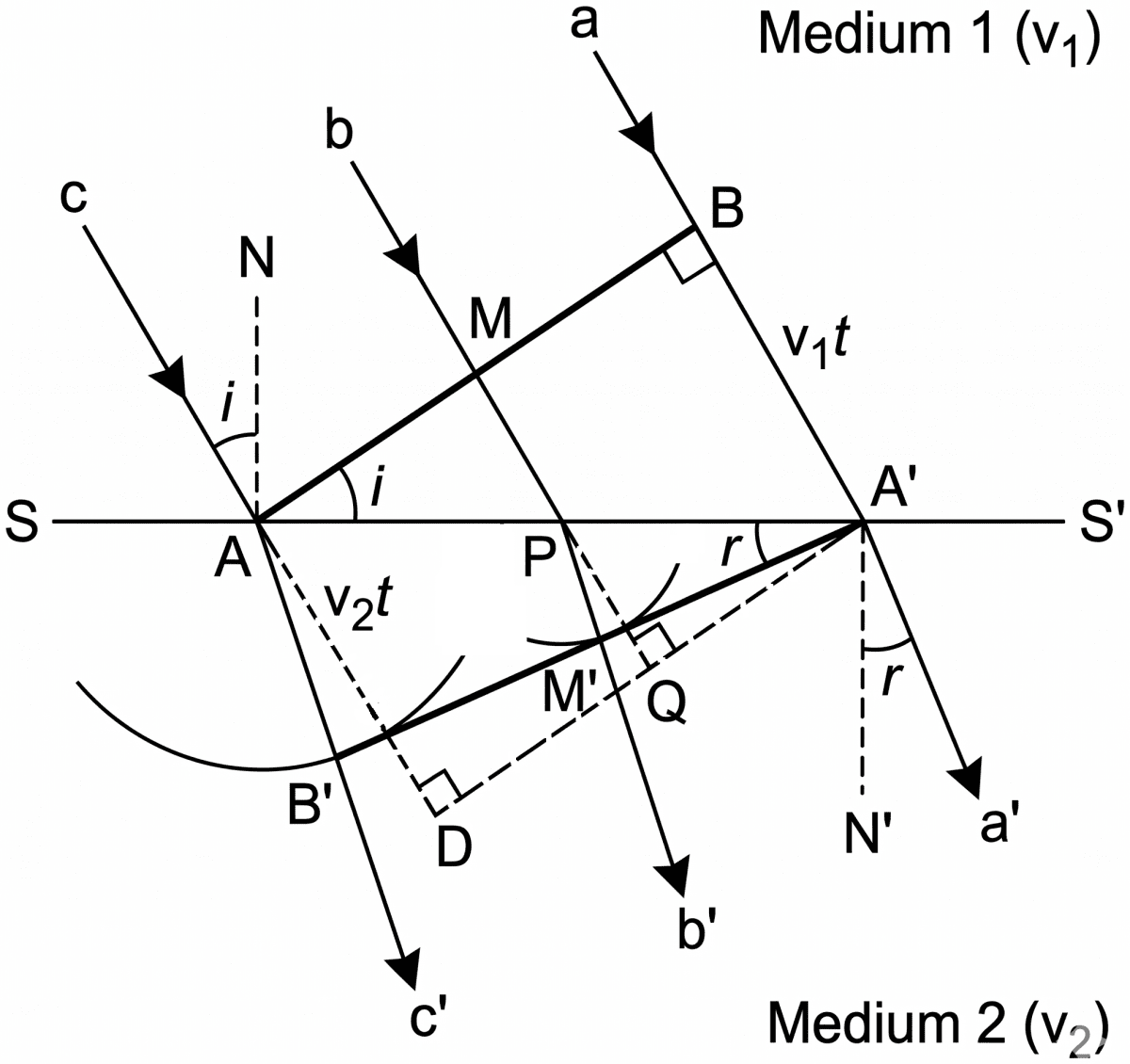
Let t be the time taken by the end B of the wavefront to reach the point A' on the surface. Then
As the wavefront advances, the points of SS' between A and A' are struck one after another and each becomes a source of secondary wavelets. In the time t, the secondary wavelet from A travels into medium 2 and acquires a radius
whereas the wavelet from A' just starts. The wavelets from the points between A and A' have radii that fall off in proportion to their distance from A', so the tangent A'B' drawn from A' to the wavelet from A touches all of them. Hence, A'B' is the refracted wavefront.
The rays a, b and a', b' are normal to the incident and refracted wavefronts respectively. Since the angle between two lines equals the angle between their normals, the angle of incidence i = ∠BAA' and the angle of refraction r = ∠AA'B'.
From the right-angled triangles ABA' and AB'A',
Therefore, using Eqs. (i) and (ii),
Second law (Snell's law) : As v1 and v2 are constant for the given pair of media, = constant = 1n2, the refractive index of medium 2 with respect to medium 1.
First law : AB, A'B' and SS' all lie in the plane of the paper. Hence, the incident ray, the refracted ray and the normal at the point of incidence all lie in the same plane.
State Huygen's principle.
Answer
Huygens' principle states that :
(i) Each particle of the medium that lies on a wavefront becomes a new source of disturbance and sends out fresh waves, known as secondary wavelets.
(ii) These secondary wavelets spread out in all directions in the medium, with the same speed as the original wave (light) has in that medium.
(iii) At any instant, the surface that touches all the secondary wavelets in the forward direction, that is, their forward envelope, gives the position of the new wavefront.
What type of wavefront is produced by : (i) Point source of light, (ii) Line source of light.
Answer
(i) Spherical wavefront.
(ii) Cylindrical wavefront.
Explanation:
The disturbance from a point source reaches all points lying on a sphere centred at the source at the same instant, while that from a line source (such as a fine slit) reaches all points on a cylinder having the source as its axis at the same instant.
If 'd' is the distance travelled by a light wave in air in 't' seconds and 'D' is the distance travelled in a medium of refractive index 'n' in the same time, prove that d = nD.
Answer
Let c be the speed of light in air and v its speed in the medium of refractive index n. According to wave theory,
The time taken by the light wave to travel a distance D in the medium is
In the same time t, the distance travelled by the light wave in air is
Hence, d = nD. The product nD is called the optical path travelled by the light in the medium.
The refractive indices of glass, diamond and water are 1.5, 2.09 and 1.33 respectively. In which of these will the speed of light be maximum? Justify your answer with a suitable reason.
Answer
The speed of light is maximum in water.
Reason : According to wave theory, the speed of light in a medium of refractive index n is
that is, the speed of light in a medium is inversely proportional to its refractive index. Among glass (1.5), diamond (2.09) and water (1.33), water has the smallest refractive index, so light travels fastest in water.
What type of wavefront is generated from a line source of light?
Answer
Cylindrical wavefront.
Explanation:
For a line source, such as a fine rectangular slit, the points that the disturbance reaches at the same instant lie on a cylinder with the source as its axis.
State one postulate of Huygens' wave theory.
Answer
Every particle of the medium situated on a wavefront acts as a new source of disturbance, from which fresh waves, called secondary wavelets, spread out in all directions with the speed of light in that medium.
What is the shape of the wavefront diverging from a point source of light?
Answer
Spherical wavefront.
Explanation:
The disturbance from a point source reaches all particles of the medium lying on a sphere centred at the source at the same instant, so these particles oscillate in the same phase.
On the basis of Huygens' wave theory, show that when light is incident on a plane mirror obliquely, angle of reflection is equal to angle of incidence.
Answer
Let SS' be a plane mirror and AB a plane wavefront incident on it obliquely, so that its end A strikes the mirror first. Let v be the speed of light and t the time taken by the end B to reach the point A' on the mirror.
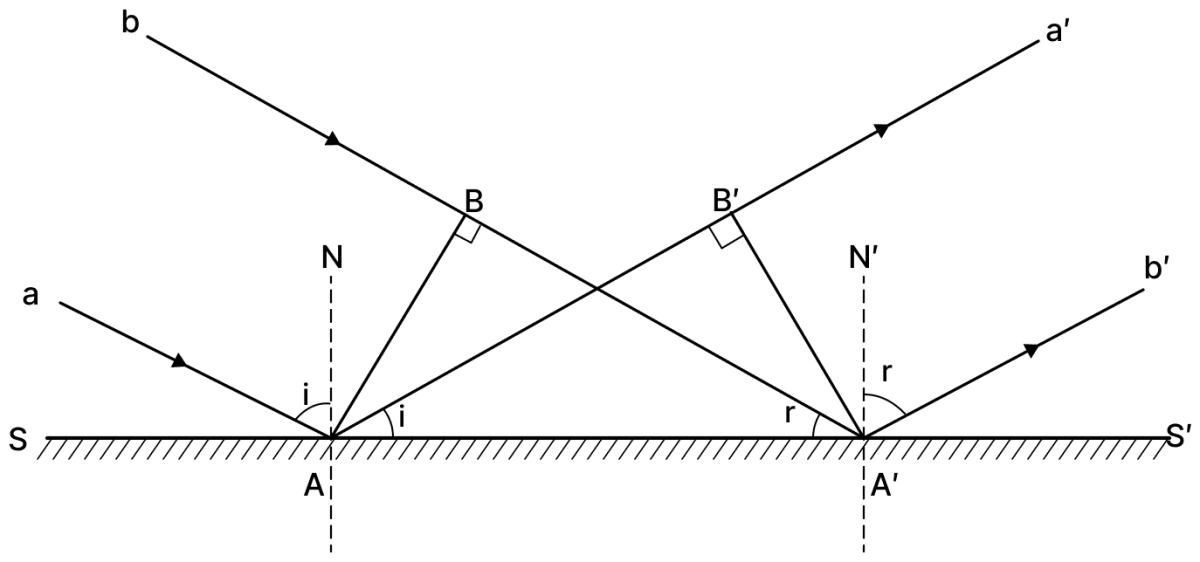
The points of the mirror between A and A' are struck in turn and become sources of secondary wavelets. As the reflected wavelets travel in the same medium, the wavelet from A acquires in time t a radius
while the wavelet from A' just starts. The tangent A'B' drawn from A' to the wavelet from A is common to all the wavelets from the points between A and A', so A'B' is the reflected wavefront.
Let i and r be the angles of incidence and reflection. Then i = ∠BAA' and r = ∠AA'B'. From the right-angled triangles ABA' and AB'A', which have the common hypotenuse AA',
Dividing, and using Eqs. (i) and (ii),
so that sin i = sin r.
Hence, i = r, that is, the angle of reflection is equal to the angle of incidence.
What is the phase difference between any two points lying on the same wavefront?
Answer
Zero.
Explanation:
A wavefront is a surface on which all the particles of the medium are in the same phase of oscillation. Hence, there is no phase difference between any two points lying on it.
On the basis of Huygens' wave theory, prove Snell's law of refraction of light. Draw a neat and labelled diagram. (Postulates of Huygens' wave theory not required)
Answer
Let SS' be a plane surface separating medium 1 and medium 2, in which light travels with speeds v1 and v2 (v1 > v2). A plane wavefront AB strikes SS' obliquely, the end A reaching the surface first.
Construction : Let the end B of the wavefront reach the point A' on SS' in time t. Then
During this time the points between A and A' become sources of secondary wavelets one after another. The wavelet from A, travelling in medium 2, acquires a radius
while the wavelet from A' just starts. The tangent A'B' from A' to the wavelet from A is common to the wavelets from all the points between A and A'. Hence, A'B' is the refracted wavefront.
Deduction of the law : Rays are normal to the wavefronts, so a, b are the incident rays and a', b' the refracted rays. Let AN and A'N' be the normals to SS'. As the angle between two lines equals the angle between their normals,
From ΔABA' and ΔAB'A',
Therefore, from Eqs. (i) and (ii),
Since v1 and v2 are constant for a given pair of media,
This is Snell's law of refraction, where 1n2 is the refractive index of medium 2 with respect to medium 1.
Derive the law of reflection using Huygens' wave theory.
Answer
Consider a plane wavefront AB incident obliquely on a plane reflecting surface SS'. The end A of the wavefront touches the surface first. Let v be the speed of light in the medium.
Let the end B reach the point A' on SS' in time t, so that
By Huygens' principle, each point of SS' between A and A' becomes a source of secondary wavelets as the wavefront strikes it. In the time t, the wavelet from A spreads back into the same medium to a radius
and the wavelet from A' just starts. The common tangent A'B' drawn from A' to all these wavelets is the reflected wavefront.
If i and r are the angles of incidence and reflection, i = ∠BAA' and r = ∠AA'B'.
In ΔABA',
In ΔAB'A',
Hence, using Eqs. (i) and (ii),
so that sin i = sin r, or i = r.
Second law of reflection : The angle of incidence is equal to the angle of reflection.
First law of reflection : AB, A'B' and SS' lie in the plane of the paper, so the incident ray, the reflected ray and the normal at the point of incidence all lie in the same plane.
What type of wavefronts are associated with a source at infinity?
- Cylindrical
- Plane wavefronts
- Spherical wavefronts
- All types of wavefronts
Answer
Plane wavefronts
Reason — A source at infinity sends parallel rays. The wavefront reaching us is a very small portion of a sphere of very large radius, which is practically plane.