
The de-Broglie wavelength of a particle is:
- proportional to its mass
- proportional to its energy
- proportional to its momentum
- inversely proportional to its momentum
Answer
inversely proportional to its momentum
Reason — The de-Broglie wavelength of a particle of momentum p is , where h is Planck's constant. As h is constant, λ is inversely proportional to the momentum p.
The wavelength of de-Broglie waves associated with a moving particle is independent of its:
- mass
- charge
- velocity
- momentum
Answer
charge
Reason — The de-Broglie wavelength depends only on the mass and the velocity (that is, the momentum) of the particle. It does not depend upon whether the moving particle is charged or uncharged.
Which one of the following particles moving with the same velocity has longest waves associated with it?
- Proton
- Neutron
- α-particle
- β-particle
Answer
β-particle
Reason — For the same velocity v, , so λ ∝ . Of the four particles, the β-particle (electron) has the smallest mass, so the wave associated with it is the longest.
The de-Broglie wavelength λ of a particle and its kinetic energy are related as:
- λ ∝ K
- λ ∝
- λ ∝
- λ ∝
Answer
λ ∝
Reason — The de-Broglie wavelength of a particle of mass m and kinetic energy K is . For a given particle m is constant, so λ ∝ .
A moving proton and electron have the same de-Broglie wavelength. If K and P denote the KE and momentum, respectively, then, choose the correct option.
- Kp < Ke and Pp = Pe
- Kp = Ke and Pp = Pe
- Kp < Ke and Pp < Pe
- Kp > Ke and Pp = Pe
Answer
Kp < Ke and Pp = Pe
Reason — Since , equal de-Broglie wavelengths mean equal momenta, Pp = Pe. The kinetic energy is , so for the same momentum K ∝ . As mp > me, Kp < Ke.
An electron of mass me and a proton of mass mp are accelerated through the same potential difference. The ratio of the de-Broglie wavelength associated with the electron to that with proton is:
Answer
Reason — A particle of charge q accelerated through a potential difference V acquires kinetic energy K = qV, so
The electron and the proton carry charges of the same magnitude e and are accelerated through the same V, so λ ∝ . Hence,
The de-Broglie wavelength of a neutron in thermal equilibrium with heavy water at a temperature T (Kelvin) and mass m, is:
Answer
Reason — A neutron in thermal equilibrium at temperature T has average kinetic energy . Therefore,
The kinetic energy of a proton is equal to the energy E of a photon. If λ1 be the (de-Broglie) wavelength of the proton and λ2 that of the photon, then the ratio λ1 / λ2 is proportional to:
- E
- E1/2
- E-1/2
- E-1
Answer
E1/2
Reason — For the proton of kinetic energy E, . For the photon, , so . Hence,
As m and c are constants, λ1 / λ2 ∝ E1/2.
The de-Broglie wavelength of a proton and α-particle are equal. The ratio of their velocities is:
- 4 : 2
- 4 : 1
- 1 : 4
- 4 : 3
Answer
4 : 1
Reason — Since , equal wavelengths mean equal momenta, mpvp = mαvα. With mα = 4mp,
If α-particle and proton are accelerated from same potential difference then the ratio of their linear momenta is:
- : 1
- : 3
- : 1
- : 2
Answer
: 1
Reason — A particle of mass m and charge q accelerated through a potential difference V has K = qV, so its momentum is . For the α-particle mα = 4mp and qα = 2e; for the proton the charge is e. Hence,
A particle of mass 4M at rest disintegrates into two particles of mass M and 3M, respectively, having non-zero velocities. The ratio of de-Broglie wavelength of particle of mass M to that of mass 3M will be:
- 1 :
- 1 : 3
- 1 : 1
- 3 : 1
Answer
1 : 1
Reason — The particle is initially at rest, so its momentum is zero. By the law of conservation of linear momentum, the two fragments move in opposite directions with momenta of equal magnitude. Since , their de-Broglie wavelengths are equal, whatever their masses.
What information is derived from electron diffraction experiments?
Answer
Electron diffraction experiments show that moving electrons have a wave-like character — a beam of electrons is diffracted just as a wave is. This confirms de-Broglie's hypothesis of matter waves.
The historic experiment on the diffraction of electrons confirms a new nature of electrons. What is this new nature of electron? Who had proposed it?
Answer
The new nature is the wave nature of electrons, that is, moving electrons behave like waves in some circumstances. It was proposed by Louis de-Broglie (1924).
Are matter waves electromagnetic? Why?
Answer
No. Electromagnetic waves are produced only by accelerated charged particles, whereas matter waves are associated with every moving particle, charged or uncharged. The de-Broglie wavelength does not depend on charge, so matter waves are not electromagnetic in nature.
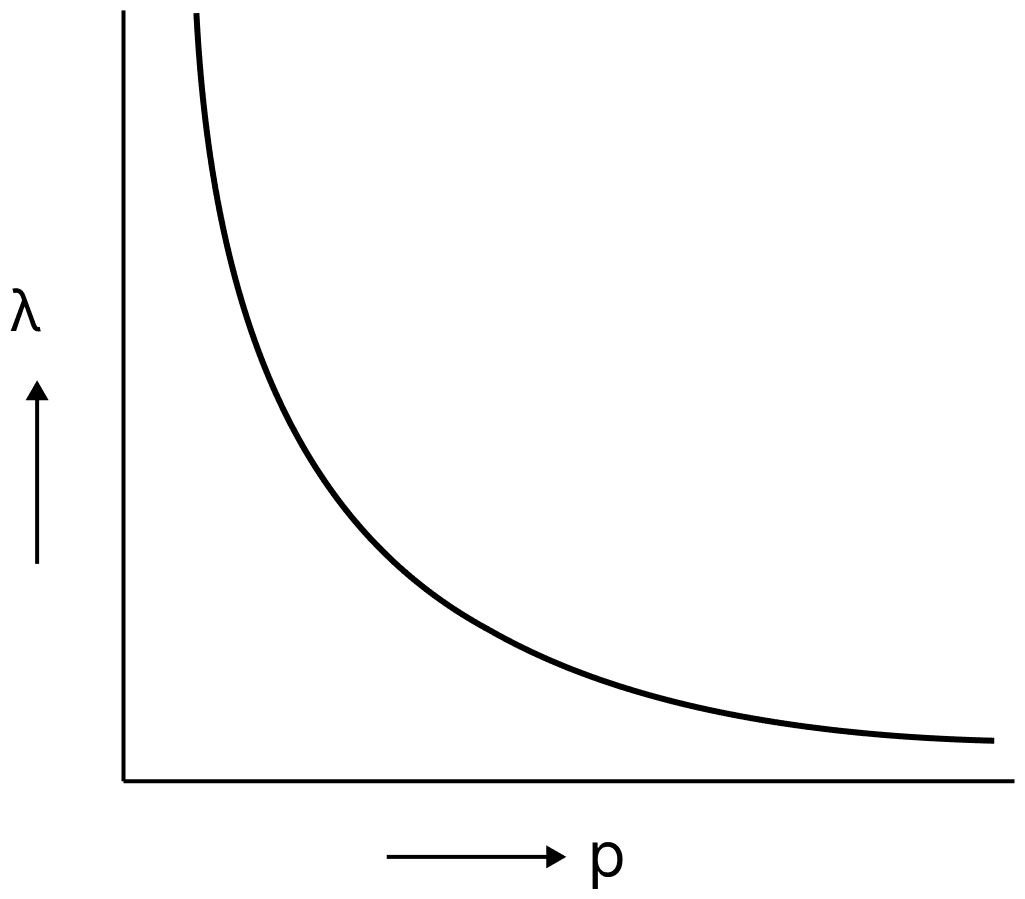
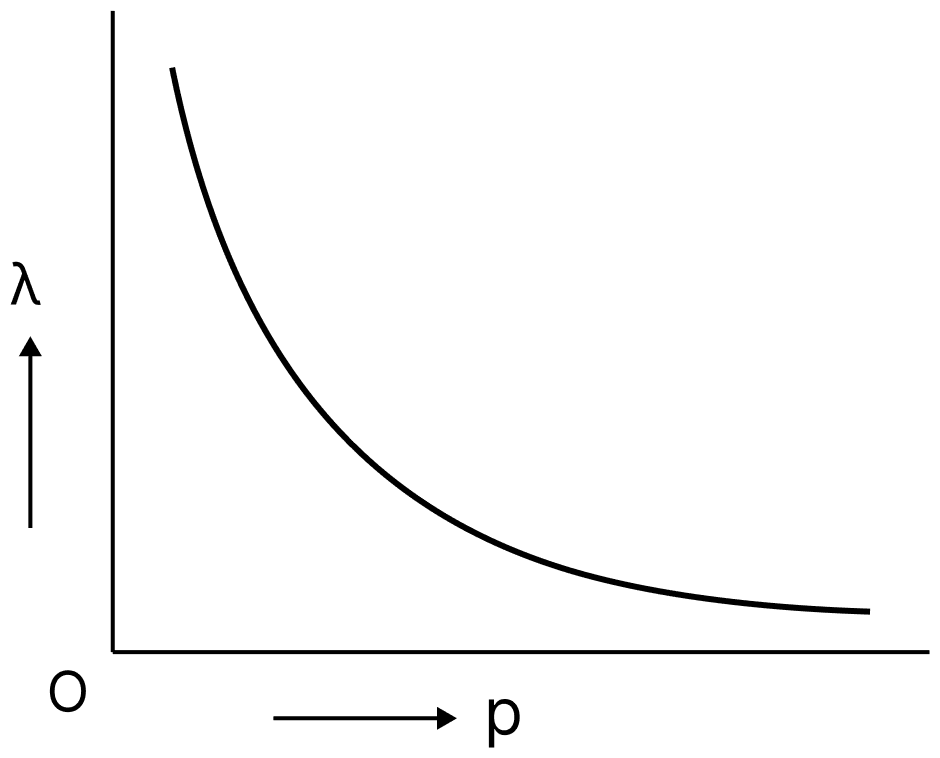
What will be the nature of graph between de-Broglie wavelength and momentum of a moving particle?
Answer
Rectangular hyperbola.
Explanation:
Since , λp = h = constant. Hence the graph of λ against p is a rectangular hyperbola.
Name an instrument based upon the wave like behaviour of electrons. Explain.
Answer
Electron microscope.
In it, a beam of electrons accelerated through a high potential difference is used in place of light. The beam is converged or diverged by suitable electric or magnetic fields, which act on it just as lenses act on light, to form a magnified image. As the de-Broglie wavelength of such electrons is far smaller than that of light, and the resolving power of a microscope is inversely proportional to the wavelength used, an electron microscope has a far higher resolving power than an optical microscope.
Name a phenomenon or an experiment which proves:
(i) particle nature of electromagnetic radiations.
(ii) wave nature of particles.
Answer
(i) Photoelectric effect (also Compton effect).
(ii) Davisson and Germer experiment (electron diffraction).
The velocity of an electron of de-Broglie wavelength λ increases four times. Find the new wavelength.
Answer
Explanation:
For an electron of mass m, , so λ ∝ . When the velocity becomes 4v,
Hence, the new wavelength is .
Which has a greater de-Broglie wavelength, a proton or an electron, moving with the same velocity?
Answer
Electron.
Explanation:
, so for the same velocity λ ∝ . The electron is much lighter than the proton (me < mp), so it has the greater de-Broglie wavelength.
(i) What are matter waves?
(ii) Show how de-Broglie wavelength (λ) of moving particles varies with their linear momentum (p).
Answer
(i) The waves associated with moving material particles are called matter waves or de-Broglie waves.
(ii) The de-Broglie wavelength of a particle of momentum p is
As h is constant, λ ∝ , i.e. λp = h = constant. Thus λ decreases as p increases, and the graph of λ against p is a rectangular hyperbola.
Why is the wave nature of matter not apparent to our daily observations?
Answer
The de-Broglie wavelength of a body is . The objects of our daily life are macroscopic, with large masses, so their wavelengths are extremely small. For example, for a ball of mass 0.060 kg moving at 1.0 m s-1,
This is far smaller than any obstacle or aperture, even of atomic size (~ 10-10 m), so no diffraction or interference effect can be observed. Hence the wave nature of such matter is not apparent.
Show that the wavelength of electromagnetic radiation is equal to the de-Broglie wavelength of its quantum (photon).
Answer
For a photon of frequency ν, the energy is E = hν. From Einstein's relation E = mc2, its (kinetic) mass is . As it moves with the speed of light c, its momentum is
But , where λ is the wavelength of the radiation. Therefore,
The de-Broglie wavelength of the photon is
Substituting Eq. (i) in Eq. (ii),
Hence, the wavelength of electromagnetic radiation is equal to the de-Broglie wavelength of its quantum (photon).
An electron and a proton have the same kinetic energy. Which one has greater de-Broglie wavelength? Give formula.
Answer
The electron has the greater de-Broglie wavelength.
The de-Broglie wavelength of a particle of mass m and kinetic energy K is
For the same K, λ ∝ , so
Since me < mp, λe > λp.
An electron and a proton have the same de-Broglie wavelength. Which one has higher kinetic energy? Which one is moving faster?
Answer
Since , the same de-Broglie wavelength means the same momentum p for both particles.
Kinetic energy : , so for the same p, K ∝ . As me < mp, the electron has the higher kinetic energy.
Speed : , so for the same p, v ∝ . Hence the electron is moving faster.
A photon and an electron have same de-Broglie wavelength (≈ 10-10 m). Compare the kinetic energy of the electron with the (total) energy of the photon.
Answer
Given,
- de-Broglie wavelength of each, λ = 10-10 m
- h = 6.63 × 10⁻³⁴ J s
- Mass of electron, m = 9.1 × 10⁻³¹ kg
- c = 3 × 10⁸ m s-1
Kinetic energy of the electron : and , so . Therefore,
Energy of the photon :
Dividing,
Hence, K/E ≈ 0.012 < 1, i.e. the kinetic energy of the electron is much less (about ) than the energy of the photon.
A proton and an alpha particle have been accelerated through the same potential difference. Compute the ratio of their de-Broglie wavelengths.
Answer
Given,
- Proton : mass mp, charge e
- α-particle : mass mα = 4mp, charge 2e
- Both accelerated through the same potential difference V
The kinetic energies acquired are
so . The de-Broglie wavelength of a particle of mass m and kinetic energy K is . Therefore,
Hence, λp : λα = : 1.
Describe in brief what is observed when moving electrons are allowed to fall on a thin graphite film and the emergent beam falls on a fluorescent screen.
Answer
A central bright spot, formed by the undeflected electrons, surrounded by a series of concentric bright and dark diffraction rings is observed on the screen.
The regularly arranged atoms of the graphite film act as a diffraction grating for the electrons, whose de-Broglie wavelength is of the order of the interatomic spacing. The ring pattern shows the wave nature of moving electrons.
Show that the de-Broglie wavelength of electron of energy K is given by .
Answer
Consider an electron of mass m moving with velocity v (much smaller than the velocity of light). Its de-Broglie wavelength is
If K is its kinetic energy,
Substituting Eq. (ii) in Eq. (i),
Hence, the de-Broglie wavelength of an electron of energy K is .
After his lecture on Wave Nature of Matter, teacher asks some questions to the student. State whether the responses of the students, in each case, are correct or incorrect. Give a reason for your answer.
(i) TEACHER : How is the de-Broglie wavelength related to the momentum of the material particle?
STUDENT : It is inversely proportional to the momentum of the material particle.
(ii) TEACHER : If kinetic energy of a moving particle is quadrupled, how does it affect the wavelength?
STUDENT : It is doubled.
(iii) TEACHER : Name an experiment which verify the existence of matter waves?
STUDENT : Davisson and Germer's experiment.
Answer
(i) Response is correct.
The de-Broglie wavelength is
As h is constant, λ ∝ , i.e. λ is inversely proportional to the momentum.
(ii) Response is incorrect.
For a particle of mass m and kinetic energy K,
When the kinetic energy becomes 4K,
So the wavelength becomes half, not double.
(iii) Response is correct.
In the Davisson and Germer experiment a beam of electrons was diffracted by a nickel crystal, and the wavelength found from the diffraction agreed with the de-Broglie wavelength. This verified that a wave is always associated with moving electrons, i.e. the existence of matter waves.
What do you understand by wave particle duality for electromagnetic radiation. Derive the relation , where symbols have their usual meanings.
Answer
Wave-particle duality of electromagnetic radiation :
Phenomena like interference, diffraction and polarisation are explained only by treating radiation as an electromagnetic wave. On the other hand, the photoelectric effect and the Compton effect are explained only by the quantum (photon) theory, in which radiation consists of particles called photons, each having energy E = hν and momentum p = . Thus radiation has a dual nature — it behaves sometimes as a wave and sometimes as a particle. No single experiment shows both aspects simultaneously; which picture applies depends upon the nature of the experiment.
Derivation of :
According to de-Broglie, the wavelength associated with a particle of mass m moving with velocity v is
where h is Planck's constant.
Let an electron of charge e be accelerated from rest through a potential difference V. The work done on it by the field, eV, appears as its kinetic energy:
Substituting Eq. (ii) in Eq. (i),
where m is the mass of the electron, e its charge, V the accelerating potential difference and h Planck's constant.
Hence, .
Explain Davisson and Germer's experiment to the wave nature of fast moving electrons by using the relation Å, where λ is wavelength and V is accelerating voltage.
Answer
Principle : If electrons have a wave nature, a beam of electrons should be diffracted by a crystal, whose regularly arranged atoms act as a diffraction grating.
Apparatus :
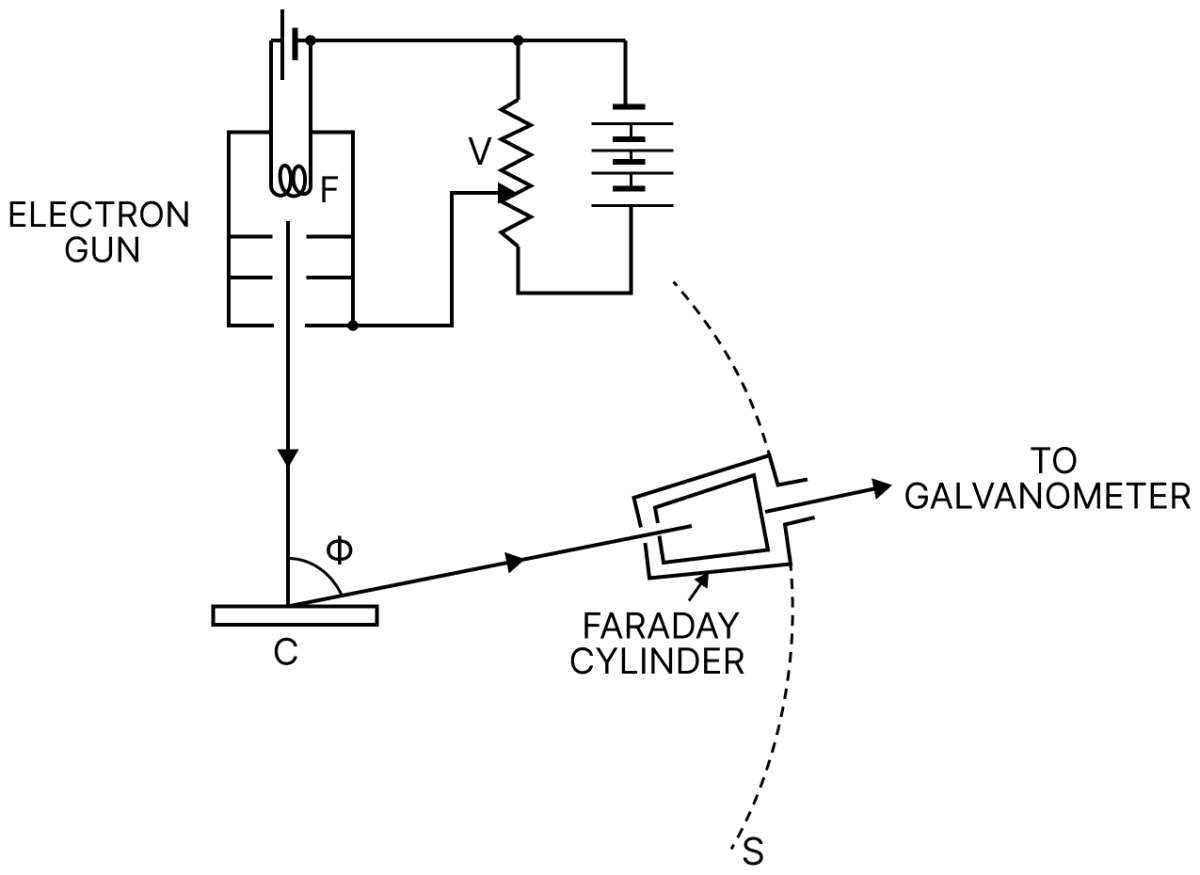
In the electron gun, a heated filament F emits electrons, which are collimated into a fine pencil and accelerated through a variable potential difference V. This electron beam is incident normally on a nickel crystal C. A Faraday cylinder connected to a galvanometer collects the electrons scattered by the crystal. The cylinder can be moved to any position along a circular scale S, and the crystal is free to turn about an axis parallel to the incident beam.
Working and observation : For a given V, the Faraday cylinder is set at various positions and the galvanometer current — a measure of the intensity of the diffracted beam — is noted against the angle φ between the incident beam and the beam entering the cylinder. The readings are repeated for different accelerating potentials.
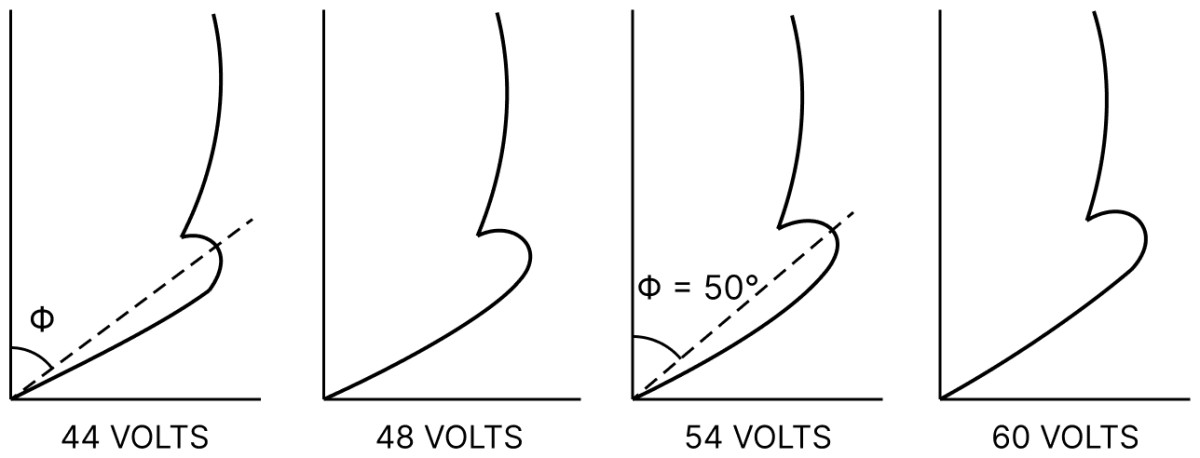
A bump appears in the curve at 44 V. It grows with increasing potential, is most prominent for 54 V electrons at φ = 50°, and then gradually disappears. This strong peak in a particular direction is due to diffraction of the electron waves by the crystal.
Wavelength from the de-Broglie relation : Substituting the values of h, m and e in gives Å, and since (12.27)2 ≈ 150, Å. For V = 54 V,
Wavelength from the diffraction :
Given,
- Spacing of the Bragg planes of nickel, d = 0.91 Å
- Angle of the diffracted beam, φ = 50°
- Order, n = 1
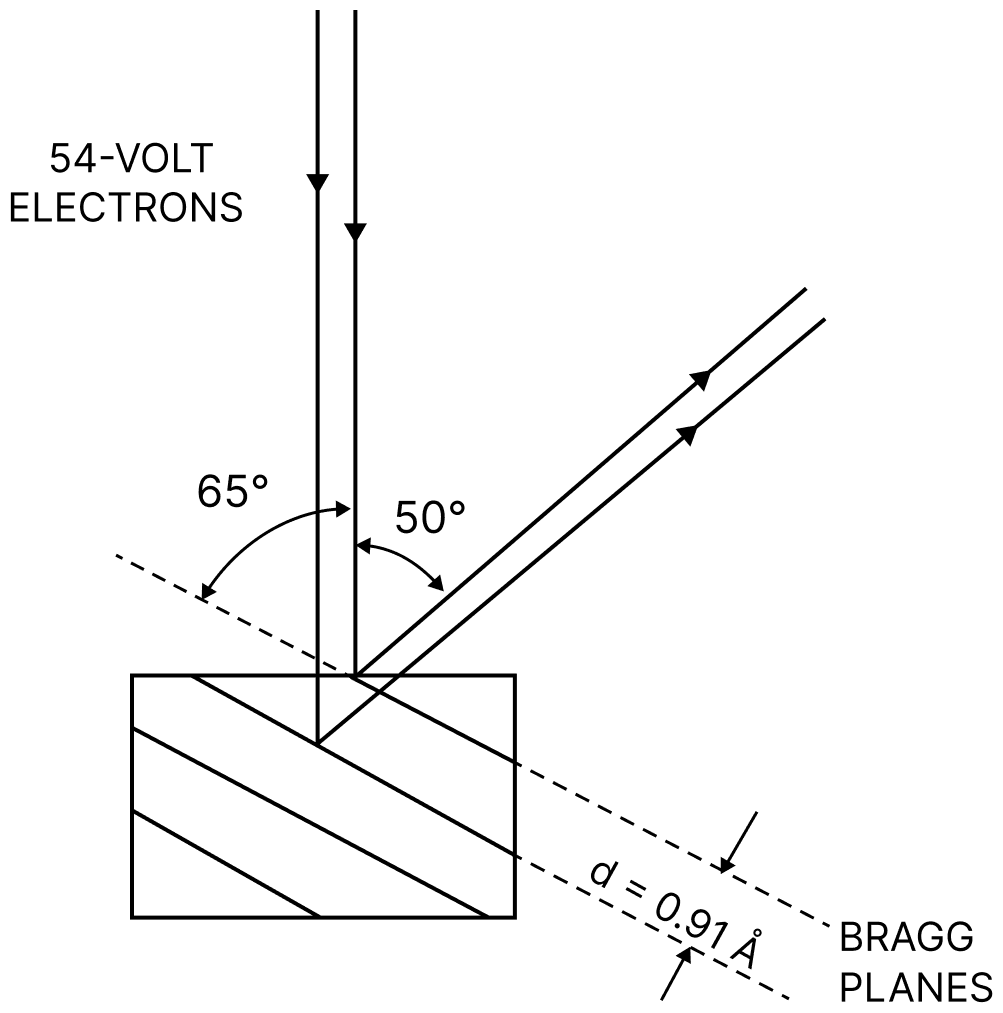
The glancing angle θ of the beam with the family of Bragg planes is
Using Bragg's equation, 2d sin θ = nλ,
Conclusion : The wavelength obtained from the diffraction (1.65 Å) agrees closely with the de-Broglie wavelength (1.67 Å). Hence, fast moving electrons have a wave nature, and the Davisson and Germer experiment directly verifies de-Broglie's hypothesis.
The experiments of interference, diffraction and polarization established the wave nature of light, while the experiments on photo electric effect and Compton scattering confirmed the corpuscular nature of light. Einstein's equation E = mc2 gives the relation of conversion of mass into energy de-Broglie noted that the corpuscular properties were more obvious for very energetic light i.e., light of shorter wavelength.
Thus the light particles known as photons has corpuscular as well as wave nature.
"Nature likes symmetry", thinking on the same lines de-Broglie suggested that particles like electrons must have wave nature also. Till 1924, the matter was considered exclusively corpuscular in nature. This ideology was broken by Louis de-Broglie in 1924 by proposing that wave-particle duality may not be a monopoly of radiation, but a universal characteristic of nature. In his doctoral dissertation, he suggested a new overwhelming idea of the existence of matter waves purely on theoretical ground. He enunciated that matter must also possess dual character as light. Like electromagnetic radiation, material particles such as electrons, protons and neutrons also exhibit wave-like character.
According to de-Broglie's concept a moving particle always has a wave associated with it and the motion of the particle is guided by that wave is similar manner as photon is controlled by a wave.
(i) Give one difference between matter waves and electromagnetic waves.
(ii) Draw a graph showing the variation of de-Broglie wavelength (λ) of a particle with its momentum p.
(iii) de-Broglie wavelength of electron of kinetic energy E is λ. What will be its value if kinetic energy of electron is made 4E?
(iv) The de-Broglie wavelength of a neutron in thermal equilibrium with heavy water at temperature T1 is λ1 and at temperature T2 is λ2. Find the value of .
(v) The de-Broglie wavelength of a proton and α-particle are equal. Find the ratio of their velocities.
Answer
(i) Matter waves are associated with moving particles whether they are charged or not, whereas electromagnetic waves are produced only by accelerated charged particles.
(ii) Since , λp = h = constant, so the graph of λ against p is a rectangular hyperbola.
(iii) For an electron of kinetic energy E,
so λ ∝ . When the kinetic energy is made 4E,
(iv) A neutron in thermal equilibrium at temperature T has average kinetic energy kT, so
Hence λ ∝ , and
(v) Since , equal wavelengths give mpvp = mαvα. With mα = 4mp,
Hence, vp : vα = 4 : 1.