
Pair-production means :
- annihilation of a γ-ray into an electron and a positron.
- ejection of electron from a metal surface illuminated by ultraviolet light.
- ejection of electron from a nucleus.
- ionisation of a neutral atom.
Answer
annihilation of a γ-ray into an electron and a positron.
Reason — In pair-production, an energetic γ-ray photon falling on a heavy nucleus is absorbed and its energy is converted into mass, giving rise to an electron and a positron:
The minimum gamma-ray photon energy for pair-production is :
- 1.02 eV
- 1.02 keV
- 1.02 MeV
- 1.02 BeV
Answer
1.02 MeV
Reason — The rest-mass energy of each of the electron and the positron is m0c2 = 0.51 MeV. Hence the γ-photon must have energy at least 2 × 0.51 MeV = 1.02 MeV to produce the pair.
As the mass number of a nucleus increases, the binding energy per nucleon :
- goes on increasing
- goes on decreasing
- remains same
- first increases, then decreases
Answer
first increases, then decreases
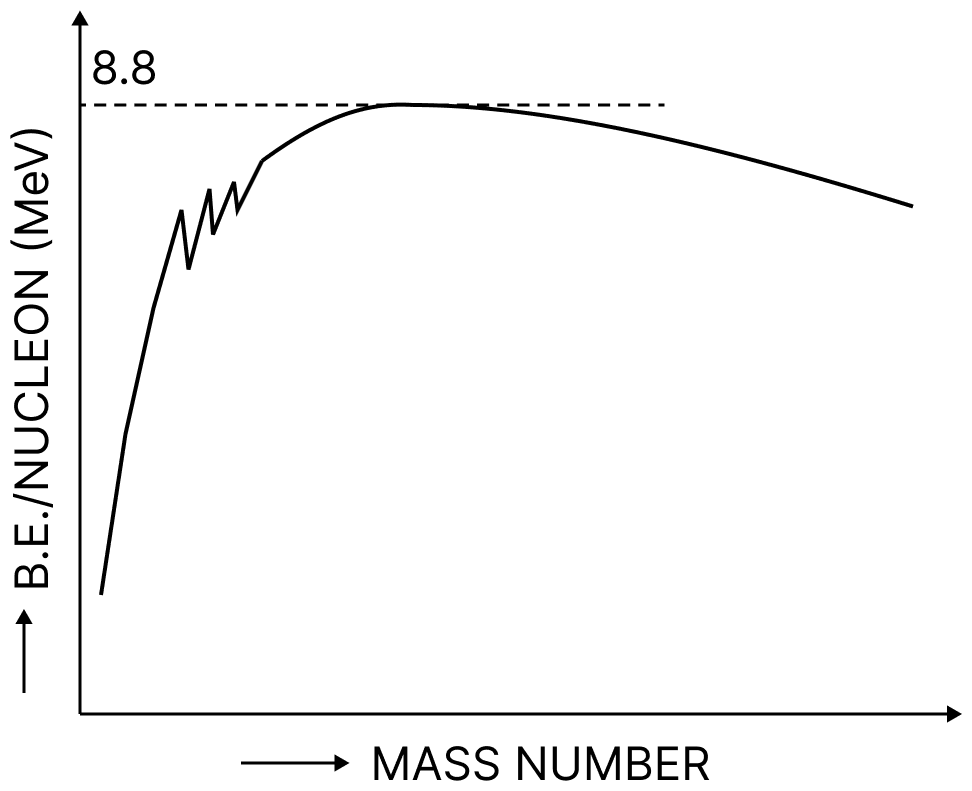
Reason — The binding energy curve rises sharply for light nuclei, has an almost flat maximum (about 8.8 MeV for 26Fe56) in the range A = 50 to 80, and then decreases slowly to about 7.6 MeV for uranium (A = 238).
The binding energy of the hydrogen nucleus is :
- 13.6 eV
- -13.6 eV
- 13.6 MeV
- zero
Answer
zero
Reason — The hydrogen nucleus is a single proton. There are no other nucleons to which it is bound, so there is no mass defect and its nuclear binding energy is zero.
The stability of a nucleus is decided by its :
- binding energy
- binding energy/nucleon
- number of protons
- number of nucleons
Answer
binding energy/nucleon
Reason — The total binding energy increases with the number of nucleons, so it cannot compare different nuclei. Higher the binding energy per nucleon, greater is the stability of the nucleus.
The curve of binding energy per nucleon against mass number has a sharp peak for helium nucleus. This means that helium nucleus :
- is very stable
- is radioactive
- is easily fissionable
- none of these
Answer
is very stable
Reason — A peak on the binding energy curve means that the binding energy per nucleon of 2He4 is higher than that of its immediate neighbours. Higher binding energy per nucleon means greater stability.
The binding energy per nucleon is almost same for many nuclei. It indicates that the nuclear forces are :
- attractive
- short-range
- charge-independent
- saturated
Answer
saturated
Reason — Since Ebn is nearly constant over a wide range of A, the total binding energy is proportional to A. This shows that a nucleon interacts only with its neighbouring nucleons and not with all the nucleons of the nucleus, which is the saturation property of nuclear forces.
The most stable nuclei are :
- odd-even
- odd-odd
- even-even
- even-odd
Answer
even-even
Reason — The binding energy curve shows peaks at 2He4, 6C12 and 8O16, which have even numbers of protons and neutrons. These even-even nuclei are more stable than their immediate neighbours.
The dependence of binding energy per nucleon (Ebn) on the mass number A is represented by :
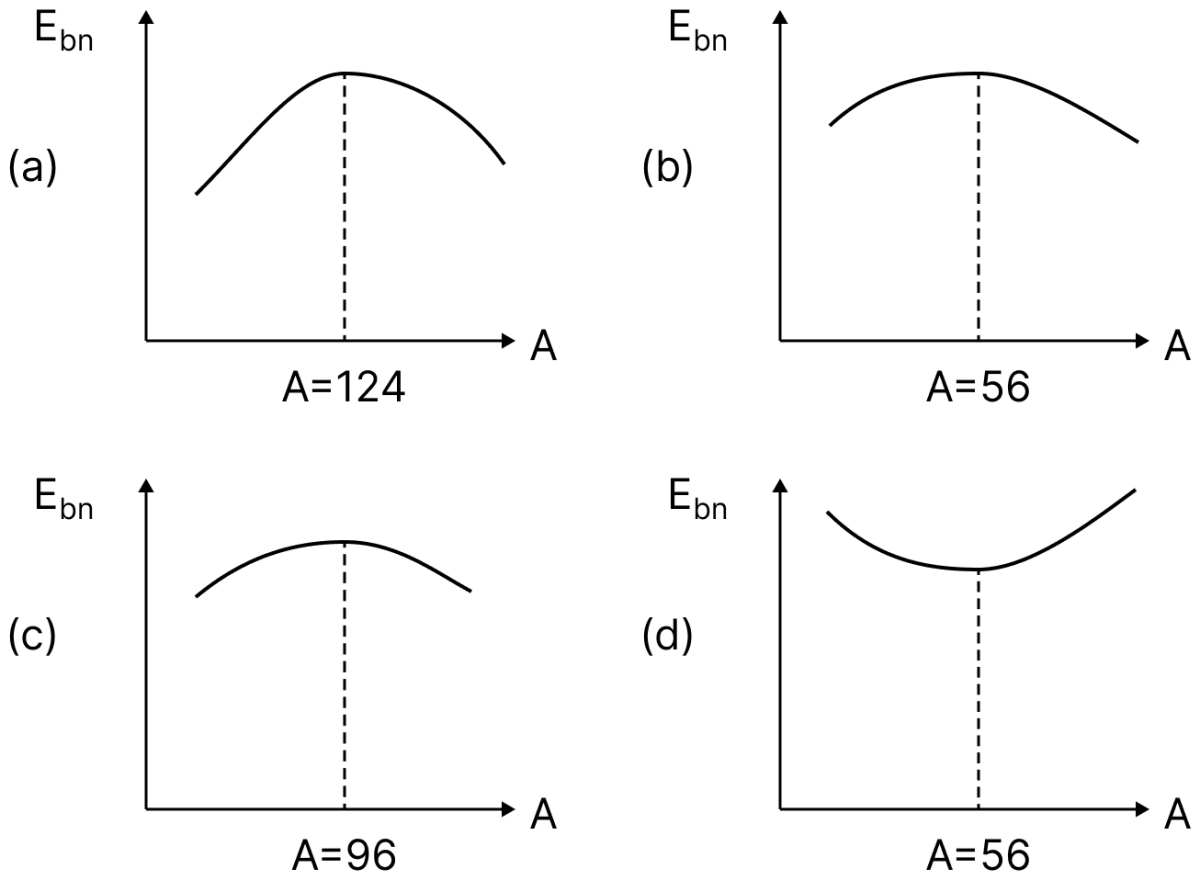
Answer
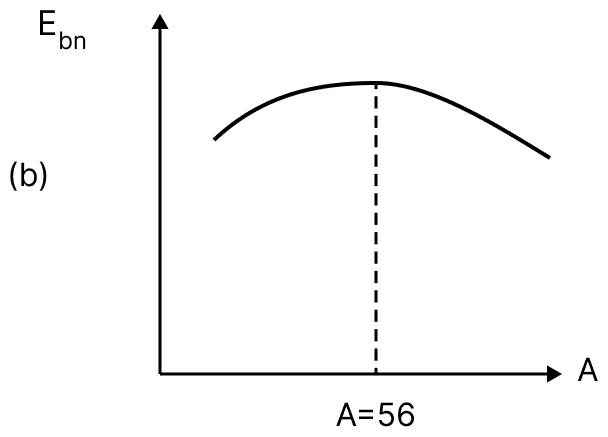
Reason — The binding energy per nucleon rises with A, reaches its maximum value (about 8.8 MeV) for iron, A = 56, and then decreases slowly for heavier nuclei. Graph (b) alone has its maximum at A = 56.
If mo is the mass of isotope 178O, mp and mn are the masses of a proton and neutron respectively, the nuclear binding energy of the isotope is:
- (17 mn - mo)c2
- (8 mp + 9 mn)c2
- (9 mn + 8 mp - mo)c2
- moc2
Answer
(9 mn + 8 mp - mo)c2
Reason — The nucleus 178O has Z = 8 protons and A − Z = 17 − 8 = 9 neutrons. Its binding energy is the energy equivalent of its mass defect:
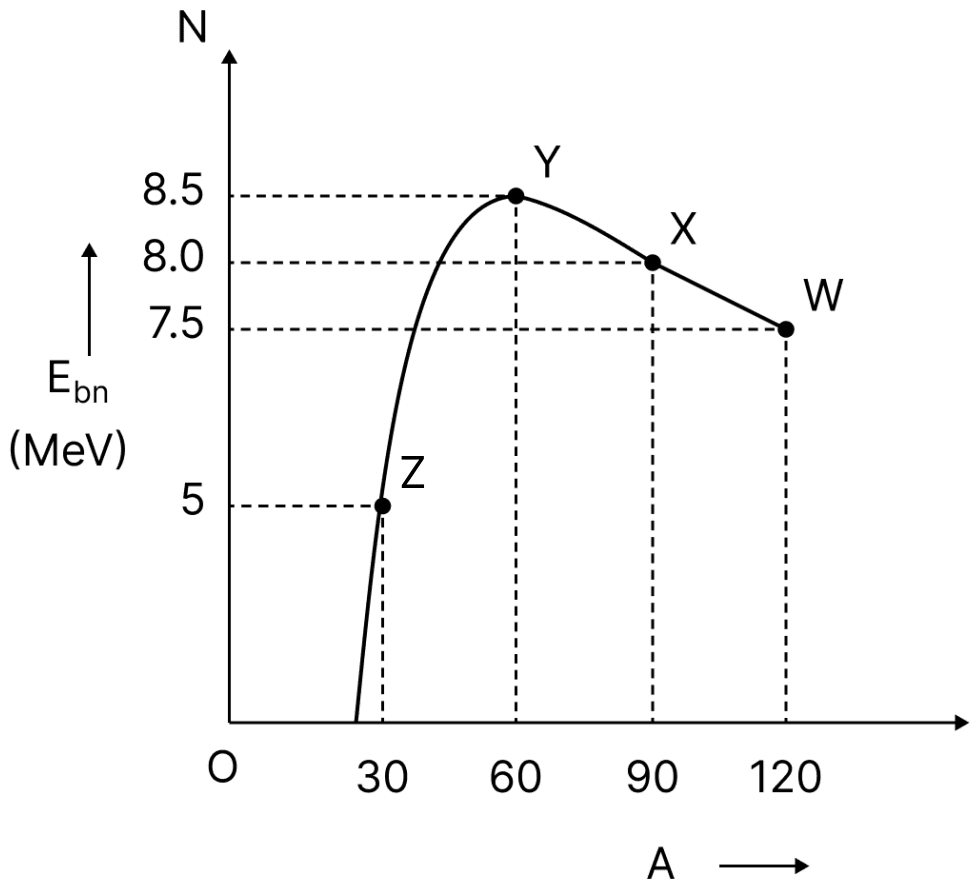
Binding energy per nucleon versus mass number curve for nuclei is shown in the figure. W, X, Y and Z are four nuclei indicated on the curve. The process that would release energy is :
- Y → 2Z
- W → X + Z
- W → 2Y
- X → Y + Z
Answer
W → 2Y
Reason — Total binding energy = A × Ebn. From the graph, W has A = 120, Ebn = 7.5 MeV and Y has A = 60, Ebn = 8.5 MeV.
In each of the other three processes the products have a smaller total binding energy than the parent nucleus, so energy would have to be supplied.
Match the column I and Column II
| Column I | Column II | ||
|---|---|---|---|
| A. | Hydrogen bomb | 1. | Fission |
| B. | Atom bomb | 2. | Fusion |
| C. | Binding energy | 3. | Critical mass |
| D. | Nuclear reactor | 4. | Mass defect |
- A → 3; B → 2; C → 1; D → 4
- A → 2; B → 1; C → 4; D → 3
- A → 3; B → 1; C → 2; D → 4
- A → 4; B → 2; C → 3; D → 1
Answer
A → 2; B → 1; C → 4; D → 3
Reason — A hydrogen bomb works on nuclear fusion and an atom bomb on uncontrolled nuclear fission. Binding energy is the energy equivalent of the mass defect, BE = (Δm)c2. A nuclear reactor needs fuel of at least the critical mass to sustain the chain reaction.
Write down Einstein's energy-mass relation.
Answer
Explanation:
If a substance loses mass Δm, an equivalent amount of energy ΔE is produced, where c is the speed of light in vacuum.
Which is bigger, MeV or J?
Answer
J is bigger.
Explanation:
1 MeV = 1.6 × 10⁻¹³ J, so 1 J = 6.25 × 10¹² MeV.
Which is bigger, MeV or kWh? What is the ratio of kWh to MeV?
Answer
kWh is bigger. The ratio of kWh to MeV is 2.25 × 10¹⁹.
Explanation:
1 kWh = 1000 W × 3600 s = 3.6 × 10⁶ J and 1 MeV = 1.6 × 10⁻¹³ J.
Can you give an example in which rest-mass is produced, while the generating particle has zero rest-mass?
Answer
Yes, pair-production by a γ-ray photon.
Explanation:
A γ-photon has zero rest-mass. When an energetic γ-photon falls on a heavy nucleus, it produces an electron and a positron, each having rest-mass 9.1 × 10⁻³¹ kg.
Give an example where energy is converted into matter.
Answer
Pair-production.
Explanation:
A γ-photon of energy at least 1.02 MeV is converted into an electron-positron pair, hν = -1β0 + +1β0.
Can a 0.75 MeV γ-photon cause pair-production?
Answer
No.
Explanation:
For pair-production the energy of the γ-photon must be at least 2m0c2 = 2 × 0.51 MeV = 1.02 MeV. A 0.75 MeV photon has less energy than this.
What is the minimum energy which a gamma ray photon must possess in order to produce electron-positron pair?
Answer
1.02 MeV.
Explanation:
This is equal to the rest-mass energy of the electron-positron pair, 2m0c2 = 2 × 0.51 MeV.
What is unified atomic mass unit (u)? State its relation to kg.
Answer
The unified atomic mass unit (u) is th of the mass of one atom of carbon-12 (6C12).
1 u = 1.6605 × 10⁻²⁷ kg.
What is the meaning of 'atomic mass unit'? Calculate the equivalent energy in MeV of a unified atomic mass unit.
Answer
An atomic mass unit is th of the mass of one atom of carbon-12 (6C12), that is, 1 u = 1.6605 × 10⁻²⁷ kg.
By Einstein's energy-mass relation, taking c = 2.9979 × 10⁸ m s-1 and 1 MeV = 1.6022 × 10⁻¹³ J,
Hence, 1 u is equivalent to 931.5 MeV.
By annihilation of one γ-photon, an electron and a positron are obtained. If the kinetic energy of the pair so obtained is 0.88 MeV, what was the energy of the photon?
Answer
1.90 MeV.
Explanation:
The energy of the photon provides the rest-mass energy of the pair (1.02 MeV) and the kinetic energy of the pair (0.88 MeV).
The isotope 8O16 has 8 protons, 8 neutrons and 8 electrons; while the isotope 4Be8 has 4 protons, 4 neutrons and 4 electrons. Yet the ratio of their atomic masses is not exactly 2. Why?
Answer
The mass of a nucleus is less than the total mass of its nucleons by the mass defect, . The binding energy of 8O16 is not exactly twice the binding energy of 4Be8, because their binding energies per nucleon are different. So their mass defects are not in the ratio 2 : 1, and the ratio of their atomic masses is not exactly 2.
If the speed of light were half of its present value, what effect would it have on the binding energy of nucleus?
Answer
The binding energy would be reduced to one-fourth.
Explanation:
Binding energy = (mass defect) × c2. For the same mass defect, halving c makes c2, and hence the binding energy, one-fourth.
The binding energies of helium and heavy-hydrogen nuclei are roughly 7 MeV/nucleon and 1 MeV/nucleon respectively. Which nucleus is more stable?
Answer
Helium nucleus.
Explanation:
Higher the binding energy per nucleon, greater is the stability of the nucleus. Helium has 7 MeV/nucleon against 1 MeV/nucleon for heavy hydrogen.
The binding energy of 4Be9 nucleus is 58.0 MeV while that of 2He4 nucleus is 28.3 MeV. But 4Be9 is less stable than 2He4. Why?
Answer
Stability depends on the binding energy per nucleon, not on the total binding energy.
Hence, 4Be9 has a smaller binding energy per nucleon than 2He4 and is less stable.
The binding energies of nuclei of atoms A and B are Ea and Eb respectively. Three nuclei of atom B fuse together to form a nucleus of atom A and energy e is released in this process. Write an equation relating Ea, Eb and e.
Answer
Ea = 3Eb + e.
Explanation:
Energy is released in the fusion because the nucleus A formed has a greater binding energy than the three nuclei B together. The energy released is the increase in binding energy, e = Ea − 3Eb.
Note: The textbook prints 3Eb = Ea + e, which is incorrect; it would require energy to be absorbed, not released (compare Question 16).
The binding energies of nuclei Xn and Y2n are P and Q respectively. If 2P > Q, then state whether energy will be released or absorbed in the process Xn + Xn → Y2n.
Answer
Energy will be absorbed.
Explanation:
The binding energy Q of Y2n is less than the binding energy 2P of Xn + Xn, so the product is less tightly bound than the reactants. An amount of energy (2P − Q) must be supplied in the process.
What is meant by mass defect?
Answer
The difference between the sum of the masses of the nucleons constituting a nucleus and the rest-mass of the nucleus is called mass defect.
For a nucleus ZXA,
The binding energy of a beryllium isotope (94Be) is 60.3 MeV. What is the binding energy per nucleon of this isotope?
Answer
Given,
- Binding energy, Eb = 60.3 MeV
- Mass number, A = 9
Hence, the binding energy per nucleon of 94Be is 6.7 MeV.
Write the equation of pair annihilation. Why are two (not one) photons produced in pair annihilation?
Answer
Equation of pair annihilation :
Here the rest-mass of the electron and the positron is converted into energy, each γ-photon carrying 0.51 MeV.
Why two photons : Just before annihilation, the electron and the positron (moving slowly) have almost zero total momentum. A single photon always carries momentum , so it cannot have zero momentum. Hence, if only one photon were produced, both energy and momentum would not be conserved. Two photons of equal energy moving in opposite directions have zero total momentum, so both energy and momentum are conserved.
'The binding energy per nucleon of α-particle is 7.07 MeV.' What do you mean by this statement?
Answer
An α-particle is a helium nucleus having four nucleons (2 protons and 2 neutrons). Its total binding energy is
The statement means that 28.28 MeV of energy is required to separate the four nucleons of the α-particle and place them at rest at infinite distance apart. On the average, 7.07 MeV is needed to remove one nucleon from the nucleus to infinite distance.
Energy-mass interconversion takes place only in nuclear reactions and never in chemical reactions. Do you agree?
Answer
No.
Explanation:
Energy-mass interconversion takes place in chemical reactions also. In an exothermic chemical reaction the products are slightly lighter than the reactants, and the energy released equals (Δm)c2. However, the mass defect involved in a chemical reaction is about a million times smaller than that in a nuclear reaction, so the change in mass is imperceptible.
A spring is kept in a compressed state with its both ends tied. On immersing this spring in acid, it is dissolved. Where does the potential energy stored in the compressed spring go?
Answer
According to Einstein's energy-mass relation, the potential energy stored in the compressed spring increases its mass a little, .
When the spring is dissolved in acid, this potential energy is not lost. The chemical substance produced from the compressed spring is a little more massive than that produced by dissolving the uncompressed spring. Thus the potential energy appears as the increased mass of the products. The increase is too small to be measured by any balance.
Why is the mass of nucleus less than the sum of the masses of nucleons forming it? Can it be more also? Why?
Answer
A nucleus confines its nucleons within a very small space, of size about 10-15 m. The energy required to hold them there (the binding energy) comes from the nucleons themselves, at the cost of part of their mass. Hence the nucleus is lighter than the total mass of its nucleons by the mass defect
The mass of the nucleus cannot be more than the total mass of its nucleons. If it were more, the binding energy would be negative; the nucleus would then break up on its own into its nucleons and could not be formed as a stable nucleus.
1H3 and 2He3 have almost same atomic mass. Do they have the same nuclear binding energy?
Answer
No. The binding energy of 1H3 is greater.
Explanation:
In terms of atomic masses, the nuclear binding energy of ZXA is
For 1H3 : Z = 1, A = 3, and for 2He3 : Z = 2, A = 3. Thus,
Since mn > mH and m(1H3) ≈ m(2He3),
The α-decay of 92U238, that is, the reaction 92U238 → 90Th234 + 2He4 is energetically allowed. Then, what prevents 92U238 from decaying all at once? Why is its half-life so large?
Answer
Inside the nucleus, the α-particle is held by nuclear forces, and outside it is repelled by the Coulomb force of the remaining nucleus. These together form a potential barrier of height about 27 MeV for 92U238, which is much greater than the energy of the α-particle.
Classically the α-particle cannot cross this barrier. It escapes only by 'leaking' through it, and the probability of this is extremely small. An α-particle has to wait, on the average, a time of the order of 109 years before it actually escapes. Hence 92U238 does not decay all at once, and its half-life is very large.
A free neutron decays to a proton but a free proton does not decay to a neutron. Why?
Answer
The rest-mass of a free neutron is greater than the rest-mass of a free proton plus an electron:
Hence the β--decay of a neutron releases energy and is energetically allowed:
On the contrary, the β+-decay of a free proton, 1H1 → 0n1 + +1β0 + ν, would produce more mass than the proton has. It needs energy to be supplied, so it is not energetically allowed.
The β+-decay of a free proton is not possible but that of a proton bound in the nucleus is possible. Why?
Answer
A free proton is lighter than a neutron plus a positron, so the energy for its β+-decay is not available.
Inside a nucleus, protons and neutrons are not free particles. There, neutrons change into protons by β--decay and protons change into neutrons by β+-decay, both processes going on side by side. The energy a bound proton needs for β+-decay is supplied by the difference in the binding energies of the nucleus before and after the decay. In a stable nucleus the two decays balance each other, in dynamical equilibrium.
Discuss energy-mass equivalence. Explain, why 1 kg of mass is equivalent to an energy as high as 2.5 × 10¹⁰ kWh.
Answer
Energy-mass equivalence : Before Einstein, mass and energy were regarded as two different entities, and the conservation of mass and the conservation of energy were treated as two independent laws. Einstein, by his theory of relativity, showed that every substance has energy due to its mass also. If a substance loses mass Δm, an equivalent amount of energy ΔE is produced, where
and c is the speed of light. Conversely, if energy ΔE is given to matter, its mass increases by . Thus the laws of conservation of energy and of mass are unified into a single law: the total (energy + mass) of the universe is conserved. The interconversion is observed at the nuclear level in pair-production and pair-annihilation.
Energy equivalent of 1 kg :
Given,
- Δm = 1 kg
- c = 3.0 × 10⁸ m s-1
- 1 kWh = 3.6 × 10⁶ J
The energy is so large because the mass is multiplied by c2 = 9.0 × 10¹⁶ m2 s-2, an enormous number.
Hence, 1 kg of mass is equivalent to 9.0 × 10¹⁶ J, that is, 2.5 × 10¹⁰ kWh.
Find the minimum energy which a gamma ray photon should possess so that it is capable of producing an electron-positron pair.
Answer
Given,
- Rest-mass of electron (or positron), m0 = 9.1 × 10⁻³¹ kg
- c = 3.0 × 10⁸ m s-1
- 1 MeV = 1.6 × 10⁻¹³ J
In pair-production, a γ-photon is converted into an electron and a positron:
The photon must have at least the rest-mass energy of the two particles, Emin = 2m0c2.
Hence, the γ-ray photon must possess at least 1.02 MeV of energy to produce an electron-positron pair.
Write one balanced equation each to show
(i) Nuclear fission
(ii) Nuclear fusion
(iii) Emission of β- (i.e., a negative particle).
Answer
(i) Nuclear fission :
(ii) Nuclear fusion :
(iii) Emission of β- :
Define unified atomic mass unit u. Obtain its value in kg. Find energy equivalent to 1 u.
Answer
Definition : The unified atomic mass unit (u) is th of the mass of one atom of carbon-12 (6C12).
Value in kg :
Given,
- Mass of 1 mole of 6C12 = 12 g = 12 × 10-3 kg
- Avogadro's number, NA = 6.02214 × 10²³ per mole
Energy equivalent : Taking c = 2.9979 × 10⁸ m s-1 and 1 MeV = 1.6022 × 10⁻¹³ J, by Einstein's relation,
Hence, 1 u = 1.6605 × 10⁻²⁷ kg, and its energy equivalent is 931.5 MeV.
Define mass defect of a nucleus. How is it related to the binding energy of the nucleus?
Answer
Mass defect : The difference between the sum of the masses of the nucleons constituting a nucleus and the rest-mass of the nucleus is called mass defect. For a nucleus ZXA having Z protons and (A − Z) neutrons,
Relation with binding energy : When the nucleons combine to form the nucleus, the mass Δm disappears and reappears as the equivalent energy (Δm)c2, which is liberated. The same energy must be supplied to break the nucleus into its nucleons. This is the binding energy of the nucleus:
If Δm is in u, then BE = Δm × 931.5 MeV.
What do you understand by 'binding energy of a nucleus'? Derive binding energy equation for the nucleus of an atom ZXA in terms of atomic masses and neutron mass. State the approximation involved and justify it.
Answer
Binding energy : The binding energy of a nucleus is the minimum energy required to separate its nucleons and place them at rest at infinite distance apart. It equals the energy equivalent of the mass defect, (Δm)c2.
Derivation : The nucleus of ZXA has Z protons and (A − Z) neutrons. If mp, mn and mN are the masses of a proton, a neutron and the nucleus,
The mass of the nucleus is not measured directly. What is measured is the mass of the atom, m(ZXA), which includes the mass of Z electrons (Zme). Neglecting the binding energy of the electrons,
Substituting in Eq. (i),
But mp + me = mH, the mass of a hydrogen atom. Therefore,
This gives the nuclear binding energy in terms of atomic masses and the neutron mass. If the masses are in u, Eb = [ZmH + (A − Z)mn − m(ZXA)] × 931.5 MeV.
Approximation and its justification : The mass equivalent of the energy binding the Z electrons to the nucleus has been neglected. This is justified because the electron binding energy is only of the order of eV to keV, whereas the nucleon binding energy is of the order of MeV, so it is negligible in comparison.
Draw a graph showing the variation of binding energy per nucleon with mass number of different nuclei. Mark the regions where the nuclei are (i) most stable, (ii) prone to fission, (iii) prone to fusion.
Answer
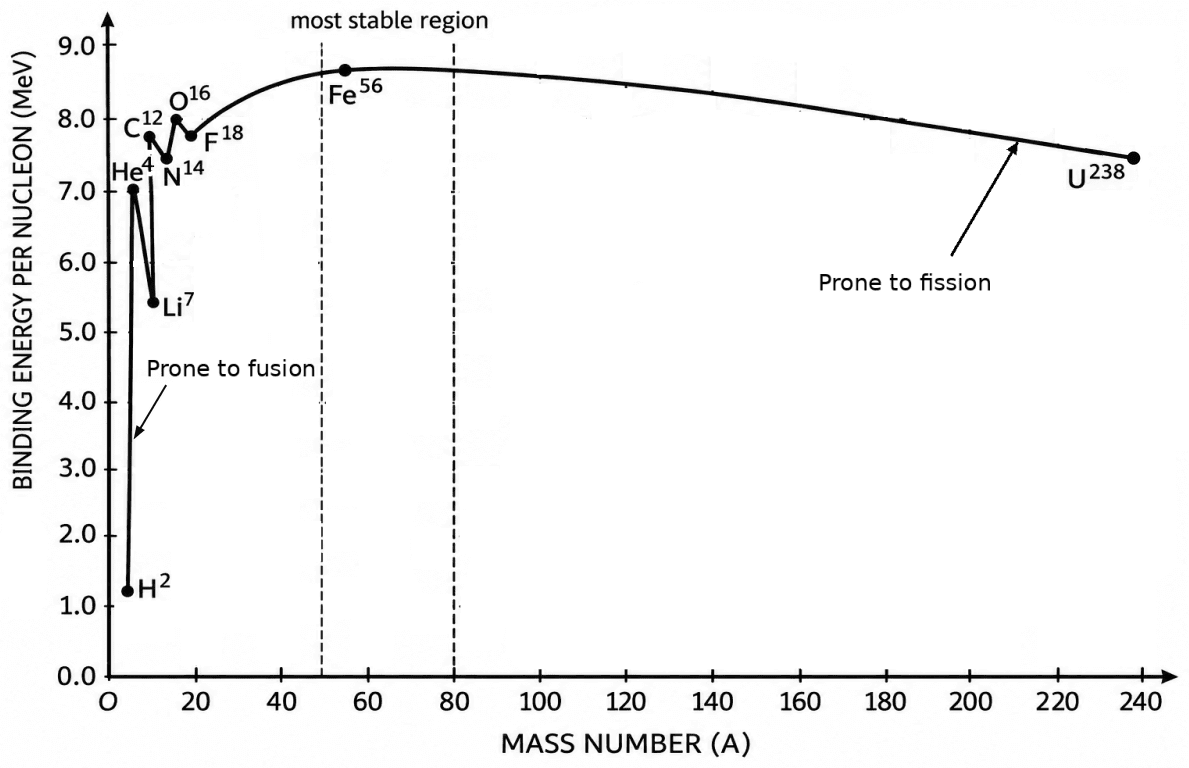
The graph of binding energy per nucleon against mass number rises sharply for light nuclei, has an almost flat maximum of about 8.5 MeV between A = 50 and A = 80 (8.8 MeV for 26Fe56), and then decreases slowly to about 7.6 MeV for uranium (A = 238).
(i) Most stable : The flat portion of the curve, roughly from A = 50 to A = 80, where the binding energy per nucleon is maximum.
(ii) Prone to fission : The slowly falling portion of the curve beyond about A = 200. A heavy nucleus here can split into two nuclei of the flat region with an increase in binding energy per nucleon.
(iii) Prone to fusion : The sharply rising portion of the curve for light nuclei (A below about 20). Two such nuclei can combine into a heavier nucleus with a larger binding energy per nucleon.
Binding energy per nucleon versus mass number curve is as shown.
AZS, A1Z1W, A2Z2X, and A3Z3Y
are four nuclei indicated on the curve.
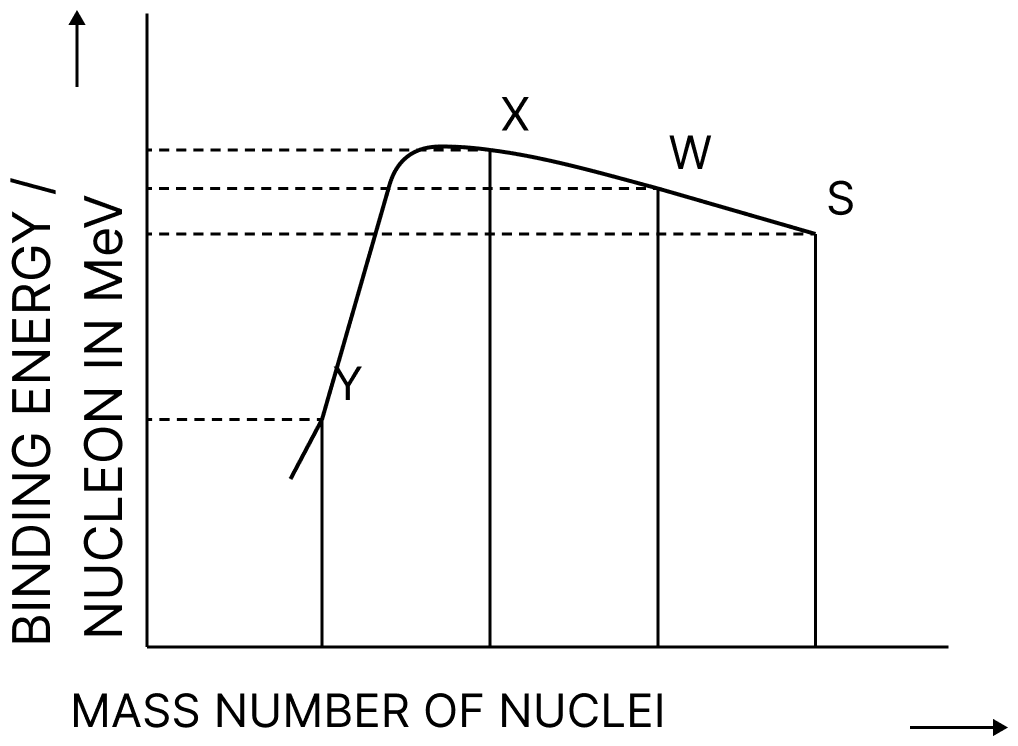
Based on the graph:
(i) Arrange X, W and S in the increasing order of stability.
(ii) Write the relation between the relevant A and Z values for the following nuclear reaction.
S → X + W
(iii) Explain why binding energy for heavy nuclei is low.
Answer
(i) Larger the binding energy per nucleon, more stable is the nucleus. From the graph, the binding energy per nucleon of X is the greatest, that of W is smaller, and that of S is the smallest. Therefore, in the increasing order of stability,
S < W < X
(ii) The reaction is
Since the total number of nucleons and the total charge are conserved,
A = A1 + A2 and Z = Z1 + Z2
(iii) A heavy nucleus contains a large number of protons, and the Coulomb repulsion between them is large. The nuclear force is short-range and acts only between neighbouring nucleons, while the Coulomb repulsion acts between all pairs of protons. Hence, in heavy nuclei the Coulomb repulsion reduces the binding, and the binding energy per nucleon is low.
Explain pair production and annihilation, show that energy required to produce electron and antielectron is 1.02 MeV by γ photon.
Answer
Pair production : A γ-ray photon of high energy, on striking a heavy substance, is absorbed by a nucleus of the substance, and its energy produces an electron and a positron. Since energy is converted into mass in this process, it is called pair-production:
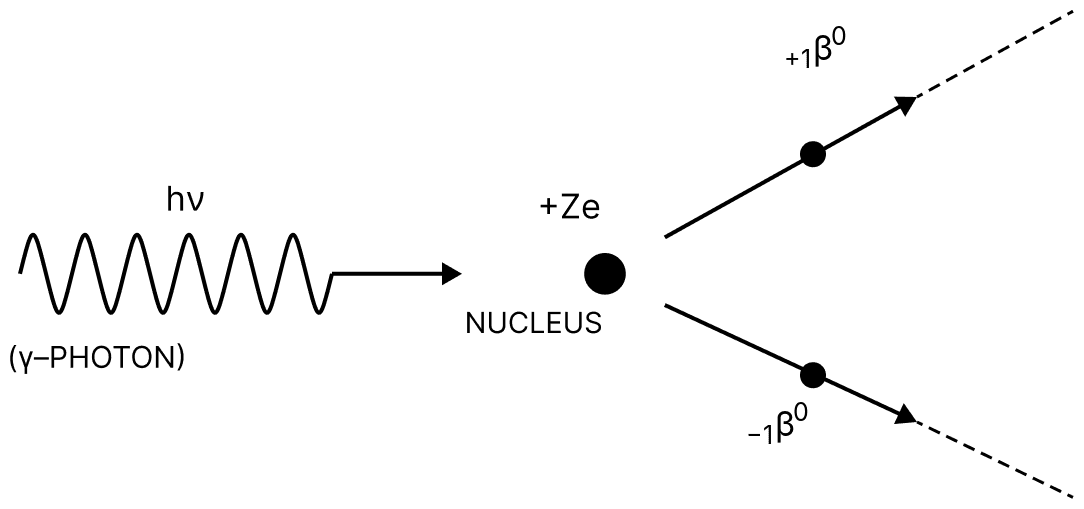
The presence of the nucleus is necessary, since without it both energy and momentum would not be conserved. If the energy of the photon exceeds the rest-mass energy of the pair, the excess appears as the kinetic energy of the electron and the positron.
Pair annihilation : When an electron and a positron approach very close to each other, they combine and annihilate each other, producing two γ-photons. Since mass is converted into energy in this process, it is called pair-annihilation:
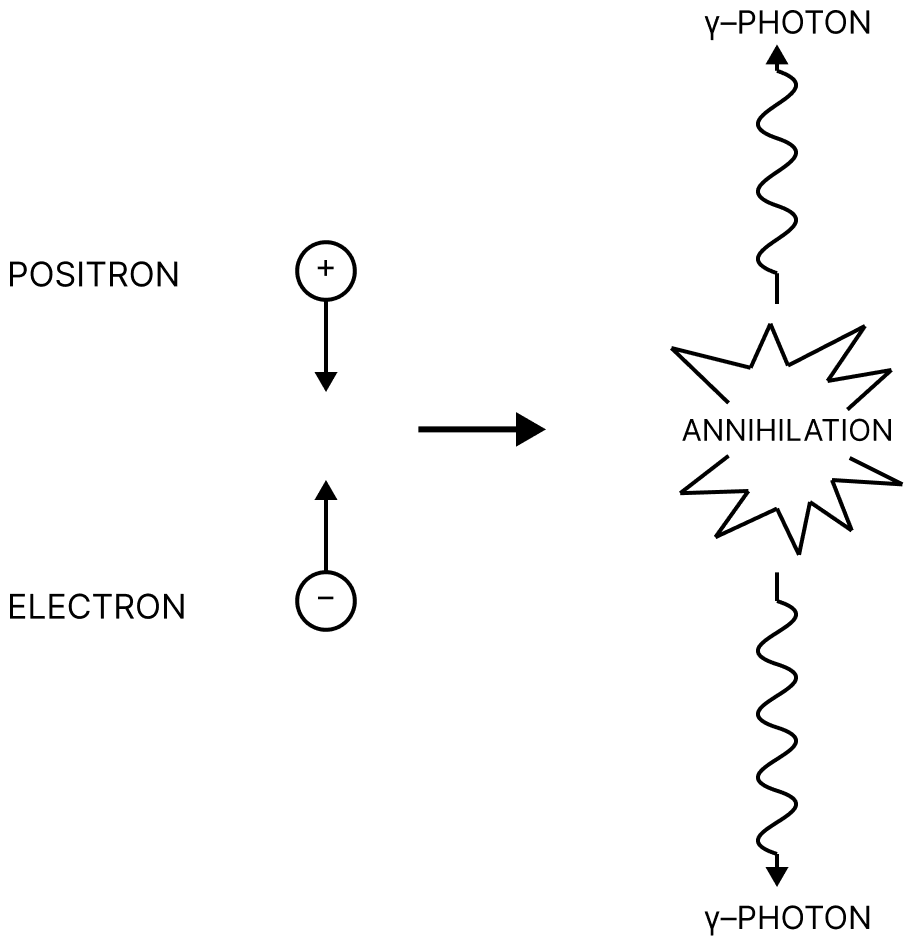
Each γ-photon has energy 0.51 MeV, equal to the rest-mass energy of an electron or a positron. Two photons are produced, moving in opposite directions, so that both energy and momentum are conserved.
Minimum energy for pair production :
Given,
- Rest-mass of electron (or positron), m0 = 9.1 × 10⁻³¹ kg
- c = 3.0 × 10⁸ m s-1
- 1 MeV = 1.6 × 10⁻¹³ J
According to Einstein's energy-mass relation, the rest-mass energy of each particle is
The γ-photon must provide the rest-mass energy of both the electron and the antielectron (positron),
Hence, the energy required by a γ-photon to produce an electron and an antielectron is 1.02 MeV.
What do you mean by mass defect and binding energy? Draw a graph showing variation of average binding energy per nucleon with mass number.
Answer
Mass defect : The difference between the sum of the masses of the nucleons constituting a nucleus and the rest-mass of the nucleus is called mass defect. For a nucleus ZXA,
Binding energy : The binding energy of a nucleus is the minimum energy required to separate its nucleons and place them at rest at infinite distance apart. The mass defect reappears as this energy when the nucleus is formed, so
The binding energy per nucleon, , measures the stability of a nucleus: higher the binding energy per nucleon, greater is the stability.
Graph :
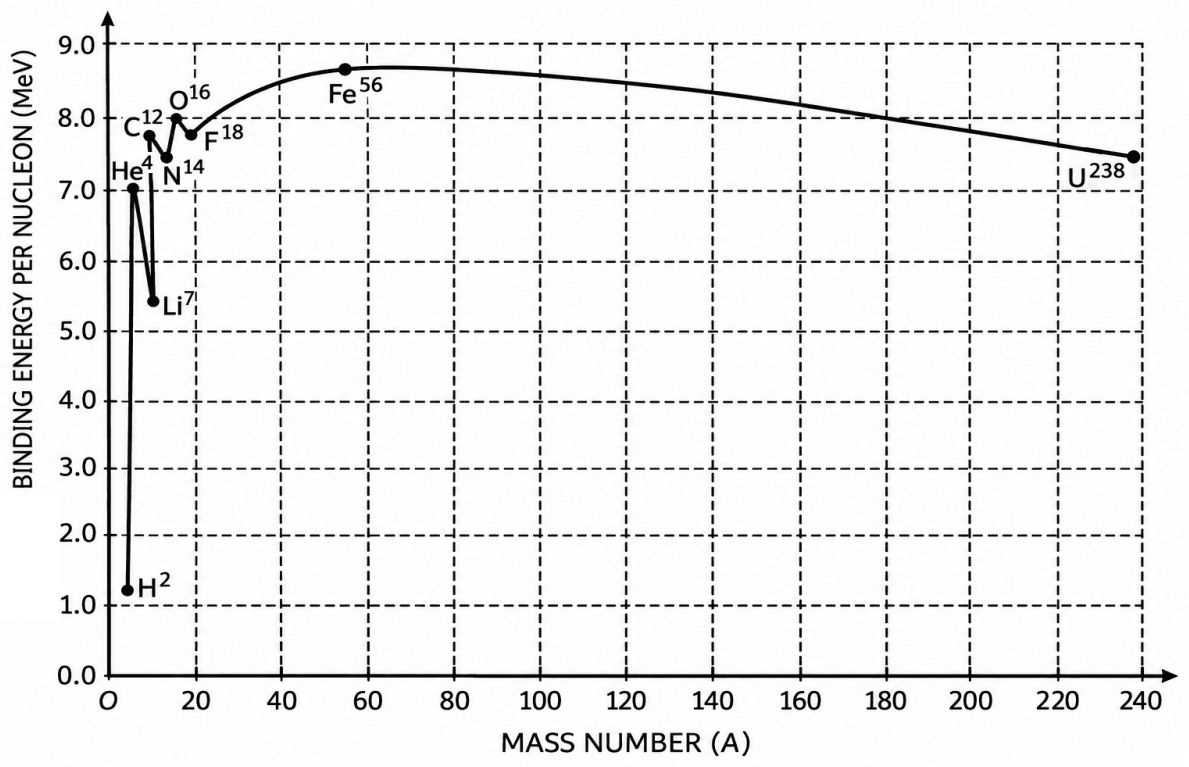
The main features of the curve are :
(i) The binding energy per nucleon rises sharply for light nuclei; it is only about 1.1 MeV for 1H2.
(ii) Below A = 50 there are subsidiary peaks at 2He4, 6C12 and 8O16.
(iii) The curve has an almost flat maximum of about 8.5 MeV from A = 50 to A = 80, with about 8.8 MeV for 26Fe56. These nuclei are the most stable.
(iv) Beyond A = 80, the binding energy per nucleon decreases slowly to about 7.6 MeV for uranium (A = 238).
Define atomic mass unit (amu), obtain its value in kilogram. Find amount of energy released due to 1 amu mass.
Answer
Definition : The atomic mass unit is th of the mass of one atom of carbon-12 (6C12).
Value in kg :
Given,
- Mass of 1 mole of 6C12 = 12 g = 12 × 10-3 kg
- Avogadro's number, NA = 6.02214 × 10²³ per mole
Energy released due to 1 amu : If a mass of 1 amu is converted into energy, then by Einstein's relation, taking c = 2.9979 × 10⁸ m s-1 and 1 MeV = 1.6022 × 10⁻¹³ J,
Hence, 1 amu = 1.6605 × 10⁻²⁷ kg, and the energy released due to 1 amu of mass is 931.5 MeV (1.4924 × 10⁻¹⁰ J).
Explain binding energy and obtain the relation B.E. = [Z Mp + (A - Z)Mn - MN]c2, where Z and A are atomic number and atomic weight, Mn is mass of neutron, MN is mass of nucleus, c is speed of light. Also, explain why binding energy per nucleon is more for the elements whose mass number is multiple of 4.
Answer
Binding energy : The binding energy of a nucleus is the minimum energy required to separate its nucleons and place them at rest at infinite distance apart. When free nucleons combine to form a nucleus, some mass (the mass defect) disappears and is liberated as an equivalent amount of energy. It is due to this energy that the protons and neutrons remain bound in the nucleus.
Derivation : Consider a nucleus ZXA of atomic number Z and mass number A. It contains Z protons and (A − Z) neutrons.
Total mass of the free nucleons,
The mass of the nucleus MN is always less than this. The mass defect is
When Z free protons and (A − Z) free neutrons come in from infinity and combine to form the nucleus, the mass Δm disappears. By Einstein's energy-mass relation, it reappears as energy
Substituting Δm from Eq. (i) in Eq. (ii),
The same amount of energy must be supplied to break the nucleus into its nucleons.
Nuclei with mass number a multiple of 4 : The binding energy curve shows peaks at 2He4, 6C12 and 8O16, whose mass numbers are multiples of 4. These even-even nuclei contain equal and even numbers of protons and neutrons, which can be regarded as made up of α-particle-like groups of 2 protons and 2 neutrons. Such a group is very tightly bound. Hence these nuclei have a higher binding energy per nucleon than their immediate neighbours and are more stable.
Read the passage(s) and answer the following questions :
The graph given below represents the average binding energy per nucleon in MeV against mass number A. It is observed that the binding energy per nucleon rises first sharply, reaches a maximum value 8.8 MeV, then falls slowly, decreasing to 7.6 MeV for elements of higher mass number A = 238.
(i) Define the term binding energy of a nucleus.
(ii) Binding energy per nucleon is almost same for many nuclei. What does it indicate about nuclear forces?
(iii) What is the significance of binding energy per nucleon of a nucleus of a radioactive element?
(iv) Mass defect for helium (2He4) nucleus is 0.0304 amu. Calculate the binding energy per nucleon of helium nucleus.
(1 amu = 931 MeV/c2)
Answer
(i) The binding energy of a nucleus is the minimum energy required to break the nucleus into its constituent protons and neutrons and separate them to a very large distance apart, where they do not interact with each other. It equals (Δm)c2, where Δm is the mass defect.
(ii) It indicates that nuclear forces are saturated. A nucleon interacts only with its neighbouring nucleons and not with the nucleons which are not in direct contact with it. Hence the total binding energy is proportional to A, and the binding energy per nucleon is almost constant.
(iii) The binding energy per nucleon tells about the stability of the nucleus. A heavy radioactive nucleus has a lower binding energy per nucleon (about 7.6 MeV for A = 238) than nuclei of intermediate mass, so it is less stable. Higher the binding energy per nucleon, more stable is the nucleus.
(iv) Given,
- Mass defect, Δm = 0.0304 amu
- 1 amu = 931 MeV/c2
- Number of nucleons in 2He4, A = 4
Hence, the binding energy per nucleon of the helium nucleus is about 7.1 MeV.
Nuclear binding energy is the energy required to separate an atomic nucleus into its constituent protons and neutrons, or, equivalently, the energy that would be liberated by combining individual protons and neutrons into a single nucleus. For example, the nucleus of the hydrogen isotope deuterium, which is composed of one proton and one neutron, can be separated by supplying 2.23 million electron volts (MeV) of energy. Conversely, when a slowly moving neutron and proton combine to form a deuterium nucleus, 2.23 MeV energy is liberated in the form of gamma rays.
(i) Why is the energy needed to separate an atomic nucleus into its constituents?
(ii) In the case of two atoms 3X6 and 3Y7, which atom is likely to be more stable and why?
(iii) Calculate mass defect when a neutron and a proton combine to form a deuterium nucleus.
Answer
(i) The nucleons in a nucleus are held together by strong, attractive nuclear forces; the energy equivalent of the mass defect is released when they bind. To separate the nucleus into its constituents, work must be done against the strong nuclear forces to take the nucleons infinitely far apart. Hence an energy equal to the binding energy must be supplied.
(ii) 3Y7 is likely to be more stable. Both atoms have 3 protons, but 3Y7 has 4 neutrons against 3 neutrons in 3X6. The extra neutron adds to the attractive nuclear force without adding to the electrostatic repulsion between the protons, so the nucleus is more tightly bound.
(iii) Given,
- Binding energy of deuterium, E = 2.23 MeV
- 1 u × c2 = 931.5 MeV
By Einstein's energy-mass relation,
Hence, the mass defect when a neutron and a proton combine to form a deuterium nucleus is 0.002394 u.