
Assertion (A): Only a change in magnetic flux will maintain an induced current in the coil.
Reason (R): The presence of large magnetic flux through a coil maintains a current in the coil if the circuit is continuous.
- If both assertion and reason are true and reason is the correct explanation of assertion.
- If both assertion and reason are true but reason is not the correct explanation of assertion.
- If assertion is true but reason is false.
- If both assertion and reason are false.
Answer
If assertion is true but reason is false.
Explanation
Assertion (A) is correct: By Faraday's law, the induced emf is . An induced current flows in a coil only while the magnetic flux linked with it is changing, so the current is maintained only so long as the flux keeps changing.
Reason (R) is incorrect: A large but constant magnetic flux through a coil induces no emf, however continuous the circuit may be. It is the rate of change of flux, not the amount of flux, that produces the current.
Therefore, assertion is true but reason is false.
Assertion (A): A metallic surface is moved in and moved out in a magnetic field, then emf is induced in it.
Reason (R): Eddy current will be produced in a metallic surface moving in and out of magnetic field.
- If both assertion and reason are true and reason is the correct explanation of assertion.
- If both assertion and reason are true but reason is not the correct explanation of assertion.
- If assertion is true but reason is false.
- If both assertion and reason are false.
Answer
If both assertion and reason are true and reason is the correct explanation of assertion.
Explanation
Assertion (A) is correct: When a metallic surface is moved into or out of a magnetic field, the magnetic flux linked with it changes, and so an emf is induced in it.
Reason (R) is also correct: The emf induced throughout the metal by this change of flux sets up closed loops of current within the metal surface, which are the eddy currents. The eddy currents produced in the moving surface are the evidence of the emf induced in it, so the Reason explains the Assertion.
Therefore, both assertion and reason are true and reason is the correct explanation of assertion.
Assertion (A): Faraday's laws are consequence of conservation of energy.
Reason (R): In a purely resistive a.c. circuit, the current lags behind the emf in phase.
- If both assertion and reason are true and reason is the correct explanation of assertion.
- If both assertion and reason are true but reason is not the correct explanation of assertion.
- If assertion is true but reason is false.
- If both assertion and reason are false.
Answer
If assertion is true but reason is false.
Explanation
Assertion (A) is correct: In electromagnetic induction, the mechanical work done in moving a magnet or conductor against the opposing force (Lenz's law) is converted into electrical energy. Faraday's laws, together with Lenz's law, are thus in accordance with the law of conservation of energy.
Reason (R) is incorrect: In a purely resistive a.c. circuit, the current is in phase with the emf; it neither leads nor lags.
Therefore, assertion is true but reason is false.
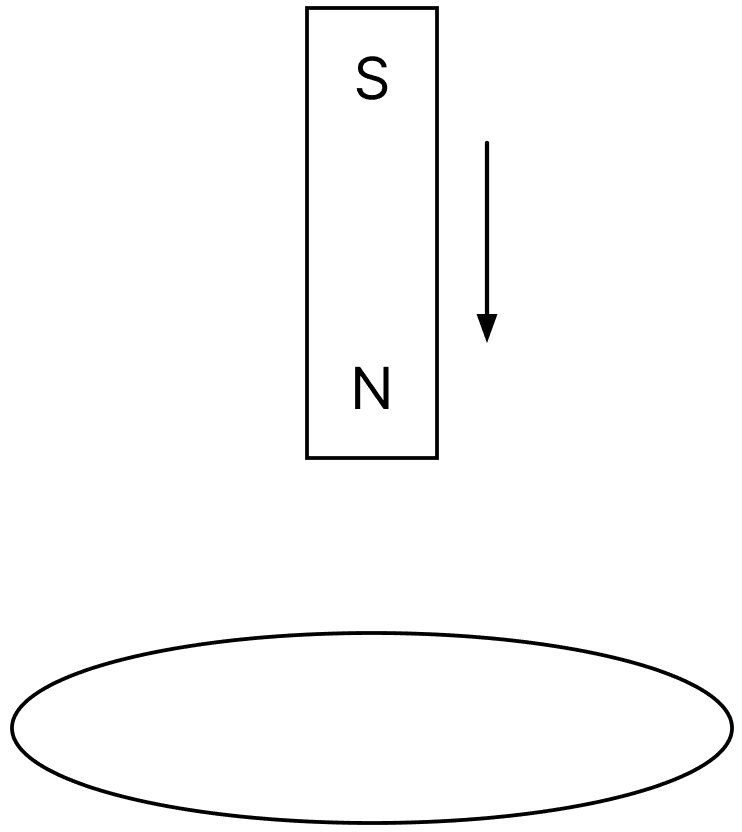
Assertion (A): The bar magnet falling vertically along the axis of the horizontal coil will be having acceleration less than g.
Reason (R): Clockwise current is induced in the coil.
- If both assertion and reason are true and reason is the correct explanation of assertion.
- If both assertion and reason are true but reason is not the correct explanation of assertion.
- If assertion is true but reason is false.
- If both assertion and reason are false.
Answer
If assertion is true but reason is false.
Explanation
Assertion (A) is correct: As the bar magnet falls towards the coil, the magnetic flux linked with the coil increases and a current is induced in it. By Lenz's law, this current opposes the approach of the magnet, so the coil exerts an upward force on the magnet and its acceleration is less than g.
Reason (R) is incorrect: The N pole of the magnet faces the coil. To oppose its approach, the upper face of the coil must become a north pole, so the induced current is anticlockwise when viewed from above (from the magnet), not clockwise.
Therefore, assertion is true but reason is false.