
A current of 20 µA flows in a wire for 30 seconds. Find the amount of charge and the number of free electrons transferred through the wire.
Answer
Given,
- Current, I = 20 µA = 20 × 10-6 A
- Time, t = 30 s
- Electronic charge, e = 1.6 × 10⁻¹⁹ C
The electric current is the rate of flow of charge,
Substituting the values,
If N is the number of free electrons transferred, then q = Ne, so
Hence, the charge transferred is 6 × 10⁻⁴ C and the number of free electrons transferred is 3.75 × 10¹⁵.
The current passing through a wire varies with time as provided below.
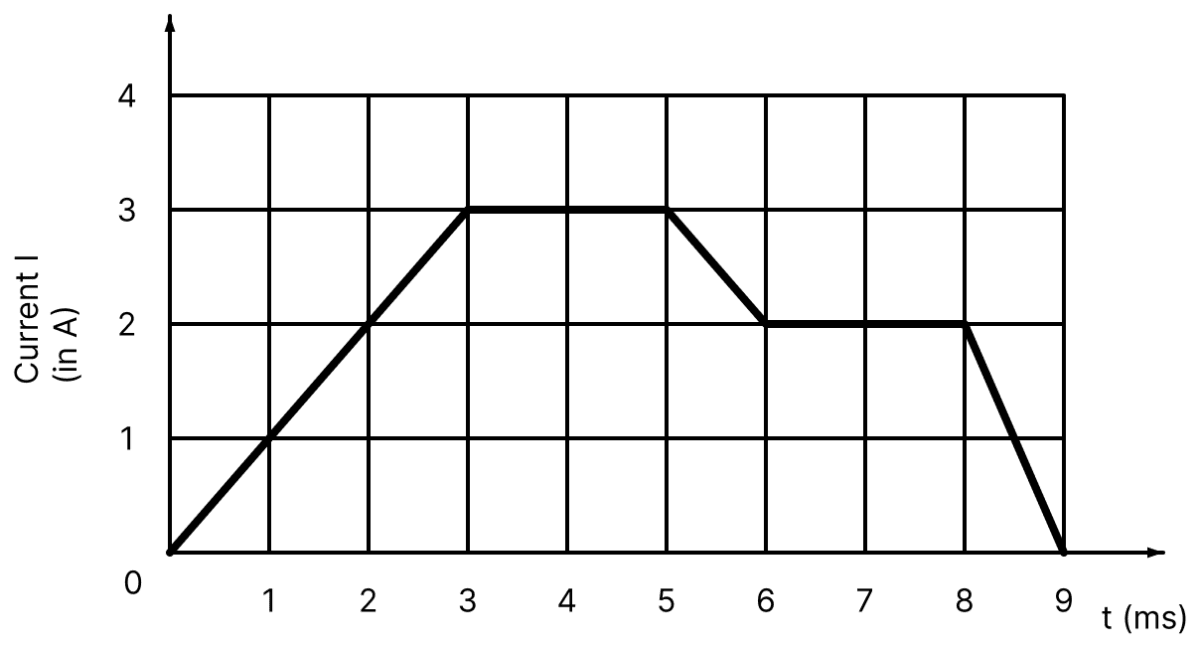
Calculate the charge passing through the wire in (i) 0s to 5s, (ii) 0 to 9s.
Answer
Given, the current–time graph of the wire. The time axis of the graph is in milliseconds, so the intervals are 0 to 5 ms and 0 to 9 ms.
The charge passing through the wire is , which is equal to the area under the current–time graph.
(i) From 0s to 5s :
From 0 to 3 ms the current rises uniformly from 0 to 3 A, and from 3 ms to 5 ms it stays constant at 3 A.
(ii) From 0 to 9s :
From 5 ms to 6 ms the current falls uniformly from 3 A to 2 A, from 6 ms to 8 ms it stays constant at 2 A, and from 8 ms to 9 ms it falls uniformly from 2 A to 0.
Hence, the charge passing through the wire is 10.5 mC in the first case and 18 mC in the second case.
The current in a wire varies with time according to the equation i = 4 + 2t, where i is in ampere and t in second. Calculate the quantity of charge which has passed through a cross-section of the wire during the time t = 2s to t = 6s.
Answer
Given,
- Current, i = 4 + 2t (i in ampere, t in second)
- Time interval, from t = 2 s to t = 6 s
The current is the rate of flow of charge,
Integrating between the given limits,
Hence, the quantity of charge passed is 48 C.
The cross-sectional area of a wire is 1.0 × 10⁻⁷ m2 and the density of free electrons is 2.0 × 1028 m-3. What will be the drift velocity of the free electrons for a current of 3.2 A in the wire?
Answer
Given,
- Area of cross-section, A = 1.0 × 10⁻⁷ m2
- Free-electron density, n = 2.0 × 1028 m-3
- Current, I = 3.2 A
- Electronic charge, e = 1.6 × 10⁻¹⁹ C
The current in terms of the drift velocity is
Substituting the values,
Hence, the drift velocity of the free electrons is 1.0 × 10⁻² m s-1.
90 C charge flows for 75 minutes in a silver wire of diameter 1.0 mm. The free-electron density in the wire is 5.8 × 1028 m-3. Find the current and the drift velocity of free electrons in the wire.
Answer
Given,
- Charge, q = 90 C
- Time, t = 75 minutes = 75 × 60 = 4500 s
- Diameter of the wire, d = 1.0 mm, so radius r = 0.5 mm = 0.5 × 10⁻³ m
- Free-electron density, n = 5.8 × 1028 m-3
- Electronic charge, e = 1.6 × 10⁻¹⁹ C
Current in the wire :
Area of cross-section :
Drift velocity : From I = n e A vd,
Hence, the current is 0.02 A and the drift velocity of the free electrons is 2.7 × 10⁻⁶ m s-1.
Estimate the average drift speed of conduction electrons in a copper wire of cross-sectional area 1.0 × 10⁻⁷ m2 carrying a current of 1.5 A. Assume that each copper atom contributes one conduction electron. The density of copper is 9.0 × 10³ kg m-3 and its atomic mass is 63.5. Take Avogadro's number N = 6.0 × 10²³ mol-1.
Answer
Given,
- Area of cross-section, A = 1.0 × 10⁻⁷ m2
- Current, I = 1.5 A
- Density of copper, d = 9.0 × 10³ kg m-3
- Atomic mass of copper = 63.5, that is, 63.5 × 10⁻³ kg mol-1
- Avogadro's number, N = 6.0 × 10²³ mol-1
Free-electron density : Each copper atom contributes one conduction electron, so n is equal to the number of copper atoms per unit volume,
Drift speed : From I = n e A vd,
Hence, the average drift speed of the conduction electrons is 1.1 × 10⁻³ m s-1.
A 3.0 m long copper wire is carrying a current of 3.0 A. How long does it take for an electron to drift from one end of the wire to the other? The cross-sectional area of the wire is 2.0 × 10⁻⁶ m-2 and the number of conduction electrons in copper is 8.5 × 1028 m-3.
Answer
Given,
- Length of the wire, l = 3.0 m
- Current, I = 3.0 A
- Area of cross-section, A = 2.0 × 10⁻⁶ m2
- Free-electron density, n = 8.5 × 1028 m-3
- Electronic charge, e = 1.6 × 10⁻¹⁹ C
Drift velocity : From I = n e A vd,
Time taken to drift the whole length :
Hence, an electron takes about 7.6 hours to drift from one end of the wire to the other.
Note: The textbook gives 7.5 h, which is 7.56 h truncated rather than rounded.
Find out the resistivity of a conductor in which a current density of 2.5 A-m-2 is found when an electric field of 15 V-m-1 is applied on it.
Answer
Given,
- Current density, j = 2.5 A-m-2
- Electric field, E = 15 V-m-1
By Ohm's law in vector form, .
Therefore the resistivity is
Substituting the values,
Hence, the resistivity of the conductor is 6 Ω-m.
A very small current is sent through a wire of length 15 m and cross-sectional area 6.0 × 10⁻⁷ m-2. Its resistance is measured to be 5.0 Ω. Find the specific resistance of the material of the wire at the temperature of the experiment. What will be the specific conductance?
Answer
Given,
- Length of the wire, l = 15 m
- Area of cross-section, A = 6.0 × 10⁻⁷ m2
- Resistance, R = 5.0 Ω
The resistance of a wire is
Substituting the values,
The specific conductance is the reciprocal of the specific resistance,
Hence, the specific resistance is 2.0 × 10⁻⁷ Ω-m and the specific conductance is 5.0 × 10⁶ (Ω-m)-1.
What length of a wire of diameter 0.46 mm and specific resistance 50 × 10-6 ohm-cm will be required to prepare a coil of 10 ohm?
Answer
Given,
- Diameter of the wire, d = 0.46 mm = 0.046 cm, so radius r = 0.023 cm
- Specific resistance, ρ = 50 × 10-6 ohm-cm
- Resistance required, R = 10 ohm
Area of cross-section :
Length required : From ,
Hence, a wire of length 332 cm will be required.
A piece of copper of mass 50 g is drawn into a wire of length 50 m. Find the resistance of the wire. The density and the specific resistance of copper are 8.9 × 10³ kg m-3 and 1.7 × 10⁻⁸ Ω-m respectively.
Answer
Given,
- Mass of copper, m = 50 g = 0.05 kg
- Length of the wire, l = 50 m
- Density of copper, d = 8.9 × 10³ kg m-3
- Specific resistance, ρ = 1.7 × 10⁻⁸ Ω-m
Volume of the wire :
Area of cross-section : Since V = A l,
Resistance of the wire :
Hence, the resistance of the wire is 7.6 Ω.
Two copper wires A and B of equal masses are taken. The length of A is double the length of B. If the resistance of the wire A be 160 Ω, then calculate the resistance of the wire B.
Answer
Given,
- The wires A and B are of copper and of equal masses
- lA = 2 lB
- RA = 160 Ω
Since the two wires are of the same material and of equal masses, their volumes are also equal. For a wire of volume V,
Hence for wires of the same material and the same volume,
Therefore
Hence, the resistance of the wire B is 40 Ω.
A 200 V bulb takes a current of 0.2 A. The length of its filament is 22 cm and the specific resistance of the material of the filament is 7 × 10⁻⁵ Ω-cm. Find the radius of the filament .
Answer
Given,
- Potential difference, V = 200 V
- Current, I = 0.2 A
- Length of the filament, l = 22 cm
- Specific resistance, ρ = 7 × 10⁻⁵ Ω-cm
Resistance of the filament :
Area of cross-section : From ,
Radius of the filament : Since A = πr2,
Hence, the radius of the filament is 7 × 10⁻⁴ cm.
A rectangular block of iron has dimensions 1.2 cm × 1.2 cm × 15 cm. Compute the resistance of the block (a) between the two square ends, (b) between the two opposite rectangular faces. The specific resistance of iron at room temperature is 9.68 × 10⁻⁸ Ω m.
Answer
Given,
- Dimensions of the block, 1.2 cm × 1.2 cm × 15 cm
- Specific resistance of iron, ρ = 9.68 × 10⁻⁸ Ω m
(a) Between the two square ends :
Here the length along the current is l = 15 cm = 0.15 m and the area of cross-section is
(b) Between the two opposite rectangular faces :
Here the length along the current is l = 1.2 cm = 0.012 m and the area of cross-section is
Hence, the resistance is 100 µΩ between the square ends and 0.65 µΩ between the opposite rectangular faces.
Two wires of different materials; of lengths 50 cm and 75 cm and respective diameters 0.2 mm and 0.1 mm, have resistances of 0.8 Ω and 1.5 Ω respectively. What is the ratio of the specific resistances of the materials?
Answer
Given,
- l1 = 50 cm, d1 = 0.2 mm, R1 = 0.8 Ω
- l2 = 75 cm, d2 = 0.1 mm, R2 = 1.5 Ω
The specific resistance of a wire is
Hence, for the two wires,
Substituting the values,
Hence, the ratio of the specific resistances of the materials is 16 : 5.
A thick wire of 10 Ω resistance is drawn into a thin wire so that its length becomes three times. Calculate its new resistance.
Answer
Given,
- Initial resistance, R = 10 Ω
- The length becomes three times, that is, l' = 3l, so n = 3
On drawing the wire, its volume remains constant, so if the length becomes n times, the area of cross-section becomes times. Hence
Substituting n = 3 and R = 10 Ω,
Hence, the new resistance of the wire is 90 Ω.
A 1-kg piece of copper is drawn into a wire 1 mm thick and another piece into a wire 2 mm thick. Compare the resistances of these wires.
Answer
Given,
- Two pieces of copper of equal mass (1 kg each)
- Thickness (diameter) of the first wire, d1 = 1 mm
- Thickness (diameter) of the second wire, d2 = 2 mm
Since both pieces are of the same material and of equal masses, their volumes V are equal. For such a wire,
Therefore
Hence
Hence, the resistances of the two wires are in the ratio 16 : 1.
The resistance of a silver wire at 0°C is 1.25 Ω. Up to what temperature it must be heated so that its resistance is doubled? The temperature coefficient of resistance of silver is 0.00375°C-1. Will the temperature be the same for all conductors of silver?
Answer
Given,
- Resistance at 0°C, R0 = 1.25 Ω
- Resistance at t°C, Rt = 2 × 1.25 = 2.50 Ω
- Temperature coefficient of resistance of silver, α = 0.00375°C-1
The resistance of a conductor at t°C is
Substituting the values,
Yes, the temperature will be the same for all conductors of silver. The temperature coefficient of resistance α is a property of the material and does not depend on the dimensions of the specimen. Since the resistance is to be doubled in every case, the relation gives the same temperature for every silver conductor.
Hence, the wire must be heated up to 267°C, and the temperature will be the same for all conductors of silver.
The resistance of the coil used in a platinum-resistance thermometer at 0°C is 3.00 Ω and at 100°C is 3.75Ω. Its resistance at an unknown temperature is measured 3.15 Ω. Calculate the unknown temperature.
Answer
Given,
- Resistance at 0°C, R0 = 3.00 Ω
- Resistance at 100°C, R100 = 3.75 Ω
- Resistance at the unknown temperature t°C, Rt = 3.15 Ω
The resistance at t°C is given by Rt = R0(1 + αt).
Temperature coefficient of resistance :
Unknown temperature :
Hence, the unknown temperature is 20°C.
The resistance of a carbon filament at 0°C is 104 Ω. What should be the resistance of an iron filament which should be connected in series with the carbon filament so that the resistance of the combined filament does not change with temperature? The temperature coefficient of resistance of iron is α = + 0.0052°C-1 and of carbon is − 0.0003°C-1.
Answer
Given,
- Resistance of the carbon filament at 0°C, RC = 104 Ω
- Temperature coefficient of resistance of carbon, αC = − 0.0003°C-1
- Temperature coefficient of resistance of iron, αFe = + 0.0052°C-1
Let RFe be the resistance of the iron filament at 0°C. In series the combined resistance at t°C is
For the combined resistance to be independent of temperature, the coefficient of t must be zero,
Substituting the values,
Hence, an iron filament of resistance 6.00 ohm at 0°C should be connected in series.
A metallic wire has a resistance of 3.0 Ω at 0°C and 4.8 Ω at 150°C. Find the temperature coefficient of resistance of its material.
Answer
Given,
- Resistance at 0°C, R0 = 3.0 Ω
- Resistance at 150°C, Rt = 4.8 Ω
- Temperature, t = 150°C
The resistance at t°C is
Substituting the values,
Hence, the temperature coefficient of resistance of the material is 4 × 10⁻³ °C-1.
How can three resistances of 2 Ω, 3 Ω and 6 Ω be connected to give an equivalent resistance of 4 Ω?
Answer
Given, three resistances of 2 Ω, 3 Ω and 6 Ω, and the required equivalent resistance is 4 Ω.
Connect the 3 Ω and the 6 Ω resistances in parallel, and join the 2 Ω resistance in series with this combination.
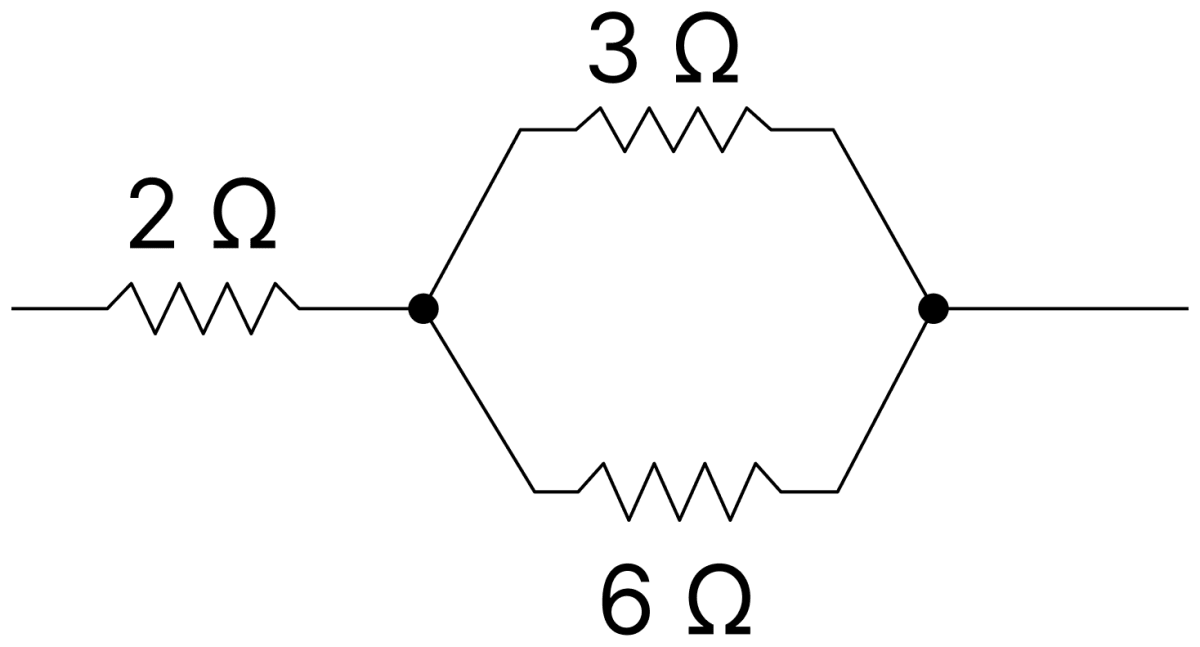
The equivalent resistance of the parallel combination is
This is in series with the 2 Ω resistance, so the equivalent resistance of the whole combination is
Hence, the 2 Ω resistance should be connected in series with the parallel combination of the 3 Ω and 6 Ω resistances.
Join three 3 Ω resistances to obtain an effective resistance of 2 Ω.
Answer
Given, three resistances of 3 Ω each, and the required effective resistance is 2 Ω.
Connect two of the 3 Ω resistances in series and join the third 3 Ω resistance in parallel with this combination.
The resistance of the two in series is
This is joined in parallel with the third resistance of 3 Ω,
Hence, two resistances should be joined in series and the third in parallel with them.
A 5 Ω resistor is connected in series with a parallel combination of n resistors each of 6 Ω. The equivalent resistance is 7 Ω. Find n.
Answer
Given,
- Resistance in series, R1 = 5 Ω
- n resistors each of 6 Ω joined in parallel
- Equivalent resistance, R = 7 Ω
For n equal resistances of 6 Ω each in parallel, the equivalent resistance is
This is joined in series with the 5 Ω resistor, so
Substituting R = 7 Ω,
Hence, the number of resistors joined in parallel is n = 3.
Three resistors are joined to form a triangle ABC. The resistances of the sides AB, BC and CA are 40 Ω, 60 Ω and 100 Ω respectively. Find the equivalent resistance between points A and B.
Answer
Given,
- RAB = 40 Ω, RBC = 60 Ω, RCA = 100 Ω
- Equivalent resistance is required between A and B
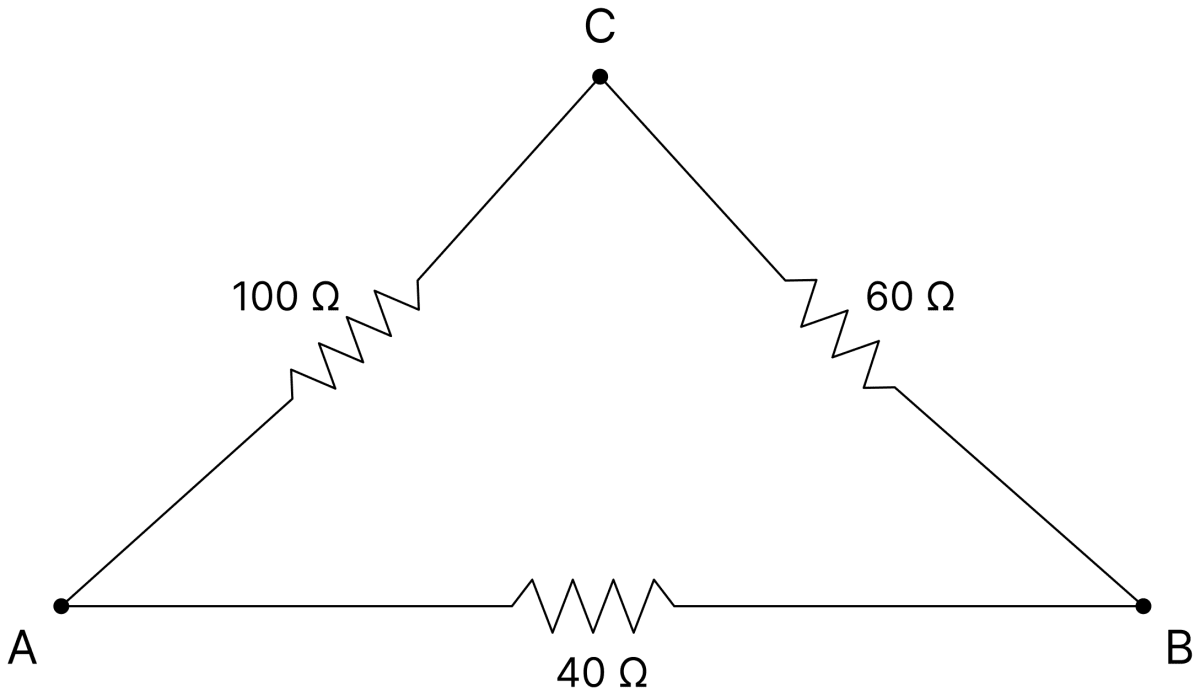
Between the points A and B there are two paths in parallel :
(i) the direct side AB, of resistance 40 Ω, and
(ii) the path A → C → B, consisting of CA and BC in series,
These two are in parallel between A and B, so
Hence, the equivalent resistance between the points A and B is 32 Ω.
Four resistors, each 10 Ω are joined in the form of a square. Find the equivalent resistance between two diagonally-opposite corners.
Answer
Given, four resistors each of 10 Ω joined in the form of a square, and the equivalent resistance is required between two diagonally-opposite corners.
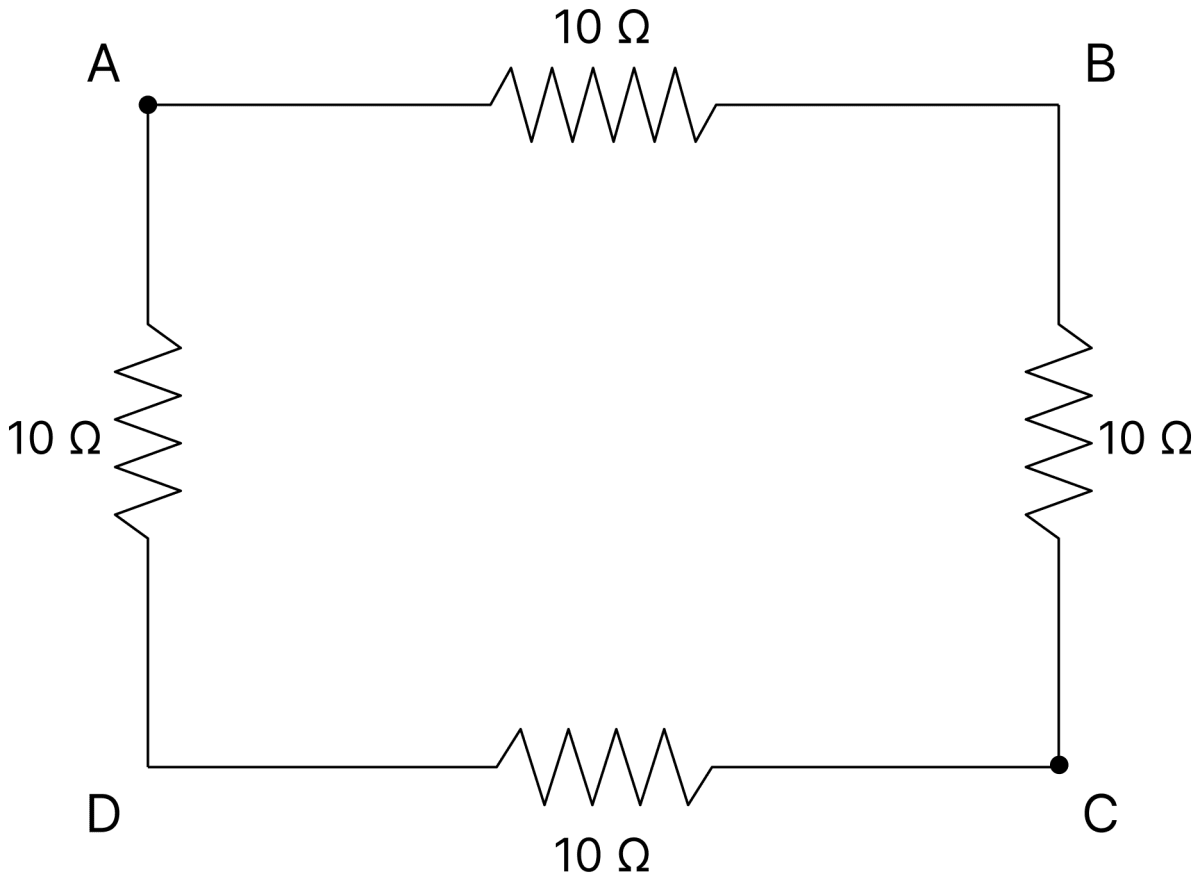
Let the square be ABCD and let the equivalent resistance be required between the diagonally-opposite corners A and C. There are two paths in parallel between A and C :
(i) the path A → B → C, of resistance
(ii) the path A → D → C, of resistance
These two branches of 20 Ω each are in parallel between A and C, so
Hence, the equivalent resistance between the two diagonally-opposite corners is 10 Ω.
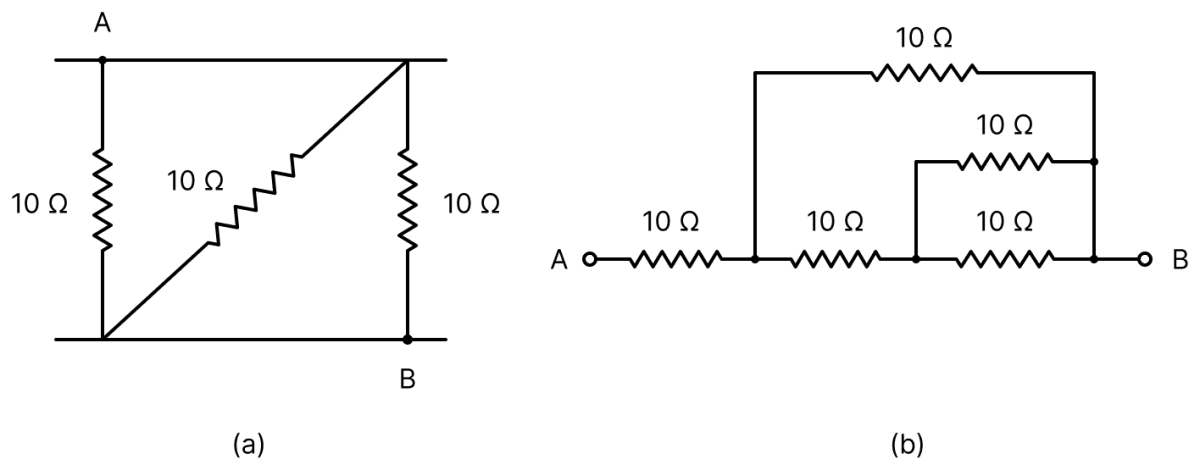
Calculate the equivalent resistance between points A and B in each of the shown networks of resistors.
Answer
(a) From the figure, A is joined to the upper rail and B to the lower rail by plain connecting wires. Hence all the three 10 Ω resistances are connected between the same two points A and B, that is, they are in parallel.
(b) Let the junctions be marked P (after the first 10 Ω from A), Q (the next junction) and B.
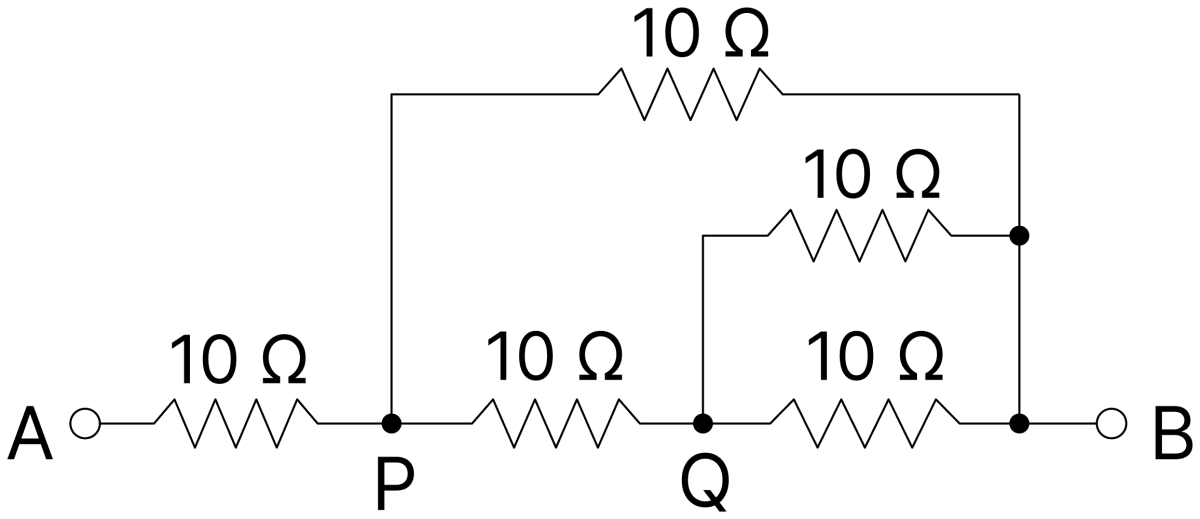
Between Q and B two resistances of 10 Ω each are joined in parallel (the lower 10 Ω and the upper 10 Ω),
Between P and B there are now two paths in parallel : the path P → Q → B of resistance
and the upper 10 Ω joined directly from P to B. Hence
Finally, the 10 Ω between A and P is in series with this,
Hence, the equivalent resistance is Ω in the network (a) and 16 Ω in the network (b).
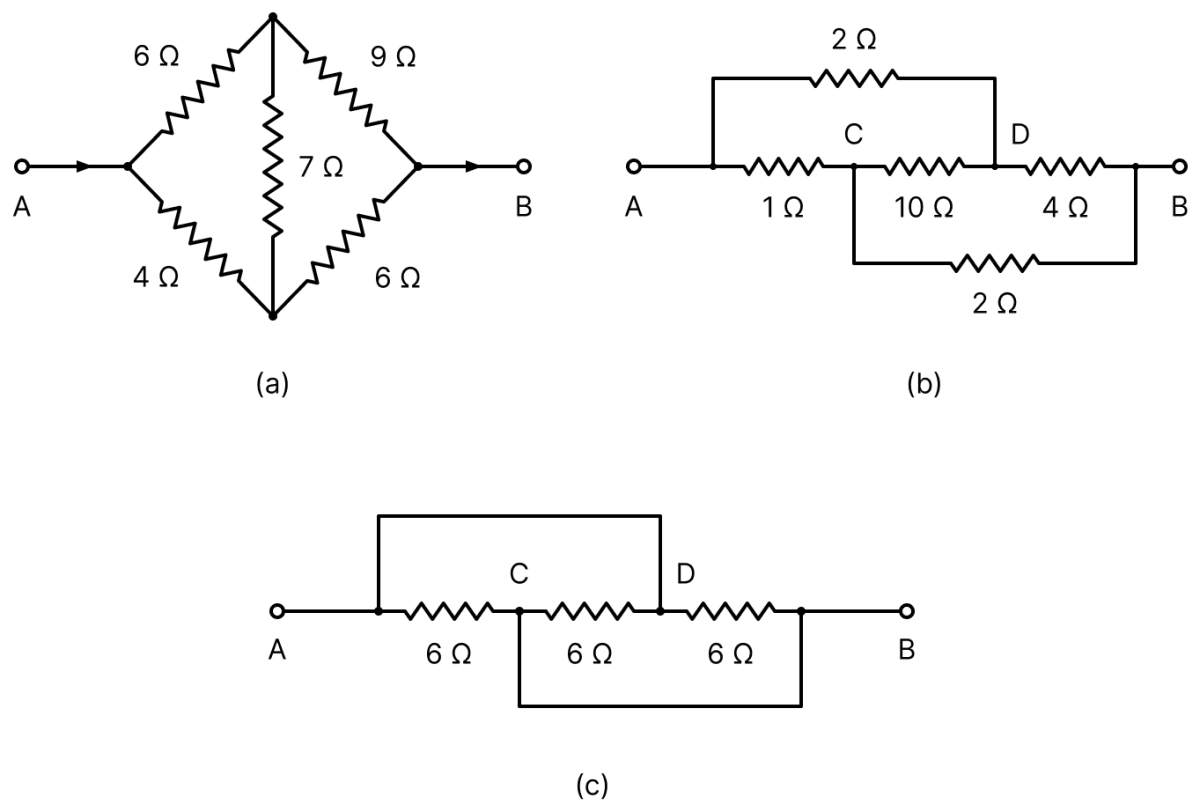
Calculate the equivalent resistance between points A and B in each of the following networks of resistors.
Answer
(a) The network is a Wheatstone bridge with the 6 Ω and 9 Ω in the upper two arms, the 4 Ω and 6 Ω in the lower two arms, and the 7 Ω as the bridge arm.
In a Wheatstone bridge, if the ratio of the resistances in the two arms on one side equals that on the other side (), the bridge is balanced and no current flows through the bridge arm.
The bridge is balanced, because
Hence no current flows through the 7 Ω arm and it may be ignored. The upper branch (6 + 9 = 15 Ω) and the lower branch (4 + 6 = 10 Ω) are then in parallel between A and B,
(b) Here also the arrangement is a balanced Wheatstone bridge. The arms are AC = 1 Ω, CB = 2 Ω, AD = 2 Ω and DB = 4 Ω, with the 10 Ω between C and D as the bridge arm.
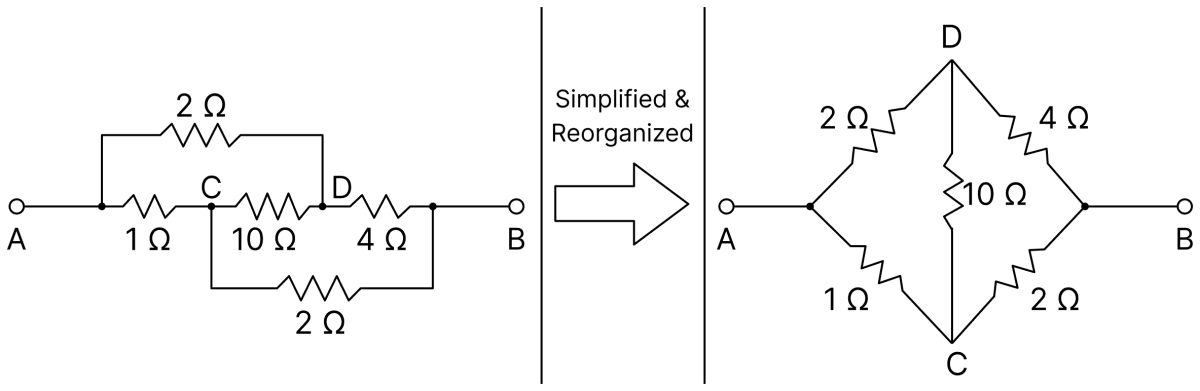
so the bridge is balanced and no current flows through the 10 Ω. The two branches in parallel are then
(c) In this network the connecting wire joins A to D, and another connecting wire joins C to B. Hence A and D are the same point, and C and B are the same point.
Therefore each of the three 6 Ω resistances is connected between A and B, that is, all three are in parallel,
Hence, the equivalent resistance is 6 Ω in (a), 2 Ω in (b) and 2 Ω in (c).
A wire whose resistance 0.1 Ω/cm, is bent in the form of a square ABCD of side 10 cm. An exactly similar wire is connected across the points B and D. What will be the equivalent resistance between the other two corners A and C of the square? If a 2 V battery be connected between A and C, then what will be the current drawn from the battery? If an ammeter be connected across B and D, what will it read?
Answer
Given,
- Resistance of the wire = 0.1 Ω/cm
- Side of the square, 10 cm
- Emf of the battery, V = 2 V
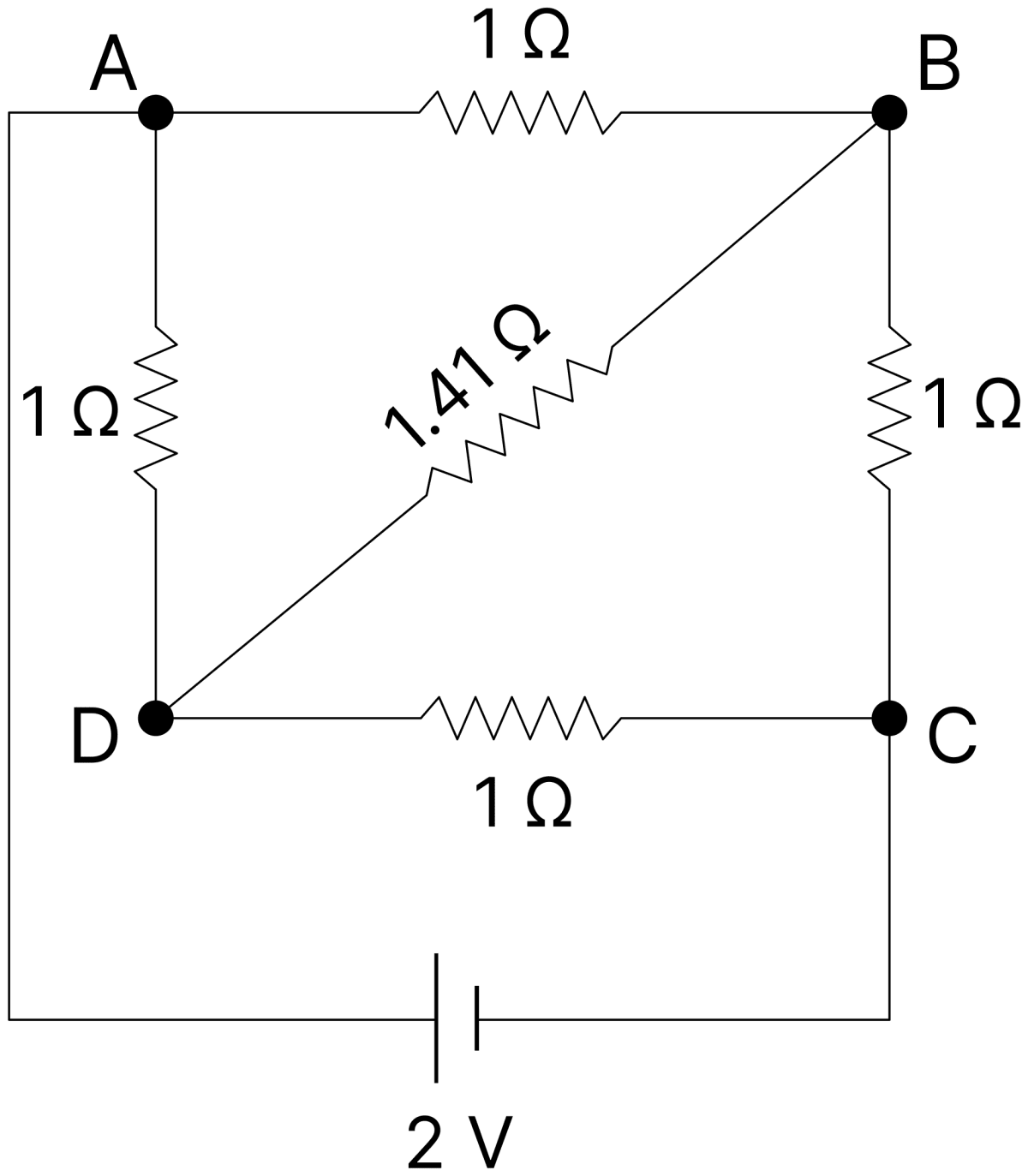
Resistance of each side :
Equivalent resistance between A and C : The arms AB and BC are equal (1 Ω each) and the arms AD and DC are also equal (1 Ω each). Hence the points B and D are at the same potential and no current flows through the wire joining B and D, whatever be its resistance.
Therefore the two branches A → B → C and A → D → C, each of resistance
are in parallel between A and C,
Current drawn from the battery :
Reading of the ammeter across B and D : Since B and D are at the same potential, no current passes between them. Hence the ammeter reads zero.
Hence, the equivalent resistance is 1.0 Ω, the current drawn is 2.0 A and the ammeter reads zero.
How much charge flows through a 250 V-1000 W heater in one minute?
Answer
Given,
- Rating of the heater, 250 V-1000 W
- Time, t = 1 minute = 60 s
Current drawn by the heater :
Charge flowing in one minute :
Hence, the charge flowing through the heater in one minute is 240 C.
Compute the voltage drop across a 2 kW electric heater element whose resistance when hot is 20 Ω.
Answer
Given,
- Power of the heater element, P = 2 kW = 2000 W
- Resistance when hot, R = 20 Ω
The power consumed in terms of the voltage drop across the element is
Substituting the values,
Hence, the voltage drop across the heater element is 200 V.
A heating element is marked 210 V, 630 W. What is the current drawn by the element when connected to 210 V DC mains? What is the resistance of the element?
Answer
Given,
- Rating of the heating element, 210 V, 630 W
- Supply voltage, V = 210 V
Current drawn :
Resistance of the element :
Hence, the current drawn is 3.0 A and the resistance of the element is 70 Ω.
An electric motor of 1 HP (horse-power) is running at 220 V. What is the current in the motor?
Answer
Given,
- Power of the motor, P = 1 HP = 746 W
- Supply voltage, V = 220 V
The power consumed is P = VI, so
Substituting the values,
Hence, the current in the motor is 3.39 A.
An electric press has a resistance of 44 Ω and a current of 5.0 A flows through it. Calculate the power consumed by the press.
Answer
Given,
- Resistance of the press, R = 44 Ω
- Current, I = 5.0 A
The power consumed by a resistor carrying a current I is
Substituting the values,
Hence, the power consumed by the press is 1100 W.
A current of 4.0 A flows in a heating-wire of 100 W. Determine the resistance of the wire.
Answer
Given,
- Current, I = 4.0 A
- Power of the heating-wire, P = 100 W
The power consumed is P = I2R, so
Substituting the values,
Hence, the resistance of the wire is 6.25 Ω.
Find the ratio of the resistances of a 40 W bulb and a 100 W bulb designed to work at 220 V supply line.
Answer
Given,
- Power of the first bulb, P1 = 40 W
- Power of the second bulb, P2 = 100 W
- Both are designed for the same supply line of V = 220 V
The resistance of a bulb from its rating is
Since both bulbs work at the same voltage, R is inversely proportional to P. Hence
Hence, the ratio of the resistances of the 40 W bulb and the 100 W bulb is 5 : 2.
Find the resistance of the filament of a 100 W-220 V bulb when glowing. The length and radius of the filament are 0.1 m and 2.5 × 10⁻⁵ m. Find the specific resistance of the material of the filament.
Answer
Given,
- Rating of the bulb, 100 W-220 V
- Length of the filament, l = 0.1 m
- Radius of the filament, r = 2.5 × 10⁻⁵ m
Resistance of the filament when glowing :
Area of cross-section of the filament :
Specific resistance : From ,
Hence, the resistance of the filament is 484 Ω and the specific resistance of its material is 9.5 × 10⁻⁶ Ω-m.
Find the resistance of a 240 V-200 W electric bulb when glowing. If this resistance is 10 times the resistance at 0°C and the temperature of the glowing filament is 2000°C, then find the temperature coefficient of resistance of the filament.
Answer
Given,
- Rating of the bulb, 240 V-200 W
- Resistance when glowing, R = 10 R0, where R0 is the resistance at 0°C
- Temperature of the glowing filament, t = 2000°C
Resistance of the bulb when glowing :
Resistance at 0°C :
Temperature coefficient of resistance : Using Rt = R0(1 + αt),
Hence, the resistance of the glowing bulb is 288 Ω and the temperature coefficient of resistance of the filament is 4.5 × 10⁻³ °C-1.
A lamp marked '15 V-20 W' is connected to a DC source of 25 V and a resistance R in series for full illumination. Find (i) the current in the circuit, (ii) the resistance of the lamp, (iii) the resistance R.
Answer
Given,
- Rating of the lamp, 15 V-20 W
- Emf of the DC source, E = 25 V
- A resistance R is joined in series with the lamp
(i) Current in the circuit : For full illumination the lamp works at its rated values, so
(ii) Resistance of the lamp :
(iii) Resistance R : The potential difference across R is the remaining part of the source voltage,
Hence, the current is A, the resistance of the lamp is Ω and the resistance R is 7.5 Ω.
In a house having a 220 V line the following three appliances are operating : (i) a 60 W bulb, (ii) a 1000 W heater and (iii) a 40 W radio. Calculate (a) the current drawn by the heater and (b) the current passing through the fuse for this line.
Answer
Given,
- Line voltage, V = 220 V
- Appliances : a 60 W bulb, a 1000 W heater and a 40 W radio
All the three appliances are joined in parallel, so a potential difference of 220 V acts across each of them.
(a) Current drawn by the heater :
(b) Current through the fuse : The fuse carries the total current drawn by all the three appliances. The total power consumed is
Hence, the current drawn by the heater is A and the current passing through the fuse is 5.0 A.
We have a 30 W-6 V bulb which we want to glow by a supply of 120 V. What will have to be done for it?
Answer
Given,
- Rating of the bulb, 30 W-6 V
- Supply voltage, V = 120 V
Current required for the bulb to glow properly :
The bulb needs only 6 V across it, whereas the supply is of 120 V. Hence a resistance must be joined in series with the bulb so that the excess voltage is dropped across it.
Potential difference to be dropped across the series resistance :
Resistance required :
Hence, a resistance wire of 22.8 Ω should be connected in series with the bulb.
Two cities are 150 km away from each other. Electric power is transmitted through copper wires from one city to the other. There is a potential-drop of 8 V/km in the wires and the average resistance of the wires is 0.5 Ω/km (i) Calculate the current flowing in the wires. (ii) Find out the loss of electric power in the wires.
Answer
Given,
- Distance between the cities, l = 150 km
- Potential-drop in the wires = 8 V/km
- Average resistance of the wires = 0.5 Ω/km
(i) Current flowing in the wires : Consider 1 km length of the wire. Across it the potential drop is 8 V and its resistance is 0.5 Ω. By Ohm's law,
Since the same current flows through the whole line, the current in the wires is 16 A.
(ii) Loss of electric power in the wires :
Total resistance of the wires,
Hence, the current flowing in the wires is 16 A and the loss of electric power in them is 19.2 kW.
A 500 W electric heater is designed to work with a 115 V line. If the voltage of the line drops to 110, then what will be the percentage loss of energy liberated?
Answer
Given,
- Rating of the heater, 500 W at 115 V
- Reduced line voltage, V' = 110 V
The resistance of the heating element is taken to be unchanged, so the power liberated is
Hence
Percentage loss of energy liberated :
Hence, the percentage loss of energy liberated is 8.5%.
An electric heater has a rating of 1100 W-220 V. How much electrical energy (in kW-h) will it consume in 4 hours? What is the resistance of its element?
Answer
Given,
- Rating of the heater, 1100 W-220 V
- Time, t = 4 hours
Electrical energy consumed :
Resistance of the element :
Hence, the heater consumes 4.4 kW-h of electrical energy and the resistance of its element is 44 Ω.
Calculate the number of electrons drifting per second through the filament of a 100 W–220 V bulb, when glowing (e = 1.6 × 10⁻¹⁹ C).
Answer
Given,
- Rating of the bulb, 100 W–220 V
- Electronic charge, e = 1.6 × 10⁻¹⁹ C
Current through the filament :
Number of electrons drifting per second : The current is the charge flowing per second, and if N electrons drift per second, then I = Ne. Hence
Hence, 2.84 × 10¹⁸ electrons drift per second through the filament.
Two resistors R1 = 60 Ω and R2 = 90 Ω are connected in parallel. If electric power consumed by the resistor R1 is 15 W, calculate the power consumed by the resistor R2.
Answer
Given,
- R1 = 60 Ω, R2 = 90 Ω, joined in parallel
- Power consumed by R1, P1 = 15 W
In a parallel combination the same potential difference V acts across both the resistors, and the power consumed is
For the resistor R1,
For the resistor R2, the same V acts, so
Hence, the power consumed by the resistor R2 is 10 W.
A 60 W bulb is switched on in a room. A 240 W heater is also turned on in the same room. The voltage of the mains is 120 V and the resistance of the connecting leads is 6 Ω. What is the change in the voltage at the bulb when the heater is turned on?
Answer
Given,
- Power of the bulb = 60 W, power of the heater = 240 W
- Mains voltage, V = 120 V
- Resistance of the connecting leads, r = 6 Ω
Resistances of the bulb and the heater :
When only the bulb is switched on : The bulb is in series with the leads,
Voltage at the bulb,
When the heater is also turned on : The bulb and the heater are in parallel,
Voltage at the bulb,
Change in the voltage at the bulb :
Hence, the voltage at the bulb will reduce by 10.4 V.
Three resistors 2 Ω, 4 Ω and 5 Ω are joined in parallel and connected to a battery of 20 V and negligible internal resistance. Find (a) equivalent resistance, (b) current drawn from the battery and (c) current through each resistor.
Answer
Given,
- Resistors of 2 Ω, 4 Ω and 5 Ω joined in parallel
- Emf of the battery, V = 20 V, internal resistance negligible
(a) Equivalent resistance :
(b) Current drawn from the battery :
(c) Current through each resistor : In parallel the same potential difference of 20 V acts across each resistor,
Hence, the equivalent resistance is Ω, the current drawn from the battery is 19 A, and the currents through the 2 Ω, 4 Ω and 5 Ω resistors are 10 A, 5 A and 4 A respectively.
A 150 Ω electric heater can take a maximum current of 1.1 A. What minimum resistance should be joined in series with it so that it may be operated at 220 V mains?
Answer
Given,
- Resistance of the heater, RH = 150 Ω
- Maximum current it can take, I = 1.1 A
- Supply voltage, V = 220 V
The total resistance of the circuit needed to limit the current to 1.1 A is
If R' is the resistance joined in series with the heater, then
Hence, a minimum resistance of 50 Ω should be joined in series with the heater.
A filament lamp of 200 Ω resistance is used at 150 V supply. How much resistance should be joined in series with it to use it at 210 V supply?
Answer
Given,
- Resistance of the filament lamp, RL = 200 Ω
- Rated supply, V = 150 V
- New supply, V' = 210 V
Current at which the lamp works properly :
To use the lamp at 210 V the same current must flow through it, so the total resistance of the circuit must be
If R' is the resistance joined in series, then
Hence, a resistance of 80 Ω should be joined in series with the lamp.
Each of the two bulbs takes 2 A current at 50 V supply. They are joined in series. How much resistance should be added in series with the lamps so that on connecting them with 120 V supply, a current of 2 A flows through each of them?
Answer
Given,
- Each bulb takes a current of 2 A at 50 V
- The two bulbs are joined in series
- Supply voltage, V = 120 V, required current I = 2 A
Resistance of each bulb :
Resistance of the two bulbs in series :
Total resistance needed for a current of 2 A at 120 V :
Resistance to be added in series :
Hence, a resistance of 10 Ω should be added in series with the lamps.