KnowledgeBoat Logo
|
OPEN IN APP

Chapter 23

Photoelectric Effect — Numericals

Class 12 - Nootan Physics


Numericals

Question 1

Find the frequency of a photon of energy 75 eV.

Answer

Given,

  • Energy of the photon, E = 75 eV = 75 × 1.6 × 10-19 J

  • Planck's constant, h = 6.6 × 10⁻³⁴ J s

The energy of a photon of frequency ν is E = hν. Therefore,

ν=Ehν=75×1.6×10−196.6×10⁻³⁴ν=1.2×10−176.6×10⁻³⁴ν=1.82×10¹⁶ Hz\nu = \dfrac{\text E}{\text h} \\[1em] \nu = \dfrac{75 \times 1.6 \times 10^{-19}}{6.6 \times 10^{-34}} \\[1em] \nu = \dfrac{1.2 \times 10^{-17}}{6.6 \times 10^{-34}} \\[1em] \nu = 1.82 \times 10^{16}\ \text{Hz}

Hence, the frequency of the photon is 1.82 × 10¹⁶ Hz.

Question 2

The frequency of a beam of UV light is 1.0 × 10¹⁵ Hz. What is the energy in one quantum of this light? Express it in eV.

Answer

Given,

  • Frequency of UV light, ν = 1.0 × 10¹⁵ Hz

  • Planck's constant, h = 6.6 × 10⁻³⁴ J s

The energy in one quantum (photon) of light of frequency ν is

E=hνE=6.6×10−34×1.0×1015E=6.6×10⁻¹⁹ J\text E = \text h\nu \\[1em] \text E = 6.6 \times 10^{-34} \times 1.0 \times 10^{15} \\[1em] \text E = 6.6 \times 10^{-19}\ \text J

Since 1 eV = 1.6 × 10⁻¹⁹ J,

E=6.6×10−191.6×10⁻¹⁹ eVE=4.125 eV≈4.13 eV\text E = \dfrac{6.6 \times 10^{-19}}{1.6 \times 10^{-19}}\ \text{eV} \\[1em] \text E = 4.125\ \text{eV} \approx 4.13\ \text{eV}

Hence, the energy in one quantum of this light is 6.6 × 10⁻¹⁹ J, i.e., 4.125 eV.

Note: The textbook prints 4.14 eV, which follows from h = 6.63 × 10⁻³⁴ J s; with h = 6.6 × 10⁻³⁴ J s from the given table, the energy is 4.125 eV.

Question 3

A certain spectral line has a wavelength of 400 nm. Calculate the frequency and energy of the photons associated with it.

Answer

Given,

  • Wavelength, λ = 400 nm = 400 × 10-9 m = 4 × 10⁻⁷ m

  • c = 3.0 × 10⁸ m s-1, h = 6.6 × 10⁻³⁴ J s

Frequency :

ν=cλν=3.0×1084×10−7ν=7.5×10¹⁴ Hz\nu = \dfrac{\text c}{\lambda} \\[1em] \nu = \dfrac{3.0 \times 10^8}{4 \times 10^{-7}} \\[1em] \nu = 7.5 \times 10^{14}\ \text{Hz}

Energy of each photon :

E=hνE=6.6×10−34×7.5×1014E=4.95×10⁻¹⁹ J\text E = \text h\nu \\[1em] \text E = 6.6 \times 10^{-34} \times 7.5 \times 10^{14} \\[1em] \text E = 4.95 \times 10^{-19}\ \text J

In electron-volt,

E=4.95×10−191.6×10⁻¹⁹ eVE=3.09 eV≈3.1 eV\text E = \dfrac{4.95 \times 10^{-19}}{1.6 \times 10^{-19}}\ \text{eV} \\[1em] \text E = 3.09\ \text{eV} \approx 3.1\ \text{eV}

Hence, the frequency of the photons is 7.5 × 10¹⁴ Hz and their energy is 4.95 × 10⁻¹⁹ J or 3.1 eV.

Question 4

The energy of 600 nm photon is 3.30 × 10⁻¹⁹ J. Find the energy of 400 nm photon.

Answer

Given,

  • Energy of 600 nm photon, E1 = 3.30 × 10⁻¹⁹ J, λ1 = 600 nm

  • λ2 = 400 nm

The energy of a photon of wavelength λ is E=hcλ\text E = \dfrac{\text{hc}}{\lambda}, so E ∝ 1λ\dfrac{1}{\lambda}. Therefore,

E2E1=λ1λ2E2=E1×λ1λ2E2=3.30×10−19×600400E2=4.95×10⁻¹⁹ J\dfrac{\text E_2}{\text E_1} = \dfrac{\lambda_1}{\lambda_2} \\[1em] \text E_2 = \text E_1 \times \dfrac{\lambda_1}{\lambda_2} \\[1em] \text E_2 = 3.30 \times 10^{-19} \times \dfrac{600}{400} \\[1em] \text E_2 = 4.95 \times 10^{-19}\ \text J

Hence, the energy of a 400 nm photon is 4.95 × 10⁻¹⁹ J.

Question 5

Calculate the number of photons emitted per second from a monochromatic light source of 40 W, giving out light of wavelength 500 nm.

Answer

Given,

  • Power of the source, P = 40 W

  • Wavelength, λ = 500 nm = 5 × 10⁻⁷ m

Energy of one photon,

E=hcλE=6.6×10−34×3.0×1085×10−7E=3.96×10⁻¹⁹ J\text E = \dfrac{\text{hc}}{\lambda} \\[1em] \text E = \dfrac{6.6 \times 10^{-34} \times 3.0 \times 10^8}{5 \times 10^{-7}} \\[1em] \text E = 3.96 \times 10^{-19}\ \text J

If n photons are emitted per second, then P = nE. Therefore,

n=PEn=403.96×10⁻¹⁹n=1.01×10²⁰≈1.0×10²⁰\text n = \dfrac{\text P}{\text E} \\[1em] \text n = \dfrac{40}{3.96 \times 10^{-19}} \\[1em] \text n = 1.01 \times 10^{20} \approx 1.0 \times 10^{20}

Hence, the source emits about 1.0 × 10²⁰ photons per second.

Question 6

Light of wavelength 500 nm falls on a sensitive surface. If the surface has received 10-7 J energy, how many photons have fallen on the surface?

Answer

Given,

  • Wavelength, λ = 500 nm = 5 × 10⁻⁷ m

  • Total energy received, ET = 10-7 J

Energy of one photon,

E=hcλE=6.6×10−34×3.0×1085×10−7E=3.96×10⁻¹⁹ J\text E = \dfrac{\text{hc}}{\lambda} \\[1em] \text E = \dfrac{6.6 \times 10^{-34} \times 3.0 \times 10^8}{5 \times 10^{-7}} \\[1em] \text E = 3.96 \times 10^{-19}\ \text J

Number of photons that have fallen on the surface,

n=ETEn=10−73.96×10⁻¹⁹n=2.525×10¹¹≈25×1010\text n = \dfrac{\text E_\text T}{\text E} \\[1em] \text n = \dfrac{10^{-7}}{3.96 \times 10^{-19}} \\[1em] \text n = 2.525 \times 10^{11} \approx 25 \times 10^{10}

Hence, about 25 × 1010 photons have fallen on the surface.

Question 7

Find the number of photons of wavelength λ1 = 5.0 × 10⁻⁵ cm whose total energy is equal to the energy of one photon of wavelength λ2 = 2.0 × 10⁻¹² cm. In which part of the electromagnetic spectrum do λ1 and λ2 fall?

Answer

Given,

  • λ1 = 5.0 × 10⁻⁵ cm = 5.0 × 10⁻⁷ m

  • λ2 = 2.0 × 10⁻¹² cm = 2.0 × 10⁻¹⁴ m

Let n photons of wavelength λ1 have total energy equal to that of one photon of wavelength λ2. Since the energy of a photon is hcλ\dfrac{\text{hc}}{\lambda},

n×hcλ1=hcλ2n=λ1λ2n=5.0×10−72.0×10−14n=2.5×10⁷\text n \times \dfrac{\text{hc}}{\lambda_1} = \dfrac{\text{hc}}{\lambda_2} \\[1em] \text n = \dfrac{\lambda_1}{\lambda_2} \\[1em] \text n = \dfrac{5.0 \times 10^{-7}}{2.0 \times 10^{-14}} \\[1em] \text n = 2.5 \times 10^7

λ1 = 5.0 × 10⁻⁷ m = 5000 Å, which lies in the visible region. λ2 = 2.0 × 10⁻¹⁴ m = 2.0 × 10⁻⁴ Å, which lies in the gamma-ray (cosmic radiation) region.

Hence, 2.5 × 10⁷ photons of wavelength λ1 are required; λ1 falls in the visible region and λ2 in the gamma-ray (cosmic radiation) region.

Question 8

5% energy of a monochromatic light source is converted into light of wavelength 560 nm. If the power of the source be 100 W, then how many photons of light will be emitted by it per second?

Answer

Given,

  • Power of the source, P = 100 W

  • Fraction converted into light = 5%

  • Wavelength, λ = 560 nm = 5.6 × 10⁻⁷ m

Power emitted as light of wavelength 560 nm,

P′=5100×100P′=5 W\text P' = \dfrac{5}{100} \times 100 \\[1em] \text P' = 5\ \text W

Energy of one photon,

E=hcλE=6.6×10−34×3.0×1085.6×10−7E=3.536×10⁻¹⁹ J\text E = \dfrac{\text{hc}}{\lambda} \\[1em] \text E = \dfrac{6.6 \times 10^{-34} \times 3.0 \times 10^8}{5.6 \times 10^{-7}} \\[1em] \text E = 3.536 \times 10^{-19}\ \text J

Number of photons emitted per second,

n=P′En=53.536×10⁻¹⁹n=1.414×10¹⁹\text n = \dfrac{\text P'}{\text E} \\[1em] \text n = \dfrac{5}{3.536 \times 10^{-19}} \\[1em] \text n = 1.414 \times 10^{19}

Hence, 1.414 × 10¹⁹ photons of light are emitted per second.

Question 9

Light of wavelength 500 nm from a 2 W bulb is falling on a surface. If the absorptive power of the surface be 60%, then how many photons are being absorbed by the surface per second? If 100 absorbed photons cause emission of 1 electron, then how much current will flow from the surface?

Answer

Given,

  • Wavelength, λ = 500 nm = 5 × 10⁻⁷ m

  • Power of the bulb, P = 2 W

  • Absorptive power of the surface = 60%

  • 100 absorbed photons eject 1 electron

Power absorbed by the surface,

Pa=60100×2Pa=1.2 W\text P_\text a = \dfrac{60}{100} \times 2 \\[1em] \text P_\text a = 1.2\ \text W

Energy of one photon,

E=hcλE=6.6×10−34×3.0×1085×10−7E=3.96×10⁻¹⁹ J\text E = \dfrac{\text{hc}}{\lambda} \\[1em] \text E = \dfrac{6.6 \times 10^{-34} \times 3.0 \times 10^8}{5 \times 10^{-7}} \\[1em] \text E = 3.96 \times 10^{-19}\ \text J

Number of photons absorbed per second,

n=PaEn=1.23.96×10−19n=3.03×10¹⁸≈3×10¹⁸\text n = \dfrac{\text P_\text a}{\text E} \\[1em] \text n = \dfrac{1.2}{3.96 \times 10^{-19}} \\[1em] \text n = 3.03 \times 10^{18} \approx 3 \times 10^{18}

Current :

Number of electrons emitted per second,

N=n100N=3.03×10¹⁶\text N = \dfrac{\text n}{100} \\[1em] \text N = 3.03 \times 10^{16}

Current is the charge flowing per second,

I=NeI=3.03×1016×1.6×10−19I=4.85×10⁻³ A≈4.8 mA\text I = \text{Ne} \\[1em] \text I = 3.03 \times 10^{16} \times 1.6 \times 10^{-19} \\[1em] \text I = 4.85 \times 10^{-3}\ \text A \approx 4.8\ \text{mA}

Hence, about 3 × 10¹⁸ photons are absorbed per second and a current of about 4.8 mA flows from the surface.

Question 10

The energy of a photon is 42 eV. Find out the momentum of the photon.

Answer

Given,

  • Energy of the photon, E = 42 eV = 42 × 1.6 × 10-19 J

  • c = 3.0 × 10⁸ m s-1

The momentum of a photon is

p=Ecp=42×1.6×10−193.0×10⁸p=6.72×10−183.0×10⁸p=2.24×10⁻²⁶ kg m s−1\text p = \dfrac{\text E}{\text c} \\[1em] \text p = \dfrac{42 \times 1.6 \times 10^{-19}}{3.0 \times 10^8} \\[1em] \text p = \dfrac{6.72 \times 10^{-18}}{3.0 \times 10^8} \\[1em] \text p = 2.24 \times 10^{-26}\ \text{kg m s}^{-1}

Hence, the momentum of the photon is 2.24 × 10⁻²⁶ kg m s-1.

Question 11

The energy of a photon is 10 eV. Calculate :

(i) momentum of the photon,

(ii) wavelength of the photon,

(iii) rest mass and dynamic-mass of the photon.

Answer

Given,

  • Energy of the photon, E = 10 eV = 10 × 1.6 × 10-19 J = 1.6 × 10⁻¹⁸ J

  • c = 3.0 × 10⁸ m s-1, h = 6.6 × 10⁻³⁴ J s

(i) Momentum of the photon :

p=Ecp=1.6×10−183.0×10⁸p=5.33×10⁻²⁷ kg m s−1\text p = \dfrac{\text E}{\text c} \\[1em] \text p = \dfrac{1.6 \times 10^{-18}}{3.0 \times 10^8} \\[1em] \text p = 5.33 \times 10^{-27}\ \text{kg m s}^{-1}

(ii) Wavelength of the photon :

Since p=hλ\text p = \dfrac{\text h}{\lambda} and p=Ec\text p = \dfrac{\text E}{\text c},

λ=hpλ=hcEλ=6.6×10−34×3.0×1081.6×10−18λ=1.2375×10⁻⁷ mλ=1237.5 A˚\lambda = \dfrac{\text h}{\text p} \\[1em] \lambda = \dfrac{\text{hc}}{\text E} \\[1em] \lambda = \dfrac{6.6 \times 10^{-34} \times 3.0 \times 10^8}{1.6 \times 10^{-18}} \\[1em] \lambda = 1.2375 \times 10^{-7}\ \text m \\[1em] \lambda = 1237.5\ \text{Å}

(iii) Rest mass and dynamic mass :

A photon does not exist at rest, so its rest mass is zero.

Its dynamic (equivalent) mass is obtained from E = mc2,

m=Ec2m=1.6×10⁻¹⁸(3.0×10⁸)2m=1.6×10−189.0×10¹⁶m=1.78×10⁻³⁵ kg\text m = \dfrac{\text E}{\text c^2} \\[1em] \text m = \dfrac{1.6 \times 10^{-18}}{\left(3.0 \times 10^8\right)^2} \\[1em] \text m = \dfrac{1.6 \times 10^{-18}}{9.0 \times 10^{16}} \\[1em] \text m = 1.78 \times 10^{-35}\ \text{kg}

Hence, (i) p = 5.33 × 10⁻²⁷ kg m s-1, (ii) λ = 1237.5 Å, (iii) rest mass = zero and dynamic mass = 1.78 × 10⁻³⁵ kg.

Question 12

A photon ejects an electron of negligible kinetic energy from a metal surface. If the threshold frequency for the surface be 4.6 × 10¹⁴ Hz, calculate the energy of the incident photon in electron-volt.

Answer

Given,

  • Threshold frequency, ν0 = 4.6 × 10¹⁴ Hz

  • Kinetic energy of the ejected electron is negligible

Since the electron is ejected with negligible kinetic energy, the whole energy of the incident photon is just used up as the work function. Hence the photon energy is

E=hν0E=6.6×10−34×4.6×1014E=3.036×10⁻¹⁹ J\text E = \text h\nu_0 \\[1em] \text E = 6.6 \times 10^{-34} \times 4.6 \times 10^{14} \\[1em] \text E = 3.036 \times 10^{-19}\ \text J

In electron-volt,

E=3.036×10−191.6×10⁻¹⁹ eVE=1.9 eV\text E = \dfrac{3.036 \times 10^{-19}}{1.6 \times 10^{-19}}\ \text{eV} \\[1em] \text E = 1.9\ \text{eV}

Hence, the energy of the incident photon is 1.9 eV.

Question 13

A metal sheet has a negative charge of 11.2 nC (1 nC = 10-9 C). How many photons of ultraviolet light are required to completely discharge the sheet by photoelectron ejection? What minimum amount of energy must be absorbed by the sheet to effect this discharge? The threshold frequency of the metal is 4.5 × 10¹⁵ Hz.

Answer

Given,

  • Negative charge on the sheet, q = 11.2 nC = 11.2 × 10⁻⁹ C

  • Threshold frequency, ν0 = 4.5 × 10¹⁵ Hz

Number of photons :

The sheet is discharged when all its excess electrons are ejected. One photon can eject one photoelectron, so the number of photons required equals the number of excess electrons,

n=qen=11.2×10−91.6×10−19n=7×10¹⁰\text n = \dfrac{\text q}{\text e} \\[1em] \text n = \dfrac{11.2 \times 10^{-9}}{1.6 \times 10^{-19}} \\[1em] \text n = 7 \times 10^{10}

Minimum energy :

The minimum energy a photon must have to eject an electron is the work function, W = hν0,

W=hν0W=6.6×10−34×4.5×1015W=2.97×10⁻¹⁸ J\text W = \text h\nu_0 \\[1em] \text W = 6.6 \times 10^{-34} \times 4.5 \times 10^{15} \\[1em] \text W = 2.97 \times 10^{-18}\ \text J

Minimum energy absorbed by the sheet,

Emin=nWEmin=7×1010×2.97×10−18Emin=2.08×10⁻⁷ J\text E_\text{min} = \text{nW} \\[1em] \text E_\text{min} = 7 \times 10^{10} \times 2.97 \times 10^{-18} \\[1em] \text E_\text{min} = 2.08 \times 10^{-7}\ \text J

Hence, 7 × 10¹⁰ photons are required, and the minimum energy absorbed by the sheet is 2.08 × 10⁻⁷ J.

Question 14

Assuming the visible region of the spectrum to be from 400 nm to 750 nm, calculate the maximum work function in electron-volt of a photo-cathode that can emit electrons with visible light of any wavelength.

Answer

Given,

  • Visible region : 400 nm to 750 nm

Photoelectrons are emitted only if the energy of the incident photon is equal to or greater than the work function. The photon of least energy in the visible region is the one of longest wavelength, λ = 750 nm = 7.5 × 10⁻⁷ m. For emission with visible light of every wavelength, the work function can be at most equal to the energy of this photon,

Wmax=hcλWmax=6.6×10−34×3.0×1087.5×10−7Wmax=2.64×10⁻¹⁹ J\text W_\text{max} = \dfrac{\text{hc}}{\lambda} \\[1em] \text W_\text{max} = \dfrac{6.6 \times 10^{-34} \times 3.0 \times 10^8}{7.5 \times 10^{-7}} \\[1em] \text W_\text{max} = 2.64 \times 10^{-19}\ \text J

In electron-volt,

Wmax=2.64×10−191.6×10⁻¹⁹ eVWmax=1.65 eV\text W_\text{max} = \dfrac{2.64 \times 10^{-19}}{1.6 \times 10^{-19}}\ \text{eV} \\[1em] \text W_\text{max} = 1.65\ \text{eV}

Hence, the maximum work function of the photo-cathode is 1.65 eV.

Question 15

Calculate the threshold frequency of photon for photoelectric emission from a metal whose work function is 0.1 eV.

Answer

Given,

  • Work function, W = 0.1 eV = 0.1 × 1.6 × 10-19 J = 1.6 × 10⁻²⁰ J

The work function and threshold frequency are related by W = hν0. Therefore,

ν0=Whν0=1.6×10−206.6×10⁻³⁴ν0=2.42×10¹³ Hz≈2.4×10¹³ Hz\nu_0 = \dfrac{\text W}{\text h} \\[1em] \nu_0 = \dfrac{1.6 \times 10^{-20}}{6.6 \times 10^{-34}} \\[1em] \nu_0 = 2.42 \times 10^{13}\ \text{Hz} \approx 2.4 \times 10^{13}\ \text{Hz}

Hence, the threshold frequency is 2.4 × 10¹³ Hz.

Question 16

The work function of sodium is 2.3 eV. Calculate the maximum wavelength in nm (nanometre) for the light that will cause photoelectrons to be emitted from sodium. (h = 6.63 × 10⁻³⁴ J s).

Answer

Given,

  • Work function of sodium, W = 2.3 eV = 2.3 × 1.6 × 10-19 J = 3.68 × 10⁻¹⁹ J

  • h = 6.63 × 10⁻³⁴ J s, c = 3.0 × 10⁸ m s-1

The maximum wavelength that can cause photoemission is the threshold wavelength, given by W=hcλ0\text W = \dfrac{\text{hc}}{\lambda_0}. Therefore,

λ0=hcWλ0=6.63×10−34×3.0×1083.68×10−19λ0=5.405×10⁻⁷ mλ0=540.5 nm\lambda_0 = \dfrac{\text{hc}}{\text W} \\[1em] \lambda_0 = \dfrac{6.63 \times 10^{-34} \times 3.0 \times 10^8}{3.68 \times 10^{-19}} \\[1em] \lambda_0 = 5.405 \times 10^{-7}\ \text m \\[1em] \lambda_0 = 540.5\ \text{nm}

Hence, the maximum wavelength is 540.5 nm.

Question 17

If the work function of a certain metal is 4.2 eV, will radiation of wavelength 330 nm incident on the surface emit electrons? Confirm it by calculation.

Answer

Given,

  • Work function, W = 4.2 eV = 4.2 × 1.6 × 10-19 J = 6.72 × 10⁻¹⁹ J

  • Wavelength of radiation, λ = 330 nm

Threshold wavelength of the metal,

λ0=hcWλ0=6.6×10−34×3.0×1086.72×10−19λ0=2.946×10⁻⁷ mλ0=294.6 nm\lambda_0 = \dfrac{\text{hc}}{\text W} \\[1em] \lambda_0 = \dfrac{6.6 \times 10^{-34} \times 3.0 \times 10^8}{6.72 \times 10^{-19}} \\[1em] \lambda_0 = 2.946 \times 10^{-7}\ \text m \\[1em] \lambda_0 = 294.6\ \text{nm}

Photoelectrons are emitted only by radiation of wavelength equal to or less than λ0. The given radiation has wavelength 330 nm, which is longer than 294.6 nm.

Hence, radiation of wavelength 330 nm will not emit electrons from the surface.

Question 18

The work function of copper metal is 4 eV. Monochromatic light of wavelength 4000 Å falls upon it. Calculate the energy of the incident photon in joule. Also, express the work function in joule. Find out the kinetic energy of the fastest electron ejected from it.

Answer

Given,

  • Work function of copper, W = 4 eV

  • Wavelength, λ = 4000 Å = 4000 × 10-10 m = 4 × 10⁻⁷ m

Energy of the incident photon :

E=hcλE=6.6×10−34×3.0×1084×10−7E=4.95×10⁻¹⁹ J\text E = \dfrac{\text{hc}}{\lambda} \\[1em] \text E = \dfrac{6.6 \times 10^{-34} \times 3.0 \times 10^8}{4 \times 10^{-7}} \\[1em] \text E = 4.95 \times 10^{-19}\ \text J

Work function in joule :

W=4×1.6×10−19W=6.4×10⁻¹⁹ J\text W = 4 \times 1.6 \times 10^{-19} \\[1em] \text W = 6.4 \times 10^{-19}\ \text J

Kinetic energy of the fastest electron :

From Einstein's photoelectric equation, Ek = hν − W. Here the energy of the incident photon (4.95 × 10⁻¹⁹ J) is less than the work function (6.4 × 10⁻¹⁹ J), so the photon cannot eject an electron at all.

Hence, E = 4.95 × 10⁻¹⁹ J and W = 6.4 × 10⁻¹⁹ J; since E is less than W, no electron will be ejected.

Question 19

Calculate the work function of sodium metal in electron-volt, if the photoelectric threshold wavelength is 5400 Å. Will photoelectrons be emitted, if red light of wavelength 6800 Å be incident on sodium?

Answer

Given,

  • Threshold wavelength, λ0 = 5400 Å = 5.4 × 10⁻⁷ m

  • Wavelength of red light, λ = 6800 Å

Work function :

W=hcλ0W=6.6×10−34×3.0×1085.4×10−7W=3.67×10⁻¹⁹ J\text W = \dfrac{\text{hc}}{\lambda_0} \\[1em] \text W = \dfrac{6.6 \times 10^{-34} \times 3.0 \times 10^8}{5.4 \times 10^{-7}} \\[1em] \text W = 3.67 \times 10^{-19}\ \text J

In electron-volt,

W=3.67×10−191.6×10⁻¹⁹ eVW=2.29 eV≈2.3 eV\text W = \dfrac{3.67 \times 10^{-19}}{1.6 \times 10^{-19}}\ \text{eV} \\[1em] \text W = 2.29\ \text{eV} \approx 2.3\ \text{eV}

Emission with red light :

Photoelectrons are emitted only if the wavelength of the incident light is equal to or less than the threshold wavelength. The red light has λ = 6800 Å, which is greater than λ0 = 5400 Å.

Hence, the work function of sodium is 2.3 eV, and no photoelectrons will be emitted by red light of wavelength 6800 Å.

Question 20

An electromagnetic radiation of frequency 3 × 10¹⁵ Hz falls on a photoelectric surface whose work function is 4.0 eV. Find out the maximum velocity of the photoelectrons emitted by the surface.

Answer

Given,

  • Frequency, ν = 3 × 10¹⁵ Hz

  • Work function, W = 4.0 eV = 4.0 × 1.6 × 10-19 J = 6.4 × 10⁻¹⁹ J

  • Mass of electron, m = 9.1 × 10⁻³¹ kg

Energy of the incident photon,

E=hνE=6.6×10−34×3×1015E=1.98×10⁻¹⁸ J\text E = \text h\nu \\[1em] \text E = 6.6 \times 10^{-34} \times 3 \times 10^{15} \\[1em] \text E = 1.98 \times 10^{-18}\ \text J

From Einstein's photoelectric equation, the maximum kinetic energy of the photoelectrons is

Ek=hν−WEk=1.98×10⁻¹⁸−0.64×10⁻¹⁸Ek=1.34×10⁻¹⁸ J\text E_\text k = \text h\nu - \text W \\[1em] \text E_\text k = 1.98 \times 10^{-18} - 0.64 \times 10^{-18} \\[1em] \text E_\text k = 1.34 \times 10^{-18}\ \text J

Since Ek=12mvmax2\text E_\text k = \dfrac{1}{2}\text{mv}_\text{max}^2,

vmax=2Ekmvmax=2×1.34×10−189.1×10⁻³¹vmax=2.945×10¹²vmax=1.72×10⁶ m s−1\text v_\text{max} = \sqrt{\dfrac{2\text E_\text k}{\text m}} \\[1em] \text v_\text{max} = \sqrt{\dfrac{2 \times 1.34 \times 10^{-18}}{9.1 \times 10^{-31}}} \\[1em] \text v_\text{max} = \sqrt{2.945 \times 10^{12}} \\[1em] \text v_\text{max} = 1.72 \times 10^6\ \text{m s}^{-1}

Hence, the maximum velocity of the photoelectrons is 1.72 × 10⁶ m s-1.

Question 21

The maximum energy of photoelectrons is 10 × 10-19 J when a surface is illuminated by light of wavelength 100 nm. What is the work function of the surface?

Answer

Given,

  • Maximum energy of photoelectrons, Ek = 10 × 10-19 J

  • Wavelength, λ = 100 nm = 1 × 10⁻⁷ m

Energy of the incident photon,

E=hcλE=6.6×10−34×3.0×1081×10−7E=19.8×10⁻¹⁹ J\text E = \dfrac{\text{hc}}{\lambda} \\[1em] \text E = \dfrac{6.6 \times 10^{-34} \times 3.0 \times 10^8}{1 \times 10^{-7}} \\[1em] \text E = 19.8 \times 10^{-19}\ \text J

From Einstein's photoelectric equation, Ek = hν − W. Therefore,

W=hcλ−EkW=19.8×10⁻¹⁹−10×10−19W=9.8×10⁻¹⁹ J\text W = \dfrac{\text{hc}}{\lambda} - \text E_\text k \\[1em] \text W = 19.8 \times 10^{-19} - 10 \times 10^{-19} \\[1em] \text W = 9.8 \times 10^{-19}\ \text J

In electron-volt,

W=9.8×10−191.6×10⁻¹⁹ eVW=6.125 eV\text W = \dfrac{9.8 \times 10^{-19}}{1.6 \times 10^{-19}}\ \text{eV} \\[1em] \text W = 6.125\ \text{eV}

Hence, the work function of the surface is 6.125 eV.

Question 22

Light of wavelength 500 nm is incident on a surface having a work function of 2.2 eV. Calculate the threshold frequency for this surface and the maximum velocity of emitted photoelectrons.

Answer

Given,

  • Wavelength, λ = 500 nm = 5 × 10⁻⁷ m

  • Work function, W = 2.2 eV = 2.2 × 1.6 × 10-19 J = 3.52 × 10⁻¹⁹ J

  • Mass of electron, m = 9.1 × 10⁻³¹ kg

Threshold frequency :

ν0=Whν0=3.52×10−196.6×10⁻³⁴ν0=5.33×10¹⁴ Hz\nu_0 = \dfrac{\text W}{\text h} \\[1em] \nu_0 = \dfrac{3.52 \times 10^{-19}}{6.6 \times 10^{-34}} \\[1em] \nu_0 = 5.33 \times 10^{14}\ \text{Hz}

Maximum velocity :

Energy of the incident photon,

E=hcλE=6.6×10−34×3.0×1085×10−7E=3.96×10⁻¹⁹ J\text E = \dfrac{\text{hc}}{\lambda} \\[1em] \text E = \dfrac{6.6 \times 10^{-34} \times 3.0 \times 10^8}{5 \times 10^{-7}} \\[1em] \text E = 3.96 \times 10^{-19}\ \text J

From Einstein's photoelectric equation,

Ek=hν−WEk=3.96×10⁻¹⁹−3.52×10⁻¹⁹Ek=4.4×10⁻²⁰ J\text E_\text k = \text h\nu - \text W \\[1em] \text E_\text k = 3.96 \times 10^{-19} - 3.52 \times 10^{-19} \\[1em] \text E_\text k = 4.4 \times 10^{-20}\ \text J

Since Ek=12mvmax2\text E_\text k = \dfrac{1}{2}\text{mv}_\text{max}^2,

vmax=2Ekmvmax=2×4.4×10−209.1×10⁻³¹vmax=9.67×10¹⁰vmax=3.11×10⁵ m s−1\text v_\text{max} = \sqrt{\dfrac{2\text E_\text k}{\text m}} \\[1em] \text v_\text{max} = \sqrt{\dfrac{2 \times 4.4 \times 10^{-20}}{9.1 \times 10^{-31}}} \\[1em] \text v_\text{max} = \sqrt{9.67 \times 10^{10}} \\[1em] \text v_\text{max} = 3.11 \times 10^5\ \text{m s}^{-1}

Hence, the threshold frequency is 5.33 × 10¹⁴ Hz and the maximum velocity of the emitted photoelectrons is 3.11 × 10⁵ m s-1.

Question 23

A metal whose work function is 3.0 eV, is illuminated by light of wavelength 3 × 10⁻⁷ m. Calculate (i) the threshold frequency, (ii) the maximum energy of photoelectrons and (iii) the stopping potential.

Answer

Given,

  • Work function, W = 3.0 eV = 3.0 × 1.6 × 10-19 J = 4.8 × 10⁻¹⁹ J

  • Wavelength, λ = 3 × 10⁻⁷ m

(i) Threshold frequency :

ν0=Whν0=4.8×10−196.6×10⁻³⁴ν0=7.27×10¹⁴ Hz≈0.73×10¹⁵ Hz\nu_0 = \dfrac{\text W}{\text h} \\[1em] \nu_0 = \dfrac{4.8 \times 10^{-19}}{6.6 \times 10^{-34}} \\[1em] \nu_0 = 7.27 \times 10^{14}\ \text{Hz} \approx 0.73 \times 10^{15}\ \text{Hz}

(ii) Maximum energy of photoelectrons :

Energy of the incident photon,

E=hcλE=6.6×10−34×3.0×1083×10−7E=6.6×10⁻¹⁹ J\text E = \dfrac{\text{hc}}{\lambda} \\[1em] \text E = \dfrac{6.6 \times 10^{-34} \times 3.0 \times 10^8}{3 \times 10^{-7}} \\[1em] \text E = 6.6 \times 10^{-19}\ \text J

From Einstein's photoelectric equation,

Ek=hν−WEk=6.6×10⁻¹⁹−4.8×10⁻¹⁹Ek=1.8×10⁻¹⁹ J\text E_\text k = \text h\nu - \text W \\[1em] \text E_\text k = 6.6 \times 10^{-19} - 4.8 \times 10^{-19} \\[1em] \text E_\text k = 1.8 \times 10^{-19}\ \text J

(iii) Stopping potential :

Since Ek = eV0,

V0=EkeV0=1.8×10−191.6×10⁻¹⁹V0=1.125 V\text V_0 = \dfrac{\text E_\text k}{\text e} \\[1em] \text V_0 = \dfrac{1.8 \times 10^{-19}}{1.6 \times 10^{-19}} \\[1em] \text V_0 = 1.125\ \text V

Hence, (i) ν0 = 0.73 × 10¹⁵ Hz, (ii) Ek = 1.8 × 10⁻¹⁹ J, (iii) V0 = 1.125 V.

Question 24

500 nm light falls on a surface whose photoelectric work function is 1.90 eV. Find (i) energy of the incident photon, (ii) maximum kinetic energy of the photoelectrons, (iii) stopping potential, and (iv) threshold wavelength.

Answer

Given,

  • Wavelength, λ = 500 nm = 5 × 10⁻⁷ m

  • Work function, W = 1.90 eV

(i) Energy of the incident photon :

E=hcλE=6.6×10−34×3.0×1085×10−7E=3.96×10⁻¹⁹ JE=3.96×10−191.6×10⁻¹⁹ eVE=2.475 eV\text E = \dfrac{\text{hc}}{\lambda} \\[1em] \text E = \dfrac{6.6 \times 10^{-34} \times 3.0 \times 10^8}{5 \times 10^{-7}} \\[1em] \text E = 3.96 \times 10^{-19}\ \text J \\[1em] \text E = \dfrac{3.96 \times 10^{-19}}{1.6 \times 10^{-19}}\ \text{eV} \\[1em] \text E = 2.475\ \text{eV}

(ii) Maximum kinetic energy of the photoelectrons :

Ek=hν−WEk=2.475−1.90Ek=0.575 eV\text E_\text k = \text h\nu - \text W \\[1em] \text E_\text k = 2.475 - 1.90 \\[1em] \text E_\text k = 0.575\ \text{eV}

(iii) Stopping potential :

Since Ek = eV0,

V0=EkeV0=0.575 eVeV0=0.575 V\text V_0 = \dfrac{\text E_\text k}{\text e} \\[1em] \text V_0 = \dfrac{0.575\ \text{eV}}{\text e} \\[1em] \text V_0 = 0.575\ \text V

(iv) Threshold wavelength :

λ0=hcWλ0=6.6×10−34×3.0×1081.90×1.6×10−19λ0=1.98×10−253.04×10⁻¹⁹λ0=6.513×10⁻⁷ mλ0=651.3 nm\lambda_0 = \dfrac{\text{hc}}{\text W} \\[1em] \lambda_0 = \dfrac{6.6 \times 10^{-34} \times 3.0 \times 10^8}{1.90 \times 1.6 \times 10^{-19}} \\[1em] \lambda_0 = \dfrac{1.98 \times 10^{-25}}{3.04 \times 10^{-19}} \\[1em] \lambda_0 = 6.513 \times 10^{-7}\ \text m \\[1em] \lambda_0 = 651.3\ \text{nm}

Hence, (i) E = 2.475 eV, (ii) Ek = 0.575 eV, (iii) V0 = 0.575 V, (iv) λ0 = 651.3 nm.

Question 25

(i) When light of 300 nm is incident on sodium cathode, the stopping potential is 1.85 V; and when light of 400 nm is incident, then the stopping potential becomes 0.82 V. Calculate : Planck's constant, work function of sodium, threshold wavelength for sodium.

(ii) At stopping potential, if the wavelength of the incident light is kept fixed at 400 nm, but the intensity of light is increased two times, will photoelectric current be obtained? Give reasons for your answer.

Answer

Given,

  • λ1 = 300 nm = 3 × 10⁻⁷ m, V01 = 1.85 V

  • λ2 = 400 nm = 4 × 10⁻⁷ m, V02 = 0.82 V

(i) Planck's constant :

From Einstein's photoelectric equation, eV0=hcλ−W\text{eV}_0 = \dfrac{\text{hc}}{\lambda} - \text W. For the two wavelengths,

eV01=hcλ1−W...(i)eV02=hcλ2−W...(ii)\text{eV}_{01} = \dfrac{\text{hc}}{\lambda_1} - \text W \qquad ...(\text i) \\[1em] \text{eV}_{02} = \dfrac{\text{hc}}{\lambda_2} - \text W \qquad ...(\text{ii})

Subtracting Eq. (ii) from Eq. (i),

e(V01−V02)=hc(1λ1−1λ2)h=e(V01−V02)c(1λ1−1λ2)h=1.6×10−19×(1.85−0.82)3.0×108×(13×10−7−14×10−7)h=1.6×10−19×1.033.0×108×8.333×105h=1.648×10−192.5×10¹⁴h=6.59×10⁻³⁴ J s≈6.6×10⁻³⁴ J s\text e\left(\text V_{01} - \text V_{02}\right) = \text{hc}\left(\dfrac{1}{\lambda_1} - \dfrac{1}{\lambda_2}\right) \\[1em] \text h = \dfrac{\text e\left(\text V_{01} - \text V_{02}\right)}{\text c\left(\dfrac{1}{\lambda_1} - \dfrac{1}{\lambda_2}\right)} \\[1em] \text h = \dfrac{1.6 \times 10^{-19} \times (1.85 - 0.82)}{3.0 \times 10^8 \times \left(\dfrac{1}{3 \times 10^{-7}} - \dfrac{1}{4 \times 10^{-7}}\right)} \\[1em] \text h = \dfrac{1.6 \times 10^{-19} \times 1.03}{3.0 \times 10^8 \times 8.333 \times 10^5} \\[1em] \text h = \dfrac{1.648 \times 10^{-19}}{2.5 \times 10^{14}} \\[1em] \text h = 6.59 \times 10^{-34}\ \text{J s} \approx 6.6 \times 10^{-34}\ \text{J s}

Work function of sodium :

From Eq. (i), with h = 6.6 × 10⁻³⁴ J s,

hcλ1=6.6×10−34×3.0×1083×10−7hcλ1=6.6×10⁻¹⁹ Jhcλ1=6.6×10−191.6×10⁻¹⁹ eVhcλ1=4.125 eV\dfrac{\text{hc}}{\lambda_1} = \dfrac{6.6 \times 10^{-34} \times 3.0 \times 10^8}{3 \times 10^{-7}} \\[1em] \dfrac{\text{hc}}{\lambda_1} = 6.6 \times 10^{-19}\ \text J \\[1em] \dfrac{\text{hc}}{\lambda_1} = \dfrac{6.6 \times 10^{-19}}{1.6 \times 10^{-19}}\ \text{eV} \\[1em] \dfrac{\text{hc}}{\lambda_1} = 4.125\ \text{eV}

Therefore,

W=hcλ1−eV01W=4.125−1.85W=2.275 eV\text W = \dfrac{\text{hc}}{\lambda_1} - \text{eV}_{01} \\[1em] \text W = 4.125 - 1.85 \\[1em] \text W = 2.275\ \text{eV}

Threshold wavelength :

λ0=hcWλ0=6.6×10−34×3.0×1082.275×1.6×10−19λ0=1.98×10−253.64×10⁻¹⁹λ0=5.44×10⁻⁷ mλ0=5440 A˚\lambda_0 = \dfrac{\text{hc}}{\text W} \\[1em] \lambda_0 = \dfrac{6.6 \times 10^{-34} \times 3.0 \times 10^8}{2.275 \times 1.6 \times 10^{-19}} \\[1em] \lambda_0 = \dfrac{1.98 \times 10^{-25}}{3.64 \times 10^{-19}} \\[1em] \lambda_0 = 5.44 \times 10^{-7}\ \text m \\[1em] \lambda_0 = 5440\ \text{Å}

(ii) No, photoelectric current will not be obtained. At the stopping potential even the fastest photoelectrons are just stopped. Increasing the intensity of light increases only the number of photoelectrons emitted; their maximum kinetic energy, and hence the stopping potential, depends only on the frequency (wavelength) of the incident light and not on its intensity. Since the wavelength is kept fixed at 400 nm, the same potential still stops all the photoelectrons.

Hence, (i) h = 6.6 × 10⁻³⁴ J s, W = 2.275 eV and λ0 = 5440 Å; (ii) no photoelectric current is obtained on doubling the intensity.

Question 26

A retarding potential of 0.5 V is required to block the movement of electrons from the cathode of a photoelectric cell when violet light of wavelength 400 nm strikes its surface. Find (i) the work function of this surface, (ii) the threshold frequency, (iii) the energy of light of wavelength 300 nm and (iv) the maximum energy of the electron emitted from the cathode surface when 300 nm light strikes it.

Answer

Given,

  • Retarding (stopping) potential, V0 = 0.5 V

  • Wavelength of violet light, λ = 400 nm = 4 × 10⁻⁷ m

(i) Work function :

Energy of the incident photon,

E=hcλE=6.6×10−34×3.0×1084×10−7E=4.95×10⁻¹⁹ J\text E = \dfrac{\text{hc}}{\lambda} \\[1em] \text E = \dfrac{6.6 \times 10^{-34} \times 3.0 \times 10^8}{4 \times 10^{-7}} \\[1em] \text E = 4.95 \times 10^{-19}\ \text J

From Einstein's photoelectric equation, hcλ=W+eV0\dfrac{\text{hc}}{\lambda} = \text W + \text{eV}_0,

W=hcλ−eV0W=4.95×10⁻¹⁹−1.6×10−19×0.5W=4.95×10⁻¹⁹−0.8×10⁻¹⁹W=4.15×10⁻¹⁹ J\text W = \dfrac{\text{hc}}{\lambda} - \text{eV}_0 \\[1em] \text W = 4.95 \times 10^{-19} - 1.6 \times 10^{-19} \times 0.5 \\[1em] \text W = 4.95 \times 10^{-19} - 0.8 \times 10^{-19} \\[1em] \text W = 4.15 \times 10^{-19}\ \text J

(ii) Threshold frequency :

ν0=Whν0=4.15×10−196.6×10⁻³⁴ν0=6.3×10¹⁴ Hz\nu_0 = \dfrac{\text W}{\text h} \\[1em] \nu_0 = \dfrac{4.15 \times 10^{-19}}{6.6 \times 10^{-34}} \\[1em] \nu_0 = 6.3 \times 10^{14}\ \text{Hz}

(iii) Energy of light of wavelength 300 nm :

E′=hcλ′E′=6.6×10−34×3.0×1083×10−7E′=6.6×10⁻¹⁹ J\text E' = \dfrac{\text{hc}}{\lambda'} \\[1em] \text E' = \dfrac{6.6 \times 10^{-34} \times 3.0 \times 10^8}{3 \times 10^{-7}} \\[1em] \text E' = 6.6 \times 10^{-19}\ \text J

(iv) Maximum energy of the emitted electron :

Ek=E′−WEk=6.6×10⁻¹⁹−4.15×10⁻¹⁹Ek=2.45×10⁻¹⁹ J\text E_\text k = \text E' - \text W \\[1em] \text E_\text k = 6.6 \times 10^{-19} - 4.15 \times 10^{-19} \\[1em] \text E_\text k = 2.45 \times 10^{-19}\ \text J

Hence, (i) W = 4.15 × 10⁻¹⁹ J, (ii) ν0 = 6.3 × 10¹⁴ Hz, (iii) E' = 6.6 × 10⁻¹⁹ J, (iv) Ek = 2.45 × 10⁻¹⁹ J.

Question 27

Find the frequency of light which ejects from a metal surface electrons which are fully stopped by a retarding potential of 3 V. The photoelectric effect starts in this metal at a frequency of 6 × 10¹⁴ s-1.

(h = 6.63 × 10⁻³⁴ J s, e = 1.6 × 10⁻¹⁹ C)

Answer

Given,

  • Stopping (retarding) potential, V0 = 3 V

  • Threshold frequency, ν0 = 6 × 10¹⁴ s-1

  • h = 6.63 × 10⁻³⁴ J s, e = 1.6 × 10⁻¹⁹ C

From Einstein's photoelectric equation, hν = hν0 + eV0. Therefore,

ν=ν0+eV0hν=6×10¹⁴+1.6×10−19×36.63×10−34ν=6×10¹⁴+7.24×10¹⁴ν=13.24×10¹⁴ Hz≈13×1014 Hz\nu = \nu_0 + \dfrac{\text{eV}_0}{\text h} \\[1em] \nu = 6 \times 10^{14} + \dfrac{1.6 \times 10^{-19} \times 3}{6.63 \times 10^{-34}} \\[1em] \nu = 6 \times 10^{14} + 7.24 \times 10^{14} \\[1em] \nu = 13.24 \times 10^{14}\ \text{Hz} \approx 13 \times 10^{14}\ \text{Hz}

Hence, the frequency of the light is about 13 × 1014 Hz.

Question 28

Ultraviolet light of wavelengths 80 nm and 70 nm, when allowed to fall on hydrogen atoms in their ground state, is found to liberate electrons with kinetic energies 1.8 eV and 4.0 eV respectively. Find the value of Planck's constant.

Answer

Given,

  • λ1 = 80 nm = 80 × 10-9 m, Ek1 = 1.8 eV

  • λ2 = 70 nm = 70 × 10-9 m, Ek2 = 4.0 eV

The energy needed to liberate the electron from a hydrogen atom in its ground state plays the role of the work function W. From Einstein's photoelectric equation,

hcλ1=W+Ek1...(i)hcλ2=W+Ek2...(ii)\dfrac{\text{hc}}{\lambda_1} = \text W + \text E_{\text k1} \qquad ...(\text i) \\[1em] \dfrac{\text{hc}}{\lambda_2} = \text W + \text E_{\text k2} \qquad ...(\text{ii})

Subtracting Eq. (i) from Eq. (ii),

hc(1λ2−1λ1)=Ek2−Ek1hc(λ1−λ2λ1λ2)=(4.0−1.8)×1.6×10−19h×3.0×108×10×10−980×10−9×70×10−9=3.52×10−19h×3.0×108×1.786×106=3.52×10⁻¹⁹h=3.52×10−195.357×10¹⁴h=6.57×10⁻³⁴ J s\text{hc}\left(\dfrac{1}{\lambda_2} - \dfrac{1}{\lambda_1}\right) = \text E_{\text k2} - \text E_{\text k1} \\[1em] \text{hc}\left(\dfrac{\lambda_1 - \lambda_2}{\lambda_1\lambda_2}\right) = (4.0 - 1.8) \times 1.6 \times 10^{-19} \\[1em] \text h \times 3.0 \times 10^8 \times \dfrac{10 \times 10^{-9}}{80 \times 10^{-9} \times 70 \times 10^{-9}} = 3.52 \times 10^{-19} \\[1em] \text h \times 3.0 \times 10^8 \times 1.786 \times 10^6 = 3.52 \times 10^{-19} \\[1em] \text h = \dfrac{3.52 \times 10^{-19}}{5.357 \times 10^{14}} \\[1em] \text h = 6.57 \times 10^{-34}\ \text{J s}

Hence, the value of Planck's constant is 6.57 × 10⁻³⁴ J s.

Question 29

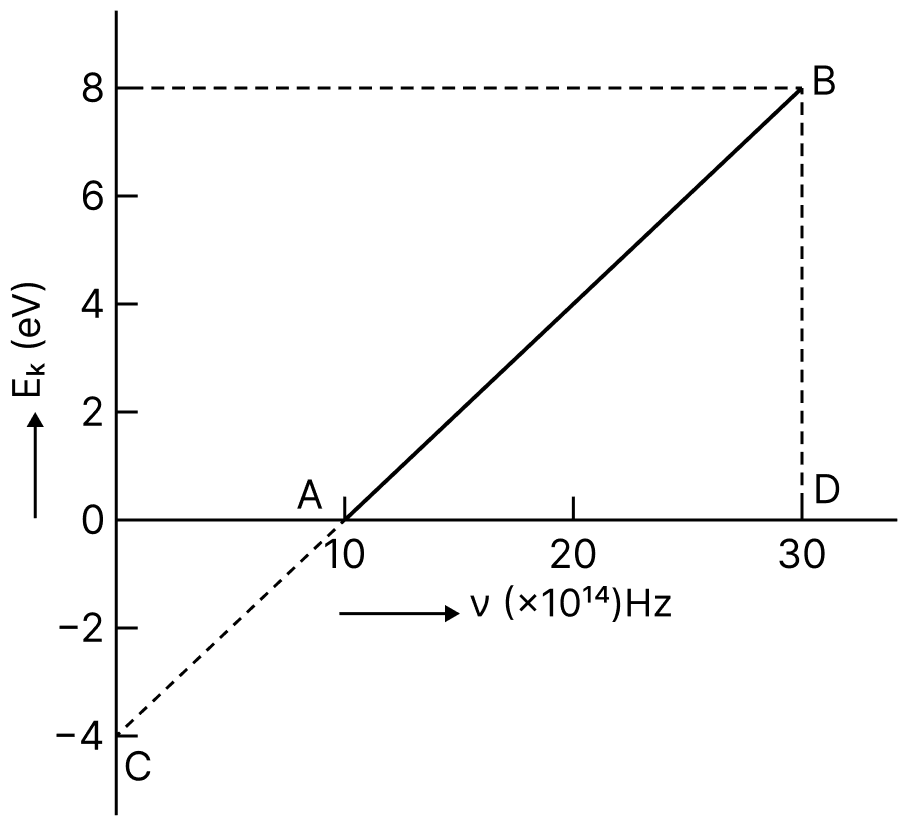
In an experiment of photoelectric effect, the graph of maximum kinetic energy Ek of the emitted photoelectrons versus the frequency ν of the incident light is a straight line shown in the figure. Calculate : (i) threshold frequency, (ii) work function W of cathode-metal in eV, (iii) stopping potential for the electrons emitted by light of frequency ν = 30 × 1014 second-1.

In an experiment of photoelectric effect, the graph of maximum kinetic energy E k of the emitted photoelectrons versus the frequency ν of the incident light is a straight line shown in the figure. Calculate: (i) threshold frequency, (ii) work function W of cathode-metal in eV, (iii) stopping potential for the electrons emitted by light of frequency ν = 30 × 10 14 second -1. Photoelectric Effect, Nootan Physics Solutions ICS Class 12.

Answer

Given,

  • The Ek–ν graph is the straight line ABC.

  • A : (ν = 10 × 1014 Hz, Ek = 0)

  • B : (ν = 30 × 1014 Hz, Ek = 8 eV)

  • C : (ν = 0, Ek = −4 eV), on the line produced backwards

From Einstein's photoelectric equation,

Ek=hν−W\text E_\text k = \text h\nu - \text W

so the graph of Ek versus ν is a straight line of slope h. It cuts the frequency-axis where Ek = 0, i.e., at ν = ν0, and on producing it backwards, it cuts the Ek-axis at −W.

(i) Threshold frequency :

The line cuts the frequency-axis at A. Hence,

ν0=10×1014 Hz\nu_0 = 10 \times 10^{14}\ \text{Hz}

(ii) Work function :

The intercept on the Ek-axis (point C) is −4 eV. Hence,

W=4 eV\text W = 4\ \text{eV}

(iii) Stopping potential :

At ν = 30 × 1014 s-1 (point B), Ek = 8 eV. Since Ek = eV0,

V0=EkeV0=8 eVeV0=8 V\text V_0 = \dfrac{\text E_\text k}{\text e} \\[1em] \text V_0 = \dfrac{8\ \text{eV}}{\text e} \\[1em] \text V_0 = 8\ \text V

Hence, (i) ν0 = 10 × 1014 Hz, (ii) W = 4 eV, (iii) V0 = 8 V.

Note: The textbook prints the stopping potential as 8 eV; stopping potential is measured in volt, so the correct answer is 8 V.

Question 30

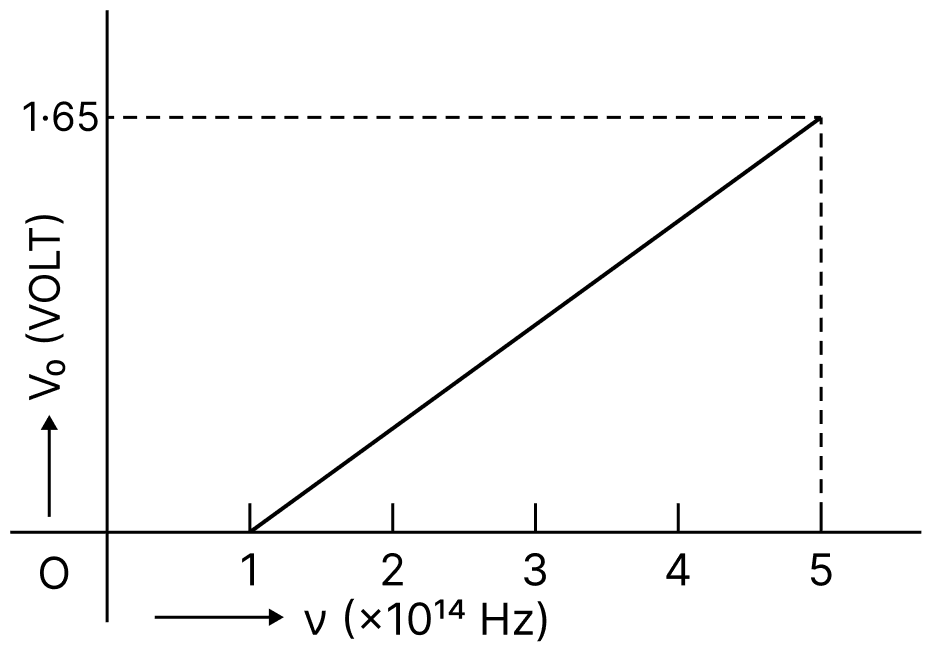
Given figure shows the plot of the stopping potential versus the frequency of the light used in an experiment on photoelectric effect. Calculate the value of Planck's constant h. Charge on an electron e = 1.6 × 10⁻¹⁹ C.

Given figure shows the plot of the stopping potential versus the frequency of the light used in an experiment on photoelectric effect. Calculate the value of Plancks constant h. Charge on an electron e = 1.6 × 10 -19 C. Photoelectric Effect, Nootan Physics Solutions ICS Class 12.

Answer

Given,

  • From the graph, V0 = 0 at ν = 1 × 10¹⁴ Hz

  • V0 = 1.65 V at ν = 5 × 10¹⁴ Hz

  • e = 1.6 × 10⁻¹⁹ C

From Einstein's photoelectric equation, eV0 = hν − W, so

V0=heν−We\text V_0 = \dfrac{\text h}{\text e}\nu - \dfrac{\text W}{\text e}

The V0–ν graph is therefore a straight line of slope he\dfrac{\text h}{\text e}. From the graph,

Slope=1.65−0(5−1)×1014Slope=4.125×10⁻¹⁵ V s\text{Slope} = \dfrac{1.65 - 0}{(5 - 1) \times 10^{14}} \\[1em] \text{Slope} = 4.125 \times 10^{-15}\ \text{V s}

Planck's constant,

h=e×slopeh=1.6×10−19×4.125×10−15h=6.6×10⁻³⁴ J s\text h = \text e \times \text{slope} \\[1em] \text h = 1.6 \times 10^{-19} \times 4.125 \times 10^{-15} \\[1em] \text h = 6.6 \times 10^{-34}\ \text{J s}

Hence, the value of Planck's constant is 6.6 × 10⁻³⁴ J s.

Question 31

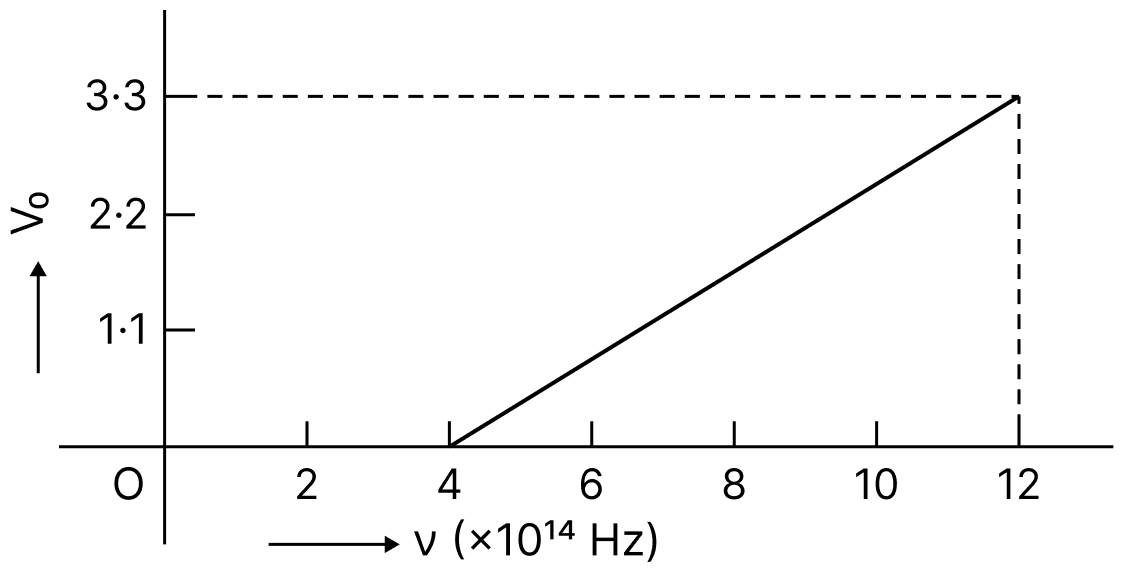
The stopping potential V0 (in volt) as a function of frequency (ν) for a sodium emitter, is shown in the figure. What will be the work function of sodium, from the data plotted in the figure? You can't use the known value of Planck's constant.

The stopping potential V 0 (in volt) as a function of frequency (ν) for a sodium emitter, is shown in the figure. What will be the work function of sodium, from the data plotted in the figure? You cant use the known value of Plancks constant. Photoelectric Effect, Nootan Physics Solutions ICS Class 12.

Answer

Given,

  • From the graph, V0 = 0 at ν = 4 × 10¹⁴ Hz, so threshold frequency ν0 = 4 × 10¹⁴ Hz

  • V0 = 3.3 V at ν = 12 × 1014 Hz

From Einstein's photoelectric equation, eV0 = hν − W, so

V0=heν−We\text V_0 = \dfrac{\text h}{\text e}\nu - \dfrac{\text W}{\text e}

The V0–ν graph is a straight line of slope he\dfrac{\text h}{\text e}. As the known value of h cannot be used, it is obtained from the slope of the graph,

he=3.3−0(12−4)×1014he=4.125×10⁻¹⁵ V s\dfrac{\text h}{\text e} = \dfrac{3.3 - 0}{(12 - 4) \times 10^{14}} \\[1em] \dfrac{\text h}{\text e} = 4.125 \times 10^{-15}\ \text{V s}

The work function is W = hν0. Therefore,

W=e×he×ν0W=1.6×10−19×4.125×10−15×4×1014W=2.64×10⁻¹⁹ J\text W = \text e \times \dfrac{\text h}{\text e} \times \nu_0 \\[1em] \text W = 1.6 \times 10^{-19} \times 4.125 \times 10^{-15} \times 4 \times 10^{14} \\[1em] \text W = 2.64 \times 10^{-19}\ \text J

In electron-volt,

W=2.64×10−191.6×10⁻¹⁹ eVW=1.65 eV\text W = \dfrac{2.64 \times 10^{-19}}{1.6 \times 10^{-19}}\ \text{eV} \\[1em] \text W = 1.65\ \text{eV}

Hence, the work function of sodium is 2.64 × 10⁻¹⁹ J, i.e., 1.65 eV.

Question 32

When a certain metallic surface is illuminated with monochromatic light of wavelength λ, the stopping potential for photoelectric current is 3V0 and when the same surface is illuminated with light of wavelength 2λ, the stopping potential is V0. Find the threshold wavelength for the given surface.

Answer

Given,

  • Wavelength λ : stopping potential = 3V0

  • Wavelength 2λ : stopping potential = V0

Let W be the work function of the surface. From Einstein's photoelectric equation, eV0=hcλ−W\text{eV}_0 = \dfrac{\text{hc}}{\lambda} - \text W. Therefore,

3eV0=hcλ−W...(i)eV0=hc2λ−W...(ii)3\text{eV}_0 = \dfrac{\text{hc}}{\lambda} - \text W \qquad ...(\text i) \\[1em] \text{eV}_0 = \dfrac{\text{hc}}{2\lambda} - \text W \qquad ...(\text{ii})

Subtracting Eq. (ii) from Eq. (i),

2eV0=hcλ−hc2λ2eV0=hc2λeV0=hc4λ2\text{eV}_0 = \dfrac{\text{hc}}{\lambda} - \dfrac{\text{hc}}{2\lambda} \\[1em] 2\text{eV}_0 = \dfrac{\text{hc}}{2\lambda} \\[1em] \text{eV}_0 = \dfrac{\text{hc}}{4\lambda}

Substituting in Eq. (ii),

hc4λ=hc2λ−WW=hc4λ\dfrac{\text{hc}}{4\lambda} = \dfrac{\text{hc}}{2\lambda} - \text W \\[1em] \text W = \dfrac{\text{hc}}{4\lambda}

The threshold wavelength is given by W=hcλ0\text W = \dfrac{\text{hc}}{\lambda_0}. Therefore,

hcλ0=hc4λλ0=4λ\dfrac{\text{hc}}{\lambda_0} = \dfrac{\text{hc}}{4\lambda} \\[1em] \lambda_0 = 4\lambda

Hence, the threshold wavelength for the surface is λ0 = 4λ.

Question 33

When the energy of incident radiation is increased by 40%, the kinetic energy of the photoelectrons emitted from a metal surface is increased from 0.5 eV to 1.0 eV. Find the work function of the metal surface.

Answer

Given,

  • Initial kinetic energy, Ek1 = 0.5 eV

  • Final kinetic energy, Ek2 = 1.0 eV, when the energy of incident radiation is increased by 40%

Let E be the initial energy of the incident radiation and W the work function. From Einstein's photoelectric equation, Ek = E − W. Therefore,

0.5=E−W...(i)1.0=1.4E−W...(ii)0.5 = \text E - \text W \qquad ...(\text i) \\[1em] 1.0 = 1.4\text E - \text W \qquad ...(\text{ii})

Subtracting Eq. (i) from Eq. (ii),

0.5=0.4EE=1.25 eV0.5 = 0.4\text E \\[1em] \text E = 1.25\ \text{eV}

Substituting in Eq. (i),

W=1.25−0.5W=0.75 eV\text W = 1.25 - 0.5 \\[1em] \text W = 0.75\ \text{eV}

Hence, the work function of the metal surface is 0.75 eV.

Question 34

In a photoelectric experiment, ultraviolet light of wavelength 280 nm is used with lithium cathode having work-function φ = 2.5 eV. If the wavelength of incident light is switched to 400 nm, find out the change in the stopping potential.

(h = 6.63 × 10⁻³⁴ Js and c = 3 × 10⁸ ms-1)

Answer

Given,

  • λ1 = 280 nm = 2.8 × 10⁻⁷ m

  • λ2 = 400 nm = 4 × 10⁻⁷ m

  • Work function, φ = 2.5 eV

  • h = 6.63 × 10⁻³⁴ J s, c = 3 × 10⁸ m s-1

From Einstein's photoelectric equation, eV0=hcλ−ϕ\text{eV}_0 = \dfrac{\text{hc}}{\lambda} - \phi.

For λ1 = 280 nm :

hcλ1=6.63×10−34×3×1082.8×10−7hcλ1=7.10×10⁻¹⁹ Jhcλ1=7.10×10−191.6×10⁻¹⁹ eVhcλ1=4.44 eVeV01=4.44−2.5eV01=1.94 eVV01=1.94 V\dfrac{\text{hc}}{\lambda_1} = \dfrac{6.63 \times 10^{-34} \times 3 \times 10^8}{2.8 \times 10^{-7}} \\[1em] \dfrac{\text{hc}}{\lambda_1} = 7.10 \times 10^{-19}\ \text J \\[1em] \dfrac{\text{hc}}{\lambda_1} = \dfrac{7.10 \times 10^{-19}}{1.6 \times 10^{-19}}\ \text{eV} \\[1em] \dfrac{\text{hc}}{\lambda_1} = 4.44\ \text{eV} \\[1em] \text{eV}_{01} = 4.44 - 2.5 \\[1em] \text{eV}_{01} = 1.94\ \text{eV} \\[1em] \text V_{01} = 1.94\ \text V

For λ2 = 400 nm :

hcλ2=6.63×10−34×3×1084×10−7hcλ2=4.97×10⁻¹⁹ Jhcλ2=4.97×10−191.6×10⁻¹⁹ eVhcλ2=3.11 eVeV02=3.11−2.5eV02=0.61 eVV02=0.61 V\dfrac{\text{hc}}{\lambda_2} = \dfrac{6.63 \times 10^{-34} \times 3 \times 10^8}{4 \times 10^{-7}} \\[1em] \dfrac{\text{hc}}{\lambda_2} = 4.97 \times 10^{-19}\ \text J \\[1em] \dfrac{\text{hc}}{\lambda_2} = \dfrac{4.97 \times 10^{-19}}{1.6 \times 10^{-19}}\ \text{eV} \\[1em] \dfrac{\text{hc}}{\lambda_2} = 3.11\ \text{eV} \\[1em] \text{eV}_{02} = 3.11 - 2.5 \\[1em] \text{eV}_{02} = 0.61\ \text{eV} \\[1em] \text V_{02} = 0.61\ \text V

Change in the stopping potential,

ΔV0=V01−V02ΔV0=1.94−0.61ΔV0=1.33 V≈1.3 V\Delta \text V_0 = \text V_{01} - \text V_{02} \\[1em] \Delta \text V_0 = 1.94 - 0.61 \\[1em] \Delta \text V_0 = 1.33\ \text V \approx 1.3\ \text V

Hence, the stopping potential decreases by about 1.3 V.

Question 35

When the wavelength of radiation falling on a metal is changed from 500 nm to 200 nm, the maximum kinetic energy of the photoelectrons becomes three times larger. Find the work function of the metal.

Answer

Given,

  • λ1 = 500 nm, maximum kinetic energy = Ek

  • λ2 = 200 nm, maximum kinetic energy = 3Ek

With the given constants, hc expressed in eV nm is

hc=6.6×10−34×3.0×1081.6×10−19×109 eV nmhc=1237.5 eV nm\text{hc} = \dfrac{6.6 \times 10^{-34} \times 3.0 \times 10^8}{1.6 \times 10^{-19}} \times 10^9\ \text{eV nm} \\[1em] \text{hc} = 1237.5\ \text{eV nm}

Energies of the incident photons,

hcλ1=1237.5500hcλ1=2.475 eVhcλ2=1237.5200hcλ2=6.1875 eV\dfrac{\text{hc}}{\lambda_1} = \dfrac{1237.5}{500} \\[1em] \dfrac{\text{hc}}{\lambda_1} = 2.475\ \text{eV} \\[1em] \dfrac{\text{hc}}{\lambda_2} = \dfrac{1237.5}{200} \\[1em] \dfrac{\text{hc}}{\lambda_2} = 6.1875\ \text{eV}

From Einstein's photoelectric equation, Ek = hcλ\dfrac{\text{hc}}{\lambda} − W. Therefore,

Ek=2.475−W...(i)3Ek=6.1875−W...(ii)\text E_\text k = 2.475 - \text W \qquad ...(\text i) \\[1em] 3\text E_\text k = 6.1875 - \text W \qquad ...(\text{ii})

Multiplying Eq. (i) by 3 and equating with Eq. (ii),

3(2.475−W)=6.1875−W7.425−3W=6.1875−W2W=1.2375W=0.62 eV3(2.475 - \text W) = 6.1875 - \text W \\[1em] 7.425 - 3\text W = 6.1875 - \text W \\[1em] 2\text W = 1.2375 \\[1em] \text W = 0.62\ \text{eV}

Hence, the work function of the metal is 0.62 eV.

Question 36

The stopping potential for electrons emitted from a photosensitive surface illuminated by light of wavelength 491 nm is 0.710 V. When the incident wavelength is changed to a new value, the stopping potential is 1.43 V. Find the new wavelength. hc = 1240 eV nm.

Answer

Given,

  • λ1 = 491 nm, V01 = 0.710 V

  • New stopping potential, V02 = 1.43 V

  • hc = 1240 eV nm

Work function :

From Einstein's photoelectric equation, eV0=hcλ−W\text{eV}_0 = \dfrac{\text{hc}}{\lambda} - \text W. Therefore,

W=hcλ1−eV01W=1240491−0.710W=2.525−0.710W=1.815 eV\text W = \dfrac{\text{hc}}{\lambda_1} - \text{eV}_{01} \\[1em] \text W = \dfrac{1240}{491} - 0.710 \\[1em] \text W = 2.525 - 0.710 \\[1em] \text W = 1.815\ \text{eV}

New wavelength :

hcλ2=W+eV02hcλ2=1.815+1.43hcλ2=3.245 eVλ2=12403.245λ2=382 nm\dfrac{\text{hc}}{\lambda_2} = \text W + \text{eV}_{02} \\[1em] \dfrac{\text{hc}}{\lambda_2} = 1.815 + 1.43 \\[1em] \dfrac{\text{hc}}{\lambda_2} = 3.245\ \text{eV} \\[1em] \lambda_2 = \dfrac{1240}{3.245} \\[1em] \lambda_2 = 382\ \text{nm}

Hence, the new wavelength is about 382 nm.

Note: The textbook prints 383.14 nm; the given data lead to 382.1 nm, so the printed value appears to be an arithmetic slip.

PrevNext