Hence, the energy of a 400 nm photon is 4.95 × 10⁻¹⁹ J.
Question 5
Calculate the number of photons emitted per second from a monochromatic light source of 40 W, giving out light of wavelength 500 nm.
Answer
Given,
Power of the source, P = 40 W
Wavelength, λ = 500 nm = 5 × 10⁻⁷ m
Energy of one photon,
E=λhcE=5×10−76.6×10−34×3.0×108E=3.96×10⁻¹⁹J
If n photons are emitted per second, then P = nE. Therefore,
n=EPn=3.96×10−1940n=1.01×10²⁰≈1.0×10²⁰
Hence, the source emits about 1.0 × 10²⁰ photons per second.
Question 6
Light of wavelength 500 nm falls on a sensitive surface. If the surface has received 10-7 J energy, how many photons have fallen on the surface?
Answer
Given,
Wavelength, λ = 500 nm = 5 × 10⁻⁷ m
Total energy received, ET = 10-7 J
Energy of one photon,
E=λhcE=5×10−76.6×10−34×3.0×108E=3.96×10⁻¹⁹J
Number of photons that have fallen on the surface,
n=EETn=3.96×10−1910−7n=2.525×10¹¹≈25×1010
Hence, about 25 × 1010 photons have fallen on the surface.
Question 7
Find the number of photons of wavelength λ1 = 5.0 × 10⁻⁵ cm whose total energy is equal to the energy of one photon of wavelength λ2 = 2.0 × 10⁻¹² cm. In which part of the electromagnetic spectrum do λ1 and λ2 fall?
Answer
Given,
λ1 = 5.0 × 10⁻⁵ cm = 5.0 × 10⁻⁷ m
λ2 = 2.0 × 10⁻¹² cm = 2.0 × 10⁻¹⁴ m
Let n photons of wavelength λ1 have total energy equal to that of one photon of wavelength λ2. Since the energy of a photon is λhc,
λ1 = 5.0 × 10⁻⁷ m = 5000 Å, which lies in the visible region. λ2 = 2.0 × 10⁻¹⁴ m = 2.0 × 10⁻⁴ Å, which lies in the gamma-ray (cosmic radiation) region.
Hence, 2.5 × 10⁷ photons of wavelength λ1 are required; λ1 falls in the visible region and λ2 in the gamma-ray (cosmic radiation) region.
Question 8
5% energy of a monochromatic light source is converted into light of wavelength 560 nm. If the power of the source be 100 W, then how many photons of light will be emitted by it per second?
Answer
Given,
Power of the source, P = 100 W
Fraction converted into light = 5%
Wavelength, λ = 560 nm = 5.6 × 10⁻⁷ m
Power emitted as light of wavelength 560 nm,
P′=1005×100P′=5W
Energy of one photon,
E=λhcE=5.6×10−76.6×10−34×3.0×108E=3.536×10⁻¹⁹J
Number of photons emitted per second,
n=EP′n=3.536×10−195n=1.414×10¹⁹
Hence, 1.414 × 10¹⁹ photons of light are emitted per second.
Question 9
Light of wavelength 500 nm from a 2 W bulb is falling on a surface. If the absorptive power of the surface be 60%, then how many photons are being absorbed by the surface per second? If 100 absorbed photons cause emission of 1 electron, then how much current will flow from the surface?
Answer
Given,
Wavelength, λ = 500 nm = 5 × 10⁻⁷ m
Power of the bulb, P = 2 W
Absorptive power of the surface = 60%
100 absorbed photons eject 1 electron
Power absorbed by the surface,
Pa=10060×2Pa=1.2W
Energy of one photon,
E=λhcE=5×10−76.6×10−34×3.0×108E=3.96×10⁻¹⁹J
Number of photons absorbed per second,
n=EPan=3.96×10−191.2n=3.03×10¹⁸≈3×10¹⁸
Current :
Number of electrons emitted per second,
N=100nN=3.03×10¹⁶
Current is the charge flowing per second,
I=NeI=3.03×1016×1.6×10−19I=4.85×10⁻³A≈4.8mA
Hence, about 3 × 10¹⁸ photons are absorbed per second and a current of about 4.8 mA flows from the surface.
Question 10
The energy of a photon is 42 eV. Find out the momentum of the photon.
Answer
Given,
Energy of the photon, E = 42 eV = 42 × 1.6 × 10-19 J
c = 3.0 × 10⁸ m s-1
The momentum of a photon is
p=cEp=3.0×10842×1.6×10−19p=3.0×1086.72×10−18p=2.24×10⁻²⁶kg m s−1
Hence, the momentum of the photon is 2.24 × 10⁻²⁶ kg m s-1.
Question 11
The energy of a photon is 10 eV. Calculate :
(i) momentum of the photon,
(ii) wavelength of the photon,
(iii) rest mass and dynamic-mass of the photon.
Answer
Given,
Energy of the photon, E = 10 eV = 10 × 1.6 × 10-19 J = 1.6 × 10⁻¹⁸ J
Hence, (i) p = 5.33 × 10⁻²⁷ kg m s-1, (ii) λ = 1237.5 Å, (iii) rest mass = zero and dynamic mass = 1.78 × 10⁻³⁵ kg.
Question 12
A photon ejects an electron of negligible kinetic energy from a metal surface. If the threshold frequency for the surface be 4.6 × 10¹⁴ Hz, calculate the energy of the incident photon in electron-volt.
Answer
Given,
Threshold frequency, ν0 = 4.6 × 10¹⁴ Hz
Kinetic energy of the ejected electron is negligible
Since the electron is ejected with negligible kinetic energy, the whole energy of the incident photon is just used up as the work function. Hence the photon energy is
E=hν0E=6.6×10−34×4.6×1014E=3.036×10⁻¹⁹J
In electron-volt,
E=1.6×10−193.036×10⁻¹⁹eVE=1.9eV
Hence, the energy of the incident photon is 1.9 eV.
Question 13
A metal sheet has a negative charge of 11.2 nC (1 nC = 10-9 C). How many photons of ultraviolet light are required to completely discharge the sheet by photoelectron ejection? What minimum amount of energy must be absorbed by the sheet to effect this discharge? The threshold frequency of the metal is 4.5 × 10¹⁵ Hz.
Answer
Given,
Negative charge on the sheet, q = 11.2 nC = 11.2 × 10⁻⁹ C
Threshold frequency, ν0 = 4.5 × 10¹⁵ Hz
Number of photons :
The sheet is discharged when all its excess electrons are ejected. One photon can eject one photoelectron, so the number of photons required equals the number of excess electrons,
n=eqn=1.6×10−1911.2×10−9n=7×10¹⁰
Minimum energy :
The minimum energy a photon must have to eject an electron is the work function, W = hν0,
W=hν0W=6.6×10−34×4.5×1015W=2.97×10⁻¹⁸J
Minimum energy absorbed by the sheet,
Emin=nWEmin=7×1010×2.97×10−18Emin=2.08×10⁻⁷J
Hence, 7 × 10¹⁰ photons are required, and the minimum energy absorbed by the sheet is 2.08 × 10⁻⁷ J.
Question 14
Assuming the visible region of the spectrum to be from 400 nm to 750 nm, calculate the maximum work function in electron-volt of a photo-cathode that can emit electrons with visible light of any wavelength.
Answer
Given,
Visible region : 400 nm to 750 nm
Photoelectrons are emitted only if the energy of the incident photon is equal to or greater than the work function. The photon of least energy in the visible region is the one of longest wavelength, λ = 750 nm = 7.5 × 10⁻⁷ m. For emission with visible light of every wavelength, the work function can be at most equal to the energy of this photon,
The work function of sodium is 2.3 eV. Calculate the maximum wavelength in nm (nanometre) for the light that will cause photoelectrons to be emitted from sodium. (h = 6.63 × 10⁻³⁴ J s).
Answer
Given,
Work function of sodium, W = 2.3 eV = 2.3 × 1.6 × 10-19 J = 3.68 × 10⁻¹⁹ J
h = 6.63 × 10⁻³⁴ J s, c = 3.0 × 10⁸ m s-1
The maximum wavelength that can cause photoemission is the threshold wavelength, given by W=λ0hc. Therefore,
If the work function of a certain metal is 4.2 eV, will radiation of wavelength 330 nm incident on the surface emit electrons? Confirm it by calculation.
Answer
Given,
Work function, W = 4.2 eV = 4.2 × 1.6 × 10-19 J = 6.72 × 10⁻¹⁹ J
Photoelectrons are emitted only by radiation of wavelength equal to or less than λ0. The given radiation has wavelength 330 nm, which is longer than 294.6 nm.
Hence, radiation of wavelength 330 nm will not emit electrons from the surface.
Question 18
The work function of copper metal is 4 eV. Monochromatic light of wavelength 4000 Å falls upon it. Calculate the energy of the incident photon in joule. Also, express the work function in joule. Find out the kinetic energy of the fastest electron ejected from it.
Answer
Given,
Work function of copper, W = 4 eV
Wavelength, λ = 4000 Å = 4000 × 10-10 m = 4 × 10⁻⁷ m
Energy of the incident photon :
E=λhcE=4×10−76.6×10−34×3.0×108E=4.95×10⁻¹⁹J
Work function in joule :
W=4×1.6×10−19W=6.4×10⁻¹⁹J
Kinetic energy of the fastest electron :
From Einstein's photoelectric equation, Ek = hν − W. Here the energy of the incident photon (4.95 × 10⁻¹⁹ J) is less than the work function (6.4 × 10⁻¹⁹ J), so the photon cannot eject an electron at all.
Hence, E = 4.95 × 10⁻¹⁹ J and W = 6.4 × 10⁻¹⁹ J; since E is less than W, no electron will be ejected.
Question 19
Calculate the work function of sodium metal in electron-volt, if the photoelectric threshold wavelength is 5400 Å. Will photoelectrons be emitted, if red light of wavelength 6800 Å be incident on sodium?
Answer
Given,
Threshold wavelength, λ0 = 5400 Å = 5.4 × 10⁻⁷ m
Wavelength of red light, λ = 6800 Å
Work function :
W=λ0hcW=5.4×10−76.6×10−34×3.0×108W=3.67×10⁻¹⁹J
In electron-volt,
W=1.6×10−193.67×10⁻¹⁹eVW=2.29eV≈2.3eV
Emission with red light :
Photoelectrons are emitted only if the wavelength of the incident light is equal to or less than the threshold wavelength. The red light has λ = 6800 Å, which is greater than λ0 = 5400 Å.
Hence, the work function of sodium is 2.3 eV, and no photoelectrons will be emitted by red light of wavelength 6800 Å.
Question 20
An electromagnetic radiation of frequency 3 × 10¹⁵ Hz falls on a photoelectric surface whose work function is 4.0 eV. Find out the maximum velocity of the photoelectrons emitted by the surface.
Answer
Given,
Frequency, ν = 3 × 10¹⁵ Hz
Work function, W = 4.0 eV = 4.0 × 1.6 × 10-19 J = 6.4 × 10⁻¹⁹ J
Mass of electron, m = 9.1 × 10⁻³¹ kg
Energy of the incident photon,
E=hνE=6.6×10−34×3×1015E=1.98×10⁻¹⁸J
From Einstein's photoelectric equation, the maximum kinetic energy of the photoelectrons is
Hence, the maximum velocity of the photoelectrons is 1.72 × 10⁶ m s-1.
Question 21
The maximum energy of photoelectrons is 10 × 10-19 J when a surface is illuminated by light of wavelength 100 nm. What is the work function of the surface?
Answer
Given,
Maximum energy of photoelectrons, Ek = 10 × 10-19 J
Wavelength, λ = 100 nm = 1 × 10⁻⁷ m
Energy of the incident photon,
E=λhcE=1×10−76.6×10−34×3.0×108E=19.8×10⁻¹⁹J
From Einstein's photoelectric equation, Ek = hν − W. Therefore,
W=λhc−EkW=19.8×10⁻¹⁹−10×10−19W=9.8×10⁻¹⁹J
In electron-volt,
W=1.6×10−199.8×10⁻¹⁹eVW=6.125eV
Hence, the work function of the surface is 6.125 eV.
Question 22
Light of wavelength 500 nm is incident on a surface having a work function of 2.2 eV. Calculate the threshold frequency for this surface and the maximum velocity of emitted photoelectrons.
Answer
Given,
Wavelength, λ = 500 nm = 5 × 10⁻⁷ m
Work function, W = 2.2 eV = 2.2 × 1.6 × 10-19 J = 3.52 × 10⁻¹⁹ J
Hence, the threshold frequency is 5.33 × 10¹⁴ Hz and the maximum velocity of the emitted photoelectrons is 3.11 × 10⁵ m s-1.
Question 23
A metal whose work function is 3.0 eV, is illuminated by light of wavelength 3 × 10⁻⁷ m. Calculate (i) the threshold frequency, (ii) the maximum energy of photoelectrons and (iii) the stopping potential.
Answer
Given,
Work function, W = 3.0 eV = 3.0 × 1.6 × 10-19 J = 4.8 × 10⁻¹⁹ J
Hence, (i) ν0 = 0.73 × 10¹⁵ Hz, (ii) Ek = 1.8 × 10⁻¹⁹ J, (iii) V0 = 1.125 V.
Question 24
500 nm light falls on a surface whose photoelectric work function is 1.90 eV. Find (i) energy of the incident photon, (ii) maximum kinetic energy of the photoelectrons, (iii) stopping potential, and (iv) threshold wavelength.
Hence, (i) E = 2.475 eV, (ii) Ek = 0.575 eV, (iii) V0 = 0.575 V, (iv) λ0 = 651.3 nm.
Question 25
(i) When light of 300 nm is incident on sodium cathode, the stopping potential is 1.85 V; and when light of 400 nm is incident, then the stopping potential becomes 0.82 V. Calculate : Planck's constant, work function of sodium, threshold wavelength for sodium.
(ii) At stopping potential, if the wavelength of the incident light is kept fixed at 400 nm, but the intensity of light is increased two times, will photoelectric current be obtained? Give reasons for your answer.
Answer
Given,
λ1 = 300 nm = 3 × 10⁻⁷ m, V01 = 1.85 V
λ2 = 400 nm = 4 × 10⁻⁷ m, V02 = 0.82 V
(i) Planck's constant :
From Einstein's photoelectric equation, eV0=λhc−W. For the two wavelengths,
eV01=λ1hc−W...(i)eV02=λ2hc−W...(ii)
Subtracting Eq. (ii) from Eq. (i),
e(V01−V02)=hc(λ11−λ21)h=c(λ11−λ21)e(V01−V02)h=3.0×108×(3×10−71−4×10−71)1.6×10−19×(1.85−0.82)h=3.0×108×8.333×1051.6×10−19×1.03h=2.5×10141.648×10−19h=6.59×10⁻³⁴J s≈6.6×10⁻³⁴J s
(ii) No, photoelectric current will not be obtained. At the stopping potential even the fastest photoelectrons are just stopped. Increasing the intensity of light increases only the number of photoelectrons emitted; their maximum kinetic energy, and hence the stopping potential, depends only on the frequency (wavelength) of the incident light and not on its intensity. Since the wavelength is kept fixed at 400 nm, the same potential still stops all the photoelectrons.
Hence, (i) h = 6.6 × 10⁻³⁴ J s, W = 2.275 eV and λ0 = 5440 Å; (ii) no photoelectric current is obtained on doubling the intensity.
Question 26
A retarding potential of 0.5 V is required to block the movement of electrons from the cathode of a photoelectric cell when violet light of wavelength 400 nm strikes its surface. Find (i) the work function of this surface, (ii) the threshold frequency, (iii) the energy of light of wavelength 300 nm and (iv) the maximum energy of the electron emitted from the cathode surface when 300 nm light strikes it.
Answer
Given,
Retarding (stopping) potential, V0 = 0.5 V
Wavelength of violet light, λ = 400 nm = 4 × 10⁻⁷ m
(i) Work function :
Energy of the incident photon,
E=λhcE=4×10−76.6×10−34×3.0×108E=4.95×10⁻¹⁹J
From Einstein's photoelectric equation, λhc=W+eV0,
Hence, (i) W = 4.15 × 10⁻¹⁹ J, (ii) ν0 = 6.3 × 10¹⁴ Hz, (iii) E' = 6.6 × 10⁻¹⁹ J, (iv) Ek = 2.45 × 10⁻¹⁹ J.
Question 27
Find the frequency of light which ejects from a metal surface electrons which are fully stopped by a retarding potential of 3 V. The photoelectric effect starts in this metal at a frequency of 6 × 10¹⁴ s-1.
(h = 6.63 × 10⁻³⁴ J s, e = 1.6 × 10⁻¹⁹ C)
Answer
Given,
Stopping (retarding) potential, V0 = 3 V
Threshold frequency, ν0 = 6 × 10¹⁴ s-1
h = 6.63 × 10⁻³⁴ J s, e = 1.6 × 10⁻¹⁹ C
From Einstein's photoelectric equation, hν = hν0 + eV0. Therefore,
Hence, the frequency of the light is about 13 × 1014 Hz.
Question 28
Ultraviolet light of wavelengths 80 nm and 70 nm, when allowed to fall on hydrogen atoms in their ground state, is found to liberate electrons with kinetic energies 1.8 eV and 4.0 eV respectively. Find the value of Planck's constant.
Answer
Given,
λ1 = 80 nm = 80 × 10-9 m, Ek1 = 1.8 eV
λ2 = 70 nm = 70 × 10-9 m, Ek2 = 4.0 eV
The energy needed to liberate the electron from a hydrogen atom in its ground state plays the role of the work function W. From Einstein's photoelectric equation,
λ1hc=W+Ek1...(i)λ2hc=W+Ek2...(ii)
Subtracting Eq. (i) from Eq. (ii),
hc(λ21−λ11)=Ek2−Ek1hc(λ1λ2λ1−λ2)=(4.0−1.8)×1.6×10−19h×3.0×108×80×10−9×70×10−910×10−9=3.52×10−19h×3.0×108×1.786×106=3.52×10⁻¹⁹h=5.357×10143.52×10−19h=6.57×10⁻³⁴J s
Hence, the value of Planck's constant is 6.57 × 10⁻³⁴ J s.
Question 29
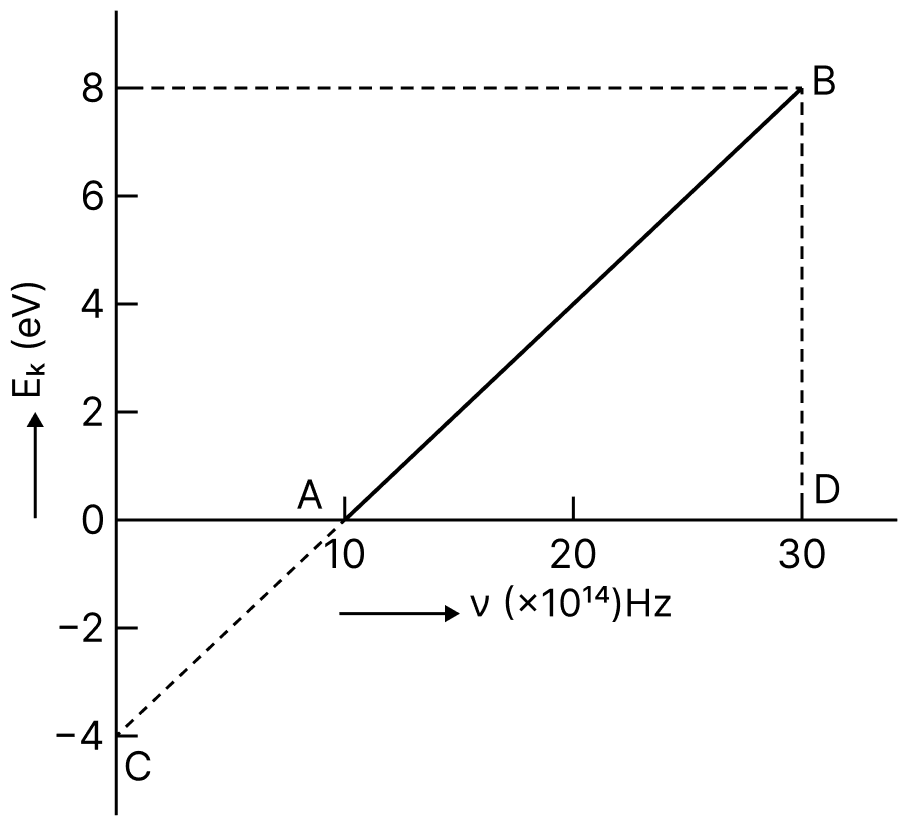
In an experiment of photoelectric effect, the graph of maximum kinetic energy Ek of the emitted photoelectrons versus the frequency ν of the incident light is a straight line shown in the figure. Calculate : (i) threshold frequency, (ii) work function W of cathode-metal in eV, (iii) stopping potential for the electrons emitted by light of frequency ν = 30 × 1014 second-1.
Answer
Given,
The Ek–ν graph is the straight line ABC.
A : (ν = 10 × 1014 Hz, Ek = 0)
B : (ν = 30 × 1014 Hz, Ek = 8 eV)
C : (ν = 0, Ek = −4 eV), on the line produced backwards
From Einstein's photoelectric equation,
Ek=hν−W
so the graph of Ek versus ν is a straight line of slope h. It cuts the frequency-axis where Ek = 0, i.e., at ν = ν0, and on producing it backwards, it cuts the Ek-axis at −W.
(i) Threshold frequency :
The line cuts the frequency-axis at A. Hence,
ν0=10×1014Hz
(ii) Work function :
The intercept on the Ek-axis (point C) is −4 eV. Hence,
W=4eV
(iii) Stopping potential :
At ν = 30 × 1014 s-1 (point B), Ek = 8 eV. Since Ek = eV0,
V0=eEkV0=e8eVV0=8V
Hence, (i) ν0 = 10 × 1014 Hz, (ii) W = 4 eV, (iii) V0 = 8 V.
Note: The textbook prints the stopping potential as 8 eV; stopping potential is measured in volt, so the correct answer is 8 V.
Question 30
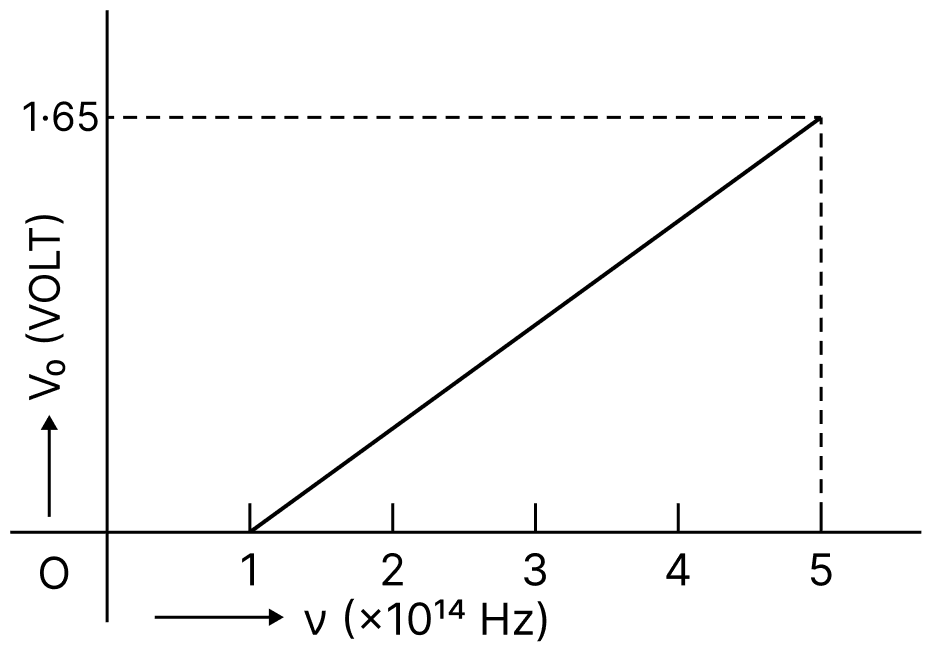
Given figure shows the plot of the stopping potential versus the frequency of the light used in an experiment on photoelectric effect. Calculate the value of Planck's constant h. Charge on an electron e = 1.6 × 10⁻¹⁹ C.
Answer
Given,
From the graph, V0 = 0 at ν = 1 × 10¹⁴ Hz
V0 = 1.65 V at ν = 5 × 10¹⁴ Hz
e = 1.6 × 10⁻¹⁹ C
From Einstein's photoelectric equation, eV0 = hν − W, so
V0=ehν−eW
The V0–ν graph is therefore a straight line of slope eh. From the graph,
Slope=(5−1)×10141.65−0Slope=4.125×10⁻¹⁵V s
Planck's constant,
h=e×slopeh=1.6×10−19×4.125×10−15h=6.6×10⁻³⁴J s
Hence, the value of Planck's constant is 6.6 × 10⁻³⁴ J s.
Question 31
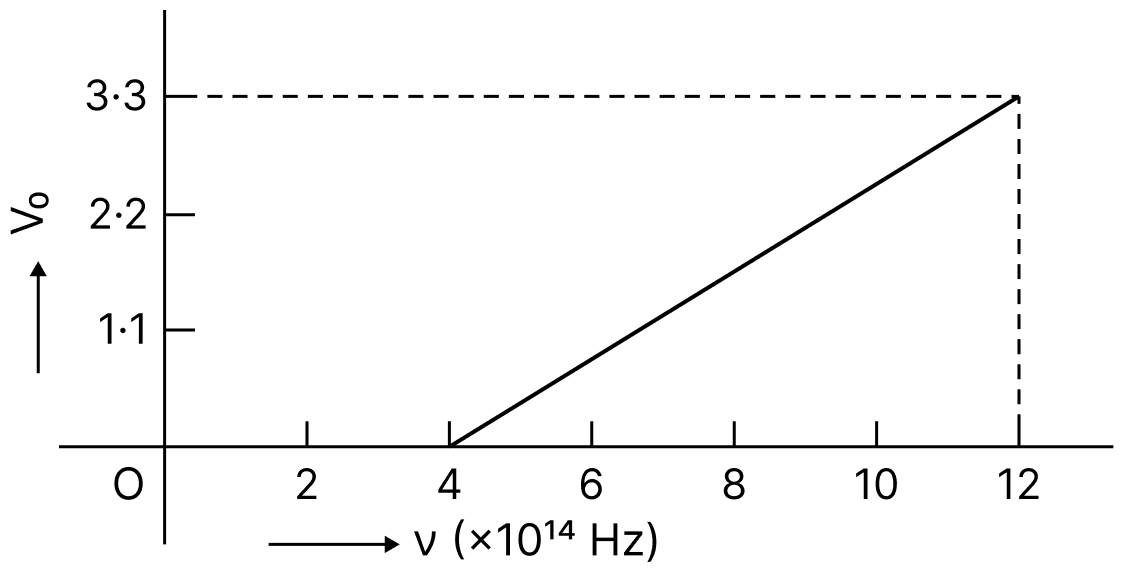
The stopping potential V0 (in volt) as a function of frequency (ν) for a sodium emitter, is shown in the figure. What will be the work function of sodium, from the data plotted in the figure? You can't use the known value of Planck's constant.
Answer
Given,
From the graph, V0 = 0 at ν = 4 × 10¹⁴ Hz, so threshold frequency ν0 = 4 × 10¹⁴ Hz
V0 = 3.3 V at ν = 12 × 1014 Hz
From Einstein's photoelectric equation, eV0 = hν − W, so
V0=ehν−eW
The V0–ν graph is a straight line of slope eh. As the known value of h cannot be used, it is obtained from the slope of the graph,
Hence, the work function of sodium is 2.64 × 10⁻¹⁹ J, i.e., 1.65 eV.
Question 32
When a certain metallic surface is illuminated with monochromatic light of wavelength λ, the stopping potential for photoelectric current is 3V0 and when the same surface is illuminated with light of wavelength 2λ, the stopping potential is V0. Find the threshold wavelength for the given surface.
Answer
Given,
Wavelength λ : stopping potential = 3V0
Wavelength 2λ : stopping potential = V0
Let W be the work function of the surface. From Einstein's photoelectric equation, eV0=λhc−W. Therefore,
3eV0=λhc−W...(i)eV0=2λhc−W...(ii)
Subtracting Eq. (ii) from Eq. (i),
2eV0=λhc−2λhc2eV0=2λhceV0=4λhc
Substituting in Eq. (ii),
4λhc=2λhc−WW=4λhc
The threshold wavelength is given by W=λ0hc. Therefore,
λ0hc=4λhcλ0=4λ
Hence, the threshold wavelength for the surface is λ0 = 4λ.
Question 33
When the energy of incident radiation is increased by 40%, the kinetic energy of the photoelectrons emitted from a metal surface is increased from 0.5 eV to 1.0 eV. Find the work function of the metal surface.
Answer
Given,
Initial kinetic energy, Ek1 = 0.5 eV
Final kinetic energy, Ek2 = 1.0 eV, when the energy of incident radiation is increased by 40%
Let E be the initial energy of the incident radiation and W the work function. From Einstein's photoelectric equation, Ek = E − W. Therefore,
0.5=E−W...(i)1.0=1.4E−W...(ii)
Subtracting Eq. (i) from Eq. (ii),
0.5=0.4EE=1.25eV
Substituting in Eq. (i),
W=1.25−0.5W=0.75eV
Hence, the work function of the metal surface is 0.75 eV.
Question 34
In a photoelectric experiment, ultraviolet light of wavelength 280 nm is used with lithium cathode having work-function φ = 2.5 eV. If the wavelength of incident light is switched to 400 nm, find out the change in the stopping potential.
(h = 6.63 × 10⁻³⁴ Js and c = 3 × 10⁸ ms-1)
Answer
Given,
λ1 = 280 nm = 2.8 × 10⁻⁷ m
λ2 = 400 nm = 4 × 10⁻⁷ m
Work function, φ = 2.5 eV
h = 6.63 × 10⁻³⁴ J s, c = 3 × 10⁸ m s-1
From Einstein's photoelectric equation, eV0=λhc−ϕ.
Hence, the stopping potential decreases by about 1.3 V.
Question 35
When the wavelength of radiation falling on a metal is changed from 500 nm to 200 nm, the maximum kinetic energy of the photoelectrons becomes three times larger. Find the work function of the metal.
Answer
Given,
λ1 = 500 nm, maximum kinetic energy = Ek
λ2 = 200 nm, maximum kinetic energy = 3Ek
With the given constants, hc expressed in eV nm is
The stopping potential for electrons emitted from a photosensitive surface illuminated by light of wavelength 491 nm is 0.710 V. When the incident wavelength is changed to a new value, the stopping potential is 1.43 V. Find the new wavelength. hc = 1240 eV nm.
Answer
Given,
λ1 = 491 nm, V01 = 0.710 V
New stopping potential, V02 = 1.43 V
hc = 1240 eV nm
Work function :
From Einstein's photoelectric equation, eV0=λhc−W. Therefore,