
When a coil of magnetic moment 2.5 × 10⁻⁸ J T-1 is placed with its face parallel to a uniform magnetic field, it experiences a torque of 7.5 × 10⁻⁹ J. Find the magnitude of the field.
Answer
Given,
- Magnetic moment of the coil, m = 2.5 × 10⁻⁸ J T-1
- Torque on the coil, τ = 7.5 × 10⁻⁹ J
The face (plane) of the coil is parallel to the field, so the normal to the coil makes an angle θ = 90° with the field. The coil therefore experiences the maximum torque.
The torque on a coil of magnetic moment m in a uniform magnetic field B is
With θ = 90°,
Hence, the magnitude of the magnetic field is 0.30 T.
A square coil of side 10 cm consists of 20 turns and carries a current of 12 A. It is suspended vertically in a uniform horizontal magnetic field of 0.80 T, such that the normal to the plane of the coil makes an angle of 30° with the field direction. Find the magnitude of the torque experienced by the coil.
Answer
Given,
- Number of turns, N = 20
- Area of the coil, A = 10 cm × 10 cm = 100 cm2 = 100 × 10-4 m2
- Current, I = 12 A
- Magnetic field, B = 0.80 T
- Angle between the normal to the coil and the field, θ = 30°
The torque on a coil of N turns carrying current I in a uniform magnetic field B is
Substituting the values,
Hence, the magnitude of the torque experienced by the coil is 0.96 N m.
A rectangular loop of area 5 m2, has 50 turns and carries a current of 1 A. It is held in a uniform magnetic field of 0.1 T, at an angle of 30°. Calculate the torque experienced by the coil.
Answer
Given,
- Area of the loop, A = 5 m2
- Number of turns, N = 50
- Current, I = 1 A
- Magnetic field, B = 0.1 T
- Angle between the field and the plane of the coil = 30°
In τ = NIAB sin θ, the angle θ is measured between the normal to the plane of the coil and the field. As the field makes 30° with the plane of the coil,
Substituting the values in τ = NIAB sin θ,
Hence, the torque experienced by the coil is 21.65 N m.
Note: The question does not say from what the 30° is measured. The printed answer, 21.65 N m, takes it as the angle with the plane of the coil. Measured from the normal, the torque would be 12.5 N m.
A circular coil of radius 6.0 cm and 25 turns carries a current of 10 A. It is suspended vertically in a uniform magnetic field of 1.2 T and the field lines are horizontal in the plane of the coil. Compute torque acting on the coil.
Answer
Given,
- Radius of the coil, r = 6.0 cm = 6.0 × 10⁻² m
- Number of turns, N = 25
- Current, I = 10 A
- Magnetic field, B = 1.2 T
The field lines lie in the plane of the coil, so the normal to the coil is perpendicular to the field, θ = 90°.
Area of the coil,
The torque on the coil is τ = NIAB sin θ. With θ = 90°,
Hence, the torque acting on the coil is 3.4 N m.
A rectangular coil of sides 8.0 cm and 6.0 cm having 2000 turns and carrying a current of 0.20 A is suspended in a uniform magnetic field of 0.20 T directed along the positive X-axis.
(a) What is the net force on the coil?
(b) What is the maximum torque the coil can experience and in which orientation?
(c) For which orientation of the coil the torque is zero? When is this equilibrium stable and when is it unstable?
Answer
Given,
- Area of the coil, A = 8.0 cm × 6.0 cm = 48 cm2 = 48 × 10-4 m2
- Number of turns, N = 2000
- Current, I = 0.20 A
- Magnetic field, B = 0.20 T, along the positive X-axis
(a) Net force on the coil :
In a uniform magnetic field, the forces on each pair of opposite sides of the coil are equal in magnitude and opposite in direction, and they cancel each other. Hence, the net force on the coil is zero.
(b) Maximum torque :
The torque on the coil is τ = NIAB sin θ, where θ is the angle between the normal to the plane of the coil and the field. It is maximum when θ = 90°, so
θ = 90° means that the plane of the coil is parallel to the field.
The maximum torque is 0.384 N m, when the X-axis lies in the plane of the coil.
(c) Orientation for zero torque :
τ = 0 when sin θ = 0, that is, θ = 0° or 180°. The normal to the coil is then along the X-axis, so the plane of the coil is perpendicular to the field. The torque is zero when the coil lies in the Y-Z plane.
Stable equilibrium : when θ = 0°, that is, the area vector (and the magnetic moment ) is parallel to . If the coil is turned slightly from this position, the torque brings it back.
Unstable equilibrium : when θ = 180°, that is, is anti-parallel to . If the coil is turned slightly from this position, the torque turns it further away, until becomes parallel to .
A coil of area 5 cm2 and having 100 turns is placed in a uniform magnetic field of 1.5 T. When a current of 0.2 A is passed through the coil find the magnetic dipole moment of the coil and the maximum torque produced.
Answer
Given,
- Area of the coil, A = 5 cm2 = 5 × 10⁻⁴ m2
- Number of turns, N = 100
- Magnetic field, B = 1.5 T
- Current, I = 0.2 A
Magnetic dipole moment :
The magnitude of the magnetic moment of a coil is m = NIA. Hence,
Maximum torque :
From τ = mB sin θ, the torque is maximum when θ = 90°. Hence,
Hence, the magnetic dipole moment of the coil is 1.0 × 10⁻² A m2 and the maximum torque is 1.5 × 10⁻² N m.
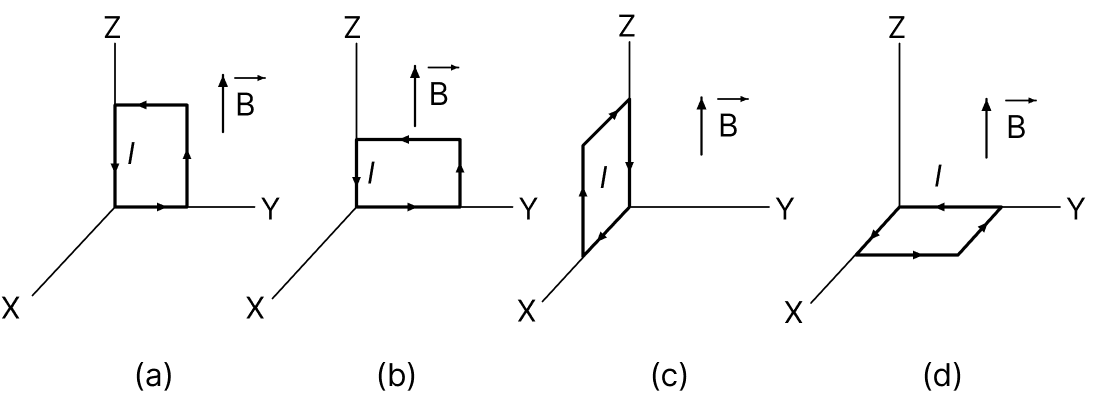
A uniform magnetic field of 3000 gauss is established along the positive Z-axis. A rectangular loop of size 10 cm × 5 cm carries a current of 12 A. What is the magnitude and direction of the torque on the loop in the four cases shown in the figure?
Answer
Given,
- Magnetic field, B = 3000 G = 3000 × 10-4 T = 0.30 T, along the positive Z-axis, so T
- Area of the loop, A = 10 cm × 5 cm = 50 cm2 = 50 × 10-4 m2
- Current, I = 12 A
The torque on a current-loop in a uniform magnetic field is
where the area vector is normal to the plane of the loop, its sense given by the right-hand rule from the direction of the current.
Case (a) :
The loop lies in the Y-Z plane. From the sense of the current, is along the positive X-axis, so m2.
The torque is 1.8 × 10⁻² N m along the negative Y-axis.
Case (b) :
The loop again lies in the Y-Z plane with the current in the same sense, so is again along the positive X-axis and the angle between and is 90°. The torque is the same as in case (a):
The torque is 1.8 × 10⁻² N m along the negative Y-axis.
Case (c) :
The loop lies in the Z-X plane. From the sense of the current, is along the negative Y-axis, so m2.
The torque is 1.8 × 10⁻² N m along the negative X-axis.
Case (d) :
The loop lies in the X-Y plane, so is along the Z-axis, parallel to . The angle between and is 0°, so
Hence, the torque is 1.8 × 10⁻² N m along the negative Y-axis in cases (a) and (b), 1.8 × 10⁻² N m along the negative X-axis in case (c), and zero in case (d).
A moving-coil galvanometer has its coil of 24 turns and 12 Ω resistance. By how much the number of turns should be increased so that the current-sensitivity of the galvanometer increases by 25%? If, in doing so, the resistance of the coil increases to 20 Ω, what will be the effect on the voltage-sensitivity of the galvanometer?
Answer
Given,
- Initial number of turns, N = 24
- Initial resistance of the coil, R = 12 Ω
- New resistance of the coil, R' = 20 Ω
Increase in the number of turns :
The current-sensitivity of a moving-coil galvanometer is
where c is the torsional constant of the suspension. With A, B and c unchanged, Sc ∝ N. To increase Sc by 25%, N must also be increased by 25%:
So the number of turns must be increased by 30 − 24 = 6.
Effect on the voltage-sensitivity :
The voltage-sensitivity is
Original voltage-sensitivity, with N = 24 and R = 12 Ω :
New voltage-sensitivity, with N' = 30 and R' = 20 Ω :
Therefore,
Hence, the number of turns should be increased by 6, from 24 to 30. The voltage-sensitivity then falls to 0.75 of its original value, a decrease of 25%.
To increase the current-sensitivity of a moving-coil galvanometer by 50%, its resistance is increased so that the new resistance becomes twice its initial resistance. By what factor does its voltage-sensitivity change?
Answer
Given,
- New current-sensitivity, Sc' = 1.5 Sc (an increase of 50%)
- New resistance, R' = 2R
The voltage-sensitivity of a galvanometer is related to its current-sensitivity by
So the new voltage-sensitivity is
Hence, the voltage-sensitivity changes by a factor of 0.75, that is, it is reduced to 0.75 of its previous value.
A galvanometer has a resistance of 100 Ω. A PD of 100 mV between its terminals gives a full-scale deflection. Calculate the shunt resistance required to convert the galvanometer into an ammeter reading up to 5 A.
Answer
Given,
- Resistance of the galvanometer, G = 100 Ω
- PD for full-scale deflection, Vg = 100 mV = 0.1 V
- Range of the ammeter, I = 5 A
The current for full-scale deflection in the galvanometer is
The shunt S required to convert the galvanometer into an ammeter of range I is
Substituting the values,
Hence, a shunt of 0.02 Ω is required.
A galvanometer of resistance 99 Ω gives a full-scale deflection for a current of 50 mA. Find the value of the shunt required to convert it into an ammeter reading up to a maximum current of 5 A. What is the resistance of the ammeter?
Answer
Given,
- Resistance of the galvanometer, G = 99 Ω
- Current for full-scale deflection, Ig = 50 mA = 0.05 A
- Range of the ammeter, I = 5 A
Shunt required :
Substituting the values,
Resistance of the ammeter :
The galvanometer and the shunt are in parallel, so the resistance of the ammeter is
Hence, the shunt required is 1.0 Ω and the resistance of the ammeter is 0.99 Ω.
The resistance of a galvanometer is 30 Ω and it has 100 divisions on the scale. A current of 0.2 mA produces a deflection of 1 division. What shunt will be required for measuring a current of 5 A?
Answer
Given,
- Resistance of the galvanometer, G = 30 Ω
- Number of divisions on the scale = 100
- Current per division = 0.2 mA
- Current to be measured, I = 5 A
The current for full-scale deflection (100 divisions) is
The required shunt is given by
Substituting the values,
Hence, a shunt of 0.12 Ω will be required.
A 80 Ω galvanometer shows a deflection of 1 division per mA. It has 50 divisions on its scale. If a shunt of 2.5 Ω be attached to the galvanometer, what maximum current will this galvanometer measure?
Answer
Given,
- Resistance of the galvanometer, G = 80 Ω
- Deflection = 1 division per mA
- Number of divisions on the scale = 50
- Shunt, S = 2.5 Ω
The current required for full-scale (50 divisions) deflection is
Let I be the maximum current the shunted galvanometer can measure. Of this, Ig passes through the galvanometer and (I − Ig) through the shunt. As G and S are in parallel, the PD across them is the same:
Substituting the values,
Hence, the galvanometer can measure a maximum current of 1.65 A.
The coil of a galvanometer has a resistance of 100 Ω. It shows full-scale deflection for a current of 5 × 10⁻⁴ A. How will you convert it into a voltmeter to read a maximum PD of 5 V?
Answer
Given,
- Resistance of the galvanometer, G = 100 Ω
- Current for full-scale deflection, Ig = 5 × 10⁻⁴ A
- Range of the voltmeter, V = 5 V
To convert a galvanometer into a voltmeter, a high resistance R is connected in series with it, such that
Substituting the values,
Hence, the galvanometer is converted into a voltmeter of range 0 to 5 V by connecting a resistance of 9900 Ω in series with it.
A 50 Ω resistance galvanometer has 25 divisions on its scale. On sending a current of 4.0 × 10⁻⁴ A in it, the pointer gives a deflection of 1 division. How much resistance should be connected in series with the galvanometer to convert it into a voltmeter of 2.5 V range?
Answer
Given,
- Resistance of the galvanometer, G = 50 Ω
- Number of divisions on the scale = 25
- Current per division = 4.0 × 10⁻⁴ A
- Range of the voltmeter, V = 2.5 V
The current for full-scale (25 divisions) deflection is
The resistance R to be connected in series is given by
Substituting the values,
Hence, a resistance of 200 Ω should be connected in series with the galvanometer.
The resistance of a voltmeter is 180 Ω. When there is 5 V potential difference across its ends, it gives full-scale deflection. What resistance should be connected in series to obtain a full-scale deflection at 25 V?
Answer
Given,
- Resistance of the voltmeter, G = 180 Ω
- PD for full-scale deflection = 5 V
- New range, V' = 25 V
The current giving full-scale deflection in the voltmeter is
Let R be the resistance connected in series with the voltmeter so that it reads up to V' = 25 V. Then
Substituting the values,
Hence, a resistance of 720 Ω should be connected in series.
A galvanometer coil has a resistance of 15 Ω and it shows full-scale deflection for a current of 2.0 mA. How will you convert it into (a) an ammeter of range 0 to 5.0 A, (b) a voltmeter of range 0 to 15.0 V? Also determine the net resistances of the ammeter and the voltmeter.
Answer
Given,
- Resistance of the galvanometer coil, G = 15 Ω
- Current for full-scale deflection, Ig = 2.0 mA = 2.0 × 10⁻³ A
(a) Conversion into an ammeter of range 0 to 5.0 A :
A shunt S is connected in parallel with the galvanometer, where
With I = 5.0 A,
The net resistance of the ammeter (G and S in parallel) is
(b) Conversion into a voltmeter of range 0 to 15.0 V :
A resistance R is connected in series with the galvanometer, where
With V = 15.0 V,
The net resistance of the voltmeter (G and R in series) is
Hence, (a) a shunt of 6.0 × 10⁻³ Ω in parallel makes an ammeter of net resistance 6.0 × 10⁻³ Ω, and (b) a resistance of 7485 Ω in series makes a voltmeter of net resistance 7500 Ω.
Note: The textbook prints the ammeter's resistance as 0.00599 Ω, which is 5.998 × 10⁻³ Ω truncated. Correctly rounded, it is 6.0 × 10⁻³ Ω.
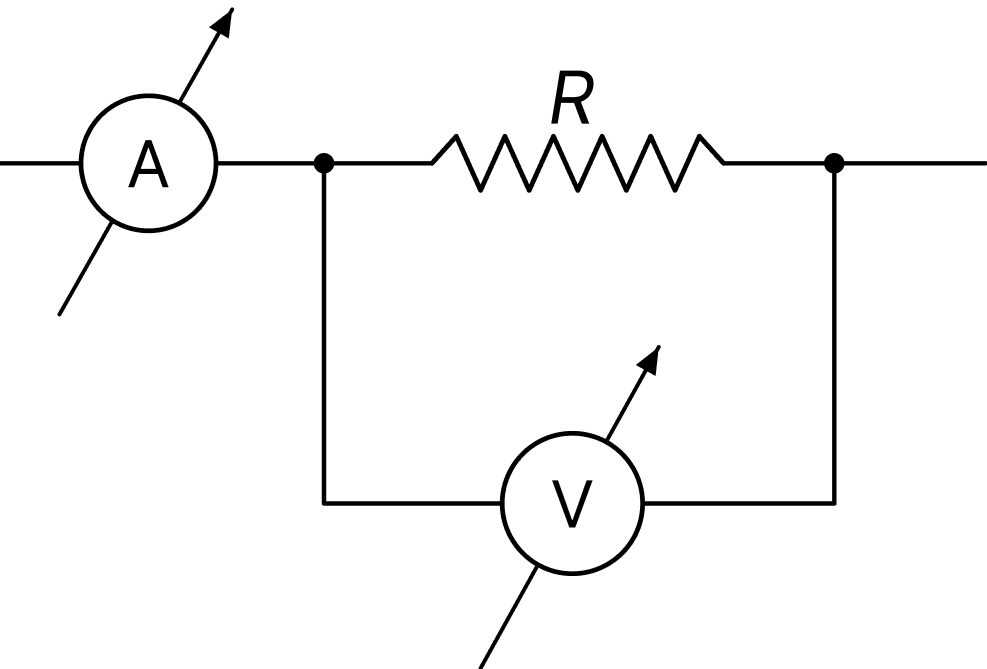
The given circuit is used to measure the resistance R. The ammeter reads 2 A and the voltmeter 120 V. What is the value of R if the resistance of the voltmeter is 3000 Ω? If the resistance of the voltmeter is taken to be infinitely large, then what is the value of R?
Answer
Given,
- Reading of the ammeter, I = 2 A
- Reading of the voltmeter, V = 120 V
- Resistance of the voltmeter, RV = 3000 Ω
The voltmeter is connected in parallel with R, so the PD across R is 120 V. The ammeter is in the main line, so the current of 2 A divides between R and the voltmeter.
When the resistance of the voltmeter is 3000 Ω :
Current through the voltmeter,
Current through R,
Therefore,
When the resistance of the voltmeter is infinitely large :
No current flows through the voltmeter, so the whole 2 A flows through R:
Hence, R = 61.2 Ω when the resistance of the voltmeter is 3000 Ω, and R = 60 Ω when the resistance of the voltmeter is taken to be infinitely large.