
The relation between focal length and radius of curvature of a spherical mirror is :
- R = 2f
- none of these
Answer
R = 2f
Reason — For a spherical mirror of small aperture, the focal length is one-half of the radius of curvature, , that is, R = 2f.
When does a convex mirror form a magnified image?
- When the object is between f and R
- When object is beyond 2f
- When the object is at f
- Never
Answer
Never
Reason — A convex mirror always forms a virtual, erect and diminished image lying between the pole and the focus, whatever the position of the object. Hence it never forms a magnified image.
A virtual image larger than the object can be produced by :
- concave mirror
- convex mirror
- plane mirror
- none of these
Answer
concave mirror
Reason — When the object is placed between the pole and the focus of a concave mirror, the image is virtual, erect and magnified.
A mirror forms a real and inverted image of an object placed in front of it. The mirror is :
- convex mirror
- concave mirror
- plane mirror
- all of these
Answer
concave mirror
Reason — For an object placed beyond its focus, the reflected rays from a concave mirror actually meet in front of the mirror, forming a real, inverted image.
A concave mirror of focal length f produces a real image n times the size of the object. The distance of the object from the mirror is :
- (n - 1)f
- (n + 1)f
Answer
Reason — For a real (inverted) image the magnification is negative, so m = −n. By the sign convention, the focal length of the concave mirror is −f. Using ,
The object is in front of the mirror at a distance .
A convex mirror of focal length f produces an image th of the size of the object. The distance of the object from the mirror is :
- nf
- (n + 1)f
- (n - 1)f
Answer
(n - 1)f
Reason — A convex mirror forms a virtual, erect image, so m = and the focal length is +f. Using ,
The object is in front of the mirror at a distance (n − 1)f.
An object is placed on the principal axis of a concave mirror at a distance of (f is the focal length). The image will be at :
- (-3f)
- 3f
Answer
(-3f)
Reason — For the concave mirror, focal length = −f and . From the mirror formula ,
The image is real and lies in front of the mirror at a distance 3f.
Assertion (A): The graph for 'v' versus 'u' of a concave mirror forming real images, falls within the second quadrant.
Reason (R): For concave mirrors, according to the sign convention for real images, 'u' is negative, and 'v' is positive.
- Both Assertion and Reason are true, and Reason is the correct explanation of Assertion.
- Both Assertion and Reason are true but Reason is not the correct explanation of Assertion.
- Assertion is true but Reason is false.
- Both Assertion and Reason are false.
Answer
Both Assertion and Reason are false.
Explanation
Assertion (A) is incorrect: In the coordinate geometry (New Cartesian) sign convention, the object is placed on the left of the mirror, so u is negative. A concave mirror forms its real image in front of the mirror, so v is also negative. With both u and v negative, the graph of v versus u for real images lies in the third quadrant, not the second.
Reason (R) is also incorrect: For a real image the image distance is negative, not positive. The image distance v of a concave mirror is positive only for a virtual image, formed when the object lies between the pole and the focus.
Therefore, both Assertion and Reason are false.
Note: The textbook's answer key gives option (a), which is incorrect. It takes v as positive for a real image, contrary to the chapter's sign convention (distance of a real image is negative).
Day and night settings for rearview mirrors uses :
- plane mirrors
- concave mirrors
- thin mirrors
- thick wedge shaped mirrors
Answer
thick wedge shaped mirrors
Reason — In such a mirror the front glass surface is inclined to the silvered back surface. In the day setting the bright image from the silvered surface is seen; at night the mirror is tilted so that only the faint image from the front glass surface reaches the eye, reducing the glare of headlights from behind.
While capturing solar energy for commercial purposes, we use :
- plane mirror
- parabolic mirror
- convex mirror
- concave mirror
Answer
parabolic mirror
Reason — A paraboloidal (parabolic) mirror brings a wide beam of parallel rays from the sun to a point-focus, without spherical aberration. All the solar energy falling on the large aperture is therefore concentrated at the focus.
A short linear object of length b lies along the axis of a concave mirror of focal length f at a distance u from its pole. The size of the image is :
Answer
Reason — For a short object lying along the principal axis, the longitudinal magnification is
where is the lateral magnification. Hence,
When does a concave mirror form a virtual image?
Answer
A concave mirror forms a virtual image when the object is placed between the pole and the focus of the mirror.
Use the mirror formula to show that :
(i) an object placed between focus and centre of curvature of a concave mirror produces a real image beyond the centre of curvature.
(ii) for an object placed between the pole and the focus of a concave mirror, the image is always virtual and enlarged.
(iii) a convex mirror always produces a virtual image, independent of the location of the object.
(iv) the virtual image produced by a convex mirror is always diminished in size and is located between the focus and the pole of the mirror.
Answer
In the coordinate geometry sign convention, the object is on the left of the mirror, so u is negative. The focal length of a concave mirror is negative and that of a convex mirror is positive. The mirror formula is used in the form
(i) Object between F and C of a concave mirror :
Here f < 0 and 2f < u < f, so
Since , we get . Since , we get . Thus,
So v is negative and |v| > |2f| = |R|. Hence, the image is real and lies beyond the centre of curvature.
(ii) Object between P and F of a concave mirror :
Here f < u < 0, so and
So v is positive and the image is formed behind the mirror, that is, it is virtual. Also, as ,
so v > |u| and . Hence, the image is virtual and enlarged.
(iii) Convex mirror :
Here f > 0 and u < 0 for every position of the object, so
v is always positive. Hence, a convex mirror always forms a virtual image, independent of the location of the object.
(iv) Size and position of the image in a convex mirror :
From (iii), , so 0 < v < f; the image lies between the pole and the focus. Also , so v < |u| and
Hence, the virtual image is always diminished and lies between the focus and the pole.
Where will you keep an object in front of a concave mirror to get a real and diminished image?
Answer
Beyond the centre of curvature of the mirror.
Explanation:
For an object placed beyond C, a concave mirror forms the image between C and F. The image is real, inverted and diminished.
A boy runs with velocity v towards a plane mirror. With what velocity does his image move towards him?
Answer
2v.
Explanation:
The image formed by a plane mirror is always as far behind the mirror as the object is in front of it. As the boy moves towards the mirror with velocity v, his image moves towards the mirror (and towards him) with the same velocity v. Hence, the relative velocity of the image with respect to the boy is
A concave (or convex) mirror is held under water. Will its focal length change?
Answer
No.
Explanation:
The focal length of a small-aperture spherical mirror is half its radius of curvature, . It depends only on the curvature of the reflecting surface. Reflection obeys the same laws in any medium, so the focal length does not depend on the surrounding medium and stays the same under water.
Why is a concave mirror preferred to a plane mirror for shaving?
Answer
When the face is held between the pole and the focus of a concave mirror, the mirror forms a virtual, erect and magnified image of the face. The enlarged image shows the fine details of the face clearly, which makes shaving easier.
A plane mirror forms an image of the same size as the face, wherever the face is held, so it gives no such enlargement.
An object is placed between two plane parallel mirrors. How many images are formed? Why do distant images get fainter and fainter?
Answer
Number of images : The image formed by one mirror acts as an object for the other mirror, whose image again acts as an object for the first, and so on. Hence, theoretically, an infinite number of images is formed.
Fainter distant images : The more distant images are formed after a larger number of successive reflections. At each reflection a part of the light energy is absorbed by the mirror, so less and less light reaches the distant images. Hence, they become fainter and fainter.
A man holding a lighted candle in front of a 'thick' glass mirror and viewing it obliquely sees a number of images of the candle. What is the origin of these multiple images?
Answer
The multiple images arise from multiple reflections of light at the two surfaces of the thick glass mirror.
At the front surface of the glass, light from the candle is partly reflected, giving a faint image, and partly refracted into the glass. The refracted light is reflected by the silvered back surface, giving the brightest image. This light is again partly reflected back at the inner side of the front surface, then reflected at the back surface, and so on. At each internal reflection at the front surface, a part of the light is refracted out, producing a further image. Hence a row of images of decreasing brightness is seen when the mirror is viewed obliquely.
How can we judge, without touching, whether a given mirror is plane, concave or convex?
Answer
Hold the mirror close to the face and look at the (virtual) image of the face in it:
- if the image is of the same size as the face, the mirror is plane;
- if the image is enlarged, the mirror is concave;
- if the image is diminished, the mirror is convex.
Show that the spherical mirror formula holds equally to a plane mirror.
Answer
For a plane mirror, the radius of curvature R = ∞, so the focal length f = = ∞. Putting this in the mirror formula,
As u is negative, v is positive and equal in magnitude to u. This means the image is formed as far behind the mirror as the object is in front of it, which is exactly what a plane mirror does. Also, , so the image is erect and of the same size as the object.
Hence, the spherical mirror formula holds equally for a plane mirror.
Why are mirrors used in searchlights parabolic and not concave spherical?
Answer
A searchlight must send out an intense, broad, parallel beam of light whose intensity remains undiminished with distance, so it needs a reflector of large aperture.
If the source is placed at the focus of a large-aperture concave spherical mirror, only the paraxial rays are reflected parallel to the axis. The marginal rays are not, due to spherical aberration, so the reflected beam is somewhat divergent. A parabolic mirror, with the source at its focus, reflects all the rays falling on its entire surface as a perfectly parallel beam. Hence, parabolic mirrors are used in searchlights.
What type of mirror would you prefer in your car for observing traffic at your back and why?
Answer
A convex mirror is preferred, because:
(i) it gives a much wider field of view of the traffic at the back than a plane mirror of the same size, and
(ii) it always forms erect, diminished images of all the objects behind, at whatever distance they are.
Write any one use for each of the following mirrors.
(i) convex
(ii) concave
Answer
(i) Convex mirror : Used as the driver's (rear-view) mirror in cars, trucks and scooters.
(ii) Concave mirror : Used as a shaving mirror.
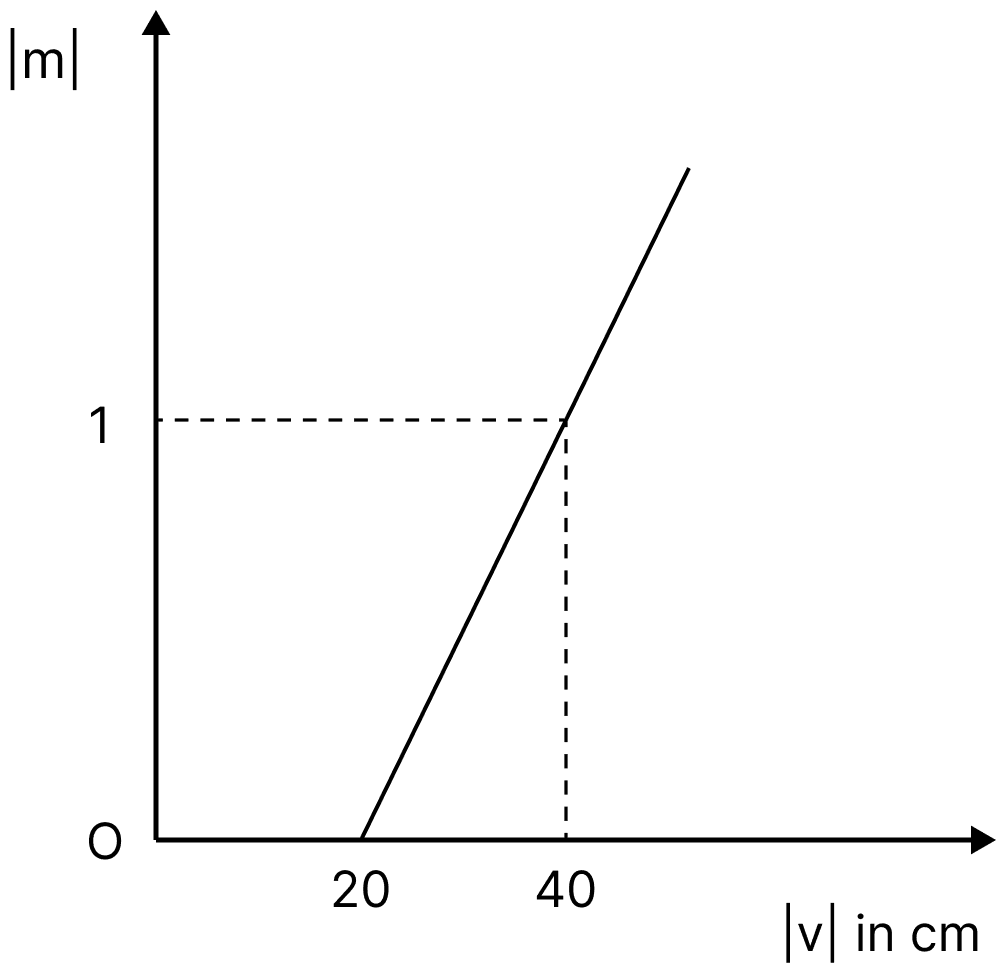
(i) Name the type of mirror used here.
(ii) What is its focal length?
Answer
(i) Concave mirror.
(ii) Focal length = 20 cm.
Explanation:
The graph shows |m| increasing beyond 1, that is, magnified images. A convex mirror always forms a diminished image (|m| < 1), so the mirror is concave.
The magnification is 1 when the object and the image are of the same size, which happens when both are at the centre of curvature. From the graph, |m| = 1 at |v| = 40 cm, so the radius of curvature is 40 cm and
Prove that for a concave mirror, the radius of curvature is twice the focal length.
Answer
Let M1M2 be a concave mirror of small aperture, with pole P, principal focus F and centre of curvature C. A ray OA parallel to the principal axis strikes the mirror at A and, after reflection, passes through the focus F along AB. The line CA is normal to the mirror at A, so ∠OAC is the angle of incidence (i) and ∠CAF is the angle of reflection (r).
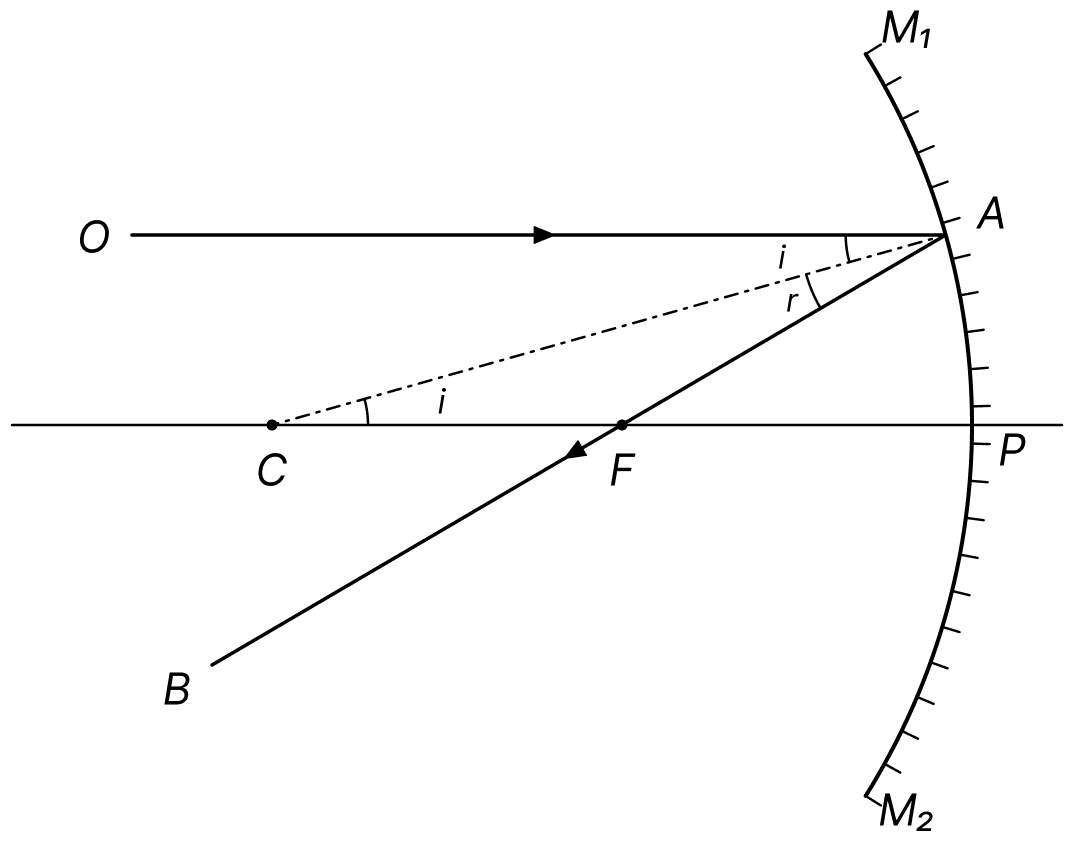
By the law of reflection (i = r),
As OA is parallel to CP, the alternate angles are equal,
From Eqs. (i) and (ii), ∠ACF = ∠CAF. Hence, the triangle AFC is isosceles and
As the aperture of the mirror is small, the point A is very near to P, so we can put AF ≈ PF. Thus,
But PF = f (focal length) and PC = R (radius of curvature). Therefore,
Hence, the radius of curvature of a concave mirror is twice its focal length, R = 2f.
Establish the relation between object distance, image distance and radius of curvature for a concave mirror.
Answer
Let O be a point object on the principal axis of a small-aperture concave mirror with pole P and centre of curvature C. A ray OA from O strikes the mirror at A and, after reflection, passes through the point I on the axis, so I is the image of O. CA is normal to the mirror at A, so ∠OAC = ∠CAI = θ.
Let the rays OA, CA and IA make angles α, γ and β with the principal axis, and let h be the height of A above the axis.
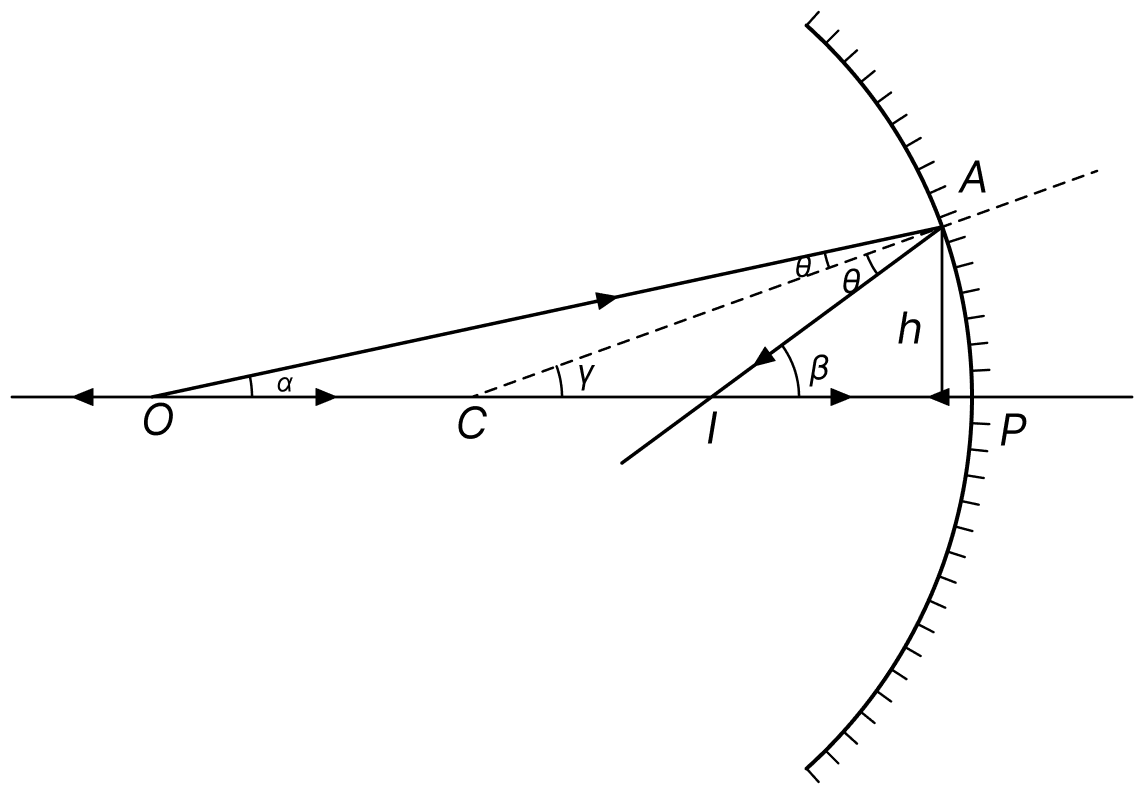
In ΔOAC, the exterior angle γ is
In ΔOAI, the exterior angle β is
Putting θ = γ − α from Eq. (i) in Eq. (ii),
For paraxial rays, A is very close to P and the angles are small, so
Substituting in Eq. (iii),
Using the coordinate geometry sign convention, PO = −u, PI = −v and PC = −R. Making these substitutions in Eq. (iv),
Hence, the relation between object distance u, image distance v and radius of curvature R is . Since R = 2f, this is the mirror formula .
Draw a ray-diagram to show image formation of an object placed between the pole and the focus of a concave mirror. Derive the relation among u, v and f for this particular case. State the assumptions and sign convention used.
Answer
Ray diagram :
Let OO' be a small object placed perpendicular to the principal axis, between the pole P and the focus F of a small-aperture concave mirror M1M2 whose centre of curvature is C. A ray O'A parallel to the principal axis is reflected at A through F. Another ray, along the line CO', strikes the mirror at B normally and retraces its path. The two reflected rays diverge. On producing them back, they appear to come from I' behind the mirror. The perpendicular II' drawn from I' on the principal axis is the virtual, erect and magnified image of OO'. Let AN be the perpendicular from A on the principal axis.
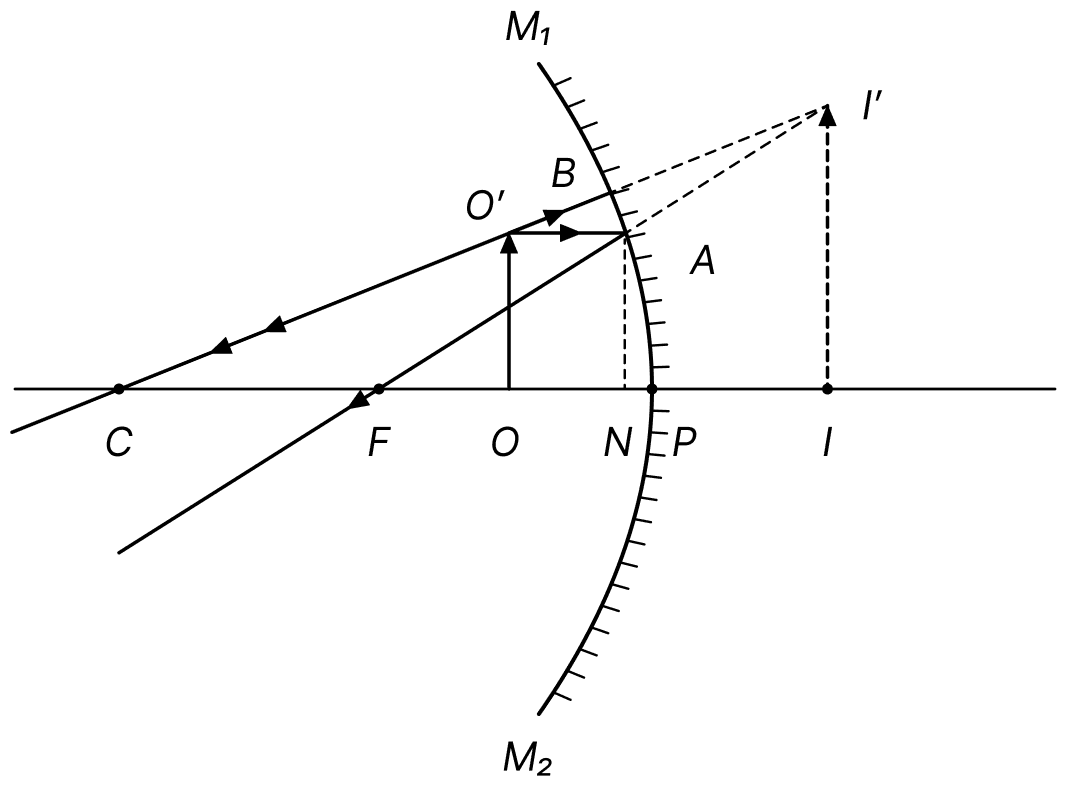
Derivation :
The triangles OO'C and II'C are similar. Therefore,
The points F, A and I' lie on one straight line, so the triangles NAF and II'F are similar. Therefore,
But NA = OO'. Hence,
From Eqs. (i) and (ii),
For paraxial rays, A is very close to P, so NF ≈ PF. Also, from the figure, CO = PC − PO, CI = PC + PI and FI = PF + PI. Thus,
By the sign convention, PO = −u, PI = +v (virtual image behind the mirror), PC = −R and PF = −f. Making these substitutions in Eq. (iii),
Putting R = 2f,
Cross-multiplying,
Dividing both sides by uvf,
Hence, the relation among u, v and f for this case is , the same mirror formula as for a real image.
Assumptions :
(i) The aperture of the mirror is small, so only paraxial rays are considered and the point A is very close to P (NF ≈ PF).
(ii) The object is small and is placed perpendicular to the principal axis.
Sign convention (coordinate geometry or New Cartesian) :
(i) The pole of the mirror is taken as the origin and the principal axis as the X-axis.
(ii) All distances are measured from the pole. Distances measured along the principal axis to the right of the pole are positive, and those to the left are negative. The object is placed on the left of the mirror.
(iii) Distances measured upward from the principal axis are positive, and those measured downward are negative.
Establish the relation between object distance, image distance and focal length for a convex mirror.
Answer
Let P be the pole, F the principal focus and C the centre of curvature of a small-aperture convex mirror M1M2, so that PF = f and PC = R. Let OO' be an object placed in front of the mirror, perpendicular to the principal axis.
A ray O'A parallel to the principal axis is reflected at A along AD, as if coming from F. Another ray O'B, directed towards C, falls normally on the mirror and retraces its path. The reflected rays BO' and AD, on producing back, appear to come from I'. The perpendicular II' drawn from I' on the principal axis is the virtual, erect image of OO' formed behind the mirror. Let AN be the perpendicular from A on the principal axis.
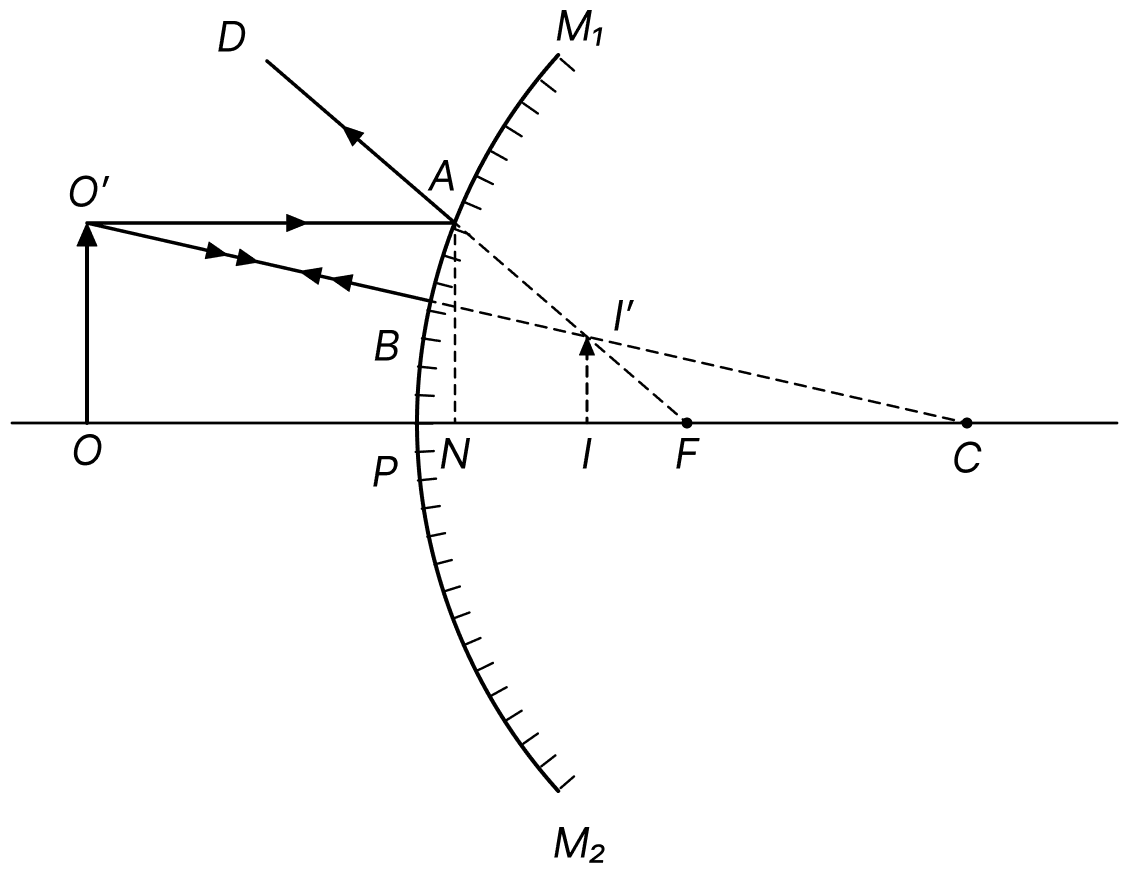
In the similar triangles OO'C and II'C,
In the similar triangles II'F and NAF,
But NA = OO'. Hence,
From Eqs. (i) and (ii),
For paraxial rays, A is very close to P, so NF ≈ PF. Since OC = PO + PC, IC = PC − PI and IF = PF − PI,
Using the coordinate geometry sign convention, PO = −u, PC = +R, PI = +v and PF = +f. Making these substitutions in Eq. (iii),
Putting R = 2f,
Cross-multiplying,
Dividing both sides by uvf,
Hence, the relation for a convex mirror is , the same as for a concave mirror.
What is linear magnification? Obtain expressions for the linear magnification of the image formed by a spherical mirror.
Answer
Linear magnification : For a spherical mirror, the linear magnification (m) is the size of the image divided by the size of the object, the two sizes being measured perpendicular to the principal axis. If y1 and y2 are the lengths of the object and the image,
Magnification formula : Let P be the pole, F the principal focus and C the centre of curvature of a small-aperture concave mirror M1M2. Let OO' be an object placed perpendicular to the axis beyond C. A ray O'A parallel to the axis passes through F after reflection. Another ray O'P is reflected along PD such that ∠O'PO = ∠OPD (i = r). The two reflected rays meet at I', and II' is the real, inverted image of OO'.
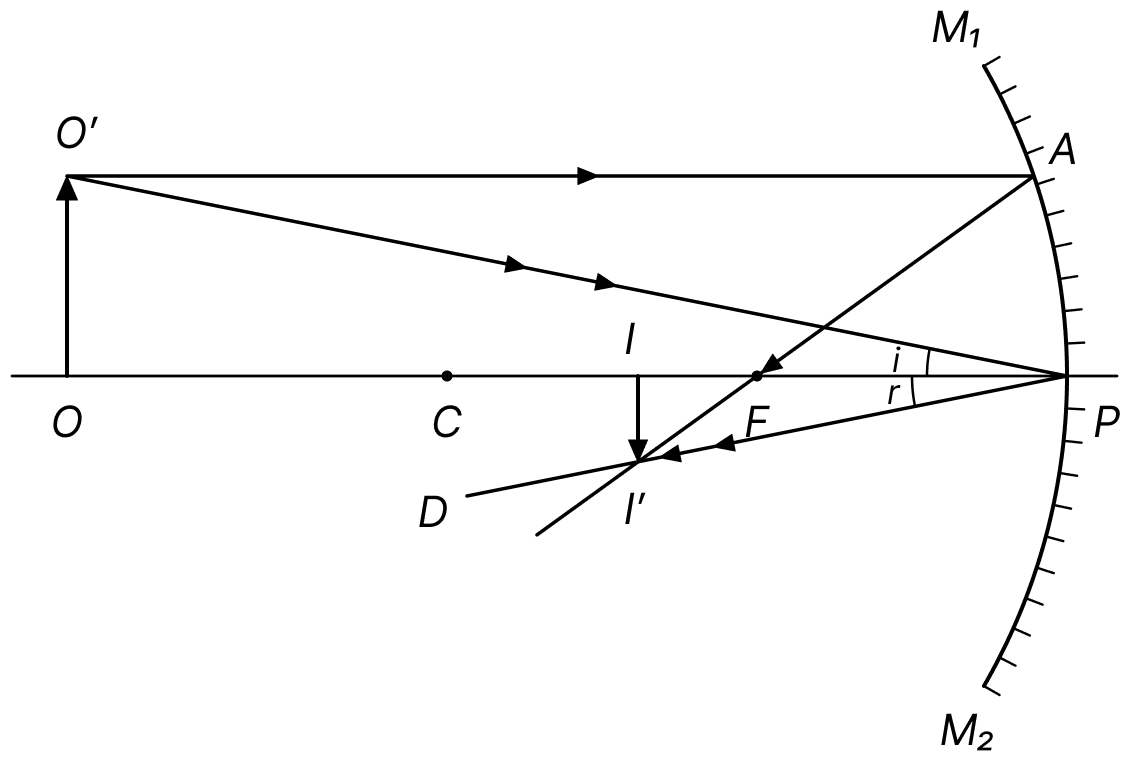
Since ∠O'PO = ∠I'PI (i = r) and ∠O'OP = ∠I'IP = 90°, the triangles OO'P and II'P are similar. Therefore,
Using the coordinate geometry sign convention, II' (measured downward) = −y2, OO' (measured upward) = +y1, PI = −v and PO = −u. Making these substitutions in Eq. (i),
But = m. Therefore,
The same result follows for a concave mirror forming a virtual image and for a convex mirror.
Other expressions : The mirror formula is
Multiplying both sides of Eq. (iii) by v,
Multiplying both sides of Eq. (iii) by u,
Hence, the linear magnification of a spherical mirror is . For a real, inverted image m is negative; for a virtual, erect image m is positive.
Draw a ray diagram to show the image formation by a concave mirror when the object is kept between its focus and the pole. Using this diagram, derive the magnification formula for the image formed.
Answer
Ray diagram :
Let OO' be a small object placed perpendicular to the principal axis between the focus F and the pole P of a concave mirror. A ray O'A parallel to the axis is reflected through F. Another ray O'P falls on the pole and is reflected along PD, making an equal angle with the principal axis (i = r). The reflected rays diverge; on producing them back, they meet at I' behind the mirror. The perpendicular II' is the virtual, erect and magnified image of OO'.
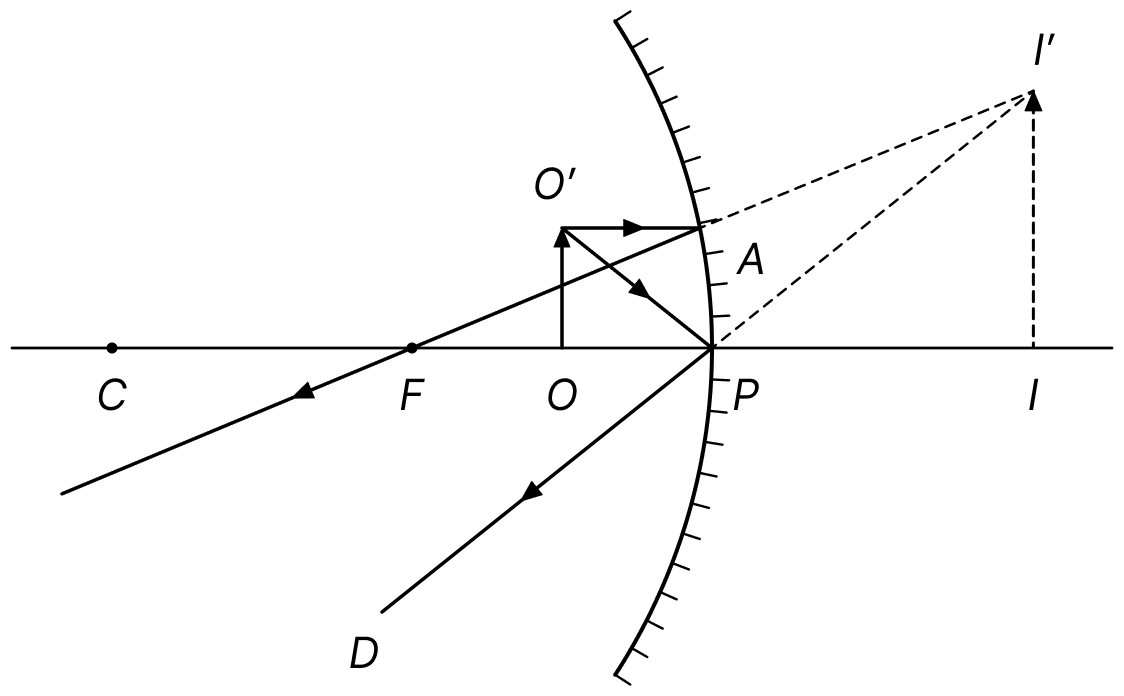
Magnification formula :
At the pole the principal axis is normal to the mirror, so ∠O'PO = i and the reflected ray PD makes the angle r with the axis. The ray PD produced back behind the mirror makes the same angle with the axis (vertically opposite angles), so ∠I'PI = r = i. Also ∠O'OP = ∠I'IP = 90°. Hence, the triangles OO'P and II'P are similar, and
Using the coordinate geometry sign convention, II' (erect image, measured upward) = +y2, OO' = +y1, PI (image behind the mirror) = +v and PO = −u. Making these substitutions in Eq. (i),
Here u is negative and v is positive, so m is positive (erect image). As the image is farther from the mirror than the object (v > |u|), m > 1.
Hence, the magnification formula is , and for this case the image is virtual, erect and magnified.
Examiner assigned a task to the student, in which he has to find the focal length of a concave mirror by u-v method. The examiner gives certain instructions to the student and asks some questions. State whether the responses of the student, in each case, are correct or incorrect. Give a reason for your answer.
(i) EXAMINER : If the distance of object from the focus of the concave mirror is x1 and distance of its real image from focus is x2, then what is the focal length of the mirror?
STUDENT :
(ii) EXAMINER : Where will you place an object in front of a concave mirror to get real, inverted and magnified image?
STUDENT : Between focus and centre of curvature of the mirror.
(iii) EXAMINER : When does concave mirror forms virtual magnified image?
STUDENT : When object is somewhere between its focus and pole.
Answer
(i) Response of the student is incorrect.
The student has taken x1 and x2 as the distances of the object and the image from the mirror. They are measured from the focus. If f is the focal length, the correct distances from the pole are (x1 + f) and (x2 + f). With the sign convention, u = −(x1 + f), v = −(x2 + f) and focal length = −f. From the mirror formula ,
So the correct answer is (Newton's formula), not .
(ii) Response of the student is correct.
When the object is placed between the focus and the centre of curvature, the image is formed beyond C, on the same side as the object. So v is negative (real image) and |v| > |u|. Hence,
is negative with |m| > 1, so the image is real, inverted and magnified.
(iii) Response of the student is correct.
When the object is placed between the focus and the pole, the reflected rays diverge and appear to come from a point behind the mirror. The image is formed behind the mirror (v positive), and v > |u|, so m is positive and greater than 1. Hence, the image is virtual, erect and magnified.
Read the passage(s) and answer the following questions :
A man visited a shopping store with his friend. The owner of the store had fixed number of mirrors at different locations to monitor the activities of the customers and sales persons. The man picked up some utility items and his friend purchased a make-up mirror for his wife.
(i) Name the type of mirrors fixed in the store to watch the activities of the customers.
(ii) Write an another use of this type of mirror.
(iii) Name the type of mirror used as shaving or make-up mirror.
(iv) When does a concave mirror form a virtual image?
(v) What is the relation between focal length and radius of curvature of a spherical mirror?
Answer
(i) Convex mirrors.
(ii) A convex mirror is used as the driver's (rear-view) mirror in vehicles.
(iii) Concave mirror.
(iv) When the object is placed between the pole and the focus of the mirror.
(v) The focal length is half the radius of curvature, .