
An astronomical telescope set for normal adjustment has a magnifying power 10. If the focal length of the objective is 1.20 m, what is the focal length of the eye-piece?
Answer
Given,
- Magnifying power in normal adjustment, M = 10
- Focal length of objective, fo = 1.20 m = 120 cm
In normal adjustment, the magnifying power (in magnitude) of an astronomical telescope is
Hence, the focal length of the eye-piece is 12 cm.
(i) Draw the ray diagram for the formation of image by a refracting telescope having the final image formed at infinity.
(ii) For refracting telescope, define the angular magnification and derive the formula for the same for image formed at infinity.
Answer
(i) Ray diagram of a refracting telescope in normal adjustment (final image at infinity):
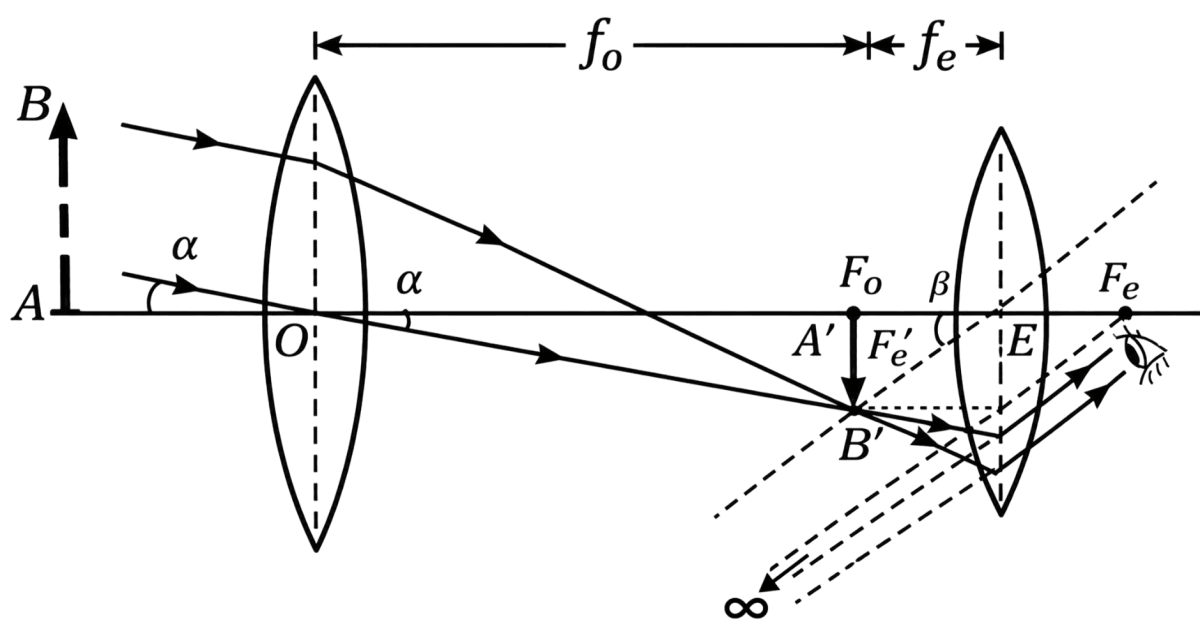
(ii) Angular magnification : The magnifying power (angular magnification) of a telescope in normal adjustment is defined as the ratio of the angle subtended at the eye by the final image, as seen through the telescope, to the angle subtended at the eye by the object seen directly, when both the image and the object lie at infinity.
Derivation : The objective O forms a real and inverted image of the distant object AB at its second focus Fo. In normal adjustment, the eye-piece E is set so that lies at its first focus Fe′. The eye-piece therefore forms the final image at infinity.
As the object is very far off, the angle it subtends at the eye is practically equal to the angle it subtends at the objective. Thus, , and let be the angle subtended at the eye by the final image.
Applying the new Cartesian sign convention, (distance of from the objective, along the incident light) and (distance of from the eye-piece, against the incident light).
The negative sign shows that the final image is inverted. For a large magnifying power, fo >> fe. The length of the tube is .
Hence, the angular magnification of a refracting telescope with the final image at infinity is .
What are the two possible values of the magnifying powers of a simple microscope made of convex lens of focal length f = 5.0 cm?
Answer
Given,
- Focal length of lens, f = 5.0 cm
- Least distance of distinct vision, D = 25 cm
(a) Final image at the least distance of distinct vision :
(b) Final image at infinity (relaxed eye) :
Hence, the two possible values of the magnifying power are 6 and 5.
Define the angular magnification of an optical instrument.
Answer
The angular magnification (magnifying power) of an optical instrument is defined as the ratio of the visual angle subtended at the eye by the final image formed by the instrument to the visual angle subtended at the unaided eye by the object (placed at the least distance of distinct vision in the case of a microscope, and in its actual position in the case of a telescope).
Define magnifying power of an optical instrument. An astronomical refracting telescope consists of two lenses of focal lengths 75 cm and 5 cm. Calculate the magnifying power of the telescope, when the final image is formed at a distance of 25 cm from the eye.
Answer
Magnifying power : The magnifying power of an optical instrument is defined as the ratio of the visual angle subtended at the eye by the image formed by the instrument to the visual angle subtended by the object at the unaided eye.
Given,
- Focal length of objective, fo = 75 cm
- Focal length of eye-piece, fe = 5 cm
- Distance of final image, D = 25 cm
When the final image is formed at the least distance of distinct vision, the magnifying power of the telescope is
The negative sign shows that the final image is inverted.
Hence, the magnifying power of the telescope is 18 (M = −18).
A simple microscope or a magnifying glass with a focal length 5 cm forms an image at the near point of the eye. Find its magnification.
Answer
Given,
- Focal length of lens, f = 5 cm
- Image at the near point, D = 25 cm
When the image is formed at the least distance of distinct vision, the magnifying power of a simple microscope is
Hence, the magnification is 6.
An astronomical telescope is adjusted to form the final image at infinity. The separation between the lenses is 80 cm. The angular magnification is 15. Calculate the focal lengths of the objective lens and the eye-piece.
Answer
Given,
- Separation between the lenses (normal adjustment), L = 80 cm
- Angular magnification, M = 15
In normal adjustment, the length of the telescope and its magnifying power (in magnitude) are
Substituting (ii) in (i),
From (ii),
Hence, the focal length of the objective is 75 cm and that of the eye-piece is 5 cm.
In a compound microscope, which consists of two convex lenses of focal length 1.5 cm and 10 cm, the object is 2 cm from the objective and the final image is formed at the least distance of distinct vision (D = 25 cm). Find the distance of separation of the two lenses.
Answer
Given,
- Focal length of objective, fo = 1.5 cm
- Focal length of eye-piece, fe = 10 cm
- Object distance from objective, uo = −2 cm
- Final image distance from eye-piece, ve = −D = −25 cm
For the objective lens : From the lens formula ,
For the eye-piece : From the lens formula ,
Separation of the lenses :
Hence, the distance of separation of the two lenses is 13.14 cm.
Draw a labelled ray diagram of an image of a distant object formed by a refracting astronomical telescope in normal adjustment. Write (do not derive) an expression for its magnifying power.
Answer
Labelled ray diagram of a refracting astronomical telescope in normal adjustment:
Magnifying power in normal adjustment :
where fo and fe are the focal lengths of the objective and the eye-piece respectively.
A convex lens of focal length 5 cm is to be used as a simple microscope. Where should an object be kept, so that image formed by the lens lies at least distance D of distinct vision (D = 25 cm)? Also, calculate the magnifying power of this instrument in this set-up.
Answer
Given,
- Focal length of lens, f = +5 cm
- Image at the least distance of distinct vision, v = −D = −25 cm
Position of the object : From the lens formula ,
The object should be kept 4.17 cm in front of the lens.
Magnifying power : When the image is formed at the least distance of distinct vision,
Hence, the object should be placed at cm (≈ 4.17 cm) in front of the lens, and the magnifying power is 6.
Why all over the world, giant telescopes are of reflecting type? State any one reason.
Answer
Giant telescopes are of reflecting type because a concave (paraboloidal) mirror of very large aperture is much easier to construct and to support than a lens of equal aperture; a mirror can be supported over its whole back surface, while a lens can be held only at its rim.
An astronomical telescope consists of two convex lenses having focal lengths 80 cm and 4 cm. When it is in normal adjustment, what is its
(i) length?
(ii) magnifying power?
Answer
Given,
- Focal length of objective, fo = 80 cm
- Focal length of eye-piece, fe = 4 cm
(i) Length : In normal adjustment,
(ii) Magnifying power :
Hence, the length of the telescope is 84 cm and its magnifying power is −20.
Explain the statement : "Angular magnification of a compound microscope in normal use is 30".
Answer
A compound microscope is in normal use when the final image is formed at the least distance of distinct vision (D = 25 cm). Its angular magnification is
where is the angle subtended at the eye by the final image and is the angle subtended at the unaided eye by the object when placed at D.
The statement "angular magnification is 30" means that the final image formed at 25 cm from the eye subtends at the eye an angle 30 times the angle that the object itself would subtend if it were placed at 25 cm from the unaided eye (). Hence, the object appears 30 times larger than when seen directly.
An astronomical telescope consists of two thin convex lenses having focal lengths of 140 cm and 5 cm. The telescope is adjusted to be in normal adjustment.
(i) What is the angular magnification, i.e., magnifying power of the telescope in this set-up?
(ii) What is the distance between the two lenses equal to?
Answer
Given,
- Focal length of objective, fo = 140 cm
- Focal length of eye-piece, fe = 5 cm
(i) Magnifying power : In normal adjustment,
(ii) Distance between the lenses :
Hence, the angular magnification is −28 and the distance between the lenses is 145 cm, i.e., equal to the sum of the focal lengths of the two lenses.
A compound microscope consists of an objective of focal length 2 cm and an eye-piece of focal length 5 cm. When an object is kept 2.4 cm from the objective, final image formed is virtual and 25 cm from the eye-piece. Determine magnifying power of compound microscope in this set-up, i.e., in normal use.
Answer
Given,
- Focal length of objective, fo = 2 cm
- Focal length of eye-piece, fe = 5 cm
- Object distance from objective, uo = −2.4 cm
- Final image at D = 25 cm from the eye-piece
For the objective lens : From the lens formula ,
Magnifying power : With the final image at D, taking the distance of the object from the objective as = 2.4 cm,
Hence, the magnifying power of the compound microscope in normal use is 30 (M = −30).
Note: The textbook prints the answer as 120, which is incorrect. With uo = 2.4 cm, vo = 12 cm and the magnifying power is 30; 120 is the value for uo = 2.1 cm (Question 24).
Define resolving power of a simple astronomical telescope.
Answer
The resolving power of an astronomical telescope is its ability to produce distinctly separate images of two distant point-objects lying very close to each other. It is measured by the reciprocal of its limit of resolution (the smallest angle subtended at the objective by two point-objects which are just resolved):
where d is the diameter of the aperture of the objective and is the wavelength of light used.
An astronomical telescope uses two lenses of powers 10 D and 1 D. If the final image of a distant object is formed at infinity, calculate the length of the telescope.
Answer
Given,
- Powers of the lenses = 10 D and 1 D
- Final image at infinity (normal adjustment)
The objective must have the larger focal length, i.e., the smaller power. Using ,
In normal adjustment, the length of the telescope is
Hence, the length of the telescope is 110 cm.
(i) Define the magnifying power of a microscope in terms of visual angles.
(ii) What is the advantage of a compound microscope over a simple microscope?
Answer
(i) The magnifying power of a microscope is defined as the ratio of the visual angle () subtended at the eye by the final image to the visual angle () subtended at the unaided eye by the object when it is placed at the least distance of distinct vision.
(ii) A compound microscope gives a much higher magnifying power than a simple microscope. The magnifying power of a simple microscope cannot be increased much by decreasing f, because the quality of the image is then seriously impaired by spherical aberration. A compound microscope magnifies in two stages (M = mo × me), the objective and the eye-piece, so that a large magnification is obtained.
Draw a labelled ray diagram showing the formation of an image by a refracting telescope when the final image lies at infinity.
Answer
Labelled ray diagram of a refracting telescope with the final image at infinity (normal adjustment):
The objective O forms a real, inverted image of the distant object at its focus Fo, which coincides with the first focus Fe′ of the eye-piece E. The rays emerging from the eye-piece are parallel, so the final image is formed at infinity.
Draw a labelled diagram of an image formed by a compound microscope with image at least distance of distinct vision.
Answer
Labelled ray diagram of a compound microscope with the final image at the least distance of distinct vision D:
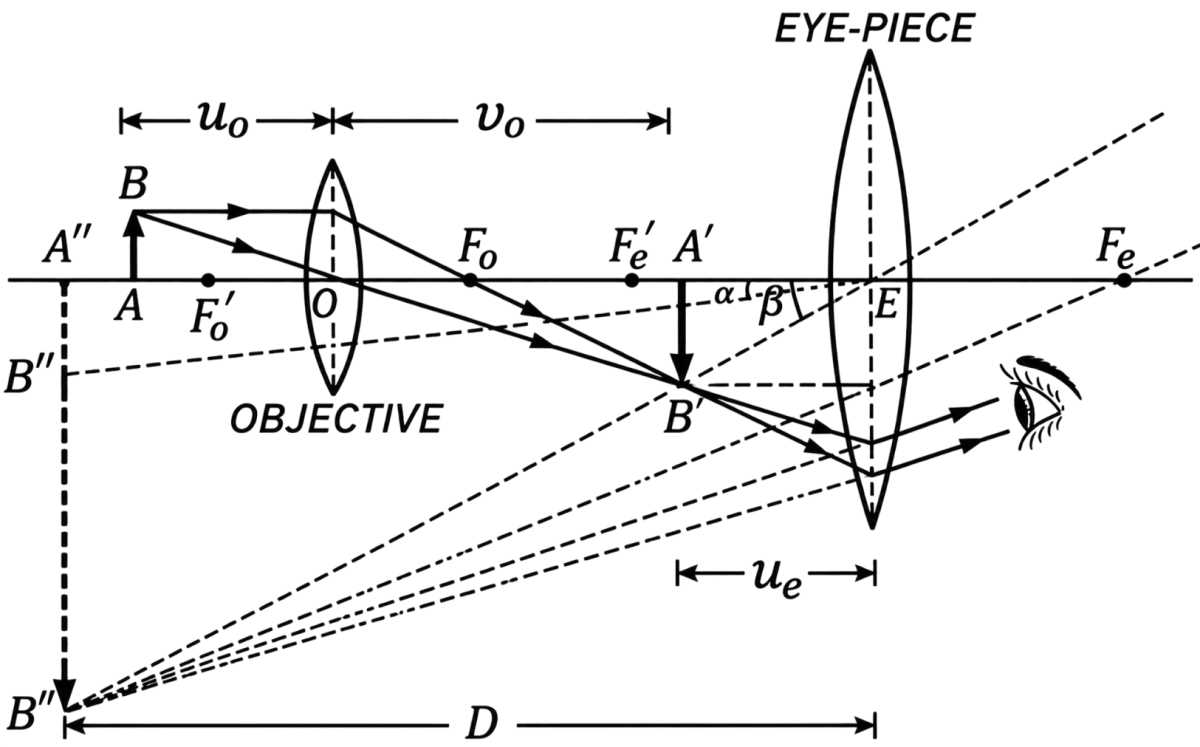
The objective O forms a real, inverted and magnified image of the object AB (placed slightly beyond Fo′). lies between the eye-piece E and its first focus Fe′, so the eye-piece forms a virtual, magnified final image at distance D.
A convex lens of focal length 5 cm is used as a simple microscope. Where should an object be placed so that the image formed by it lies at the least distance of distinct vision (D = 25 cm)?
Answer
Given,
- Focal length of lens, f = +5 cm
- Image at the least distance of distinct vision, v = −D = −25 cm
From the lens formula ,
Hence, the object should be placed about 4.2 cm in front of the lens.
Derive the formula for angular magnification of a compound microscope, when the final images is formed at the least distance of distinct vision. Draw the required ray diagram.
Answer
Formation of image : The object AB is placed slightly beyond the first focus Fo′ of the objective O, which forms a real, inverted and magnified image . This image lies between the optical centre E of the eye-piece and its first focus Fe′, and acts as an object for the eye-piece. The eye-piece forms a magnified, virtual final image at the least distance of distinct vision D.
Magnifying power : Cut a length from . Then is the angle subtended by the object had it been at D. Let be the angle subtended by the final image at E; since the eye is very close to the eye-piece, may be taken as the angle subtended at the eye.
But (linear magnification by the eye-piece) and (linear magnification by the objective).
For the objective, with uo and vo the distances of the object and of the image from O,
For the eye-piece, with ue the distance of from E and the final image at D,
Putting u = −ue, v = −D and f = fe in the lens formula ,
From (iii) and (iv),
Substituting mo and me in (i),
Hence, the angular magnification of a compound microscope with the final image at D is .
With regard to an astronomical telescope of refracting type, state how you will increase its
(i) magnifying power
(ii) resolving power
Answer
(i) Magnifying power : By taking the objective lens of larger focal length and the eye-piece of smaller focal length, since (in magnitude).
(ii) Resolving power : By taking an objective lens of larger aperture (diameter d), since the limit of resolution decreases, i.e., the resolving power increases.
A compound microscope consists of two convex lenses of focal lengths 2 cm and 5 cm. When an object is kept at a distance of 2.1 cm from the objective, a virtual and magnified image is formed 25 cm from the eye-piece. Calculate the magnifying power of the microscope.
Answer
Given,
- Focal length of objective, fo = 2 cm
- Focal length of eye-piece, fe = 5 cm
- Object distance from objective, uo = −2.1 cm
- Final image at D = 25 cm from the eye-piece
For the objective lens : From the lens formula ,
Magnifying power : With the final image at D, taking the distance of the object from the objective as = 2.1 cm,
Hence, the magnifying power of the microscope is 120 (M = −120).
State any method of increasing the resolving power of an astronomical telescope.
Answer
The resolving power of an astronomical telescope can be increased by using an objective lens of larger aperture (diameter d).
Explanation:
The limit of resolution of the telescope, , then becomes smaller.
With the help of a ray diagram, obtain, the expression for the magnifying power of a simple microscope, when the image is formed at the least distance of distinct vision.
Answer
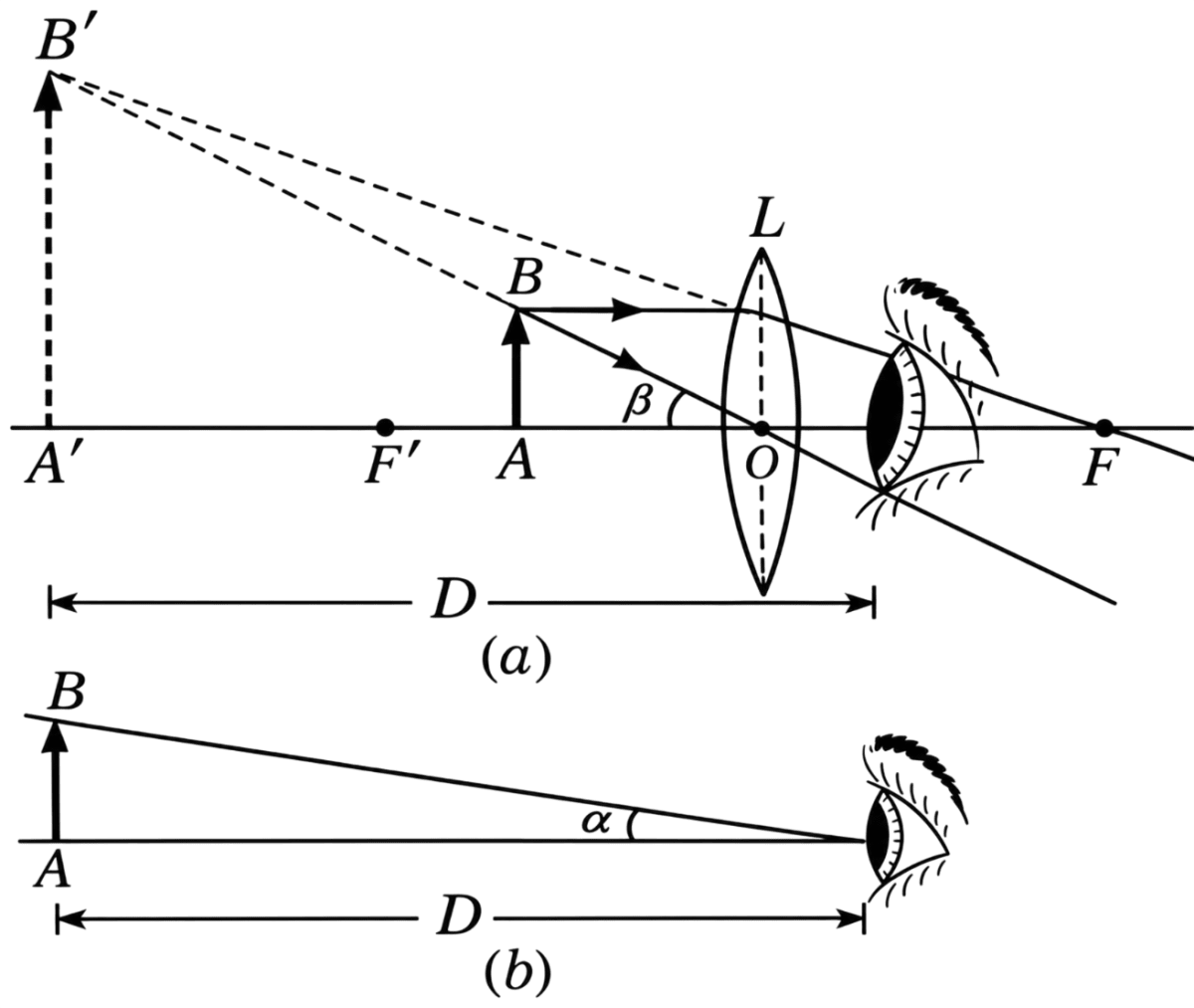
In Fig. (a), AB is a small object placed between the lens L and its first focus F′. Its magnified, virtual and erect image is formed at distance D from the lens. Since the eye is just behind the lens, the image is also at distance D from the eye.
Let be the angle subtended by the image at the eye [Fig. (a)] and the angle subtended by the object AB at the eye when placed directly at distance D [Fig. (b)]. Then the magnifying power is
Since the object is small, the angles are small. From Fig. (a) and (b),
where u = OA is the distance of the object from the lens. Since the image is formed at distance D, put v = −D and u = −u in the lens formula :
Substituting this value of in (i),
Hence, the magnifying power of a simple microscope with the image at the least distance of distinct vision is .
In an astronomical telescope of refracting type :
- objective should have small focal length.
- objective should have large focal length.
- eye-piece should have large focal length.
- both objective and eye-piece should have large focal length.
Answer
objective should have large focal length.
Reason — In normal adjustment, the magnifying power of a refracting telescope is . A large magnifying power therefore needs an objective of large focal length (and an eye-piece of small focal length).
A compound microscope consists of two convex lenses having focal length of 1.5 cm and 5 cm. When an object is kept at a distance of 1.6 cm from the objective, the final image is virtual and lies at a distance of 25 cm from the eye-piece. Calculate magnifying power of compound microscope in this set-up.
Answer
Given,
- Focal length of objective, fo = 1.5 cm
- Focal length of eye-piece, fe = 5 cm
- Object distance from objective, uo = −1.6 cm
- Final image at D = 25 cm from the eye-piece
For the objective lens : From the lens formula ,
Magnifying power : With the final image at D, taking the distance of the object from the objective as = 1.6 cm,
Hence, the magnifying power of the compound microscope is −90.
Draw a labelled ray diagram of an image formed by a refracting telescope with final image formed at infinity. Derive an expression for its magnifying power with the final image at infinity.
Answer
Labelled ray diagram of a refracting telescope with the final image at infinity (normal adjustment):
Magnifying power : The magnifying power (angular magnification) of a telescope in normal adjustment is defined as the ratio of the angle subtended at the eye by the final image, as seen through the telescope, to the angle subtended at the eye by the object seen directly, when both the image and the object lie at infinity.
The objective O forms a real and inverted image of the distant object AB at its second focus Fo. In normal adjustment, the eye-piece E is set so that lies at its first focus Fe′. The eye-piece therefore forms the final image at infinity.
As the object is very far off, the angle it subtends at the eye is practically equal to the angle it subtends at the objective. Thus, , and let be the angle subtended at the eye by the final image.
Applying the new Cartesian sign convention, (distance of from the objective, along the incident light) and (distance of from the eye-piece, against the incident light).
The negative sign shows that the final image is inverted. For a large magnifying power, fo >> fe. The length of the tube is .
Hence, the magnifying power of a refracting telescope with the final image at infinity is .
(i) Draw a labelled ray diagram of an image formed by a compound microscope with the final image formed at the least distance of distinct vision 'D'. Write (do not derive) an expression for its magnifying power.
(ii) A simple microscope forms a virtual and magnified image of an object. State the position of the object.
Answer
(i) Labelled ray diagram of a compound microscope with the final image at the least distance of distinct vision D:
Magnifying power :
where uo and vo are the distances of the object and of its image from the objective, and fe is the focal length of the eye-piece.
(ii) The object is placed between the lens and its first principal focus, i.e., at a distance less than the focal length of the lens (u < f).
Write an expression for magnifying power of an astronomical refracting telescope in terms of focal lengths of objective (fo) and eye-piece (fe) when the final image is formed at infinity. (Derivation of the formula is not required.)
Answer
Explanation:
The magnifying power is in magnitude; the negative sign shows that the final image is inverted.
State any one advantage of a reflecting telescope over a refracting telescope.
Answer
The image formed by a reflecting telescope is free from chromatic aberration.
Explanation:
Only reflection is involved at the objective mirror.
Draw a neat labelled ray diagram of a simple microscope when the image is formed at the least distance of distinct vision D. Write the expression for its angular magnification (magnifying power) in this setup. (Derivation of formula is not required.)
Answer
Labelled ray diagram of a simple microscope with the image at the least distance of distinct vision D:
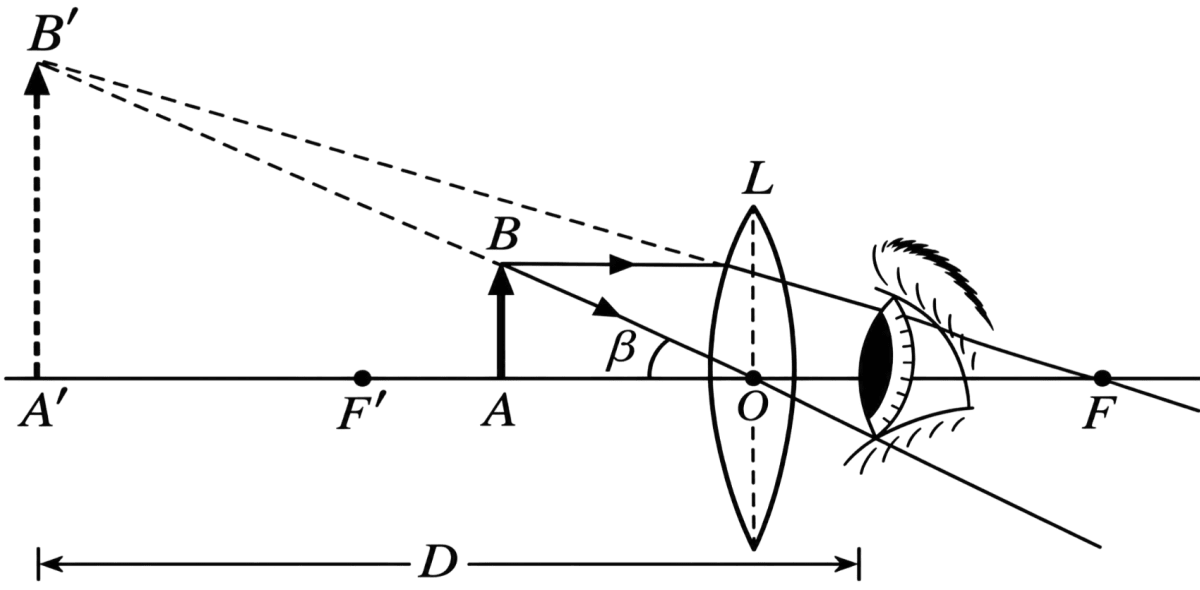
Angular magnification (magnifying power) in this set-up :
where f is the focal length of the lens.
What is meant by a microscope in normal use?
Answer
A microscope is said to be in normal use when it is so adjusted that the final image is formed at the least distance of distinct vision (D = 25 cm) from the eye.
Read the given passage and answer the questions that follow.
There are two types of lenses : Converging lenses and Diverging lenses, depending on whether they converge or diverge an incident beam of light. They are also called convex or concave lenses. Lenses are usually made of glass. Convex lenses are more popular as they form a real image of an object. They are widely used in our daily life, for instance, in microscopes, telescopes, projectors, cameras, spectacles, etc. Microscopes are used to view small and nearby objects whereas telescopes are used to see distant objects.
(i) State any one factor on which focal length of a lens depends.
(ii) Give an example where a convex lens behaves like a diverging lens.
(iii) What type of lens is used in a camera?
(iv) Write an expression for magnifying power of a compound microscope when its final image lies at the least distance of distinct vision (D).
(v) State any one difference between a reflecting telescope and a refracting telescope.
Answer
(i) The refractive index of the material of the lens (relative to the surrounding medium).
(ii) A convex glass lens immersed in a medium whose refractive index is greater than that of glass, such as carbon disulphide (μ = 1.63), behaves like a diverging lens.
(iii) A convex (converging) lens.
(iv)
(v) In a reflecting telescope the objective is a concave (paraboloidal) mirror, whereas in a refracting telescope the objective is a convex lens.
Read the given passage and answer the questions that follow.
There are two types of optical instruments : Microscopes and Telescopes.
Microscopes are used to magnify very tiny objects whereas telescopes are used to study distant objects. Both of them deploy convex lenses. In his telescope, Newton used a large parabolic mirror to collect light from the stars and reduce aberrations.
(i) Rohit observed the launch of Chandrayan 3 with the help of an optical instrument. Name the instrument used by him.
(ii) State any one advantage of a reflecting telescope over a refracting telescope.
(iii) Which instrument is used to study the structure of a virus?
(iv) What is the ability of an optical instrument to form enlarged images called?
(v) What is the difference between a compound microscope and an astronomical telescope (refracting type), as far as their lenses are concerned?
Answer
(i) Telescope.
(ii) The image formed by a reflecting telescope is free from chromatic aberration (only reflection is involved).
(iii) Electron microscope.
(iv) Magnification (magnifying power).
(v)
| Compound microscope | Astronomical telescope (refracting type) |
|---|---|
| The objective is a convex lens of short focal length and small aperture. | The objective is a convex lens of large focal length and large aperture. |
| The eye-piece is a convex lens of comparatively larger focal length and larger aperture than the objective. | The eye-piece is a convex lens of small focal length and small aperture. |
Note: For (iii) the textbook prints "Compound microscope". A virus is smaller than the limit of resolution of an optical microscope in visible light (about 4000 Å), so its structure is studied with an electron microscope, as the chapter explains.