
In a plane electromagnetic wave the phase difference between electric and magnetic field vectors is :
- zero
- π
Answer
zero
Reason — In an electromagnetic wave the variations in the electric and magnetic fields occur simultaneously, and the fields acquire their maximum values E0 and B0 at the same place and at the same time. Hence and are in phase and the phase difference between them is zero.
Point out the wrong statement : Electromagnetic waves :
- are transverse
- are produced by accelerating charges
- travel with same speed in all media
- travel with speed of light in free space
Answer
travel with same speed in all media
Reason — The speed of electromagnetic waves in a medium is , where μ and ε are the permeability and permittivity of the medium. Since μ and ε differ from medium to medium, the speed is not the same in all media; it equals the speed of light only in free space.
The dimensions of are :
- [LT-1]
- [L-1T]
- [L-2T2]
- [L2T-2]
Answer
[L2T-2]
Reason — The speed of electromagnetic waves in free space is , so . Therefore,
The amplitude of electric field in an electromagnetic wave is 5 V m-1. The amplitude of the magnetic field is :
- 5 T
- 1.67 × 10⁻⁸ T
- 1.5 × 10⁹ T
- 1.67 × 10⁻¹⁰ T
Answer
1.67 × 10⁻⁸ T
Reason — In free space the amplitudes of the electric and magnetic fields are related by . With E0 = 5 V m-1,
Heat radiations are :
- γ-rays
- microwaves
- infrared radiations
- radio waves
Answer
infrared radiations
Reason — Infrared radiation is emitted by hot bodies and produces a heating effect on the bodies on which it falls (it is detected by a thermopile or a bolometer). Hence infrared rays are also called the 'heat rays'.
Which of the following are not electromagnetic waves?
- Cosmic rays
- Gamma rays
- β-rays
- X-rays
Answer
β-rays
Reason — β-rays are a stream of fast-moving electrons, i.e., charged material particles, and are deflected by electric and magnetic fields. Electromagnetic waves, being uncharged, are not deflected by these fields. Gamma rays and X-rays are electromagnetic waves.
Note: Strictly, cosmic rays (mainly high-energy protons and nuclei) are also not electromagnetic waves; β-rays is the answer printed in the textbook and is the intended one.
The decreasing order of wavelength of infrared, microwaves, ultraviolet and gamma rays is :
- infrared, microwaves, ultraviolet, gamma rays
- microwaves, infrared, ultraviolet, gamma rays
- gamma rays, ultraviolet, infrared, microwaves
- microwaves, gamma rays, infrared, ultraviolet
Answer
microwaves, infrared, ultraviolet, gamma rays
Reason — The approximate wavelength ranges are : microwaves 10-3 m to 3 × 10⁻¹ m, infrared 8 × 10⁻⁷ m to 5 × 10⁻³ m, ultraviolet 6 × 10⁻¹⁰ m to 4 × 10⁻⁷ m and gamma rays 10-14 m to 10-10 m. Hence, in decreasing order of wavelength : microwaves > infrared > ultraviolet > gamma rays.
Match List-I with List-II.
| List-I | List-II |
|---|---|
| A. Source of microwave frequency | 1. Radioactive decay of nucleus |
| B. Source of infrared frequency | 2. Magnetron |
| C. Source of gamma rays | 3. Inner shell electrons |
| D. Source of X-rays | 4. Vibration of atoms and molecules |
| 5. LASER | |
| 6. R-C circuit |
Choose the correct answer from the options.
- A-6, B-4, C-1, D-5
- A-6, B-5, C-1, D-4
- A-2, B-4, C-6, D-3
- A-2, B-4, C-1, D-3
Answer
A-2, B-4, C-1, D-3
Reason — Microwaves are produced by oscillating currents in special vacuum tubes such as the magnetron (A-2). Infrared radiation arises from the vibrational and rotational transitions of atoms and molecules (B-4). Gamma rays are emitted in transitions of atomic nuclei during radioactive decay (C-1). Characteristic X-rays arise from electronic transitions among the innermost orbits, i.e., of inner shell electrons (D-3).
Electromagnetic waves are transverse in nature is evident by :
- polarisation
- interference
- reflection
- diffraction
Answer
polarisation
Reason — Only transverse waves can be polarised; longitudinal waves such as sound cannot. Hence the polarisation of electromagnetic waves shows that they are transverse in nature.
A plane electromagnetic wave propagating along y-direction can have the following pair of electric field (E) and magnetic field (B) components :
- Ey, By or Ez, Bz
- Ey, Bx or Ex, By
- Ex, Bz or Ez, Bx
- Ex, By or Ey, Bx
Answer
Ex, Bz or Ez, Bx
Reason — In an electromagnetic wave and are perpendicular to each other and to the direction of propagation, which is along . For propagation along the y-direction, both fields must lie in the x-z plane and be mutually perpendicular. So either is along x and along z, or is along z and along x.
The relative permittivity of distilled water is 81. The velocity of light in it will be :
(Take, μr = 1)
- 4.33 × 10⁷ m/s
- 2.33 × 10⁷ m/s
- 3.33 × 10⁷ m/s
- 5.33 × 10⁷ m/s
Answer
3.33 × 10⁷ m/s
Reason — The speed of electromagnetic waves in a medium is . With εr = 81 and μr = 1,
Match List-I with List-II.
| List-I | List-II |
|---|---|
| A. | I. Gauss' law for electricity |
| B. | II. Gauss' law for magnetism |
| C. | III. Faraday law |
| D. | IV. Ampere-Maxwell law |
Choose the correct answer from the options given below :
- A-IV, B-I, C-III, D-II
- A-II, B-III, C-I, D-IV
- A-IV, B-III, C-I, D-II
- A-IV, B-II, C-III, D-IV
Answer
A-IV, B-III, C-I, D-II
Reason — A is the Ampere-Maxwell law : the line integral of is μ0 times the sum of the conduction current and the displacement current. B is Faraday's law : the line integral of round a closed path is given by the rate of change of magnetic flux. C is Gauss' law for electricity : the electric flux through a closed surface is . D is Gauss' law for magnetism : the magnetic flux through any closed surface is zero.
Note: In List-I (B), Faraday's law should read ; the minus sign is missing in the textbook, but the matching is unaffected.
The electric field in an electromagnetic wave is given by NC-1. The magnetic field induction of this wave is (in SI unit) :
Answer
Reason — The phase shows that the wave travels along the +z direction, and is along . must be perpendicular to both, with along ; since , is along . It is in phase with , and its amplitude is .
A plane electromagnetic wave propagating in x-direction is described by
Ey = (200 Vm-1) sin[1.5 × 10⁷ t - 0.05 x];
The intensity of the wave is :
(Use ε0 = 8.85 × 10⁻¹² C2N-1m-2)
- 35.4 Wm-2
- 53.1 Wm-2
- 26.6 Wm-2
- 106.2 Wm-2
Answer
53.1 Wm-2
Reason — Comparing with Ey = E0 sin(ωt − kx), the amplitude is E0 = 200 V m-1. The intensity of the wave is , so
Which of the following statement is true?
- According to both Maxwell's electromagnetic theory and Huygens's wave theory, light is treated as a wave in nature and requires a medium to travel
- According to both Maxwell's electromagnetic theory and Huygens's wave theory, light is treated as a particle in nature and requires a medium to travel
- According to both Maxwell's electromagnetic theory and Huygens's wave theory, light is treated as a wave in nature and does not require a medium to travel
- According to Maxwell's electromagnetic theory, light is treated as a wave in nature and requires no medium to travel. However, according to Huygens's theory, light is treated as a wave in nature and requires a medium to travel
Answer
According to Maxwell's electromagnetic theory, light is treated as a wave in nature and requires no medium to travel. However, according to Huygens's theory, light is treated as a wave in nature and requires a medium to travel
Reason — Maxwell's electromagnetic theory treats light as an electromagnetic wave made up of oscillating electric and magnetic fields, which needs no material medium for propagation. Huygens' wave theory also treated light as a wave, but assumed a medium (the hypothetical 'ether') filling all space for it to travel through.
The electric field of a plane electromagnetic wave propagating along the X-direction in vacuum is . The magnetic field , at the moment t = 0 is :
Answer
Reason — For propagation along +X with along , must be along , since . is in phase with and its amplitude is . Hence , and at t = 0, cos(−kx) = cos(kx).
The oscillating magnetic field in a plane electromagnetic wave is given by T. The amplitude of electric field will be :
- 15 × 102 V m-1
- 5 × 10⁻⁶ V m-1
- 16 × 1012 V m-1
- 4 × 10² V m-1
Answer
4 × 10² V m-1
Reason — Comparing By = 5 × 10⁻⁶ sin(5000πx − 4 × 10¹¹πt) with B = B0 sin(kx − ωt), we get B0 = 5 × 10⁻⁶ T, k = 5000π m-1 and ω = 4 × 10¹¹π rad s-1. The speed of the wave and the amplitude of the electric field are
What oscillates in electromagnetic waves? Are these waves transverse or longitudinal?
Answer
The electric field and the magnetic field oscillate. Electromagnetic waves are transverse.
Explanation:
In an electromagnetic wave and vary sinusoidally in mutually perpendicular directions, and both are perpendicular to the direction of propagation of the wave. Hence the waves are transverse in nature.
A plane EM wave is travelling in vacuum along X-direction. What can you say about the directions of magnetic and electric fields? If the frequency of the wave is 30 MHz, what is its wavelength?
Answer
Directions of the fields : Both and are perpendicular to the X-direction, i.e., they lie in the Y-Z plane, and they are also perpendicular to each other. For example, may be along the Y-axis and along the Z-axis, so that points along the X-direction.
Wavelength :
Given,
- Frequency, ν = 30 MHz = 30 × 106 Hz
- Speed of light, c = 3 × 10⁸ m s-1
Using the relation ,
Hence, the wavelength of the wave is 10 m.
At any instant, the electric field , magnetic field and velocity vector are mutually perpendicular to each other, for a linearly polarised ray of light. Identify (name) three different planes, which are mutually perpendicular to each other.
Answer
The –plane, the –plane and the –plane.
Explanation:
For a wave travelling along the X-axis with along the Y-axis and along the Z-axis, these three planes are the X-Y, X-Z and Y-Z planes respectively, which are mutually perpendicular.
What is the phase difference, if any, between the electric field and magnetic field associated with a plane-polarised light?
Answer
Zero.
Explanation:
The electric and magnetic fields of light vary simultaneously and acquire their maximum values at the same place and at the same time, i.e., they are in phase. For example, when Ey has its maximum value, Bz is also maximum.
What feature of electromagnetic waves led Maxwell to conclude that light itself is an electromagnetic wave?
Answer
The speed of electromagnetic waves in free space, , worked out by Maxwell, comes out equal to the speed of light.
Explanation:
On putting the values of μ0 and ε0, = 3 × 10⁸ m s-1, which is the measured speed of light in free space. Maxwell therefore concluded that light itself is an electromagnetic wave.
What are the dimensions and the value of ?
Answer
[LT-1]; 3 × 10⁸ m s-1.
Explanation:
is the speed c of electromagnetic waves in free space, so it has the dimensions of velocity, [LT-1]. Its value is
What physical quantity is the same for X-rays of wavelength 10-10 m, red light of wavelength 6800 Å and radio waves of wavelength 500 m?
Answer
Their speed in vacuum (3 × 10⁸ m s-1).
Explanation:
X-rays, red light and radio waves are all electromagnetic waves. In vacuum every electromagnetic wave travels with the same speed , whatever its wavelength; only their wavelengths and frequencies differ.
What evidence is there to show that sound is not electromagnetic in nature?
Answer
Sound waves cannot travel through vacuum, whereas electromagnetic waves can.
Explanation:
Electromagnetic waves do not require any material medium for their propagation. Sound needs a material medium, so it is not electromagnetic in nature.
Write the relationship between amplitudes of electric and magnetic fields in free space for an electromagnetic wave.
Answer
E0 = cB0, i.e., .
Explanation:
In free space the ratio of the amplitudes of the electric and magnetic fields equals the speed of light in free space, c = 3 × 10⁸ m s-1.
A charged particle oscillates about its mean position with a frequency of 109 Hz. What is the frequency of the EM waves produced by the oscillator?
Answer
109 Hz.
Explanation:
According to Maxwell's theory, a charged particle oscillating with frequency ν radiates electromagnetic waves of the same frequency ν.
Name any one property which are common to all electromagnetic waves (radiation).
Answer
Electromagnetic waves do not require any material medium for their propagation.
Name the source of radio waves.
Answer
Oscillating electric circuits.
Explanation:
Radio waves are produced by the accelerated motion of charges in oscillating electric circuits.
Which electromagnetic wave is longer than X-rays but shorter than light wave?
Answer
Ultraviolet rays.
Explanation:
The ultraviolet region (6 × 10⁻¹⁰ m to 4 × 10⁻⁷ m) lies between the X-ray region on the shorter-wavelength side and visible light (4 × 10⁻⁷ m to 7 × 10⁻⁷ m) on the longer-wavelength side.
Arrange in descending order of wavelength :
γ-rays, X-rays, infrared rays, radiowaves, microwaves.
Answer
Radio waves, microwaves, infrared rays, X-rays, γ-rays.
Arrange in ascending order of wavelength :
microwaves, γ-rays, radio waves, ultraviolet light.
Answer
γ-rays, ultraviolet light, microwaves, radio waves.
Which part of the electromagnetic spectrum does the wavelength 10-10 m correspond to?
Answer
X-rays.
Explanation:
The wavelength 10-10 m (= 1 Å) lies within the X-ray range, 10-13 m to 3 × 10⁻⁸ m.
Which of the following has the shortest wavelength? Lowest frequency?
Microwaves, ultraviolet rays, infrared rays and X-rays?
Answer
Shortest wavelength : X-rays; lowest frequency : microwaves.
Explanation:
Of the four, X-rays have the smallest wavelength and microwaves the largest. Since , the radiation of largest wavelength, i.e., microwaves, has the lowest frequency.
Arrange the following electromagnetic waves in increasing order of their frequencies :
Visible light, γ-rays, X-rays, microwaves, radio waves, infrared radiations and ultraviolet radiations.
Answer
Radio waves, microwaves, infrared radiations, visible light, ultraviolet radiations, X-rays, γ-rays.
Which part of the electromagnetic spectrum has the largest penetrating power?
Answer
γ-rays.
Explanation:
γ-rays have the shortest wavelength (highest frequency) in the electromagnetic spectrum and are highly penetrating; X-rays have similar properties but are less penetrating.
Name the part of the electromagnetic spectrum which is used in greenhouses to keep plants warm.
Answer
Infrared radiation.
Explanation:
Infrared radiation has a strong heating effect, so it is used in green houses to keep the plants warm.
State any one use of infrared radiation.
Answer
In warfare, for looking through haze, fog or mist.
Explanation:
Infrared radiation can penetrate through fog, so objects can be viewed through haze and fog using it.
In which part of the electromagnetic spectrum do the following radiations lie :
(i) Having wavelength of 20 nm
(ii) Having frequency of 10 MHz.
Answer
(i) X-rays.
(ii) Radio waves.
Explanation:
(i) 20 nm = 2 × 10⁻⁸ m, which lies in the X-ray region (10-13 m to 3 × 10⁻⁸ m). As adjacent regions of the spectrum overlap, this wavelength also falls within the ultraviolet range (6 × 10⁻¹⁰ m to 4 × 10⁻⁷ m).
(ii) For ν = 10 MHz = 107 Hz,
which lies in the radio-wave region (10-1 m to 104 m).
To which regions of the electromagnetic spectrum do the following wavelengths belong :
(a) 250 nm,
(b) 1500 nm.
Answer
(a) Ultraviolet radiation.
(b) Infrared radiation.
Explanation:
(a) 250 nm = 2.5 × 10⁻⁷ m lies in the ultraviolet range, 6 × 10⁻¹⁰ m to 4 × 10⁻⁷ m.
(b) 1500 nm = 1.5 × 10⁻⁶ m lies in the infrared range, 8 × 10⁻⁷ m to 5 × 10⁻³ m.
The charging current for a capacitor is 0.25 A. What is the displacement current across its plates?
Answer
0.25 A.
Explanation:
During charging, the displacement current between the plates of a capacitor is equal to the conduction current in the connecting wires,
so the displacement current is also 0.25 A.
A radio can tune to any station in the 7.5-12 MHz frequency range (HF). What is the corresponding wavelength band?
Answer
Given,
- ν1 = 7.5 MHz = 7.5 × 10⁶ Hz
- ν2 = 12 MHz = 12 × 106 Hz
- c = 3 × 10⁸ m s-1
Using the relation ,
Hence, the corresponding wavelength band is 25 m to 40 m.
What is audio-frequency range?
Answer
20 Hz to 20 kHz.
Explanation:
The audio-frequency range is the range of frequencies of sound waves that the human ear can hear.
State any one source of ultraviolet radiation.
Answer
Ionised gases.
Explanation:
Ultraviolet radiation is also emitted by the sun, an electric arc and a vacuum spark.
What are electromagnetic waves?
Answer
Electromagnetic waves are waves in which the electric and magnetic fields vary sinusoidally in mutually perpendicular directions, both being perpendicular to the direction of propagation of the wave. Such waves can propagate even through space without any material medium.
Explanation:
They are produced by accelerated charges and travel in free space with the speed of light, = 3 × 10⁸ m s-1.
Which of the following pairs of components of and would generate a plane electromagnetic wave propagating along Z-direction?
(i) Ex, By; (ii) Ey, Bx; (iii) Ex, Bx; (iv) Ey, By; (v) Ez, Bz; (vi) Ez, Bx.
Answer
Pairs (i) Ex, By and (ii) Ey, Bx.
Explanation:
For a wave propagating along the Z-direction, and must both be perpendicular to the Z-axis, i.e., lie in the X-Y plane, and must be perpendicular to each other. Pairs (i) and (ii) satisfy this. In (iii) and (iv) the two fields are parallel, and in (v) and (vi) a field has a component along the direction of propagation, which is not possible for a transverse wave.
What is the ratio of the speed of gamma rays to that of radio waves in vacuum?
Answer
1 : 1.
Explanation:
Gamma rays and radio waves are both electromagnetic waves, and all electromagnetic waves travel in vacuum with the same speed c = 3 × 10⁸ m s-1. Hence the ratio of their speeds is = 1 : 1.
Draw a sketch of electromagnetic spectrum, showing relative positions of UV, IR, X-rays and microwaves with respect to visible light. State approximate wavelengths of any two.
Answer
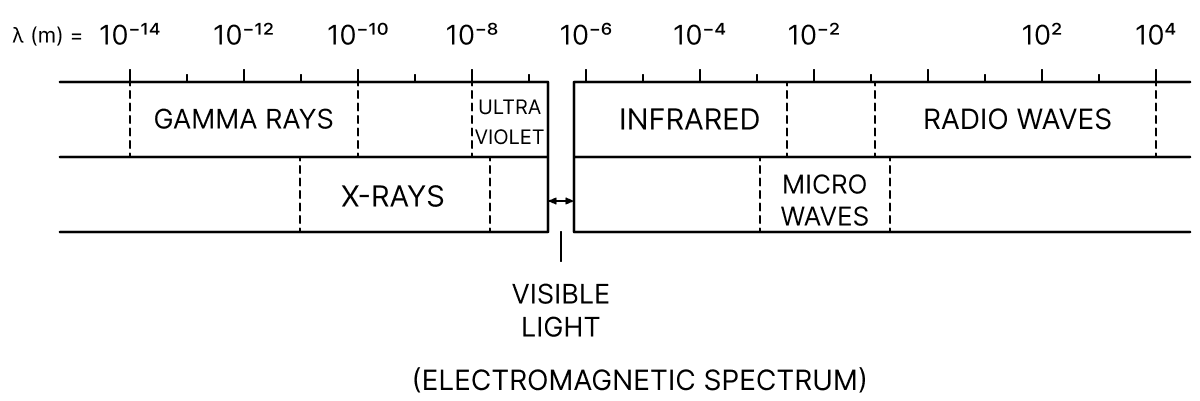
In order of increasing wavelength, the regions follow one another as : X-rays, ultraviolet (UV), visible light, infrared (IR), microwaves. UV lies just below the violet end and IR just beyond the red end of the visible spectrum (4 × 10⁻⁷ m to 7 × 10⁻⁷ m).
Approximate wavelengths :
- Ultraviolet : 6 × 10⁻¹⁰ m to 4 × 10⁻⁷ m
- Infrared : 8 × 10⁻⁷ m to 5 × 10⁻³ m
Name the waves used in radar. Give order of their wavelength. Explain why these particular waves are used in radar.
Answer
Microwaves are used in radar. Their wavelength is of the order of 10-2 m (range 10-3 m to 3 × 10⁻¹ m).
Because of their short wavelength, microwaves are not appreciably diffracted by obstacles of normal dimensions, so they can be transmitted as a narrow 'beam' in a particular direction. They are also reflected by objects such as aircraft, and the reflected beam locates the object. Hence microwaves are used in radar.
Name the part of the electromagnetic spectrum which is :
(i) suitable for radar systems used in aircraft navigation.
(ii) produced by bombarding a metal target with high speed electrons.
Answer
(i) Microwaves.
(ii) X-rays.
Explanation:
(i) Microwaves travel as a narrow beam and are reflected by aircraft, so they are used in the radar systems of aircraft navigation.
(ii) X-rays are produced by the sudden deceleration of high-speed electrons when they strike a metal target of high atomic number.
Name two electromagnetic waves relevant in radio transmission and communication. What is the difference between them?
Answer
Radio waves and microwaves. They differ as follows :
| Radio waves | Microwaves |
|---|---|
| Wavelength range 10-1 m to 104 m | Wavelength range 10-3 m to 3 × 10⁻¹ m |
| Frequency range 3 × 10⁴ Hz to 3 × 10⁹ Hz | Frequency range 109 Hz to 3 × 10¹¹ Hz |
| Used in radio and T.V. communication systems | Used in long-distance wireless communication via satellites and in radar |
Induced electric fields due to changing magnetic fields are more readily observed than the induced magnetic fields due to changing electric fields. Why?
Answer
The electric field induced by a changing magnetic field shows itself as an induced emf, which can easily be made large by taking a coil of a large number of turns and moving it rapidly in a magnetic field. Hence it is readily observed.
The magnetic field induced by a changing electric field is due to the displacement current, . Since ε0 is very small (8.85 × 10⁻¹² C2 N-1 m-2), this current, and hence the induced magnetic field, is too small to be observed at moderate frequencies.
State the regions of the electromagnetic spectrum to which the following belong :
(i) 21 cm wavelength, (ii) 1057 MHz frequency, (iii) 2.7 K temperature, (iv) 5890 Å wavelength, (v) 14.4 keV energy.
Answer
Given,
- c = 3 × 10⁸ m s-1, h = 6.62 × 10⁻³⁴ J s
- Wien's displacement law : λmT = 0.29 cm K
(i) 21 cm wavelength :
λ = 21 cm = 0.21 m lies at the short-wavelength end of radio waves (10-1 m to 104 m). It belongs to short radio waves.
(ii) 1057 MHz frequency :
This also lies at the short-wavelength end of radio waves, so it belongs to short radio waves.
(iii) 2.7 K temperature :
This wavelength lies in the microwave region (10-3 m to 3 × 10⁻¹ m).
(iv) 5890 Å wavelength :
λ = 5890 Å = 5.89 × 10⁻⁷ m lies between 4 × 10⁻⁷ m and 7 × 10⁻⁷ m, so it belongs to visible light (yellow light of sodium).
(v) 14.4 keV energy :
E = 14.4 keV = 14.4 × 103 × 1.6 × 10-19 J. From ,
i.e., λ = 0.86 Å, which lies in the X-ray region.
Hence, (i) and (ii) belong to short radio waves, (iii) to microwaves, (iv) to visible light and (v) to X-rays.
State any two properties of microwaves.
Answer
(i) Microwaves can be reflected and polarised.
(ii) Owing to their short wavelength, microwaves are not appreciably diffracted by obstacles of ordinary size, so they can be sent as a narrow beam in a particular direction.
Analyse the given figure and mention the electromagnetic wave produced here. Write its frequency range.

Answer
Ultraviolet radiation; frequency range about 7 × 10¹⁴ Hz to 5 × 10¹⁷ Hz.
Explanation:
The figure shows a welder joining a metal pipe with a welding arc. The arc emits intense ultraviolet radiation along with visible light, which is why the welder wears a protective face shield. Ultraviolet radiation has wavelengths from 6 × 10⁻¹⁰ m to 4 × 10⁻⁷ m, i.e., frequencies from about 7 × 10¹⁴ Hz to 5 × 10¹⁷ Hz.
Note: The textbook answer quotes the narrower range 800 THz to 30 PHz (8 × 10¹⁴ Hz to 3 × 10¹⁶ Hz); the range given here is the one stated in the chapter for ultraviolet radiation.
Arrange all the seven types of electromagnetic radiations in increasing order of their frequencies. (You must begin with a radiation with lowest frequency and end with the one having the highest frequency.)
State how electric vector , magnetic vector and velocity vector are oriented in an electromagnetic wave.
Answer
Increasing order of frequency :
Radio waves, microwaves, infrared radiation, visible light, ultraviolet radiation, X-rays, gamma rays.
Orientation of , and :
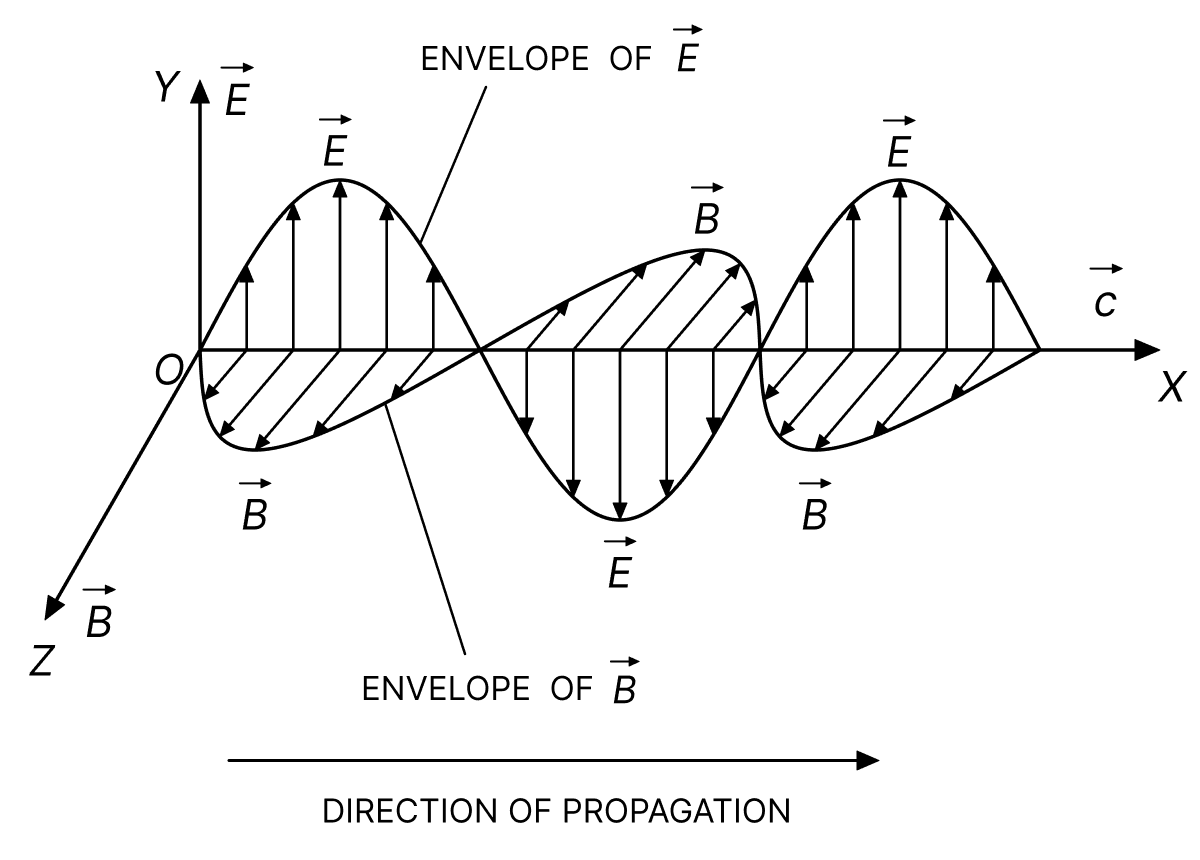
In an electromagnetic wave the electric vector , the magnetic vector and the velocity vector are mutually perpendicular to each other, and the wave travels in the direction of . For instance, if oscillates along the Y-axis and along the Z-axis, i.e., both in the Y-Z plane, the direction of propagation is along the X-axis.
Describe, with the help of a diagram, the electromagnetic spectrum from gamma rays to radio waves, showing approximate wavelength ranges.
Answer
The orderly distribution of electromagnetic radiations according to their wavelengths (or frequencies) is called the electromagnetic spectrum. It extends from very short gamma rays to very long radio waves, as shown below.
The approximate wavelength ranges of the different regions are :
| Region | Approximate wavelength range |
|---|---|
| Gamma rays | 10-14 m to 10-10 m |
| X-rays | 10-13 m to 3 × 10⁻⁸ m |
| Ultraviolet rays | 6 × 10⁻¹⁰ m to 4 × 10⁻⁷ m |
| Visible light | 4 × 10⁻⁷ m to 7 × 10⁻⁷ m |
| Infrared rays | 8 × 10⁻⁷ m to 5 × 10⁻³ m |
| Microwaves | 10-3 m to 3 × 10⁻¹ m |
| Radio waves | 10-1 m to 104 m |
All these radiations travel in free space with the same speed c = 3 × 10⁸ m s-1. Adjacent regions overlap, with no gaps in between, and the visible spectrum is only a very small part of the whole electromagnetic spectrum.
Describe very briefly any four regions of electromagnetic spectrum, mentioning their special properties/features.
Answer
(i) X-rays (10-13 m to 3 × 10⁻⁸ m) : They are produced by the sudden deceleration of high-speed electrons at a target of high atomic number. They are highly penetrating (though less than gamma rays) and affect photographic plates; they are used to detect fractures in bones and to study crystal structure.
(ii) Ultraviolet radiation (6 × 10⁻¹⁰ m to 4 × 10⁻⁷ m) : It is emitted by the sun, electric arcs and ionised gases. It produces photoelectric effect, is absorbed by atmospheric ozone and is harmful to the human body; it is used to sterilise surgical instruments and to detect forged documents and fingerprints.
(iii) Infrared radiation (8 × 10⁻⁷ m to 5 × 10⁻³ m) : It is emitted by hot bodies and arises from vibrational and rotational transitions in molecules. It has a strong heating effect ('heat rays') and penetrates fog; it is used in green houses, in weather forecasting through infrared photography and for treating muscular strain.
(iv) Microwaves (10-3 m to 3 × 10⁻¹ m) : They are produced by oscillating currents in special vacuum tubes such as the magnetron. They can be reflected and polarised and travel as a narrow beam; they are used in radar, in long-distance communication via satellites and in microwave ovens.
Electromagnetic spectrum is commonly classified as gamma rays, X-rays, UV-rays, visible light, IR-rays, etc. Mention very briefly two special features of any three of these, with respect to their production (source) and properties.
Answer
| Radiation | Production (source) | Properties |
|---|---|---|
| Gamma rays | Transitions of atomic nuclei (radioactive decay) and decay of certain elementary particles | Most penetrating of all; harmful to the human body |
| X-rays | Sudden deceleration of high-speed electrons at a high-atomic-number target, and electronic transitions among the innermost orbits of atoms | Highly penetrating (less than gamma rays); diffracted by crystals, as their wavelength is of the order of the interatomic spacing |
| Visible light | Radiated by excited atoms in gases and by incandescent bodies | Produces the sensation of sight; shows reflection, refraction, interference, diffraction and polarisation |
A student was performing an experiment to detect electromagnetic waves. Examiner gives certain instructions and asks some questions. State whether the responses of the student, in each of the following cases are correct or incorrect. Give a reason for your answer.
(i) EXAMINER : Electromagnetic waves can be polarised. This confirm to which nature of the wave?
STUDENT : Transverse nature of the wave.
(ii) EXAMINER : Which electromagnetic waves are also known as 'heat waves'?
STUDENT : Microwaves.
(iii) EXAMINER : Name the electromagnetic waves, used to study the crystal structure?
STUDENT : X-rays are used to study crystal structure.
Answer
(i) Correct. Only transverse waves can be polarised; a longitudinal wave such as sound cannot. Since electromagnetic waves can be polarised, their electric and magnetic fields vibrate perpendicular to the direction of propagation, i.e., they are transverse.
(ii) Incorrect. The 'heat waves' are infrared waves, not microwaves. Infrared radiation is emitted by hot bodies and raises the temperature of the objects on which it falls.
(iii) Correct. The wavelength of X-rays (about 10-10 m) is of the same order as the interatomic spacing in crystals. A crystal therefore diffracts X-rays, and the diffraction pattern reveals the arrangement of atoms, so X-rays are used to study crystal structure.