
Classically, the proposed circular path of an electron in the Rutherford's nuclear model of atom would be:
- circular
- parabolic
- spiral
- straight
Answer
spiral
Reason — An electron revolving in a circular orbit has a centripetal acceleration. According to classical electromagnetic theory, an accelerated charge radiates energy continuously, so the radius of the orbit would go on decreasing and the electron would spiral into the nucleus.
In hydrogen atom the minimum angular momentum of the electron in an energy state is:
- h / π
- h / 2π
- 2π / h
- 2h
Answer
h / 2π
Reason — By Bohr's quantisation condition, the angular momentum of the electron is
It is minimum for n = 1, so .
If l3 and l2 represent angular momenta of an orbiting electron in III and II Bohr orbits respectively, then l3 : l2 is:
- 3 : 2
- 9 : 4
- 2 : 3
- 4 : 9
Answer
3 : 2
Reason — Since , the angular momentum is proportional to n. Hence l3 : l2 = 3 : 2.
Which of the following parameters is same for all hydrogen-like atoms and ions in the same energy state?
- Radius of orbit
- Speed of electron
- Energy of electron
- Angular momentum of electron
Answer
Angular momentum of electron
Reason — The angular momentum depends only on the quantum number n, not on the atomic number Z. The radius (), the speed () and the energy () all depend on Z.
According to Bohr's model of the hydrogen atom, the radius of the stationary orbit characterised by the principal quantum number n is proportional to:
- n-1
- n
- n-2
- n2
Answer
n2
Reason — The radius of the nth orbit is
so r ∝ n2.
If the radius of second electron-orbit in hydrogen atom be r, then the radius of the third orbit will be:
- 3r
- 2.25 r
- 9r
- r / 3
Answer
2.25 r
Reason — Since r ∝ n2,
In Bohr's model of hydrogen atom, radius of the third orbit of an electron is r0. Then, radius of the first orbit is:
- 3r0
- 9r0
Answer
Reason — Since r ∝ n2,
The total energy of an electron in the ground state of hydrogen atom is:
- zero
- 13.6 eV
- −13.6 eV
- −13.6 J
Answer
−13.6 eV
Reason — The energy of the electron in the nth level of hydrogen atom is eV. For the ground state (n = 1), E1 = −13.6 eV. The negative sign shows that the electron is bound to the nucleus.
Total energy of an electron in the ground state of hydrogen atom is −13.6 eV. Its total energy, when hydrogen atom is in the second excited state, is:
- 13.6 eV
- 3.4 eV
- − 3.4 eV
- − 1.51 eV
Answer
− 1.51 eV
Reason — The second excited state is the level n = 3. Since ,
In which of the following transitions will the wavelength of emitted radiation be minimum?
- n = 5 to n = 4
- n = 4 to n = 3
- n = 3 to n = 2
- n = 2 to n = 1
Answer
n = 2 to n = 1
Reason — The wavelength of the emitted radiation is , so λ is minimum when the energy difference ΔE is maximum. The energy difference between two successive levels decreases as n increases, so it is largest for the transition n = 2 to n = 1 (10.2 eV).
Which of the following series is found partly in the visible region?
- Lyman
- Balmer
- Paschen
- Pfund
Answer
Balmer
Reason — The Balmer series (transitions ending on n = 2) has its lines Hα (6563 Å), Hβ (4861 Å), Hγ, ... in the visible region. The Lyman series lies in the ultraviolet region, and the Paschen and Pfund series in the infrared region.
If Ep and Ek represent potential energy and kinetic energy respectively, of an orbital electron, then according to Bohr's theory:
- Ek =
- Ek = −Ep
- Ek = −2Ep
- Ek = 2Ep
Answer
Ek =
Reason — For an electron in an orbit of radius r,
Hence .
Angular momentum of an electron orbiting in the 2nd Bohr orbit of a hydrogen atom is:
Answer
Reason — By Bohr's quantisation condition, . For the 2nd orbit, n = 2, so .
A hydrogen atom in ground state absorbs 12.09 eV of energy. The angular momentum of the electron increases by:
- remains same
Answer
Reason — After absorbing 12.09 eV, the energy of the electron becomes
which is the energy of the level n = 3 . The angular momentum therefore changes from to , an increase of .
The ratio of wavelength of the last line of Lyman series and that the last line of Balmer series is:
- 4
- 2
- 0.5
- 0.25
Answer
0.25
Reason — The last line of a series corresponds to n2 = ∞ (series limit).
Hence .
When an α particle of mass 'm' moving with velocity 'v' bombards on a gold nucleus, its distance of closest approach from the nucleus depends on 'm' as:
- m
Answer
Reason — At the distance of closest approach, the whole kinetic energy is converted into electrostatic potential energy,
Putting ,
For a given velocity v, r0 ∝ .
The ratio of kinetic energy to the total energy of an electron in a Bohr orbit of the hydrogen atom, is:
- 1 : −2
- 2 : −1
- 1 : −1
- 1 : 1
Answer
1 : −1
Reason — In a Bohr orbit, the total energy E = −K, where K is the kinetic energy. Hence K : E = 1 : −1.
An electron makes a transition from lower orbit showing energy E1 to higher orbit having energy E2 by absorbing a photon of radiation of wavelength 'λ' then:
λ =
λ =
λ =
λ =
Answer
λ =
Reason — The energy of the absorbed photon equals the difference of the energies of the two orbits,
In a hydrogen atom the electron makes a transition from (n + 1)th level to the nth level. If n >> 1, the frequency of radiation emitted is proportional to:
Answer
Reason — The frequency of the emitted radiation is
For n >> 1, , so ν ∝ .
In the spectrum of hydrogen, the ratio of the longest wavelength in the Lyman series to the longest wavelength in the Balmer series is:
Answer
Reason — The longest wavelength of a series corresponds to its first line.
If an electron in a hydrogen atom jumps from the 3rd orbit to the 2nd orbit, it emits a photon of wavelength λ. When it jumps from the 4th orbit to the 3rd orbit, the corresponding wavelength of the photon will be:
λ
λ
λ
λ
Answer
λ
Reason — Using ,
If the series limit frequency of the Lyman series is νL, then the series limit frequency of the Pfund series is:
25νL
16νL
Answer
Reason — The series limit (n2 = ∞) has frequency . For the Lyman series n1 = 1, so νL = Rc. For the Pfund series n1 = 5, so .
Which level of the single ionized carbon has the same energy as the ground state energy of hydrogen atom?
- 1
- 6
- 4
- 8
Answer
6
Reason — For a hydrogen-like ion, eV. For carbon, Z = 6. Equating this to the ground-state energy of hydrogen,
Note: Bohr's formula applies only to a one-electron (hydrogen-like) ion, so the carbon ion intended here is C5+ (Z = 6), not singly-ionised carbon. The printed key (b) holds on that reading.
Why was 'gold' foil used in α-particle scattering experiment?
Answer
Being heavy, the gold nucleus is able to turn an α-particle through a large deflection. Moreover, gold can be hammered out into extremely thin foils.
Why was 'extremely thin' foil used?
Answer
An extremely thin foil was used to ensure that each α-particle was deflected by a single collision (with one nucleus) while passing through the foil.
The Rutherford's α-particle experiment shows that most of the α-particles pass through almost unscattered while some of them are scattered through large angles. What information does it give about the structure of atom?
Answer
Most of the space inside the atom is hollow, and the whole positive charge of the atom is concentrated in a very small central region called the nucleus.
What is the significance of the 'distance of closest approach' of α-particles to atomic nuclei?
Answer
It gives an estimate of the size (radius) of the nucleus.
Explanation:
An α-particle cannot touch the nucleus because of the strong repulsion, so the distance of closest approach gives the upper limit of the nuclear radius.
For scattering of α-particles at large angles, only the nucleus of the atom is responsible, not the electron. Why?
Answer
An electron is very light compared to an α-particle. Hence, by the law of conservation of momentum, a collision with an electron can deflect the α-particle only slightly. Only the heavy nucleus can scatter it through large angles.
Is the probability of scattering of α-particles at angles greater than 90° predicted by Thomson's atomic model less, same or greater than that predicted by Rutherford's model?
Answer
Less.
Explanation:
In Thomson's model the positive charge is spread over the whole atom, so the repulsion on an α-particle is weak and it cannot be turned back. In Rutherford's model the positive charge is concentrated in a very small nucleus, so an α-particle passing close to it experiences a very strong repulsion and can be scattered through more than 90°.
Write the order of magnitude of the radius of nucleus.
Answer
10-15 m (1 fermi).
What is the order of the size of the atom?
Answer
10-10 m.
What is Bohr's quantisation condition for the angular momentum of an electron in the second orbit?
Answer
Explanation:
By Bohr's quantisation condition, . For the second orbit, n = 2.
What is Bohr's frequency condition?
Answer
Explanation:
When an electron jumps from a higher orbit of energy E2 to a lower orbit of energy E1, it emits a single photon whose frequency ν is given by hν = E2 − E1.
Use fine structure constant α to obtain electron speed v1 in the first orbit of hydrogen atom.
Answer
Given,
- Fine structure constant,
- Speed of light, c = 3.0 × 10⁸ m s-1
The speed of the electron in the nth orbit of hydrogen atom (Z = 1) is . For the first orbit (n = 1),
Hence, the speed of the electron in the first orbit is 2.19 × 10⁶ m s-1.
What is the ground-state energy of electron in the hydrogen atom? What for n = ∞ (ionised state)?
Answer
−13.6 eV; zero.
Explanation:
The energy of the electron in the nth level is eV. For n = 1 it is −13.6 eV, and for n = ∞ (ionised state) it becomes zero.
What are the first and the second excitation potentials of hydrogen atom?
Answer
10.2 V and 12.1 V.
Explanation:
The energies of the levels n = 1, 2 and 3 are −13.6 eV, −3.4 eV and −1.51 eV. The first excitation energy is −3.4 − (−13.6) = 10.2 eV and the second is −1.51 − (−13.6) = 12.09 ≈ 12.1 eV, so the first and the second excitation potentials are 10.2 V and 12.1 V.
What is the value of the ionisation potential of hydrogen atom? Ionisation energy?
Answer
Ionisation potential = 13.6 V; ionisation energy = 13.6 eV.
Explanation:
To ionise the atom, the electron must be taken from n = 1 (−13.6 eV) to n = ∞ (zero energy), which needs 13.6 eV. An electron accelerated through 13.6 V acquires this energy.
The ionisation potential for hydrogen atom is 13.6 V. Will it be more or less for helium?
Answer
More.
Explanation:
The helium nucleus has a charge +2e, so its electrons are bound more strongly than the electron of hydrogen. Its ionisation potential is 24.6 V.
The ionisation potential of helium atom is 24.6 V. How much energy is required to ionise helium atom?
Answer
24.6 eV.
Explanation:
The energy required is e × (ionisation potential) = 24.6 eV = 24.6 × 1.6 × 10-19 J ≈ 3.94 × 10⁻¹⁸ J.
Name the series in the hydrogen spectrum whose few lines lie in the visible region.
Answer
Balmer series.
Name a series of hydrogen spectrum which is obtained in infrared region. Write the general formula expressing the wavelength of the series.
Answer
Paschen series. The wavelengths of its lines are given by
where R is Rydberg's constant and n = 4, 5, 6, ....
Write the unit of Rydberg's constant.
Answer
m-1 (metre-1).
Explanation:
In , the bracket is a pure number, so R has the unit of .
In a sample of hydrogen gas, most of its atoms are in the energy level n = 1. On passing visible light through this gas, some spectral lines are absorbed. Lines of which series (Lyman or Balmer) are absorbed maximum and why?
Answer
Lines of the Lyman series are absorbed maximum. Absorption transitions start from the level in which the atoms are present, and since most of the atoms are in the level n = 1, most of the absorption transitions start from n = 1, which gives the Lyman series.
Note: Lyman lines lie in the ultraviolet region, so they can be absorbed only if the light passed contains these wavelengths; the question presumably means white light rather than visible light alone.
Only certain definite lines are found in the atomic spectrum of substances, why?
Answer
An atom has only certain definite energy-states. Radiation is emitted only when the atom passes from one of these states to a lower one, with frequency . Hence only certain definite frequencies are emitted, and the spectrum consists of definite lines.
The radius of the first electron-orbit in hydrogen atom is r0. What will be the radius of the second orbit? What of the second orbit of singly-ionised helium atom?
Answer
Second orbit of hydrogen: 4r0; second orbit of singly-ionised helium: 2r0.
Explanation:
From , r ∝ . For hydrogen (Z = 1) with n = 2, r = 4r0. For He+ (Z = 2) with n = 2, .
The electron energy in the first orbit of hydrogen atom is −E0. What will it be in singly-ionised helium atom?
Answer
−4E0.
Explanation:
From , E ∝ Z2 for the same n. For He+, Z = 2, so the energy in the first orbit is 22 × (−E0) = −4E0.
The wavelengths of some of the spectral lines obtained in hydrogen spectrum are given below. Select out the wavelengths corresponding to (i) Lyman series, (ii) Paschen series.
6563 Å, 1216 Å, 9546 Å, 4861 Å and 1026 Å.
Answer
(i) Lyman series: 1216 Å and 1026 Å
(ii) Paschen series: 9546 Å
Explanation:
The Lyman series lies in the ultraviolet region, between 1216 Å (longest) and 912 Å (series limit). The lines 6563 Å and 4861 Å are the Hα and Hβ lines of the Balmer series (visible). The line 9546 Å lies in the infrared region and belongs to the Paschen series.
Energies of the first three energy-levels of hydrogen atom are −13.6, −3.4 and −1.5 eV respectively. What should be the limits of energy of the electrons striking (and exciting) hydrogen atoms so that only one line is obtained in the hydrogen spectrum?
Answer
At least 10.2 eV but less than 12.1 eV.
Explanation:
For only one line, the atom must be excited to n = 2 and not beyond, so that only the transition 2 → 1 occurs. Excitation to n = 2 needs −3.4 − (−13.6) = 10.2 eV, and excitation to n = 3 needs −1.5 − (−13.6) = 12.1 eV. Hence the energy of the striking electrons must lie between these limits.
What should be the minimum energy of an electron exciting the hydrogen atom so that three spectral lines are observed in the hydrogen spectrum?
Answer
12.1 eV.
Explanation:
Three lines are obtained when the atom is excited to n = 3, giving the transitions 3 → 2, 3 → 1 and 2 → 1. The energy required is −1.5 − (−13.6) = 12.1 eV.
What conclusion is drawn from Rutherford's scattering experiment of α-particles?
Answer
The whole of the positive charge and almost the entire mass of an atom are concentrated in an extremely small central core, called the nucleus. The rest of the atom, around the nucleus, is mostly hollow, and the electrons move in this space.
What is the difference between Rutherford's model and Bohr's model of an atom?
Answer
| Rutherford's model | Bohr's model |
|---|---|
| Electrons can revolve around the nucleus in orbits of any radius. | Electrons can revolve only in certain orbits of definite radii, for which . |
| The revolving electrons radiate energy continuously, so the atom is not stable. | Electrons do not radiate while in the stationary orbits, so the atom is stable. |
| Electrons radiate waves of all frequencies, so the spectrum would be continuous. | Electrons emit waves of certain definite frequencies only, on jumping from one orbit to another, so a line spectrum is obtained. |
State any two Bohr's postulates and write the energy value of the ground state of the hydrogen atom.
Answer
Postulate 1 (stationary orbits) : The electrons revolve around the nucleus only in those circular orbits for which the angular momentum is an integral multiple of ,
While revolving in these orbits, the electrons do not radiate energy.
Postulate 2 (frequency condition) : When an electron jumps from a higher orbit of energy E2 to a lower orbit of energy E1, it emits a photon of frequency ν given by
Energy of the ground state : The energy of the ground state of the hydrogen atom is −13.6 eV.
What is meant by excitation potential and ionisation potential?
Answer
Excitation potential : The minimum accelerating potential required to energise an electron which, on colliding with an atom, can excite it, is called the excitation potential of that atom. For hydrogen, the first excitation potential is 10.2 V.
Ionisation potential : The minimum accelerating potential required to energise an electron which, on collision, can ionise an atom, is called the ionisation potential of that atom. For hydrogen, it is 13.6 V.
Write down the names of the spectral series of hydrogen atom.
Answer
The spectral series of the hydrogen atom are:
(i) Lyman series (ultraviolet region)
(ii) Balmer series (visible region)
(iii) Paschen series (infrared region)
(iv) Brackett series (infrared region)
(v) Pfund series (infrared region)
Lyman series of hydrogen is available both in emission and absorption, but Balmer series is available only in emission, not in absorption. Give reason.
Answer
At ordinary temperatures almost all the hydrogen atoms are in their lowest energy level (n = 1). Absorption transitions can start only from a level in which the atoms are present, so they start from n = 1 and give only the Lyman series.
The Balmer absorption lines would require transitions starting from n = 2, but practically no atoms are in this level at ordinary temperatures. In emission, however, excited electrons return from higher levels to n = 2 also, so the Balmer series appears in the emission spectrum.
Is it essential that all the lines available in emission spectrum should be available in absorption spectrum also? Give reason.
Answer
No. In excited atoms, emission transitions may begin at any higher level and end at any lower level, but in normal atoms almost all the absorption transitions begin from the level n = 1. Hence the absorption spectrum has far fewer lines; for hydrogen at ordinary temperatures, only the Lyman lines appear in absorption.
How can the elements be identified by the study of line spectrum?
Answer
Each element has its own set of definite energy levels, and no other element has the same set. Hence the spectrum emitted by the atoms of an element consists of lines of certain definite wavelengths which are characteristic of that element. By measuring the wavelengths of the spectral lines and comparing them with the known spectra, the element can be identified.
The distance of closest approach r0 depends upon the charge of the nucleus but not upon its mass, why?
Answer
At the distance of closest approach r0, the whole kinetic energy K of the α-particle is converted into the electrostatic potential energy of the system,
This depends only on the charge Ze of the nucleus (for a given K). The mass of the nucleus does not appear, because the gravitational potential energy between the α-particle and the nucleus is insignificant compared to the electrostatic potential energy.
An α-particle passing through a potential difference of V volt strikes a nucleus. Prove that if the atomic number be Z, then the distance of the closest approach of the particle to the nucleus will be Å.
Answer
Given,
- Charge on the α-particle, q = 2e
- Accelerating potential difference = V volt
- Charge on the nucleus = Ze
The kinetic energy acquired by the α-particle on passing through V volt is
At the distance of closest approach r0, this kinetic energy is wholly converted into electrostatic potential energy,
Substituting = 9.0 × 10⁹ N m2 C-2 and e = 1.6 × 10⁻¹⁹ C,
Hence, the distance of closest approach is Å.
Why is motion of planets around the sun not governed by Bohr's postulate of quantisation of angular momentum ?
Answer
The angular momentum of a planet in its orbit is enormously large compared to , so in it corresponds to an extremely large value of n. At such large quantum numbers the allowed orbits and energies are so close together that they are practically continuous, and quantum physics passes over into classical physics. Hence the quantisation of angular momentum has no observable effect on planetary motion.
Using Bohr's formula for energy quantisation, find:
(i) the excitation energy of n = 3 level of He+ ion and
(ii) the ionisation potential of the ground state of Li++ ion.
Answer
Given,
- Bohr's formula, eV
- For He+, Z = 2; for Li++, Z = 3
(i) Excitation energy of n = 3 level of He+ :
The excitation energy is the energy required to take the electron from n = 1 to n = 3,
(ii) Ionisation potential of the ground state of Li++ :
The ionisation energy is the energy required to take the electron from n = 1 to n = ∞,
Hence, (i) the excitation energy of the n = 3 level of He+ is 48.4 eV, and (ii) the ionisation potential of the ground state of Li++ is 122.4 V.
Hydrogen atom has only one electron but its emission spectrum has many lines. Explain with reason.
Answer
An atom can exist only in certain definite energy-states. Normally the electron of the hydrogen atom stays in the lowest energy level. On receiving appropriate energy from outside, the electron is raised to some higher level; the atom is then said to be excited. Within about 10-8 s it leaves this level and returns to the lowest level, either directly or after passing through other lower levels, emitting a photon in each transition.
A light source (hydrogen lamp) contains an enormous number of atoms, excited to different levels and returning by different routes. Hence all the possible transitions take place in the source together, and many lines are seen in the spectrum.
The electron in an hydrogen atom is in the third excited state (n = 4 level). What is the maximum number of photons that may be emitted in passing of the electron to the ground state? What is minimum number?
Answer
Maximum number = 3; minimum number = 1.
Explanation:
The maximum number of photons is emitted when the electron comes down one level at a time, 4 → 3, 3 → 2 and 2 → 1, giving three photons. The minimum is one photon, emitted in the direct transition 4 → 1.
If hydrogen atoms are excited to the 4th energy-level, how many different wavelengths are possible for the emitted radiation?
Answer
Explanation:
Between n energy levels, the number of possible emission transitions is
namely 4 → 3, 4 → 2, 4 → 1, 3 → 2, 3 → 1 and 2 → 1, each giving a different wavelength.
Describe briefly Rutherford's experiment on the scattering of α-particles by a nucleus. What conclusions do follow from this experiment about the structure of atom?
Answer
Experiment : Geiger and Marsden, under Rutherford, directed a narrow beam of high-energy α-particles from a radioactive source (polonium) on to a very thin gold foil. The whole arrangement was kept in vacuum, so that the α-particles did not collide with air molecules. The α-particles scattered in different directions by the foil were counted by a scintillation counter, which could be turned round the foil to measure the number scattered at different angles θ.
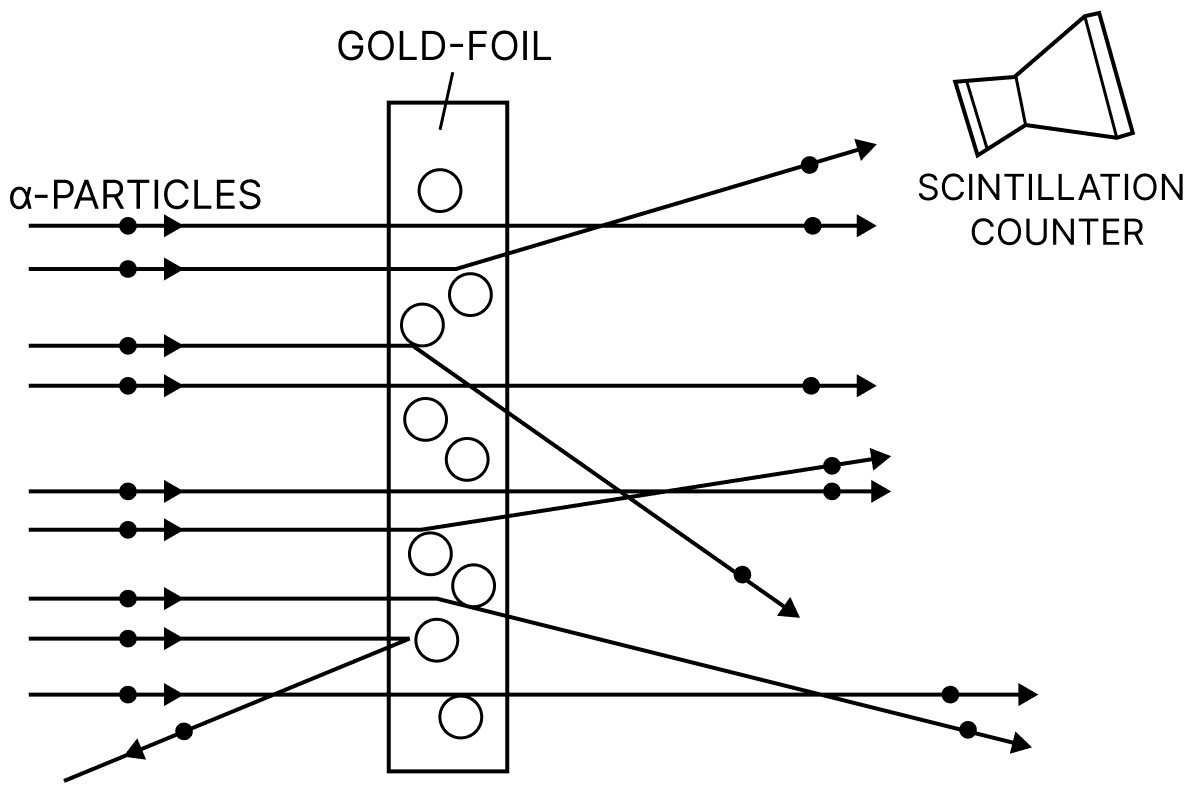
Observations : Most of the α-particles passed through the foil almost undeflected (θ ≈ 1° or less). A few were deflected through large angles, and a very small number (about 1 in 20000) were scattered through more than 90°, some coming almost straight back.
Conclusions :
(i) Since most α-particles pass straight through, the atom is mostly hollow.
(ii) Since a few α-particles are turned back by a very strong repulsion, the whole positive charge of the atom, together with almost its entire mass, must be concentrated in an extremely small central region called the nucleus. Its radius is of the order of 10-15 m, while that of the atom is of the order of 10-10 m.
(iii) The electrons are present in the empty space around the nucleus, and the scattering agrees with Coulomb's law, so Coulomb's law holds even at such small distances.
On the basis of α-particle scattering experiment, obtain an expression for the upper limit of the radius of the scattering nuclei in terms of the atomic number Z and the energy K of the incident α-particles.
Answer
Let an α-particle (charge 2e) of kinetic energy K move head-on towards a nucleus of charge Ze. As it approaches, its kinetic energy is converted into electrostatic potential energy. At the distance of closest approach r0, it momentarily stops, so the whole of K has become potential energy,
Because of the strong repulsion, the α-particle cannot touch the periphery of the nucleus, so the radius R of the nucleus must be less than r0.
Hence, the upper limit of the radius of the scattering nucleus is .
Describe Rutherford's model of an atom, stating its main features. Discuss two major shortcomings of the model.
Answer
Rutherford's model : On the basis of the α-particle scattering experiment, Rutherford proposed the following model.
(i) The whole positive charge and almost the entire mass of the atom are concentrated at its centre in a nucleus of radius about 10-15 m.
(ii) The electrons are distributed around the nucleus in a hollow sphere of radius about 10-10 m. The total negative charge of the electrons equals the positive charge of the nucleus, so the atom as a whole is electrically neutral.
(iii) The electrons are not stationary but revolve around the nucleus in different orbits; the electrostatic force of attraction exerted by the nucleus on the electrons supplies the centripetal force needed for this motion.
Shortcomings :
(i) Stability of the atom : A revolving electron has a centripetal acceleration and, according to electrodynamics, an accelerated charged particle radiates energy. The electron would therefore lose energy continuously, the radius of its orbit would keep decreasing, and it would finally fall into the nucleus. Thus the atom could not remain stable.
(ii) Line spectrum : As the radius of the orbit changes continuously, the frequency of revolution also changes continuously, so the electron would radiate waves of all frequencies and the spectrum would be continuous. Experimentally, however, atomic spectra consist of sharp lines of definite frequencies.
Explain how Rutherford's model of atom failed to explain the existence of sharp lines in the hydrogen spectrum. How was this difficulty removed by Bohr?
Answer
Failure of Rutherford's model : In Rutherford's model, the revolving electron radiates energy continuously, so the radius of its orbit and hence its frequency of revolution change continuously. The electron would therefore radiate waves of all frequencies, and the spectrum of hydrogen would be continuous. Experimentally, however, the hydrogen spectrum consists of sharp lines, each of a definite frequency.
Bohr's explanation : Bohr removed this difficulty by applying the quantum theory.
(i) The electron can revolve only in certain stationary orbits, for which , and while in these orbits it does not radiate. Each such orbit has a definite energy.
(ii) Radiation is emitted only when the electron jumps from a higher orbit of energy E2 to a lower orbit of energy E1, as a single photon of frequency
Since the energy levels are discrete, only certain definite frequencies can be emitted, and hence the hydrogen spectrum consists of sharp lines.
On the basis of Bohr's theory, derive the expression for the radius of the nth orbit of an electron of hydrogen atom.
Answer
Let an electron of mass m and charge e revolve with speed v in an orbit of radius r around the nucleus of hydrogen atom (charge +e). The necessary centripetal force is provided by the electrostatic force of attraction,
By Bohr's quantisation condition, the angular momentum of the electron is
where n = 1, 2, 3, ... is the principal quantum number. Squaring Eq. (ii),
Dividing Eq. (iii) by Eq. (i),
Thus r ∝ n2, and the radii of the permitted orbits increase in the ratio 1 : 4 : 9 : 16 : .... For n = 1, Å (Bohr's radius), so rn = 0.53 n2 Å.
Hence, the radius of the nth orbit of hydrogen atom is .
State Bohr's postulates. Using them, derive an expression for the stationary energy levels of electron in the hydrogen atom. What does the negative value of this energy signify?
Answer
Bohr's postulates :
(i) The electrons revolve around the nucleus only in certain circular orbits, called stationary orbits; the necessary centripetal force is provided by the electrostatic attraction between the nucleus and the electron.
(ii) In a stationary orbit, the angular momentum of the electron is an integral multiple of , that is, , and while revolving in such an orbit the electron does not radiate energy.
(iii) When an electron jumps from a higher orbit of energy E2 to a lower orbit of energy E1, it emits a photon of frequency ν given by hν = E2 − E1.
Energy levels : For an electron of mass m and speed v in an orbit of radius r around the hydrogen nucleus (charge +e),
Squaring Eq. (ii) and dividing by Eq. (i) gives the radius of the nth orbit,
From Eq. (i), the kinetic energy of the electron is
and its electrostatic potential energy is
The total energy is therefore
Putting the value of r from Eq. (iii),
where n = 1, 2, 3, .... Putting the values of the constants, eV.
Significance of the negative sign : The negative total energy shows that the electron is bound to the nucleus. Energy has to be supplied to it to make it free, that is, to raise its total energy to zero (n = ∞).
Obtain an expression for the kinetic energy of electron in the Bohr model of hydrogen atom (Z = 1). Start from equating the electrostatic force with the centripetal force required and then use the quantisation condition for angular momentum.
Answer
Let an electron of mass m and charge e revolve with speed v in an orbit of radius r around the nucleus of hydrogen atom (Z = 1). Equating the electrostatic force to the required centripetal force,
so that
By Bohr's quantisation condition for angular momentum,
Putting r from Eq. (ii) in Eq. (iii),
The kinetic energy of the electron is therefore
Hence, the kinetic energy of the electron in the nth orbit is , which equals eV.
Draw energy-level diagram for the hydrogen atom. Show transitions corresponding to (i) Lyman and (ii) Balmer series. In which regions of the spectrum do these series lie?
Answer
The energy of the electron in the nth level of hydrogen atom is eV, which gives
| n | 1 | 2 | 3 | 4 | 5 | ∞ |
|---|---|---|---|---|---|---|
| En (eV) | −13.6 | −3.4 | −1.51 | −0.85 | −0.54 | 0 |
These levels are drawn as horizontal lines, and the transitions as downward arrows.
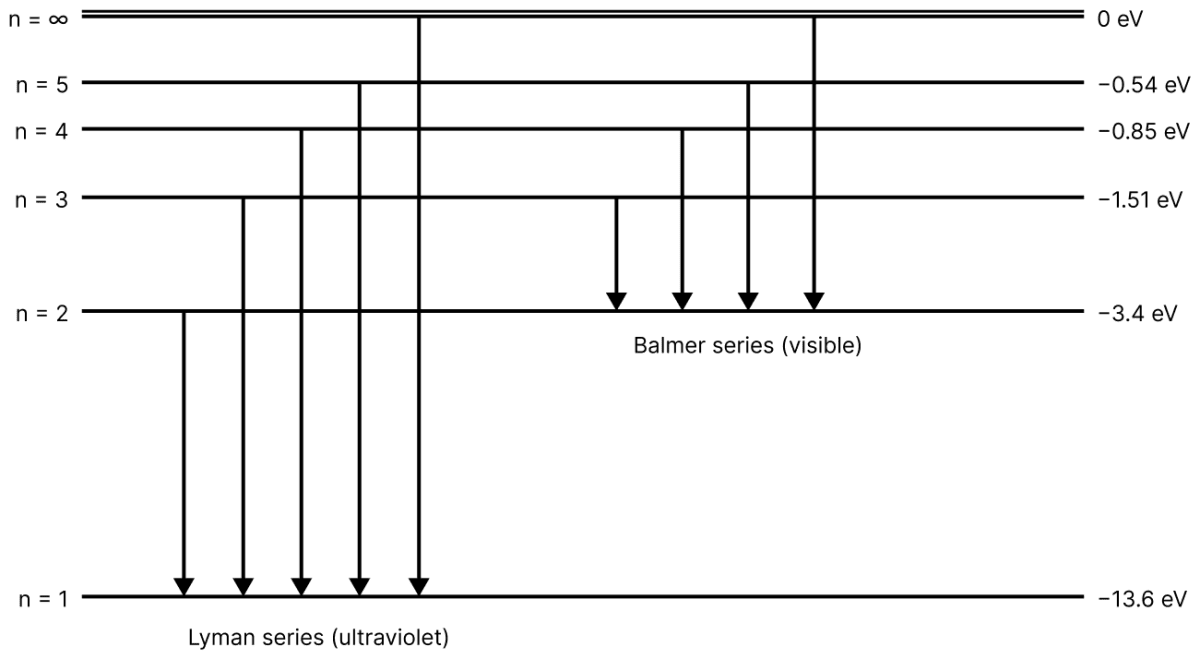
(i) Lyman series : The transitions from the higher levels n = 2, 3, 4, ... to the lowest level n = 1. These lines lie in the ultraviolet region of the spectrum.
(ii) Balmer series : The transitions from the higher levels n = 3, 4, 5, ... to the second level n = 2. These lines lie in the visible region of the spectrum.
For Bohr's model of the hydrogen atom, the energy of the electron in its ground state is found to be −13.6 eV. (i) Draw an energy level diagram for the hydrogen atom and mark the values of energy (in eV) at n = 1 to n = ∞. (ii) Obtain the maximum energy of a photon emitted by the hydrogen atom in eV.
Answer
(i) Energy level diagram :
The energy of the nth level is eV. Hence,
| n | 1 | 2 | 3 | 4 | 5 | 6 | ∞ |
|---|---|---|---|---|---|---|---|
| En (eV) | −13.6 | −3.4 | −1.51 | −0.85 | −0.54 | −0.38 | 0 |
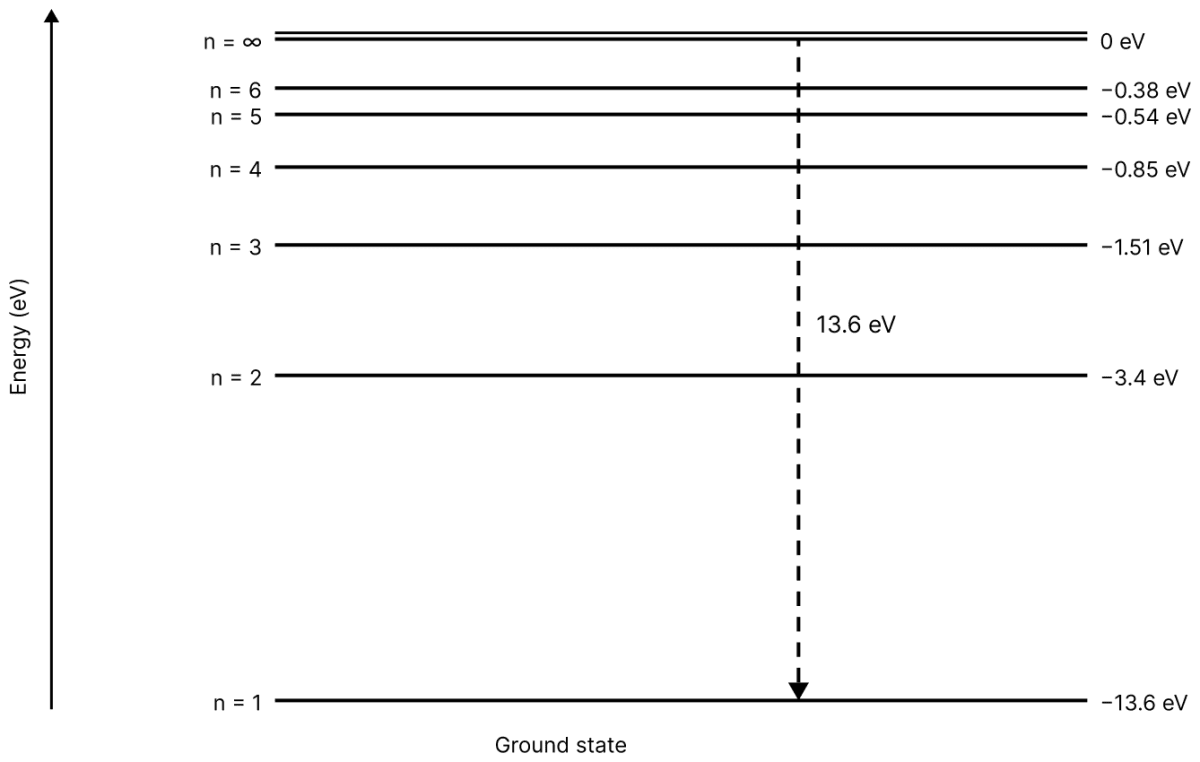
(ii) Maximum energy of the emitted photon :
The energy of the emitted photon is largest for the transition from n = ∞ to n = 1,
Hence, the maximum energy of a photon emitted by the hydrogen atom is 13.6 eV.
In the following questions, a student is involved and performing certain assigned task related with physics. The examiner gives the requisite instructions and asks some questions to the student. State whether the responses of the student, in each case, are correct or incorrect. Give a reason for your answer.
A student is studying Neils Bohr's atomic model.
(i) EXAMINER: State, how Bohr provided stability to unstable Rutherford's atom?
STUDENT: Bohr provided stability to Rutherford's atom through his very first postulate of stationary states.
(ii) EXAMINER: Asks student to write minimum value of angular momentum of electron in hydrogen atom.
STUDENT: Says it is , where h is Planck's constant.
(iii) EXAMINER: What is the frequency condition of Bohr's Model?
STUDENT: Electrons radiate energy, only when they jump from a permitted higher energy orbit to a lower energy orbit.
E2 − E1 = hν
Answer
(i) Correct. According to Bohr's first postulate, the electrons revolve around the nucleus only in certain stationary orbits, and while revolving in these orbits they do not radiate energy. Hence the atom does not collapse, which gives stability to Rutherford's atom.
(ii) Incorrect. The angular momentum of the electron is . It is minimum for n = 1, so , not .
(iii) Correct. In a stationary orbit the electron does not radiate. It emits energy only when it jumps from a permitted higher energy orbit E2 to a lower energy orbit E1, as a photon of frequency ν given by E2 − E1 = hν.
In the following questions, a student is involved and performing certain assigned task related with physics. The examiner gives the requisite instructions and asks some questions to the student. State whether the responses of the student, in each case, are correct or incorrect. Give a reason for your answer.
A student is studying the spectrum of hydrogen atom.
(i) EXAMINER: Identify the part of spectrum which belongs to visible part of electromagnetic spectrum.
STUDENT: Says it is Lyman band.
(ii) EXAMINER: Find energy range of photons absorbed for the formation of Lyman series of absorption spectrum.
STUDENT: 10.2 eV to 13.6 eV.
(iii) EXAMINER: Instructs student to find the transition which produces Hα line of emission spectrum.
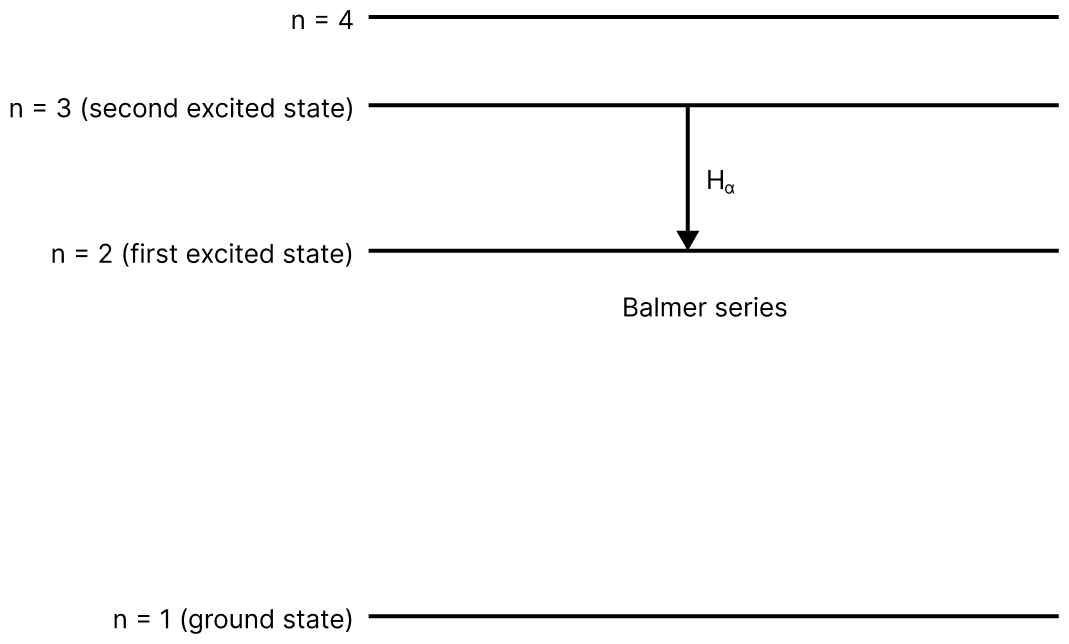
STUDENT: Says when electron moves from second excited state to first excited state, Hα line is emitted.
Answer
(i) Incorrect. The Lyman series lies in the ultraviolet region. The series of the hydrogen spectrum which lies in the visible region is the Balmer series.
(ii) Correct. Lyman absorption transitions start from n = 1. The smallest energy absorbed is for n = 1 to n = 2,
and the largest is for n = 1 to n = ∞, which is 13.6 eV. Hence the photons absorbed range from 10.2 eV to 13.6 eV.
(iii) Correct. The Hα line is the first line of the Balmer series, emitted in the transition n = 3 → n = 2. The level n = 3 is the second excited state and n = 2 is the first excited state.
State Bohr's postulates in connection with structure of atom and derive the relation En = where En is energy in the nth level, R is Rydberg constant, c is speed of light and n is integer.
Answer
Bohr's postulates :
(i) The positive charge of the atom is concentrated in the nucleus, and the electrons revolve around it only in certain circular orbits, called stationary orbits. The necessary centripetal force is provided by the electrostatic attraction between the nucleus and the electron.
(ii) In a stationary orbit, the angular momentum of the electron is an integral multiple of ,
where n = 1, 2, 3, ... is the principal quantum number. While revolving in these orbits the electrons do not radiate energy.
(iii) When an electron jumps from a higher orbit of energy E2 to a lower orbit of energy E1, it emits a single photon of frequency ν given by hν = E2 − E1.
Derivation : Let an electron of mass m and charge e revolve with speed v in an orbit of radius r around the hydrogen nucleus (charge +e). The electrostatic attraction provides the centripetal force,
By the second postulate,
Squaring Eq. (ii) and dividing by Eq. (i),
Energy : From Eq. (i), the kinetic energy is
and the potential energy is
Hence the total energy is
Putting the value of r from Eq. (iii),
Multiplying and dividing Eq. (iv) by ch,
The quantity is a constant, called Rydberg's constant R (= 1.097 × 10⁷ m-1). Therefore,
Hence, the energy of the electron in the nth level is , where n = 1, 2, 3, ....
Describe Rutherford's α-scattering experiment and obtain an expression for closest approach.
Answer
Rutherford's α-scattering experiment :
Geiger and Marsden, under Rutherford, allowed a narrow beam of high-energy α-particles from a radioactive source (polonium) to fall on a very thin gold foil. The whole apparatus was kept in vacuum. The α-particles scattered by the foil through different angles θ were counted by a scintillation counter that could be rotated around the foil.
Observations :
(i) Most of the α-particles passed through the foil almost undeflected.
(ii) A few were deflected through large angles, and a very small number (about 1 in 20000) were scattered through more than 90°, some returning almost along their own path.
Conclusions :
(i) The atom is mostly hollow.
(ii) The whole positive charge and almost the entire mass of the atom are concentrated in an extremely small central region, the nucleus, of radius of the order of 10-15 m.
(iii) The electrons occupy the empty space around the nucleus, and Coulomb's law holds even at nuclear distances.
Distance of closest approach :
Consider an α-particle (charge 2e) of initial kinetic energy K moving head-on towards a nucleus of charge Ze. As it approaches the nucleus, the electrostatic repulsion slows it down and its kinetic energy is converted into electrostatic potential energy. At a distance r0 from the nucleus, the whole kinetic energy has been converted, the particle stops momentarily and then returns along its own path (scattering through 180°).
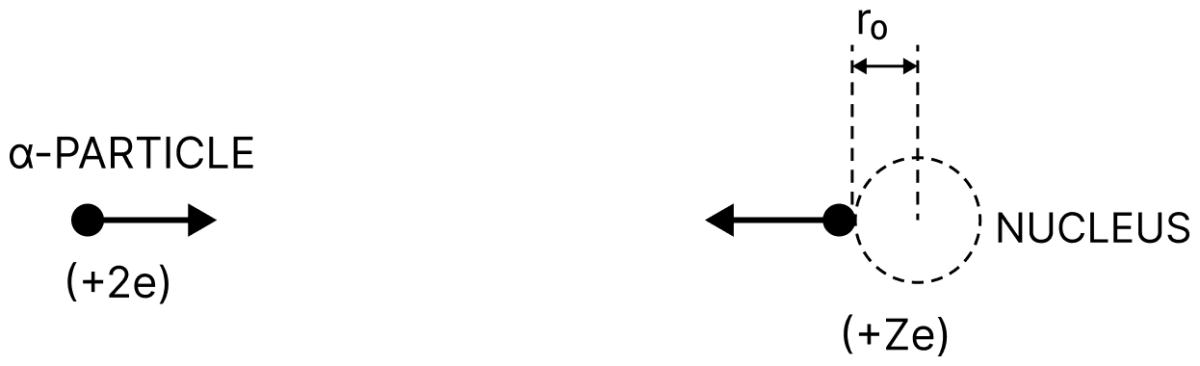
At this point, the electrostatic potential energy of the system is
Equating U to the initial kinetic energy K,
Since the α-particle cannot touch the nucleus, r0 gives the upper limit of the radius of the nucleus.
Hence, the distance of closest approach is .
Write Bohr's first postulate for angular momentum of an electron in any orbit and obtain the relation rm = where symbols stands for usual meanings.
Answer
Bohr's first postulate (angular momentum) : The electron revolves around the nucleus only in those circular orbits for which its angular momentum is an integral multiple of ,
where n = 1, 2, 3, ... is the principal quantum number. While revolving in these orbits, the electron does not radiate energy.
Derivation : Let an electron of mass m and charge e revolve with speed v in an orbit of radius r around a nucleus of charge Ze (Z = atomic number). The electrostatic force of attraction provides the centripetal force,
From the postulate,
Squaring Eq. (ii),
Dividing Eq. (iii) by Eq. (i),
Here m is the mass of the electron, e the electronic charge, Z the atomic number, h Planck's constant, ε0 the permittivity of free space and n the principal quantum number.
Hence, the radius of the nth permitted orbit is ; for hydrogen (Z = 1) and n = 1 this gives Bohr's radius, 0.53 Å.
Write unit of Rydberg constant and derive the relation for wave number (1/λ), and write the symbols stands for.
Answer
Unit of Rydberg constant : m-1.
Derivation : Consider an electron of mass m and charge e revolving with speed v in an orbit of radius r around a nucleus of charge Ze. From the condition for circular motion and Bohr's quantisation condition,
Squaring Eq. (ii) and dividing by Eq. (i),
The kinetic energy is and the potential energy is , so the total energy is
Putting r from Eq. (iii),
When the electron jumps from a higher level n2 to a lower level n1, the energy difference is
By Bohr's frequency condition, the frequency of the emitted photon is
Since ,
Writing ,
Symbols :
- = wave number of the emitted radiation, λ being its wavelength
- Z = atomic number of the hydrogen-like atom (Z = 1 for hydrogen)
- R = Rydberg's constant = = 1.097 × 10⁷ m-1
- n1 = quantum number of the lower level and n2 = quantum number of the higher level (n2 > n1)
- m = mass of electron, e = electronic charge, ε0 = permittivity of free space, h = Planck's constant, c = speed of light
Hence, .
Read the passage(s) and answer the following questions:
Hydrogen is the simplest atom of nature. According to Neils Bohr, the electron revolves in a stationary orbit around the nucleus. While revolving in this orbit electron does not emit electromagnetic radiation. The angular momentum of the electron is quantized. When transition of an electron takes place from higher energy level n2 to lower energy level n1, the energy is emitted in the form of a photon. Wavelength of this emitted photon is given by , where R is Rydberg's constant. Now, suppose on a different planet, the hydrogen atom's structure is some what different from ours and there the angular momentum of electron is .
(i) If L3 and L2 represent angular momenta of an orbiting electron in III and II Bohr orbit respectively, then find the ratio .
(ii) What is the value of total energy of an electron in the ground state of hydrogen atom?
(iii) Which series of hydrogen spectrum lies in visible region?
(iv) What is the series limit of Lyman series? Give your answer in terms of Rydberg constant R.
(v) On our planet, the ionisation potential energy of hydrogen atom is 13.6 eV. On the other planet (as mentioned in the given passage). What will be the value of ionisation energy?
Answer
(i) Ratio :
On the other planet, , so L ∝ n. Hence,
(The same ratio is obtained with on our planet.)
(ii) Total energy in the ground state :
In the ground state (n = 1), E = −13.6 eV.
(iii) Series in the visible region :
The Balmer series lies in the visible region.
(iv) Series limit of Lyman series :
For the Lyman series,
For the series limit, n = ∞,
(v) Ionisation energy on the other planet :
On our planet, gives eV, so the ionisation energy is +13.6 eV.
On the other planet, , so n is replaced by 2n in the energy expression,
In the ground state (n = 1), E' = −3.4 eV, so the energy needed to free the electron is 3.4 eV.
Hence, the ionisation energy on the other planet is + 3.4 eV.