
The least distance of distinct vision is 25 cm. A convergent lens of focal length 5 cm acts as a magnifier of maximum magnifying power :
- less than 5
- 5
- 6
- more than 6
Answer
6
Reason — Magnifying power is maximum when the final image is formed at the least distance of distinct vision :
The compound microscope was invented by :
- Galileo
- Römer
- Foucault
- Fizeau
Answer
Galileo
Reason — Galileo is credited with the first compound microscope, made by combining a convex objective with an eye-piece lens.
The focal length of the objective of a microscope is :
- larger than the focal length of the eye-piece
- smaller than the focal length of the eye-piece
- equal to the focal length of the eye-piece
- None of the above
Answer
smaller than the focal length of the eye-piece
Reason — In a compound microscope both lenses are of short focal length, but the focal length of the eye-piece is kept slightly larger than that of the objective so that the image formed by the objective lies within the focus of the eye-piece.
When the length of a microscope tube is increased, its magnifying power :
- decreases
- increases
- does not change
- none of these
Answer
increases
Reason — With the object close to Fo and the image by the objective close to the eye-piece, , where L is the length of the microscope tube. Hence M increases as L increases.
Note: The printed key gives (a) decreases, but the chapter's tube-length relation shows that the magnitude of M increases with L.
In an astronomical telescope of refracting type :
- eye-piece has greater focal length
- objective has greater focal length
- objective and eye-piece both have greater focal length
- eye-piece has greater aperture than the objective
Answer
objective has greater focal length
Reason — The objective is a convex lens of large focal length and large aperture, while the eye-piece has a small focal length, so that is large.
The magnifying power of an astronomical telescope at normal adjustment is :
- fo fe
Answer
Reason — In normal adjustment the image formed by the objective lies at the focus of the eye-piece (ue = fe), so , whose magnitude is .
On increasing the focal length of the objective, the magnifying power :
- of microscope will increase, of telescope will decrease
- of both will increase
- of both will decrease
- of microscope will decrease, of telescope will increase
Answer
of microscope will decrease, of telescope will increase
Reason — For a microscope , so M decreases as fo increases. For a telescope , so M increases as fo increases.
The objective in a reflecting telescope is :
- concave mirror
- convex mirror
- prism
- convex lens
Answer
concave mirror
Reason — In a reflecting telescope the objective is a concave mirror of large focal length and large aperture, used in place of a lens.
The resolving power of a telescope depends upon :
- focal length of objective
- focal length of eye-piece
- length of the telescope
- aperture of the objective
Answer
aperture of the objective
Reason — Resolving power of a telescope , where d is the diameter of the aperture of the objective. It does not depend on the focal lengths or on the length of the telescope.
The formula for the resolving limit of a telescope is :
- λd
Answer
Reason — By Rayleigh criterion, two point-objects are just resolved when the angle subtended by them at the objective equals the angular radius of the central disc, radian, where d is the diameter of the aperture of the objective.
The aperture of the objective of a telescope is 0.1 m and the wavelength of light is 6000 Å. Resolving limit will be nearly :
- 6 × 10⁻⁵ radian
- 6 × 10⁻⁴ radian
- 7.32 × 10⁻³ radian
- 7.32 × 10⁻⁶ radian
Answer
7.32 × 10⁻⁶ radian
Reason —
When the space between the object and the objective of a microscope is filled with water, then the resolving power :
- increases
- decreases
- remains unchanged
- may increase or decrease
Answer
increases
Reason — Resolving power of a microscope . Water (μ ≈ 1.33) in place of air (μ = 1) increases the numerical aperture μ sin θ, so the resolving power increases.
A telescope consisting of an objective of focal length 100 cm and a single convex lens eye-piece of focal length 5 cm is focussed at distant object in such a way that parallel rays emerges from the eye-piece. If object subtends an angle of 2° at the objective, then the angular width of the image will be :
- 10°
- 52.5°
- 40°
Answer
40°
Reason — With parallel rays emerging, the telescope is in normal adjustment :
A lens of large focal length and large aperture is best suited as an objective of an astronomical telescope since :
- a large aperture provide better resolution
- large focal length provides large angular magnification
- a large area of the objective ensures better light gathering power
- all of the above
Answer
all of the above
Reason — A large focal length gives a large magnifying power (), while a large aperture gives a greater resolving power () and collects more light from the distant object, giving a brighter image.
In normal adjustment, for a refracting telescope, the distance between objective and eye-piece is 30 cm. The focal length of the objective, when the angular magnification of the telescope is 2, will be :
- 20 cm
- 30 cm
- 10 cm
- 15 cm
Answer
20 cm
Reason — In normal adjustment, fo + fe = 30 cm and , so fo = 2fe.
Three lenses L1, L2 and L3 are specified in the given table. To construct an astronomical telescope, which one of the following is to be used as an eyepiece and as an objective?
| Lens | Aperture (cm) | Power (D) |
|---|---|---|
| L1 | 8 | 3 |
| L2 | 1 | 10 |
| L3 | 1 | 6 |
- L1, L2
- L2, L1
- L2, L3
- L3, L1
Answer
L2, L1
Reason — The objective must have a large focal length (small power) and large aperture — L1 (P = 3 D, f ≈ 33.3 cm, aperture 8 cm). The eye-piece must have a small focal length and small aperture — L2 (P = 10 D, f = 10 cm, aperture 1 cm).
In an astronomical telescope in normal adjustment a straight black line of length L is drawn on inside part of objective lens. The eye-piece forms a real image of this line. The length of this image is I. The magnification of the telescope is :
Answer
Reason — In normal adjustment the line on the objective is at a distance (fo + fe) from the eye-piece. For the eye-piece, with u = −(fo + fe) :
Hence, , which equals .
Assuming human pupil to have a radius of 0.25 cm and a comfortable viewing distance of 25 cm, the minimum separation between two objects that human eye can resolve at 500 nm wavelength is :
- 1 μm
- 30 μm
- 100 μm
- 300 μm
Answer
30 μm
Reason — Diameter of the pupil, d = 2 × 0.25 cm = 5 × 10⁻³ m. The limit of resolution of the eye is
Minimum separation at D = 25 cm :
that is, about 30 μm.
What is the least distance of distinct vision?
Answer
It is the minimum distance from the eye at which an object can be seen distinctly by applying the maximum power of accommodation. It is denoted by D, and for a normal eye D = 25 cm.
Distant objects which appear quite small with naked eye, appear larger through a telescope; how?
Answer
The telescope forms an image of the distant object close to the eye. This image subtends a much larger visual angle at the eye than the object does, so the object appears larger.
What should be the position of an object relative to a biconvex lens so that it behaves like a magnifying glass?
Answer
The object should be placed between the optical centre and the focus of the lens, that is, at a distance less than its focal length.
What is the angular magnification produced by a single convex lens used as a simple microscope in 'normal' use?
Answer
Explanation:
In normal use (relaxed eye) the object is at the focus and the image is formed at infinity. Here D is the least distance of distinct vision and f is the focal length of the lens.
An object is seen first in red light and then in violet light through a simple microscope. In which case will the magnifying power be larger?
Answer
In violet light.
Explanation:
In normal use, . The focal length of a lens is smaller for violet light than for red light (fV < fR), so the magnifying power is larger for violet light.
What steps are taken to obtain a high angular magnification from a compound microscope?
Answer
Both the objective and the eye-piece are taken of small focal lengths, the eye-piece's being slightly longer, and the object is placed just beyond the focus of the objective.
A distant object is being seen through a telescope. If a fly sits on the objective, what will be its effect on the image of the object?
Answer
The fly is not seen in the image. Only the intensity of the image decreases slightly, because the fly stops some of the light entering the objective.
Why is the power of the objective lens of a telescope is kept as small as possible?
Answer
Small power means a large focal length fo of the objective, and the magnifying power increases with fo.
In which, microscope or telescope, is the difference in focal lengths of the objective and the eye-piece smaller?
Answer
In a microscope.
Explanation:
In a microscope both lenses have small focal lengths, the eye-piece's being only slightly larger, whereas in a telescope the objective's focal length is much larger than the eye-piece's (fo ≫ fe).
The resolving power of normal human eye is 1′ (one minute). Explain its meaning.
Answer
Two distant objects can be seen as separate by a normal eye only if they subtend an angle of at least 1′ at the eye. If they subtend a smaller angle, they are seen as one.
On what factors does the resolving limit of a telescope depend?
Answer
Limit of resolution . It is directly proportional to the wavelength λ of the light used and inversely proportional to the aperture (diameter) d of the objective.
Using a ray-diagram, show the image formation by a simple microscope (magnifying glass). What is the nature of the image?
Answer
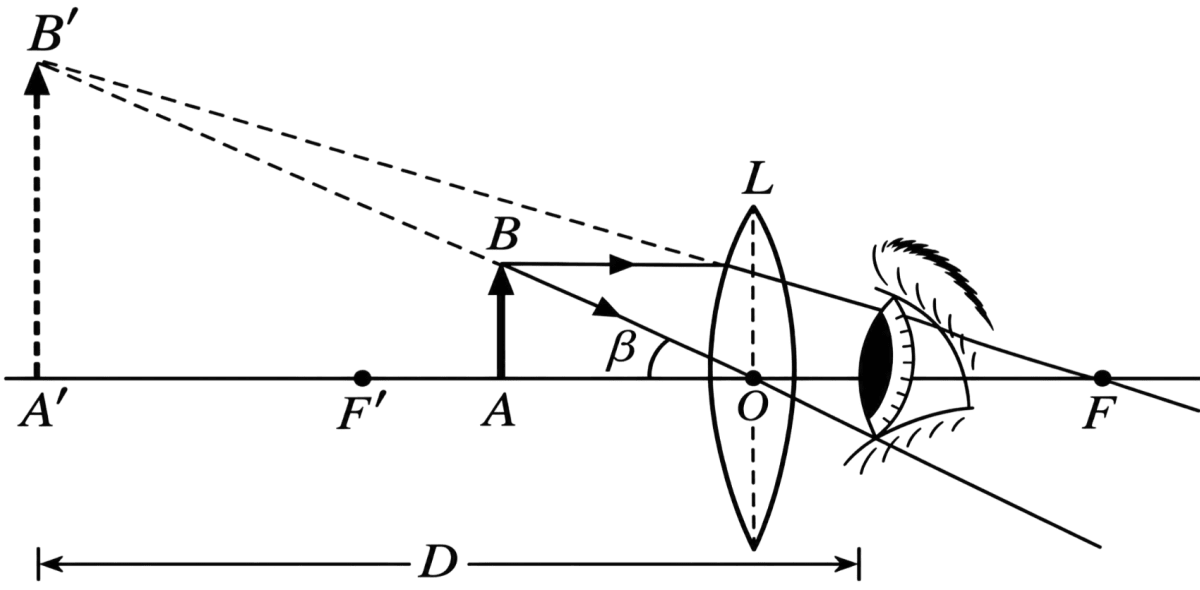
The object AB is placed between the lens L and its focus F′. The refracted rays appear to come from B′, so the eye sees the image A′B′ at the least distance of distinct vision D.
The image is virtual, erect, magnified and on the same side of the lens as the object.
What is the difference between linear magnification and angular magnification (also called magnifying power) produced by a lens?
Answer
| Linear magnification (m) | Angular magnification or magnifying power (M) |
|---|---|
| Ratio of the size of the image to the size of the object. | Ratio of the angle (β) subtended at the eye by the image to the angle (α) subtended by the object when placed at the least distance of distinct vision D. |
| , which for a lens gives |
The two are equal only when the image is formed at D (v = D).
Why is, in a microscope, objective lens of a small aperture taken?
Answer
A microscope is used to see very small objects placed very close to the objective. When the objective has a small aperture, the light from the tiny object is gathered by a small area, so the image formed is brighter.
Draw ray diagram to illustrate formation of image in a compound microscope.
Answer
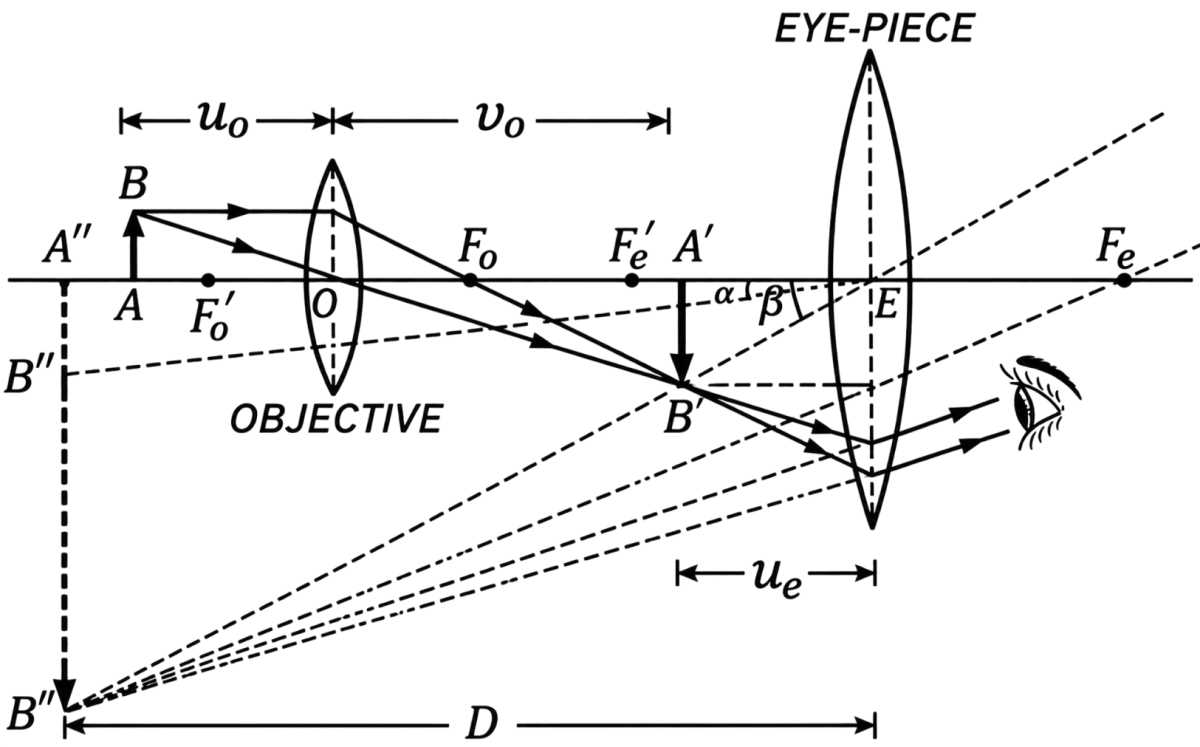
The objective O forms a real, inverted and magnified image A′B′ of the object AB placed just beyond its focus Fo′. A′B′ lies between the eye-piece E and its focus Fe′, so the eye-piece forms a virtual, magnified final image A″B″ at the least distance of distinct vision D.
In a telescope the focal length of the objective is large while that of the eye-piece is small. Explain its reason, giving the necessary formula.
Answer
The magnifying power of a telescope in normal adjustment is
Hence M is large when fo is large and fe is small. A large fo also forms a larger image of the distant object, which the short-focus eye-piece then magnifies further.
In a telescope, the objective has a large aperture while the eye-piece has a small aperture. Why?
Answer
A large aperture lets the objective collect sufficient light from distant objects (stars, etc.) to form a bright image, and it also gives the telescope a greater resolving power. The eye-piece has a small aperture so that all the light forming the image can enter the small pupil of the eye.
Why is parabolic mirror often used in terrestrial reflecting telescope?
Answer
A parabolic mirror is free from spherical aberration. All rays parallel to its axis, paraxial as well as marginal, are brought to a single focus, so a sharp and undistorted image is obtained even with a mirror of large aperture.
What is the difference in the construction of the objective of a telescope and that of a microscope?
Answer
| Objective of a telescope | Objective of a microscope |
|---|---|
| Convex lens of large focal length. | Convex lens of small focal length. |
| Large aperture (compared to the eye-piece). | Small aperture (compared to the eye-piece). |
In a telescope the objective is larger and the eye-piece is smaller. In a microscope the objective is smaller and the eye-piece is larger. If a telescope is inverted, will it be able to work as microscope? Is the reverse of this possible?
Answer
No. A microscope needs both lenses of small focal length with only a small difference between them. An inverted telescope has a lens of large focal length, so as a microscope its magnifying power would be very small.
The reverse is also not possible. A telescope needs fo ≫ fe (M = fo/fe), but the two lenses of a microscope have nearly equal small focal lengths, so an inverted microscope used as a telescope would have a very small magnifying power.
The size of the moon is much smaller than stars, still it appears bigger. Why?
Answer
The apparent size of an object depends on the visual angle it subtends at the eye. The moon is much closer to us than the stars, so it subtends a larger visual angle and appears bigger.
The diameter of the sun is of the order of 109 m, still it appears to be a small disc. Why?
Answer
The sun is at a very large distance (≈ 1011 m) from the earth, so it subtends a very small visual angle, radian, at the eye. This is the same angle that a disc of 1 cm diameter subtends from 1 m, so the sun appears as a small disc.
In viewing through a magnifying glass, we put our eye quite close to the lens. Does angular magnification change, if the eye is moved away from the lens?
Answer
Yes, the angular magnification decreases slightly. When the eye is moved away from the lens, the angle subtended by the virtual image at the eye is slightly less than the angle it subtends at the lens. The effect is negligible if the image is very far away.
The magnifying power of a simple microscope is inversely proportional to the focal length of the lens. Then, why can we not obtain a very high magnifying power by using a lens of very small focal length?
Answer
A very high magnifying power needs a lens of very small focal length. Such lenses are difficult to manufacture. They are also very thick in the middle and produce large spherical and chromatic aberrations, so the image is coloured and distorted.
In a compound microscope, both the objective and the eye-piece should be of small focal lengths. Why?
Answer
When the final image is formed at D, the magnifying power of a compound microscope is
For high M, the object must be very near the objective (uo small) yet just beyond its focus, which needs a small fo. The eye-piece factor is large only when fe is small.
Two lenses of focal lengths 5 cm and 50 cm are to be used for making a telescope. Which lens will you use for the objective?
Answer
The 50 cm lens.
Explanation:
For a relaxed eye, . A higher magnifying power needs the lens of larger focal length as the objective, so the 50 cm lens is the objective and the 5 cm lens is the eye-piece.
Explain the working of a simple microscope and show that its angular magnification is given by
(i) , where D is the least distance of distinct vision.
(ii) for relaxed eye.
Answer
Working : A simple microscope is a convex lens of short focal length. The object AB is placed between the lens and its first focus F′, with the eye just behind the lens. The lens forms a magnified, erect and virtual image A′B′ on the same side as the object, and the object's position is adjusted so that A′B′ is formed at the least distance of distinct vision D.
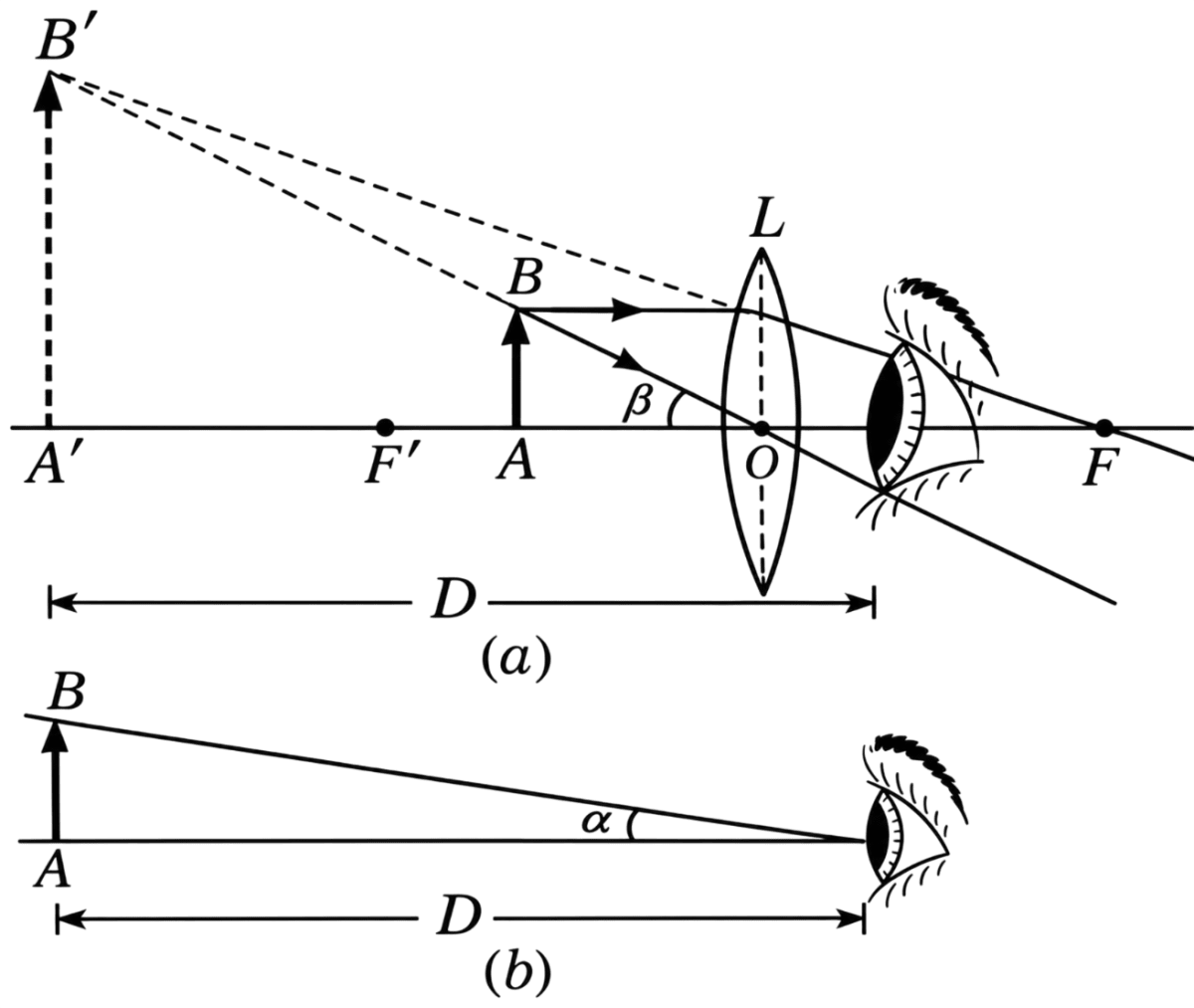
Magnifying power : Let β be the angle subtended at the eye by the image A′B′ [Fig. (a)], and α the angle subtended by the object AB when placed directly at D [Fig. (b)]. Then
As α and β are small, and . With OA = u,
(i) Image at the least distance of distinct vision : Putting v = −D and u = −u in the lens formula ,
Substituting in Eq. (ii),
Hence, .
(ii) Relaxed eye : The image is formed at infinity, so the object lies at the focus, u = f. From Eq. (ii),
Hence, for relaxed eye, .
With the help of a labelled diagram, explain the construction and working of a compound microscope. Derive an expression for its magnifying power. How can the magnifying power be increased?
Answer
Construction : A compound microscope has two convergent lens systems mounted co-axially in a tube. The objective O, facing the object, is an achromatic lens of short focal length and small aperture. The eye-piece E, fitted in an inner sliding tube, has a slightly larger focal length and aperture. The separation between them is changed by a rack and pinion arrangement, and cross-wires are placed at the position of the image formed by the objective.
Working : The object AB is placed slightly beyond the first focus Fo′ of the objective. The objective forms a real, inverted and magnified image A′B′. This image lies between the eye-piece and its first focus Fe′ and acts as the object for the eye-piece, which forms a virtual, magnified final image A″B″ at the least distance of distinct vision D.
Magnifying power : Cut A″B‴ = AB at D. Then α = ∠A″EB‴ is the angle the object would subtend at D, and β is the angle subtended by A″B″ at the eye (close to E).
For the objective, ...(ii)
For the eye-piece, with v = −D, u = −ue and f = fe in the lens formula,
Substituting Eqs. (ii) and (iii) in Eq. (i),
Hence, .
Since uo ≈ fo and vo ≈ L (length of the tube), .
Increasing the magnifying power : The magnifying power can be increased by
- taking an objective of small focal length fo, with the object placed as close to its focus as possible,
- taking an eye-piece of small focal length fe,
- increasing the length of the microscope tube.
Draw a ray diagram of an astronomical refracting telescope and derive an expression for its magnifying power when :
(i) the image is formed at infinity,
(ii) the image is formed at the least distance of distinct vision.
Answer
(i) Final image at infinity (normal adjustment) :
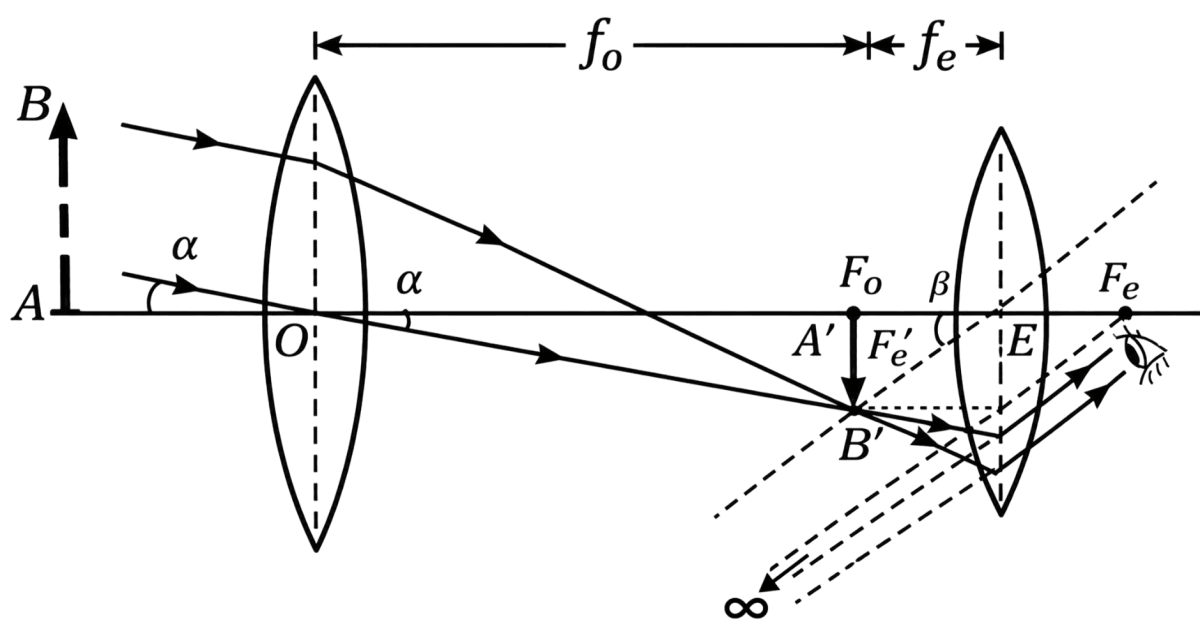
The objective O forms a real, inverted image A′B′ of the distant object AB at its focus Fo. The eye-piece is adjusted so that A′B′ lies at its focus Fe′ (ue = fe), and the final image is formed at infinity.
Let α be the angle subtended by the object at the objective (practically the angle at the eye) and β the angle subtended by the final image at the eye. As both are small,
By the new cartesian sign convention, OA′ = +fo and EA′ = −fe.
Hence, . The negative sign shows that the final image is inverted.
(ii) Final image at the least distance of distinct vision :
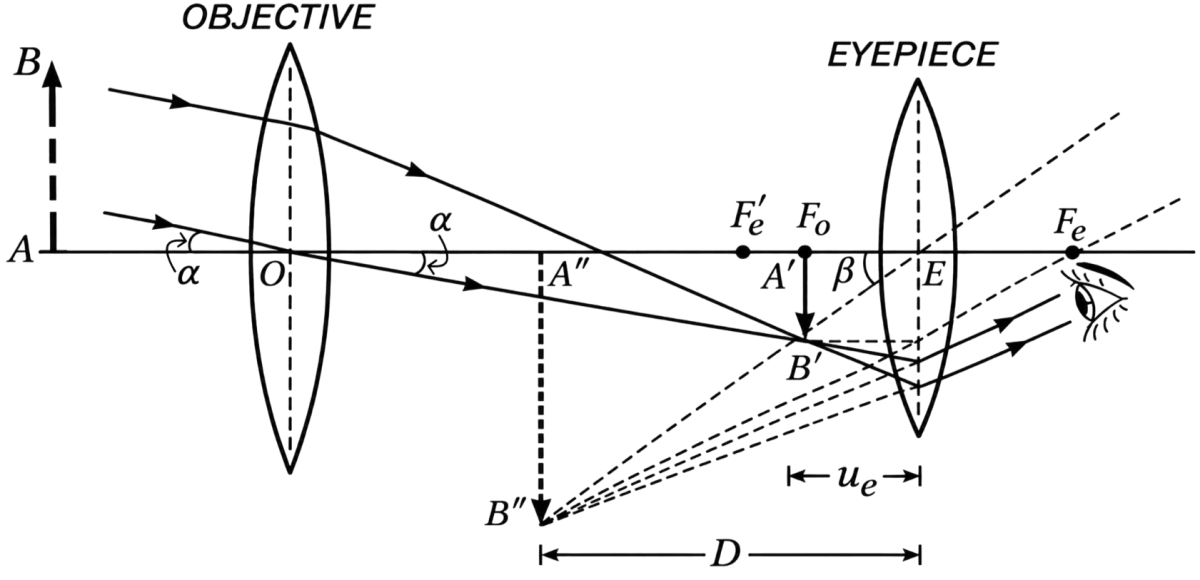
Now A′B′ lies within the focus of the eye-piece, at EA′ = −ue, so
For the eye-piece, v = −D, u = −ue, f = +fe :
Substituting in Eq. (i),
Hence, .
Derive the general relation for the magnifying power of an astronomical telescope when image is formed at infinity. State any one advantage of an astronomical telescope of the reflecting type over a refracting type.
Answer
The objective O forms a real, inverted image A′B′ of the distant object AB at its focus. Let α be the angle subtended by the object at the objective (practically the angle at the eye) and β the angle subtended at the eye by the final image. As both are small,
With OA′ = +fo and EA′ = −ue, the general relation is
When the final image is formed at infinity, A′B′ lies at the focus of the eye-piece, so ue = fe.
Hence, .
Advantage of a reflecting telescope : Its image is free from chromatic aberration, because only reflection is involved, whereas this defect persists in a refracting telescope.
Draw a ray diagram to show how the image of a distant object is formed by a reflecting astronomical telescope when in normal use. State one advantage over a refracting-type telescope.
Answer
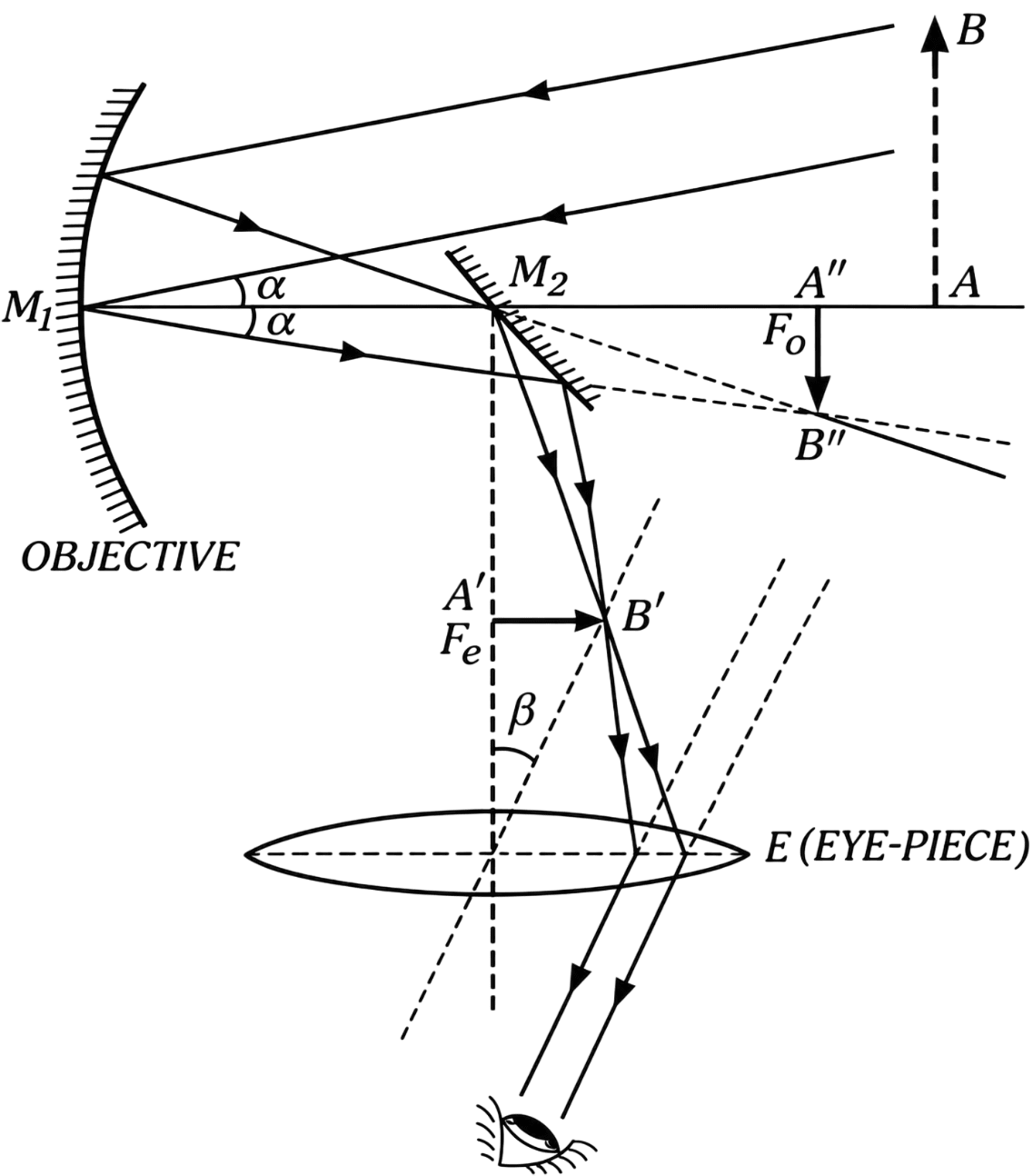
Parallel rays from the distant object AB fall on the concave mirror M1 (objective) of large focal length and large aperture. The reflected convergent beam is intercepted by a plane mirror M2, inclined at 45° to the principal axis, which turns it sideways to form a small, real image A′B′ in the focal plane of the eye-piece E. The eye-piece forms a magnified virtual image at infinity. The magnifying power is .
Advantage : The image is brighter than that of a refracting telescope of equivalent size, because no light is lost by reflection and absorption in an objective lens.
What do you mean by the resolving power of a telescope? How does the resolving power of a telescope depend upon the wavelength of the light and the aperture of the objective lens?
Answer
Resolving power : The power of a telescope to produce distinctly separate images of two close (distant) objects is its resolving power. It is measured by the reciprocal of its limit of resolution, the angle subtended at the objective by two point-objects that are just resolved.
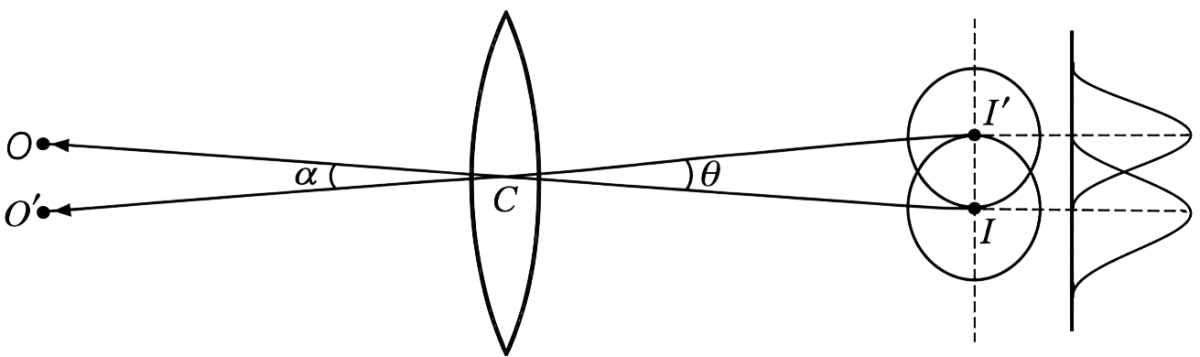
By Rayleigh criterion, the images of two stars O and O′ are just resolved when the centre of the central disc of one falls on the first dark ring of the other, that is, when
where d is the diameter of the aperture of the objective. Therefore,
Dependence : The resolving power is inversely proportional to the wavelength λ of light (shorter wavelength, higher resolving power) and directly proportional to the aperture d of the objective (larger aperture, higher resolving power).
In an experiment of OPTICS student is using a compound microscope. The examiner gives the requisite instructions and asks some questions to the student. State whether the responses of the student, in each case are correct or incorrect. Give a reason for your answer.
(i) EXAMINER : Increase the magnification produced by objective lens.
STUDENT : Decreases the distance between object and objective lens, keeping in mind that this distance must be greater than the focal length of the objective lens.
(ii) EXAMINER : Increase the resolving power of the instrument.
STUDENT : Illuminates the object with the light of longer wavelength.
(iii) EXAMINER : Which of the two lenses among f1, f2 and f3, will you prefer to take as an objective and eye-piece of compound microscope? (f1 = 2.0 cm, f2 = 100.0 cm and f3 = 6.0 cm)
STUDENT : f1 = 2.0 cm as an objective and f2 = 100.0 cm as an eyepiece.
Answer
(i) Response is correct. Magnification by the objective is
As uo is decreased towards fo (keeping uo > fo), (uo − fo) decreases, so the magnitude of mo increases.
(ii) Response is incorrect. Resolving power of a microscope , which is inversely proportional to λ. Light of longer wavelength decreases the resolving power; light of shorter wavelength should be used.
(iii) Response is incorrect. Both the objective and the eye-piece of a compound microscope must be of small focal length, the eye-piece's being only slightly larger than the objective's. A lens of focal length 100.0 cm is unsuitable as the eye-piece. The proper choice is f1 = 2.0 cm as the objective and f3 = 6.0 cm as the eye-piece.
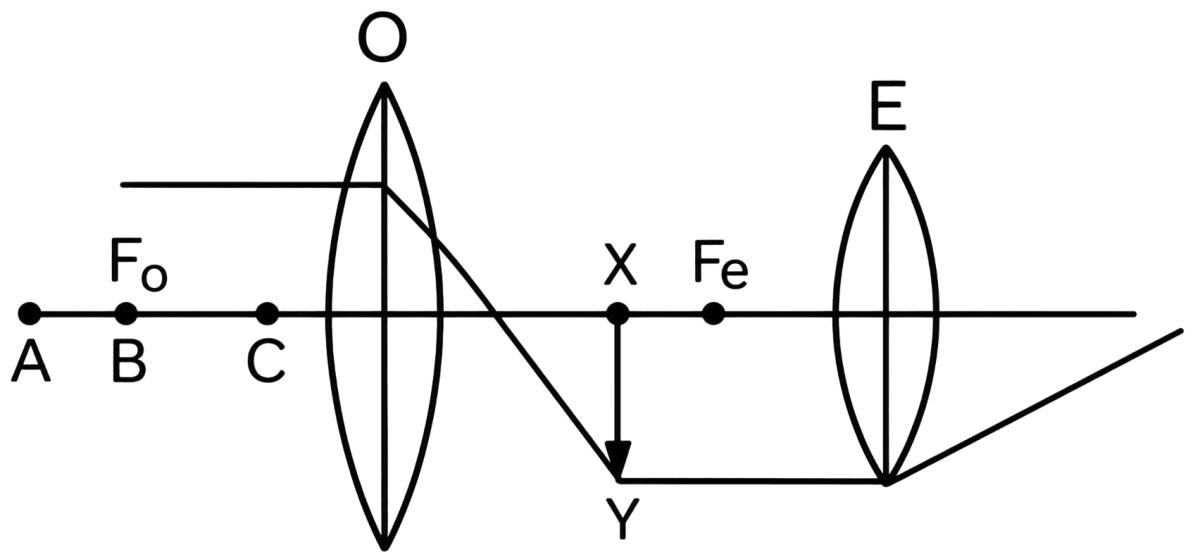
(a) Identify two errors in the student's attempt to draw a ray diagram of a compound microscope for normal vision.
(b) Which position A, B, or C, is optimal for placing the object?
Answer
(a) Two errors in the diagram :
- The image XY formed by the objective lies beyond the focus Fe of the eye-piece. For a magnified virtual final image, XY must lie between the optical centre E of the eye-piece and its focus Fe.
- The eye-piece is drawn with a focal length smaller than that of the objective, whereas the eye-piece's focal length must be slightly larger than the objective's.
(Other errors that may be cited : arrows are missing on the rays, and the objective is drawn with a large aperture instead of a small one.)
(b) Position A. The object must be placed slightly beyond the focus Fo of the objective (uo slightly greater than fo), so that a real, highly magnified image is formed. B is at the focus itself and C lies within the focal length, so neither gives a real image.
Define magnifying power of an optical instrument in term of visual angles. Write the condition when visual angle in maximum for naked eye. Write two possible values for magnification of simple microscope.
Answer
Magnifying power : The magnifying power of an optical instrument is the ratio of the visual angle (β) subtended at the eye by the final image formed by the instrument to the visual angle (α) subtended at the unaided eye by the object.
For a microscope, α is taken with the object at the least distance of distinct vision; for a telescope, with the object at its actual position.
Condition for maximum visual angle : For the naked eye the visual angle is maximum when the object is placed at the least distance of distinct vision D (the near point, 25 cm for a normal eye). Nearer than this the object cannot be seen distinctly.
Two values for a simple microscope :
(a) Final image at the least distance of distinct vision D — maximum magnifying power :
(b) Final image at infinity (relaxed eye, object at the focus) — minimum magnifying power :
Draw ray diagram for astronomical telescope in normal adjustment and derive the expression for its magnifying power when final image is formed at (i) infinity (ii) least distance of distinct vision. Also write the length of tube in each case.
Answer
(i) Final image at infinity (normal adjustment) :
The objective O forms a real, inverted image A′B′ of the distant object AB at its focus Fo. The eye-piece is adjusted so that A′B′ lies at its focus Fe′ (ue = fe), so the final image is at infinity.
Let α be the angle subtended by the object at the objective (practically the angle at the eye) and β the angle subtended at the eye by the final image. As α and β are small,
With OA′ = +fo and EA′ = −fe,
Hence, . The negative sign shows that the final image is inverted.
Length of tube : L = fo + fe.
(ii) Final image at the least distance of distinct vision :
Now A′B′ lies within the focus of the eye-piece at EA′ = −ue. From Eq. (i), with OA′ = +fo,
For the eye-piece, v = −D, u = −ue, f = +fe in :
Substituting Eq. (iii) in Eq. (ii),
Hence, .
Length of tube : L = fo + ue, where from Eq. (iii)
so that .
Draw ray diagram of compound microscope. Write its magnifying power in (i) normal adjustment (ii) final image is formed at D. If objective and eye-piece are interchanged, will it behave like a telescope? Explain.
Answer
The objective forms a real, inverted, magnified image A′B′ of the object AB placed just beyond its focus. The eye-piece forms the final virtual, magnified image A″B″ of A′B′.
(i) Normal adjustment (relaxed eye, final image at infinity) : A′B′ lies at the focus of the eye-piece (ue = fe), and
With uo ≈ fo and vo ≈ L, this is .
(ii) Final image at D :
With uo ≈ fo and vo ≈ L, this is .
Interchanging objective and eye-piece : No, it will not work as a telescope. A telescope needs an objective of large focal length and an eye-piece of small focal length, so that is large. In a microscope both lenses have very small focal lengths (a few mm to a few cm) and the difference (fe − fo) is very small. After interchanging, the new objective (the former eye-piece) still has a short focal length and a small aperture, so it cannot give the large magnifying power and light-gathering power of an astronomical telescope; its magnifying power would be very small.
Draw labelled ray diagram of reflecting telescope, write its magnifying power and write its advantages over refracting telescope.
Answer
Construction and working : The objective is a concave mirror M1 of large focal length and large aperture at one end of a wide tube. A plane mirror M2, placed between M1 and its focus and inclined at 45° to the principal axis, turns the reflected convergent beam sideways. It forms a small, real image A′B′ in the focal plane of the eye-piece E, a convex lens of small focal length fitted in a side tube. E forms a magnified virtual image at infinity.
Magnifying power : With and , where A′B′ = A″B″,
where fo (= R/2) is the focal length of the concave mirror and fe that of the eye-piece.
Advantages over a refracting telescope :
- The image is brighter, as no light is lost by reflection and absorption in an objective lens.
- The image is free from chromatic aberration, since only reflection is involved.
- With a paraboloidal mirror the image is also free from spherical aberration.
- Large-aperture mirrors are easier to make than large lenses, whose glass becomes distorted in manufacture; a mirror's image is not affected by flaws inside the glass.
- High resolution is obtained with a large mirror, which is easier to support than a lens of equal aperture.
What do you understand by resolving power and limit of resolution of astronomical telescope and explain their interdependence?
Answer
Resolving power : The resolving power of a telescope is its ability to produce distinctly separate images of two distant point-objects lying very close to each other.
Limit of resolution : It is the smallest angle subtended at the objective by two point-objects that are just resolved when seen through the telescope.
The image of a distant star O formed by the objective is not a point but a diffraction pattern — a central bright disc surrounded by dark and bright rings. The angular radius of the central disc is
where d is the diameter of the aperture of the objective. By Rayleigh criterion, the images of two stars O and O′ are just resolved when the centre of the disc of one falls on the first dark ring of the other, that is, when the angle α subtended by them at the objective equals θ.
Interdependence : The resolving power is the reciprocal of the limit of resolution.
The smaller the limit of resolution, the greater the resolving power. A larger aperture d (or a shorter wavelength λ) lowers the limit of resolution and so raises the resolving power.
Read the passage(s) and answer the following questions :
For viewing terrestrial objects, astronomical telescope is unsuitable. The astronomical telescope can be altered to view terrestrial objects by using an erecting lens in between objective and eye-piece of the astronomical telescope. fo, f and fe are the focal lengths of the objective, erecting lens and eye-piece respectively. The objective forms the inverted image I1M1 of the distant object at 2F of the erecting lens which forms the erect image of the same size I2M2 at 2F of the erecting lens on the other side of this lens. When the telescope is in normal adjustment the principal focus of the eye-piece coincides with 2F of the erecting lens. The final image formed by the eye-piece at infinity is virtual, erect and magnified.
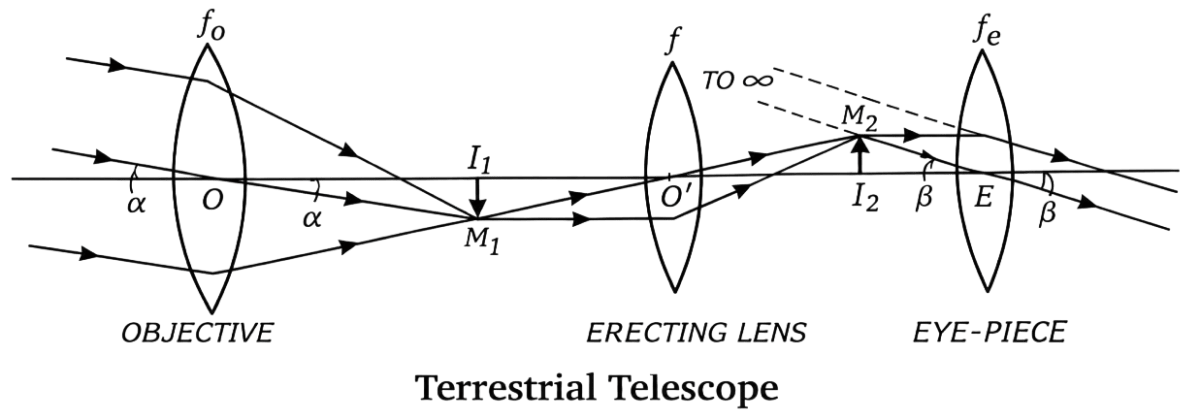
(i) What is the function of erecting lens? Does it produce any magnification?
(ii) Write the expression for magnifying power M of a terrestrial telescope, when the final image is formed at infinity.
(iii) What is the total length of the terrestrial telescope in normal adjustment?
(iv) An astronomical refracting telescope consists of two convex lenses having focal length 80 cm and 4 cm. When it is in normal adjustment, what is its :
(a) length
(b) magnifying power?
Answer
(i) The erecting lens only erects the final image, by inverting the inverted image I1M1 formed by the objective. It produces no magnification, since the object I1M1 and the image I2M2 both lie at 2F of the lens and are of the same size.
(ii) When the final image is formed at infinity,
(iii) The objective's image is fo from the objective, the erecting lens is 2f from it, the erect image is a further 2f beyond, and the eye-piece is fe from that image. Hence the total length is
(iv) Given,
- Focal length of objective, fo = 80 cm
- Focal length of eye-piece, fe = 4 cm
For an astronomical telescope in normal adjustment, L = fo + fe and .
(a)
(b)
Hence, the length of the telescope is 84 cm and its magnifying power is −20 (magnitude 20, final image inverted).