
Identify the nuclides X and Y in the nuclear reactions.
5B11 + 1H1 → 4Be8 + X and 6C14 → Y + -1e0
Answer
In every nuclear reaction the total mass number and the total atomic number (charge) are conserved.
First reaction : Let X be ZXA.
So X is 2He4, i.e., an α-particle.
Second reaction : Let Y be ZYA.
So Y is 7N14, a nitrogen nucleus.
Hence, X is 2He4 (α-particle) and Y is 7N14.
What is the function of heavy water in a nuclear reactor?
Answer
Heavy water acts as the moderator in a nuclear reactor. The fast neutrons produced in fission lose their energy through elastic collisions with the heavy-hydrogen (1H2) nuclei of heavy water and are slowed down to thermal energies, at which they have a very high probability of fissioning U235 nuclei. Heavy water has a very low probability of absorbing neutrons, so it slows them down without removing them from the chain reaction.
What is the principle of operation of a nuclear reactor?
Answer
A nuclear reactor works on the principle of controlled nuclear fission chain reaction.
Explanation:
In a reactor, the extra neutrons produced at each stage of fission are absorbed, so that on an average only one neutron from each fission remains available to cause further fission. The chain reaction then proceeds at a steady rate and the energy is released at a controlled rate.
What is the role of control rods in a nuclear reactor?
Answer
Control rods are rods of cadmium (or boron), which are good absorbers of slow neutrons. They are used to control the fission rate in the reactor. When the rods are pushed into the reactor, they absorb more neutrons and the fission rate decreases; when they are pulled out, the fission rate increases. In this way, the number of neutrons available for further fission is kept at about one per fission, and the chain reaction remains controlled.
Why are neutrons (and not protons or α-particles) considered as ideal particles for nuclear fission reactions?
Answer
Neutrons are uncharged particles. Hence, they suffer no electrostatic repulsion from the positively charged target nucleus and can penetrate deep into it even when their energy is small (slow or thermal neutrons).
Protons and α-particles, on the other hand, are positively charged and are electrostatically repelled by the target nucleus. They can reach the nucleus only if they have very high energies, so they are not suitable for causing fission.
Draw a labelled diagram of a nuclear reactor, stating the function of each part.
Answer
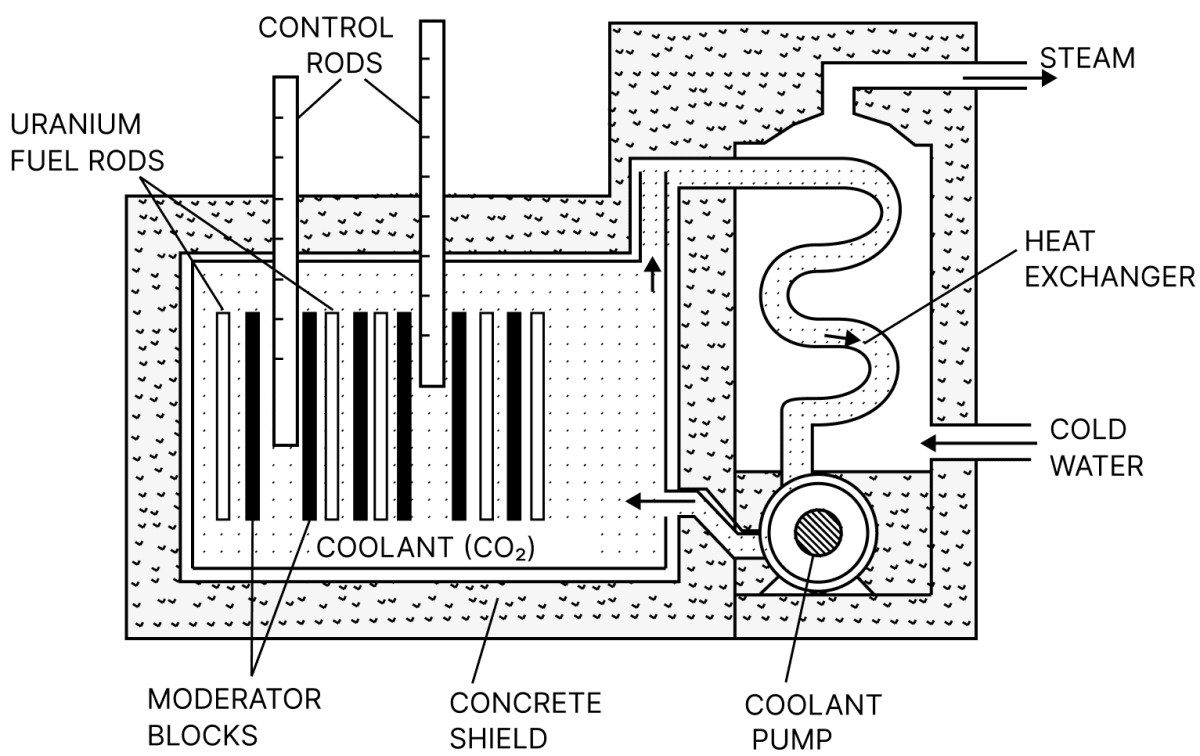
The labelled diagram above shows a nuclear reactor. The functions of its main parts are :
(i) Fuel (uranium fuel rods) : The fissionable material, natural uranium or uranium enriched with U235 (or Pu239), undergoes fission and releases energy. The rods are covered by close-fitting aluminium cylinders to prevent oxidation of uranium.
(ii) Moderator (graphite blocks) : It slows down the fast neutrons produced in fission to thermal energies through elastic collisions, so that they can cause further fission of U235 nuclei.
(iii) Control rods (cadmium or boron) : They absorb slow neutrons and control the fission rate. Pushing them in decreases the fission rate; pulling them out increases it.
(iv) Coolant (CO2 gas, water or air) : It carries away the heat produced in the reactor core. The hot coolant passes through a heat exchanger and converts cold water into steam.
(v) Heat exchanger : The steam produced here drives turbines which run generators to produce electricity.
(vi) Concrete shield : The thick concrete walls protect the people working near the reactor from the intense radiation emitted by the reactor.
(vii) Safety device (shut-off rods) : In case of an emergency, these special control rods enter the reactor automatically and absorb the neutrons, so that the chain reaction stops entirely.
What is the source of energy of stars?
Answer
The source of energy of stars is the nuclear fusion of lighter nuclei, mainly hydrogen nuclei fusing into helium nuclei (thermonuclear energy).
Explanation:
The interior of the sun and the stars is at a temperature of about 2 × 10⁷ K, at which the atoms are completely ionised into a hot plasma. Four hydrogen nuclei fuse, through the carbon cycle or the proton-proton cycle, to form a helium nucleus,
4 1H1 → 2He4 + 2 +1β0 + 2ν + γ (energy)
releasing about 26.7 MeV of energy per helium nucleus formed.
Fission of U-235 nucleus releases 200 MeV of energy. Calculate the fission rate (i.e., number of fissions per second) in order to produce a power of 320 MW.
Answer
Given,
- Energy released per fission = 200 MeV
- Power required, P = 320 MW
The power required is
As 1 MeV = 1.6 × 10⁻¹³ J,
Number of fissions per second =
Hence, the fission rate is 1019 fissions per second.
Where in our universe is the thermo-nuclear energy being released naturally?
Answer
In the sun and the stars.
Explanation:
The interior of the sun and the stars is at a very high temperature (about 2 × 10⁷ K), at which hydrogen nuclei continuously fuse into helium nuclei. The energy so released is thermonuclear energy, which these bodies radiate continuously.
Complete the following nuclear reaction,
10n + 126C → 115B + ...............
Answer
10n + 126C → 115B + 21H
Explanation:
Let the missing particle be AZX. Conserving mass number and atomic number,
So the missing particle is 21H, a deuteron.
(i) Write a balance equation showing nuclear fission of uranium (23592U) nucleus.
(ii) In a nuclear reactor, what is the function of:
(a) cadmium rods
(b) graphite rods?
Answer
(i) Fission of uranium (23592U) nucleus :
92U235 + 0n1 → (92U236) → 56Ba141 + 36Kr92 + 3 0n1 + Q (energy)
A slow neutron is captured by the U235 nucleus to form the highly unstable U236, which at once splits into barium and krypton nuclei with the emission of three fast neutrons and about 200 MeV of energy.
(ii) (a) Cadmium rods : They act as control rods. Cadmium is a good absorber of slow neutrons, so these rods absorb the excess neutrons and control the fission rate in the reactor.
(b) Graphite rods : They act as the moderator. They slow down the fast neutrons produced in fission to thermal energies, so that these neutrons can cause further fission of U235 nuclei.
Consider the following nuclear reaction,
21H + 21H → 32He + 10n
What is the name of this reaction?
Answer
Nuclear fusion.
Explanation:
Two light deuterium (21H) nuclei fuse together to form a relatively heavier nucleus, 32He, with the emission of a neutron and release of energy. Such a reaction is called nuclear fusion.
In a nuclear reactor what is the function of:
(i) the moderator?
(ii) the control rods?
(iii) the coolant?
Answer
(i) Moderator : It slows down the fast neutrons produced in fission to thermal energies by elastic collisions with its nuclei. Thermal neutrons have a very high probability of fissioning U235 nuclei, so the chain reaction is maintained.
(ii) Control rods : Made of cadmium (or boron), they absorb slow neutrons and thus control the fission rate. Pushing them into the reactor decreases the fission rate and pulling them out increases it.
(iii) Coolant : It removes the heat produced inside the reactor and transfers it to a heat exchanger, where water is converted into steam to drive the turbines.
Write any one balanced equation representing nuclear fission.
Answer
92U235 + 0n1 → (92U236) → 56Ba141 + 36Kr92 + 3 0n1 + Q (energy)
Explanation:
A slow (thermal) neutron is captured by U235 to form the highly unstable U236, which splits into two lighter nuclei of comparable masses, releasing three fast neutrons and about 200 MeV of energy.
Why nuclear fusion reaction is also called thermo-nuclear reactions?
Answer
Nuclear fusion can take place only at extremely high temperatures, hence it is called a thermonuclear reaction.
The nuclei to be fused are positively charged and repel one another strongly. To overcome this repulsion and bring them very close together, they must have very high kinetic energies (≈ 0.1 MeV), which requires a temperature of the order of 108 K.
Name a material which is used in making control rods in a nuclear reactor.
Answer
Cadmium (or boron).
Explanation:
Cadmium has a high cross-section for absorbing slow (thermal) neutrons, so rods of cadmium can absorb the excess neutrons and control the fission rate.
Write one balanced equation each to show:
(a) Nuclear fission
(b) Nuclear fusion.
Answer
(a) Nuclear fission :
92U235 + 0n1 → (92U236) → 56Ba141 + 36Kr92 + 3 0n1 + Q (energy)
(b) Nuclear fusion :
1H3 + 1H2 → 2He4 + 0n1 + 17.6 MeV energy
In a nuclear reactor, cadmium rods are used as:
- control rods
- fuel rods
- coolant
- moderator
Answer
control rods
Reason — Cadmium is a very good absorber of slow neutrons. Rods of cadmium are therefore pushed in or pulled out of the reactor to absorb the excess neutrons and control the fission rate.
In a nuclear reactor, what is the function of a moderator?
Answer
The moderator slows down the fast neutrons (energy about 2 MeV) produced in fission to thermal energies (≈ 0.03 eV) through elastic collisions with its nuclei. Thermal neutrons have a very high probability of fissioning U235 nuclei, so the chain reaction can be maintained. Graphite and heavy water are commonly used as moderators.
State any two differences between nuclear fusion and nuclear fission.
Answer
| Nuclear Fission | Nuclear Fusion |
|---|---|
| A heavy nucleus splits into two lighter nuclei of comparable masses. | Two or more light nuclei fuse into a relatively heavier nucleus. |
| It occurs at normal temperature and pressure. | It needs extremely high temperature and pressure. |
What is the essential difference between the working of a fission bomb and a nuclear reactor?
Answer
In a fission bomb, the chain reaction is uncontrolled, whereas in a nuclear reactor it is controlled.
In a fission bomb, more than one of the neutrons emitted in each fission cause further fissions, so the number of fissions increases very rapidly and the whole fissionable material is fissioned in a few moments. The huge energy is released as a violent explosion.
In a nuclear reactor, the extra neutrons are absorbed by control rods so that, on an average, only one neutron from each fission causes further fission. The chain reaction remains steady and the energy is released at a controlled rate.
Read the given passage and answer the questions that follow.
India built its first nuclear reactor, Apsara, at Trombay, Maharashtra, in the year 1956.
It was used mainly to generate electric power. Nuclear reactors are also used to produce radio-isotopes which are used in the fields of research, medicine, agriculture, etc. Unlike thermal power stations, nuclear power stations do not cause atmospheric pollution. Still, there is opposition to installing them as there is an apprehension that there may be a radiation leakage which can be harmful to the people living nearby.
(i) In a nuclear reactor, what is the function of cadmium rods?
(ii) In a nuclear reactor, which material is used as a moderator?
(iii) Give any one balanced equation representing the nuclear fission reaction taking place in a nuclear reactor.
Answer
(i) Function of cadmium rods : Cadmium rods act as control rods. Cadmium is a good absorber of slow neutrons, so these rods absorb the excess neutrons and control the fission rate in the reactor.
(ii) Moderator : Heavy water (or graphite) is used as a moderator.
(iii) Fission reaction in a nuclear reactor :
92U235 + 0n1 → (92U236) → 56Ba141 + 36Kr92 + 3 0n1 + Q (energy)
Name the type of nuclear reaction that takes place in the core of the Sun.
Answer
Nuclear fusion (thermonuclear fusion of hydrogen nuclei into helium).
Explanation:
At the very high temperature of the sun's core (about 2 × 10⁷ K), four hydrogen nuclei fuse to form a helium nucleus, releasing about 26.7 MeV of energy,
4 1H1 → 2He4 + 2 +1β0 + 2ν + γ (energy)
Name any two essential parts of a nuclear reactor. State the function of any one of them.
Answer
Two essential parts of a nuclear reactor are :
- the moderator, and
- the control rods.
Function of the moderator : It slows down the fast neutrons produced in fission to thermal energies through elastic collisions with its nuclei, so that they can fission U235 nuclei and sustain the chain reaction.
(i) In a nuclear reactor, state the function of each of the following:
(a) Graphite rods.
(b) Molten metal or cold gases.
(ii) Why is nuclear fusion reaction also called thermonuclear reaction?
Answer
(i) (a) Graphite rods : They act as the moderator. They slow down the fast-moving neutrons produced in fission to thermal energies, so that they can cause further fission of U235 nuclei.
(b) Molten metal or cold gases : They act as the coolant. They absorb the heat produced in the reactor core and carry it away to the heat exchanger, where it is used to produce steam.
(ii) Nuclear fusion requires very high temperatures (of the order of 108 K). Only at such temperatures do the positively charged nuclei acquire kinetic energy large enough to overcome their mutual electrostatic repulsion and fuse together. Hence, it is called a thermonuclear reaction.