
Draw ray diagram to illustrate the formation of primary rainbow by refraction and total internal reflection of sunlight in water drops.
Answer
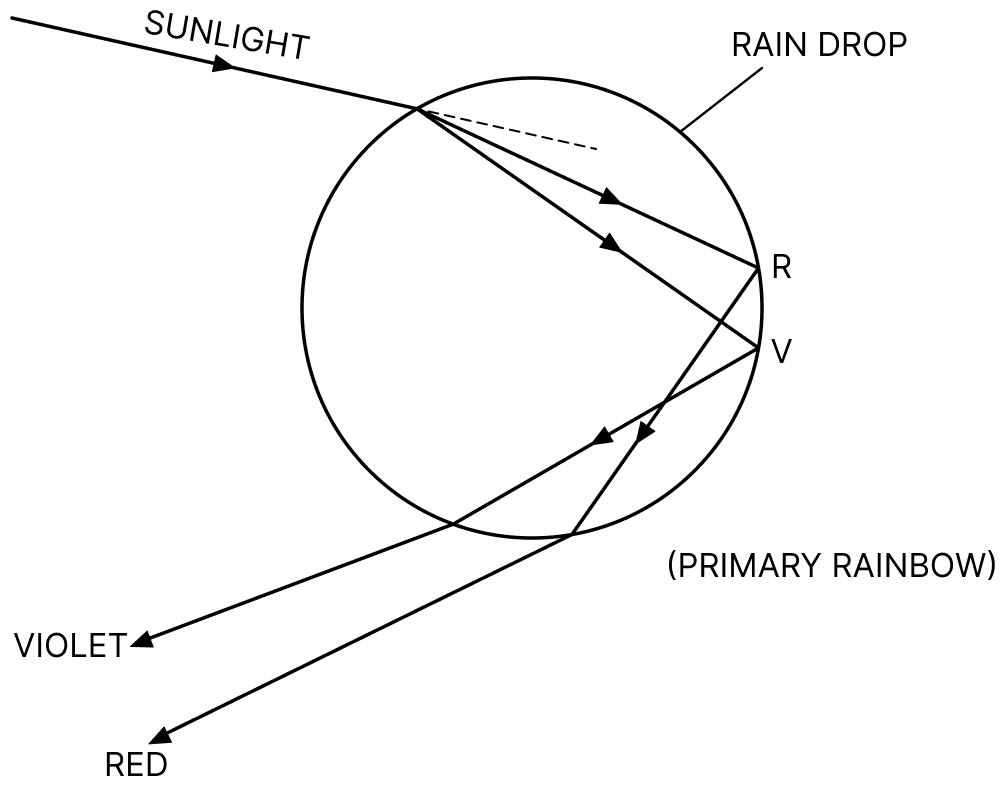
The primary rainbow is formed when sunlight suffers two refractions and one total internal reflection inside a raindrop:
(i) On entering the drop, the ray of sunlight is refracted and dispersed into its constituent colours.
(ii) The coloured rays suffer one total internal reflection at the back surface of the drop.
(iii) On leaving the drop, the rays are refracted again into air. The red rays emerge making about 43° and the violet rays about 41° with the direction of the incident sunlight, so the primary rainbow has its outer edge red and inner edge violet.
Define dispersive power of the material of prism. The refractive indices of a prism for violet, yellow and red colours are 1.632, 1.620 and 1.613, respectively. Calculate the dispersive power of the material of the prism.
Answer
Dispersive power : When white light passes through a thin prism, the ratio of the angular dispersion between the violet and the red emergent rays to the deviation suffered by the mean (yellow) ray is called the dispersive power of the material of the prism. It is denoted by ω.
Given,
- nv = 1.632
- ny = 1.620
- nr = 1.613
The dispersive power is
Substituting the values,
Hence, the dispersive power of the material of the prism is 0.0306.
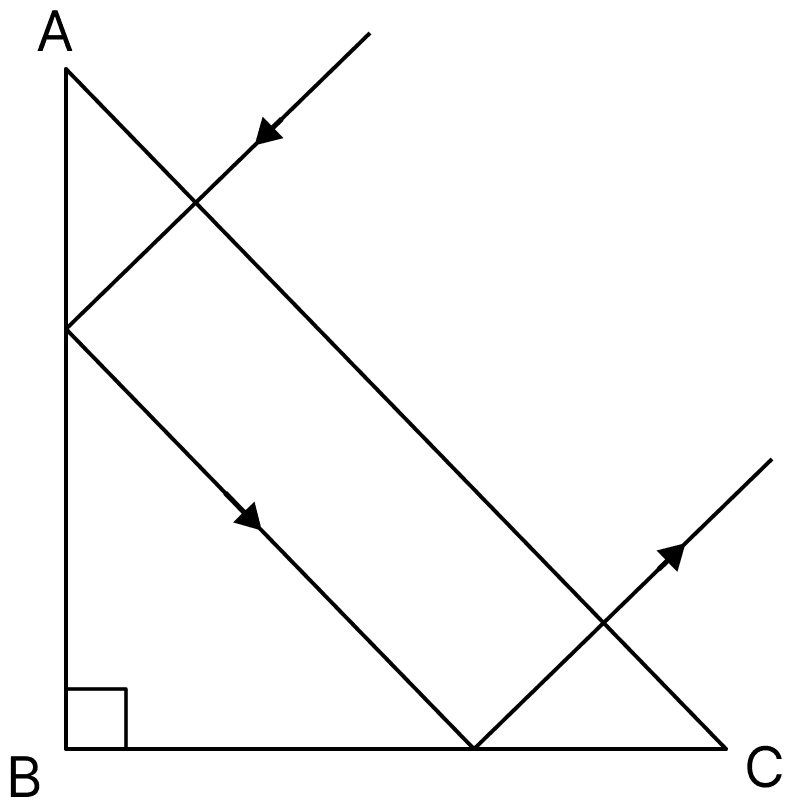
A ray of light falls on a right angled prism ABC (AB = BC) and travels as shown in the figure. What is the refractive index of the material of the prism?
Answer
Given,
- Prism ABC with ∠B = 90° and AB = BC, so ∠A = ∠C = 45°
The ray enters the face AC normally, so it passes into the prism without deviation. Its angle of incidence at the face AB is equal to ∠A = 45°. After reflection at AB, it meets the face BC at an angle of incidence equal to ∠C = 45°. After reflection at BC, it emerges normally through AC.
As shown in the figure, the ray is totally reflected at both AB and BC. Hence the angle of incidence (45°) at these faces must be greater than the critical angle θc of the material,
Hence, the refractive index of the material of the prism must be greater than (≈ 1.414).
The refractive indices of a material for red, violet and yellow colour lights are 1.52, 1.62 and 1.59, respectively. Calculate the dispersive power of the material. If the mean deviation is 40°, what will be the angular dispersion produced by a prism of this material?
Answer
Given,
- nr = 1.52
- nv = 1.62
- ny = 1.59
- Mean deviation, δy = 40°
Dispersive power :
Angular dispersion : The dispersive power is also given by
Hence, the angular dispersion between the violet and red rays is
Hence, the dispersive power of the material is 0.17 and the angular dispersion produced by the prism is 6.78°.
What is the angle of refraction made by a ray of light inside a regular, i.e., an equilateral glass prism in the minimum deviation?
Answer
30°.
Explanation:
In the minimum deviation position, the ray passes symmetrically through the prism, so r = r'. Since r + r' = A, and A = 60° for an equilateral prism,
The angle of an equilateral glass prism is 59.5°. The angle of minimum deviation is 38.5°. Without using the value of refractive index of the glass, calculate the angle of incidence for a ray of light suffering minimum deviation.
Answer
Given,
- Angle of prism, A = 59.5°
- Angle of minimum deviation, δm = 38.5°
In the position of minimum deviation, i = i' and r = r'. Hence, from δ = i + i' − A,
Therefore,
Hence, the angle of incidence for minimum deviation is 49°.
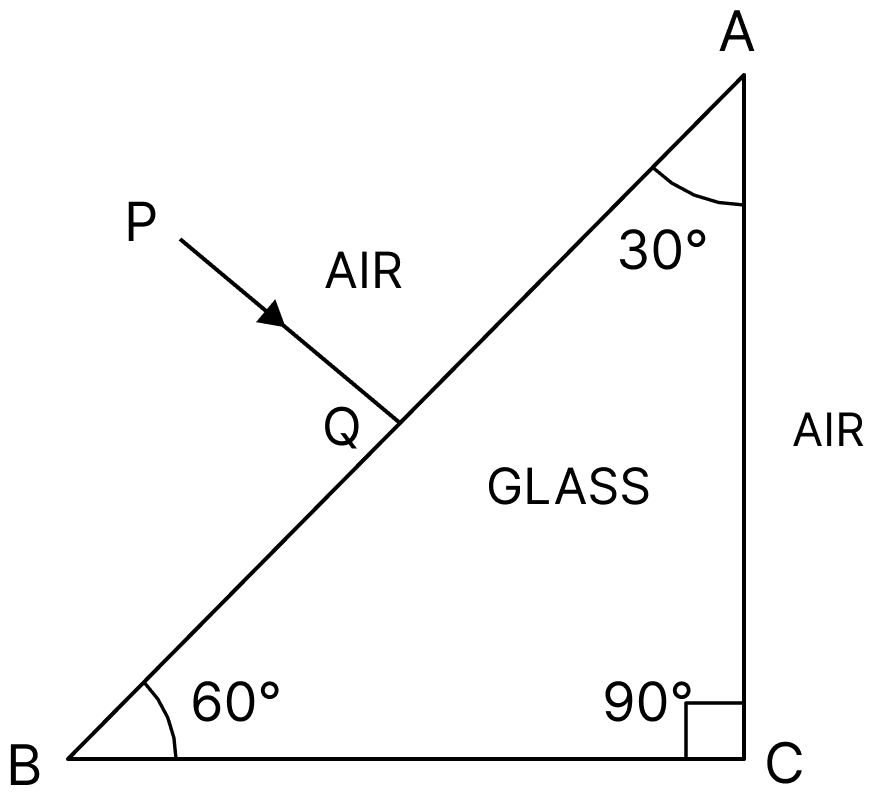
In the figure, ABC is the cross-section of a right angled prism with angle B = 60° and angle A = 30°. PQ is a ray incident normally at Q. Copy the diagram and complete the passage of the ray through the prism. Explain briefly what happens at the interfaces between glass and air? Calculate sin i2, where i2 is the angle of emergence in air. Take critical angle for glass as 42° and refractive index of glass is 1.5.
Answer
Given,
- ∠A = 30°, ∠B = 60°, ∠C = 90°
- Critical angle for glass, θc = 42°
- Refractive index of glass, n = 1.5
The completed passage of the ray is shown below.
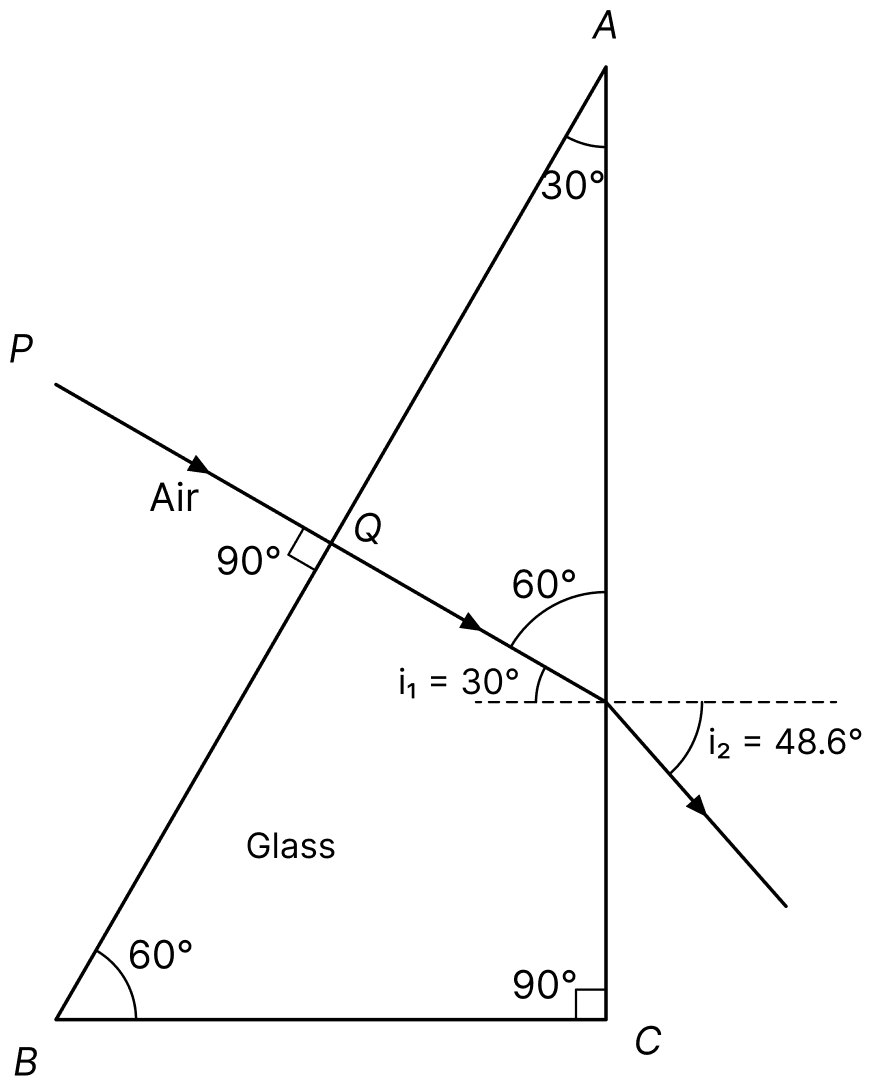
At the face AB (point Q) : The ray PQ is incident normally, so it enters the glass without any deviation and travels perpendicular to AB.
At the face AC : The ray is perpendicular to AB and the normal is perpendicular to AC, so the angle of incidence i1 at AC equals the angle between the faces AB and AC,
Since 30° is less than the critical angle 42°, total internal reflection does not occur. The ray is refracted into air, bending away from the normal.
By Snell's law at the face AC,
Hence, sin i2 = , i.e., the ray emerges into air at i2 ≈ 48.6° to the normal to AC.
Calculate dispersive power of glass, accurately up to three decimal places from following data.
(i) Refractive index of glass for red colour = 1.60
(ii) Refractive index of glass for yellow colour = 1.61
(iii) Refractive index of glass for violet colour = 1.62
Answer
Given,
- nr = 1.60
- ny = 1.61
- nv = 1.62
The dispersive power is
Hence, the dispersive power of the glass, correct to three decimal places, is 0.033.
Note: The textbook prints the answer as 0.032. Since 0.02 ÷ 0.61 = 0.0328, the value correct to three decimal places is 0.033.
A ray EF of monochromatic light is incident on the refracting surface AB of a regular glass prism (refractive index = 1.5) at an angle of incidence of i = 55°. If it emerges through the adjacent face AC, calculate the angle of emergence 'e'.
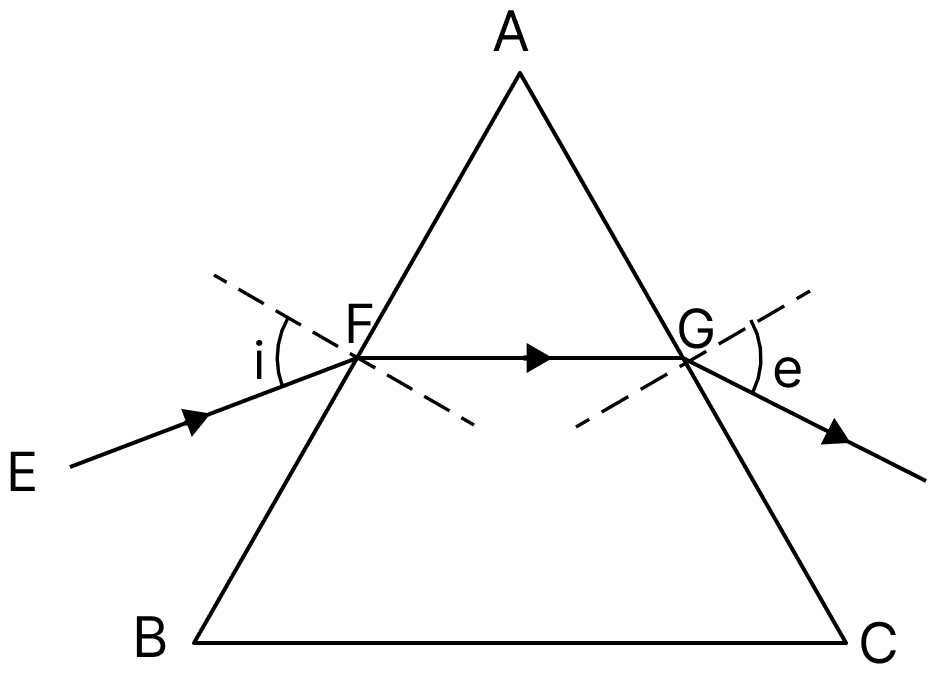
Answer
Given,
- Refractive index of glass, n = 1.5
- Angle of incidence at AB, i = 55°
- Angle of prism (regular prism), A = 60°
Let r be the angle of refraction at F and r' the angle of incidence at G.
At the face AB : By Snell's law,
At the face AC : Since r + r' = A,
By Snell's law,
Hence, the angle of emergence is e = 42.7°.
Calculate angle of minimum deviation (δm) for a regular glass prism. (Take refractive index of glass = 1.6)
Answer
Given,
- Angle of prism (regular prism), A = 60°
- Refractive index of glass, n = 1.6
The refractive index of the prism is
Substituting the values,
Hence, the angle of minimum deviation is δm ≈ 46.3°.
Note: The textbook prints 46.2°, which comes from rounding sin−1(0.8) down to 53.1°. The value is 46.26°, i.e. 46.3°, as printed for the same data in Question 22.
Calculate dispersive power of a transparent material given : nv = 1.56, nr = 1.54, ny = 1.55.
Answer
Given,
- nv = 1.56
- nr = 1.54
- ny = 1.55
The dispersive power is
Hence, the dispersive power of the material is 0.036.
Find the angle of incidence at which a ray of monochromatic light should be incident on the first surface AB of a regular glass prism ABC so that the emergent ray grazes the adjacent surface AC. (refractive index of glass = 1.56)
Answer
Given,
- Angle of prism (regular prism), A = 60°
- Refractive index of glass, n = 1.56
When the emergent ray grazes the face AC, the angle of emergence is 90°, so the angle of incidence at AC equals the critical angle θc of glass.
Critical angle :
Angle of refraction at AB : Since r + θc = A,
Angle of incidence at AB : By Snell's law,
Hence, the ray should be incident on the face AB at an angle of about 32.5°.
Note: The textbook prints the answer as i ≈ 30°. For n = 1.56 the angle works out to about 32.5° (Solved Example 4, with the same data, gives 32°).
In a regular prism, what is the relation between angle of incidence and angle of emergence when it is in the minimum deviation position?
Answer
The angle of incidence is equal to the angle of emergence (∠i = ∠e).
Explanation:
In the minimum deviation position, the ray passes symmetrically through the prism. If the path of the ray is reversed, the deviation is still minimum, and minimum deviation occurs for only one angle of incidence. Hence i = e, and correspondingly r = r' = A/2, so the ray inside a regular prism travels parallel to its base.
State any two differences between primary rainbow and secondary rainbow.
Answer
| Primary rainbow | Secondary rainbow |
|---|---|
| It is formed when sunlight suffers two refractions and one total internal reflection inside the raindrop. | It is formed when sunlight suffers two refractions and two total internal reflections inside the raindrop. |
| Its inner edge is violet and outer edge is red. | The order of colours is reversed; its inner edge is red and outer edge is violet. |
The deviation produced for violet, yellow and red lights for crown glass are 3.75°, 3.25° and 2.86° respectively. Calculate the dispersive power of the crown glass.
Answer
Given,
- δv = 3.75°
- δy = 3.25°
- δr = 2.86°
The dispersive power is
Hence, the dispersive power of the crown glass is 0.2738.
A ray of light is incident on a prism whose refractive index is 1.52 at an angle of 40°. If the angle of emergence is 60°, calculate the angle of the prism.
Answer
Given,
- Refractive index, n = 1.52
- Angle of incidence, i = 40°
- Angle of emergence, e = 60°
At the first face : By Snell's law,
At the second face : By Snell's law,
The angle of the prism is
Hence, the angle of the prism is about 60°.
Draw a labelled graph of angle of deviation (δ) versus angle of incidence (i) for a prism.
Answer
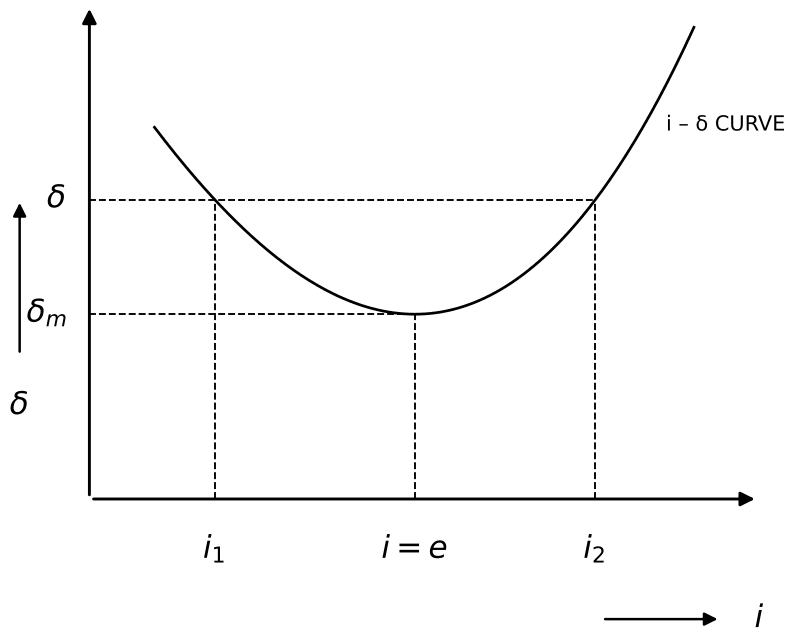
As the angle of incidence i increases, the angle of deviation δ first decreases, becomes minimum (δm) at one particular angle of incidence, for which i = i', and then increases again. Any deviation δ greater than δm is produced at two angles of incidence i1 and i2.
Name the phenomenon due to which the sun appears reddish at sunset.
Answer
Scattering of light.
Explanation:
At sunset, sunlight travels the maximum distance through the atmosphere. By Rayleigh's law (scattering ∝ ), most of the blue and neighbouring colours are scattered out on the way, so the light reaching the observer is mainly red.
Define angular dispersion.
Answer
The angle between the emergent rays of any two colours of light after passing through a prism is called the angular dispersion between those colours.
Explanation:
For the violet and red rays through a thin prism, the angular dispersion is θ = δv − δr = (nv − nr)A.
Define dispersive power of the material of the prism.
Answer
When white light passes through a thin prism, the ratio of the angular dispersion between the violet and the red emergent rays to the deviation suffered by the mean (yellow) ray is called the dispersive power of the material of the prism.
Explanation:
Calculate dispersive power of a transparent material whose refractive indices for violet and red colour are 1.58 and 1.56 respectively.
Answer
Given,
- nv = 1.58
- nr = 1.56
The refractive index for yellow (mean) light is taken as the mean of nv and nr,
The dispersive power is
Hence, the dispersive power of the material is 0.035.
A certain equilateral prism of glass has a refractive index of 1.60. Calculate the angle of minimum deviation produced by it.
Answer
Given,
- Angle of prism (equilateral prism), A = 60°
- Refractive index, n = 1.60
The refractive index of the prism is
Substituting the values,
Hence, the angle of minimum deviation produced by the prism is about 46.3°.
Dispersive power of a prism depends upon :
- shape of the prism
- height of the prism
- material of the prism
- angle of the prism
Answer
material of the prism
Reason — The dispersive power depends only on the refractive indices, i.e., on the material of the prism. It does not depend on the shape, size or angle of the prism.
Calculate refractive index of the material of an equilateral prism if its angle of minimum deviation is 30°.
Answer
Given,
- Angle of prism (equilateral prism), A = 60°
- Angle of minimum deviation, δm = 30°
The refractive index of the material is
Hence, the refractive index of the material of the prism is (≈ 1.414).
For any prism, prove that :
where the terms have their usual meaning.
Answer
Let ABC be the principal section of a prism of refracting angle A and refractive index n. A monochromatic ray PQ is incident on the face AB at an angle i and is refracted along QR at an angle r. It meets the face AC at an angle of incidence r' and emerges along RS at an angle of emergence i'.
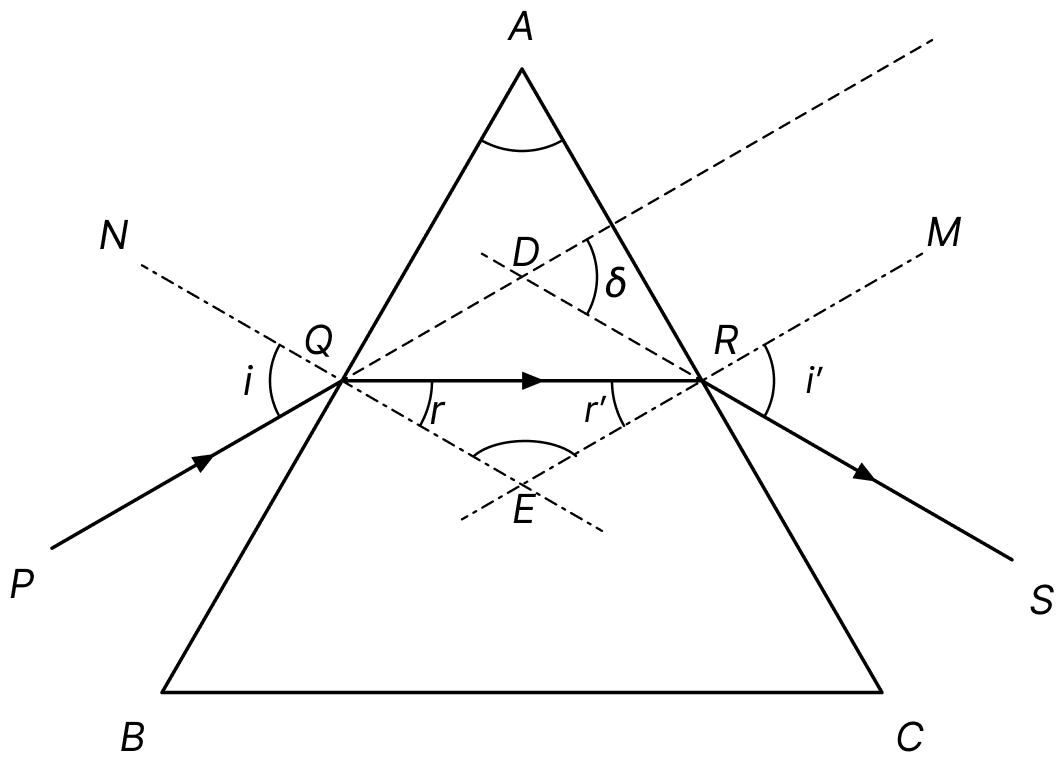
The normals at Q and R meet at E. The incident ray PQ produced forward and the emergent ray RS produced backward meet at D, and δ is the angle of deviation.
Angle of deviation : In the triangle QDR, the exterior angle δ is
In the quadrilateral AQER, ∠AQE and ∠ARE are right angles, so
In the triangle QER,
From Eqs. (ii) and (iii),
Substituting Eq. (iv) in Eq. (i),
Minimum deviation : Let the deviation be minimum, δ = δm. If the path of the ray is reversed (SRQP), the angle of incidence becomes i' and the deviation is still δm. Since δ is minimum for only one angle of incidence, i' = i. Then, by Snell's law at Q and R, r' = r.
Putting i' = i and r' = r in Eqs. (iv) and (v),
By Snell's law at the point Q,
Substituting the values of i and r,
Hence proved.
Name any two phenomena which take place in the formation of a rainbow.
Answer
(i) Dispersion of light
(ii) Total internal reflection of light
Explanation:
Sunlight is refracted and dispersed into its constituent colours on entering a raindrop, suffers total internal reflection at the back surface of the drop, and is refracted again on emerging from it.
What is meant by dispersion of light?
Answer
The splitting of white light into its constituent colours on passing through a prism (or any refracting medium) is called dispersion of light.
Explanation:
It occurs because, in a material medium, light of different colours (wavelengths) travels with different speeds, so the refractive index of the medium is different for different colours.
When a ray of white light is incident obliquely on the first surface of a prism, then :
- red colour is deviated most
- green colour is deviated most
- yellow colour is deviated most
- violet colour is deviated most
Answer
violet colour is deviated most
Reason — The refractive index of glass is maximum for violet light. Since the deviation δ = (n − 1)A increases with n, the violet ray suffers the maximum deviation and the red ray the minimum.
Figure shows a ray of monochromatic light LM incident on the first surface AB of a regular (equilateral) glass prism ABC. The emergent ray grazes the adjacent surface AC. Calculate the angle of incidence. (Refractive index of glass = 1.5)
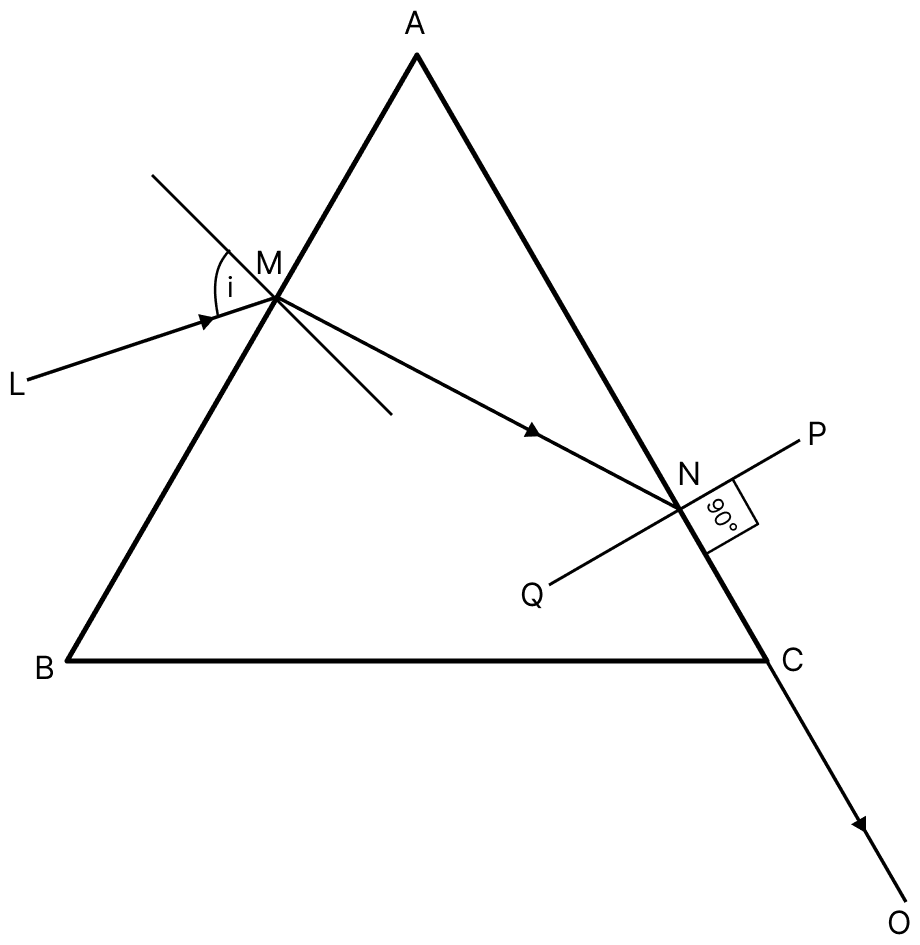
Answer
Given,
- Refractive index of glass, n = 1.5
- Angle of the regular (equilateral) prism, A = 60°
- The emergent ray NO grazes the face AC (from the figure), that is, the angle of emergence at N is 90°.
As the emergent ray grazes the face AC, the angle of incidence at N on the face AC is equal to the critical angle C for the glass-air interface. Then,
If r is the angle of refraction at M on the face AB, then r + C = A. Hence,
By Snell's law for the refraction at M, . Hence,
Hence, the angle of incidence is 27.9° (about 28°).