
A coil of wire enclosing an area 100 cm2 is placed with its plane making an angle 60° with the magnetic field of strength 10-1 T. What is the flux through the coil? If magnetic field is reduced to zero in 10-3 s, then find the induced emf.
Answer
Given,
- Area of the coil, A = 100 cm2 = 10-2 m2
- Magnetic field, B = 10-1 T
- Angle between the plane of the coil and the field = 60°
- Time taken by the field to become zero, Δt = 10-3 s
Magnetic flux :
The angle θ between the field and the normal to the plane of the coil is 90° − 60° = 30°. Hence,
Induced emf :
When the field is reduced to zero, the flux changes from ϕ to zero. By Faraday's law, the magnitude of the induced emf is
Hence, the flux through the coil is Wb (= 8.66 × 10⁻⁴ Wb) and the induced emf is 0.866 V.
The magnetic flux through a coil of 50 turns changes from 0.3 Wb to zero in 1 second. Calculate the induced emf across the two ends of the coil.
Answer
Given,
- Number of turns, N = 50
- Change in flux through each turn, Δϕ = 0.3 − 0 = 0.3 Wb
- Time, Δt = 1 s
By Faraday's law, the magnitude of the induced emf is
Hence, the induced emf across the ends of the coil is 15 V.
A coil of area 0.5 m2 and having 100 turns is placed perpendicular to a magnetic field of 0.04 Wb m-2. If the coil is suddenly removed away from the field in 0.01 second, calculate the average emf induced in the coil.
Answer
Given,
- Area of the coil, A = 0.5 m2
- Number of turns, N = 100
- Magnetic field, B = 0.04 Wb m-2
- Time, Δt = 0.01 s
As the coil is perpendicular to the field, the initial flux through each turn is BA. On removal from the field the flux becomes zero, so Δϕ = BA.
Hence, the average emf induced in the coil is 200 V.
A 28 turn coil with average diameter of 0.02 m is placed perpendicular to a magnetic field of 8000 T. If the field changes to 3000 T in 4 s, what is the magnitude of the induced emf?
Answer
Given,
- Number of turns, N = 28
- Radius of the coil, r = = 0.01 m
- Initial field, B1 = 8000 T; final field, B2 = 3000 T
- Time, Δt = 4 s
Area of the coil,
As the coil is perpendicular to the field, the change in flux through each turn is Δϕ = A(B1 − B2). By Faraday's law,
Hence, the magnitude of the induced emf is 11 V.
A closed copper coil of area 1.0 m2 placed perpendicular to a magnetic field of 0.10 T is rotated through 180° in 0.01 s. Find the induced emf and induced current in the coil whose resistance is 2.0 Ω. If the coil is open somewhere, then what will be the emf and the current?
Answer
Given,
- Area of the coil, A = 1.0 m2
- Magnetic field, B = 0.10 T
- Time, Δt = 0.01 s
- Resistance of the coil, R = 2.0 Ω
Initially the coil is perpendicular to the field, so ϕ1 = BA. After rotation through 180°, its normal is opposite to the field, so ϕ2 = −BA.
Induced emf :
Induced current :
If the coil is open : The induced emf depends only on the rate of change of flux, not on the resistance of the circuit, so it remains 20 V. The circuit is not closed (infinite resistance), so the induced current is zero.
Hence, the induced emf is 20 V and the induced current is 10 A. With the coil open, the emf is still 20 V but the current is zero.
A coil of area 500 cm2 and 2000 turns is kept normal to a magnetic field of 4 × 10⁻⁵ Wb m-2. It is rotated through 180° in 0.1 s.
(i) Calculate the average induced emf.
(ii) If the total resistance of the circuit be 20 Ω, calculate the induced charge.
Answer
Given,
- Area of the coil, A = 500 cm2 = 5 × 10⁻² m2
- Number of turns, N = 2000
- Magnetic field, B = 4 × 10⁻⁵ Wb m-2
- Time, Δt = 0.1 s
- Total resistance, R = 20 Ω
On rotation through 180°, the flux through each turn changes from BA to −BA, so the total change in flux linkage is
(i) Average induced emf :
(ii) Induced charge :
The induced charge depends only on the change in flux linkage and the resistance,
Hence, the average induced emf is 0.08 V and the induced charge is 4.0 × 10⁻⁴ C.
A rectangular loop of sides 10 cm × 3 cm with a small cut is moving out of a uniform magnetic field of 0.5 T directed normal to the loop. Compute the voltage induced across the cut, if the velocity of the loop is 1 cm s-1 in a direction
(i) normal to the longer side,
(ii) normal to the shorter side of the loop.
For how long does the induced voltage last in each case?
Answer
Given,
- Sides of the loop = 10 cm × 3 cm = 0.10 m × 0.03 m
- Magnetic field, B = 0.5 T
- Velocity, v = 1 cm s-1 = 0.01 m s-1
While the loop moves out, only the side that is still inside the field and perpendicular to the velocity cuts the field lines. The motional emf across the cut is e = Blv, where l is that side. It lasts until the loop has completely left the field, that is, for the time taken to move a distance equal to the side parallel to the velocity.
(i) Velocity normal to the longer side :
Here l = 0.10 m, and the loop must move 3 cm to leave the field.
(ii) Velocity normal to the shorter side :
Here l = 0.03 m, and the loop must move 10 cm to leave the field.
Hence, the induced voltage is 0.5 mV for 3 s in case (i) and 0.15 mV for 10 s in case (ii).
A long solenoid of radius 0.01 m has 600 turns per metre. A smaller coil of 100 turns is wrapped closely around the centre of the bigger solenoid. If the current in the solenoid rises from zero to 2 A in 1 ms, find the emf induced in the smaller coil.
Answer
Given,
- Radius of the solenoid, r = 0.01 m
- Turns per unit length of the solenoid, n = 600 m-1
- Turns in the smaller coil, N = 100
- Change in current, ΔI = 2 − 0 = 2 A
- Time, Δt = 1 ms = 10-3 s
The field inside the long solenoid is B = μ0nI, and it is confined to the area of cross-section A = πr2 of the solenoid. The flux linked with the smaller coil is therefore
so the emf induced in it is
Hence, the emf induced in the smaller coil is 47.3 mV.
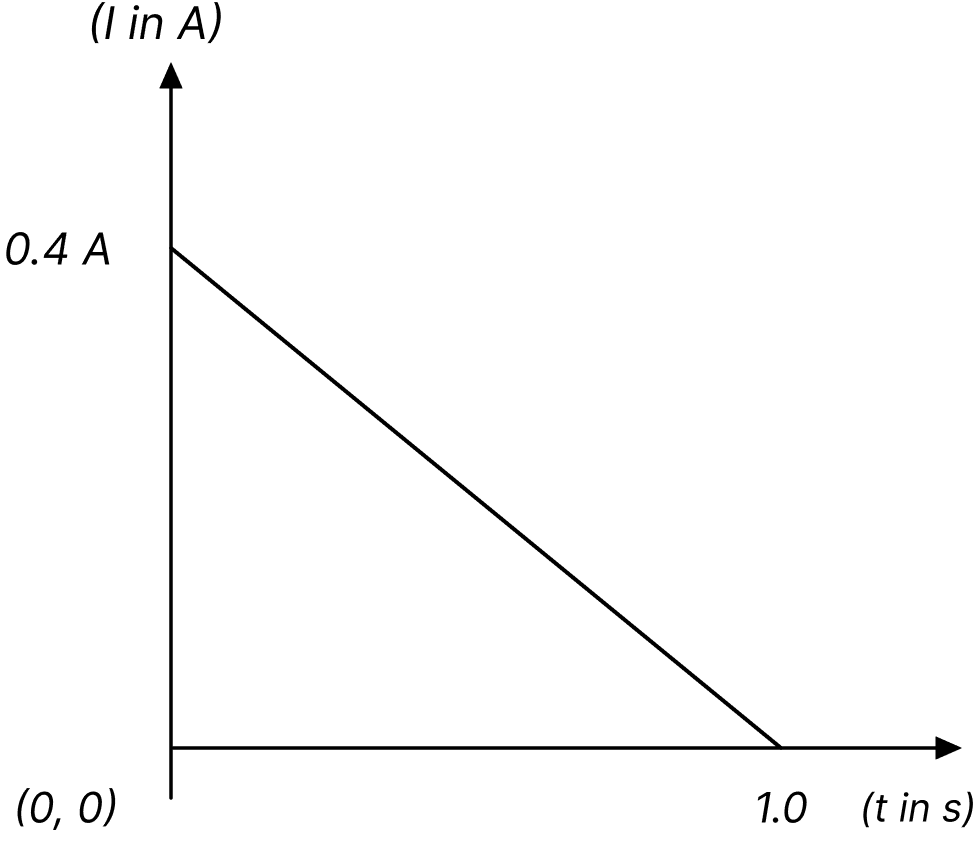
When a conducting loop of resistance 10 Ω and area 10 cm2 is removed from an external magnetic field acting normally, the variation of induced current in the loop with time is shown in the figure. Find the :
(i) total charge passed through the loop.
(ii) change in magnetic flux through the loop.
(iii) magnitude of the magnetic field applied.
Answer
Given,
- Resistance of the loop, R = 10 Ω
- Area of the loop, A = 10 cm2 = 10-3 m2
- From the graph, the current falls uniformly from 0.4 A at t = 0 to zero at t = 1.0 s
(i) Total charge :
Since I = dq/dt, the charge passed is the area under the I-t graph, which is a triangle.
(ii) Change in magnetic flux :
The induced charge is related to the change in flux by
Therefore,
(iii) Magnetic field :
The field acts normally and the loop is removed completely, so the flux changes from BA to zero and Δϕ = BA.
Hence, the charge passed is 0.2 C, the change in flux is 2 Wb and the magnetic field is 2000 T.
A 50 cm long wire is moving in a uniform magnetic field of 0.8 N A-1 m-1 with a velocity of 2 ms-1 perpendicular to both its length and the magnetic field. Calculate the induced emf in the wire. If the wire be moving parallel to the field, what will be the value of the induced emf?
Answer
Given,
- Length of the wire, l = 50 cm = 0.5 m
- Magnetic field, B = 0.8 N A-1 m-1 = 0.8 T
- Velocity, v = 2 ms-1
When the wire moves perpendicular to both its length and the field, the motional emf is
When the wire moves parallel to the field, it does not cut any field lines (e = Blv sin 0° = 0), so no emf is induced.
Hence, the induced emf is 0.8 V, and it is zero when the wire moves parallel to the field.
A 50 cm long horizontal wire is falling down with a speed of 6 ms-1 perpendicular to a uniform magnetic field of 1.1 Wb m-2. The magnetic field is directed from east to west. Calculate the emf induced in the wire. Which end of the wire (north or south) will be positive?
Answer
Given,
- Length of the wire, l = 50 cm = 0.5 m
- Speed, v = 6 ms-1
- Magnetic field, B = 1.1 Wb m-2, directed from east to west
Induced emf :
Positive end :
The wire is horizontal and perpendicular to the east-west field, so it lies along the north-south direction. The wire moves downwards and the field points west. The Lorentz force then drives the free electrons towards the south end, so the north end becomes positive.
Hence, the emf induced is 3.3 V and the north end of the wire is positive.
The axle of a car is 2.4 m long. If the car is going straight with a speed of 25 ms-1 towards south and the vertical component of earth's magnetic field at that place is 3 × 10⁻⁵ T, then calculate the potential difference induced between the ends of the axle.
Answer
Given,
- Length of the axle, l = 2.4 m
- Speed of the car, v = 25 ms-1
- Vertical component of earth's field, BV = 3 × 10⁻⁵ T
The axle is horizontal and moves horizontally, so it cuts only the vertical component BV of the earth's field.
Hence, the potential difference induced between the ends of the axle is 1.8 × 10⁻³ V.
A 0.4 m long straight conductor is moved in a magnetic field of induction 0.9 Wb m-2 with a velocity of 7 ms-1. Calculate the maximum emf induced in the conductor.
Answer
Given,
- Length of the conductor, l = 0.4 m
- Magnetic field, B = 0.9 Wb m-2
- Velocity, v = 7 ms-1
The induced emf e = Blv sin θ is maximum when the conductor moves perpendicular to the field (θ = 90°).
Hence, the maximum emf induced in the conductor is 2.52 V.
The two rails of a railway track insulated from each other and the ground, are connected to a milli-voltmeter. What will be the reading of the milli-voltmeter when a train travels at a speed of 180 km h-1 along the track? Given that the vertical component of earth's magnetic field is 0.2 × 10⁻⁴ Wb m-2 and the rails are separated by 1 m.
Answer
Given,
- Speed of the train, v = 180 km h-1 = 180 × ms-1 = 50 ms-1
- Vertical component of earth's field, BV = 0.2 × 10⁻⁴ Wb m-2
- Separation of the rails, l = 1 m
The axles of the train, of length equal to the separation of the rails, move horizontally and cut the vertical component BV. The emf so induced appears across the rails.
Hence, the milli-voltmeter reads 1 mV.
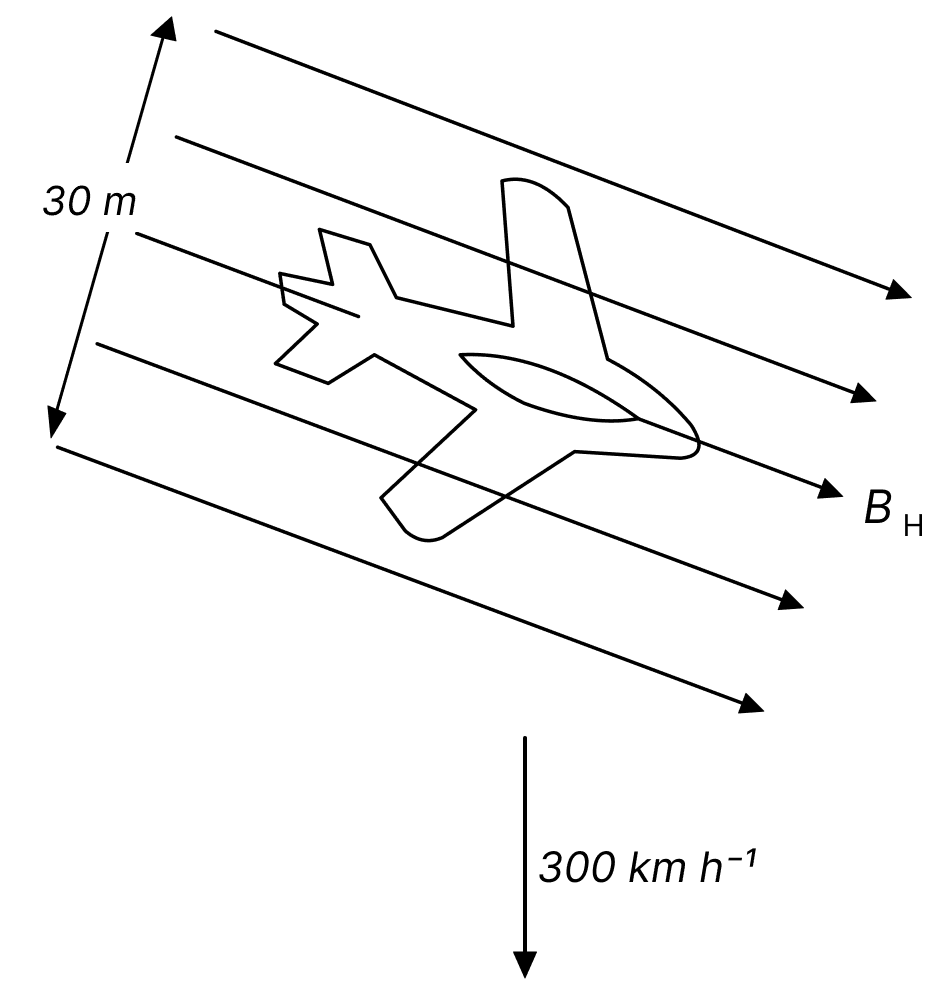
An aeroplane (the distance between the edges of its wings being 30 m) is landing down with a velocity of 300 km h-1. If, while landing, the wings of the aeroplane be east-west, find out the potential difference between the edges of the wings. If the wings be north-south, then? (Given : BH = 0.4 × 10⁻⁴ T).
Answer
Given,
- Distance between the edges of the wings, l = 30 m
- Velocity of landing, v = 300 km h-1 = 300 × ms-1 = ms-1
- BH = 0.4 × 10⁻⁴ T
As shown in the figure, the aeroplane is coming down vertically. Its velocity is parallel to the vertical component BV, so BV is never cut.
Wings east-west :
The wings (east-west), the velocity (vertical) and BH (north) are mutually perpendicular, so the wings cut BH.
Wings north-south :
The wings are now parallel to BH, and the velocity is parallel to BV. The wings cut neither component, so no potential difference is induced.
Hence, the potential difference is 0.1 V when the wings are east-west and zero when they are north-south.
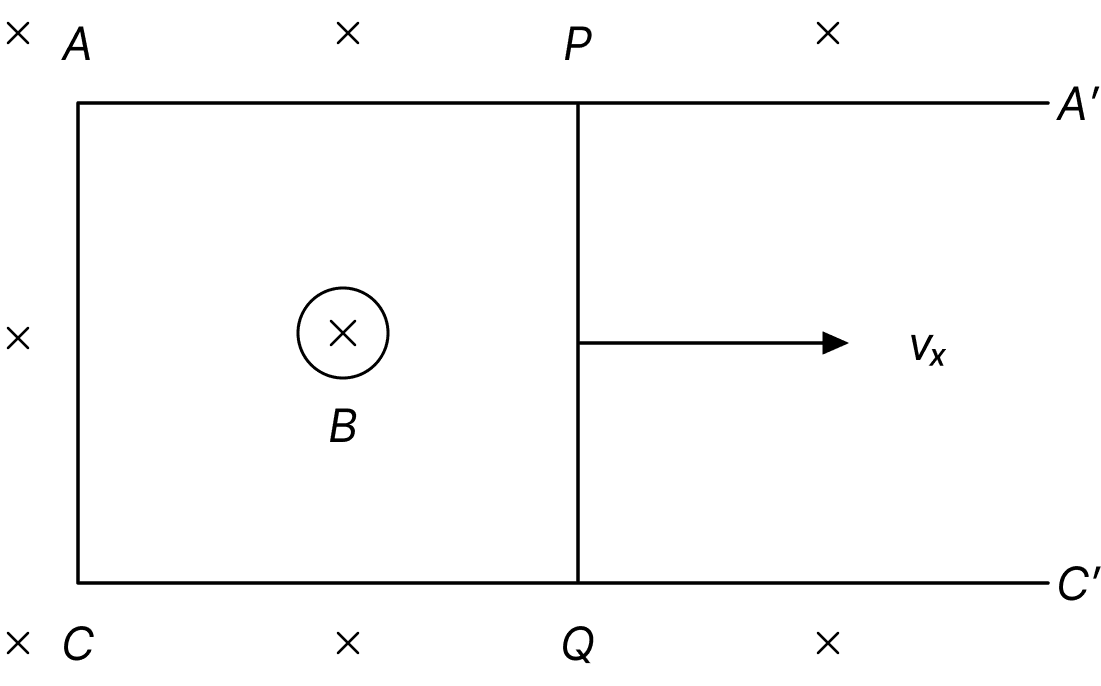
A conducting rod PQ of length 20 cm and resistance 0.1 Ω rests on two smooth parallel rails AA' and CC' of negligible resistance. It can slide on the rails and the arrangement is positioned between the poles of a permanent magnet producing uniform magnetic field B = 0.4 T. The rails, the rod and the magnetic field are in three mutually perpendicular directions as shown in the figure. If the ends A and C of the rails are short-circuited, find the :
(i) emf induced across the ends of the rod PQ.
(ii) current induced in the rod PQ and its direction when rod is moved with uniform velocity of 10 × 10-2 cm/s.
(iii) external force required to move the rod with this velocity.
(iv) power required to do so.
Answer
Given,
- Length of the rod, l = 20 cm = 0.2 m
- Resistance of the rod, R = 0.1 Ω
- Magnetic field, B = 0.4 T
- Velocity of the rod, v = 10 × 10-2 cm s-1 = 0.1 cm s-1 = 10-3 m s-1
(i) Induced emf :
(ii) Induced current and its direction :
The ends A and C are short-circuited and the rails have negligible resistance, so the whole resistance of the circuit is that of the rod.
The field is into the plane of the paper and the rod moves to the right. By Fleming's right-hand rule, the induced current in the rod flows from Q to P, that is, anticlockwise in the loop PACQ.
(iii) External force :
The current-carrying rod experiences a magnetic force F = BIl opposing its motion. To keep the velocity uniform, an equal external force must be applied.
(iv) Power required :
Hence, (i) e = 8 × 10⁻⁵ V, (ii) I = 8 × 10⁻⁴ A from Q to P (anticlockwise in loop PACQ), (iii) F = 6.4 × 10⁻⁵ N and (iv) P = 6.4 × 10⁻⁸ W.
Note: The printed key gives 8 × 10⁻³ V, 8 × 10⁻² A, 6.4 × 10⁻³ N and 6.4 × 10⁻⁴ W. These correspond to a speed of 10 × 10-2 m/s, whereas the question prints cm/s.
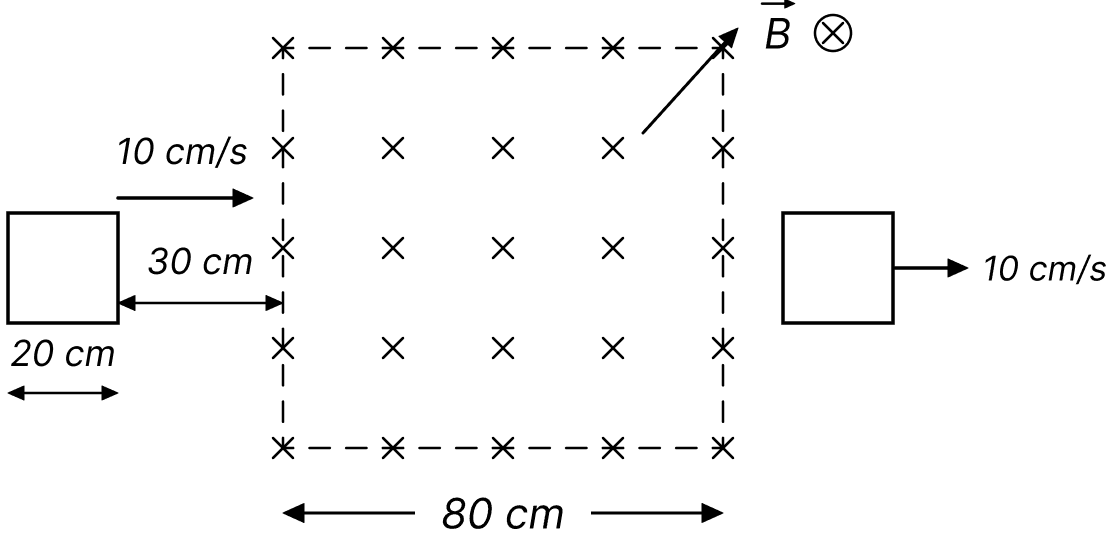
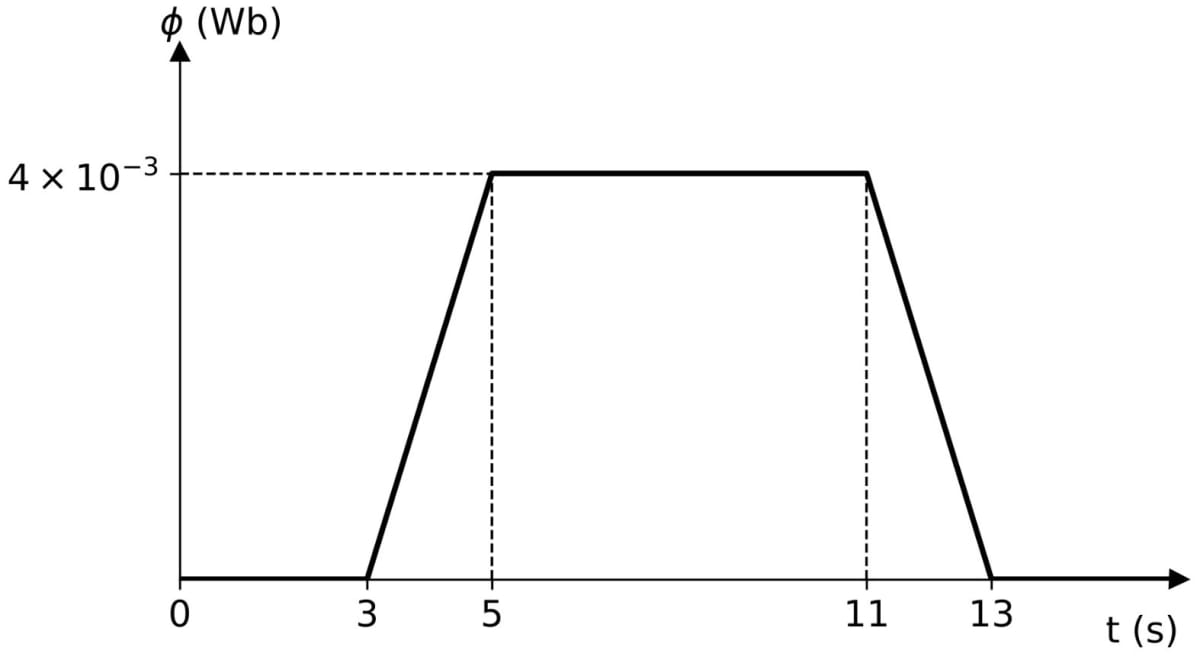
A square loop of side 20 cm is initially kept 30 cm away from a region of uniform magnetic field of 0.1 T as shown in the figure. It is then moved towards the right with a velocity of 10 cm s-1 till it goes out of the field. Plot a graph showing the variation of :
(i) magnetic flux (ϕ) through the loop with time (t).
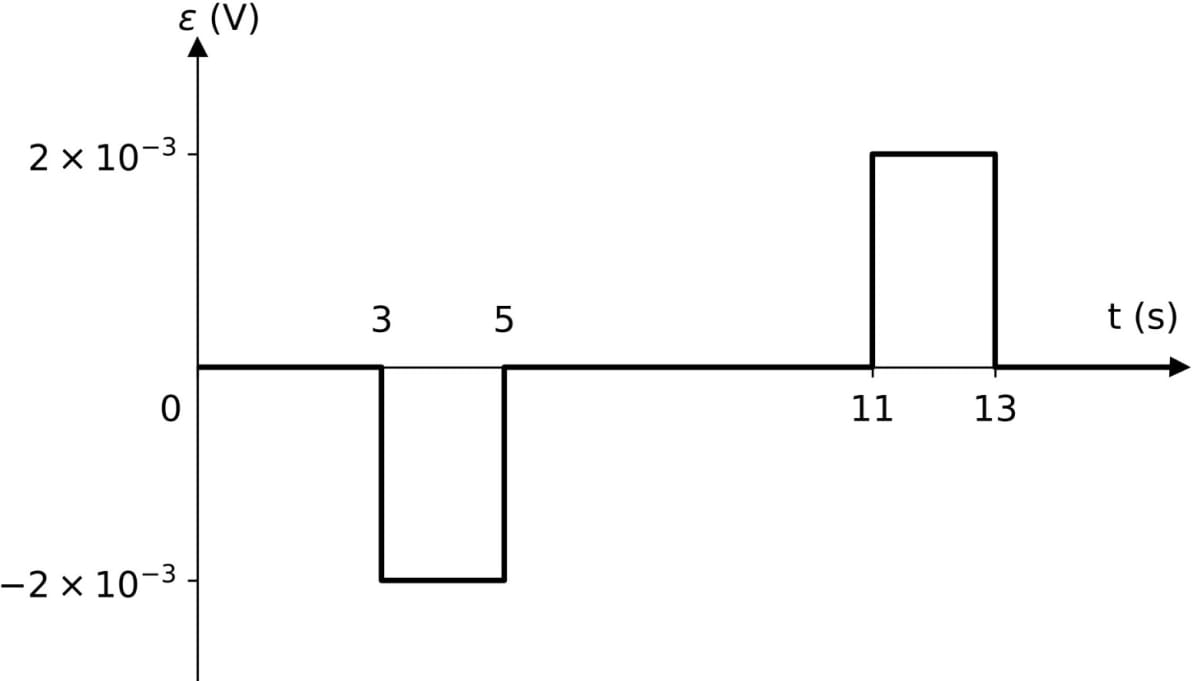
(ii) induced emf (ε) in the loop with time (t).
(iii) induced current in the loop with time (t) if it has resistance of 0.1 Ω.
Answer
Given,
- Side of the loop, a = 20 cm = 0.2 m
- Initial distance of the loop from the field = 30 cm
- Width of the field region = 80 cm
- Magnetic field, B = 0.1 T
- Velocity, v = 10 cm s-1 = 0.1 m s-1
- Resistance of the loop, R = 0.1 Ω
Stages of motion :
- t = 0 to 3 s : the loop covers the 30 cm gap; no part of it is in the field.
- t = 3 s to 5 s : the loop enters the field (20 cm); the area inside the field increases uniformly.
- t = 5 s to 11 s : the loop is wholly inside; its front edge reaches the far boundary after moving 80 cm from entry, at t = 3 + 8 = 11 s.
- t = 11 s to 13 s : the loop leaves the field; the area inside decreases uniformly.
- After t = 13 s : the loop is wholly outside.
Maximum flux, when the loop is wholly inside,
While entering or leaving, only one side of length a cuts the field, so the magnitude of the induced emf is
and the corresponding current is
By Faraday's law, ε = −dϕ/dt. So ε is negative while the flux increases (entering) and positive while it decreases (leaving).
| Time (s) | ϕ (Wb) | ε (V) | I (A) |
|---|---|---|---|
| 0 to 3 | 0 | 0 | 0 |
| 3 to 5 | rises uniformly from 0 to 4 × 10⁻³ | −2 × 10⁻³ | −2 × 10⁻² |
| 5 to 11 | 4 × 10⁻³ (constant) | 0 | 0 |
| 11 to 13 | falls uniformly from 4 × 10⁻³ to 0 | +2 × 10⁻³ | +2 × 10⁻² |
| after 13 | 0 | 0 | 0 |
(i) Magnetic flux versus time :
(ii) Induced emf versus time :
(iii) Induced current versus time :
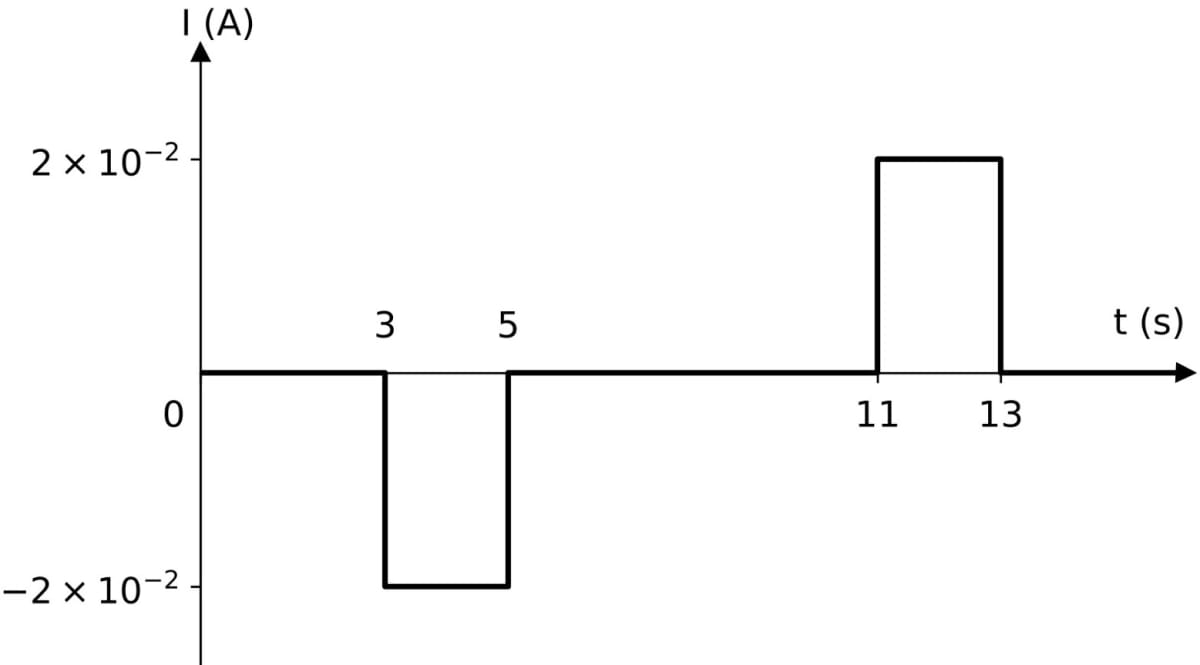
Hence, the flux graph is a trapezium of height 4 × 10⁻³ Wb, while the emf and current are rectangular pulses of 2 × 10⁻³ V and 2 × 10⁻² A, negative during entry (3 s to 5 s) and positive during exit (11 s to 13 s).
Note: The printed graphs begin changing at their time origin; the question specifies an initial 30 cm gap, so the flux and induced pulses begin after 3 s.
A player whose height is 2.0 m runs towards east with a speed of 20 km h-1. How much potential difference will be induced between his head and feet? Horizontal component of earth's magnetic field, BH = 4.0 × 10⁻⁵ Wb m-2. If he runs towards north, then?
Answer
Given,
- Height of the player, l = 2.0 m
- Speed, v = 20 km h-1 = 20 × ms-1 = ms-1
- BH = 4.0 × 10⁻⁵ Wb m-2
Running towards east :
The player's body is vertical, his velocity is towards east and BH is towards north. These three are mutually perpendicular, so the body cuts BH. The vertical component BV is parallel to his body and is not cut.
Running towards north :
His velocity is now parallel to BH, and his body is parallel to BV. He cuts neither component, so no potential difference is induced.
Hence, the potential difference between his head and feet is 4.4 × 10⁻⁴ V when running east and zero when running north.
A magnetic flux of 5 μWb is linked with a coil when a current of 1 mA flows through it. Calculate self-inductance of the coil.
Answer
Given,
- Magnetic flux, ϕ = 5 μWb = 5 × 10⁻⁶ Wb
- Current, I = 1 mA = 10-3 A
The flux linked with a coil is proportional to the current through it, ϕ = LI. Therefore,
Hence, the self-inductance of the coil is 5 mH.
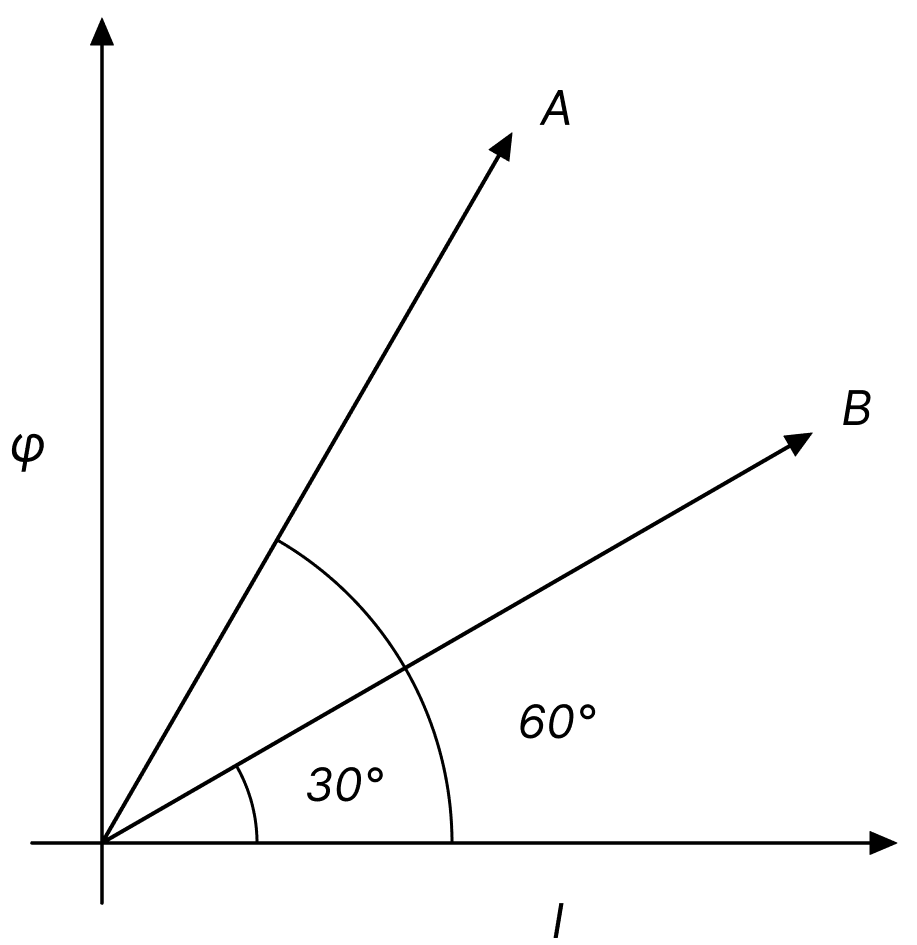
A plot of magnetic flux (ϕ) versus current (I) is shown in the figure for two inductors A and B. Find the ratio of the coefficient of self-inductance of A and B.
Answer
From the figure, line A makes an angle of 60° and line B an angle of 30° with the current (I) axis.
Since ϕ = LI, the self-inductance L = ϕ/I is the slope of the ϕ-I graph, that is, the tangent of the angle the line makes with the I-axis.
Hence, the ratio of the coefficients of self-inductance of A and B is 3 : 1.
If a rate of change of current of 2 As-1 induces an emf of 10 mV in a solenoid, what is the self-inductance of the solenoid?
Answer
Given,
- Rate of change of current, = 2 A s-1
- Induced emf, e = 10 mV = 10 × 10-3 V
The magnitude of the self-induced emf is e = L . Therefore,
Hence, the self-inductance of the solenoid is 5 mH.
The current in a coil increases from zero to 2 A in 0.05 s, due to which an induced emf of 80 V is developed. Calculate the coefficient of self-induction of the coil.
Answer
Given,
- Change in current, ΔI = 2 − 0 = 2 A
- Time, Δt = 0.05 s
- Induced emf, e = 80 V
Rate of change of current,
Using e = L ,
Hence, the coefficient of self-induction of the coil is 2 H.
A coil has an inductance of 4.0 H. Find the emf induced, if a current of 2.7 A in it is stopped within 1.35 s.
Answer
Given,
- Inductance, L = 4.0 H
- Change in current, ΔI = 2.7 A (from 2.7 A to zero)
- Time, Δt = 1.35 s
Hence, the emf induced in the coil is 8.0 V.
A solenoid has 2000 turns wound over a length of 0.3 m. The area of cross-section is 1.2 × 10⁻³ m2. Around its central section a coil of 300 turns is closely wound. If an initial current of 2 A is reversed in 0.25 s, find the emf induced in the coil.
Answer
Given,
- Turns in the solenoid, N1 = 2000
- Length of the solenoid, l = 0.3 m
- Area of cross-section, A = 1.2 × 10⁻³ m2
- Turns in the coil, N2 = 300
- Current reversed from +2 A to −2 A, so ΔI = 4 A, in Δt = 0.25 s
Mutual inductance :
The field inside the solenoid is B = μ0I, and the flux linked with the coil is N2BA. Therefore,
Induced emf :
Hence, the emf induced in the coil is 48.2 mV ≈ 48 mV.
The currents flowing in the two coils of self-inductance L1 = 16 mH and L2 = 12 mH are increasing at the same rate. If the power supplied to the two coils are equal, find the ratio of :
(i) induced voltages,
(ii) the currents and
(iii) the energies stored in the two coils at a given instant.
Answer
Given,
- L1 = 16 mH, L2 = 12 mH
- is the same for both coils
- Power supplied, P1 = P2
(i) Ratio of induced voltages :
Using V = L , with the same for both,
(ii) Ratio of currents :
Using P = VI with P1 = P2,
(iii) Ratio of energies stored :
Using U = LI2,
Hence, the ratios are (i) 4 : 3, (ii) 3 : 4 and (iii) 3 : 4.
Two coils C1 and C2 are placed close to each other. The magnetic flux ϕ2 linked with the coil C2 varies with the current I1 flowing in coil C1, as shown in the figure. Find :
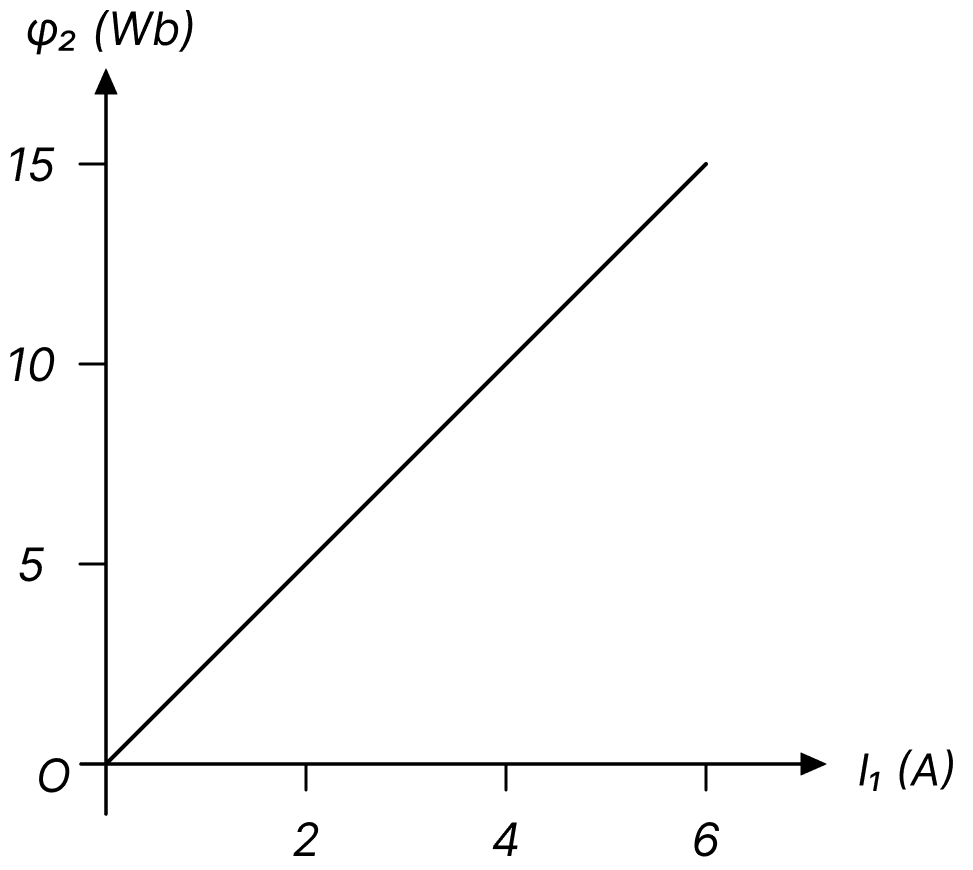
(i) the mutual inductance of the arrangement, and
(ii) the rate of change of current that will induce an emf of 100 V in coil C2.
Answer
From the figure, ϕ2 varies linearly with I1, and ϕ2 = 15 Wb when I1 = 6 A.
(i) Mutual inductance :
Since ϕ2 = MI1, M is the slope of the ϕ2-I1 graph.
(ii) Rate of change of current :
Given e2 = 100 V. Using e2 = M ,
Hence, the mutual inductance is 2.5 H and the required rate of change of current is 40 A s-1.
The current in the primary of a transformer drops from 5 to 3 A in 2 s. If the mutual inductance between the two coils is 0.16 H, then calculate the induced emf in the secondary.
Answer
Given,
- Change in primary current, ΔI = 5 − 3 = 2 A
- Time, Δt = 2 s
- Mutual inductance, M = 0.16 H
Hence, the emf induced in the secondary is 0.16 V.
The mutual inductance between two coils is 0.15 H. If a current of 20 A in the primary coil is cut off in 0.05 s, find the emf induced in the secondary coil. If the secondary coil has 60 turns, then find the flux-change in it.
Answer
Given,
- Mutual inductance, M = 0.15 H
- Change in primary current, ΔI = 20 A (from 20 A to zero)
- Time, Δt = 0.05 s
- Turns in the secondary, N = 60
Induced emf :
Flux change :
The change in flux linkage of the secondary is NΔϕ = MΔI. Therefore, the change in flux through each turn is
Hence, the emf induced in the secondary is 60 V and the flux change in it is 0.05 Wb.
A circular loop of radius 0.3 cm lies parallel to much bigger circular loop of radius 20 cm. The centre of the small loop is on the axis of the bigger loop. The distance between their centres is 15 cm. If a current of 2.0 A flows through the smaller loop, then calculate the flux linked with the bigger loop.
Answer
Given,
- Radius of the small loop, r1 = 0.3 cm = 3 × 10⁻³ m
- Radius of the big loop, R2 = 20 cm = 0.2 m
- Distance between the centres, x = 15 cm = 0.15 m
- Current in the small loop, I1 = 2.0 A
The mutual inductance of a pair of coils is the same whichever coil carries the current. So suppose a current I2 flows in the big loop. Its field at a point on its axis at distance x is
The small loop is so small that this field is uniform over its area A1 = πr12. The flux through it is B2A1, so
Here R22 + x2 = 0.04 + 0.0225 = 0.0625 m2, so (R22 + x2)3/2 = (0.25)3 = 0.015625 m3.
The flux linked with the big loop when I1 flows in the small loop is
Hence, the flux linked with the bigger loop is 9.1 × 10⁻¹¹ Wb.