
Choose the correct relation :
- J = C-V
- J = V-A
- J = C/V
- V = J-C
Answer
J = C-V
Reason — The electric potential at a point is the work done in carrying a unit positive test charge from infinity to that point,
Hence work (joule) = charge (coulomb) × potential (volt), that is 1 J = 1 C × 1 V or J = C-V. Equivalently, 1 volt = 1 joule/coulomb.
A charge of 3 C moving in a uniform electric field experiences a force of 3000 N. The potential difference between two points situated in the field at a distance 1 cm from each other will be :
- 10 V
- 90 V
- 1000 V
- 9000 V
Answer
10 V
Reason —
Given,
- Charge, q = 3 C
- Force, F = 3000 N
- Distance, d = 1 cm = 10-2 m
The intensity of the uniform electric field is
In a uniform electric field the potential difference between two points separated by a distance d along the field is
2 J work is done in taking a charge of 20 C from one point to the other at a distance of 0.2 m. The potential difference between the points is :
- 2 × 10⁻² V
- 4 × 10⁻¹ V
- 8 V
- 1 × 10⁻¹ V
Answer
1 × 10⁻¹ V
Reason —
Given,
- Work done, W = 2 J
- Charge, q = 20 C
By the definition of potential difference,
The distance between the points is not required, since the potential difference is fixed by the work done per unit charge alone.
The electric field inside a hollow charged sphere is zero. The potential V will inside the sphere vary with distance r from the centre of the sphere as :
- V ∝ r
- V ∝
- V ∝
- does not depend on r
Answer
does not depend on r
Reason — The electric field intensity at a point is equal to the negative potential gradient at that point,
Inside a hollow charged sphere E = 0 everywhere, so . Hence the potential does not change with r; it is constant throughout the interior and equal to the potential at the surface, .
A pellet carrying a charge of 0.5 C is accelerated from rest through a PD of 2000 V. It attains a kinetic energy of :
- 1000 J
- 1000 kW-h
- 1000 eV
- zero
Answer
1000 J
Reason —
Given,
- Charge, q = 0.5 C
- Potential difference, V = 2000 V
The kinetic energy gained by a charge q accelerated from rest through a potential difference V is
When a test charge is brought from infinity along the perpendicular bisector of an electric dipole, then the work done is :
- positive
- negative
- zero
- none
Answer
zero
Reason — The perpendicular bisector of a dipole is its equatorial line. At every point on this line the point is equidistant from the charges + q and − q, so the potentials due to the two charges are equal and opposite,
Since the potential is zero everywhere on this line and also zero at infinity, the work done W = q0(Vfinal − Vinitial) = 0.
An electric dipole of moment placed in a uniform electric field has minimum (maximum negative) potential energy when the angle between and is :
- zero
- π
Answer
zero
Reason — The potential energy of an electric dipole placed in a uniform electric field at an angle θ to the field is
U is most negative when cos θ has its greatest value, that is cos θ = 1 or θ = 0. Thus U0 = − pE, which is the least (maximum negative) value. In this position the dipole moment is along the field and the dipole is in stable equilibrium.
A hollow metal sphere fixed on an insulating stand is charged positively. The electric potential inside the sphere is :
- zero
- everywhere same as on the surface
- higher than that on the surface
- lower than that on the surface
Answer
everywhere same as on the surface
Reason — The whole charge given to a hollow metal sphere resides on its outer surface, so the electric field inside the sphere is zero at every point. Since
there is no potential gradient inside, and hence no work is done in moving a charge from one interior point to another. The potential is therefore uniform throughout the interior and equal to its value at the surface, .
A non-conducting ring of radius 0.45 m carries a total charge of 2 × 10⁻¹⁰ coulomb distributed uniformly on its circumference. The amount of work required to take 2 coulomb charge from infinity to the centre of the ring will be :
- 4 J
- 8 J
- − 4 J
- zero
Answer
8 J
Reason —
Given,
- Radius of the ring, R = 0.45 m
- Charge on the ring, Q = 2 × 10⁻¹⁰ C
- Charge to be brought, q = 2 C
Every element of the ring is at the same distance R from the centre, so the potential at the centre is
The work done in bringing the charge q from infinity (where V = 0) to the centre is
A positively charged particle is released from rest in a uniform electric field. The electric potential energy of the charge :
- remains a constant because the electric field is uniform.
- increases because the charge moves along the electric field.
- decreases because the charge moves along the electric field.
- decreases because the charge moves opposite to the electric field.
Answer
decreases because the charge moves along the electric field.
Reason — A free positive charge experiences a force in the direction of the field, so on release it moves along the electric field, that is from a region of higher potential to a region of lower potential. Its potential energy U = qV therefore falls, the loss of potential energy appearing as kinetic energy.
The electric potential on the axis of an electric dipole at a distance 'r' from its centre is V. Then the potential at a point at the same distance on its equatorial line will be :
- 2 V
- zero
- −V
Answer
zero
Reason — The potential at a general point (r, θ) due to a short dipole is
For an axial point θ = 0° and , while for a point on the equatorial line θ = 90°, so cos θ = 0 and V = 0. Physically, an equatorial point is equidistant from + q and − q, so their potentials cancel.
Which one of the following quantities does not obey inverse-square law ?
- Intensity of electric field due to a point-charge.
- Intensity of electric field due to an electric dipole at a distant point.
- Electric potential due to an electric dipole at a distant point.
- Intensity of electric field due to a charged sphere at an external point.
Answer
Intensity of electric field due to an electric dipole at a distant point.
Reason — For a point charge , and a charged sphere behaves at an external point as if its whole charge were placed at its centre, so there also . For a short dipole the potential varies as , which is an inverse-square dependence. But the intensity of the electric field of a dipole at a distant point varies as , and hence it does not obey the inverse-square law.
The electrostatic potential on the surface of a charged conducting sphere is 100 V. Two statements are made in this regard :
S1 : At any point inside the sphere, electric intensity is zero.
S2 : At any point inside the sphere, the electrostatic potential is 100 V.
Which of the following is a correct statement?
- S1 is true but S2 is false.
- Both S1 and S2 are false.
- S1 is true, S2 is also true and S1 is the cause of S2.
- S1 is true, S2 is also true but the statements are independent.
Answer
S1 is true, S2 is also true and S1 is the cause of S2.
Reason — The charge given to a conducting sphere resides entirely on its outer surface, so the electric intensity at every interior point is zero, which makes S1 true. Since
the potential gradient inside vanishes, so V is constant throughout the interior and equal to its surface value of 100 V. Hence S2 is true and follows directly from S1; the vanishing of the intensity is the cause of the constancy of the potential.
Which of the following statements is not true for any equipotential surface?
- The potential difference between any two points on the surface is zero.
- The electric field lines are always perpendicular to the surface.
- No work is done to move a charge from one point to another point along the surface.
- Equipotential surfaces are always spherical.
Answer
Equipotential surfaces are always spherical.
Reason — Any surface over which the electric potential is the same everywhere is an equipotential surface, so the potential difference between any two of its points is zero and no work is done in moving a charge along it. Since there is no potential gradient along the surface, the electric field can have no component parallel to it, and hence the lines of force are always at right angles to the surface. The shape of the surface, however, depends on the charge distribution — the equipotential surfaces are concentric spheres for a point charge but a family of parallel planes for a uniform electric field. Hence the fourth statement is not true.
The work done to move a charge along an equipotential from A to B :
- cannot be defined as
- must be defined as
- is zero
- can have a non-zero value
Answer
is zero
Reason — The electric field is everywhere normal to an equipotential surface, so for every displacement taken along the surface . Hence
The same conclusion follows from W = q(VB − VA), because VA = VB on an equipotential surface.
An electric dipole of dipole moment p is placed parallel to the uniform electric field (in stable equilibrium). The amount of work done in rotating the dipole from stable equilibrium position to its unstable equilibrium position is :
- pE
- 2 pE
- Zero
- −pE
Answer
2 pE
Reason — The work done in rotating a dipole in a uniform electric field from an angle θ1 to an angle θ2 is
The dipole is in stable equilibrium at θ1 = 0 and in unstable equilibrium at θ2 = 180°. Therefore
An electron is accelerated with a potential difference of 500 volt. The speed of the electron will be :
- 8 × 10⁸ m/s
- 2.3 × 10⁷ m/s
- 1.33 × 10⁷ m/s
- 1.33 × 10⁵ m/s
Answer
1.33 × 10⁷ m/s
Reason —
Given,
- Potential difference, V = 500 V
- Charge on electron, e = 1.6 × 10⁻¹⁹ C
- Mass of electron, m = 9.0 × 10⁻³¹ kg
The kinetic energy acquired by the electron equals the work done on it,
Substituting the values,
Two charged particles of same mass have charges + q and + 4q respectively. When they are allowed to fall from rest through the same potential difference, the ratio of their speeds will become :
- 2 : 1
- 1 : 2
- 1 : 4
- 4 : 1
Answer
1 : 2
Reason — For a charge falling from rest through a potential difference V,
Since the mass and the potential difference are the same for both particles, . Hence
that is, the ratio of their speeds is 1 : 2.
Two positive point-charges of 8 μC and 12 μC are situated in air, 10 cm apart. The work done in displacing them 4 cm nearer to each other is :
- zero
- 3.76 J
- 4.76 J
- 5.76 J
Answer
5.76 J
Reason —
Given,
- q1 = 8 μC = 8 × 10⁻⁶ C, q2 = 12 μC = 12 × 10-6 C
- Initial separation, r1 = 10 cm = 0.10 m
- Final separation, r2 = 10 − 4 = 6 cm = 0.06 m
The electric potential energy of a system of two point charges is
The work done equals the increase in this potential energy,
A positive charge is taken from a lower potential point to a higher potential point in an electric field. The electric potential energy :
- increases
- decreases
- remains the same
- may increase or may decrease
Answer
increases
Reason — The potential energy of a charge q at a point of potential V is U = qV. For a positive charge taken from a point of lower potential to a point of higher potential, V increases and so U also increases. This is expected, because a free positive charge moves by itself from higher to lower potential; to carry it the other way an external agent must do work on it, and this work is stored as potential energy of the system.
An electron is brought very close to another electron, then the electric potential energy of the system will :
- decrease
- increase
- remain same
- become zero
Answer
increase
Reason — For two electrons both charges are negative, so their product is positive and the potential energy
is positive, indicating net repulsion. As r decreases, U increases. Work has to be done by an external agent against the force of repulsion in bringing the electrons closer, and this work is stored as the potential energy of the system.
The given diagram shows the equipotential surfaces in a given region of space. The potential difference between any two consecutive surfaces is equal. There are four points marked in the space, namely A, B, C and D as shown.
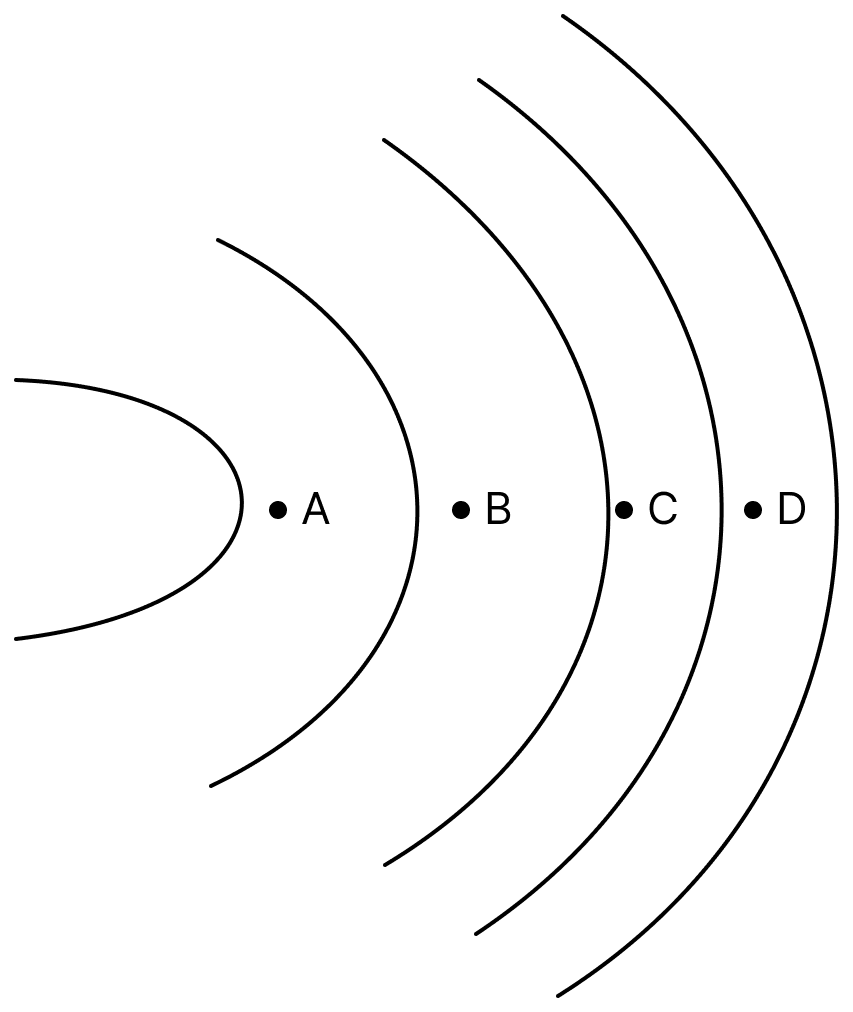
Assertion (A): The electric field strength is greatest at point A and reduces from A to D.
Reason (R): The potential difference in a region of space is equal to the negative electric field gradient in that region.
- Both Assertion and Reason are true, and Reason is the correct explanation of Assertion.
- Both Assertion and Reason are true, but Reason is not the correct explanation of Assertion.
- Assertion is true, but Reason is false.
- Both Assertion and Reason are false.
Answer
Both Assertion and Reason are false.
Reason —
Explanation
Assertion (A) is incorrect : For equal steps of potential, the spacing between successive equipotential surfaces varies inversely as the field, since ; a strong field crowds the surfaces together and a weak field spreads them apart. In the given diagram the successive surfaces come closer and closer as we go from A to D. Hence the electric field strength is least at A and greatest at D; it increases from A to D and does not reduce.
Reason (R) is also incorrect : The correct relation is the reverse of the one stated — the electric field intensity is equal to the negative potential gradient,
It is the field that equals the negative gradient of the potential, not the potential difference that equals the negative gradient of the field.
Therefore, both Assertion and Reason are false.
Three equipotential surfaces due to a point charge 'q' are shown in the diagram. Which one is the correct relation between r1 and r2?
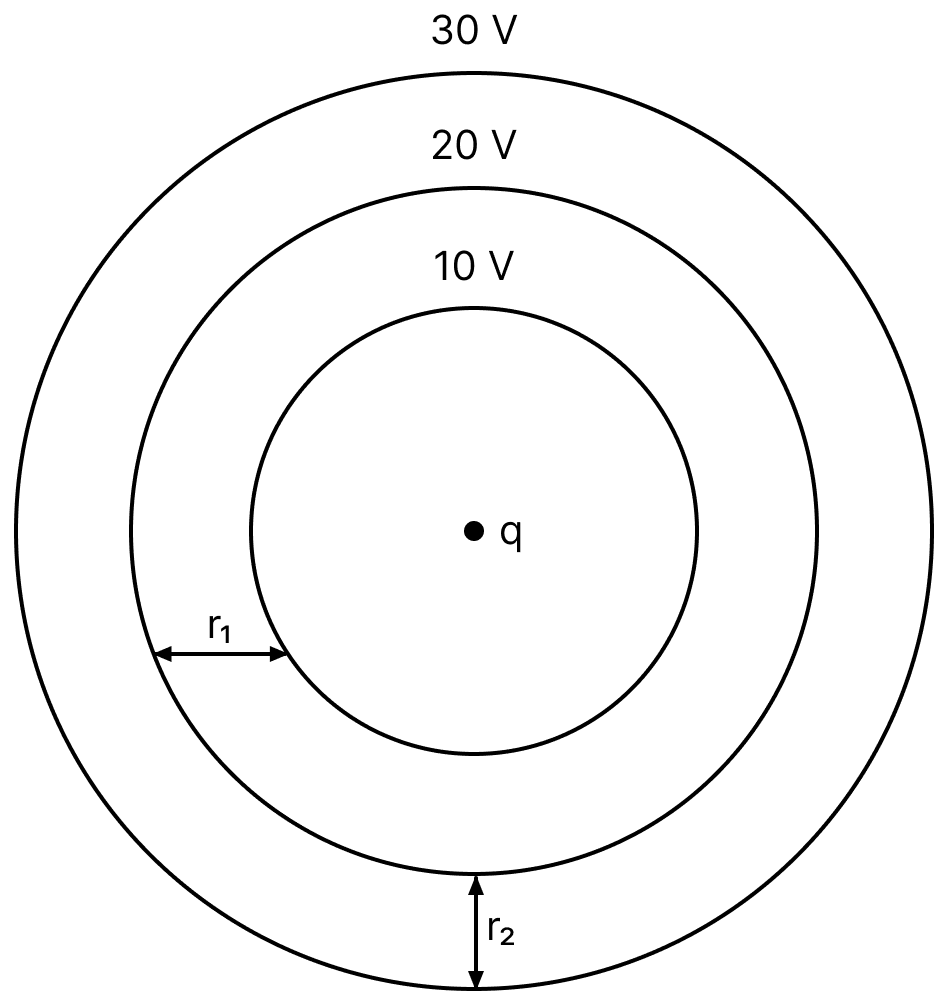
- r1 = r2
- < 1
- > 1
- data is insufficient
Answer
> 1
Reason — For a point charge the equipotential surfaces are concentric spheres of potential
Writing , the radii of the 30 V, 20 V and 10 V surfaces are
In the figure r1 is the separation between the 10 V and 20 V surfaces, and r2 is the separation between the 20 V and 30 V surfaces. Therefore
and
so that
which is > 1.
This agrees with the general property that equipotential surfaces of equal potential interval lie closer together where the field is strong and farther apart where the field is weak.
Note: The textbook gives option (b), < 1. Its figure places 10 V on the innermost and 30 V on the outermost surface, which is impossible for ; option (b) would follow only if the 10 V and 30 V labels were interchanged.
ABCD is a square of side 0.2 m and A, B, C, D, P and Q are the points in a uniform electric field. The potentials at these points are VA = 2V, VB = VD = VP = 5 V and VC = 8V. The electric field at P is :
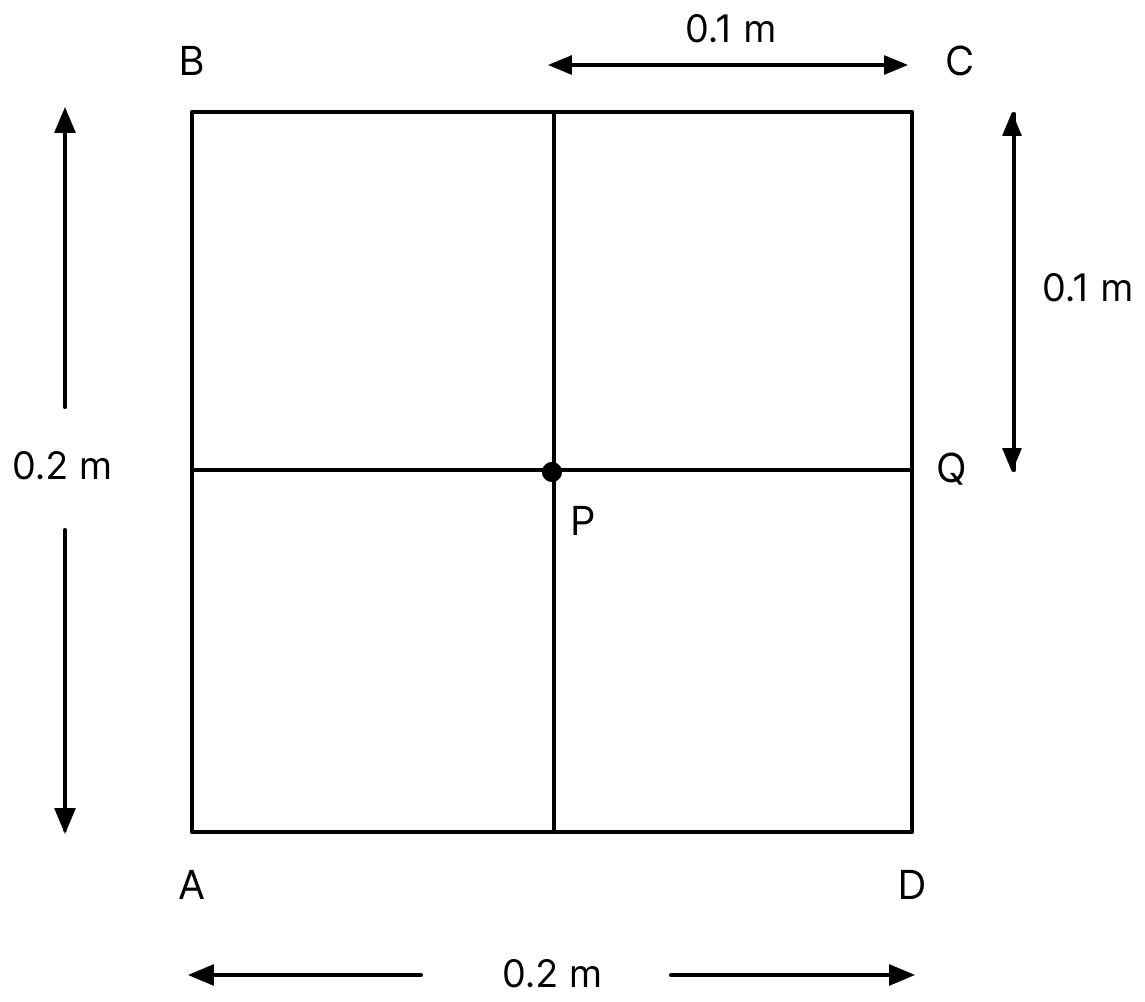
- 10 Vm-1 along PQ
- Vm-1 along PA
- 5 Vm-1 along PC
- 5 Vm-1 along PA
Answer
Vm-1 along PA
Reason —
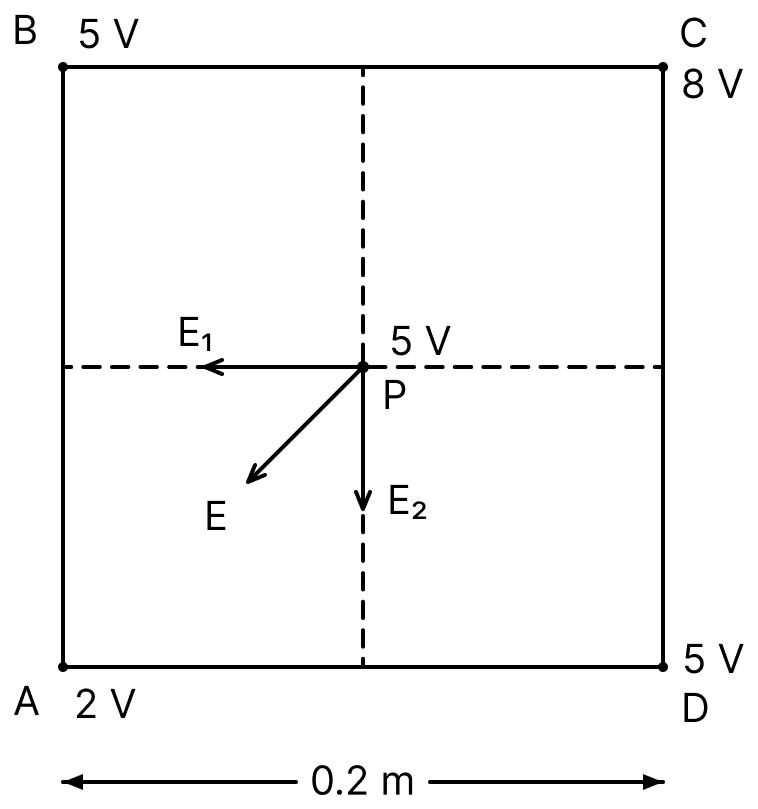
Given, the side of the square is 0.2 m, VA = 2 V, VB = VD = 5 V and VC = 8 V.
Along the side AB the potential rises from 2 V to 5 V over 0.2 m, so the component of the field along BA is
directed from B towards A, since the field points from higher to lower potential.
Similarly along the side AD the potential rises from 2 V to 5 V over 0.2 m, so
directed from D towards A.
These two components are mutually perpendicular, so the resultant field is
Its direction bisects the angle between BA and DA, that is, it points along the diagonal from C towards A. As P is the centre of the square, this direction is along PA.
Electric field at a distance x from the origin is given as
Then, potential difference between the points situated at x = 10 m and x = 20 m is :
- 5 V
- 10 V
- 15 V
- 4 V
Answer
5 V
Reason —
Given, N C-1, with x1 = 10 m and x2 = 20 m.
The potential difference between two points is obtained from
Substituting the given field,
The electric potential V is given as a function of distance x m by V = (5x2 − 10x − 9) volts. The value of electric field at x = 1 m is :
- 20 V/m
- 6 V/m
- 11 V/m
- zero
Answer
zero
Reason —
Given, V = 5x2 − 10x − 9 volt.
The electric field is the negative potential gradient,
Differentiating the given expression term by term,
Therefore
At x = 1 m,
Two concentric spheres of radii R and r have similar charges with equal surface charge densities (σ). What is the electric potential at their common centre?
- σ/ε0
- None of these
Answer
Reason —
Given, two concentric spheres of radii R and r carrying the same surface charge density σ.
The charges on the two spheres are
The potential inside a charged sphere is the same as that at its surface, so the potential at the common centre due to each sphere is . Since potential is a scalar, the two contributions add algebraically,
Situation is shown in figure. Find work done by external agent in moving the point charge (−q) from point P to ∞.
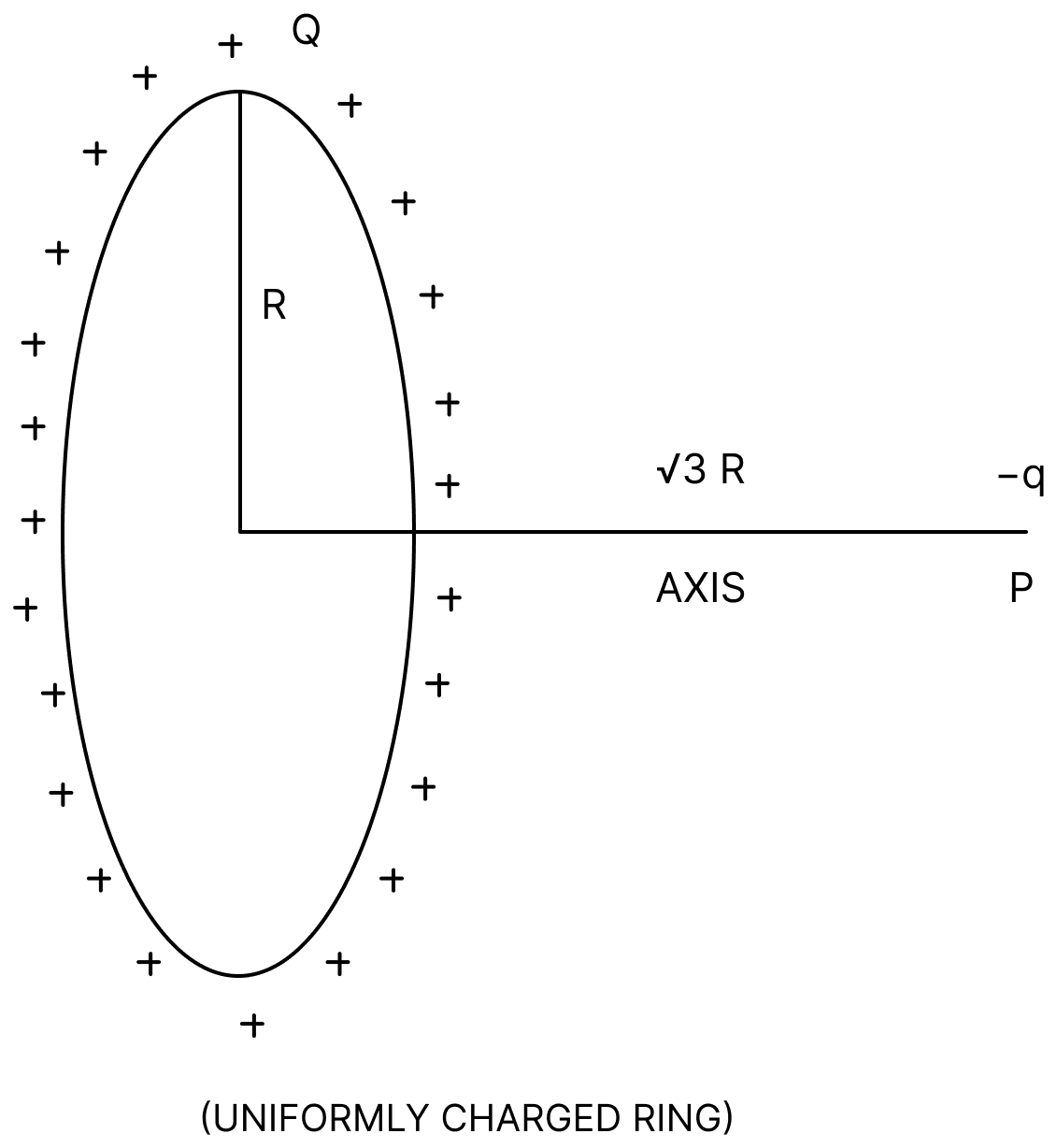
Answer
Reason —
Given, a uniformly charged ring of radius R carrying charge Q, and a point charge (− q) on its axis at a distance from the centre.
Every element of the ring is at the same distance from P,
Hence the potential at P due to the ring is
and the potential at infinity is V∞ = 0. The work done by the external agent is
The work is positive because the charge − q is attracted by the positively charged ring, so the external agent must do work in taking it to infinity.
A charged hollow metal sphere has a radius r. If the potential difference between its surface and a point at distance 3r from the centre is V, then the electric intensity at a distance 3r from the centre is :
Answer
Reason —
Given, a hollow metal sphere of radius r carrying a charge Q, with Vsurface − V3r = V.
Writing , the potential at the surface and at the external point distant 3r are
Therefore
The electric intensity at the external point distant 3r is
Which statement is true?
(i) A ring of radius R carries a uniformly distributed charge +Q. A point charge −q is placed on the axis of the ring at a distance 2R from its centre and released. The particle executes simple harmonic motion along the axis of the ring.
(ii) Electrons move from a region of higher potential to that of lower potential.
- Only (i)
- Only (ii)
- Both (i) and (ii)
- None of these
Answer
None of these
Reason — Statement (i) is false. The restoring force on the charge on the axis of the ring is proportional to the displacement, and hence the motion is simple harmonic, only when the displacement is very small compared with the radius (x << R). At a distance 2R the force is not proportional to the displacement, so the motion is oscillatory but not simple harmonic.
Statement (ii) is also false. A free positive charge moves from a region of higher potential to a region of lower potential, while a free negative charge moves in the opposite sense. Since electrons are negatively charged, they move from a region of lower potential to a region of higher potential.
Hence neither statement is true.
How much work is done in taking an electron around a nucleus in a circular path?
Answer
No work is done in this process.
Explanation:
The electrostatic force of attraction which furnishes the centripetal force always remains perpendicular to the direction of velocity of the electron. Alternatively, the circular orbit of the electron around the nucleus is an equipotential surface, so the potential difference between any two of its points is zero. Hence
We assume the potential of earth zero. Can it be assumed +100 volt? What will be the effect of it on the measurement of electric potential at a point? On the potential difference between two points?
Answer
Yes, it can be assumed.
Explanation:
The potential at a point in an electric field is arbitrary and depends on the choice of the zero of reference. If the potential of the earth is taken as +100 volt, the measured value of the potential at every point will be increased by 100 volt. There will be no effect on the potential difference between two points, because the same constant is added at both points and cancels out in the difference. It is the potential difference between two points that matters and not the absolute potential.
Does the electric potential increase or decrease along an electric line of force?
Answer
The electric potential decreases along an electric line of force.
Explanation:
This follows from the relation , in which the negative sign signifies that the potential decreases in the direction of the electric field, that is, along a line of force.
Will an electron in an electric field move towards higher potential or lower potential? Proton?
Answer
The electron will move towards higher potential and the proton towards lower potential.
Explanation:
A free positive charge such as a proton moves from a region of higher potential to a region of lower potential, since the force qE on it acts along the field. A free negative charge such as an electron experiences a force opposite to the field and therefore moves from lower potential to higher potential.
An electron is brought towards another electron. What happens to the electrostatic potential energy of the system?
Answer
It increases.
Explanation:
Both the charges are negative, so their product is positive and the potential energy is positive, indicating repulsion. As the separation r decreases, U increases; the work done by the external agent against the repulsion is stored as potential energy of the system.
How much work will be done by an external agent to turn an electric dipole of moment p through (i) 90°, (ii) 180° (end-for-end) and (iii) 360° from the direction of a uniform electric field E?
Answer
(i) pE, (ii) 2pE, (iii) 0
Explanation:
The work done in rotating a dipole from the direction of the field through an angle θ is
(i) For θ = 90°, W = pE(1 − cos 90°) = pE(1 − 0) = pE
(ii) For θ = 180°, W = pE(1 − cos 180°) = pE[1 − (−1)] = 2pE
(iii) For θ = 360°, W = pE(1 − cos 360°) = pE(1 − 1) = zero
What is the potential energy of a dipole of moment p when it is perpendicular to a uniform electric field E?
Answer
Zero.
Explanation:
The potential energy of a dipole placed at an angle θ to a uniform electric field is Uθ = − pE cos θ. For θ = 90°,
State how the following quantities depend upon r :
(i) electric field and potential due to a point-charge,
(ii) potential at a distance r from the centre of a charged metallic sphere (r < radius of the sphere).
Answer
(i) For a point charge, the electric field varies inversely as the square of the distance and the potential inversely as the distance,
(ii) The potential will not depend upon r. Inside a charged metallic sphere the electric field is zero, so there is no potential gradient and the potential remains constant, equal to its value at the surface.
A point charge Q is revolved in a circle of radius R around another point charge q. What will be the work done in a complete revolution? What if the charge q is not at the centre of the circle?
Answer
The work done is zero in both cases.
Explanation:
The work done in taking a charge from one point to another is W = Q(VA − VB), where VA and VB are the potentials at the two points. As the charge Q returns to the same point after completing a revolution, VA = VB and hence W = 0.
When q is at the centre of the circle, the circle is itself an equipotential surface, so the potential is the same at all points on it and the work done is zero even for an incomplete revolution.
What is the work done by the electric field of a nucleus in a 'complete' circular orbit of the electron around it? What if the orbit be elliptical?
Answer
The work done is zero, irrespective of whether the orbit of the electron is circular or elliptical.
Explanation:
The electrostatic field is a conservative field. In a complete orbit the electron returns to its starting point, so the potential difference between the initial and the final position is zero, and hence W = q ΔV = 0.
At each of the corners of an equilateral triangle of side a metre is placed a point charge + q coulomb. What will be the electrostatic potential at the centroid of the triangle?
Answer
The distance of the centroid from each corner of an equilateral triangle of side a is .
Since potential is a scalar quantity, the potentials due to the three charges add algebraically,
Hence, the electrostatic potential at the centroid is volt.
Three charges q1 = 5 μC, q2 = 6 μC and q3 = −7 μC are placed on the circumference of a circle of radius 1.0 m as shown in figure. What is the value of charge q4 placed on the same circle, if the potential at the centre, Vo = 0?
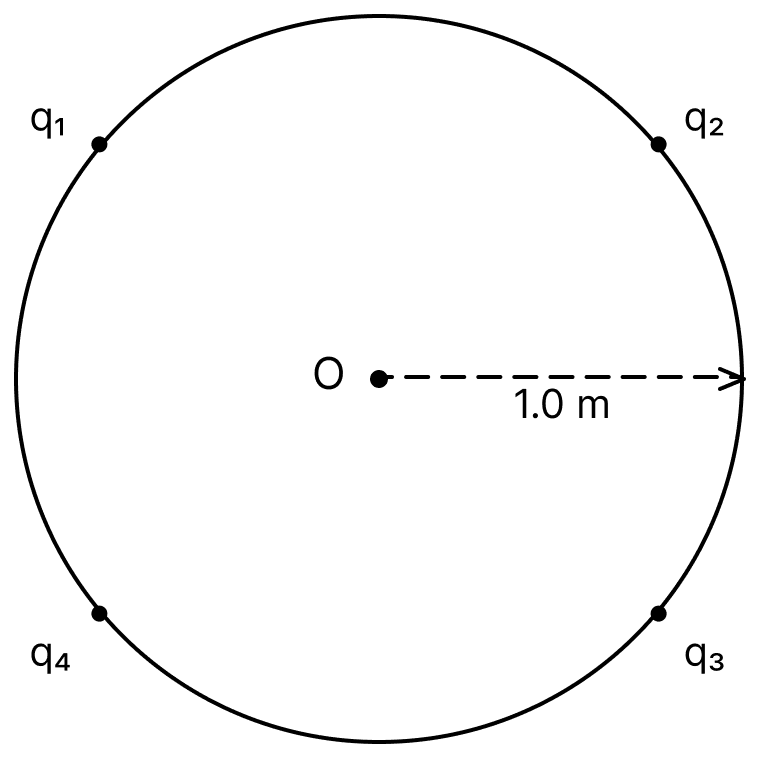
Answer
Given,
- q1 = 5 μC, q2 = 6 μC, q3 = − 7 μC
- Radius of the circle, r = 1.0 m
All four charges lie on the circumference, so each is at the same distance r from the centre. As potential is a scalar,
This requires
Hence, the charge q4 is − 4 μC.
At a point P situated at a certain distance from a point charge + q, the electric field is E and the electric potential is V. (i) If another charge + q be placed at the same distance on the other side of P, then what will be the resultant field and potential at the point P? (ii) If the new charge be − q, then?
Answer
(i) Resultant field = zero, resultant potential = 2V; (ii) resultant field = 2E, resultant potential = zero.
Explanation:
(i) The two charges + q are on opposite sides of P and at equal distances from it. The two fields at P are equal in magnitude but opposite in direction, so the resultant field is zero. The potential is a scalar and the two contributions are equal and of the same sign, so the resultant potential is 2V.
(ii) If the new charge is − q, the two fields at P point the same way and add up to give a resultant field of 2E. The two potentials are equal in magnitude but opposite in sign, so the resultant potential is zero.
If the electric potential V is constant throughout a given region of space, what can you say about the electric field E in that region?
Answer
The electric field is zero in that region.
Explanation:
If V is constant everywhere, the potential gradient vanishes in every direction, and since
the electric field intensity must be zero throughout that region.
The electric field is discontinuous across the surface of a charged conductor (field vanishes inside the conductor). Is electric potential also discontinuous there?
Answer
No, the electric potential is continuous there.
Explanation:
The potential inside a charged conductor is constant and equal to its value at the surface, so there is no sudden jump in V as the surface is crossed. Only the field, which is the potential gradient, changes abruptly from zero inside to a finite value just outside.
A small metallic sphere is placed at the centre of a large charged spherical shell and the two are connected by a wire. Will any charge flow on the inner sphere?
Answer
No, no charge will flow to the inner sphere.
Explanation:
The potential at every point inside a charged spherical shell is the same as that at its surface. Hence the inner sphere and the shell are already at the same potential, and charge flows between two conductors only when there is a potential difference between them. The entire charge continues to reside on the outer surface of the shell.
What is a conservative field? Give example.
Answer
A force field is said to be conservative if the work done by an external agent in taking a body between two points in the field depends only on the location of these two points and is independent of the path adopted in joining them.
An equivalent statement is that the work done in taking a body around any closed path in such a field is zero.
Examples : The electrostatic field and the gravitational field are conservative fields.
Define electrostatic potential at a point. Is it a scalar or a vector?
Answer
Electric potential : The minimum amount of work done by an external agent in carrying a unit positive test charge from infinity to a point in the electric field is called the electric potential at that point.
It is a scalar quantity. Its SI unit is the volt (V), where 1 volt = 1 joule/coulomb.
What is an equipotential surface? Draw equipotential surfaces in a uniform electric field.
Answer
Equipotential surface : Any surface over which the electric potential is the same everywhere is called an equipotential surface.
For a uniform electric field the equipotential surfaces are a family of planes perpendicular to the lines of force.
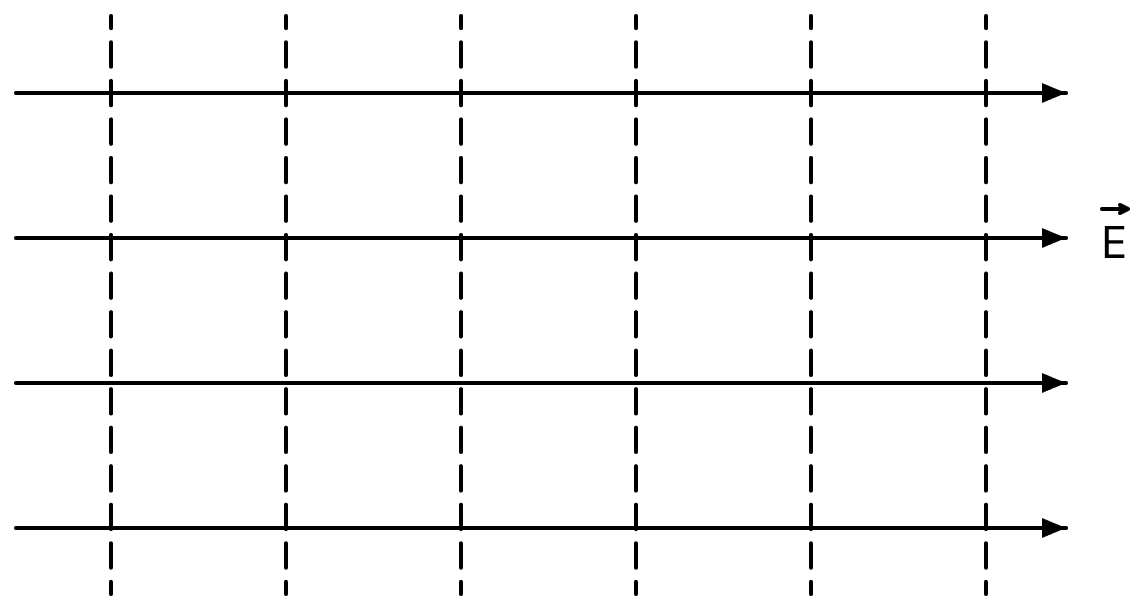
In the figure the dotted lines are the cross-sections of these planar equipotential surfaces, drawn at right angles to the uniform field .
What will be the equipotential surfaces corresponding to (i) a constant electric field in the z-direction, (ii) a field that uniformly increases in magnitude but its direction remains unchanged along the z-axis and (iii) a single positive charge at the origin?
Answer
(i) Equidistant planes parallel to the x-y plane, since the field is uniform and directed along the z-axis.
(ii) Again planes parallel to the x-y plane, but they become closer together as the field increases in magnitude, because for the same potential interval .
(iii) Concentric spheres with their centre at the origin, since for a point charge has the same value at all points of a given radius.
Electric charge is uniformly distributed on the surface of an inflated spherical rubber balloon. State how do the values of electric intensity E and potential V vary (i) on the surface, (ii) inside and (iii) outside.
Answer
(i) On the surface : E is the same everywhere and V is also the same everywhere, since the charge is uniformly distributed over a spherical surface.
(ii) Inside : E is zero at every interior point, and V is the same everywhere and equal to its value at the surface.
(iii) Outside : Both E and V decrease as one moves away from the balloon, E more rapidly than V, since while .
A charge is moved opposite to the Coulombian force in an electric field. By whom will the work be done? What will be its effect on the field? On the energy of the system?
Answer
Work will be done by some external agent in moving the charge against the electrostatic force.
This work will have no effect upon the field, since the source charges producing the field are unaltered.
However, the work done will be stored as potential energy in the field. Hence the energy of the system consisting of the source charge and the moving charge will increase.
A uniform electric field E exists between two charged plates. What will be the work done in moving a charge q along a closed rectangular path?
Answer
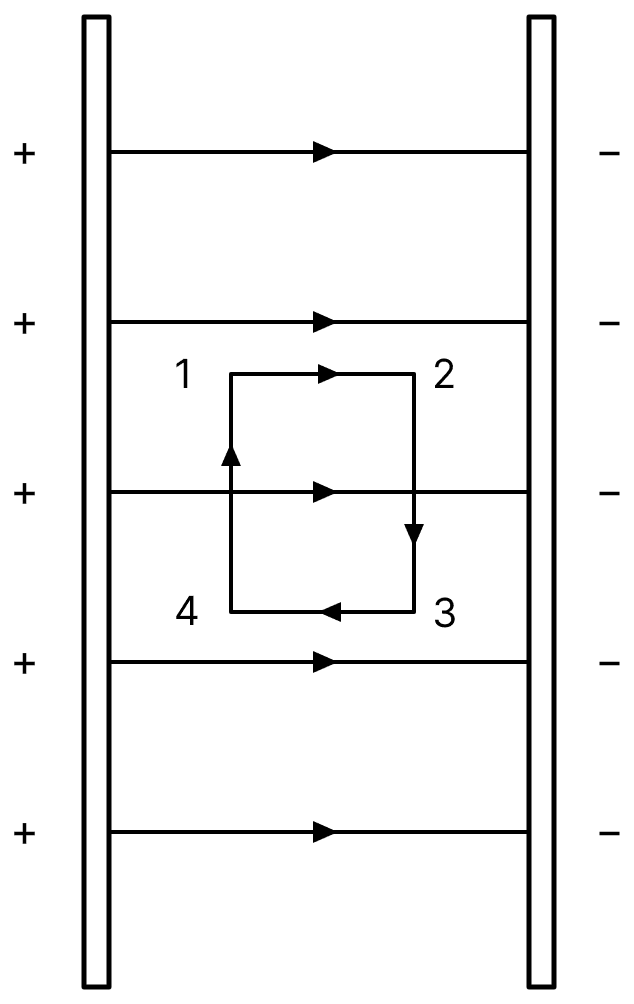
The net work done along the closed rectangular path will be zero.
Suppose the breadth of the rectangular path is d. The force on the charge q is qE. The work done in taking the charge from 1 → 2 is qE × d, and that from 3 → 4 is − qE × d, so these cancel. No work is done in taking the charge from 2 → 3 and from 4 → 1, because along these paths the direction of the force acting on the charge is perpendicular to the displacement.
This result is consistent with the conservative nature of an electrostatic field.
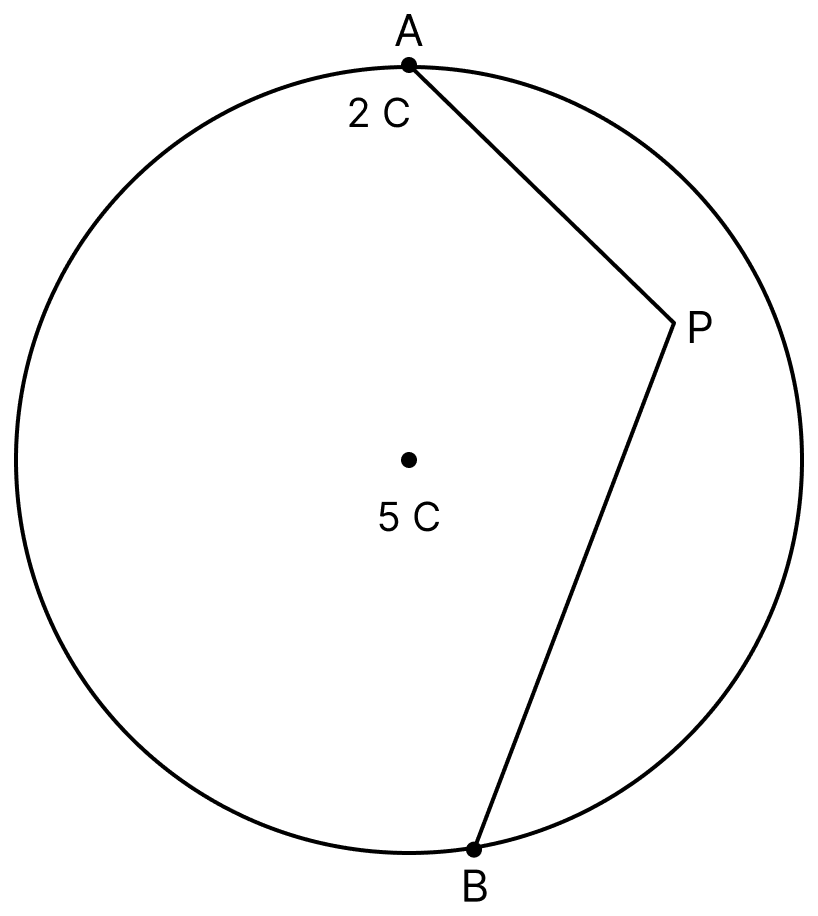
(a) A charge of 5 C is placed at the centre of a circle of radius 10 cm, as shown in the figure. Calculate the work done in moving a charge of 2 C from point A to B on the circumference of the circle.
(b) If the charge 2 C be first taken from A to P and then from P to B, then along which path more work will be done.
Answer
(a) Zero, because the points A and B lie on the circumference of the circle whose centre carries the charge 5 C. The circumference is therefore an equipotential surface, and the potential at A due to the charge 5 C is the same as that at B. Hence
(b) Equal work will be done along both the paths. Since A, P and B all lie on the same circle, VA = VP = VB. Therefore the potential difference between A and P is the same as that between P and B, both being zero, and the work done along each part of the path is zero.
Two point charges, each + q coulomb, are located on the X-axis at points (a, 0) and (−a, 0). Determine electric potentials at the origin and at point (0, b) on the Y-axis. The distances are in metre.
Answer
Given,
- Two charges, each + q, at (a, 0) and (− a, 0)
At the origin : The distance of the origin from each charge is a. Since potential is a scalar,
At the point (0, b) : The distance of this point from each charge is
Therefore
Can several identical charges be so arranged that the electric field and the potential both be zero at a point? Can several positive and negative charges be so arranged?
Answer
No, identical charges can produce zero field but not zero potential.
The fields due to identical charges can cancel vectorially at a suitable point, but the potential is a scalar and the contribution of every charge of the same sign has the same sign. Hence the potentials add up and cannot cancel.
However, positive and negative charges can be so arranged as to produce both zero field and zero potential at a point, since then the scalar contributions to the potential are of opposite signs and can also cancel.
The electric potential is zero at a point in an electric field. Will the electric field be necessarily zero at that point?
Answer
No, zero potential at a point does not necessarily mean that the electric field is zero at that point.
For example, at a point midway between two equal and opposite charges, and at every point on the equatorial line of a dipole, the potential is zero but the electric field is certainly not zero.
If the electric field intensity is zero at a point, will the electric potential be necessarily zero at that point?
Answer
No.
For example, the electric field is zero at a point exactly midway between two equal and similar charges, but the potential at that point is twice that due to a single charge. Similarly the field is zero everywhere inside a charged hollow conductor, while the potential there has the same non-zero value as at the surface.
The potentials of two points A and B are respectively +V and −V volt. If the distance between them be r metre, then calculate (i) average electric field between A and B and (ii) change in potential energy in moving q coulomb of charge from point A to B.
Answer
Given,
- VA = + V volt, VB = − V volt
- Distance between the points, d = r metre
(i) Average electric field :
(ii) Change in potential energy :
The potential energy therefore decreases by 2qV joule.
Note: The textbook answer states that the potential energy will increase by 2qV joule. For a positive charge q moving from the higher potential point A to the lower potential point B, the potential energy actually decreases by 2qV joule; the magnitude of the change is 2qV in either case.
Electric lines of force are always normal to an equipotential surface in an electric field . Why?
Answer
No work is done in moving a charge from one point to another on an equipotential surface, because the potential difference between any two of its points is zero. This means that there is no potential gradient along any direction parallel to the surface. Taking ds as a small displacement along the surface, the component of the field parallel to the surface is
Hence , and with it the lines of force, must be normal to the equipotential surface.
An electron starts from rest in an electric field and acquires a speed v in reaching a point. If V be the PD between the starting point and the reaching point, then prove that v ∝ .
Answer
Let m be the mass and e the magnitude of the charge of the electron.
The work done on the electron by the field in taking it through a potential difference V is eV, and since the electron starts from rest, this appears entirely as its kinetic energy,
For a given particle e and m are constants, so is a constant.
Hence .
An α-particle and a proton are accelerated through the same potential difference. Find the ratio of velocities and linear momenta acquired by them.
Answer
Given,
- Both particles are accelerated through the same potential difference V
- mα = 4mp and qα = 2qp
For a charge q accelerated from rest through a potential difference V,
Ratio of velocities :
Ratio of linear momenta : Since ,
Hence and .
The charges − q and + q of a dipole are located at points (0, 0, −a) and (0, 0, a). How much work is done in moving a small test charge from the point (5, 0, 0) to (−7, 0, 0) along the X-axis? Does the answer change if the path of the test charge is not along X-axis?
Answer
The dipole is held along the Z-axis with its centre at the origin. Therefore the X-axis is the equatorial line of the dipole, and the potential at all points of this line is zero.
Both the initial point (5, 0, 0) and the final point (− 7, 0, 0) lie on the X-axis, so
Hence, no work is done.
The answer will remain zero even if the path of the test charge is changed, because the work done in an electrostatic field between two given points is independent of the path connecting them.
No work is done in taking a positive charge from one point to other inside a positively charged metallic sphere, while outside the sphere work is done in taking the charge from one point to the other (towards the sphere). Explain.
Answer
All points in the space inside a charged metallic sphere are at the same electric potential, because the electric field there is zero everywhere. As there is no potential difference between any two interior points, no work is done in moving a charge between them.
Outside the sphere, however, the potential varies as , so there is a potential gradient and hence an electric field at every point. Moving a positive charge towards the positively charged sphere means moving it towards a region of higher potential, against the force of repulsion. Work must therefore be done by an external agent.
Can a charge of 1 coulomb be given to a metallic sphere of radius 1 cm?
Answer
No.
Given, q = 1 C and R = 1 cm = 0.01 m. The electric field on the surface of the sphere would be
The dielectric strength of air is about 3 × 10⁶ V m-1. If the intensity of the electric field in air is greater than this value, the air will be ionised and there will be leakage of charge from the sphere into the air.
Hence the sphere will not be able to hold a charge of 1 coulomb.
Show that electric potential at a point P, at a distance r from a fixed point charge Q is given by
Answer
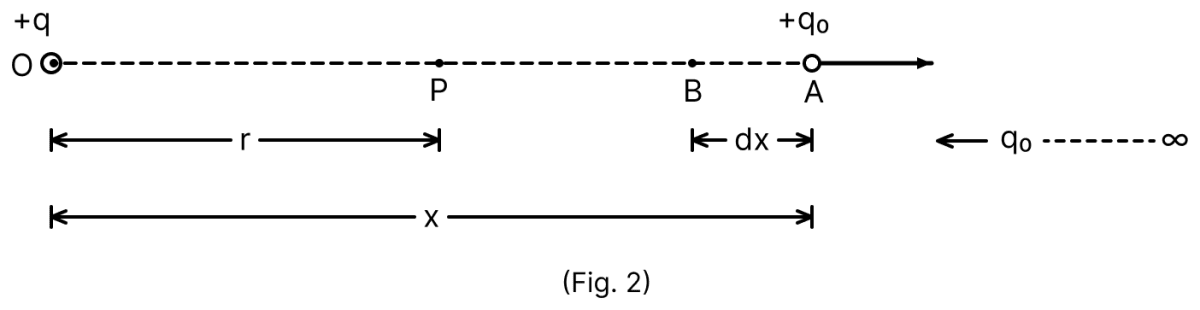
Let a point charge + Q coulomb be held at a point O in vacuum, and let P be the point, at a distance r from O, where the electric potential is required. The potential at P is the work done per unit charge in bringing a test charge + q0 from infinity to P, so this work has to be found first.
Consider the test charge + q0 at an intermediate point A, at a distance x from O on the far side of P. According to Coulomb's law, the electric force on q0 has the magnitude
This force points away from O. When the test charge is moved through a small distance dx to the neighbouring point B, its displacement is opposite to the force, which is why a negative sign appears in the work done,
Adding up all such elements from x = ∞ to x = r gives the total work done in bringing + q0 up to the point P,
Since the electric potential is the work done per unit test charge,
Hence, the electric potential at a point distant r from a point charge Q is .
Define potential difference between two points in an electric field. Derive the relation between electric field and potential difference.
Answer
Potential difference : The work done by an external agent in carrying a unit positive test charge from one point to the other point in an electric field is called the potential difference between those points.
If W is the work done in carrying a test charge q0 from B to A, then
Its SI unit is the volt and it is a scalar quantity.
Relation between electric field and potential difference :
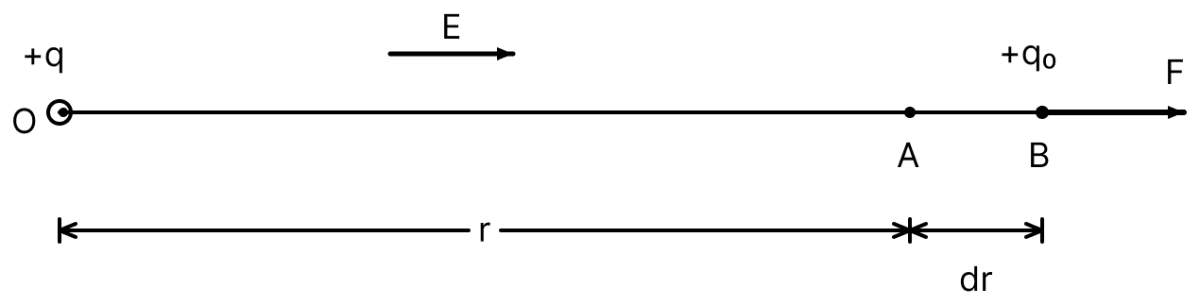
Take a point charge + q at a point O, producing an electric field E along the X-axis. Let A and B be two neighbouring points on this axis at distances r and r + dr from O, the separation dr being vanishingly small. Let V and V + dV be the electric potentials at A and B respectively, so that dV = VB − VA is the change in potential over the distance dr.
A small positive test charge q0 is now carried from B to A. The field exerts on it a force F along the direction of the field, where
In moving q0 from B to A, an external agent has to work against the force F, so it applies an equal force directed towards A. The displacement from B to A, of magnitude dr, is in the direction of this applied force, so the work done by the agent is positive. If this work is dW, then, using Eq. (i),
From the definition of potential difference, the work done per unit charge in going from B to A is VA − VB, so
Equating the right-hand sides of Eqs. (ii) and (iii),
Here , the change of potential per unit distance, is called the potential gradient. The relation therefore shows that the electric field intensity in any given direction equals the negative of the potential gradient in that direction, the negative sign indicating that the potential falls as one moves along the electric field.
The relation also shows that the unit of electric field may be written as volt/metre, so that 1 N-C-1 = 1 V-m-1.
What is an equipotential surface? Draw the same for a point charge. Show that electric field is always directed perpendicular to an equipotential surface.
Answer
Equipotential surface : Any surface over which the electric potential is the same everywhere is called an equipotential surface.
Equipotential surfaces for a point charge : An isolated point charge + q produces at a distance r the potential
Since V depends only on r, every point of a sphere of radius r centred on + q is at the same potential , so such a sphere is an equipotential surface. The equipotential surfaces of a point charge are therefore concentric spheres centred on the charge, the potential of each being inversely proportional to its radius r.
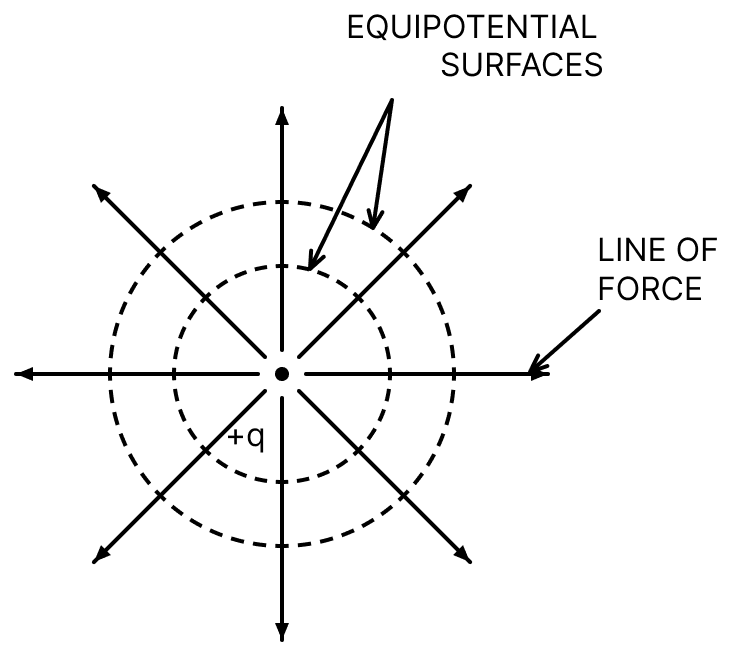
Electric field is perpendicular to an equipotential surface : All points of an equipotential surface are at the same potential, so carrying a charge between any two of them requires no work. Consequently the potential does not change along any direction lying in the surface, and the component of the field in such a direction, being the negative potential gradient, is zero,
With no component along the surface, the electric field , and with it every line of force, must cross the equipotential surface at right angles. For a point charge this is seen directly: the radial lines of force cut each of the concentric spherical equipotential surfaces normally.
What do you mean by the potential energy of a system of charges? Derive energy expression for two point charges separated by a distance. Generalise the result for a system of n point charges.
Answer
Electric potential energy : The electric potential energy of a system of charges is the work done in bringing those charges from infinity to their positions near each other in the system.
Expression for two point charges :
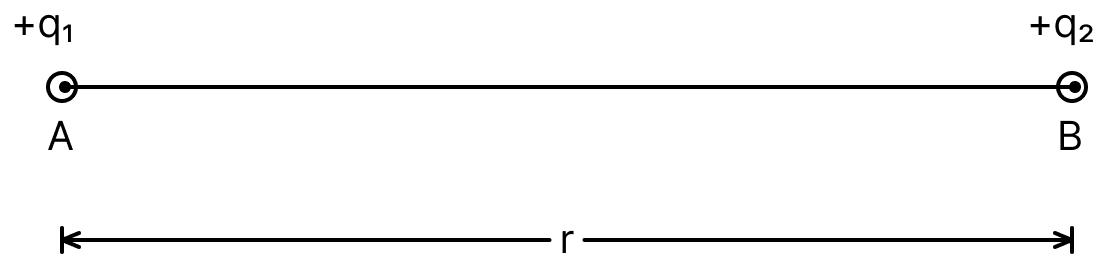
Consider two charges + q1 and + q2 coulomb in vacuum, at the points A and B, a distance r metre apart, forming the system AB.
To find the energy of this system, imagine that + q1 is already at A while + q2 is at infinity. The charge + q1 sets up at B the electric potential
The work needed to bring q2 from infinity to B is the product of the charge and this potential (= charge × potential),
This work is stored as the electric potential energy U of the system,
The charges q1 and q2 are substituted in this formula along with their signs. U therefore comes out positive for like charges, showing net repulsion, and negative for unlike charges, showing net attraction.
Generalisation for n point charges : For a system of n charges the potential energy is found pair by pair. There are distinct pairs; the energy of each pair is obtained from the two-charge formula and all the terms are added algebraically,
the sum running over all the pairs.
For instance, three charges q1, q2 and q3 at the corners of a triangle have the potential energy
Derive an expression for the total work done in rotating an electric dipole through an angle θ in a uniform electric field.
Answer
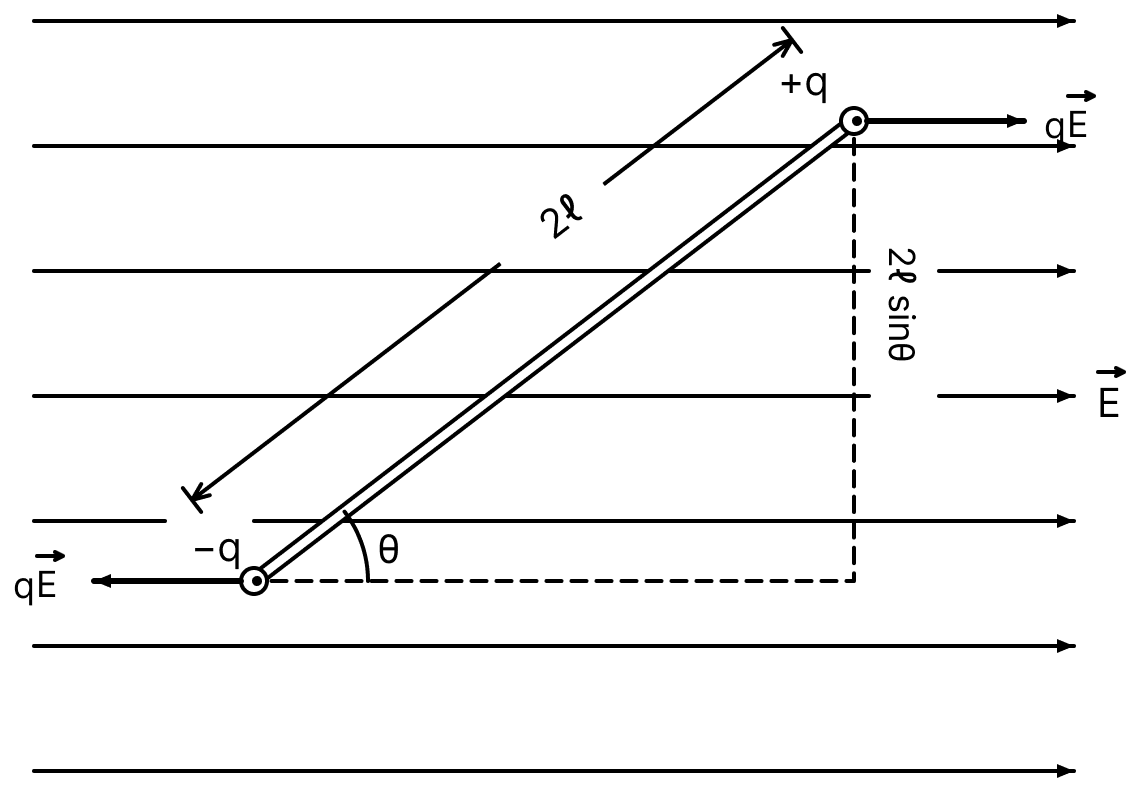
A dipole in a uniform electric field rests in equilibrium with its moment along the field, and turning it away from this position requires work. Let a dipole of moment p (= q × 2l) be turned through an angle θ from its equilibrium position in a uniform electric field E. The couple acting on the dipole does not stay constant but changes as the dipole turns.
When the dipole is at some angle θ to the field E, the torque on it is
To turn it from this position through a further, infinitesimally small angle dθ, the work required is
Integrating between the limits θ1 and θ2 gives the work done in turning the dipole from θ1 to θ2,
For a rotation that starts from the equilibrium position (θ1 = 0) and ends at an angle θ with the field,
Define potential energy of a point charge in a uniform electric field . Obtain the expression for the potential energy of a dipole of moment in a uniform electric field .
Answer
Potential energy of a point charge in an external field : Let V be the potential at a point P arising from an external electric field. If a charge q is brought slowly from infinity to P, the work done by the external agent is
This work is stored as the electrostatic potential energy of the charge q at the point P in the external field, U = qV.
Potential energy of a dipole in a uniform electric field :
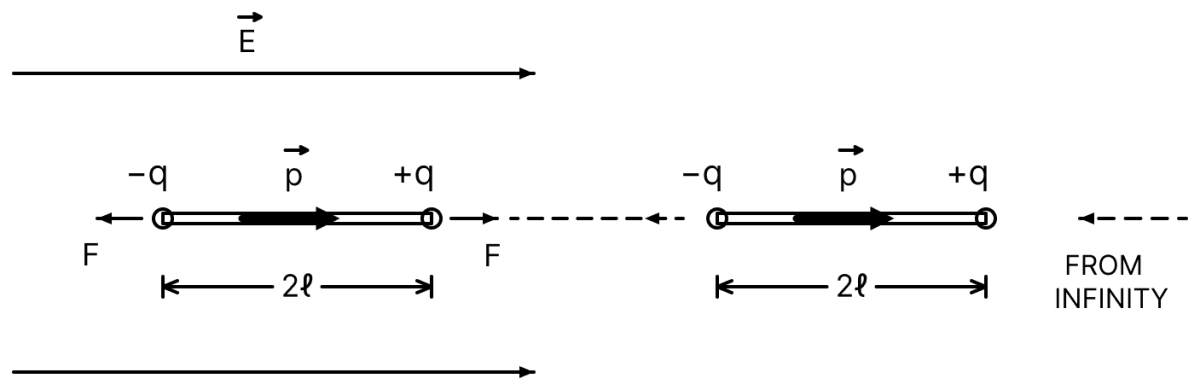
The potential energy of a dipole in an electric field equals the work done in bringing it from infinity to its position inside the field.
Imagine the dipole being carried in from infinity into a uniform electric field E, with its dipole moment p kept along the field throughout. The field pushes the charge + q along E with a force F (= qE) and pulls the charge − q the opposite way with an equal force F (= qE). So, while the dipole is brought in, an external agent does work on + q, whereas on − q the work is done by the field itself.
In the course of bringing the dipole in, the charge − q covers a distance 2l more than the charge + q, so the work associated with − q is the larger. The 'net' work done in bringing the dipole from infinity into the field is therefore
where p (= q × 2l) is the moment of the electric dipole. This net work is the potential energy U0 of the dipole lying parallel to the field,
and in this orientation the dipole is in stable equilibrium in the field.
If the dipole is next turned through an angle θ in the field, the work that must be done on it is
and this work raises its potential energy. In the orientation θ, therefore,
which in vector notation reads
Obtain an expression for electric potential 'V' at a point in an end-on position i.e., axial position of an electric dipole.
Answer
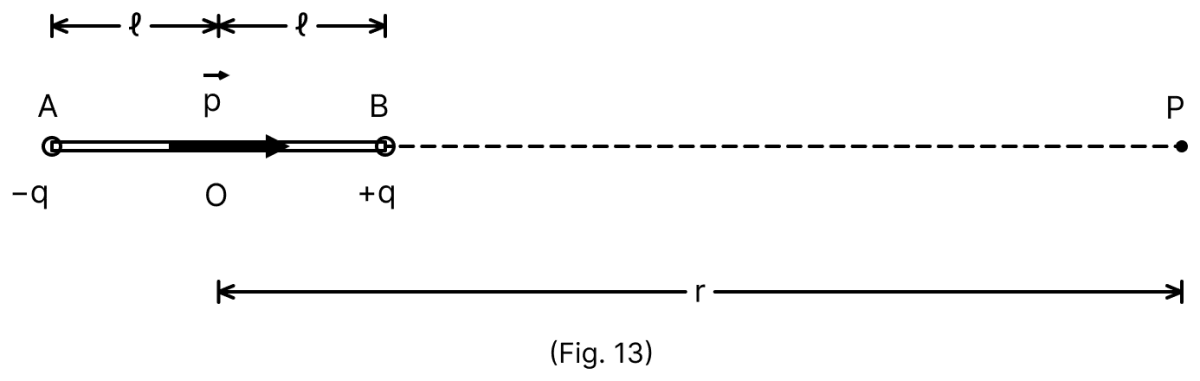
Consider an electric dipole AB made up of the charges − q and + q coulomb, a small distance 2l metre apart in vacuum. Let P lie on the axis of the dipole at a distance r metre from its mid-point O.
The point P is at a distance (r − l) from the charge + q and (r + l) from the charge − q. The charge + q alone gives at P the potential
while the charge − q gives
As electric potential is a scalar quantity, the net potential V at P is simply the algebraic sum of V1 and V2,
Writing 2ql = p, the electric dipole moment,
For a distant point, r >> 2l, the term l2 is negligible compared with r2, and the potential at P on the axis of the dipole becomes
An examiner asked a student to see and analyse the working of Van de Graff generator, a device to provide potential of several million volts. It consists a very large hollow smooth metal sphere, which can be charged to a very high potential. The examiner gives the required instructions and asks some questions to the student. State whether the responses of the student, in each case, are correct or incorrect. Give a reason for your answer.
(i) EXAMINER : Potential of the charged metal sphere is low, increase its potential.
STUDENT : Increases the charge on the sphere.
(ii) EXAMINER : Now, reduce the potential of the above sphere to zero.
STUDENT : Provides earthing to the sphere.
(iii) EXAMINER : Two thin hollow concentric metal spheres A and B are of radius R1 and R2 (R2 > R1) and have charge +q1 and +q2, respectively. Which sphere A or B has higher electric potential?
STUDENT : Sphere B has higher value of electric potential.
Answer
(i) The response of the student is correct.
The potential of a charged sphere of radius R is
For a given sphere V is proportional to q, so adding charge to the sphere raises its potential.
(ii) The response is correct.
The earth is taken to be at zero potential. A conductor connected to the earth comes to the potential of the earth, so earthing brings the potential of the sphere down to zero.
(iii) The response is incorrect.
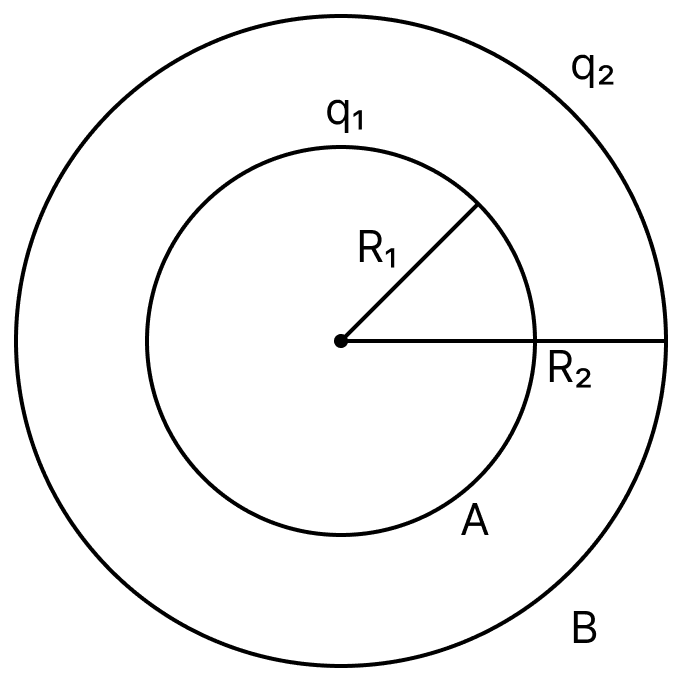
At any point inside a charged spherical shell the potential has the same value as on its surface. The inner sphere A therefore receives the full surface potential of B in addition to its own, while at B the charge on A acts as if placed at the centre. Taking ,
Since R2 > R1,
Thus it is the inner sphere A, not the sphere B, that is at the higher electric potential.
Consider two concentric spherical metal shells of radii r and R where R > r. The outer shell has charge q, but inner has no charge. Now inner shell is grounded. Find:
(a) charge on the inner shell.
(b) potential of outer sphere.
Answer
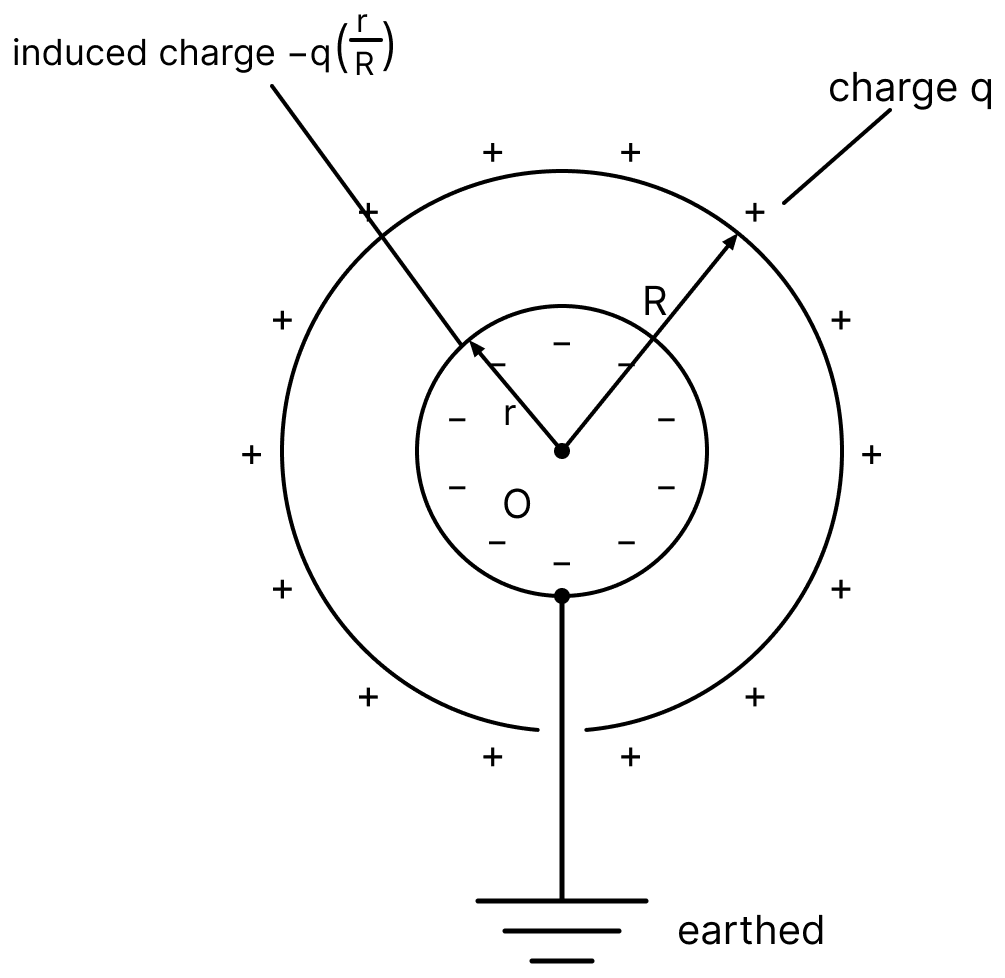
Given,
- Radius of the inner shell = r, radius of the outer shell = R, with R > r
- Charge on the outer shell = q, inner shell initially uncharged and then grounded
(a) Charge on the inner shell :
Let the charge induced on the grounded inner shell be q'. Since the inner shell is earthed, its potential must be zero. The potential of the inner shell is the sum of the potential due to its own charge q' and that due to the charge q on the outer shell (which is the same at all interior points),
(b) Potential of the outer sphere :
The potential of the outer shell is due to its own charge q and the charge q' on the inner shell, both treated as being at the common centre,
Hence, the charge on the inner shell is and the potential of the outer sphere is .
Define electric potential. Write its SI unit and dimensional formula. Is it a scalar or vector? Give an example in which electric potential is zero but electric field is not zero and also give an example in which electric potential is non-zero or uniform but electric field is zero.
Answer
Electric potential : The work done by an external agent in carrying a unit positive test charge from infinity to a point in the electric field is called the electric potential at that point,
SI unit : volt (V), where 1 volt = 1 joule/coulomb. Thus, if 1 joule of work is done in carrying a test charge of 1 coulomb from infinity to a point in an electric field, then the potential at that point will be 1 volt.
Dimensional formula :
Nature : Electric potential is a scalar quantity.
Example of V = 0 but E ≠ 0 : At every point on the equatorial line of an electric dipole, the potentials due to + q and − q are equal and opposite, so V = 0. The fields due to the two charges, however, add up and the resultant electric field is not zero.
Example of V ≠ 0 but E = 0 : At every point inside a charged hollow metallic sphere the electric field is zero, but the potential is constant and equal to the non-zero value at the surface.
Suggest a method to transfer whole charge of a hollow sphere to another hollow sphere comparatively large. Define potential difference. Write its unit and write its value for two points distant apart on an equipotential surface.
Answer
Method of transferring the whole charge : The charged hollow sphere is placed inside the larger hollow sphere and the two are connected by a conducting wire. The charge given to a conductor always resides on its outer surface. Hence the entire charge of the inner sphere flows through the wire to the outer surface of the larger sphere, and the inner sphere is left completely uncharged.
The transfer is complete no matter how high the potential of the outer sphere already is, because the potential of the inner sphere always exceeds that of the outer one so long as it carries any charge. This is the principle used in the Van de Graaff generator to build up very high potentials.
Potential difference : The work done by an external agent in carrying a unit positive test charge from one point to the other point in an electric field is called the potential difference between those points,
Unit : volt (V), the same as that of potential.
Value on an equipotential surface : By definition the potential is the same at every point of an equipotential surface. Hence the potential difference between any two points on it, however far apart they are, is zero.
Define electric potential and obtain an expression between intensity of electric field due to a point charge and electric potential. Also show that electric field is gradient of electric potential.
Answer
Electric potential : The work done by an external agent in carrying a unit positive test charge from infinity to a point in the electric field is called the electric potential at that point. It is a scalar quantity and its SI unit is the volt.
Relation between E and V for a point charge :
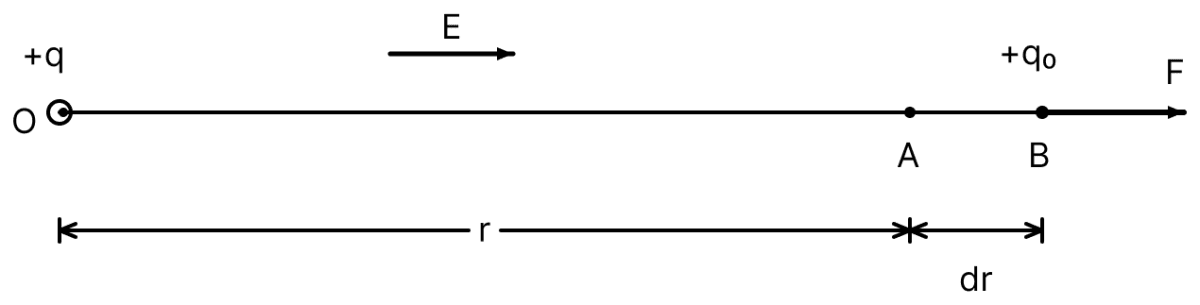
Take a point charge + q at O whose electric field is directed along the X-axis. Let A and B be neighbouring points on the axis at distances r and r + dr from O, with dr vanishingly small, and let V and V + dV be the electric potentials at A and B respectively, so that dV = VB − VA is the change in potential over the distance dr.
A small positive test charge q0 is taken from B to A. The field acts on it with the force
In moving q0 from B to A the external agent works against this force, applying an equal force directed towards A. The displacement from B to A, of magnitude dr, is along this applied force, so the work done by the agent is positive. If the work done is dW, then
The work done per unit charge from B to A is, by definition, the potential difference VA − VB, so
Equating the two expressions for in Eqs. (ii) and (iii),
Electric field is the gradient of electric potential : The quantity measures how fast the potential changes with distance and is called the potential gradient. The relation thus expresses the electric field intensity in a given direction as the negative of the potential gradient in that direction; the negative sign shows that the potential falls along the direction of the electric field.
As a check, apply this to a point charge q, whose potential at a distance r is
The field of a point charge is radial by symmetry, so its magnitude is the negative potential gradient taken along r,
This is the known expression for the intensity due to a point charge. If the potential changes along all three axes, V = f(x, y, z), its gradient is written as
What do you understand by the term electric potential energy of two point charges distant by a finite distance? Obtain expression for it. What would happen to electric potential energy if distance is reduced between two similar and opposite charges?
Answer
Electric potential energy : The electric potential energy of a system of two point charges is the work done in bringing the two charges from infinity to their given separation.
Expression :
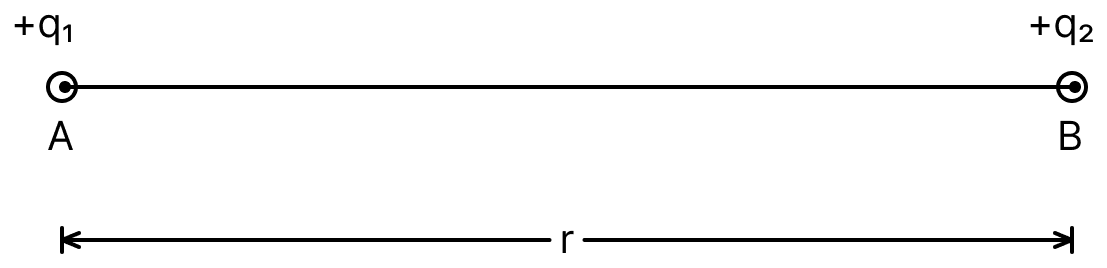
Let the charges + q1 and + q2 coulomb be at the points A and B in vacuum, r metre apart, forming the system AB. Assume that + q1 is fixed at A and that + q2 starts at infinity.
At B the charge + q1 produces the electric potential
Using the definition of electric potential, the work done (= charge × potential) in bringing q2 from infinity to B is
This work is stored as the electric potential energy U of the system,
In using this formula, q1 and q2 are substituted with their signs.
Effect of reducing the distance :
For two similar charges the product q1q2 is positive, so U is positive and indicates net repulsion. As r is reduced, U increases; work has to be done by an external agent against the repulsion, and this is stored as potential energy.
For two opposite charges the product q1q2 is negative, so U is negative and indicates net attraction. As r is reduced, U becomes more and more negative, that is, it decreases; the charges attract each other, so the field itself does the work and the potential energy of the system falls.
Obtain an expression for work done in rotating an electric dipole in uniform electric field. Write an expression for total electric potential energy of an electric dipole in uniform electric field and suggest its position for stable and most unstable equilibrium state.
Answer
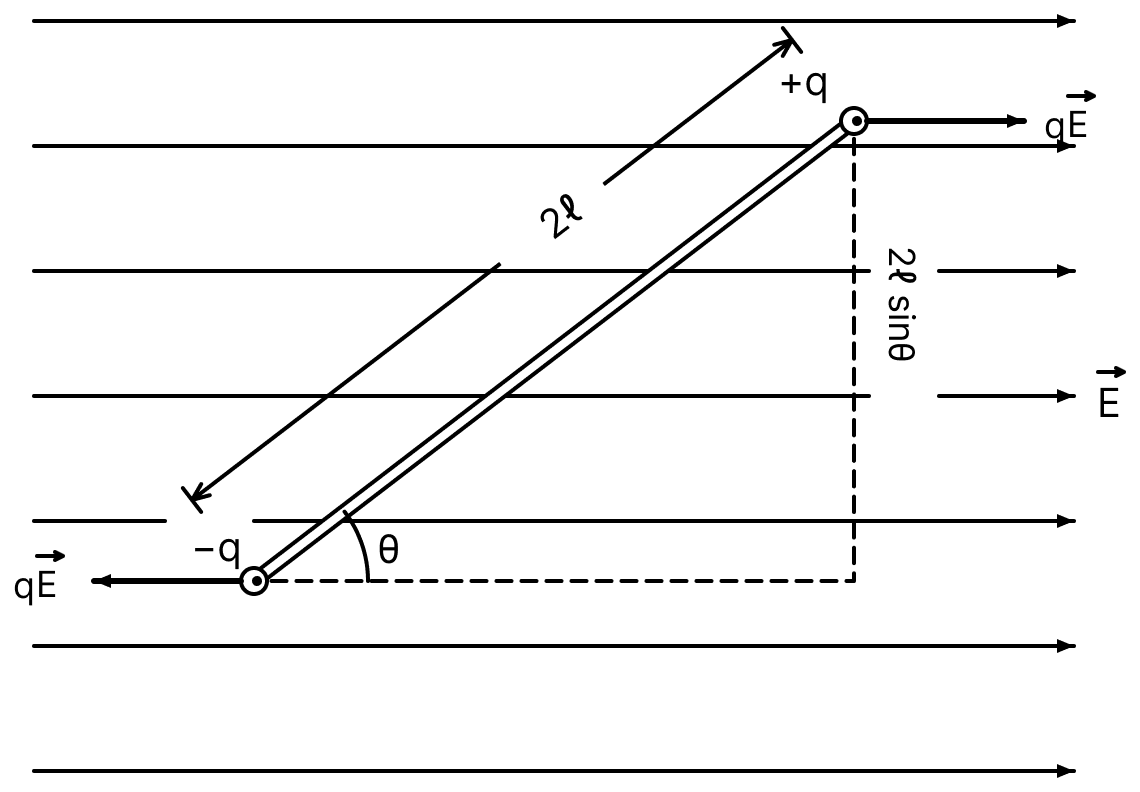
Work done in rotating an electric dipole : Consider a dipole of moment p (= q × 2l) in a uniform electric field E, turned through an angle θ away from its equilibrium position. As it turns, the couple acting on it keeps changing.
At an instant when the dipole makes an angle θ with the field E, the torque on it is
Turning it through a further, infinitesimally small angle dθ needs the work
The work done in turning the dipole from the angle θ1 to θ2 is found by integrating,
When the rotation begins at the equilibrium position (θ1 = 0) and ends at an angle θ with the field,
Total electric potential energy of the dipole : A dipole lying parallel to the field has the potential energy U0 = − pE. Turning it through an angle θ requires the work W found above, which adds to this energy, so
Stable equilibrium : This occurs when the dipole moment points along the electric intensity , that is θ = 0. Then
Since the potential energy has its minimum value here, the dipole is in stable equilibrium.
Most unstable equilibrium : This occurs when the dipole has been turned through 180° from the stable position, that is θ = 180°. Then
Since the potential energy has its maximum value here, the dipole is in unstable equilibrium.
A simple electric dipole consists of equal positive and negative charges held very close together. The dipole moment (p) defined as the product of magnitude of one charge and the separation between the charges is a vector quantity directed from negative charge to positive charge of the dipole (see figure). The electrostatic potential due to the dipole at general point (r, θ) is given by
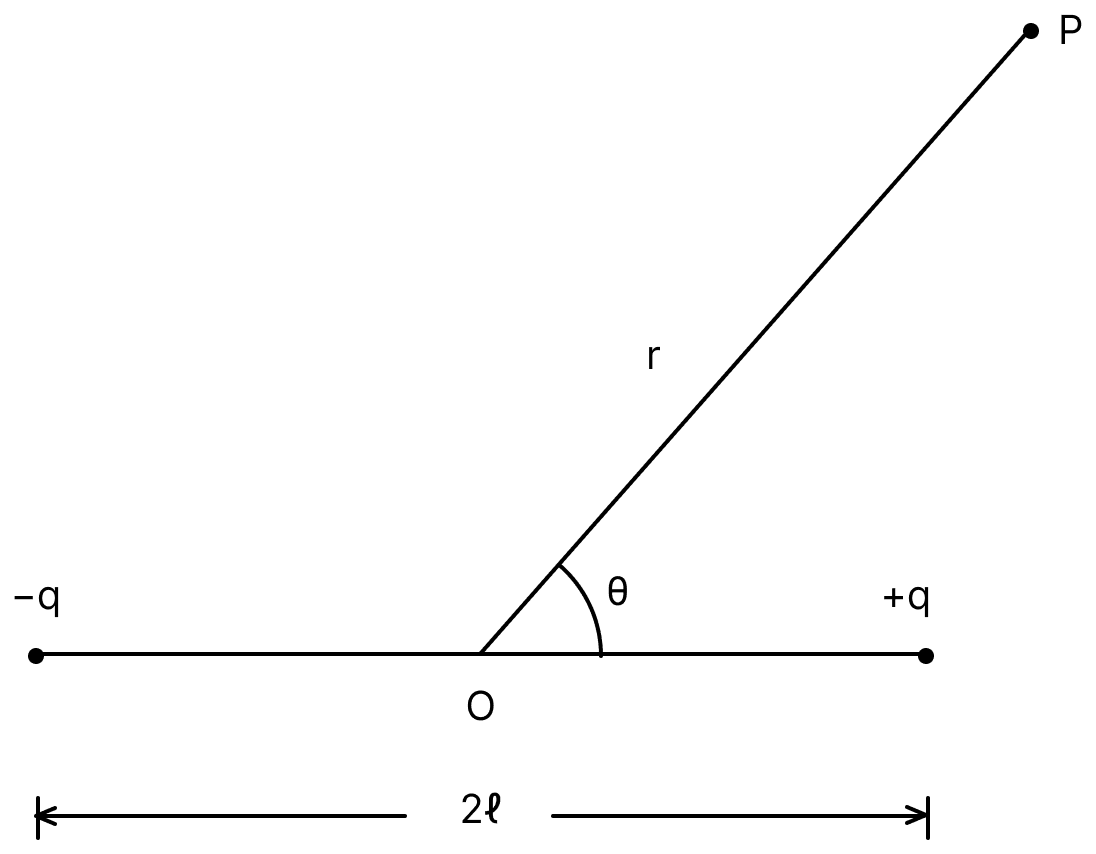
where r >> 2l. In a uniform-electric field equal and opposite forces act on the charges of the dipole which constitute a couple tending to rotate the dipole. If left freely, dipole performs angular oscillations.
(i) What will be the value of n in the expression given above?
(ii) What will be the locus of the points at which potential is zero due to the dipole?
(iii) 4 μC charge is carried from r = 5 cm to r = 3 cm on the equatorial line of the dipole. Find the amount of work done.
(iv) If this dipole is rotated through an angle 'θ' anticlockwise about point 'O' from the position as shown in the figure, then what will be the expression of electric potential at P?
(v) If this dipole is placed in uniform external field in stable equilibrium position, what will be its potential energy in this position?
Answer
(i) The potential at a general point due to a short dipole is
Comparing this with the given expression, n = 2.
(ii) The potential is zero wherever cos θ = 0, that is θ = 90°. Hence the locus is a straight line passing through the mid-point of the dipole and perpendicular to the dipole axis, that is, the equatorial line of the dipole.
(iii) On the equatorial line the potential is zero at every point, so the potential difference between the point at r = 5 cm and that at r = 3 cm is zero.
Hence, the work done is zero.
(iv) After rotation through the angle θ, the point P lies on the axis of the dipole. Hence θ = 0 and cos θ = 1, giving
(v) In stable equilibrium the dipole moment is along the field, so θ = 0 and
Electrostatic precipitators : Electrostatic precipitators are devices used to remove particles, such as dust and ash, from a flowing gas using the force of an induced electrostatic charge. It consists of two sets of electrodes : positive and negative.
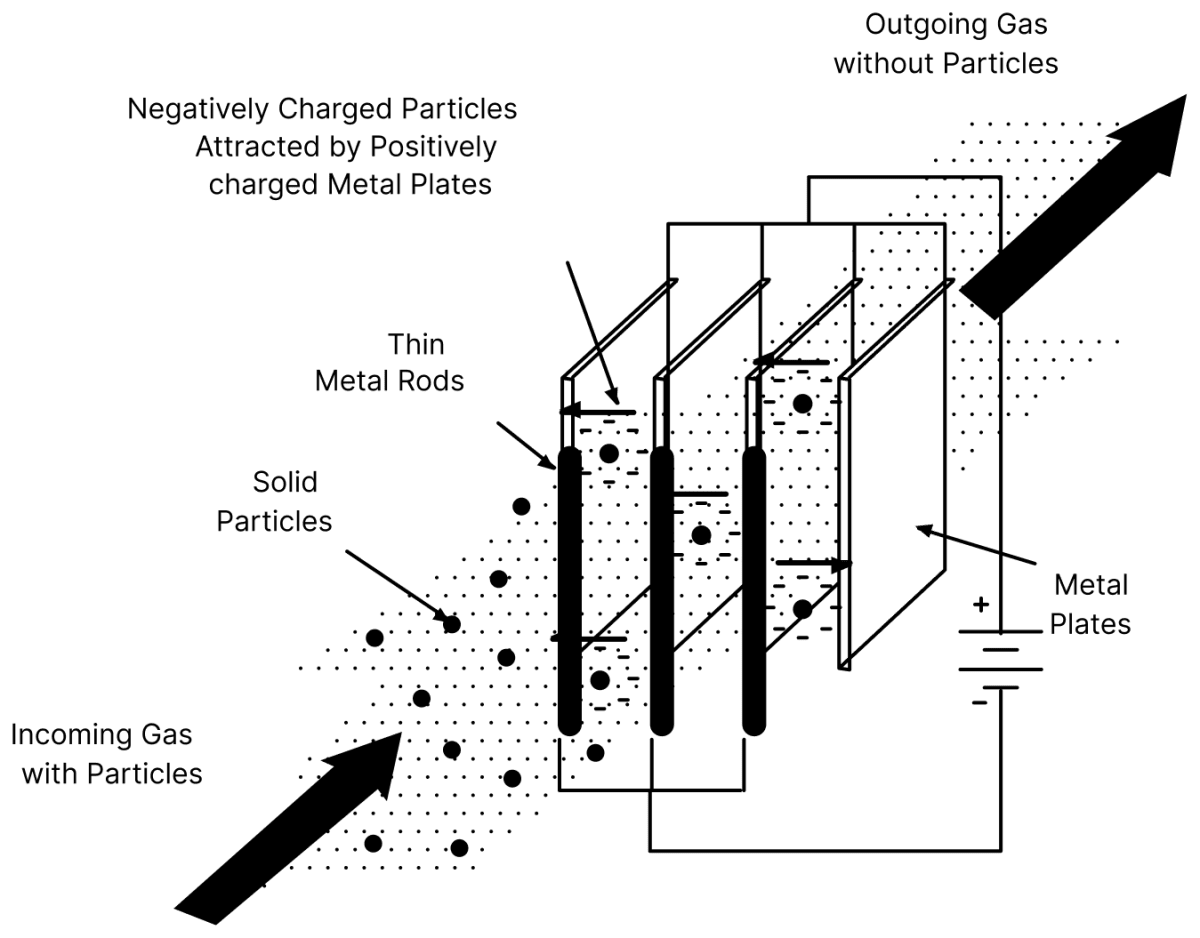
The negative electrodes are in the form of a wire mesh and the positive electrodes are plates. These electrodes are vertically placed and alternate to each other. High Direct Current (DC) voltage is fed to the discharge electrodes, generating a negative electric field around them. The gas-borne particles such as ash are ionised by the corona effect. When the polluted gas passes through the electric field, the particles become charged and are attracted to oppositely charged collector plates, where they adhere until they are removed.
(i) Name any two electrostatic processes involved in the working of an electrostatic precipitator.
(ii) If the medium between the mesh and the plates is filled with a dielectric medium of dielectric constant K = 10, what will happen to the efficiency of working of the device?
(iii) What is the strength of the electric field between two parallel conducting plates separated by 2 cm and having a potential difference (voltage) between them of 1.50 × 10⁴ V?
(iv) Name any other device used in day-to-day life, based on the principle of the electrostatic precipitator.
Answer
(i) Ionisation, electrostatic attraction and electric discharge.
(ii) The discharge electrodes are fed from a high DC voltage source, so the potential difference V between the mesh and the plates stays fixed when the dielectric is introduced. Since E = V/d and the separation d is unchanged, the electric field between the plates does not change. The force on the charged particles therefore remains the same, and on this basis the efficiency of the device does not decrease.
Note: The textbook states that the field between the plates reduces and the efficiency decreases. That holds only for isolated plates carrying a fixed charge, where E falls to E/K; it does not apply here, because the passage states that the electrodes are kept at a fixed DC voltage.
(iii)
Given,
- Potential difference, V = 1.50 × 10⁴ V
- Separation between the plates, d = 2 cm = 2 × 10⁻² m
For two parallel plates the field between them is uniform, so
(iv) Air purifier or electrostatic air cleaner.