
Fig. 11.9 shows items related to natural resources. Match them with their jumbled up names. Make another table and write the names of these resources. Classify these resources as renewable or non-renewable.
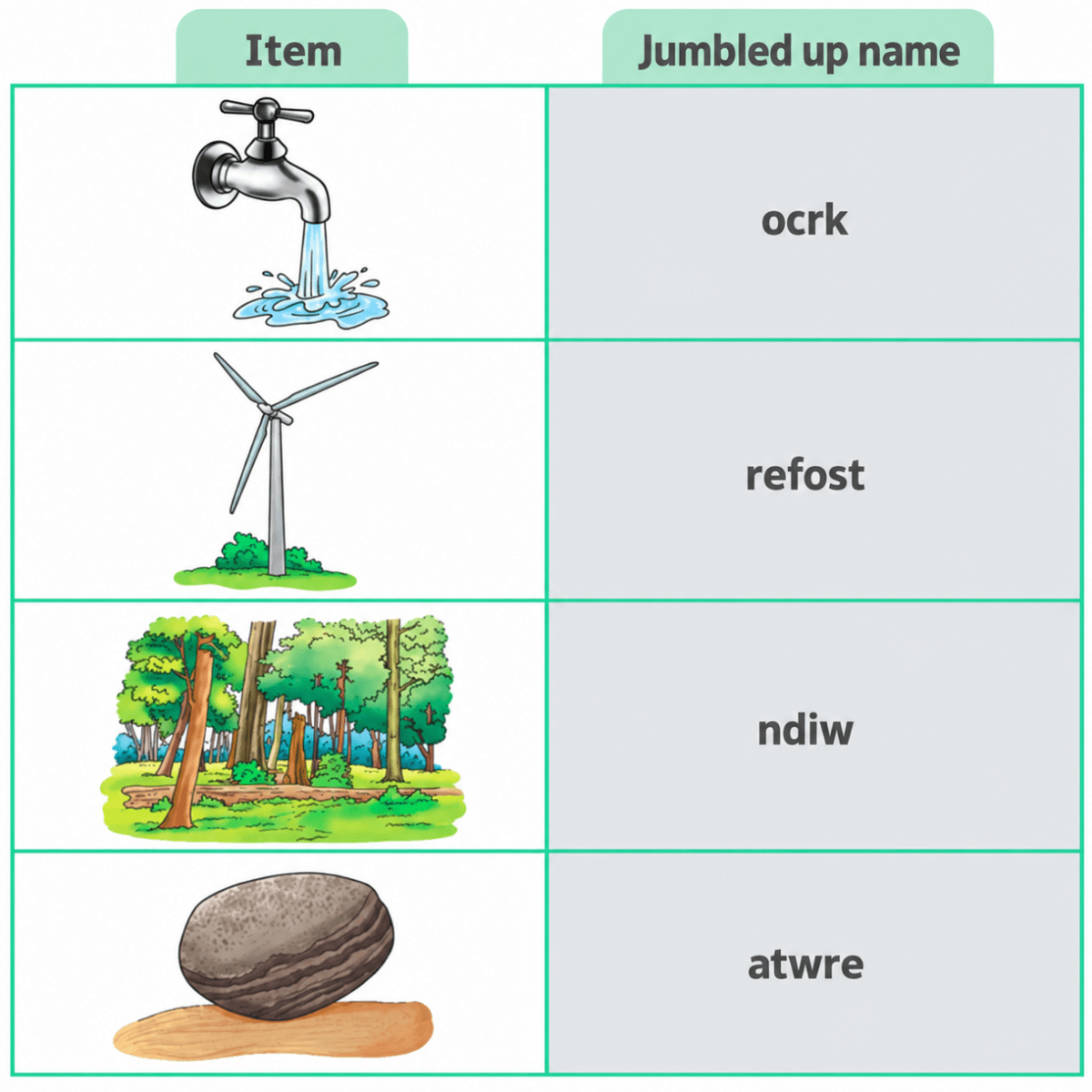
Answer
On matching the items with their correct names, we get:
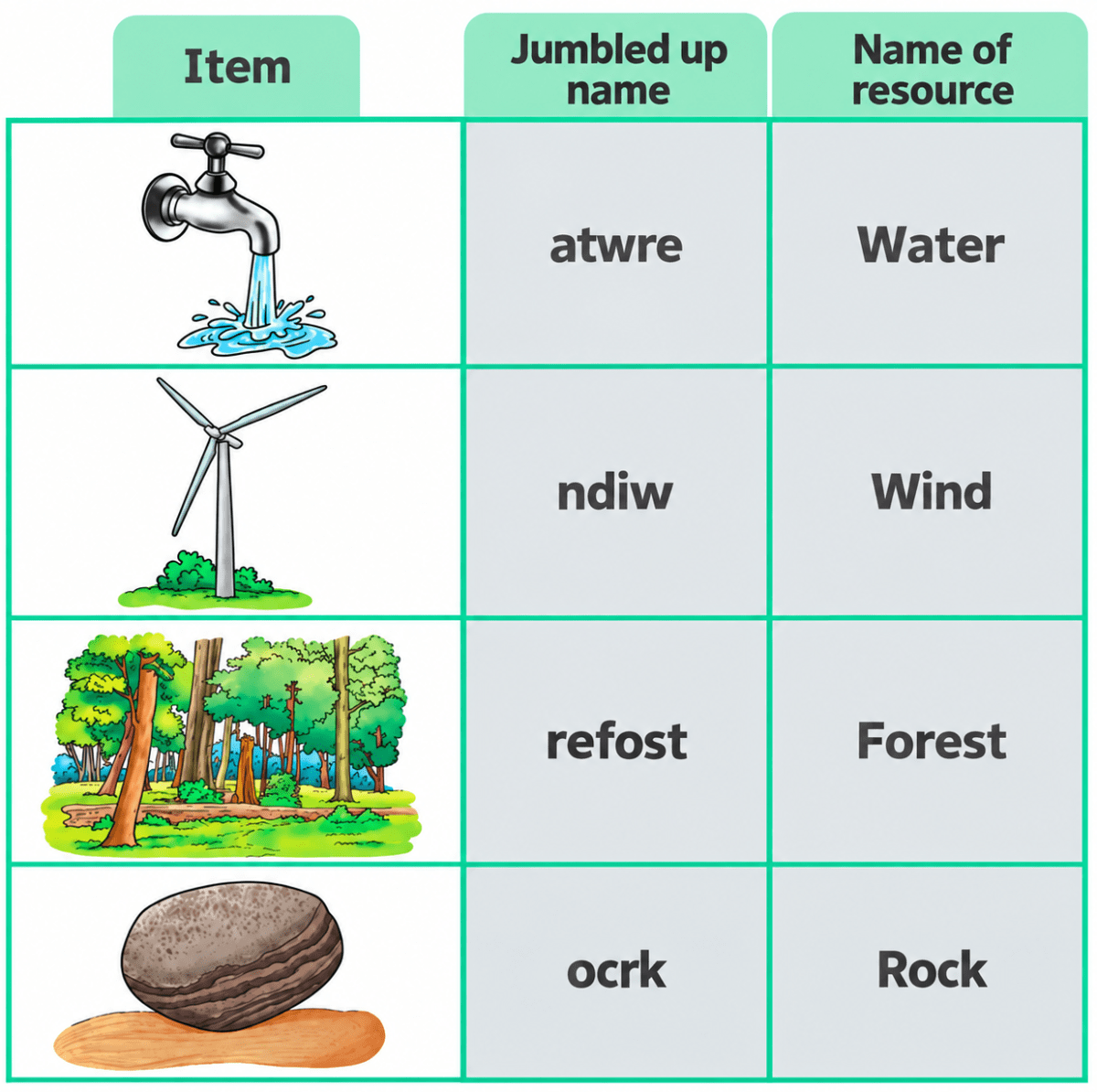
Classification of these resources:
| Name of resource | Renewable / Non-renewable |
|---|---|
| Water | Renewable |
| Wind | Renewable |
| Forest | Renewable |
| Rock | Non-renewable |
State whether the following statements are True [T] or False [F]. If False, correct them.
(i) Nature has all the resources to meet human needs.
(ii) Machines are a resource found in nature.
(iii) Natural gas is a non-renewable resource.
(iv) Air is a renewable resource.
Answer
(i) True
(ii) False
Corrected Statement — Machines are human-made resources created by human beings using natural resources.
(iii) True
(iv) True
Fill in the blanks using the most appropriate option.
(i) A fuel that is commonly used in two wheelers like scooters or bikes is ...............
- Kerosene
- Petrol
- Diesel
- LPG
(ii) An example of a renewable resource is ...............
- Coal
- Water
- Natural gas
- Petrol
Answer
(i) A fuel that is commonly used in two wheelers like scooters or bikes is Petrol.
Reason — Petrol is the fuel widely used in two wheelers such as scooters and bikes.
(ii) An example of a renewable resource is Water.
Reason — Water gets renewed by nature through the water cycle, so it is a renewable resource. Coal, natural gas and petrol are fossil fuels which are non-renewable.
Classify the following as renewable or non-renewable resources — coal, natural gas, forests and minerals.
Answer
| Resource | Renewable / Non-renewable |
|---|---|
| Coal | Non-renewable |
| Natural gas | Non-renewable |
| Forests | Renewable |
| Minerals | Non-renewable |
Why do we say that petroleum is a non-renewable resource?
Answer
Petroleum is a fossil fuel that takes millions of years to form from the remains of microorganisms and plants buried deep inside the earth. It is found in limited quantities and once used, it gets exhausted. As it cannot be replenished within a reasonable period of time, petroleum is called a non-renewable resource.
It is difficult to regrow forests. Justify this statement.
Answer
A forest is made up of a large variety of herbs, shrubs and trees that take many years to grow fully. It is also home to many animals, birds and insects that depend on it for food and shelter. Once a forest is lost, it takes many years to grow it again or to restore it to its earlier form. Therefore, it is difficult to regrow forests.
Make a list of five daily activities in which you use natural resources. Suggest ways by which you can reduce their use.
Answer
| Daily activity | Natural resource used | Ways to reduce its use |
|---|---|---|
| Drinking and bathing | Water | Turn off taps when not in use and fix leakages. |
| Cooking food | Natural gas (LPG) | Use lids while cooking and avoid wastage of gas. |
| Travelling | Petrol / diesel | Walk or cycle to nearby places and use public transport. |
| Drying clothes | Sunlight and air | Dry clothes naturally instead of using electrical appliances whenever possible. |
| Building and furniture | Wood from forests | Reuse wood and use paper carefully to save trees. |
List four activities that are possible due to the presence of air.
Answer
Four activities that are possible due to the presence of air are:
- Breathing, as the air we breathe in has oxygen needed for our survival.
- Rotating the wings of a windmill to run flour mills, pump water or generate electricity.
- Flying kites and rotating a firki (paper pinwheel).
- Drying wet clothes hung on a clothes line.
How can you contribute towards enhancing the green cover of your locality? Make a list of actions to be taken.
Answer
We can contribute towards enhancing the green cover of our locality by taking the following actions:
- Plant more trees and saplings in and around our locality.
- Organise a Van Mahotsav in our community to plant new trees and raise awareness.
- Take care of the planted trees by watering and protecting them regularly.
- Prevent unnecessary cutting of trees.
- Create awareness among people about the importance of forests and green cover.
In the given illustration, we see that food is being cooked.
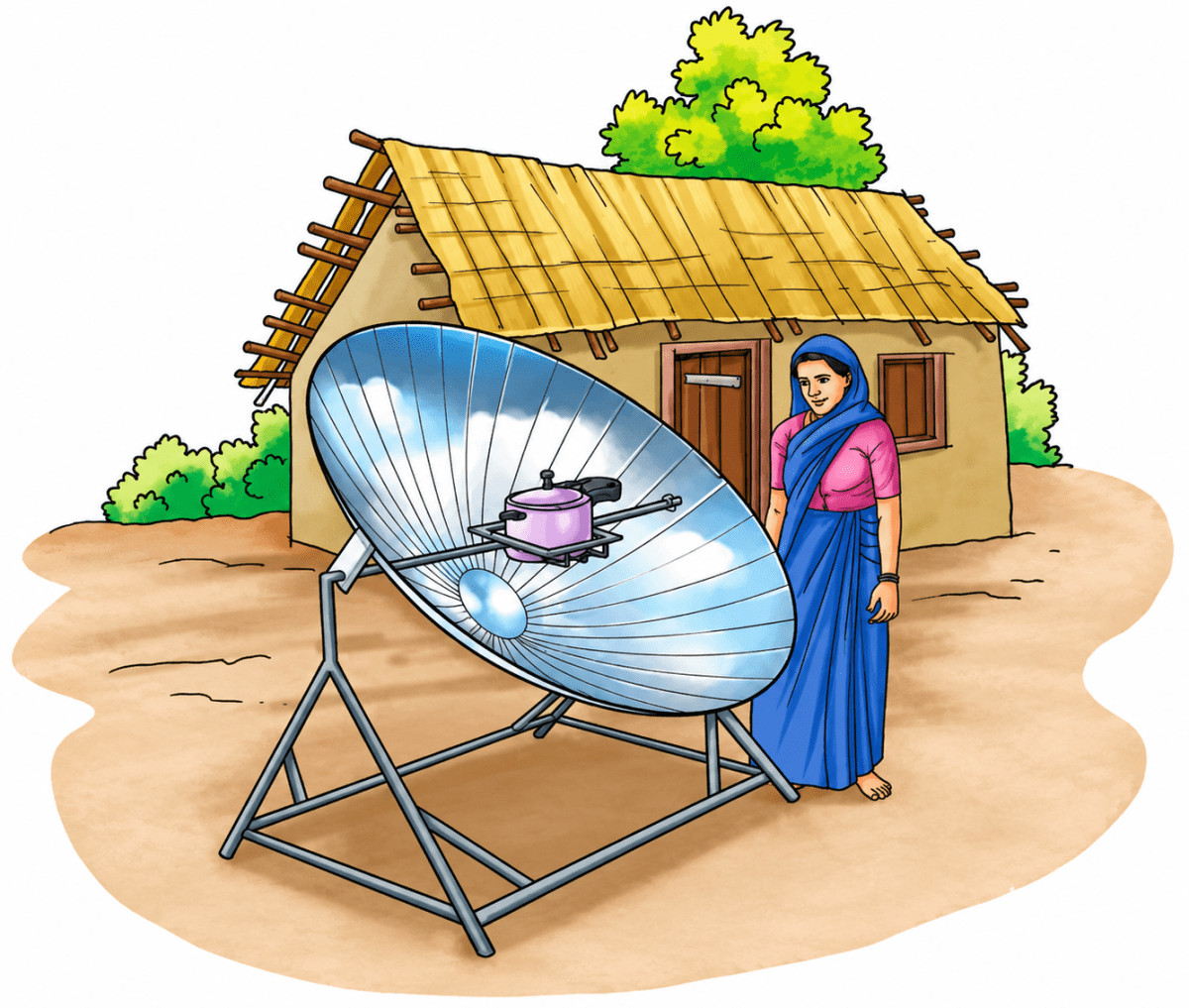
Answer the following questions
(i) What type of energy is being used for cooking?
(ii) Name one benefit and one drawback of using this type of energy for cooking.
Answer
(i) Solar energy (energy from the Sun) is being used for cooking in the solar cooker.
(ii) Benefit — It is a clean and freely available source of energy that does not produce smoke while cooking.
Drawback — It can be used only during the daytime when there is enough sunlight, and it does not work well on cloudy days.
Cutting down trees on a large scale impacts the quality of the soil. Why do you think it is so?
Answer
The roots of trees hold on to the soil and prevent it from being washed away. The leaves that fall from the trees decay and enrich the soil with nutrients. When trees are cut down on a large scale, the soil is no longer held firmly and gets washed away more easily. The soil also receives fewer nutrients from decaying leaves. As a result, the soil becomes less fertile and its quality is affected.
Explain two ways in which human activities pollute the air. Propose one action which can help in reducing air pollution.
Answer
Two ways in which human activities pollute the air are:
- Burning petrol and diesel in vehicles produces smoke and carbon dioxide, which pollute the air.
- Burning fuels such as coal and wood for domestic purposes produces smoke and other pollutants that contaminate the air.
Action to reduce air pollution — We should use public transport whenever possible so that fewer vehicles are used and less fuel is burnt.
A family uses solar panels to generate electricity, a gas stove to cook food and a windmill for pumping water from a well. What would happen if there were no sunlight for a week?
Answer
If there were no sunlight for a week, the solar panels would not be able to capture the Sun's energy, so they would not generate electricity. The family would face a problem of no electricity from the solar panels. However, cooking food on the gas stove (which uses natural gas) and pumping water using the windmill (which uses wind energy) would not be affected, as these do not depend on sunlight.
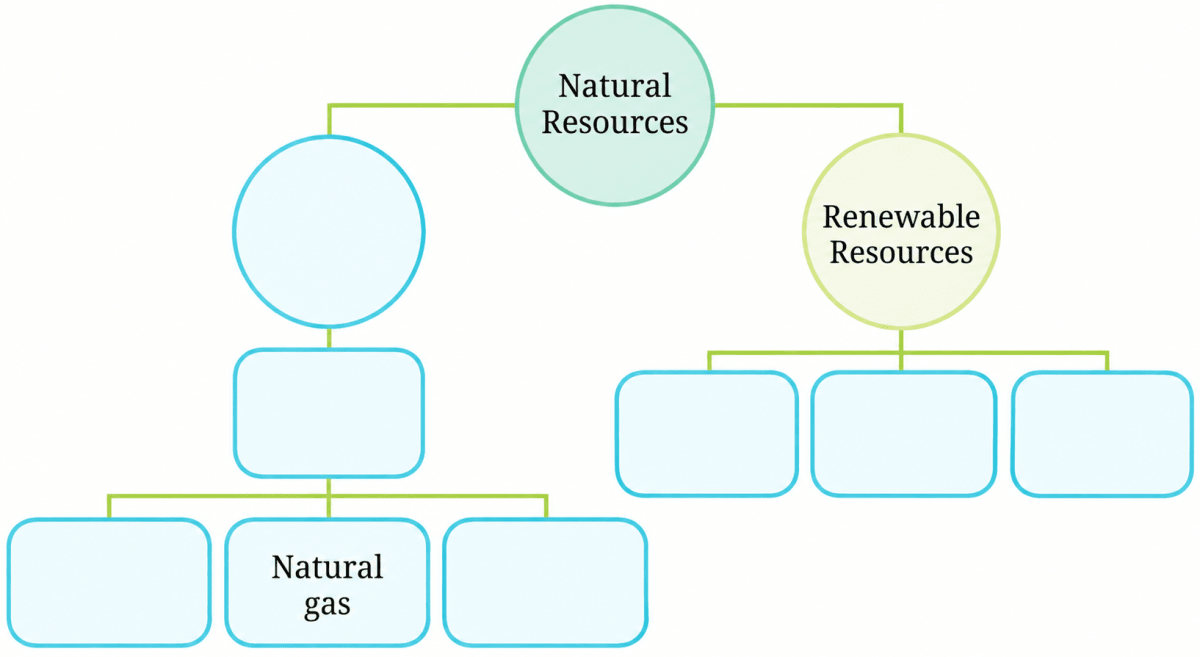
Fill up the blanks using the following terms—
(fossil fuels, forest, air, petroleum, coal, water and non-renewable resource)
Answer
The completed concept map is shown below:
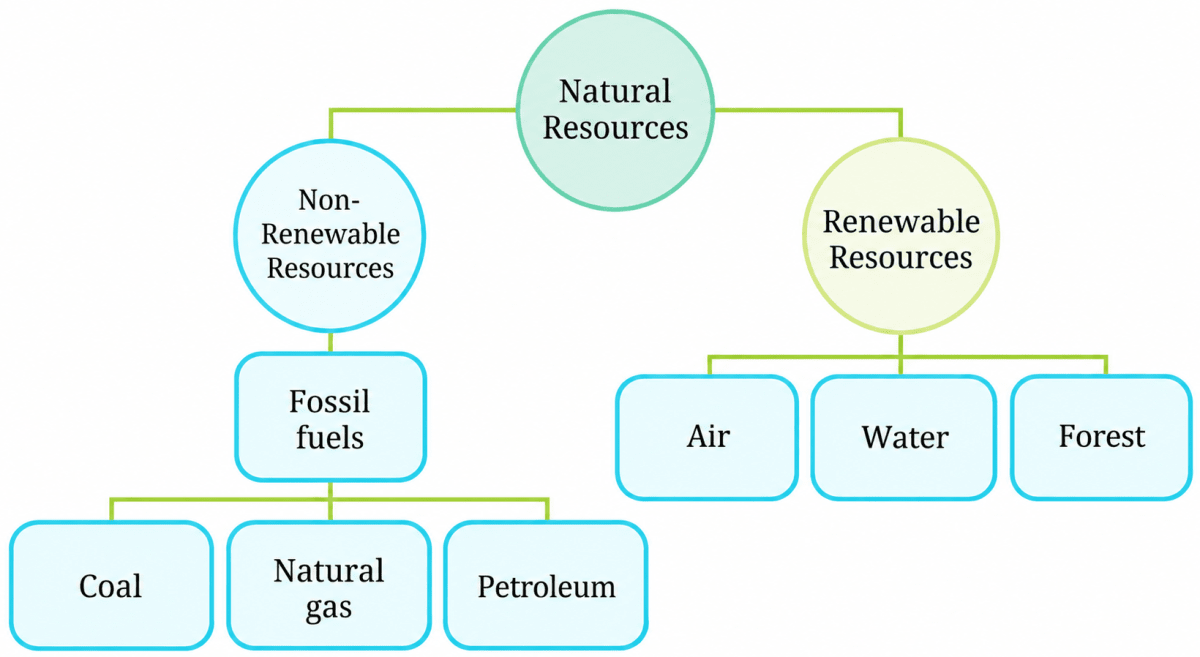
Note — Remove below lines after adding figure.
The blanks are filled as follows:
- Natural Resources are classified into Non-renewable resource and Renewable Resources.
- Under Non-renewable resource → Fossil fuels.
- The three fossil fuels are Coal, Natural gas and Petroleum.
- The three Renewable Resources are Air, Water and Forest.
There is an increasing demand of trees to meet the requirements of industries and for housing. Therefore, trees are being felled. Is it justified? Discuss and prepare a brief report.
Answer
With a growing population, the demand for trees to meet the needs of industries and housing is increasing. To meet this demand, trees are being cut on a large scale. However, large-scale felling of trees is harmful to the environment and should be avoided.
Reasons for Felling Trees:
- Wood from trees is used in industries and for making furniture.
- Land is cleared by cutting forests to build houses and factories.
Harmful Effects of Cutting Trees:
- Forest cover decreases, and many animals, birds and insects lose their food and shelter.
- The soil is no longer held firmly by roots and can be washed away more easily.
- Fewer fallen leaves are available to decay and enrich the soil, so soil fertility may decrease.
- It takes many years to grow a new forest or restore a lost one.
Although trees are needed for industries and housing, cutting them on a large scale is not justified. We must use forests responsibly and plant new trees to replace those that are cut, so that forests get enough time to regenerate. In this way, we can meet our needs without harming the environment for the future.
Propose a plan to use less water in your school. What steps would you take to make this plan happen and how would it help the environment?
Answer
A plan to use less water in our school can include the following steps:
- Repair all leaking taps and pipes in the school so that no water is wasted.
- Put up notices near taps and washbasins reminding students to turn off taps when not in use.
- Set up rainwater harvesting on the school rooftop to collect and store rainwater for later use.
- Use stored rainwater or safely reusable water for gardening and cleaning purposes.
- Create awareness among students and staff about the importance of saving water.
These steps would help the environment by conserving precious freshwater, which is available in limited quantity. Saving water ensures that more water remains available for people and other living beings and helps protect water resources for the future.