
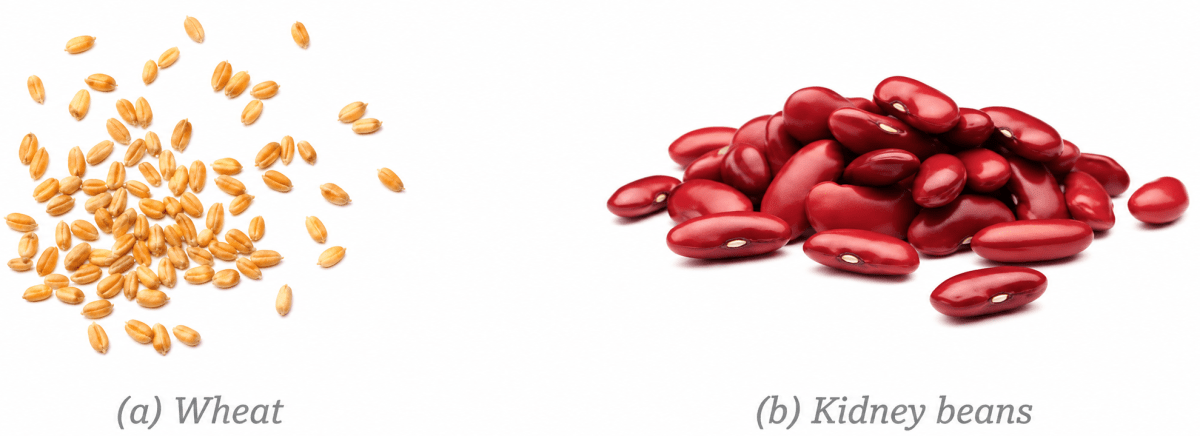
Here are two types of seeds. What differences do you find among the roots and leaf venation of their plants?
Answer
Wheat is a monocot seed while kidney bean is a dicot seed. The differences in the roots and leaf venation of their plants are:
| Wheat plant | Kidney bean plant |
|---|---|
| Its leaves show parallel venation, in which the veins run parallel to each other. | Its leaves show reticulate venation, in which the veins form a net-like pattern. |
| It has a fibrous root system, made up of many similar-sized thin roots arising from the base of the stem. | It has a taproot system, made up of one main root with small side roots arising from it. |
Names of some animals are given below. Group them based on their habitats. Write the names of aquatic animals in the area marked 'A' and terrestrial animals in the area marked 'B'. Enter the names of animals living in both habitats in part 'C'.
Horse, Dolphin, Frog, Sheep, Crocodile, Squirrel, Whale, Earthworm, Pigeon, Tortoise
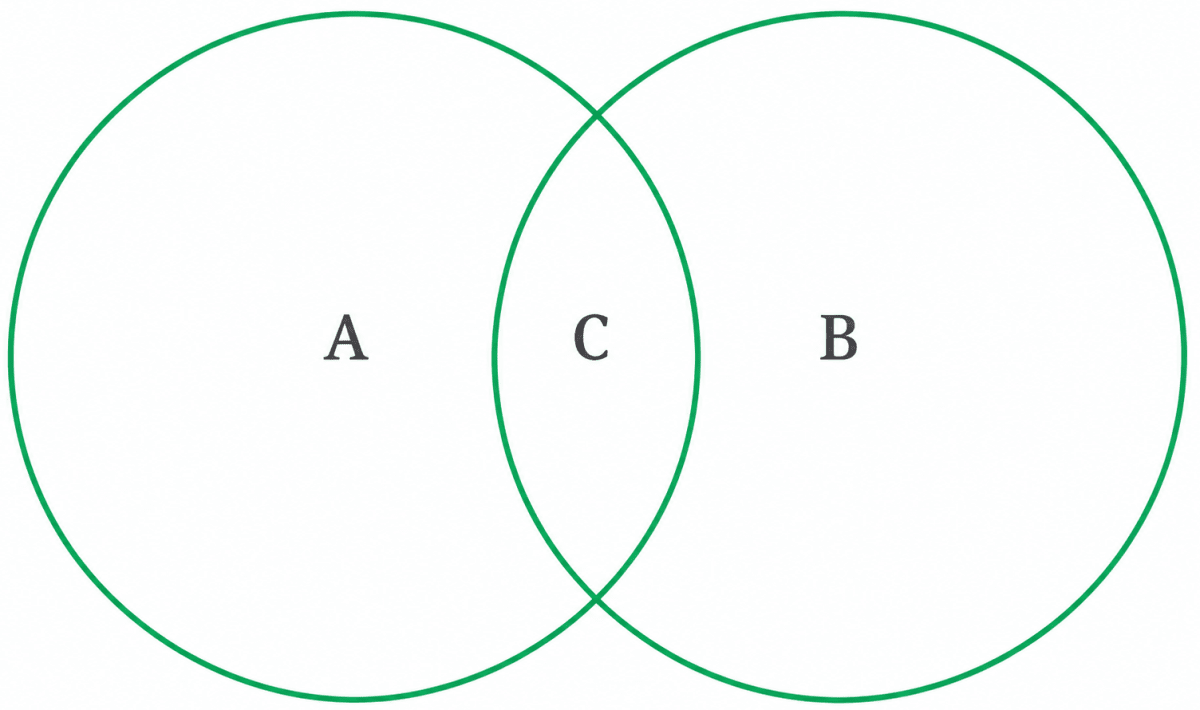
Answer
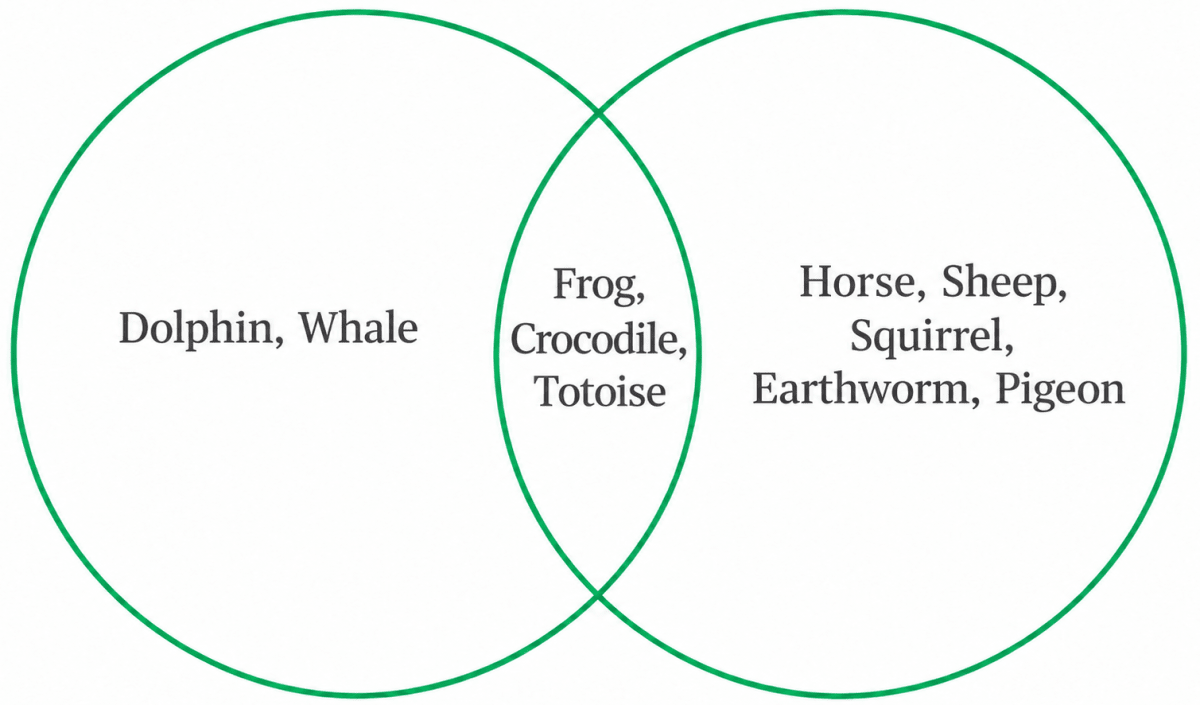
The animals are grouped based on their habitats as follows:
| Area | Type of habitat | Animals |
|---|---|---|
| A | Aquatic (live in water) | Dolphin, Whale |
| B | Terrestrial (live on land) | Horse, Sheep, Squirrel, Earthworm, Pigeon, Tortoise |
| C | Both habitats (water and land) | Frog, Crocodile |
Manu's mother maintains a kitchen garden. One day, she was digging out radish from the soil. She told Manu that radish is a kind of root. Examine a radish and write what type of root it is. What type of venation would you observe in the leaves of radish plant?
Answer
Radish has a taproot, as it consists of one main root with small side roots arising from it. Since plants with taproots generally have reticulate venation in their leaves, the leaves of the radish plant would show reticulate venation, in which the veins form a net-like pattern.
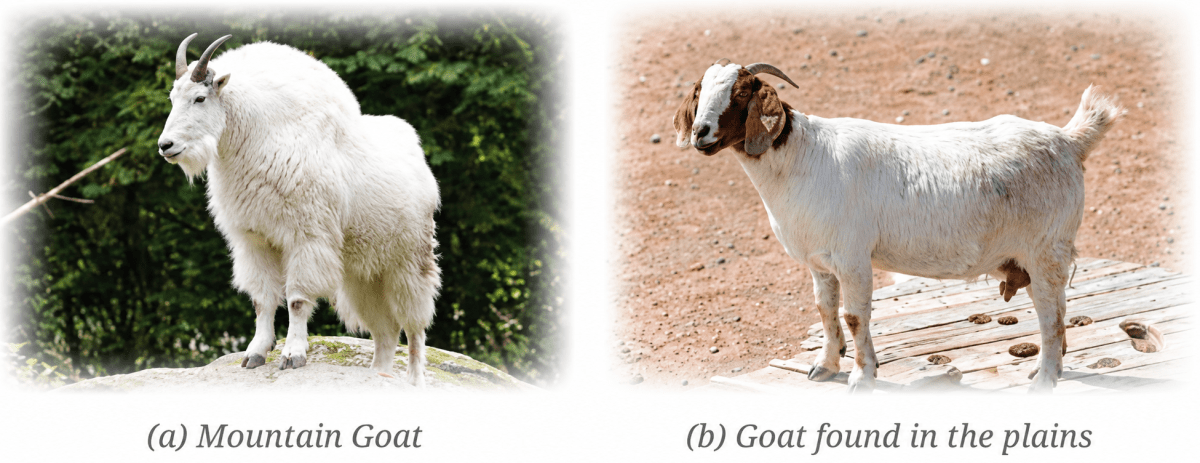
Look at the image of a mountain goat and a goat found in the plains. Point out the similarities and differences between them. What are the reasons for these differences?
Answer
Similarities — Both the mountain goat and the goat found in the plains are four-legged animals that walk on land with the help of their legs. Both have horns and hooves.
Differences — The mountain goat has a thick coat of long hair and a sturdy body, while the goat found in the plains has a thinner coat of short hair.
Reasons for the differences — These differences are adaptations that help each goat survive in its own surroundings. The mountain goat lives in cold, mountainous regions, so its thick, long hair keeps it warm in the cold. The goat in the plains lives in warmer surroundings, so it has a thinner coat of short hair which suits the warmer climate.
Group the following animals into two groups based on any feature other than those discussed in the chapter—cow, cockroach, pigeon, bat, tortoise, whale, fish, grasshopper, lizard.
Answer
The animals can be grouped on the basis of the presence or absence of a backbone:
| Group | Feature | Animals |
|---|---|---|
| 1 | Animals with a backbone | Cow, Pigeon, Bat, Tortoise, Whale, Fish, Lizard |
| 2 | Animals without a backbone | Cockroach, Grasshopper |
As the population grows and people want more comfortable lives, forests are being cut down to meet various needs. How can this affect our surroundings? How do you think we can address this challenge?
Answer
Effects on our surroundings:
- Cutting down forests damages the habitats of many plants and animals, causing them to lose their homes, food, and other resources.
- This loss of habitat leads to a decline in the population of many species and results in the loss of biodiversity.
Ways to address this challenge:
- We can protect biodiversity by conserving forests and not cutting down trees unnecessarily.
- We can support protected areas such as national parks, sanctuaries, and sacred groves where plants and animals are kept safe.
- We can plant more trees and spread awareness about the importance of forests so that our planet remains full of life.
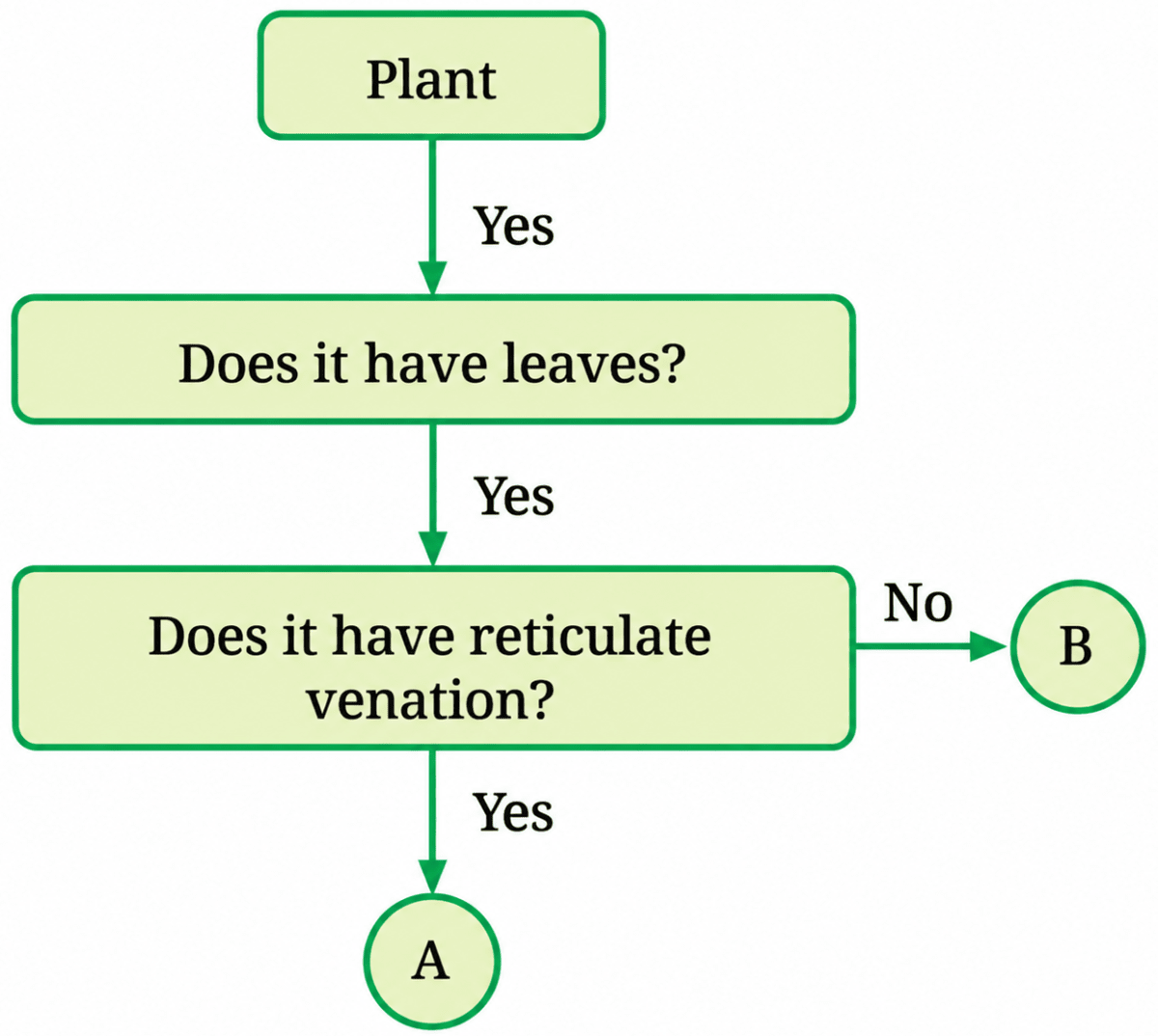
Analyse the flowchart. What can be examples of 'A' and 'B'?
Answer
In the flowchart, a plant that has leaves and shows reticulate venation leads to 'A', while a plant that has leaves but does not show reticulate venation (that is, it has parallel venation) leads to 'B'.
A — A plant with reticulate venation, for example, hibiscus (or mango).
B — A plant with parallel venation, for example, banana (or grass).
Raj argues with his friend Sanjay that "Gudhal (hibiscus) plant is a shrub." What questions can Sanjay ask for clarification?
Answer
To check whether the hibiscus plant is really a shrub, Sanjay can ask the following questions:
- What is the height of the plant—is it short, medium, or tall?
- Is the stem hard or soft, and is it brown or green?
- Is the stem thick or thin?
- Do the branches arise close to the ground or higher up on the stem?
Based on the information in the table, find out examples of these plants for each group.
| Group | Type of seed | Type of root | Examples |
|---|---|---|---|
| A | Dicot | Taproot | |
| B | Monocot | Fibrous roots |
- What other similarities do plants of group A have?
- What other similarities do plants of group B have?
Answer
| Group | Type of seed | Type of root | Examples |
|---|---|---|---|
| A | Dicot | Taproot | Chickpea (gram), Kidney bean, Hibiscus |
| B | Monocot | Fibrous roots | Maize, Wheat, Grass |
(a) Plants of group A are dicots. Apart from having taproots, their seeds have two cotyledons and their leaves show reticulate venation.
(b) Plants of group B are monocots. Apart from having fibrous roots, their seeds have a single cotyledon and their leaves show parallel venation.
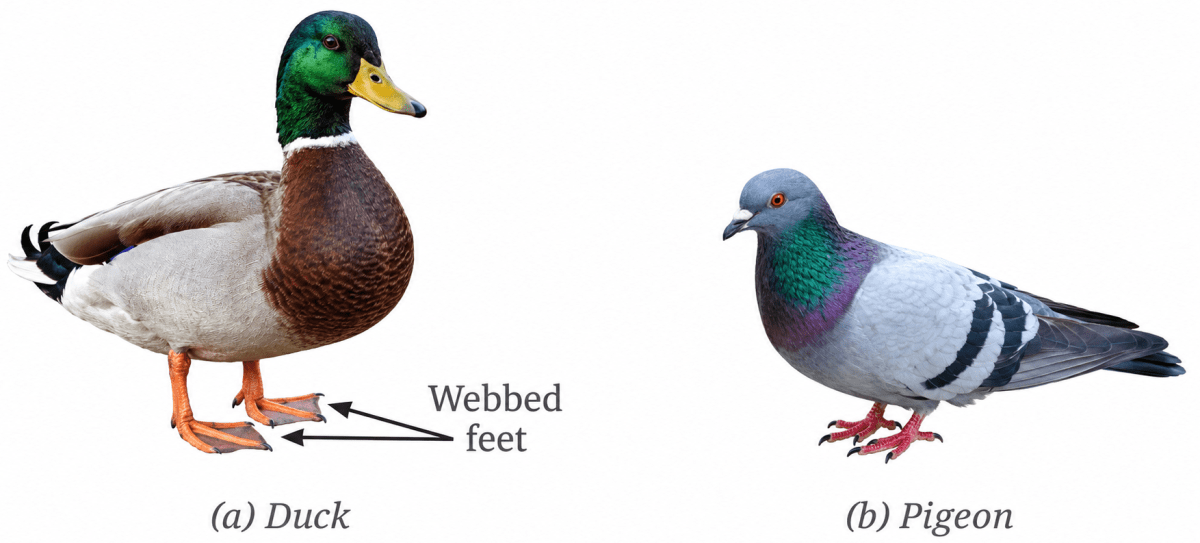
Observe the labelled part of a duck in the picture given below. What differences do you observe in the feet of the duck compared to the other birds? Which activity would the duck be able to perform using this part?
Answer
The duck has webbed feet, in which a thin skin connects its toes. The feet of other birds, such as the pigeon, do not have this webbing and have separate toes.
Using its webbed feet, the duck is able to swim and paddle through water easily. The webbed feet act like paddles and push against the water, helping the duck move in ponds, lakes, and other water bodies. This is an adaptation that helps the duck survive in its watery surroundings.