
Match the column:
| Column I | Column II |
|---|---|
| (i) Satellite of Earth | (a) Orion |
| (ii) Red planet | (b) Venus |
| (iii) Constellation | (c) Mars |
| (iv) Planet which is commonly called an evening star | (d) Moon |
Answer
| Column I | Column II |
|---|---|
| (i) Satellite of Earth | (d) Moon |
| (ii) Red planet | (c) Mars |
| (iii) Constellation | (a) Orion |
| (iv) Planet which is commonly called an evening star | (b) Venus |
(i) Solve the following riddle.
My first alphabet is in MAN but not in CAN
My second alphabet is in ACE and also in FAN
My third alphabet is in RAT and not in CAT
My fourth alphabet is in SUN but not in FUN
I am a planet that moves around the Sun.
(ii) Make two similar riddles by yourself.
Answer
(i) The planet is Mars.
- First letter — in MAN but not in CAN → M
- Second letter — in ACE and also in FAN → A
- Third letter — in RAT but not in CAT → R
- Fourth letter — in SUN but not in FUN → S
The letters together spell M-A-R-S, the Red Planet.
(ii) Two similar riddles:
Riddle 1
My first letter is in SKY but not in KEY
My second letter is in CUP but not in CAP
My third letter is in NET but not in GET
I am a star at the centre of our Solar System.
(Answer: Sun)
Riddle 2
My first letter is in MAT but not in CAT
My second letter is in TOP but not in TAP
My third letter is in COT but not in CAT
My fourth letter is in NET but not in GET
I am the natural satellite of the Earth.
(Answer: Moon)
Which of the following is not a member of our Solar System?
- Sirius
- Comets
- Asteroids
- Pluto
Answer
Sirius
Reason — Sirius is a star that lies far beyond our Solar System. The Solar System is made up of the Sun, the eight planets, their moons, and many smaller objects including asteroids and comets. Comets, asteroids and Pluto all revolve around the Sun, so they are members of the Solar System, but Sirius is not.
Which of the following is not a planet of the Sun?
- Jupiter
- Pluto
- Neptune
- Saturn
Answer
Pluto
Reason — Pluto revolves around the Sun, but according to the definition adopted by the International Astronomical Union (IAU) in 2006, it is now classified as a dwarf planet, not a planet. Jupiter, Neptune and Saturn are among the eight planets of the Sun.
Which is the brighter star, the Pole Star or Sirius?
Answer
Sirius is the brighter star.
Sirius is the brightest star in the night sky, whereas the Pole Star is not very bright. A clear, dark, moonless night makes it easier to identify the Pole Star.
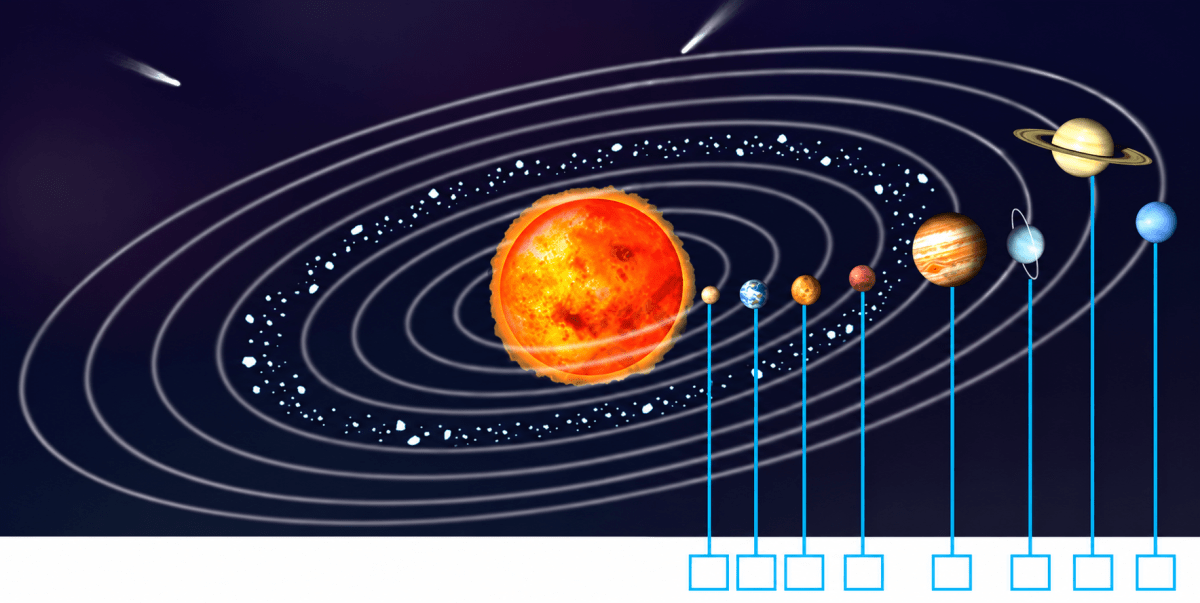
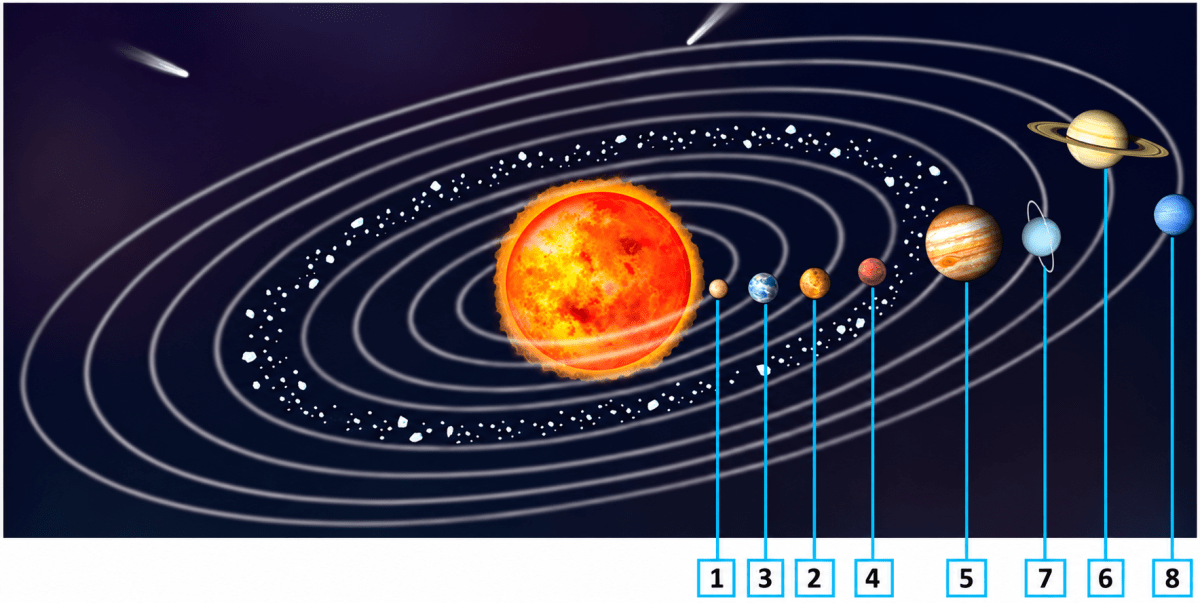
An artist's representation of the Solar System is given in Fig. 12.12. Is the order of the planets correct? If not, write the correct order in the boxes in the figure.
Answer
No, the order of the planets shown in the figure is incorrect. Earth is shown before Venus, and Uranus is shown before Saturn.
The correct order of the eight planets, from nearest to farthest from the Sun, is Mercury, Venus, Earth, Mars, Jupiter, Saturn, Uranus and Neptune.
So the boxes, from the Sun outwards, should be filled as: Mercury, Venus, Earth, Mars, Jupiter, Saturn, Uranus, Neptune.
A portion of night sky with stars is shown in Fig. 12.13. Look carefully and identify the groups of stars that form the patterns—the Big Dipper and the Little Dipper. Draw lines to connect the stars for these patterns and label them. Also, identify and label the Pole Star. You may refer to Fig. 12.4 for help.

Answer
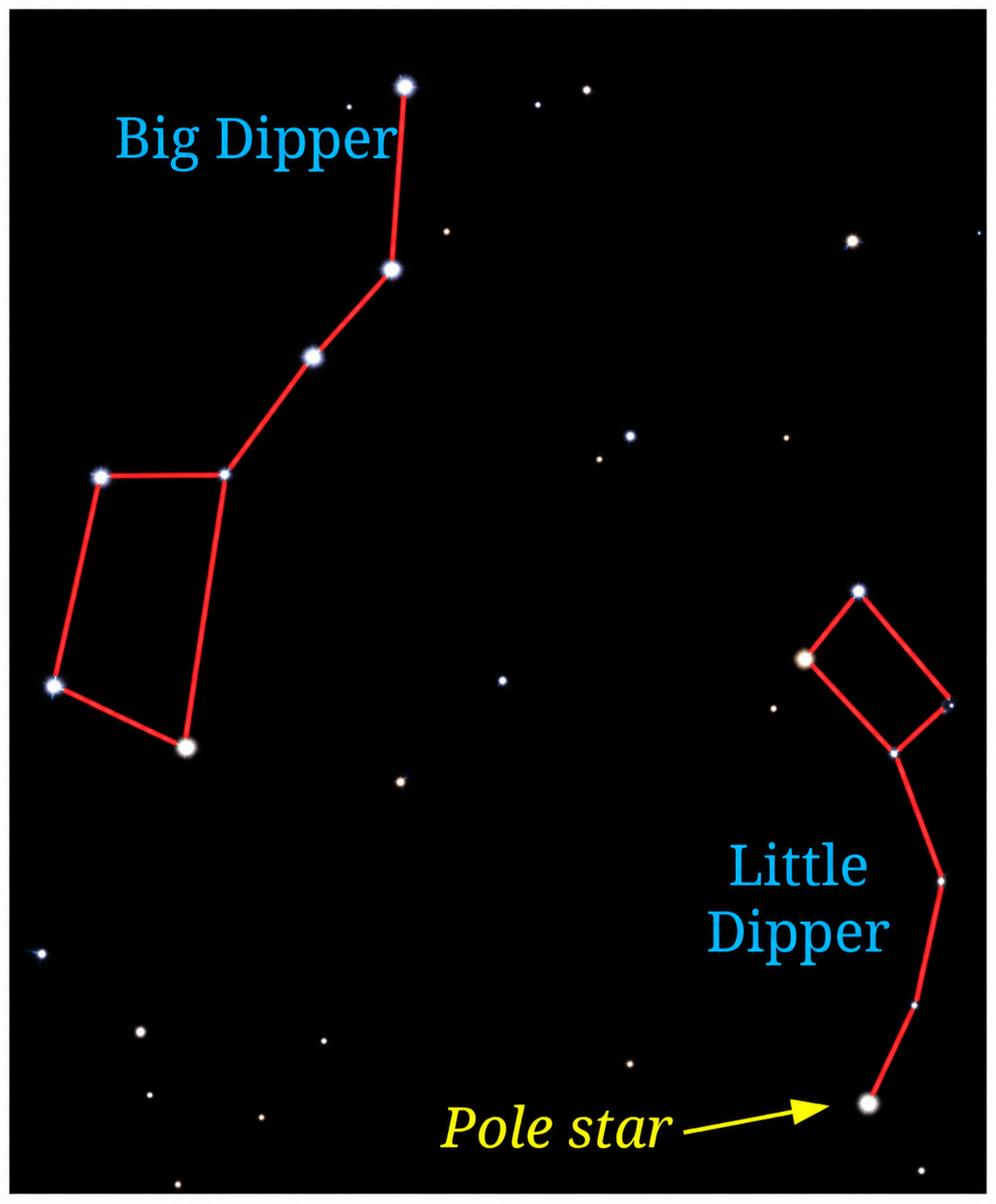
The Big Dipper and the Little Dipper are two distinct patterns of stars and should be connected with lines and labelled. The Pole Star lies at the end of the Little Dipper and should also be labelled.
To locate the Pole Star, find the two stars at the end of the Big Dipper's cup and imagine a straight line passing through them towards the north. At about five times the distance between these two stars, the line leads to the Pole Star, which is not very bright.
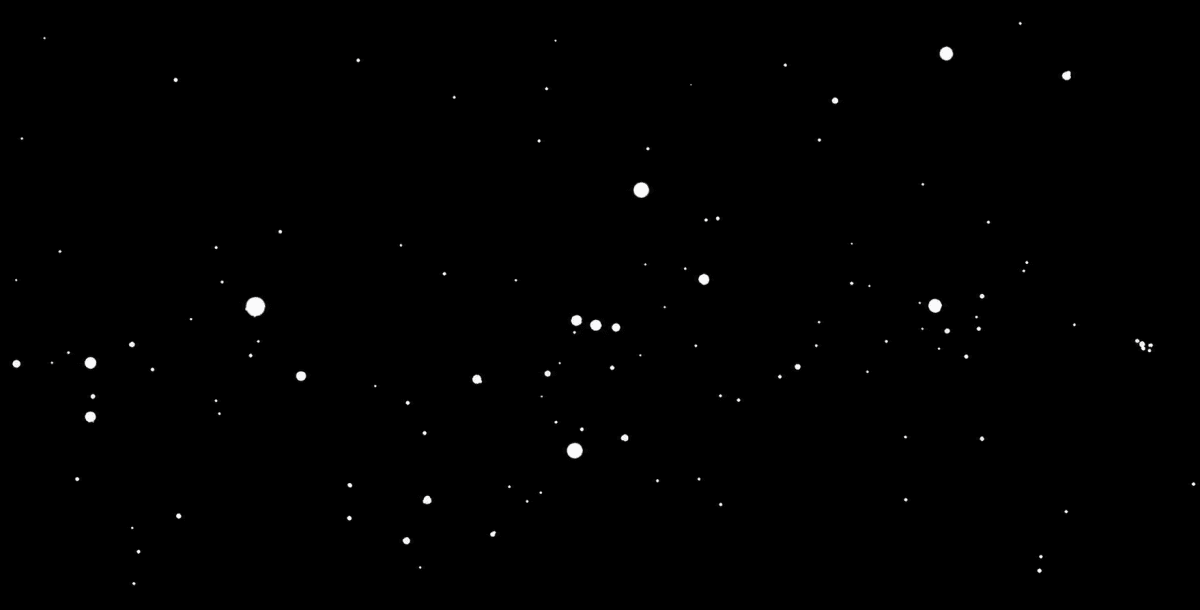
A portion of the night sky is shown in Fig. 12.14. Draw lines to connect the stars for Orion and label the star Sirius. You may refer to Fig. 12.3.
Answer
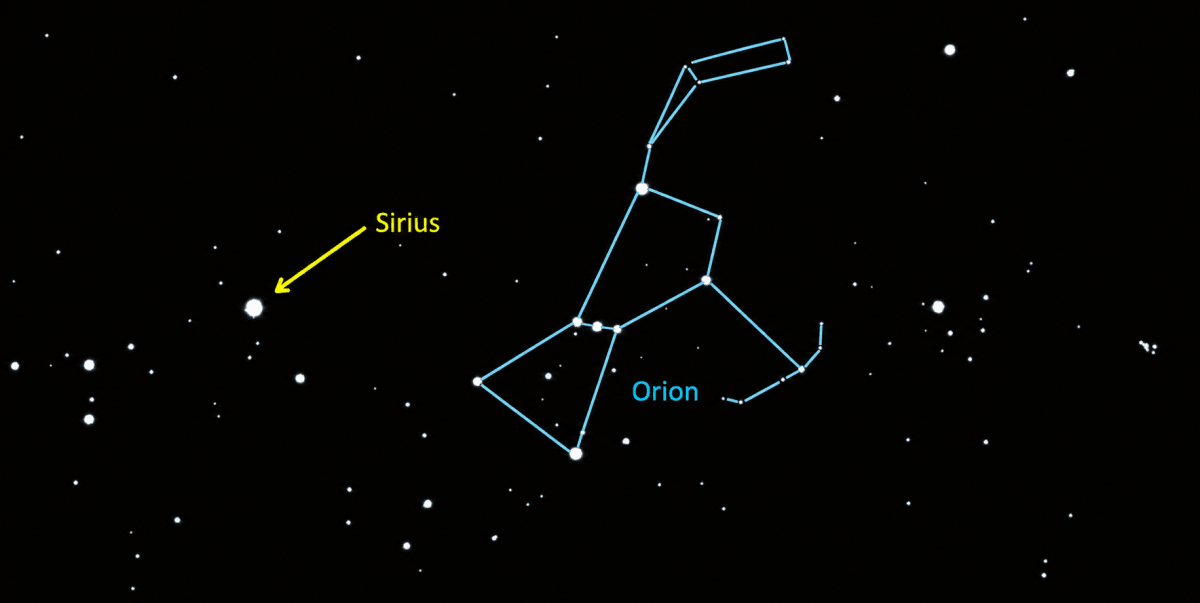
The stars of Orion should be connected with lines and the bright star Sirius should be labelled.
Orion can be identified by three bright stars in a short straight line near its middle, imagined as the belt of a hunter. To locate Sirius, imagine a straight line passing through these three middle stars and extend it towards the east. This line leads to the very bright star Sirius, which lies close to Orion.
From Earth, you can see stars fading away at dawn and appearing at dusk. During the day we do not see the stars. Explain why.
Answer
During the daytime, the Sun is extremely bright. Due to this extreme brightness of the Sun, it is not possible to see the other stars from the Earth, even though they are still present in the sky.
At dusk, as the Sun sets, the sky becomes dark and the stars begin to appear. At dawn, as the Sun rises, its bright light again hides the stars, so they seem to fade away.
During a clear night, try to observe the Big Dipper 3–4 times at an interval of 2 to 3 hours. Also try to locate the Pole Star each time. Does the Big Dipper appear to move? Draw a rough sketch to illustrate this, mentioning the time in each case.
Answer
Yes, the Big Dipper appears to change its position during the night, moving around the nearly stationary Pole Star. This apparent motion is due to the rotation of the Earth.
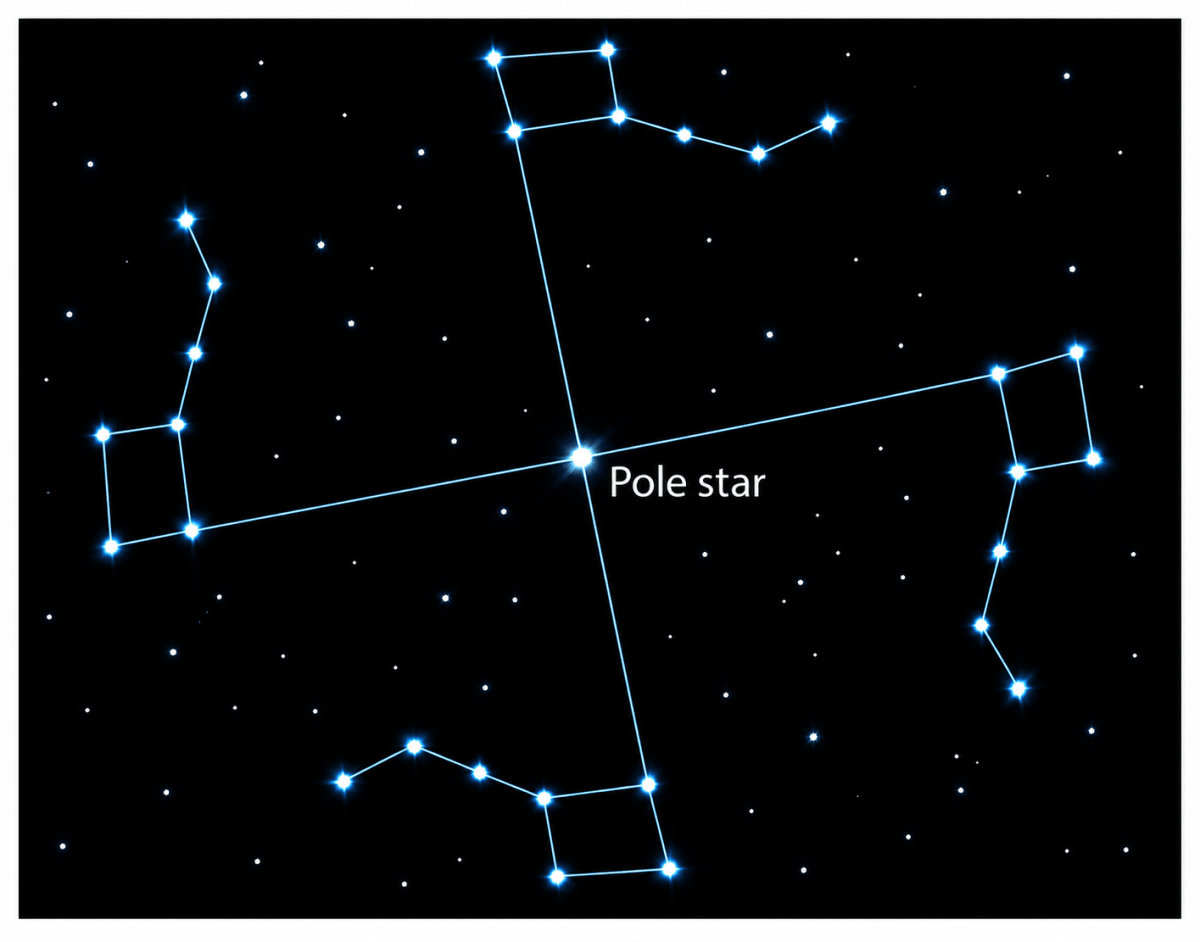
When the Big Dipper is observed at intervals of 2 to 3 hours, it is seen to change its position, appearing to move slowly around the Pole Star. The Pole Star itself stays almost fixed in the North. The sketch should show the Big Dipper at its different positions around the Pole Star, with the time of each observation noted beside it.
Think about the night sky and write a poem or a story on it.
Answer
A sample poem on the night sky:
The Night Sky
Far above my quiet town,
The dark night wears a starry crown.
The hunter Orion guards the night,
With Sirius shining, bold and bright.
The Saptarṣhi, a shining spoon,
Points the way past the silver Moon.
The Dhruva tārā holds its place,
A steady lamp in endless space.
Venus glows at dusk and dawn,
While faraway planets wander on.
O Ākāśha Gangā, river of light,
You fill with wonder every night.