
List the similarities and differences in life cycles of plants and animals.
Answer
Similarities in the life cycles of plants and animals are —
- Both begin their life cycle from a single structure — a plant begins from a seed and an animal begins from an egg or a newborn.
- Both grow and develop through several stages before becoming adults.
- Both reproduce to produce new ones of their own kind, which maintains the continuity of life.
- Both finally reach the end of life and die.
Differences in the life cycles of plants and animals are —
| Plants | Animals |
|---|---|
| The life cycle begins from a seed. | The life cycle begins from an egg or a newborn. |
| A seed germinates into a seedling, which grows into a mature plant. | An egg hatches or a young one develops and grows into an adult animal. |
| A plant produces flowers and fruits (pods) containing seeds that can grow into new plants. | Adult animals reproduce by laying eggs or giving birth to young ones, depending on the animal. |
The table given below shows some data. Study the data and try to find out examples appropriate for the conditions given in the second and third columns. If you think that an example for any of the conditions given below is not possible, explain why.
| S. no. | Does it grow? | Does it respire? | Example | Remarks |
|---|---|---|---|---|
| 1. | No | No | ||
| 2. | No | Yes | ||
| 3. | Yes | No | ||
| 4. | Yes | Yes |
Answer
| S. no. | Does it grow? | Does it respire? | Example | Remarks |
|---|---|---|---|---|
| 1. | No | No | Stone, pencil | A non-living thing neither grows nor respires. |
| 2. | No | Yes | Dormant seed | A dormant seed does not visibly grow under unsuitable conditions, but it is living and respires very slowly. |
| 3. | Yes | No | Growing crystal | A crystal can increase in size when more material is deposited on it, but it does not respire. This is not biological growth. |
| 4. | Yes | Yes | Plant, dog, human | A living being both grows and respires. |
You have learnt that different conditions are required for seed germination. How can we use this knowledge for proper storage of grains and pulses?
Answer
Seeds need water and air to germinate. We can use this knowledge to prevent unwanted germination and spoilage while storing grains and pulses.
- Grains and pulses should be dried properly before storage so that they do not contain moisture (water).
- They should be kept in air-tight containers in a dry place so that water and excess air are not available to them.
- Keep the containers in a cool, dry place and protect them from dampness.
Thus, keeping stored grains and pulses sufficiently dry helps prevent germination and keeps them safe for longer.
You have learnt that a tail is present in a tadpole but it disappears as it grows into a frog. What is the advantage of having a tail in the tadpole stage?
Answer
A tadpole lives in water, and its tail helps it swim and move from one place to another. As it develops into a froglet and then an adult frog, its legs become stronger and its tail gradually disappears. The adult frog uses its legs to jump on land and swim in water.
Charan says that a wooden log is non-living as it cannot move. Charu counters it by saying that it is living because it is made of wood obtained from trees. Give your arguments in favour or against the two statements given by Charan and Charu.
Answer
Charan's conclusion is correct, but his reason is incomplete. A wooden log is non-living. However, the inability to move from one place to another is not, by itself, proof that something is non-living. Plants are living even though they remain rooted in one place.
Charu's conclusion is incorrect. Although wood comes from a tree, a wooden log no longer carries out essential life processes such as growth, respiration, excretion, reproduction or response to stimuli.
Hence, a wooden log is non-living because it does not carry out the essential life processes, not merely because it cannot move.
What are the similarities and distinguishing features in the life cycles of a mosquito and a frog?
Answer
Similarities in the life cycles of a mosquito and a frog are —
- Both begin their life cycle from an egg.
- Both pass through several distinct stages before becoming an adult.
- Both show significant changes in body shape and structure during their stages.
- The early stages of both develop in water.
Distinguishing features in the life cycles of a mosquito and a frog are —
| Mosquito | Frog |
|---|---|
| It passes through four stages — egg, larva, pupa and adult mosquito. | It passes through four stages — egg, tadpole, froglet and adult frog. |
| The female lays eggs on or near water. Larvae and pupae live in water, while adults fly. | Eggs and tadpoles develop in water. Froglets begin to spend time on land, and adult frogs live both in water and on land. |
| The adult mosquito has wings and can fly. | The adult frog has legs and can jump on land and swim in water. |
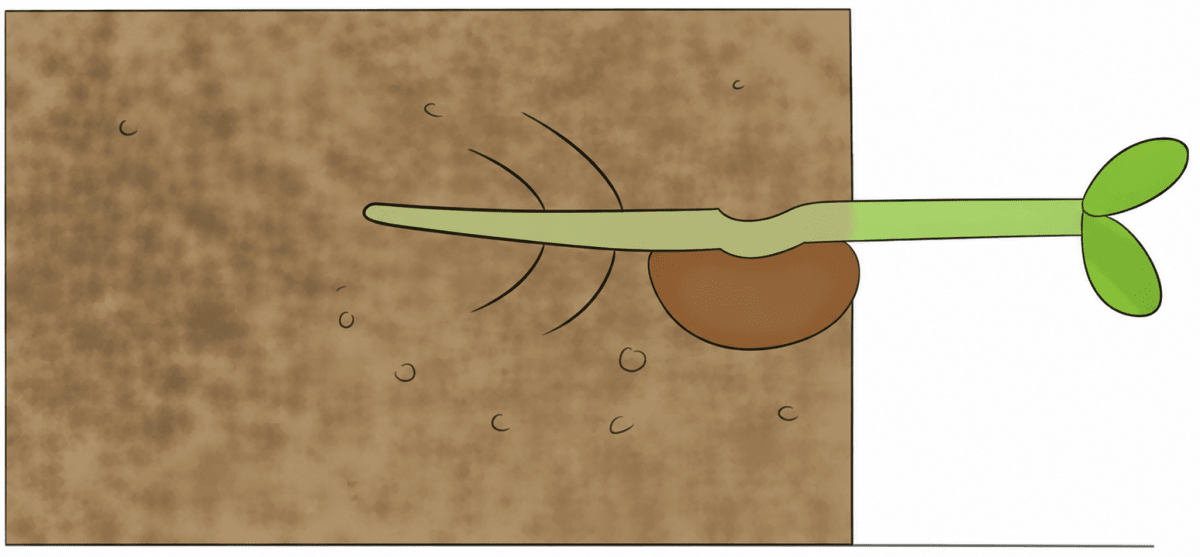
A plant is provided with all the conditions suitable for its growth (Fig. 10.9). Draw what you expect to see in the shoot and the root of the plant after one week. Write down the reasons.
Answer
After one week, the shoot of the plant will bend and grow upwards, while the root will bend and grow downwards.
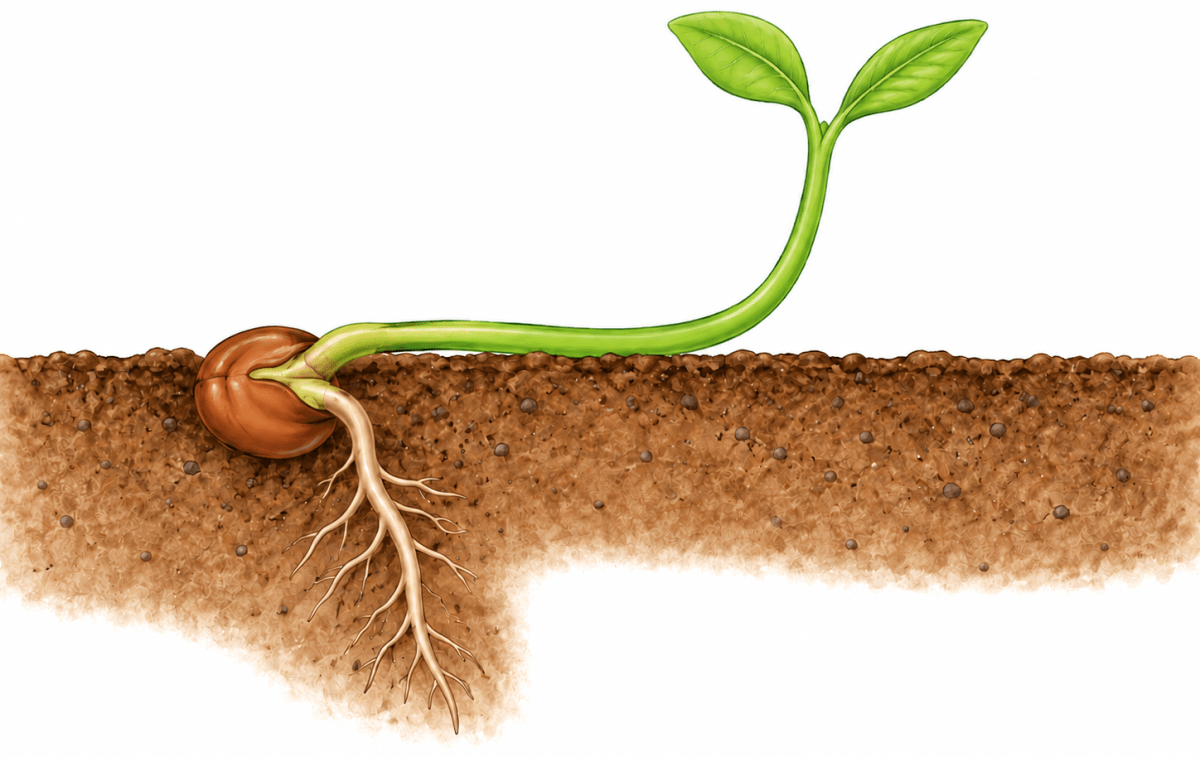
Reason — The shoot of a plant always grows upwards, away from the ground, and also moves towards sunlight. The root of a plant always grows downwards, into the soil. So even though the pot is kept along the ground, the shoot will turn and grow upwards and the root will turn and grow downwards.
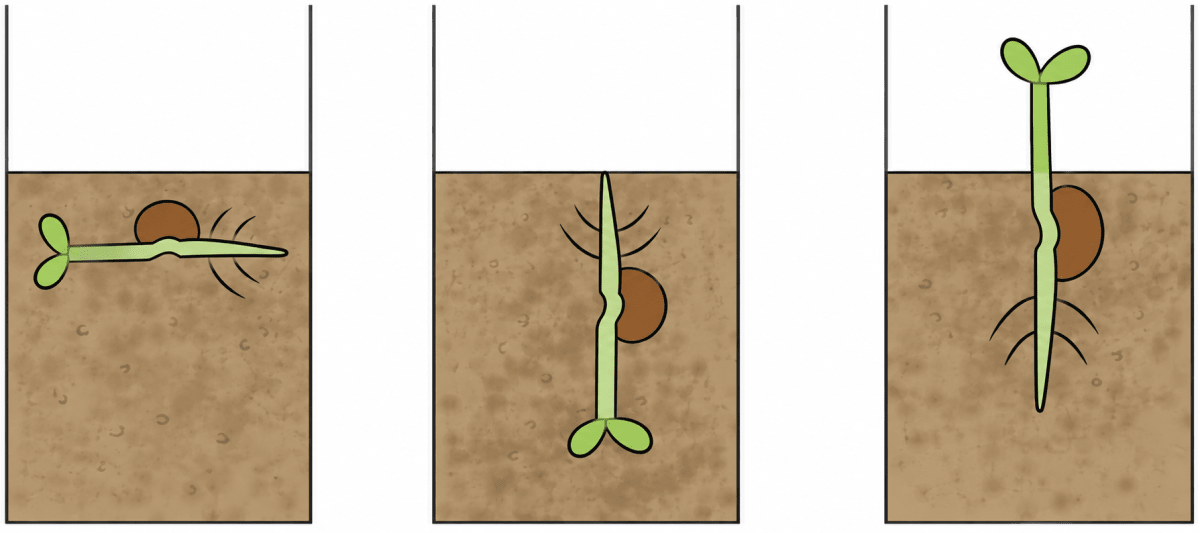
Tara and Vijay set up the experiment shown in the picture (Fig. 10.10). What do you think they want to find out? How will they know if they are correct?
Answer
The experimental set-up shows germinated seeds or seedlings placed in different orientations in the soil.
Tara and Vijay want to find out whether the direction of growth of roots and shoots depends on the initial position of the seedling.
They can observe the seedlings over a few days while giving them suitable conditions for growth. If the roots grow downwards and the shoots grow upwards in each set-up, bending where necessary, their prediction is correct.
Thus, the experiment shows that roots generally grow downwards and shoots grow upwards, irrespective of the initial orientation of the seedling.
Design an experiment to check if temperature has an effect on seed germination.
Answer
We can design the following experiment to check the effect of temperature on seed germination:
- Take three identical containers filled with the same amount of soil. Sow the same number of bean seeds of similar size at the same depth in each container. Label them A, B and C.
- Keep the soil equally moist in all three containers, without flooding it, so that the seeds receive sufficient water and air.
- Place container A in a cool place, B at room temperature and C in a moderately warm place (not a hot place). Record the temperature at each location.
- Keep the other conditions as similar as possible. Use the same type of container and soil, and give all three groups the same light or dark conditions. Check the soil moisture regularly and add water as needed.
- Observe the containers daily for 7–10 days. Record the number of seeds that germinate in each container and compare the results.
Conclusion: If the number of germinated seeds or the time taken for germination differs between the containers, it indicates that temperature affects seed germination. The seeds are expected to germinate best at a suitable temperature, rather than at temperatures that are too low or too high.